


Global Lakehouse Data Management Market Size, Share and Analysis Report By Component (Solutions, Services), By Deployment Mode (Cloud-based, On-premises), By Organization Size (Large Enterprises, Small and Medium-sized Enterprises), By Industry Vertical (Banking, Financial Services, and Insurance, Healthcare and Life Sciences, Retail and E-commerce, Manufacturing, Logistics and Transportation, Advanced Manufacturing, Fintech, Biomedicine, Others), By Architecture Type (Real-time Lakehouse Platforms, Batch Processing Lakehouse Platforms), By Regional Analysis, Global Trends and Opportunity, Future Outlook By 2025-2035
- Published date: Feb. 2026
- Report ID: 178113
- Number of Pages: 260
- Format:
-
keyboard_arrow_up
Quick Navigation
- Report Overview
- Key Takeaway
- Adoption & Performance Statistics
- By Component: Solutions
- By Deployment Mode: Cloud-based
- By Organization Size: Large Enterprises
- By Industry Vertical: BFSI
- By Architecture Type: Real-time Lakehouse Platforms
- Regional Overview: North America
- Top Driving Factors
- Demand Analysis
- Emerging Trend Analysis
- Driver Analysis
- Restraint Analysis
- Opportunity Analysis
- Challenge Analysis
- Key Market Segments
- Key Players Analysis
- Recent Developments
- Report Scope
Report Overview
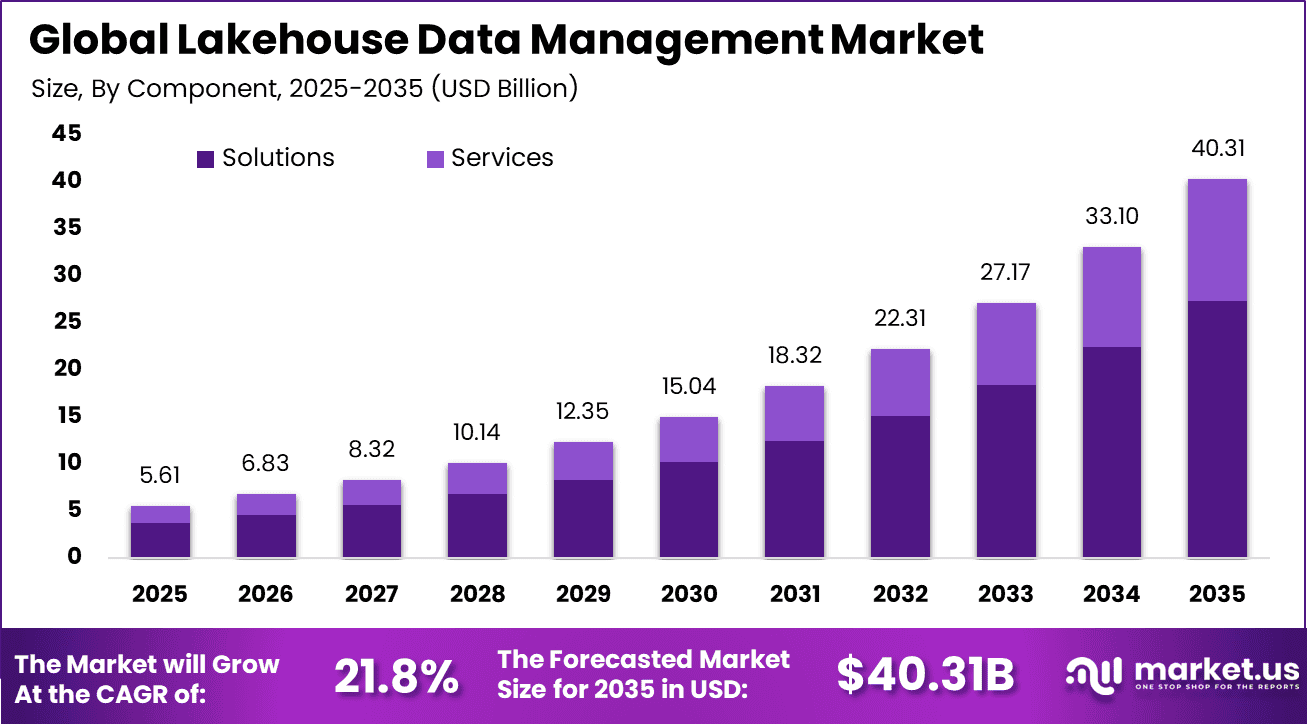
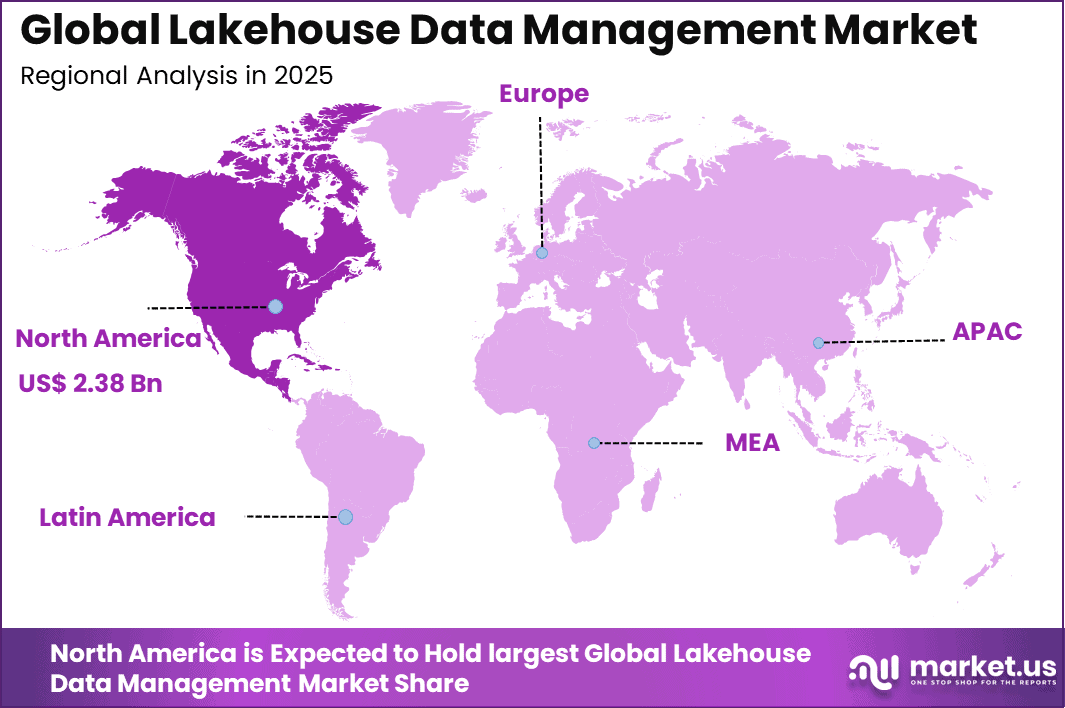
The Global Lakehouse Data Management Market size is expected to be worth around USD 40.31 billion by 2035, from USD 5.61 billion in 2025, growing at a CAGR of 21.8% during the forecast period from 2025 to 2035. North America held a dominant market position, capturing more than a 42.5% share, holding USD 2.38 billion in revenue.
The lakehouse data management market refers to the set of technologies and solutions that combine the storage and processing capabilities of data lakes with the structured management features traditionally associated with data warehouses. This approach allows organizations to manage large volumes of raw data while supporting governance, analytics, and reporting from a unified platform.
The market has expanded as businesses require a single architecture that can handle diverse data types and analytical demands. Adoption reflects the need for simplified data environments that support both traditional and modern analytics workloads. Lakehouse platforms are designed to reconcile the flexibility of unstructured data with the reliability of structured systems.
These platforms enable consistent data governance and performance across a variety of use cases. The architecture supports real time data ingestion, transformation, and access for analytics and machine learning. As enterprises seek to reduce data silos and operational duplication, lakehouse data management solutions become increasingly important.
The market includes software, services, and integrated offerings that help organizations manage, secure, and analyze data within the lakehouse architecture. A key objective is to ensure data quality, accessibility, and scalability across business functions. As data volumes grow, the need for architectures that can support diverse workloads with operational efficiency has driven attention toward lakehouse data management.
For instance, in September 2025, Cloudera launched Iceberg REST Catalog and Lakehouse Optimizer at EVOLVE25, enabling zero-copy data sharing and auto-maintenance. This unified platform is speeding up AI projects with top-tier security and performance.
Key Takeaway
- The Solutions segment accounted for 68.0% of the total Lakehouse Data Management Market share, supported by strong enterprise demand for unified platforms that integrate data lakes and data warehouses within a single architecture.
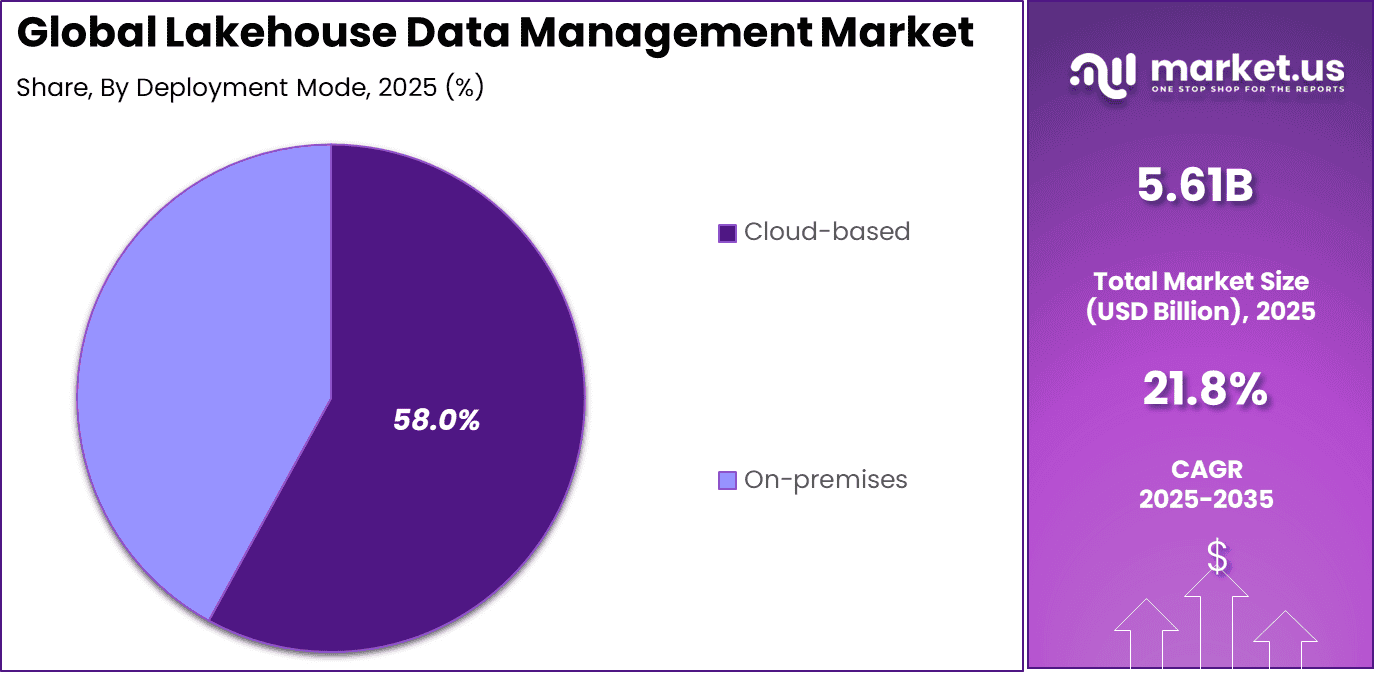
- Cloud-based deployment captured 58.0% of the market, reflecting increasing reliance on scalable infrastructure to support analytics, artificial intelligence workloads, and cross-regional data operations.
- Large Enterprises represented 71.0% of overall adoption, driven by complex data ecosystems, high transaction volumes, and stringent governance requirements.
- The Banking, Financial Services, and Insurance sector contributed 35.0% of total revenue, as institutions continue to invest in real-time analytics, compliance reporting, and fraud monitoring capabilities.
- Real-time Lakehouse Platforms dominated the architecture landscape with a 76.2% share, indicating strong enterprise focus on low-latency data processing and continuous data ingestion models.
- North America held 42.5% of the global market share, supported by mature cloud ecosystems and strong digital transformation initiatives.
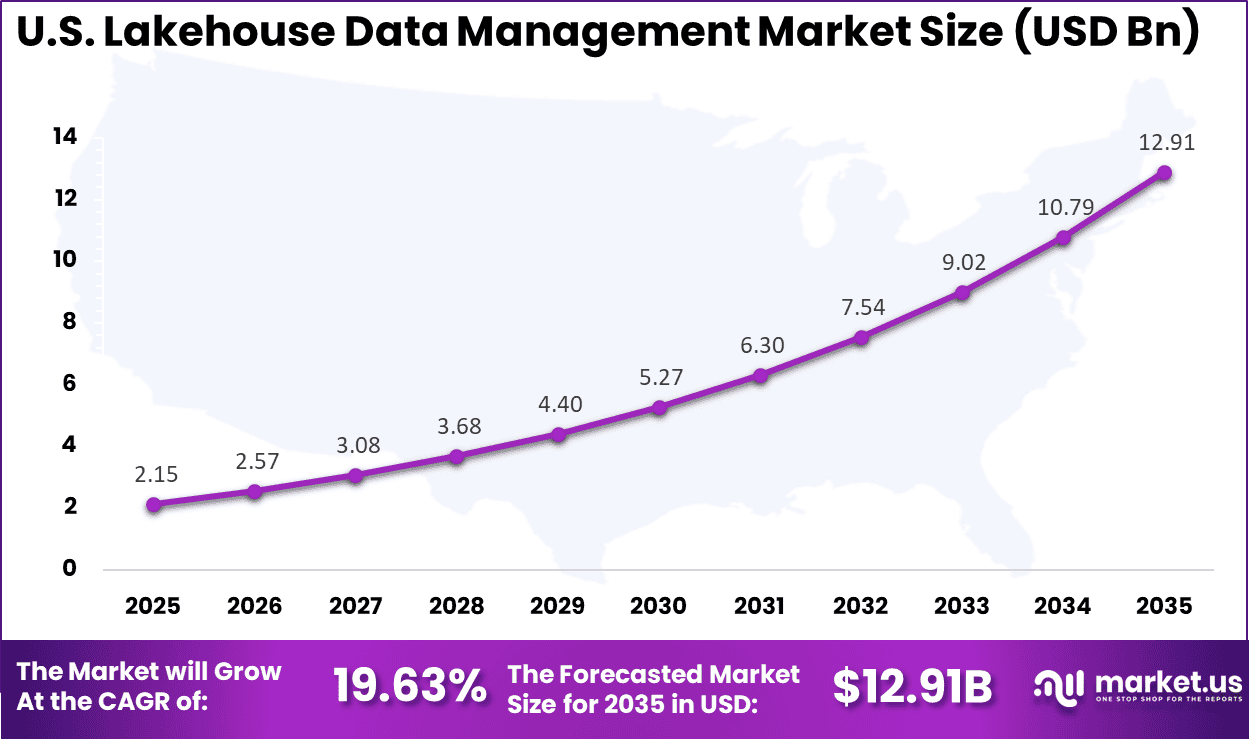
- The United States market was valued at USD 2.15 Billion, expanding at a CAGR of 19.63%, reflecting sustained investments in enterprise data modernization and analytics infrastructure.
Adoption & Performance Statistics
- Approximately 74% of global CIOs use a data lakehouse in their technology stack.
- The market is projected to grow from USD 16.6 Billion in 2023 to USD 90 Billion by 2033, at a CAGR of 21.3%.
- Low-cost cloud object storage reduces infrastructure expenses compared to separate warehouse and lake systems.
- Direct, high-speed SQL queries improve performance and reduce reliance on traditional ETL processes.
- The architecture supports structured, semi-structured, and unstructured data within a single compliant environment.
By Component: Solutions
Solutions account for 68.0% of the lakehouse data management market. This dominance reflects the increasing demand for unified platforms that combine the scalability of data lakes with the structured management of data warehouses.
Organizations are adopting lakehouse solutions to eliminate data silos and reduce duplication across analytics environments. These platforms support structured and unstructured data within a single architecture. As a result, enterprises achieve better performance, cost control, and governance efficiency.
Lakehouse solutions also provide built-in data governance, metadata management, and transaction reliability. Features such as ACID compliance and schema enforcement improve consistency across large data environments. This enables reliable analytics, reporting, and machine learning workloads. Automation within these platforms reduces manual intervention and enhances operational stability.
For Instance, in January 2026, Snowflake rolled out Gemini 3 models in Cortex AI, boosting solution capabilities for unified data analytics. This update lets users run advanced AI directly on lakehouse data, simplifying complex queries and ML tasks without moving info around. It strengthens solutions by blending storage, processing, and AI in one platform, aiding teams in faster insights.
By Deployment Mode: Cloud-based
Cloud-based deployment represents 58.0% of the market, driven by enterprise cloud transformation strategies. Cloud environments provide elastic storage and computing resources that align well with lakehouse architectures. Organizations benefit from scalability that supports growing data volumes without heavy infrastructure investments.
Cloud-based lakehouse platforms allow seamless integration with analytics and artificial intelligence tools. This strengthens data-driven decision making across business functions. Cloud deployment also improves accessibility and collaboration across distributed teams.
Centralized cloud infrastructure enables unified monitoring and governance controls. Enterprises can scale workloads dynamically based on demand, ensuring cost efficiency and performance optimization. Security frameworks embedded within cloud systems further enhance data protection. These advantages continue to support strong cloud adoption within the lakehouse segment.
For instance, in January 2026, Microsoft Fabric added bidirectional OneLake-Snowflake interoperability for Iceberg tables. This cloud feature allows native storage and reads across platforms, easing hybrid cloud shifts. It boosts cloud deployments by enabling flexible data sharing without copies, perfect for scaling lakehouse ops across AWS or Azure.
By Organization Size: Large Enterprises
Large enterprises hold 71.0% of the lakehouse data management market. These organizations manage high volumes of transactional and operational data across multiple departments. A unified lakehouse platform helps them consolidate diverse datasets into a single, reliable source. This simplifies reporting, analytics, and regulatory compliance processes.
Large enterprises also benefit from improved data transparency and faster query performance. Enterprise environments often require advanced governance, access controls, and audit tracking. Lakehouse platforms provide centralized oversight across distributed data ecosystems.
Automation reduces complexity in data engineering workflows and improves efficiency. Integration with enterprise analytics systems enhances strategic planning and forecasting. The scale and technical maturity of large enterprises support their dominant adoption share.
For Instance, in November 2025, Cloudera bought Octopai for data lineage and catalog tools. Aimed at large firms, it expands metadata management for analytics and AI in lakehouse setups. Enterprises gain better governance over big data flows, helping comply with rules while speeding insights from complex sources.
By Industry Vertical: BFSI
The Banking, Financial Services, and Insurance sector accounts for 35.0% of the market. Financial institutions rely heavily on structured and semi-structured data for risk assessment, fraud detection, and regulatory reporting.
Lakehouse architectures provide a single platform that supports real-time analytics alongside historical data analysis. This improves operational accuracy and strengthens compliance readiness. Secure data storage and governance capabilities are particularly critical in this sector. Financial institutions also require high-speed processing to manage large transaction volumes.
Lakehouse platforms enable advanced analytics and predictive modeling within a unified environment. This reduces latency and enhances decision-making efficiency. Strong governance and encryption frameworks ensure data confidentiality and regulatory alignment. The sector’s heavy reliance on accurate and timely data supports its leading share.
For Instance, in August 2025, Starburst unveiled AI capabilities for air-gapped lakehouses in regulated fields like BFSI. New features include managed Iceberg pipelines with auto-maintenance. Financial firms get secure, high-performance data for fraud detection and reporting, meeting strict privacy needs without cloud lock-in.
By Architecture Type: Real-time Lakehouse Platforms
Real-time lakehouse platforms represent 76.2% of the architecture segment. Organizations increasingly demand immediate access to insights generated from streaming and transactional data. Real-time architectures enable continuous ingestion and processing of data from multiple sources. This supports time-sensitive use cases such as fraud monitoring, operational analytics, and customer personalization.
The ability to process data instantly enhances competitive responsiveness. These platforms integrate streaming technologies with structured storage layers. They allow organizations to analyze data as it arrives while maintaining historical datasets for deeper insights.
Real-time monitoring and alerting capabilities improve operational visibility. Automated scaling ensures consistent performance even during peak workloads. The shift toward instant analytics continues to drive strong demand for real-time lakehouse architectures.
For Instance, in December 2025, Dremio upgraded its lakehouse with semantic layers and Reflections for real-time queries. The platform accelerates BI dashboards across lakes and databases cost-effectively. Users in real-time setups enjoy self-service access with lineage, ideal for streaming data and instant insights.
Regional Overview: North America
North America holds 42.5% of the global lakehouse data management market. The region demonstrates strong adoption of advanced analytics, artificial intelligence, and cloud infrastructure. Enterprises are prioritizing unified data architectures to enhance operational efficiency and regulatory compliance. Lakehouse platforms are increasingly integrated into digital transformation strategies. This supports sustained investment in data modernization initiatives.
For instance, in January 2026, Google BigQuery strengthened its North America dominance with Lakehouse Foundation updates, including materialized views for BigLake tables, JSON enhancements, and hierarchical query functions. These features unify data management and boost query performance across cloud storage.
The United States leads regional growth, with a market value of USD 2.15 Bn and a CAGR of 19.63%. Organizations across financial services, healthcare, retail, and technology sectors are accelerating adoption of unified data platforms. Investments in governance frameworks and real-time analytics continue to expand. Strong enterprise IT spending further strengthens market momentum. North America remains a key region for lakehouse innovation and deployment.
For instance, in December 2025, Databricks reinforced U.S. dominance in Lakehouse Data Management by launching advanced SQL capabilities and Unity Catalog enhancements at its Data + AI Summit 2025. These innovations enable scalable analytics, AI governance, and Lakebase for operational workloads, solidifying its leadership in open lakehouse architecture for enterprise AI.
Top Driving Factors
The primary driving factor for the lakehouse data management market is the exponential growth of enterprise data from diverse sources. Traditional data warehouses are limited in handling unstructured data at scale, while data lakes often lack strong governance. Lakehouse architectures address these gaps by combining flexibility with structure. Organizations are thereby able to manage greater volumes of data without sacrificing control or performance.
Another driving factor is the increased emphasis on analytics and real time decision making. Modern business operations depend on timely insights from both structured and unstructured data. Lakehouse platforms support integrated analytics that can process data quickly and provide actionable outcomes. The demand for consolidated environments that reduce data movement and complexity is a key growth influence.
Cost optimization has also contributed to the expansion of this market. Managing separate data lakes and warehouses can increase operational costs and resource requirements. Lakehouse data management tools unify these systems, potentially lowering infrastructure expenses. The drive to streamline data architectures and improve return on investment encourages enterprises to adopt lakehouse solutions.
Demand Analysis
Demand for lakehouse data management is rising among enterprises that require unified data strategies. Organizations undertaking digital transformation initiatives seek architectures that support advanced analytics, artificial intelligence, and machine learning. These initiatives often depend on high data quality and consistent governance. Lakehouse platforms provide a framework that enables these capabilities with reduced fragmentation.
Industries such as finance, healthcare, and retail show particular interest due to the complexity of their data footprints. In these sectors, data volumes and compliance requirements present significant challenges. Lakehouse management solutions help ensure that data remains accurate, accessible, and secure across use cases. The ability to support regulated reporting and analytics simultaneously increases adoption in critical data environments.
Demand is also influenced by the push toward cloud based operations. Many enterprises are migrating data workloads to cloud platforms to benefit from scalability and flexibility. Lakehouse architectures align with cloud native services, enabling organizations to leverage scalable storage and compute resources. The compatibility with cloud ecosystems reinforces interest in lakehouse data management solutions.
Emerging Trend Analysis
A prominent emerging trend in the lakehouse data management domain is the increasing integration of open-table formats and unified data processing frameworks that support both analytical and operational workloads. Lakehouse architectures are evolving to combine the flexibility and low-cost storage of traditional data lakes with the structural governance and performance characteristics associated with warehouses.
These hybrid platforms enable ACID compliance, dynamic partitioning, and schema evolution while supporting diverse data types, enhancing their utility across analytics and machine learning workflows. Adoption of open standards is further facilitating interoperability and reducing vendor lock-in risk in complex multi-platform environments.
In addition, there is growing adoption of real-time data processing and AI-ready analytics within lakehouse environments. Real-time ingestion and processing capabilities allow businesses to derive timely insights from operational data streams, improving responsiveness to market changes. Machine learning integration that leverages unified data repositories accelerates model development and deployment, addressing a key demand for predictive analytics.
Driver Analysis
A core driver of the lakehouse data management market is the exponential growth of structured and unstructured data generated across enterprise operations. Organizations are confronted with the need to manage vast volumes of data from different sources while extracting meaningful insights quickly, and lakehouse architectures are positioned to address these dual requirements.
By offering unified storage that accommodates diverse data formats without duplicating data across separate systems, these platforms reduce complexity and streamline analytics workflows. This expansion of data volumes is compelling enterprises to adopt modern architectures capable of supporting scalability without compromising performance.
Moreover, the need for advanced analytics, including artificial intelligence and machine learning, is strengthening demand for solutions that support seamless data access and governance. Lakehouse platforms facilitate flexible data access for data scientists and analysts, enabling SQL query performance alongside scalable data science operations. Enhanced governance and metadata capabilities ensure consistency and reliability, which are critical for analytics accuracy and compliance.
Restraint Analysis
Despite its advantages, a key restraint for lakehouse adoption is the complexity of implementing and managing this relatively new architecture. Building a lakehouse often requires integrating disparate tools and technologies, configuring metadata layers, and ensuring compatibility with existing systems, which can be technically demanding.
Organizations may also face significant migration challenges when transitioning from established data warehouses or data lakes to lakehouse environments, leading to extended timelines and increased costs. The technical complexity can deter adoption, particularly among enterprises without mature data engineering capabilities.
Another restraint arises from governance and data quality management challenges inherent in unified platforms. Although lakehouses aim to improve consistency, ensuring effective governance across structured and unstructured data requires robust policy frameworks. Without careful planning and tooling, data quality issues can persist, undermining confidence in analytics outcomes. These governance complexities demand ongoing investments in monitoring and management tools.
Opportunity Analysis
The lakehouse market presents substantial opportunities in supporting AI-driven and real-time analytics use cases. By consolidating data storage and processing within a single architecture, lakehouses enable seamless access to up-to-date datasets essential for developing predictive models and supporting operational analytics.
This capability positions enterprises to accelerate time-to-insight and drive innovation across business functions such as supply chain optimization, customer analytics, and risk management. Organizations that leverage these advanced analytics capabilities can gain competitive advantages through improved decision-making and operational efficiency.
Furthermore, there is expanding opportunity in cloud-native and serverless lakehouse deployments that reduce infrastructure management overhead and support cost-efficient scalability. Cloud platforms increasingly offer integrated services for storage, compute, cataloging, and governance, simplifying lakehouse adoption for enterprises of varying sizes.
Challenge Analysis
A significant challenge in the lakehouse market is balancing performance with cost efficiency, particularly as data volumes and query demands increase. While lakehouse architectures can deliver scalable storage and analytics performance, continuous processing of large datasets can lead to increased cloud resource consumption, driving up operational expenses.
Organizations must develop cost-management strategies that align performance requirements with budget constraints, which can be difficult in dynamic usage environments. Effective cost optimization remains a persistent operational hurdle for many enterprises. Another challenge involves upskilling and workforce readiness, as lakehouse implementations often require expertise in both data engineering and analytics.
The convergence of storage, governance, and real-time processing within a single platform demands cross-functional skills that may not exist within all IT teams. Recruiting or training talent capable of designing, deploying, and maintaining lakehouse systems can slow adoption and increase reliance on external partners. Addressing this talent gap is critical to realizing the full potential of lakehouse data management.
Key Market Segments
By Component
- Solutions
- Data Storage
- Data Integration
- Analytics and BI
- Governance and Security
- ML and AI Tools
- Services
- Professional Services
- System Integration
- Training and Consulting
- Support and Maintenance
- Managed Services
- Professional Services
By Deployment Mode
- Cloud-based
- On-premises
By Organization Size
- Large Enterprises
- Small and Medium-sized Enterprises
By Industry Vertical
- Banking, Financial Services, and Insurance
- Healthcare and Life Sciences
- Retail and E-commerce
- Manufacturing
- Logistics and Transportation
- Advanced Manufacturing
- Fintech
- Biomedicine
- Others
By Architecture Type
- Real-time Lakehouse Platforms
- Batch Processing Lakehouse Platforms
Key Regions and Countries
North America
- US
- Canada
Europe
- Germany
- France
- The UK
- Spain
- Italy
- Russia
- Netherlands
- Rest of Europe
Asia Pacific
- China
- Japan
- South Korea
- India
- Australia
- Singapore
- Thailand
- Vietnam
- Rest of APAC
Latin America
- Brazil
- Mexico
- Rest of Latin America
Middle East & Africa
- South Africa
- Saudi Arabia
- UAE
- Rest of MEA
Key Players Analysis
Lakehouse platform innovators such as Databricks and Snowflake lead the lakehouse data management market. Their architectures combine data lakes and data warehouses into a unified analytics environment. These platforms support structured and unstructured data with strong performance and governance controls. Demand is driven by the need for real-time analytics, AI model training, and scalable storage. Their ecosystems benefit from broad developer adoption and strong cloud partnerships.
Global cloud providers such as Microsoft, Amazon Web Services, and Google integrate lakehouse capabilities within native cloud environments. Aliyun, Huawei, and Tencent Cloud expand adoption across Asia-Pacific. These providers emphasize scalability, AI integration, and cost optimization. Adoption is strong among enterprises modernizing legacy data warehouses.
Enterprise software and query engine specialists such as Oracle, IBM, Cloudera, Teradata, SAP, Dremio, and Starburst Data enhance interoperability and performance. These vendors focus on open formats, governance, and hybrid deployment models. Other players expand innovation and regional presence, supporting steady growth in lakehouse data management solutions.
Top Key Players in the Market
- Databricks
- Snowflake
- Microsoft
- Amazon Web Services
- Oracle
- IBM
- Cloudera
- Teradata
- SAP
- Dremio
- Starburst Data
- Aliyun
- Huawei
- Tencent Cloud
- Others
Recent Developments
- In November 2025, Snowflake’s BUILD event unveiled game-changing lakehouse upgrades, including enhanced Apache Iceberg interoperability and OpenFlow for seamless data ingestion. Horizon Catalog now features AI-powered PII detection while Hybrid Tables support advanced encryption.
- In January 2026, BigQuery rolled out Lakehouse Foundation upgrades like materialized views for BigLake tables and smarter JSON handling. These GA features let teams query structured data in Cloud Storage or S3 with automatic refresh and pre-aggregation.
Report Scope
Report Features Description Market Value (2025) USD 5.6 Bn Forecast Revenue (2035) USD 40.3 Bn CAGR(2026-2035) 21.8% Base Year for Estimation 2025 Historic Period 2020-2024 Forecast Period 2026-2035 Report Coverage Revenue forecast, AI impact on Market trends, Share Insights, Company ranking, competitive landscape, Recent Developments, Market Dynamics and Emerging Trends Segments Covered By Component (Solutions, Services), By Deployment Mode (Cloud-based, On-premises), By Organization Size (Large Enterprises, Small and Medium-sized Enterprises), By Industry Vertical (Banking, Financial Services, and Insurance, Healthcare and Life Sciences, Retail and E-commerce, Manufacturing, Logistics and Transportation, Advanced Manufacturing, Fintech, Biomedicine, Others), By Architecture Type (Real-time Lakehouse Platforms, Batch Processing Lakehouse Platforms) Regional Analysis North America – US, Canada; Europe – Germany, France, The UK, Spain, Italy, Russia, Netherlands, Rest of Europe; Asia Pacific – China, Japan, South Korea, India, New Zealand, Singapore, Thailand, Vietnam, Rest of Latin America; Latin America – Brazil, Mexico, Rest of Latin America; Middle East & Africa – South Africa, Saudi Arabia, UAE, Rest of MEA Competitive Landscape Databricks, Snowflake, Microsoft, Amazon Web Services, Google, Oracle, IBM, Cloudera, Teradata, SAP, Dremio, Starburst Data, Aliyun, Huawei, Tencent Cloud, Others Customization Scope Customization for segments, region/country-level will be provided. Moreover, additional customization can be done based on the requirements. Purchase Options We have three license to opt for: Single User License, Multi-User License (Up to 5 Users), Corporate Use License (Unlimited User and Printable PDF)  Lakehouse Data Management MarketPublished date: Feb. 2026add_shopping_cartBuy Now get_appDownload Sample
 -
-
- Databricks
- Snowflake
- Microsoft
- Amazon Web Services
- Oracle
- IBM
- Cloudera
- Teradata
- SAP
- Dremio
- Starburst Data
- Aliyun
- Huawei
- Tencent Cloud
- Others
Our Clients

- 178113
- Feb. 2026









