


Global Kairomones Market Size, Share and Report Analysis By Function (Mass Trapping, Detection and Monitoring, Mating Disruption, Others), By Crop Type (Orchard Crops, Vegetables, Field Crops, Others) , By Region and Companies - Industry Segment Outlook, Market Assessment, Competition Scenario, Trends and Forecast 2025-2035
- Published date: Mar 2026
- Report ID: 180425
- Number of Pages: 308
- Format:
-
keyboard_arrow_up
Quick Navigation
Report Overview
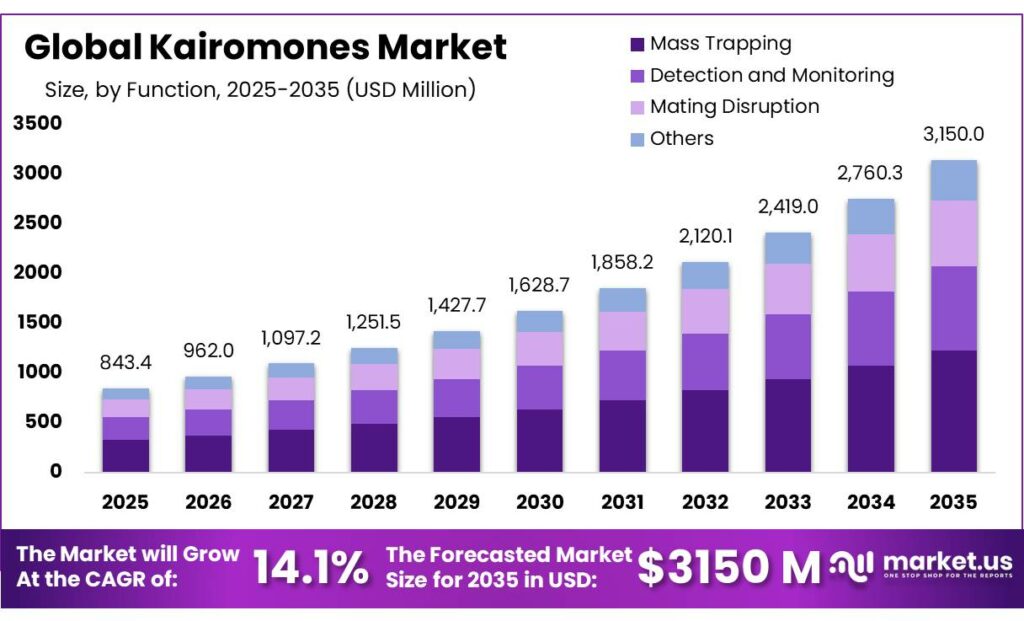
Global Kairomones Market is expected to be worth around USD 3,150.0 Million by 2035, up from USD 843.4 Million in 2025, at a CAGR of 14.1% from 2026 to 2035. The Asia Pacific segment maintained 39.4%, supporting a Kairomones value of USD 1.9 Bn.
Kairomones are interspecific semiochemicals: chemical cues released by one organism and detected by another species to the detector’s advantage. In industrial practice, they are increasingly positioned as precision tools within crop protection, food production, and post-harvest monitoring because they can attract target pests into traps, improve surveillance, and support lower-toxicity pest management programs. Their commercial relevance is strengthened by the scale of the agricultural loss problem they address.
The Food and Agriculture Organization states that up to 40% of global crop production is lost annually to plant pests and diseases, with plant diseases alone costing the global economy more than USD 220 billion each year and invasive insects at least USD 70 billion. FAO also notes that roughly one-third of food produced for human consumption, about 1.3 billion tonnes per year, is lost or wasted globally.
The present industrial scenario is being shaped by regulation, sustainability targets, and the wider biologicals transition. The U.S. Environmental Protection Agency classifies semiochemicals, including kairomones, within biochemical pesticides and distinguishes them from conventional pesticides because they work through non-toxic mechanisms such as attraction and behavioral modification..
The main demand drivers are food security, residue reduction, resistance management, and biological control infrastructure. FAO notes that feeding roughly 9 billion people by 2050 will require about 60% more food production, which pushes governments and agrifood industries toward technologies that protect yields without proportionately increasing chemical load.
In Europe, the policy signal is even stronger: the EU’s 2030 policy framework aims to reduce the use and risk of chemical pesticides by 50% and also reduce the use of more hazardous pesticides by 50% by 2030. In parallel, the EU Biodiversity Strategy promotes at least 10% of agricultural land under high-diversity landscape features, which is important because biologically based crop protection works best when supported by stronger on-farm ecological infrastructure.
- According to FiBL and IFOAM, global organic farmland reached 98.9 million hectares in 2023, managed by 4.3 million producers, while organic food and drink sales exceeded EUR 136 billion.
Key Takeaways
- Kairomones Market is expected to be worth around USD 3,150.0 Million by 2035, up from USD 843.4 Million in 2025, at a CAGR of 14.1%.
- Mass Trapping held a dominant market position, capturing more than a 39.5% share in the kairomones market.
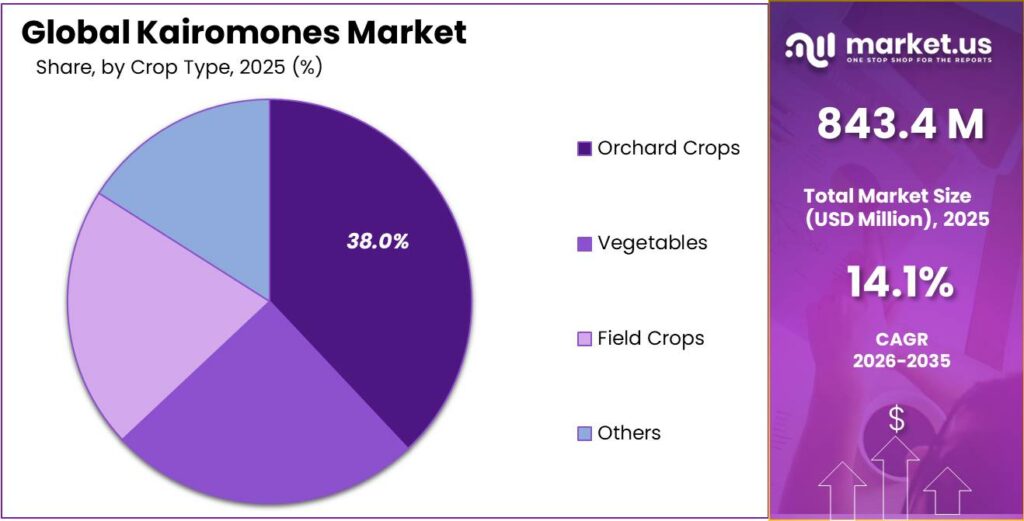
- Orchard Crops held a dominant market position, capturing more than a 38.1% share in the kairomones market
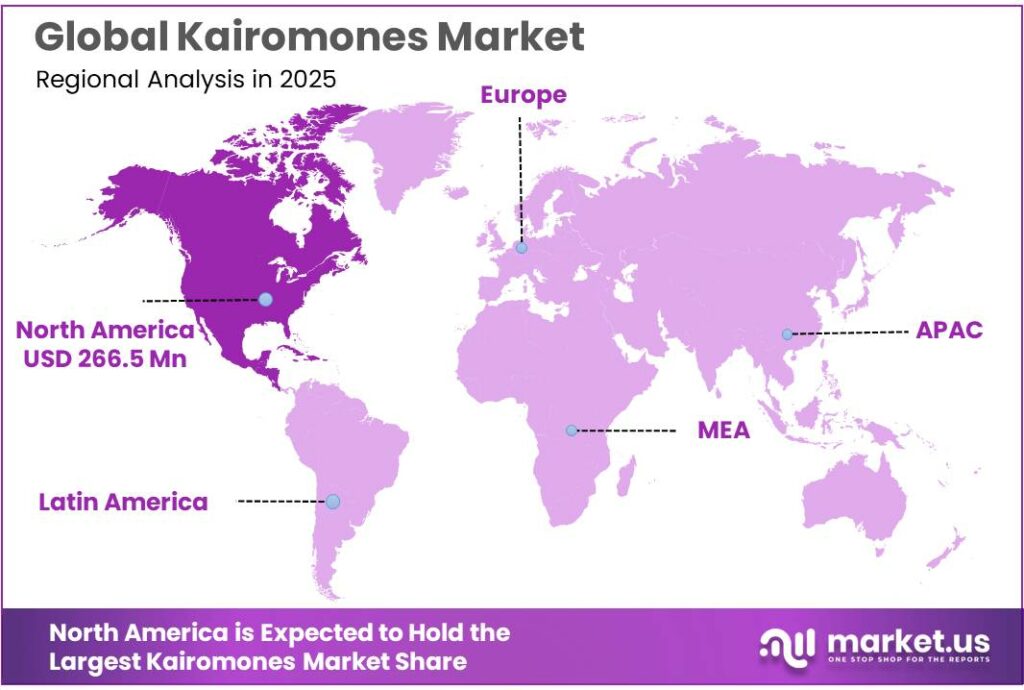
- North America emerged as the dominating region in the kairomones market, accounting for about 31.6% of the global share and reaching nearly USD 266.5 million.
By Function Analysis
Mass Trapping dominates with 39.5% due to its practical use in large-scale pest monitoring and control
In 2024, Mass Trapping held a dominant market position, capturing more than a 39.5% share in the kairomones market by function. This strong position is mainly linked to the growing use of kairomone-based traps in agricultural pest management programs. Farmers and agricultural professionals increasingly rely on mass trapping techniques because they allow continuous monitoring and reduction of pest populations without heavy dependence on chemical pesticides. The method works by releasing kairomone signals that attract specific pests into traps, helping reduce their numbers while also providing early detection of infestations. This makes it a practical tool for managing insects in crops such as fruits, vegetables, and field crops where pest damage can significantly impact yield.
By Crop Type Analysis
Orchard Crops lead with 38.1% as fruit farms increasingly rely on eco-friendly pest monitoring
In 2024, Orchard Crops held a dominant market position, capturing more than a 38.1% share in the kairomones market by crop type. The strong presence of this segment is largely connected to the high vulnerability of fruit crops to insect infestations. Orchards producing fruits such as apples, citrus, mangoes, and pears often face serious pest challenges that can directly affect fruit quality, yield, and export value. Because fruits are consumed fresh and are often subject to strict residue regulations in international trade, growers are increasingly turning to kairomone-based solutions as part of safer pest monitoring and control programs.
Key Market Segments
By Function
- Mass Trapping
- Detection and Monitoring
- Mating Disruption
- Others
By Crop Type
- Orchard Crops
- Vegetables
- Field Crops
- Others
Emerging Trends
Growing Integration of Kairomones with Integrated Pest Management (IPM) Systems
One of the most noticeable recent trends shaping the kairomones sector is their growing integration into Integrated Pest Management (IPM) programs. Farmers, researchers, and governments are increasingly combining semiochemical technologies such as pheromones and kairomones with biological and ecological pest control methods. This trend is largely driven by the need to reduce the heavy reliance on chemical pesticides while still maintaining crop productivity and food security.
International organizations have been actively encouraging this transition. The Food and Agriculture Organization (FAO) promotes IPM as a key strategy for sustainable agriculture because it reduces pesticide use while maintaining crop yields and farm profitability. According to FAO programs, around 10 million farmers across more than 95 countries have already been trained in IPM practices through Farmer Field School initiatives. These training programs teach farmers how to use pest monitoring tools such as traps, biological controls, and semiochemicals like kairomones to manage insect populations more effectively.
Another major reason for the increasing use of kairomones in IPM programs is the significant reduction in pesticide use that these strategies can achieve. FAO reports that when IPM practices are implemented effectively, pesticide use can decline by about 30% to 70% while still controlling pest populations successfully. In some crop systems such as tea, cabbage, cotton, or rice, pesticide reductions have even reached around 80% to 92% without harming crop productivity.
Drivers
Rising Crop Losses from Pests Driving the Demand for Sustainable Pest Management
One of the major factors driving the growth of kairomones in agriculture is the increasing global concern about crop losses caused by pests and diseases. Farmers across the world face significant challenges in protecting crops from insects and other damaging organisms, which directly affects food supply, farm income, and agricultural sustainability. As food demand continues to grow due to population expansion, protecting crops has become a top priority for governments, agricultural organizations, and food security programs. In this context, solutions such as kairomones are gaining attention because they help monitor and manage pests in a more environmentally friendly way compared with conventional chemical pesticides.
According to the Food and Agriculture Organization (FAO), plant pests and diseases reduce global crop yields by around 20% to 40% every year, making pest management one of the most critical challenges for global agriculture. These losses represent a major threat to food security because plants provide around 80% of the food consumed by humans worldwide. When crops are damaged by pests, the supply of fruits, vegetables, grains, and other essential foods decreases, which can affect food prices and availability in many countries. Because of this large-scale impact, agricultural researchers and policymakers are increasingly encouraging advanced pest monitoring and control systems that are both effective and environmentally responsible.
The economic consequences of pest damage are also significant. Studies supported by FAO show that plant diseases alone cause global economic losses of more than USD 220 billion every year, while invasive insects create additional losses of at least USD 70 billion annually. These numbers highlight the enormous financial burden pests place on the global agricultural sector. For many farmers, particularly in developing countries, severe pest outbreaks can reduce yields dramatically and threaten livelihoods. As a result, there is increasing demand for technologies that can detect pest activity early and help manage populations before they cause large-scale crop damage.
Government and international agricultural initiatives are also encouraging more sustainable pest management systems, which further supports the use of kairomones. Organizations such as FAO promote Integrated Pest Management (IPM) programs that combine biological, ecological, and monitoring-based approaches to control pests while reducing the excessive use of chemical pesticides. These programs emphasize techniques such as pheromone and kairomone traps that allow farmers to monitor pest populations and apply targeted interventions only when needed. Such methods help protect beneficial insects, reduce environmental contamination, and support long-term soil and ecosystem health.
Restraints
Limited Awareness and Technical Knowledge Among Farmers Restricting Wider Adoption
One of the major restraining factors affecting the adoption of kairomones in agriculture is the limited awareness and technical knowledge among farmers regarding semiochemical-based pest management. While kairomones are scientifically proven to help monitor and control pest populations, their practical use often requires understanding insect behavior, trap placement, and monitoring techniques. In many farming regions, particularly in developing economies, farmers still rely heavily on conventional chemical pesticides because these methods are widely known and easily available.
The issue of knowledge gaps in sustainable pest management practices has been highlighted by several international agricultural organizations. According to the Food and Agriculture Organization (FAO), improving farmer knowledge through training programs is essential because millions of farmers still lack access to proper guidance on environmentally friendly pest control practices. FAO reports that its Farmer Field School programs have trained more than 12 million farmers worldwide to improve their understanding of sustainable agriculture and integrated pest management (IPM).
Limited extension services also contribute to the slow adoption of new agricultural technologies. The World Bank has reported that smallholder farmers account for around 500 million farms globally, many of which operate with limited access to agricultural training, modern inputs, or advisory services. Without adequate support from extension officers or agricultural experts, farmers often continue using traditional pest control methods instead of adopting monitoring-based systems like kairomone traps.
Another challenge related to awareness is the long-standing dependence on chemical pesticides. According to the FAO, the global use of pesticides exceeded about 3.5 million tonnes annually in recent years, reflecting how widely chemical pest control methods are used across agriculture. Because these products are familiar and often marketed aggressively, farmers may see them as a faster solution to pest outbreaks compared with newer biological or semiochemical approaches.
Opportunity
Expansion of Organic and Sustainable Agriculture Creating New Opportunities for Kairomones
One of the strongest growth opportunities for the kairomones sector comes from the rapid expansion of organic and sustainable farming systems worldwide. Farmers, governments, and food organizations are increasingly focusing on agricultural methods that reduce chemical pesticide use and protect ecosystems. Since kairomones are natural chemical signals used to attract pests for monitoring or trapping, they fit well into environmentally friendly crop protection strategies.
Organic agriculture is expanding steadily across many regions, creating a favorable environment for semiochemical solutions such as kairomones. According to the Food and Agriculture Organization (FAO) and the Research Institute of Organic Agriculture (FiBL), organic farming is now practiced in almost 190 countries, and around 99 million hectares of agricultural land worldwide were managed organically in 2023. The sector also supports about 4.3 million organic farmers globally, highlighting the large and growing community of producers adopting environmentally responsible practices.
Another factor strengthening this opportunity is the growing global market for organic food. According to international organic agriculture statistics, global sales of organic food and beverages exceeded 136 billion euros in 2023, reflecting strong consumer demand for healthier and environmentally friendly food products. Another important aspect supporting this shift is the environmental concern associated with excessive pesticide use. FAO statistics show that global pesticide use in agriculture reached about 3.73 million tonnes of active ingredients in 2023, reflecting the scale of chemical inputs currently used in farming.
Regional Insights
North America dominates the Kairomones Market with 31.6% share, valued at USD 266.5 Mn
North America emerged as the dominating region in the kairomones market, accounting for about 31.6% of the global share and reaching nearly USD 266.5 million in value. The region’s strong position is largely supported by its highly developed agricultural sector, advanced pest monitoring technologies, and early adoption of sustainable crop protection practices.
Agriculture plays a significant role in North America’s food production systems, and effective pest control remains a key priority for farmers. According to agricultural statistics, the United States alone uses more than 407,000 tonnes of pesticides annually, reflecting the large scale of crop protection activities in the region.
Government programs promoting sustainable agriculture also contribute to the growth of kairomones in North America. Agencies such as the U.S. Department of Agriculture (USDA) actively support Integrated Pest Management (IPM) initiatives aimed at reducing environmental risks while maintaining farm productivity. These programs focus on improving pest monitoring systems, encouraging biological control methods, and promoting technologies that help farmers detect pest outbreaks early.
Another factor supporting regional growth is the increasing adoption of advanced pest monitoring techniques in fruit, vegetable, and orchard farming across the United States, Canada, and Mexico. Surveys of agricultural pest management practices indicate that more than 75% of vegetable crop acreage in some regions already uses multiple pest monitoring practices, including scouting and trap-based detection methods.
Key Regions and Countries Insights
- North America
- US
- Canada
- Europe
- Germany
- France
- The UK
- Spain
- Italy
- Rest of Europe
- Asia Pacific
- China
- Japan
- South Korea
- India
- Australia
- Rest of APAC
- Latin America
- Brazil
- Mexico
- Rest of Latin America
- Middle East & Africa
- GCC
- South Africa
- Rest of MEA
Key Players Analysis
Koppert Biological Systems is a Netherlands-based biological crop protection company operating in more than 60 countries with about 3,356 employees globally. The company generates an estimated annual revenue of around USD 75 million and focuses on biological pest control, natural pollination, and crop resilience technologies. Koppert develops semiochemical monitoring systems along with natural enemies and microbial solutions used in agriculture and horticulture. Its integrated pest management programs help farmers reduce chemical pesticide use while improving crop productivity and environmental sustainability.
SEDQ Healthy Crops, headquartered in Spain, focuses on sustainable agricultural technologies including pheromone and kairomone solutions used in pest monitoring and control. The company develops environmentally friendly products that help farmers manage pests while maintaining crop health and soil sustainability. SEDQ provides semiochemical-based attractants and traps designed to detect insect populations in fruit, vegetable, and field crops. These solutions help growers implement integrated pest management programs and reduce dependence on traditional chemical pest control methods.
Top Key Players Outlook
- International Pheromone Systems
- Koppert Biological Systems
- Novagrica Hellas S.A.
- Russell IPM
- SANIDAD AGRICOLA ECONEX, LTD.
- SEDQ Healthy Crops
- Suterra LLC
- Synergy Semiochemicals Corporation
- Trécé Inc.
- Harmony Ecotech Pvt. Ltd.
Recent Industry Developments
In 2024, Koppert Biological Systems reported that its biological solutions helped avoid the use of about 501,806 kg of synthetic pesticides in agricultural production, reflecting its growing role in sustainable pest management systems where semiochemicals such as pheromones and kairomone-related monitoring lures are used to track pest activity and protect crop yields.
Russell IPM operates with around 79 employees and generates an estimated USD 12.2 million in annual revenue, reflecting its specialized position in the biological pest management industry.
Report Scope
Report Features Description Market Value (2025) USD 843.4 Mn Forecast Revenue (2035) USD 3150.0 Mn CAGR (2026-2035) 14.1% Base Year for Estimation 2025 Historic Period 2020-2024 Forecast Period 2026-2035 Report Coverage Revenue Forecast, Market Dynamics, Competitive Landscape, Recent Developments Segments Covered By Function (Mass Trapping, Detection and Monitoring, Mating Disruption, Others), By Crop Type (Orchard Crops, Vegetables, Field Crops, Others) Regional Analysis North America – US, Canada; Europe – Germany, France, The UK, Spain, Italy, Rest of Europe; Asia Pacific – China, Japan, South Korea, India, Australia, Singapore, Rest of APAC; Latin America – Brazil, Mexico, Rest of Latin America; Middle East & Africa – GCC, South Africa, Rest of MEA Competitive Landscape International Pheromone Systems, Koppert Biological Systems, Novagrica Hellas S.A., Russell IPM, SANIDAD AGRICOLA ECONEX, LTD., SEDQ Healthy Crops, Suterra LLC, Synergy Semiochemicals Corporation, Trécé Inc., Harmony Ecotech Pvt. Ltd. Customization Scope Customization for segments, region/country-level will be provided. Moreover, additional customization can be done based on the requirements. Purchase Options We have three licenses to opt for: Single User License, Multi-User License (Up to 5 Users), Corporate Use License (Unlimited User and Printable PDF) 
-
-
- International Pheromone Systems
- Koppert Biological Systems
- Novagrica Hellas S.A.
- Russell IPM
- SANIDAD AGRICOLA ECONEX, LTD.
- SEDQ Healthy Crops
- Suterra LLC
- Synergy Semiochemicals Corporation
- Trécé Inc.
- Harmony Ecotech Pvt. Ltd.
Our Clients

- 180425
- Mar 2026






