


Global Hair Styling Products Market Size, Share, Growth Analysis Type (Inorganic, Organic), Category (Gels & Wax, Hair Colour, Hair Spray), Formulation (Wax & Gel, Serum, Hair Spray, Cream & Lotion, Oil, Others), Gender (Female, Male, Unisex), End Use (Individual, Fashion Industry, Spas & Salons), Sales Channel (Specialty Stores, Online, Omega Stores, Supermarket/Hypermarket, Others), Region and Companies - Industry Segment Outlook, Market Assessment, Competition Scenario, Statistics, Trends and Forecast 2026-2035
- Published date: Feb 2026
- Report ID: 178346
- Number of Pages: 306
- Format:
-
keyboard_arrow_up
Quick Navigation
Market Overview
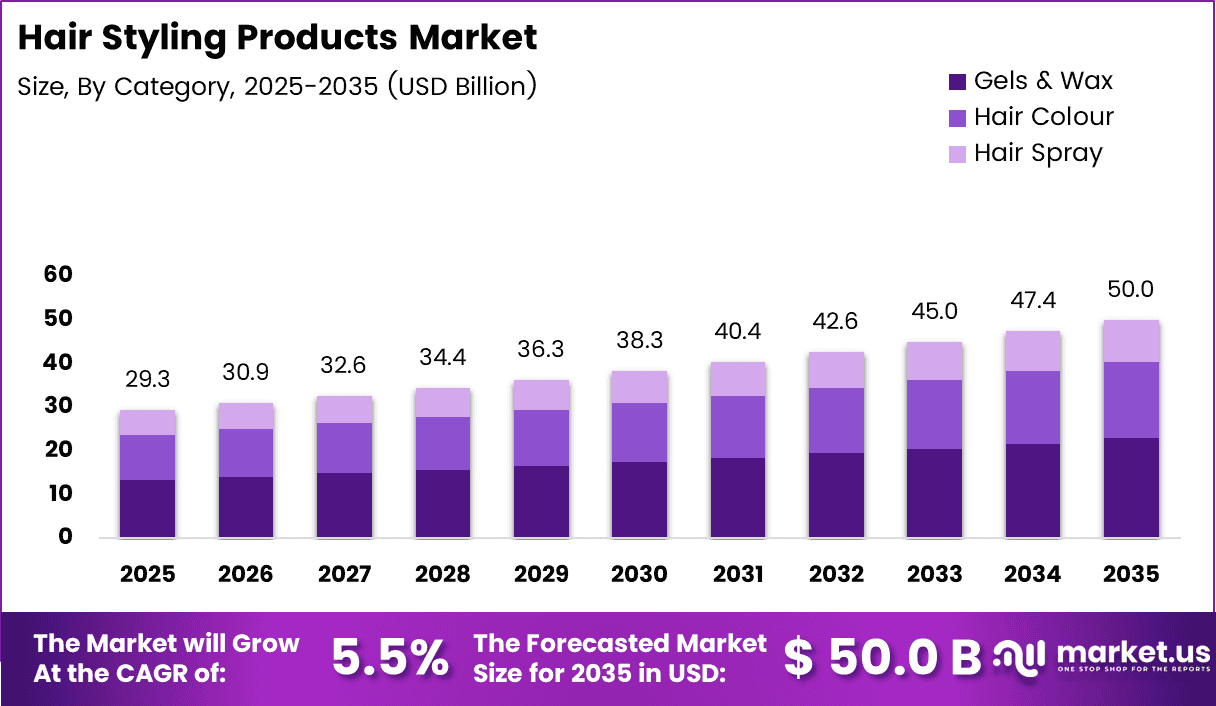
Global Hair Styling Products Market size is expected to be worth around USD 50.0 Billion by 2035 from USD 29.3 Billion in 2025, growing at a CAGR of 5.5% during the forecast period 2026 to 2035.
The hair styling products market encompasses a broad range of formulations including hair gels, waxes, serums, sprays, creams, oils, and hair colour solutions. These products are used across individual, professional salon, and fashion industry settings. Consequently, the market serves a highly diverse consumer base with varied hair types, textures, and styling preferences.
Consumer investment in personal appearance continues to rise globally. According to Scalp Los Angeles, a woman spends an average of $877 per year on hair care products including shampoos, conditioners, and styling items. Moreover, women dedicate approximately 182 hours per year to hair care routines, reinforcing the deep role of styling products in daily life.
Growing urbanization is reshaping consumer grooming habits significantly. More people in cities are incorporating professional-grade hair styling products into their daily routines. Additionally, the expanding presence of professional salons and trained hairstylists continues to elevate consumer expectations around product performance and variety.
Government frameworks around cosmetic chemical safety and product labelling are encouraging brands to innovate responsibly. Regulatory focus on transparency has accelerated the development of cleaner, safer formulations. Therefore, brands are investing in research to meet both consumer demand and compliance requirements across global markets.
Digital platforms and e-commerce have transformed how consumers discover and purchase hair styling products. According to Capital Hair and Beauty, nearly 49.7% of consumers believe getting their hair done is worth the money, highlighting strong emotional and financial commitment to hair care. This reinforces consistent demand across product categories and price segments.
The market also demonstrates strong segmental dynamics. The inorganic product type leads with a 58.3% share, while Gels and Wax dominate the category segment at 45.7%. Additionally, individual end users represent 69.2% of total consumption, reflecting the personal nature of daily hair styling routines globally.
Key Takeaways
- The global Hair Styling Products Market is valued at USD 29.3 Billion in 2025 and is projected to reach USD 50.0 Billion by 2035.
- The market is growing at a CAGR of 5.5% during the forecast period 2026 to 2035.
- By Type, the Inorganic segment dominates with a share of 58.3%.
- By Category, Gels & Wax holds the leading position with a 45.7% market share.
- By Formulation, Wax & Gel leads with a share of 37.8%.
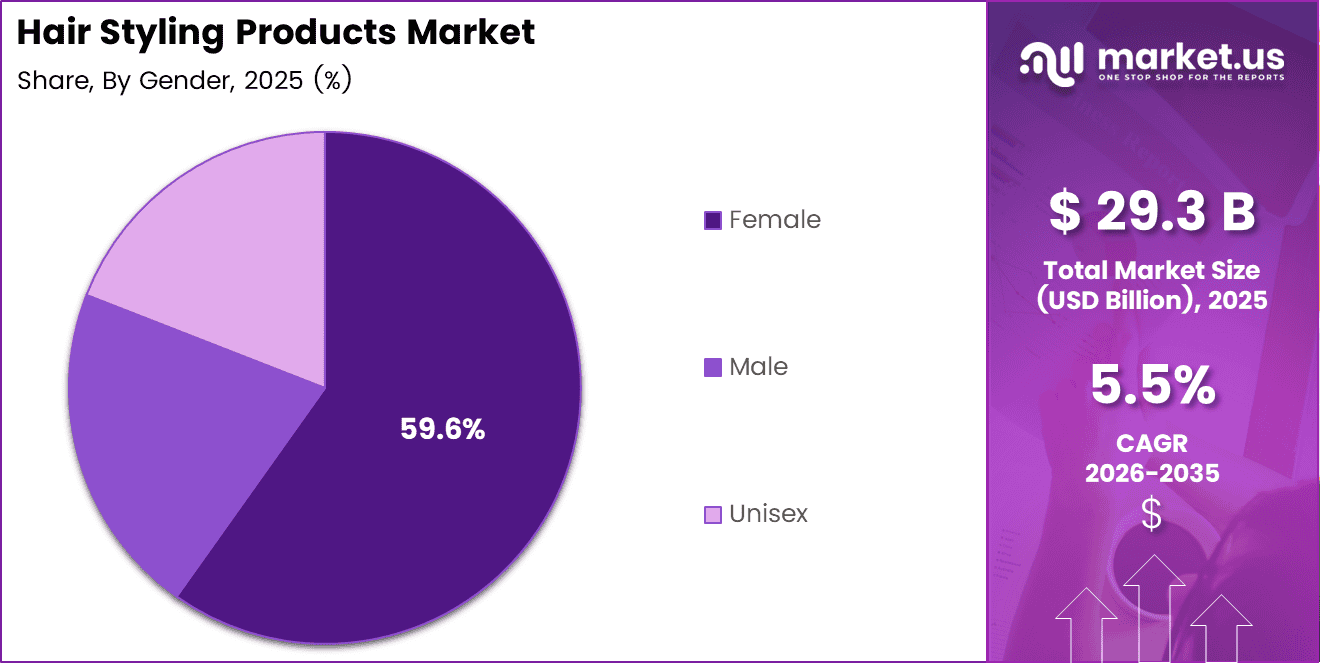
- By Gender, the Female segment accounts for 59.6% of the market.
- By End Use, the Individual segment holds a dominant share of 69.2%.
- By Sales Channel, Specialty Stores lead with a 38.5% share.
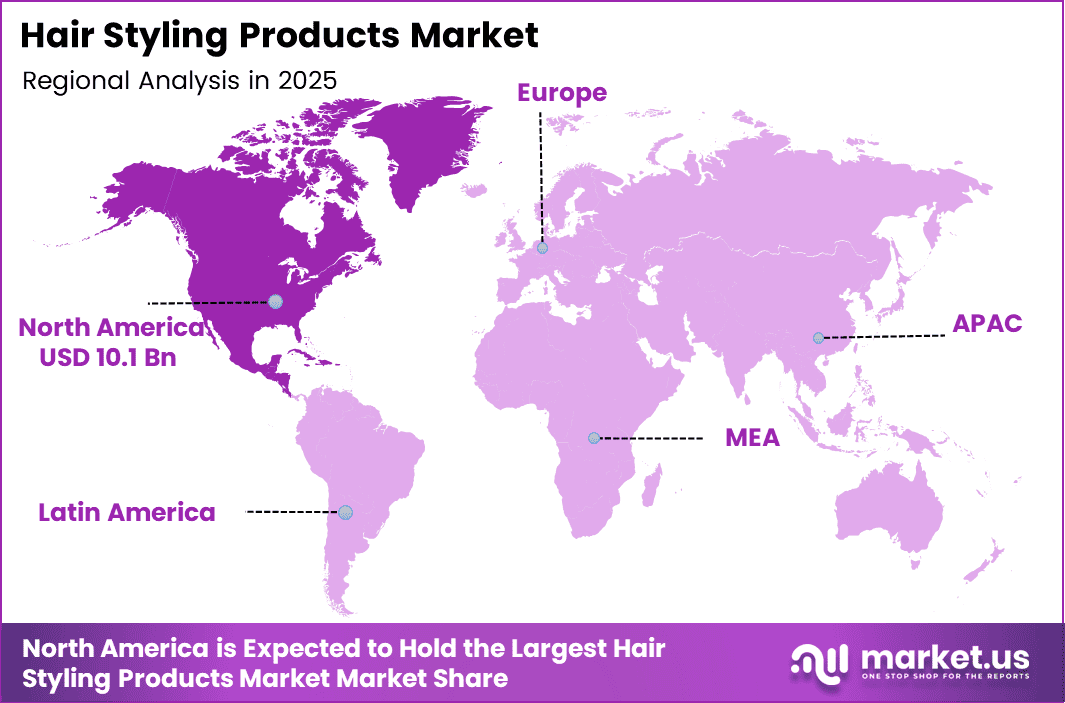
- North America dominates the regional landscape with a 34.80% share, valued at USD 10.1 Billion.
Type Analysis
Inorganic dominates with 58.3% due to proven performance, product consistency, and mass-market availability.
In 2025, Inorganic held a dominant market position in the Type segment of the Hair Styling Products Market, with a 58.3% share. These products are widely preferred for their reliable hold, texture performance, and extended shelf life. Moreover, their broad availability through specialty stores, supermarkets, and online channels supports consistent and high-volume consumer demand globally.
Organic products are steadily gaining market traction as consumers shift toward natural and chemical-free formulations. Consequently, demand for plant-derived ingredients and clean-label solutions is growing among health-conscious buyers. However, higher price points and formulation complexity currently limit the organic segment’s share compared to conventional inorganic alternatives in the overall market.
Category Analysis
Gels & Wax dominates with 45.7% due to versatility, strong hold, and widespread everyday use.
In 2025, Gels & Wax held a dominant market position in the Category segment of the Hair Styling Products Market, with a 45.7% share. These products are favoured across age groups for their ability to define, texture, and hold styles effectively. Additionally, their suitability for both casual and professional styling applications ensures sustained demand across multiple consumer segments.
Hair Colour is a high-growth category driven by rising consumer interest in personal expression and aesthetic customisation. Moreover, easy-to-use at-home colour kits have broadened accessibility well beyond professional salon service. Therefore, this sub-segment is expected to witness accelerating demand among younger demographics throughout the forecast period.
Hair Spray maintains a stable and consistent market presence due to its finishing and long-hold capabilities. It remains a staple in both everyday grooming routines and professional styling workflows. Consequently, demand for hair spray persists across both mass-market and premium product tiers globally.
Formulation Analysis
Wax & Gel dominates with 37.8% due to high demand for texturising and strong-hold styling solutions.
In 2025, Wax & Gel held a dominant market position in the Formulation segment of the Hair Styling Products Market, with a 37.8% share. These formulations deliver defined texture, shine, and durable hold, making them suitable for diverse styling needs. Moreover, their ease of application and wide availability across retail formats reinforce strong consumer preference globally.
Serum formulations are gaining strong consumer interest for their multi-functional benefits, combining styling with frizz control, heat protection, and shine enhancement. Additionally, serums appeal to consumers seeking hybrid solutions that reduce the total number of products in their daily routine. This positions serums as one of the fastest-evolving sub-segments in the formulation category.
Hair spray continues to appeal to a wide range of consumers due to its reliable finishing and long-lasting hold. It is widely used to lock hairstyles in place across everyday, professional, and event-based styling needs. The product remains a staple for achieving structure and durability in hair looks.
Cream and lotion products are favored for their moisturising and curl-enhancing properties. They help improve hair texture while providing softness and manageability without stiffness. These formulations are especially popular among consumers seeking hydration-focused styling solutions.
Oil-based formulations are witnessing growing demand as natural and holistic hair care routines gain popularity. They are valued for nourishment, shine enhancement, and scalp health benefits. Consumers increasingly prefer oils as part of daily care and styling practices.
Others category includes niche hair styling formats designed for specific treatment and styling needs. These products cater to targeted concerns such as heat protection, volumizing, or specialized hair types. Their demand is driven by customization and evolving consumer preferences.
Gender Analysis
Female dominates with 59.6% due to higher product variety usage and longer daily hair care routines.
In 2025, Female held a dominant market position in the Gender segment of the Hair Styling Products Market, with a 59.6% share. Female consumers engage with a broader range of styling products and dedicate significantly more time to hair care routines. Moreover, their higher annual spending on hair care products sustains consistent demand across multiple categories and price tiers.
Male grooming represents one of the fastest-growing sub-segments, driven by evolving attitudes toward personal care and professional appearance. Consequently, more men are incorporating styling gels, waxes, and hair serums into their daily routines. This sub-segment offers strong commercial growth potential, particularly for brands developing purpose-built male grooming product lines.
Unisex products are gaining momentum as brands increasingly adopt inclusive and gender-neutral positioning strategies. Additionally, unisex formulations align well with minimalist lifestyle trends and appeal to a broad consumer base. Therefore, this sub-segment is expected to attract growing investment in product development and retail shelf presence throughout the forecast period.
End Use Analysis
Individual dominates with 69.2% due to high household consumption and daily personal grooming habits.
In 2025, Individual held a dominant market position in the End Use segment of the Hair Styling Products Market, with a 69.2% share. Everyday grooming habits and growing social media influence on personal appearance drive consistent product use among individual consumers. Moreover, easy access through retail and online channels supports high repeat purchase rates across all demographics.
Fashion Industry end users represent a high-value segment requiring professional-grade performance and precision under demanding conditions. Consequently, stylists and creative directors favour products with advanced hold, finish quality, and formulation reliability. This segment also plays a key role in influencing mainstream consumer trends and driving innovation in product development.
Spas & Salons remain an important channel for premium and professional styling product consumption. Additionally, salon professionals directly influence consumer purchasing decisions by using and recommending specific brands during service appointments. Therefore, brand visibility within the professional salon channel continues to serve as a powerful driver of market credibility and repeat consumer demand.
Sales Channel Analysis
Specialty Stores dominate with 38.5% due to curated assortments, expert guidance, and premium brand presence.
In 2025, Specialty Stores held a dominant market position in the Sales Channel segment of the Hair Styling Products Market, with a 38.5% share. These stores offer a focused and curated range of hair styling products, often supported by trained beauty advisors. Moreover, the in-store experience and premium brand selection attract consumers seeking professional-quality styling solutions.
Online channels are growing rapidly, driven by digital adoption, convenience, and direct-to-consumer brand strategies. Additionally, e-commerce platforms enable brands to reach consumers beyond geographic boundaries and offer personalised product recommendations. Consequently, online sales are expected to close the gap with physical retail formats significantly during the forecast period.
Omega Stores and Supermarket/Hypermarket formats serve value-oriented consumers through competitive pricing and high product accessibility. These channels benefit from high daily foot traffic and broad product placement opportunities.
Meanwhile, Others including pharmacy chains and department stores provide additional reach across diverse regional consumer markets.
Key Market Segments
By Type
- Inorganic
- Organic
By Category
- Gels & Wax
- Hair Colour
- Hair Spray
By Formulation
- Wax & Gel
- Serum
- Hair Spray
- Cream & Lotion
- Oil
- Others
By Gender
- Female
- Male
- Unisex
By End Use
- Individual
- Fashion Industry
- Spas & Salons
By Sales Channel
- Specialty Stores
- Online
- Omega Stores
- Supermarket/Hypermarket
- Others
Drivers
Rising Personal Grooming Awareness, Urbanization, and Product Diversity Drive Hair Styling Products Market Growth
Growing consumer focus on personal grooming and appearance enhancement is a primary driver of demand in the hair styling products market. Additionally, rising disposable incomes and greater access to professional beauty products are encouraging consumers to invest more in daily styling routines. Consequently, product spending continues to grow across both developed and emerging markets.
Urbanization is playing a significant role in shaping regular hair care and styling habits. Consumers living in urban areas are more likely to use styling products daily for professional and social settings. Moreover, the expanding presence of professional salons and trained hairstylists further elevates consumer standards and encourages exploration of new product formats.
Increased availability of product variants tailored for diverse hair types, textures, and conditions is broadening market reach significantly. Therefore, brands offering targeted solutions for curly, straight, thick, and colour-treated hair are capturing new consumer groups. This product diversification is reinforcing sustained demand growth across multiple segments within the global hair styling products market.
Restraints
Chemical Ingredient Concerns and Price Sensitivity Limit Growth in the Hair Styling Products Market
A growing number of consumers are raising concerns about chemical ingredients commonly found in conventional hair styling products. Ingredients such as sulphates, parabens, and synthetic fixatives are linked to scalp irritation and long-term hair damage. Consequently, brands face increasing pressure to reformulate products without compromising on performance, which adds development cost and complexity.
Price sensitivity among consumers in emerging and mass-market segments remains a significant restraint for market expansion. Many buyers in these regions view hair styling products as discretionary purchases rather than daily essentials. Moreover, higher-priced premium and organic offerings often face resistance, limiting their penetration in cost-conscious consumer markets globally.
The combined challenge of meeting clean formulation standards while maintaining affordability creates a complex operating environment for manufacturers. Additionally, regulatory requirements around ingredient transparency vary by region, adding compliance complexity for global brands. Therefore, companies that cannot balance formulation quality with price competitiveness may find growth limited in key developing markets.
Growth Factors
Natural Product Demand, E-Commerce Expansion, and Male Grooming Adoption Fuel Hair Styling Products Market Growth
Increasing consumer demand for natural, organic, and clean-label hair styling products is creating strong growth opportunities across the market. Brands that offer plant-based, sulphate-free, and transparently formulated products are gaining rapid consumer trust. Consequently, the organic and clean beauty segment is expected to outpace conventional product growth in multiple regional markets during the forecast period.
The rapid expansion of e-commerce and direct-to-consumer beauty channels is transforming how styling products reach end users. Moreover, digital platforms allow brands to serve niche consumer groups with highly targeted product offerings at lower distribution costs. Therefore, online channel growth is expected to be one of the most significant contributors to overall market revenue through 2035.
Rising male grooming and styling product adoption is unlocking a previously underserved consumer segment with significant commercial potential. Additionally, product innovation targeting climate-specific conditions and diverse hair textures is broadening market appeal in regions with high hair diversity. These growth factors collectively support a strong and expanding long-term trajectory for the global market.
Emerging Trends
Multi-Functional Products, Social Media Influence, and Sustainable Formulations Are Reshaping the Hair Styling Products Market
The growing popularity of multi-functional styling products that combine hold with conditioning, heat protection, and frizz control benefits is reshaping consumer expectations. Consumers increasingly prefer products that address multiple needs in a single step. Moreover, this trend is pushing manufacturers to develop hybrid formulations that simplify daily grooming routines without sacrificing performance quality.
Social media platforms, beauty influencers, and celebrity endorsements continue to be among the most powerful forces driving product discovery and purchase behaviour. Additionally, short-form video content on platforms such as Instagram and TikTok accelerates product trial and brand awareness at scale. Consequently, digital-first marketing has become a core strategy for brands targeting younger and trend-sensitive consumer demographics.
Growth in sustainable packaging and eco-friendly formulations reflects a broader industry shift toward responsible beauty consumption. Furthermore, rising demand for long-lasting, anti-frizz, and heat-protection solutions reflects an evolving consumer focus on performance-driven products. Therefore, brands that invest in both sustainability and high-performance innovation are well-positioned to capture share in the evolving global market.
Regional Analysis
North America Dominates the Hair Styling Products Market with a Market Share of 34.80%, Valued at USD 10.1 Billion
North America leads the global Hair Styling Products Market with a dominant share of 34.80%, valued at USD 10.1 Billion. The region benefits from high consumer spending on personal care, a deeply embedded salon culture, and strong distribution infrastructure. Moreover, growing adoption of premium, organic, and multi-functional styling products continues to sustain robust revenue growth across the United States and Canada.
Europe Hair Styling Products Market Trends
Europe represents a well-established market driven by strong consumer awareness of ingredient quality, sustainability, and brand ethics. Additionally, key countries including Germany, France, the UK, Spain, and Italy maintain mature retail ecosystems with high demand for premium and professional styling products. Consequently, European consumers consistently drive innovation in clean formulation and eco-conscious packaging across the market.
Asia Pacific Hair Styling Products Market Trends
Asia Pacific is one of the fastest-growing regions in the hair styling products market, supported by a large young population and rising disposable incomes. Moreover, rapidly expanding beauty retail infrastructure in China, India, South Korea, and Japan is accelerating product access and consumer adoption. Therefore, this region represents one of the most commercially significant growth opportunities through the forecast period.
Middle East and Africa Hair Styling Products Market Trends
The Middle East and Africa market is growing steadily, driven by rising urbanisation, beauty consciousness, and a growing middle-class consumer base. Additionally, the influence of global hair styling trends is increasing product awareness and purchase intent across the region. However, growth remains concentrated in GCC countries and South Africa, where retail infrastructure and consumer spending power are strongest.
Latin America Hair Styling Products Market Trends
Latin America offers solid and consistent growth potential, particularly in Brazil and Mexico where hair care investment remains high among consumers. Moreover, the region’s naturally diverse hair textures create strong demand for specialised formulations targeting curl definition, moisture retention, and heat protection. Consequently, brands offering texture-specific and climate-appropriate solutions are gaining meaningful traction across this market.
Key Regions and Countries
North America
- US
- Canada
Europe
- Germany
- France
- The UK
- Spain
- Italy
- Rest of Europe
Asia Pacific
- China
- Japan
- South Korea
- India
- Australia
- Rest of APAC
Latin America
- Brazil
- Mexico
- Rest of Latin America
Middle East & Africa
- GCC
- South Africa
- Rest of MEA
Key Company Insights
CHANEL holds a distinguished position in the premium hair styling segment, built on decades of luxury brand heritage and a commitment to high-quality formulation. The company’s styling products are closely associated with elegance, efficacy, and sensory experience. Moreover, its strong presence in professional and high-end retail channels reinforces its appeal among premium consumers seeking refined and performance-driven styling solutions.
Coty operates across a wide range of price tiers and geographic markets, positioning itself as one of the more diversified players in the global hair styling products landscape. The company’s portfolio spans mass-market and prestige segments effectively. Additionally, Coty’s ongoing investment in digital marketing and e-commerce infrastructure has strengthened its consumer engagement, particularly among younger and digitally active beauty audiences globally.
Estee Lauder brings substantial research and development capabilities to the hair styling products market through its family of premium beauty brands. The company focuses on delivering formulations that combine visible styling results with scalp and strand health benefits. Consequently, its products resonate strongly with consumers who prioritise both performance and ingredient quality, particularly in North America and key European markets.
Hoyu is a technically specialised player recognised for its expertise in hair colour and professional styling formulations. The company has developed a strong foothold in salon and retail channels, particularly across Asia Pacific markets where hair diversity demands specialised solutions. Furthermore, Hoyu’s continued investment in professional-grade product development positions it well within both the formulation innovation and professional service segments.
Key Players
- CHANEL
- Coty
- Estee Lauder
- Hoyu
- Indus Valley
- John Paul Mitchell Systems
- Kao
- KOSE
- L’Oreal
- NATULIQUE
Recent Developments
- June 2025 – L’Oréal announced it had signed an agreement to acquire Color Wow, recognised as one of the world’s fastest-growing and most innovative professional haircare brands. This strategic acquisition strengthens L’Oréal’s position in the professional haircare segment and expands its portfolio of high-performance styling and treatment products.
- October 2025 – JOY GROUP announced the acquisition of Italian hair care brand Foltène, a move aimed at expanding its global dermatological beauty portfolio. This acquisition enables JOY GROUP to strengthen its presence in the medical and dermatological hair care category across international markets.
Report Scope
Report Features Description Market Value (2025) USD 29.3 Billion Forecast Revenue (2035) USD 50.0 Billion CAGR (2026-2035) 5.5% Base Year for Estimation 2025 Historic Period 2020-2024 Forecast Period 2026-2035 Report Coverage Revenue Forecast, Market Dynamics, Competitive Landscape, Recent Developments Segments Covered Type (Inorganic, Organic), Category (Gels & Wax, Hair Colour, Hair Spray), Formulation (Wax & Gel, Serum, Hair Spray, Cream & Lotion, Oil, Others), Gender (Female, Male, Unisex), End Use (Individual, Fashion Industry, Spas & Salons), Sales Channel (Specialty Stores, Online, Omega Stores, Supermarket/Hypermarket, Others) Regional Analysis North America (US and Canada), Europe (Germany, France, The UK, Spain, Italy, and Rest of Europe), Asia Pacific (China, Japan, South Korea, India, Australia, and Rest of APAC), Latin America (Brazil, Mexico, and Rest of Latin America), Middle East & Africa (GCC, South Africa, and Rest of MEA) Competitive Landscape CHANEL, Coty, Estee Lauder, Hoyu, Indus Valley, John Paul Mitchell Systems, Kao, KOSE, L’Oreal, NATULIQUE Customization Scope Customization for segments, region/country-level will be provided. Moreover, additional customization can be done based on the requirements. Purchase Options We have three licenses to opt for: Single User License, Multi-User License (Up to 5 Users), Corporate Use License (Unlimited User and Printable PDF)  Hair Styling Products MarketPublished date: Feb 2026add_shopping_cartBuy Now get_appDownload Sample
 -
-
- CHANEL
- Coty
- Estee Lauder
- Hoyu
- Indus Valley
- John Paul Mitchell Systems
- Kao
- KOSE
- L'Oreal
- NATULIQUE
Our Clients

- 178346
- Feb 2026






