Report Overview
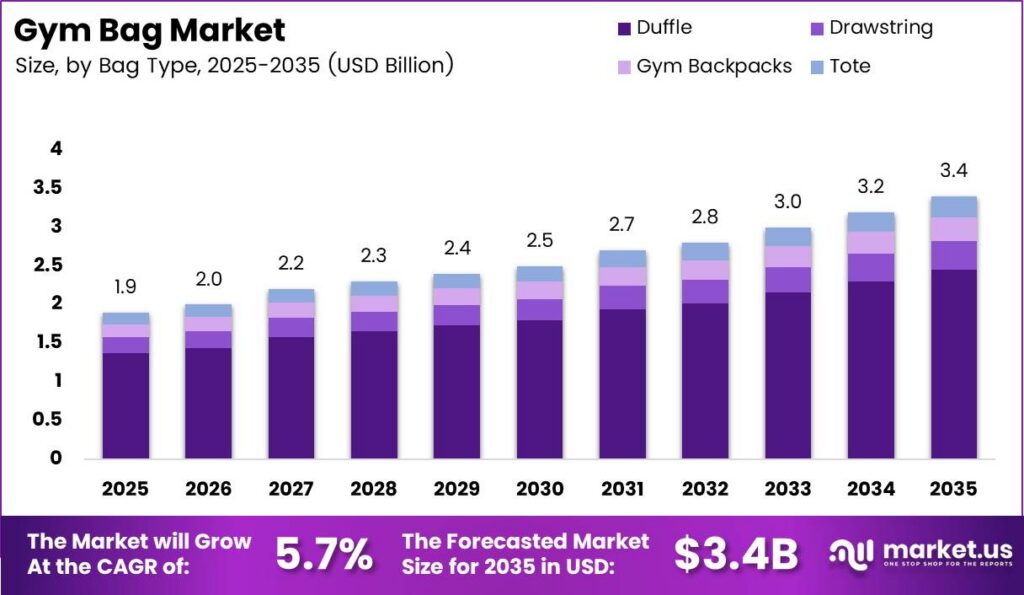
Global Gym Bag Market size is expected to be worth around USD 3.4 Billion by 2035 from USD 1.9 Billion in 2025, growing at a CAGR of 5.7% during the forecast period 2026 to 2035. A gym bag is a specialized carry container engineered with ventilated compartments, moisture-resistant linings, and ergonomic straps to transport athletic footwear, workout apparel, hydration bottles, and personal electronics between homes, offices, and fitness centers.
Key Takeaways
- The global Gym Bag Market was valued at USD 1.9 Billion in 2025.
- The market is projected to reach USD 3.4 Billion by 2035.
- Global market revenue will expand at a CAGR of 5.7% during the forecast period from 2026 to 2035.
- By Bag Type, the Duffle segment led the market with a 71.10% share in 2025 and represents the fastest growing category.
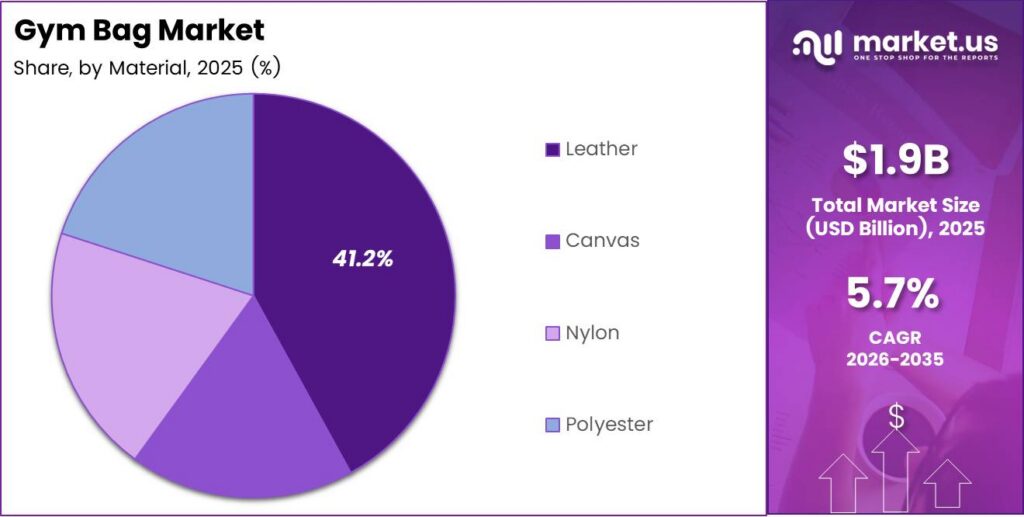
- By Material, the Leather segment held the largest share of 41.23% in 2025, while Canvas is the fastest growing material.
- By Distribution Channel, Hypermarkets & Supermarkets captured a dominant 41.67% share in 2025, whereas the Online channel is the fastest growing segment.
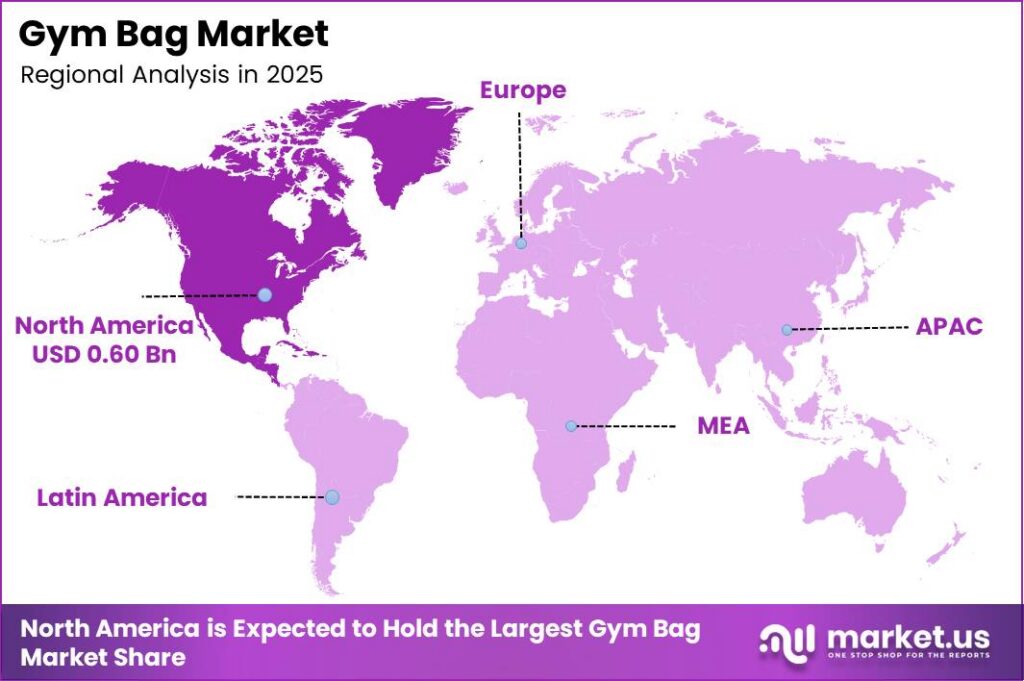
- North America dominated the regional landscape with a 31.78% market share valued at USD 0.60 Billion in 2025, while Asia-Pacific is the fastest growing region.
Commercial health clubs, collegiate athletic departments, and corporate wellness programs anchor the global market structure. According to Health & Fitness Association (IHRSA), membership in United States fitness facilities reached a record 81 million consumers in 2025, up 5.2% from 2024, while total facility users exceeded 100 million people. Consequently, higher gym foot traffic accelerates consumer wear-and-tear cycles. This means accessory brands can capture recurring replacement sales through multi-compartment carry silhouettes.
Intellectual property frameworks and statutory design protections actively shape product differentiation across international borders. Data from WIPO shows that global sports design filings rose by 8.3% annually between 2016 and 2025, with gym and fitness gear leading all sports disciplines alongside 65,700 inventions and 1.25 million trademarks . Therefore, strong patent and design enforcement protects proprietary ventilated shoe compartments and ergonomic strap geometries. This signals higher gross margins for innovation-led manufacturers.
Major sporting goods manufacturers are actively expanding into rigid, modular travel-and-training carry architectures to capture affluent athletes. In December 2025, leading athletic equipment producer debuted its first hard-shell athlete suitcase and gym gear collection in 3 distinct sizes after 5 years of research and development, priced starting at USD 260 with removable washable liners. As a result, premium hard-sided athletic carry raises average retail unit pricing across direct digital channels.
North America dominates the global landscape with a 31.78% market share in 2025, valued at USD 0.60 Billion. By contrast, European distribution relies heavily on Asian manufacturing hubs. Based on Eurostat data, extra-EU sporting goods imports totaled EUR 10.8 billion in 2024, with China supplying EUR 4.5 billion and Vietnam providing EUR 1.9 billion . High consumer spending on boutique studio memberships in North America directly fuels premium carry upgrades.
Retail consolidation continues to reshape physical shelf space and wholesale purchasing power across athletic specialty chains. In September 2025, a premier sporting goods retail chain completed the USD 2.5 billion acquisition of a global footwear and athletic gear retailer, adding USD 3.1 billion in fiscal 2025 segment net sales. Consequently, consolidated retail buyers demand faster inventory turnarounds and exclusive colorways from bag suppliers to protect store-level profitability.
Bag Type Analysis
Duffle dominates with 71.10% share in 2025 due to superior horizontal gear storage capacity.
In 2025, Duffle held a 71.10% share in the Bag Type segment of the Gym Bag Market and represents the fastest growing category. Figures from Nike, Inc. Form 10-K show that global Nike Brand Equipment revenues reached USD 2,199 million in fiscal 2026, with North America rising 6% to USD 1,119 million . Wide-mouth horizontal zippers mechanically accommodate bulky weightlifting belts, shoes, and foam rollers without crushing internal compartments. Therefore, manufacturers prioritizing structured duffle silhouettes secure higher wholesale reorder volumes.
Drawstring bags serve price-sensitive student athletes, recreational swimmers, and promotional fitness event participants requiring ultra-lightweight secondary carry. As reported by National Retail Federation (NRF), 67% of K-12 back-to-school households began shopping by early July 2025, up from 55% in 2024, spending an average of USD 249.36 on apparel and accessories within a USD 35 billion seasonal market . Low-denier cinch cords mechanically minimize fabric yardage and sewing labor per unit. Consequently, mass-market suppliers use drawstring packs as high-volume entry-level traffic drivers.
Gym Backpacks cater to urban bicycle and transit commuters who require ergonomic two-shoulder weight distribution and dedicated laptop protection. Samsonite Group S.A. Official Interim Report indicates that lifestyle and travel bag net sales increased 2.4% year-over-year in the first half of 2026 to represent 37.4% of its USD 1,680.6 million total group revenue . Vertical load alignment and padded lumbar panels mechanically prevent spinal strain when carrying heavy tech devices alongside damp workout clothes. This means brands integrating tech sleeves capture higher commuter price points.
Material Analysis
Leather dominates with 41.23% share in 2025 due to high retail price realization.
In 2025, Leather held a 41.23% share in the Material segment of the Gym Bag Market. Data from UN Comtrade shows that United States imports of leather-surface bags under HS Code 420221 totaled USD 1.98 billion in 2024, led by Italy at USD 0.80 billion and Vietnam at USD 0.22 billion . Full-grain and top-grain hides possess dense collagen fiber networks that resist puncture stress while commanding luxury retail pricing. Therefore, premium athleisure brands use leather trims and shells to maximize gross dollar revenue per unit.
Canvas represents the fastest growing segment in the Material category as eco-conscious gym members replace petrochemical synthetics with washable natural fibers. UN Comtrade found that India exported USD 49.5 million of cotton and canvas tote and carry bags under HS Code 4202.92 in fiscal 2025 to 2026, reflecting a 27% annual increase . Heavyweight plain-weave cotton yarns absorb dye uniformly and withstand repeated high-temperature machine washing without delaminating. Consequently, procurement teams sourcing Indian cotton canvas reduce microplastic compliance risks while appealing to sustainability-focused consumers.
Nylon provides high tenacity-to-weight ratios and superior abrasion resistance for heavy-duty tactical, CrossFit, and outdoor athletic packs. According to USITC and U.S. Customs and Border Protection, insulated sports and beverage bags with man-made textile outer surfaces under HTSUS 4202.92.10 carry a 3.4% ad valorem general duty rate effective February 2025 . High-denier polyamide filaments chemically resist flexing fatigue and wet-rot degradation caused by damp athletic gear. This means product developers specifying ballistic nylon minimize warranty claims and extend product lifespans.
Distribution Channel Analysis
Hypermarkets & Supermarkets dominate with 41.67% share in 2025 due to impulse basket bundling.
In 2025, Hypermarkets & Supermarkets held a 41.67% share in the Distribution Channel segment of the Gym Bag Market. Based on US Census Bureau data, United States grocery and supermarket sales reached USD 683.44 billion during the first 9 months of 2026, up 1.0% year-over-year, while general merchandise and food stores captured USD 355 billion in holiday spending . High weekly foot traffic allows big-box merchandisers to cross-sell affordable gym bags alongside protein powders and hydration bottles. Therefore, high-volume manufacturers rely on hypermarket planograms for baseline factory utilization.
Specialty Stores anchor technical product discovery by allowing athletes to physically inspect zipper gauge durability, internal shoe garages, and strap padding. US Census Bureau indicates that United States specialty sporting goods stores under NAICS 451110 generated USD 63.2 billion in 2024 annual revenue, expanding at a 2.8% 5-year compound annual rate from USD 47.8 billion in 2019 . In-store sales associates educate buyers on technical fabric coatings that justify higher retail prices. Consequently, performance brands allocate exclusive mid-tier and premium SKUs to specialty sporting chains.
Online distribution is the fastest growing channel as direct-to-consumer brands utilize social video demonstrations to showcase bag compartmentalization. Figures from US Census Bureau show that United States retail e-commerce sales rose 5.4% in 2025 to USD 1,233.7 billion, representing 16.4% of retail spending, and jumped 12.2% in Q2 2026 to USD 340.2 billion, or 17.1% share . Digital storefronts eliminate wholesale markups and enable rapid A/B testing of limited-edition color drops. This means digitally native bag brands capture superior unit contribution margins.
Key Market Segments
By Bag Type
- Duffle
- Drawstring
- Gym Backpacks
- Tote
By Material
- Leather
- Canvas
- Nylon
- Polyester
By Distribution Channel
- Hypermarkets & Supermarkets
- Specialty Stores
- Online
- Others
Regional Analysis
North America Dominates the Gym Bag Market with a Market Share of 31.78% in 2025, Valued at USD 0.60 Billion
North America leads the global market with a 31.78% revenue share in 2025, valued at USD 0.60 Billion. As reported by VF Corporation Form 10-Q and Form 8-K filings, The North Face generated USD 475.6 million in Americas revenue during Q2 FY2026 within USD 1,091.4 million globally, before global quarterly brand revenue rose 4% to USD 1,207.3 million in Q2 FY2027 . High per-capita spending on outdoor recreation and collegiate athletics directly fuels premium duffle and backpack replacement demand across United States and Canadian retail corridors.
Asia-Pacific represents the fastest growing region, supported by dense synthetic textile manufacturing clusters and expanding urban gym franchises across China, India, and Southeast Asia. Data from UNCTAD and WIPO shows that developing Asian ports handled 60% of the world’s 920 million TEUs of container traffic in 2024, up 6.9%, while Asia generated 63% of global sports patents and 76% of sports design filings through 2025 . Proximity to polyamide mills and export ports compresses factory lead times for regional brands.
Europe maintains mature demand driven by high bicycle commuting rates and strict environmental standards governing textile durability. Eurostat found that European Union consumer prices for recreational and sporting services increased 4.1% in 2025, whereas prices for sporting, camping, and open-air recreation equipment declined by 0.7% . Lower equipment inflation amid rising gym service fees encourages European fitness consumers to upgrade personal carry gear. Consequently, brands offering recycled, weatherproof commuter gym packs gain strong traction across Western Europe.
Key Regions and Countries
North America
- US
- Canada
Europe
- Germany
- France
- The UK
- Spain
- Italy
- Rest of Europe
Asia Pacific
- China
- Japan
- South Korea
- India
- Australia
- Rest of APAC
Latin America
- Brazil
- Mexico
- Rest of Latin America
Middle East and Africa
- GCC
- South Africa
- Rest of MEA
Market Dynamics
Global athletic carry manufacturers operate in a business environment defined by hybrid commuter convergence, chemical coating bans, and recycled yarn cost volatility. Based on ECHA data, European Union Regulation (EU) 2024/2462 restricts PFHxA and related substances in consumer bags and clothing from October 10, 2026 at 25 ppb for salts and 1,000 ppb for related compounds, while ECHA expanded its universal PFAS review from 14 to 22 sectors . Therefore, brands must balance eco-compliant waterproofing against rising material costs to protect operating margins.
Drivers
Permanent hybrid work schedules of 3 to 4 days per week between 2024 and 2025 and a 14.2% expansion in boutique studio memberships through Q4 2025 have merged office commuting with gym transit. Buyers now favor multi-compartment Ballistic Nylon 1680D and matte Polyurethane-coated bags priced from USD 95 to USD 165 over legacy USD 25 to USD 35 Polyester 600D duffels. Consequently, direct-to-consumer drops lifted average order values by 38.5% since H2 2024 and cut payback cycles from 11 months to 6.5 months.
Integrating padded 16-inch laptop sleeves and ventilated shoe garages compressed consumer replacement cycles from 4.2 years in 2023 to 2.6 years by early 2026. Therefore, vertically integrated athletic accessory brands achieved a 420-basis-point gross margin expansion even as paid digital customer acquisition costs rose 18% over the same 24-month period. This means investors backing direct-to-consumer commuter-gym hybrids capture faster capital velocity and superior unit economics.
| Driver | (~) % Impact on CAGR Forecast | Geographic Relevance | Impact Timeline |
|---|---|---|---|
| Boutique Studio & Hybrid Commuter Adoption | +1.9% | North America, Western Europe, Tier-1 APAC | Short term (≤ 2 years) |
| Corporate Wellness Equipment Reimbursement Mandates | +1.2% | North America, European Union | Medium term (2–4 years) |
| Direct-to-Consumer Athleisure Cross-Merchandising | +1.1% | Global | Short term (≤ 2 years) |
| Antimicrobial & Odor-Control Liner Integration | +0.8% | North America, East Asia | Medium term (2–4 years) |
| Female Strength Training Participation Surge | +0.7% | Global | Long term (≥ 4 years) |
Restraints
Statutory bans on intentionally added PFAS in consumer textiles across California and New York effective January 1, 2025, alongside European Union REACH Annex XVII phase-ins through 2026, block legacy C6 and C8 fluorocarbon water-repellent gym bags. Conventional fluorinated finishes achieved hydrostatic head ratings above 1,500 mm at USD 0.45 per linear meter. Compliance audits in Q1 2025 and Q1 2026 forced sporting goods retailers to halt procurement and quarantine non-compliant inventory representing 11.5% of active seasonal SKUs.
Replacing banned fluorocarbons with silicone or dendritic hydrocarbon C0 coatings raises mill finishing costs by USD 1.15 to USD 1.60 per linear meter and reduces Martindale abrasion durability by 22%. As a result, manufacturer gross margins shrink by 280 to 350 basis points. Mid-tier brands must delay automated seam-sealing CapEx by 12 to 18 months to absorb chemical reformulation and lab certification write-offs exceeding USD 45,000 per product line.
| Restraint | (~) % Impact on CAGR Forecast | Geographic Relevance | Impact Timeline |
|---|---|---|---|
| PFAS Water-Repellent Coating Statutory Bans | -1.4% | North America, European Union | Short term (≤ 2 years) |
| Counterfeit Unbranded Social-Commerce Proliferation | -1.1% | Global | Short term (≤ 2 years) |
| Bilateral Tariff Escalation on Synthetic Luggage | -0.8% | United States, China, Southeast Asia | Medium term (2–4 years) |
| Mass-Market Discretionary Apparel Wallet Compression | -0.6% | Europe, Latin America | Short term (≤ 2 years) |
| Extended Durability of Premium Cordura Silhouettes | -0.4% | North America, Japan, Western Europe | Long term (≥ 4 years) |
Challenges
Bottlenecks in chemical depolymerization and fishing-net collection across East and Southeast Asia create severe price and lead-time volatility for Global Recycled Standard certified Nylon 6 and Nylon 6,6 yarns. Spot prices for certified 420D and 840D recycled polyamide fabrics fluctuated by 24% to 31% during the 2024 to 2026 cycle, trading at a USD 1.85 to USD 2.40 per kilogram premium over virgin petrochemicals. Meanwhile, weaving lead times at Tier-2 mills in Taiwan and South Korea stretched from 35 days to 68 days.
To avoid breaching corporate Scope-3 emissions targets or suffering stockouts during Q1 fitness retail windows, manufacturers must shift from spot buying to 24-month take-or-pay agreements. Brands also dual-qualify mechanically recycled PET ripstop blends that require re-engineering stitch density from 8 to 11 stitches per inch. Consequently, carrying an extra 21 days of raw fabric buffer inventory ties up 6.5% of working capital annually.
| Challenge | (~) % CAGR Friction Drag | Geographic Relevance | Impact Timeline |
|---|---|---|---|
| Recycled Polyamide Feedstock Volatility | -1.1% | Global | Medium term (2–4 years) |
| Technical Cut-and-Sew Labor Deficit | -0.9% | Vietnam, Cambodia, Bangladesh, Indonesia | Medium term (2–4 years) |
| Dimensional Weight Parcel Surcharges | -0.7% | North America, Western Europe | Short term (≤ 2 years) |
| Multi-Material Hardware Recycling Friction | -0.5% | European Union, United Kingdom | Long term (≥ 4 years) |
| Container Freight Corridor Rerouting | -0.4% | Asia-Europe, Trans-Pacific | Short term (≤ 2 years) |
Opportunities
Integrating active solid-state hardware such as USB-C rechargeable 265-nanometer UV-C LED sterilization arrays, ultra-wideband tracking chips, and NFC gym locker authentication modules represents an untapped white space covering under 1.5% of global unit shipments in 2026. Embedding flexible printed circuit boards and a 5,000 mAh lithium-polymer power bank adds USD 11.40 to USD 14.80 to factory bill-of-materials costs per unit and requires FCC and CE electromagnetic compatibility certifications.
Early movers executing hardware-software co-development unlock affluent functional-fitness buyers and lift retail price points from the USD 110 conventional ceiling to between USD 220 and USD 295. Consequently, gross contribution margins expand by 850 to 1,100 basis points. Companion mobile app lost-gear warranty subscriptions priced at USD 2.99 per month create recurring software revenue and boost 36-month customer lifetime value by 44%.
| Opportunity | (~) % Potential CAGR Upside | Geographic Relevance | Execution Window |
|---|---|---|---|
| Connected Biometric & UV-C Sanitization Integration | +1.5% | North America, East Asia, Middle East | Medium term (2–4 years) |
| Tier-2 & Tier-3 Emerging Urban Gym Franchising | +1.2% | India, Southeast Asia, Brazil, Mexico | Medium term (2–4 years) |
| Modular Hard-Shell Recovery Equipment Storage Systems | +0.9% | North America, Western Europe, Australia | Short term (≤ 2 years) |
| B2B Collegiate & Youth Esports-Athletic Co-Branding | +0.7% | North America, South Korea, China | Short term (≤ 2 years) |
| Circular Resale & Mono-Material Take-Back Monetization | +0.5% | European Union, North America | Long term (≥ 4 years) |
Key Company Insights
adidas AG
adidas AG operates as a premier global athletic footwear, apparel, and hardware manufacturer with omni-channel distribution across Europe, North America, Greater China, Latin America, and emerging markets. According to adidas AG Annual Report 2025, consolidated net sales rose 13% on a currency-neutral basis to a record EUR 24,811 million in 2025, while its Accessories and Gear division, including gym bags and backpacks, grew 6% currency-neutral to EUR 1,815 million, representing 7% of total revenue . Broad wholesale and direct retail footprints allow rapid scaling of seasonal bag lines.
Collegiate athletic department sponsorships serve as a primary institutional sales and brand visibility engine for the company in North America. In July 2026, as reported by Penn State Athletics and Centre Daily Times, adidas AG officially commenced a 10-year, USD 300 million footwear, apparel, and sideline gear partnership with Pennsylvania State University covering 31 varsity sports, over 800 student-athletes, and an USD 8 million annual product allotment . Therefore, institutional team-issue duffle and backpack deployments drive high-margin co-branded fan retail sales.
Under Armour, Inc.
Under Armour, Inc. designs and distributes technical performance apparel, footwear, and athletic carry equipment engineered with water-resistant coatings and ergonomic load-bearing straps across North America, EMEA, Asia-Pacific, and Latin America. Data from Under Armour, Inc. Form 10-K shows that its Accessories category, comprising athletic bags, backpacks, headwear, and gloves, generated 8% of consolidated net revenues in fiscal 2026 alongside Apparel at 68% and Footwear at 22% . Consequently, accessory cross-selling stabilizes quarterly store ticket averages during footwear product transitions.
Product engineering at the company focuses on kinetic strap suspension systems that reduce perceived shoulder load for commuting athletes. In December 2025, based on Footwear Magazine and official release data, Under Armour, Inc. launched the convertible No Weigh Duffle Backpack featuring weather-resistant UA Storm technology and an expandable capacity from 41.5 liters to 51 liters, following the May 2025 debut of its USD 185 No Weigh Backpack expandable from 28 to 35 liters . This means proprietary ergonomic hardware allows the brand to command premium price points.
Key Players
- Jensen Lee
- EVERLAST WORLDWIDE INC.
- Nike, Inc.
- ToteBagFactory
- Herschel Supply Company Ltd.
- adidas AG
- Under Armour, Inc.
- VF Corporation (The North Face)
- DaKine (MARQUEE BRANDS)
- Other Key Players
Recent Developments
2026
- November 2026: Herschel Supply Company Ltd. launched a limited-edition automotive-inspired Porsche collaborative carry and car-organizer collection priced between USD 30 and USD 65 across retail and online channels according to DesignRush .
- November 2026: PUMA SE inaugurated a new 41,000-square-meter B2B logistics and fulfillment warehouse in Vendenheim, France with ARGAN and ID Logistics capable of processing up to 57,000 order lines per day for sportswear and accessories as reported by Yahoo Finance .
- October 2026: Samsonite Group S.A. completed the acquisition of an 85% majority equity stake in digitally native lifestyle tote, duffel, and travel bag brand BÉIS, LLC for USD 178.5 million in cash at an enterprise valuation of USD 210 million according to Samsonite Group S.A. filings.
- July 2026: EVERLAST WORLDWIDE INC. parent Frasers Group plc opened a 90,000-square-foot flagship Sports Direct and Everlast Gyms+ complex in Liverpool and expanded its UK gym estate past 60 locations as Group FY26 revenue rose 8.7% to GBP 5,325.9 million based on London Stock Exchange filings .
- July 2026: Under Armour, Inc. expanded its ergonomic No Weigh athletic bag line by launching 2 new silhouettes, including the USD 85 No Weigh Lite and the No Weigh Playmaker, featuring its UA Suspension Strap System according to company product releases .
- May 2026: Under Armour, Inc. expanded its compact United States gym and running carry portfolio by launching 4 new silhouettes comprising the UA Essential Waist Bag Crossbody, UA Studio Waist Bag Crossbody, UA Flex Waist Bag, and UA Velociti Run Belt based on company product releases .
- February 2026: YETI Holdings, Inc. unveiled its technical Skala hiking and athletic pack line in 4 volume capacities of 32L, 40L, 50L, and 60L built on load-bearing engineering from its USD 36.2 million Mystery Ranch acquisition according to SEC Form 10-K filings .
2025
- November 2025: Under Armour, Inc. signed a 10-year, USD 104.5 million partnership extension with the University of Wisconsin-Madison covering 23 Division I varsity athletic teams, a USD 3.8 million annual rights fee, and a USD 175,000 minimum annual NIL commitment as reported by Under Armour Official Newsroom .
- November 2025: Herschel Supply Company Ltd. partnered with Kraft Heinz to launch a 2-piece limited-edition travel carry collection constructed from 70% recycled polycarbonate shells according to Marketing-Interactive .
- August 2025: adidas AG signed a 10-year official footwear, apparel, and sideline equipment partnership with the University of Tennessee covering all 20 varsity athletic programs as reported by University of Tennessee Athletics .
- August 2025: DaKine (MARQUEE BRANDS) collaborated with Independent Trucks to launch a 5-style skate and gym bag capsule anchored by the 32-liter Mission Street DLX 32L clamshell pack and 25-liter daily pack alongside its 21-liter Happy People Canvas series according to BoardSport Source .
2024
- December 2024: Thule Group completed the acquisition of 100% of performance gear mount maker Quad Lock for AUD 500 million, or SEK 3.6 billion, integrating its SEK 1.4 billion annual turnover and 25% EBITDA margin into the newly renamed Bags & Mounts division based on Thule Group Annual Report data .
- October 2024: VF Corporation completed the sale of streetwear and backpack brand Supreme to EssilorLuxottica S.A. for net cash proceeds of USD 1.506 billion on a USD 1.500 billion base price to refocus capital on core outdoor brands led by The North Face according to VF Corporation Form 10-K filings .
Geopolitical Impact Analysis
Cross-border tariff realignments and diverging regional macroeconomic growth directly govern synthetic fabric sourcing and finished gym bag landed costs. Figures from WTO show that world merchandise trade volume grew 4.6% in 2025 to reach USD 26.26 trillion and expanded 3.5% year-over-year in the first half of 2026, prompting economists to upgrade full-year 2026 trade volume growth forecasts to 3.9% and 2027 projections to 4.1% . However, IMF indicates that global real GDP growth will moderate from 3.5% in 2025 to 3.1% in 2026 under an assumed effective United States tariff rate of 18.5%, even as emerging economies expand 3.7% and China grows 4.5% . Elevated bilateral duties on Chinese HS 4202 synthetic luggage directly increase import costs for ballistic nylon shells, polyester webbing, and die-cast zinc zippers. Consequently, athletic brands are shifting cut-and-sew assembly orders to Vietnam, Cambodia, and India to preserve wholesale margins.
Maritime chokepoint instability across the Red Sea and Suez Canal continues to inflate ocean container transit times and marine insurance premiums for athletic gear shipments. According to UNCTAD, global seaborne trade rose 2.2% in volume and 5.9% in ton-miles in 2024 as vessel rerouting around the Cape of Good Hope pushed the Shanghai Containerized Freight Index up 149% to an average of 2,496 points, while containerized trade is projected to grow 2.3% annually from 2026 to 2030 . Data from World Shipping Council shows that 1,478 containers were lost at sea in 2025 out of 280 million transported globally, representing a 0.0005% loss rate with 128 units recovered, up from 576 containers lost in 2024 after a 191% surge in Cape of Good Hope transits . Extended sea voyages delay Asian shipments of ethylene-vinyl acetate foam padding and ripstop fabrics, forcing distributors to hold larger domestic safety stocks.
Report Scope
| Report Features | Description |
|---|---|
| Market Value (2025) | USD 1.9 Billion |
| Forecast Revenue (2035) | USD 3.4 Billion |
| CAGR (2026-2035) | 5.7% |
| Base Year for Estimation | 2025 |
| Historic Period | 2021-2025 |
| Forecast Period | 2026-2035 |
| Report Coverage | Revenue Forecast, Market Dynamics, Market Opportunity Analysis, Technology and Innovation Landscape, Competitive Landscape, Recent Developments |
| Segments Covered | By Bag Type (Duffle, Drawstring, Gym Backpacks, Tote), By Material (Leather, Canvas, Nylon, Polyester), By Distribution Channel (Hypermarkets & Supermarkets, Specialty Stores, Online, Others) |
| Regional Analysis | North America (US and Canada), Europe (Germany, France, The UK, Spain, Italy, and Rest of Europe), Asia Pacific (China, Japan, South Korea, India, Australia, and Rest of APAC), Latin America (Brazil, Mexico, and Rest of Latin America), Middle East and Africa (GCC, South Africa, and Rest of MEA) |
| Competitive Landscape | Jensen Lee, EVERLAST WORLDWIDE INC., Nike, Inc., ToteBagFactory, Herschel Supply Company Ltd., adidas AG, Under Armour, Inc., VF Corporation (The North Face), DaKine (MARQUEE BRANDS), Other Key Players |
| Customization Scope | Customization for segments, region / country-level will be provided. Additional customization can be done based on requirements. |
| Purchase Options | We have three licenses to opt for: Single User License | Multi-User License (Up to 5 Users) | Corporate Use License (Unlimited User and Printable PDF) |