


Global Cryolite Market Size, Share and Report Analysis By Type (Natural Cryolite and Synthetic Cryolite), By Form (Powder, Granular, and Sandy), By Application (Aluminum Smelting, Abrasive Production, Metal Surface Treatment, Enamel and Glass Frits, Welding Flux, and Others), By Region and Companies - Industry Segment Outlook, Market Assessment, Competition Scenario, Trends and Forecast 2025-2035
- Published date: Mar 2026
- Report ID: 180296
- Number of Pages: 230
- Format:
-
keyboard_arrow_up
Quick Navigation
Report Overview
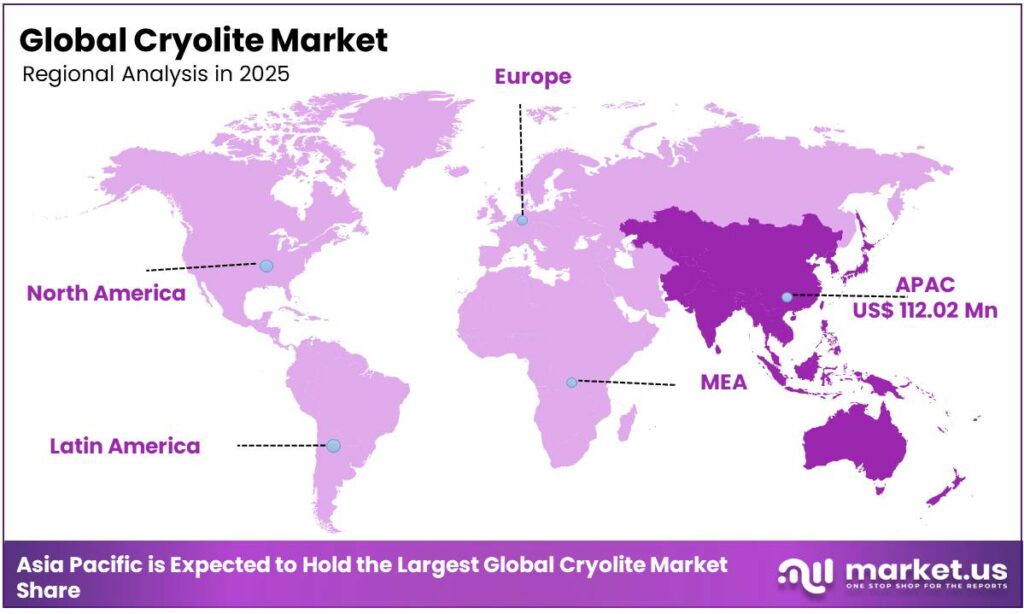
The Global Cryolite Market is expected to be worth around USD 404.3 Million by 2035, up from USD 250.6 Million in 2025, at a CAGR of 4.9% from 2026 to 2035. The Asia Pacific segment maintained 44.7%, supporting a Cryolite value of USD 112.2 Mn.
Cryolite, known as ice stone due to its translucent and frosty appearance, is a rare halide mineral primarily composed of sodium aluminum fluoride. It has a refractive index of 1.338, which is nearly identical to that of water, 1.333. In addition, it is soft and measures 2.5 to 3 on the Mohs scale. The market is primarily driven by its essential role in aluminum smelting, where it acts as a fluxing agent to lower the melting point of alumina and improve energy efficiency in the electrolytic reduction process.
- According to the United States Geological Survey (USGS), in 2024, the total global smelter aluminum production reached approximately 72 million tons, with China producing about 59.7% of the total global production.
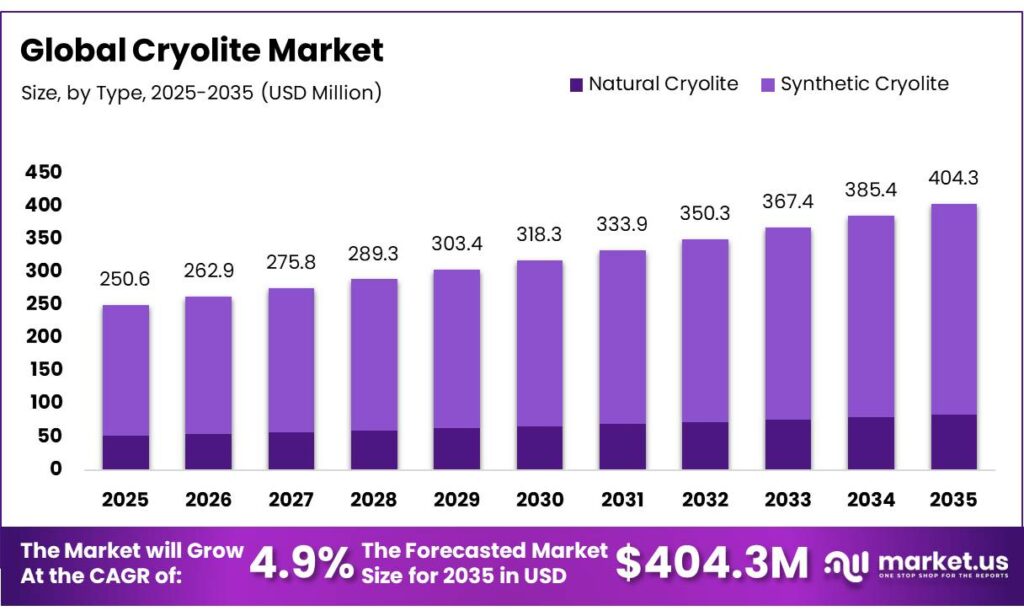
Asia Pacific dominates the global market, with China leading in aluminum production, which significantly influences cryolite demand. Synthetic cryolite has become the preferred choice due to the limited availability of natural cryolite, which is mainly found in Greenland. Synthetic cryolite offers a more consistent supply, tailored for specific industrial needs, and is less constrained by geographic and environmental challenges.
- According to the International Aluminum Institute (IAI), the Asia Pacific accounted for around 69% of the total global aluminum production in 2025, with China alone producing 44.2 million metric tons of aluminum.
While other applications, such as abrasives, metal surface treatments, and glass production, use cryolite, these sectors consume a much smaller share compared to aluminum smelting. Geopolitical tensions and supply chain disruptions further influence the market, as manufacturers face challenges in securing raw materials and ensuring stable production. The cryolite market remains heavily tied to the aluminum industry.
Key Takeaways
- The global cryolite market was valued at USD 250.6 million in 2024.
- The global cryolite market is projected to grow at a CAGR of 4.9% and is estimated to reach USD 404.3 million by 2034.
- On the basis of type, synthetic cryolite dominated the market, constituting 79.2% of the total market share.
- Based on the forms of the cryolite, powdered cryolite led the market, comprising 52.5% of the total market.
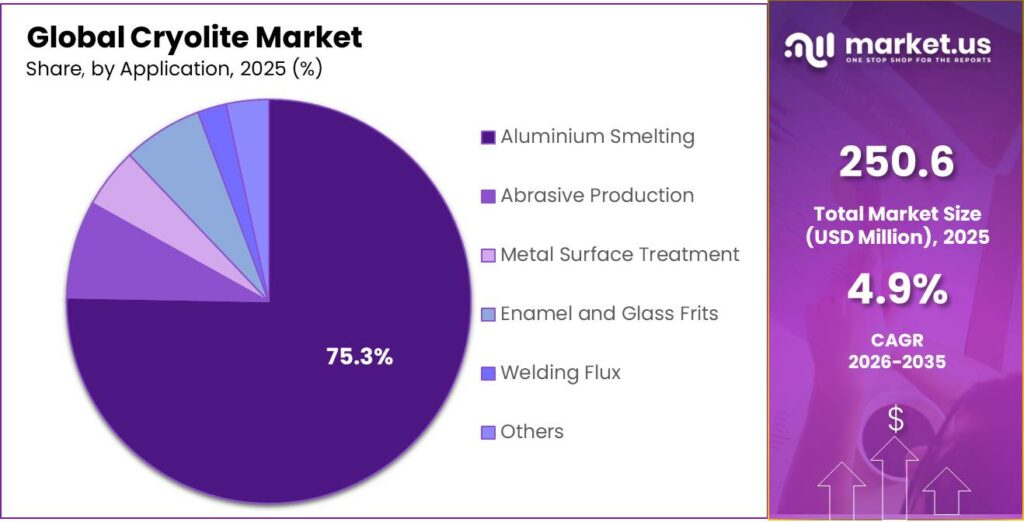
- Among the applications of the cryolite, the aluminum smelting industry is the most considerable application of the chemical, accounting for around 75.3% of the revenue.
- In 2024, the Asia Pacific was the most dominant region in the cryolite market, accounting for 44.7% of the total global consumption.
Type Analysis
Synthetic Cryolite is a Prominent Segment in the Market.
The market is segmented based on the type of cryolite into natural cryolite and synthetic cryolite. The synthetic cryolite led the market, comprising 79.2% of the market share, primarily due to the limited availability of natural deposits, which are concentrated in only a few regions, such as Greenland.
The environmental and regulatory challenges surrounding the mining of natural cryolite further restrict its supply. In contrast, synthetic cryolite, produced from sodium aluminate and aluminum fluoride, offers a more consistent and controllable supply, which is crucial for industries reliant on a steady flow of raw materials.
Additionally, synthetic cryolite can be tailored to specific industrial needs, such as aluminum smelting, where different grades may be required. Its production process, while energy-intensive, is not constrained by the scarcity and geographical limitations of natural sources, making it a more reliable and adaptable option for manufacturers.
Form Analysis
Powdered Cryolite Dominated the Market.
On the basis of form, the cryolite market is segmented into powder, granular, and sandy. The powdered cryolite dominated the market, comprising 52.5% of the market share, primarily due to its superior dissolution properties. The finer particle size of powdered cryolite allows it to dissolve more quickly and uniformly in the electrolytic reduction process during aluminum smelting. This enhances its effectiveness as a fluxing agent, lowering the melting point of alumina more efficiently and improving energy consumption.
Additionally, the finer particles ensure better dispersion in the molten bath, facilitating more consistent reactions and smoother operation in industrial processes. In contrast, granular or sandy forms dissolve more slowly and may not provide the same level of efficiency or control, making powdered cryolite the preferred choice for precision and cost-effectiveness in aluminum production.
Application Analysis
Cryolite is Mostly Utilized in Aluminum Smelting.
Among the applications of the cryolite, 75.3% of the total global consumption of cryolite is in aluminum smelting, outperforming abrasive production, metal surface treatment, enamel and glass frits, welding flux, and others. It plays a crucial role in the electrolytic reduction of alumina to aluminum, a process that dominates the global demand for cryolite.
As a fluxing agent, cryolite lowers the melting point of alumina, improving energy efficiency and reducing the overall cost of aluminum production. The aluminum industry consumes the largest share of cryolite due to its massive scale and essential role in aluminum refining.
Other applications, such as abrasive production, metal surface treatment, enamel and glass frits, and welding flux, are relatively niche and require far smaller quantities of cryolite. While these uses are important, the high demand from the aluminum sector, where cryolite is integral to production, far outweighs its use in other industries.
Key Market Segments:
By Type
- Natural Cryolite
- Synthetic Cryolite
By Form
- Powder
- Granular
- Sandy
By Application
- Aluminum Smelting
- Abrasive Production
- Metal Surface Treatment
- Enamel and Glass Frits
- Welding Flux
- Others
Drivers
Aluminum Production Demand Drives the Cryolite Market.
The cryolite market is fundamentally linked to the primary aluminum industry, where it serves as a critical electrolyte in the Hall-Héroult smelting process. As aluminum oxide (alumina) has an extremely high melting point, above 2,000°C, cryolite is utilized as a flux to lower this threshold to approximately 950°C, significantly reducing the energy intensity of electrolysis.
Approximately 20 kilograms of cryolite are consumed for the production of a single ton of aluminum. The International Aluminium Institute (IAI) reports that global primary aluminum production of aluminum is about 70 million metric tons annually. This implies an industrial requirement of roughly 1.4 million tons of cryolite equivalent annually from the aluminum industry. Additionally, the demand for aluminum has steadily increased with industrial and infrastructural growth.
Cryolite, primarily sourced from Greenland and Chile, facilitates the process by lowering the melting point of alumina, enhancing energy efficiency in aluminum production. This dependence is further corroborated by aluminum producers such as Rio Tinto and Alcoa, who mention cryolite as a crucial input in their annual reports. Consequently, fluctuations in global aluminum production directly impact cryolite demand, especially as demand for aluminum grows in sectors such as automotive, construction, and electronics.
Restraints
Scarcity of Natural Deposits Leading to High-Cost Synthetic Production Poses a Significant Challenge to the Cryolite Market.
The scarcity of natural cryolite deposits presents a significant challenge for the cryolite market, driving the high cost of synthetic production. Natural cryolite is found predominantly in Greenland, where mining activities have been limited due to environmental and regulatory concerns. According to the U.S. Geological Survey (USGS), global commercial production of natural cryolite has been almost negligible in recent years.
Since the 1987 closure of the Ivittuut mine in Greenland, the world’s only natural commercial source, the market has mostly transitioned to synthetic cryolite. Consequently, industrial supply is now driven by the synthetic cryolite production, typically derived from sodium aluminate and aluminum fluoride, and has become increasingly prevalent. The method is more expensive due to the higher energy requirements and raw material costs associated with the synthesis process. The shift towards synthetic cryolite has contributed to rising input costs for aluminum producers.
Opportunity
Advanced Industrial Applications Create Opportunities in the Cryolite Market.
While aluminum electrolysis remains the primary consumer, synthetic cryolite serves as a specialized input in diverse high-performance sectors. These applications leverage its unique chemical stability, low refractive index, and fluxing properties. Cryolite has been increasingly utilized in applications such as ceramics, metallurgy, and glass production. For instance, cryolite is used in the manufacture of certain electronic components and as a yellow coloring agent in pyrotechnics due to its sodium content. Additionally, cryolite is employed in the production of certain specialty glass types, where it acts as a melting agent, particularly in low-temperature glass manufacturing.
Similarly, its utility is in the metallurgy of rare metals, including lithium extraction, where cryolite serves as an electrolyte to enhance processing efficiency. These applications are expanding as industries look for ways to optimize energy usage and improve production processes.
Trends
Dominance of Synthetic Cryolite.
The dominance of synthetic cryolite in the global market has been a notable trend, driven by limited natural reserves and the increasing demand from aluminum production. The synthetic cryolite now accounts for over 79% of global cryolite consumption. This shift is largely due to the depletion of natural cryolite deposits, with the only significant natural source being in Greenland, where mining activities face environmental constraints.
The synthetic cryolite, produced from sodium aluminate and aluminum fluoride, offers a more consistent supply and can be tailored to specific industrial needs. For instance, Alcoa and Rio Tinto noted the transition to synthetic cryolite, particularly in regions where natural resources are scarce or unfeasible to exploit. As natural deposits become less accessible, synthetic cryolite has become the preferred option due to its availability and adaptability, aligning with the growing demand for aluminum and other industrial applications.
Geopolitical Impact Analysis
Geopolitical Tensions Have Led to Severe Disruptions of the Supply Chains of Cryolite.
The geopolitical tensions have had a discernible impact on the cryolite market, particularly due to disruptions in supply chains and trade dynamics, particularly by destabilizing the fluorine supply chain. Natural cryolite is primarily sourced from Greenland and Chile. The recent geopolitical instability in the regions of the Kingdom of Denmark, where Greenland is located, poses risks to mining operations. Greenland’s political decisions around mining activities, influenced by environmental and autonomy concerns, directly affect cryolite availability.
Additionally, sanctions and trade restrictions, particularly between major economies such as the U.S. and China, can further complicate the international movement of raw materials, including cryolite. For instance, China, accounting for over 50% of global fluorspar production, had intensified domestic inspections, contributing to a 55% increase in its own mineral imports to sustain domestic synthetic output. This disrupts industries that rely on cryolite, such as aluminum production, which is highly sensitive to material price fluctuations. These geopolitical uncertainties have led to increased dependence on synthetic cryolite production, which, while stable, is costlier due to the energy-intensive processes required for its synthesis. Consequently, geopolitical tensions exacerbate supply risks and cost pressures within the cryolite market.
Regional Analysis
Asia Pacific Held the Largest Share of the Global Cryolite Market.
In 2024, the Asia Pacific dominated the global cryolite market, holding about 44.7% of the total global consumption, driven primarily by its substantial aluminum production capacity. Asia Pacific accounts for the majority of global aluminum production, with China alone responsible for more than half of global output. As cryolite is a crucial fluxing agent in aluminum smelting, this concentration of production directly fuels demand for the material.
The region’s dominance is further supported by large-scale aluminum smelting facilities in countries such as China, India, and Japan, where cryolite is essential for improving energy efficiency in the electrolytic reduction of alumina. The U.S. Geological Survey (USGS) identifies China and Vietnam as top global producers of fluorspar, the essential raw material for synthetic cryolite, with Asia Pacific producing 6.3 million metric tons.
Moreover, the U.S. Geological Survey (USGS) notes that China is the largest importer of cryolite, reflecting the region’s heavy reliance on the material. The growing industrialization and infrastructural expansion in the Asia Pacific further bolster cryolite demand, particularly in sectors such as automotive and construction, which increasingly require aluminum. This positions Asia Pacific as the key consumer in the global cryolite market.
Key Regions and Countries
- North America
- The US
- Canada
- Europe
- Germany
- France
- The UK
- Spain
- Italy
- Russia & CIS
- Rest of Europe
- APAC
- China
- Japan
- South Korea
- India
- ASEAN
- Rest of APAC
- Latin America
- Brazil
- Mexico
- Rest of Latin America
- Middle East & Africa
- GCC
- South Africa
- Rest of MEA
Key Players Analysis
Manufacturers of cryolite focus on securing stable and cost-effective raw material sources, especially in the face of limited natural deposits. Several manufacturers prioritize developing synthetic cryolite capabilities, which offer greater flexibility and consistent supply. Furthermore, they invest in improving the energy efficiency of production processes to reduce costs and address environmental concerns. Strengthening relationships with aluminum producers and other industrial clients through long-term contracts and customized solutions is emphasized to ensure steady demand. Additionally, expanding production capacities and diversifying into emerging markets further positions manufacturers for growth in an increasingly competitive global landscape.
The Major Players in The Industry
- Solvay
- Fluorsid
- B. Chemicals
- Sanyo Corporation of America
- Eclipse Metals Ltd.
- Henan Jinhe Industry Co., Ltd
- American Elements
- Harshil Industries
- Skyline Chemical Corporation
- Do-Fluoride New Energy Technology Co., Ltd.
- Other Key Players
Key Development
- In September 2025, Eclipse Metals announced that it had entered into a drilling services agreement to carry out a diamond core drilling program at its Ivigtût and Grønnedal rare earth and critical minerals sites located in southwest Greenland. Eclipse Metals’ Ivigtût Project islocated in southwestern Greenland and includes the Ivigtût Cryolite-Polymetallic Deposit and the GrønnedalREE Deposit.
Report Scope
Report Features Description Market Value (2024) US$250.6 Mn Forecast Revenue (2034) US$404.3 Mn CAGR (2025-2034) 4.9% Base Year for Estimation 2024 Historic Period 2020-2023 Forecast Period 2025-2034 Report Coverage Revenue Forecast, Market Dynamics, Competitive Landscape, Recent Developments Segments Covered By Type (Natural Cryolite and Synthetic Cryolite), By Form (Powder, Granular, and Sandy), By Application (Aluminum Smelting, Abrasive Production, Metal Surface Treatment, Enamel and Glass Frits, Welding Flux, and Others) Regional Analysis North America – The US & Canada; Europe – Germany, France, The UK, Spain, Italy, Russia & CIS, Rest of Europe; APAC– China, Japan, South Korea, India, ASEAN & Rest of APAC; Latin America– Brazil, Mexico & Rest of Latin America; Middle East & Africa– GCC, South Africa, & Rest of MEA Competitive Landscape Solvay, Fluorsid, S.B. Chemicals, Sanyo Corporation of America, Eclipse Metals Ltd., Henan Jinhe Industry Co., Ltd., American Elements, Harshil Industries, Skyline Chemical Corporation, Do-Fluoride New Energy Technology Co., Ltd., and Other Players. Customization Scope Customization for segments, region/country-level will be provided. Moreover, additional customization can be done based on the requirements. Purchase Options We have three licenses to opt for: Single User License, Multi-User License (Up to 5 Users), Corporate Use License (Unlimited Users and Printable PDF) 
-
-
- Solvay
- Fluorsid
- B. Chemicals
- Sanyo Corporation of America
- Eclipse Metals Ltd.
- Henan Jinhe Industry Co., Ltd
- American Elements
- Harshil Industries
- Skyline Chemical Corporation
- Do-Fluoride New Energy Technology Co., Ltd.
- Other Key Players
Our Clients

- 180296
- Mar 2026






