Report Overview
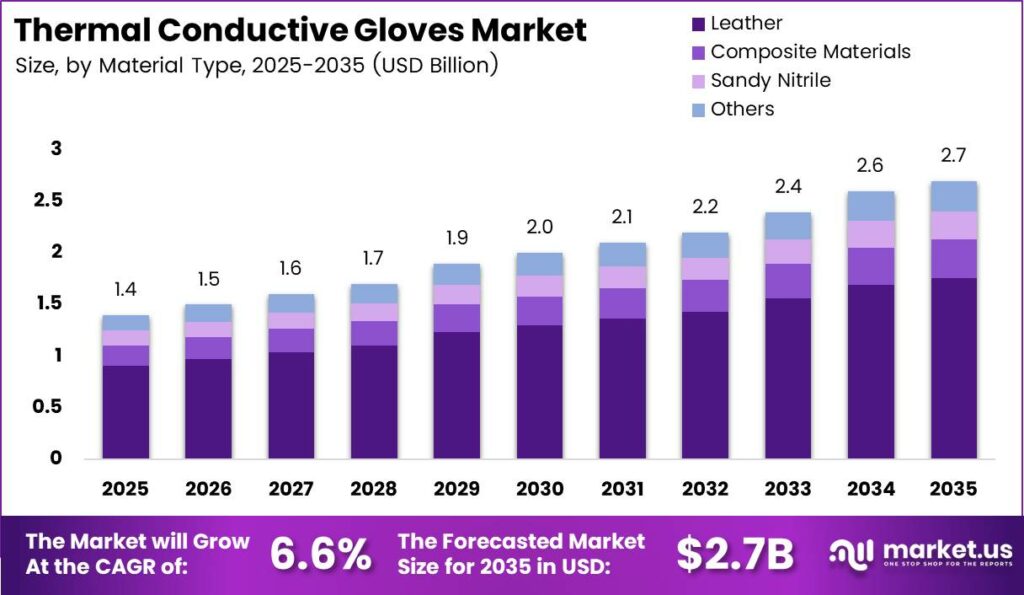
Global Thermal Conductive Gloves Market size is expected to be worth around USD 2.7 Billion by 2035 from USD 1.4 Billion in 2025, growing at a CAGR of 6.6% during the forecast period 2026 to 2035. This trajectory reflects steady industrial demand for certified hand protection across high-heat manufacturing environments worldwide.
Thermal conductive gloves are engineered hand protection products designed to shield workers from heat transfer during direct contact with hot objects, surfaces, and equipment. The market spans single-layer and double-layer para-aramid constructions, leather and composite material builds, and temperature-resistance grades covering both sub-100°C and above-100°C applications. End users range from steel and metal processing facilities to electronics manufacturers, food processors, and medical equipment handlers requiring reliable thermal barriers in daily operations.
Key Takeaways
- The Global Thermal Conductive Gloves Market is valued at USD 1.4 Billion in 2025 and is forecast to reach USD 2.7 Billion by 2035.
- The market grows at a CAGR of 6.6% during the forecast period 2026 to 2035.
- By Type, Double Layer Para Aramid Gloves dominate with a 61.23% share; Single Layer Para Aramid Gloves is the fastest-growing sub-segment.
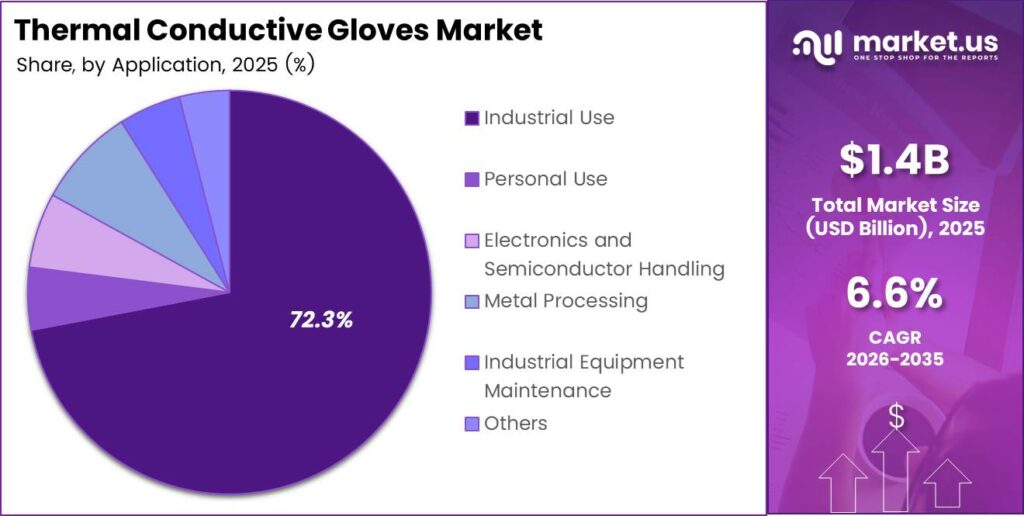
- By Application, Industrial Use holds the largest share at 72.34% and is also the fastest-growing application segment.
- By Material Type, Leather leads with 64.34% share; Composite Materials is the fastest-growing material sub-segment.
- By Temperature Resistance, the Up to 100 Degree category dominates with 73.45% share; Above 100 Degree is the fastest-growing tier.
- By Distribution Channel, Distributor/Retailers lead with 45.12% share; E-commerce is the fastest-growing channel.
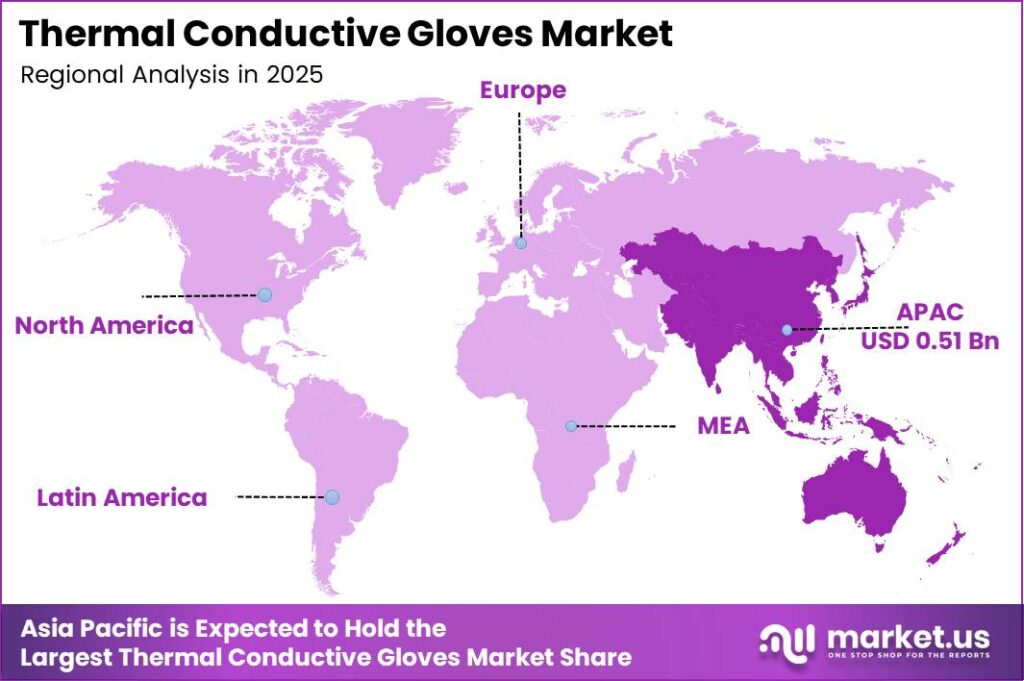
- Asia-Pacific dominates regionally with a 36.90% share valued at USD 0.51 Billion; Middle East & Africa is the fastest-growing region.
Governments across major industrial economies have tightened occupational safety mandates covering thermal-hazard hand protection in steel, electronics, and food processing sectors. Regulatory bodies in the United States require verified thermal protection compliance for workers exposed to contact-heat hazards, compelling procurement teams to replace informal glove sourcing with certified, specification-driven purchasing. This shift accelerates replacement cycles and raises average order values, creating a structural volume floor that benefits certified glove suppliers across all major distribution channels.
As per our research, India’s crude steel output rose by 10.4% between 2024 and 2025, reaching 164.9 million tonnes. This expansion adds casting, rolling, and maintenance shifts that require plant-level thermal glove replenishment contracts. Suppliers that align product qualification with Indian steelmaker procurement cycles gain early account penetration before broader regional competitors respond to the volume signal.
In May 2026, Ejendals introduced Product Environmental Footprints for selected safety gloves and footwear using life-cycle assessment calculations across more than 110 safety products. This initiative signals a measurable shift toward sustainability transparency in the protective glove category. Buyers in regulated procurement environments will increasingly require lifecycle disclosure as a supplier qualification criterion, giving early adopters a concrete differentiator over competitors still relying on product-only specifications.
Type Analysis
Double Layer Para Aramid Gloves dominate with 61.23% due to superior layered heat barrier construction.
In 2025, Double Layer Para Aramid Gloves held a dominant market position in the By Type segment of the Thermal Conductive Gloves Market, with a 61.23% share. Para-aramid fiber, commercially known as Kevlar, delivers a tensile strength of approximately 3,620 MPa, according to DuPont material specifications, making double-layer constructions the default choice for high-intensity thermal and cut-hazard environments. Industrial buyers in steel, metal processing, and automotive sectors specify double-layer builds for compliance with EN 407 contact-heat performance thresholds. This dominant share signals that procurement decisions favor verified multi-hazard protection over lower-cost single-layer alternatives, giving suppliers with double-layer product depth a clear pricing and contract renewal advantage.
Single Layer Para Aramid Gloves serve applications requiring thermal protection with reduced bulk, including electrical maintenance, light fabrication, and precision assembly tasks. The ILO estimates that 374 million occupational injuries and work-related illnesses occur globally each year, with hand injuries representing a disproportionate share of reportable incidents, according to ILO Safety and Health at Work data. This injury burden sustains demand for lighter protective glove tiers in workplaces where dexterity and speed remain operational priorities. Single Layer Para Aramid Gloves are the fastest-growing sub-segment, as cost-sensitive buyers in emerging industrial regions adopt entry-level certified thermal protection for the first time, expanding the addressable unit base beyond established double-layer strongholds.
In September 2025, Ejendals launched TEGERA 261 Heated Liner Gloves, using battery-powered heating to deliver consistent warmth for professionals working in extreme cold while maintaining comfort and flexibility. This product category expansion illustrates how glove manufacturers are extending thermal management beyond passive heat resistance into active thermal regulation, targeting workers in outdoor and refrigerated environments. The commercial implication is a broadening of the Type segment’s revenue base, as heated liner configurations command premium price points and generate recurring battery and accessory revenue alongside initial glove sales.
Application Analysis
Industrial Use dominates with 72.34% due to mandatory thermal hand protection compliance requirements.
In 2025, Industrial Use held a dominant market position in the By Application segment of the Thermal Conductive Gloves Market, with a 72.34% share. The World Steel Association reported that global steel production employed approximately 6 million workers directly in 2024, each requiring compliant thermal hand protection during casting, rolling, and maintenance operations. Industrial Use is also the fastest-growing application segment, driven by expanding steelmaking capacity in South Asia and tightening occupational safety enforcement across regulated manufacturing markets. Suppliers that secure plant-level replenishment contracts in industrial accounts capture recurring volume that individual retail or personal-use channels cannot replicate.
Electronics and Semiconductor Handling represents a technically demanding sub-segment where workers manage wafer carriers, soldering equipment, and reflow oven components at controlled temperatures. The Semiconductor Industry Association reported that global semiconductor industry revenue reached USD 627 billion in 2024, reflecting a production base that requires cleanroom-compatible thermal gloves across hundreds of fabrication facilities worldwide. This revenue scale signals substantial and stable glove consumption in semiconductor manufacturing, where product contamination risk makes specification compliance non-negotiable and substitution with unqualified alternatives commercially unacceptable.
Metal Processing and Industrial Equipment Maintenance account for high-frequency glove replacement volumes because direct contact with hot metals, welding spatter, and heated tooling degrades glove integrity faster than intermittent-use applications. The European Agency for Safety and Health at Work identifies hand and finger injuries as among the most frequent workplace injury categories in manufacturing, reinforcing the replacement-purchase cycle that sustains distributor inventory investment in this sub-segment. Food Processing and Baking, Personal Use, and other remaining applications collectively hold the balance of market share, serving lower-intensity thermal tasks where cost per unit and regulatory compliance requirements differ materially from heavy industrial specifications.
Material Type Analysis
Leather dominates with 64.34% due to proven heat resistance and abrasion durability.
In 2025, Leather held a dominant market position in the By Material Type segment of the Thermal Conductive Gloves Market, with a 64.34% share. The Food and Agriculture Organization of the United Nations reported global cattle inventories of approximately 1 billion head in its most recent livestock data, sustaining a raw leather supply base that keeps material costs structurally lower than engineered synthetic alternatives. Leather’s natural thermal resistance, grip retention, and abrasion durability make it the default specification for welding, metal processing, and general industrial applications where workers balance protection performance with unit cost. Buyers in price-sensitive procurement environments default to leather because its performance profile is well understood, qualification cycles are short, and replacement sourcing is straightforward across global distributor networks.
Composite Materials represent the fastest-growing material sub-segment, combining para-aramid, fiberglass, and polymer layers to deliver multi-hazard protection profiles that leather alone cannot achieve. ASTM International maintains active standards for composite protective material performance, including ASTM F2413 for protective footwear and related hand-protection test frameworks, reflecting institutional recognition of composite construction in industrial safety applications. This standards infrastructure lowers the qualification barrier for composite glove products in regulated procurement environments. Buyers upgrading from leather to composite constructions accept a higher unit price in exchange for documented performance improvements across heat, cut, and chemical exposure categories, raising average revenue per unit for suppliers investing in composite product lines.
Sandy Nitrile and other remaining material types serve niche applications requiring chemical resistance alongside thermal protection, including certain food processing and pharmaceutical handling tasks. The WHO’s global occupational health framework identifies chemical and thermal combined hazards as a priority protection category in manufacturing, supporting demand for hybrid-material gloves in environments where both risk types are present. These sub-segments collectively hold the balance of material share and serve specialized end-user needs that leather and composite mainstream products do not fully address, creating defensible niche positions for focused material specialists.
Temperature Resistant Analysis
Up to 100 Degree dominates with 73.45% due to broad light-industrial and food-sector applicability.
In 2025, Up to 100 Degree held a dominant market position in the By Temperature Resistant segment of the Thermal Conductive Gloves Market, with a 73.45% share. The ILO estimates that more than 2 billion workers globally operate in informal or semi-formal industrial settings where sub-100°C thermal contact is the dominant heat-exposure profile, according to ILO World Employment and Social Outlook data. This broad worker base sustains demand for entry-level and mid-range thermal gloves that address everyday heat hazards in food processing, baking, light fabrication, and general maintenance tasks. The sub-100°C category’s dominance reflects volume rather than premium value, meaning suppliers competing here must manage cost efficiency and distribution reach as primary competitive levers.
Above 100 Degree gloves are the fastest-growing temperature-resistance tier, driven by expanding steelmaking, glass processing, and high-temperature electronics manufacturing capacity in Asia and the Middle East. EN 407 testing protocols evaluate contact-heat protection at 100°C, 250°C, 350°C, and 500°C thresholds, creating a standardized performance ladder that procurement teams in regulated markets use directly in product specifications. This testing framework accelerates product qualification for above-100°C certified gloves because buyers can compare verified performance levels without conducting independent facility testing. Suppliers that achieve top-tier EN 407 ratings gain access to steel, foundry, and glass contracts where thermal performance thresholds are written into purchase orders as non-negotiable minimum criteria.
Distribution Channel Analysis
Distributor/Retailers dominate with 45.12% due to established industrial procurement network reach.
In 2025, Distributor/Retailers held a dominant market position in the By Distribution Channel segment of the Thermal Conductive Gloves Market, with a 45.12% share. The Industrial Distribution Association reported that the US industrial distribution sector generated revenues exceeding USD 200 billion annually, serving manufacturing, construction, and maintenance customers that rely on distributor networks for product availability, technical support, and consolidated invoicing. This infrastructure gives distributor/retailer channels a structural advantage in industrial glove procurement, where buyers prioritize supply continuity and account management over the lowest available unit price. Suppliers that build deep distributor relationships and provide product training programs lock in preferred-vendor status that is difficult for direct-channel or e-commerce competitors to displace in the short term.
E-commerce is the fastest-growing distribution channel for thermal conductive gloves, reflecting the shift by small and mid-size industrial buyers toward online procurement platforms for maintenance, repair, and operations supplies. The OECD Digital Economy Outlook reported that B2B e-commerce penetration in industrial supplies categories continued to advance across OECD economies through 2024, with mobile and platform-based purchasing accelerating in markets where traditional distributor coverage is thinner. This penetration trend creates a commercial opening for glove brands that invest in digital product content, certification documentation, and fulfillment speed on major industrial e-commerce platforms. Direct Sales accounts for the remaining channel share, serving large industrial accounts that negotiate volume contracts directly with glove manufacturers and bypass distributor margin structures entirely.
Key Market Segments
By Type
- Single Layer Para Aramid Gloves
- Double Layer Para Aramid Gloves
By Application
- Industrial Use
- Personal Use
- Electronics and Semiconductor Handling
- Metal Processing
- Industrial Equipment Maintenance
- Food Processing and Baking
- Others
By Material Type
- Leather
- Composite Materials
- Sandy Nitrile
- Others
By Temperature Resistant
- Up to 100 Degree
- Above 100 Degree
By Distribution Channel
- Distributor/Retailers
- E-commerce
- Direct Sales
Regional Analysis
Asia-Pacific Dominates the Thermal Conductive Gloves Market with a Market Share of 36.90%, Valued at USD 0.51 Billion
Asia-Pacific holds the largest regional share of the Thermal Conductive Gloves Market, driven by the region’s concentration of steel, electronics, and metal processing manufacturing capacity. China, Japan, South Korea, and India collectively account for the largest share of global industrial output, sustaining consistent demand for certified thermal hand protection at both the plant and distributor level. Procurement volumes in this region benefit from dense manufacturing clusters where per-facility glove consumption is high and replacement cycles are short due to intensive operational shifts across steel casting, semiconductor fabrication, and automotive assembly environments.
Middle East & Africa is the fastest-growing region in the Thermal Conductive Gloves Market, supported by ongoing industrial diversification programs across Gulf Cooperation Council economies. Saudi Arabia’s Vision 2030 industrial strategy and the UAE’s advanced manufacturing push are expanding steel, petrochemical, and construction activity, each requiring compliant thermal hand protection at scale. In December 2025, uvex announced the HexArmor Helix 3004IMP, 3013IMP, and 3014IMP protective gloves with ANSI/ISEA 138 Impact Protection Level 2, reflecting growing supplier investment in certified industrial hand protection products suited to the region’s expanding heavy-industry base. Early market entrants that establish distributor relationships and product certifications aligned to regional regulatory frameworks will secure first-mover advantages before the market reaches the competitive density seen in established Asia-Pacific and European accounts.
North America and Europe represent mature but structurally stable regional markets, sustained by stringent occupational safety enforcement, mandatory certification requirements, and well-established distributor networks. These regions generate consistent replacement demand from steel, automotive, food processing, and healthcare sectors where thermal glove compliance is a regulatory baseline rather than a discretionary purchase. Latin America holds a smaller but developing share, with Brazil and Mexico serving as the primary demand centers as industrial safety regulation enforcement tightens and multinational manufacturers standardize global hand-protection specifications across their regional facility networks.
Key Regions and Countries
North America
- US
- Canada
Europe
- Germany
- France
- The UK
- Spain
- Italy
- Rest of Europe
Asia Pacific
- China
- Japan
- South Korea
- India
- Australia
- Rest of APAC
Latin America
- Brazil
- Mexico
- Rest of Latin America
Middle East and Africa
- GCC
- South Africa
- Rest of MEA
Market Dynamics
Market Opportunity Analysis - Underserved industrial segments and emerging regions offer entry points for focused glove suppliers
Single Layer Para Aramid Gloves represent an underexploited entry point in markets where cost-sensitive buyers are adopting certified thermal protection for the first time. This sub-segment holds the smaller share within the By Type structure, yet its fastest-growing classification signals that first-time buyers in emerging industrial regions are moving from uncertified alternatives toward specification-compliant products. Suppliers that price single-layer para-aramid constructions competitively and support them with distributor-level technical training will capture first-purchase accounts before premium double-layer competitors reposition their value propositions downward to defend volume.
The Above 100 Degree temperature-resistance tier commands premium price points yet remains the smaller share category within the By Temperature Resistant segment. This gap reflects under-penetration in high-temperature steel, glass, and foundry applications in Middle East & Africa, where industrial capacity is expanding but certified high-heat glove availability through local distributor networks remains limited. Suppliers that establish EN 407 high-performance certified products within regional distribution ahead of local regulatory enforcement cycles will control preferred-vendor positioning before the competitive field catches up.
E-commerce is the fastest-growing distribution channel yet holds a smaller combined share than Distributor/Retailers, indicating that digital procurement penetration across small and mid-size industrial buyers is still in early stages. This creates a concrete channel investment opportunity for glove brands that build comprehensive product content, certification documentation, and fast fulfillment capabilities on industrial e-commerce platforms before channel leaders lock in preferred positioning. The commercial return on early e-commerce investment compounds as small-account acquisition costs decline relative to the traditional distributor-supported field sales model.
Composite Materials represent the fastest-growing material sub-segment but account for a minority share against Leather’s 64.34% dominance. This gap signals an upgrade cycle that is beginning but has not yet reached mainstream industrial procurement. New entrants with composite-construction expertise can position products as the certified performance upgrade for buyers already familiar with leather glove specifications, using documented EN 407 performance differentials to justify the premium price tier and convert specification-loyal leather accounts one facility contract at a time.
Technology and Innovation Landscape - Conductive heating materials and battery integration redefine thermal glove performance boundaries
A 2025 Nature Communications study demonstrated that a conductive cotton heating glove maintained an average temperature of 50.10°C during repeated hand clenching and unclenching, operating at an average heating power of 498.02 mW with a power variation of only 2.36%. This consistency across dynamic movement conditions is a commercially significant threshold because it confirms that conductive textile heaters can maintain stable thermal output during realistic work tasks rather than only under static laboratory conditions. Manufacturers that replicate this performance architecture in production-scale constructions will differentiate active-heating glove lines from passive-insulation products on measurable performance criteria rather than material claims alone.
The same 2025 Nature Communications research reported that the conductive textile heater component maintained an average temperature of 49.98°C at 470 mW while bent to a radius of 1 mm, confirming structural resilience under mechanical stress relevant to industrial grip and handling tasks. A separate study published in Advanced Materials Interfaces in October 2025 reported that functionalized gloves incorporating inkjet-printed textile heating conductors heated a water-filled body to 37°C in a proof-of-concept demonstration. These parallel research directions signal converging material and printing technology pathways that will enable thinner, more flexible active-heating constructions suited to precision industrial and medical applications where current battery-heated glove bulk remains a functional constraint.
Commercial battery specifications set the practical performance ceiling for heated glove products available to industrial and consumer buyers today. ORORO’s December 2025 battery guide specifies capacities of 2,000 mAh for its B22A glove battery and 2,200 mAh for its B25A, both rated at 7.4 V / 2 A DC output. The B25A weighs 105 g and measures 3.15 × 2.30 × 0.67 inches, with a safe charging-temperature range of 0 to 45°C and a manufacturer recommendation to recharge stored batteries every 6 months. These specifications define current energy density constraints that product engineers must work within when designing heated gloves for shift-length industrial wear applications.
Venture Heat’s 2026-listed heated motorcycle glove liner specification illustrates the power architecture used in vehicle-connected thermal glove products, drawing 1.2 A per pair on the high heating setting from a 12 V vehicle electrical system and consuming 14.4 W per pair at maximum output. This vehicle-power architecture removes battery capacity constraints entirely, enabling sustained high-output thermal performance across full shift durations in stationary or vehicle-mounted industrial roles. Suppliers serving logistics, mining, and construction equipment operators can apply this power delivery model to purpose-built industrial heated glove systems that outperform standalone battery products on heat output duration without requiring mid-shift battery swaps.
Drivers
India’s crude steel production climbed from 149.4 million tonnes in 2024 to 164.9 million tonnes in 2025, adding casting, rolling, and maintenance operations that require verified thermal hand protection at scale. This expansion supports a commercial shift toward plant-level replenishment contracts and task-specific product qualification, moving procurement away from isolated spot purchases. Suppliers that align their product portfolios with Indian steelmaker requirements gain account footholds before established regional competitors recognize the volume signal and respond with competing proposals.
Mandatory thermal-hazard hand protection regulations in the United States and other regulated industrial markets impose certified compliance as a procurement baseline rather than an optional upgrade. Wear-triggered replacement purchasing sustains a recurring consumption floor that is independent of new facility openings or capacity expansions. Combined heat-and-cut protection purchasing in Europe, North America, and industrial Asia raises average transaction values, because buyers consolidate multi-hazard glove specifications into single sourcing decisions. Established hospital hot-instrument handling in developed healthcare systems adds a stable, specification-driven demand stream outside the core industrial channel, broadening the addressable customer base for certified thermal glove suppliers.
| Driver | (~) % Impact on CAGR Forecast | Geographic Relevance | Impact Timeline |
|---|---|---|---|
| Indian steelmaking expansion | +0.55% | India; South Asian supply chains | Short term (≤ 2 years) |
| Mandatory thermal-hazard hand protection | +0.40% | United States; regulated industrial markets | Short term (≤ 2 years) |
| Wear-triggered replacement purchasing | +0.30% | Global industrial users | Short term (≤ 2 years) |
| Combined heat-and-cut protection purchasing | +0.25% | Europe; North America; industrial Asia | Medium term (2–4 years) |
| Established hospital hot-instrument handling | +0.15% | North America; developed healthcare systems | Short term (≤ 2 years) |
Restraints
Global crude steel production declined by 2.0% in 2025 according to Worldsteel data, with China’s output falling by 4.4% to 960.8 million tonnes. This contraction eliminates operating shifts and hot-handling tasks in affected facilities, directly reducing addressable glove consumption rather than merely complicating supply execution. Suppliers exposed to contracting steel regions face smaller replenishment orders and weaker manufacturing utilization, creating margin pressure that regional account diversification must offset before indiscriminate discounting further erodes product positioning.
Application-specific qualification rejection removes competing products from consideration at the point of facility audit, preventing suppliers without full specification compliance from accessing regulated industrial accounts. Premium-product procurement budget ceilings constrain average selling prices in price-sensitive markets where safety managers approve certified products but purchasing teams override specifications on cost grounds. Mechanized hot-object handling substitution in highly automated manufacturing clusters reduces per-worker glove consumption over a medium-term horizon. Serviceable-glove inventory overhang at distributors and intermittent-use industrial sites delays fresh purchasing cycles, limiting near-term replenishment velocity across the channel.
| Restraint | (~) % Impact on CAGR Forecast | Geographic Relevance | Impact Timeline |
|---|---|---|---|
| Steel-sector production contraction outside India | −0.30% | China; internationally exposed steel suppliers | Short term (≤ 2 years) |
| Application-specific qualification rejection | −0.20% | Regulated industrial markets | Short term (≤ 2 years) |
| Premium-product procurement budget ceilings | −0.17% | Price-sensitive industrial markets | Short term (≤ 2 years) |
| Mechanized hot-object handling substitution | −0.13% | Highly automated manufacturing clusters | Medium term (2–4 years) |
| Serviceable-glove inventory overhang | −0.10% | Distributors; intermittent-use industrial sites | Short term (≤ 2 years) |
Challenges
Thermal protection and manual dexterity impose competing design requirements across the glove category. UK Health and Safety Executive glove-selection guidance explicitly recognizes that thicker constructions improve heat resistance but can impair fine handling. An illustrative engineering sensitivity shows that increasing a manual task cycle from 60 seconds to 63 seconds raises cycle time by 5% and reduces theoretical hourly throughput by approximately 4.8%, potentially outweighing a modest purchase-price advantage. This tradeoff slows product adoption in precision and maintenance applications, where task performance is measured against throughput targets alongside safety compliance.
Batch thermal performance variability across multilayer glove manufacturing creates inconsistent protection levels within a single product run, complicating specification compliance for buyers whose procurement terms require uniform performance across all units delivered. Specialty yarn sourcing concentration in import-dependent manufacturing clusters exposes suppliers to supply disruption risk when para-aramid and composite fiber procurement is bottlenecked through a limited number of qualified suppliers. Fragmented sizing inventory requirements at multisite employers and international distributors raise working capital costs and increase stockout risk. Application engineering talent gaps in emerging industrial regions slow product qualification at the facility level, delaying new account conversion and extending sales cycles for technically complex glove categories.
| Challenge | (~) % CAGR Friction Drag | Geographic Relevance | Mitigation Horizon |
|---|---|---|---|
| Thermal protection dexterity tradeoff | −0.25% | Global precision and maintenance applications | Medium term (2–4 years) |
| Batch thermal performance variability | −0.14% | Global multilayer glove manufacturing | Medium term (2–4 years) |
| Specialty yarn sourcing concentration | −0.11% | Import-dependent manufacturing clusters | Medium term (2–4 years) |
| Fragmented sizing inventory requirements | −0.08% | Multisite employers; international distributors | Short term (≤ 2 years) |
| Application engineering talent gaps | −0.07% | Emerging industrial regions | Medium term (2–4 years) |
Opportunities
A validated glove lifecycle service model combining manufacturer-approved cleaning, inspection, traceability, and scheduled replenishment would monetize lifecycle management rather than relying exclusively on replacement-pair sales. An illustrative unit-economic scenario assumes validated care extends usable service life by 20% while adding 8% to lifecycle cost, reducing cost per protected use by approximately 10%. A proposed commercial threshold of 5 to 8% customer savings alongside 2 to 3 percentage-point supplier gross-margin expansion illustrates the revenue model, conditional on route density, service utilization, and failure rates.
Sensor-enabled thermal exposure analytics embedded in gloves would give industrial safety managers real-time data on worker heat exposure, shift utilization, and glove degradation rates, converting a consumable product into a managed safety asset. Cleanroom-compatible hot-tool handling represents a growing revenue stream in East Asia, North America, and Europe, where semiconductor and electronics manufacturers require contamination-free thermal protection that standard industrial gloves cannot provide. Private-label channel partnerships in underserved regional industrial markets allow global glove manufacturers to access distribution relationships without building direct sales infrastructure. Specialist converter consolidation across fragmented regional manufacturing bases creates acquisition pathways for scale-seeking suppliers targeting long-term capacity and certification advantages.
| Opportunity | (~) % Potential CAGR Upside | Geographic Relevance | Execution Window |
|---|---|---|---|
| Validated glove lifecycle services | +0.35% | North America; Europe; large industrial campuses | Medium term (2–4 years) |
| Sensor-enabled thermal exposure analytics | +0.25% | Digitally mature industrial markets | Long term (≥ 4 years) |
| Cleanroom-compatible hot-tool handling | +0.20% | East Asia; North America; Europe | Medium term (2–4 years) |
| Private-label channel partnerships | +0.17% | Underserved regional industrial channels | Medium term (2–4 years) |
| Specialist converter consolidation | +0.13% | Fragmented regional manufacturing bases | Long term (≥ 4 years) |
Key Company Insights
Protective Industrial Products completed the acquisition of Honeywell’s Personal Protective Equipment business for USD 1.325 billion in an all-cash transaction in May 2025. This acquisition expands PIP’s certified product portfolio and distribution reach across North American and international industrial accounts simultaneously. The integration of Honeywell’s PPE brand equity and established customer relationships positions PIP to compete for large enterprise thermal glove contracts that smaller specialist suppliers cannot serve at comparable scale or certification depth.
uvex group announced an agreement in July 2025 under which Warburg Pincus would acquire a majority interest, with the Winter and Grau families retaining a significant minority stake. This ownership transition injects institutional capital into a group that includes uvex safety and HexArmor, two brands with certified thermal and impact protection product lines. The transaction signals an intent to accelerate growth through product expansion, geographic market entry, or further acquisition, creating a better-capitalized competitor in the industrial protective glove category across regulated markets in Europe and North America.
Key Players
- SAVIOR HEAT
- DAY WOLF
- SNOW DEER
- Gobi Heat
- Outdoor Research
- Seirus
- Hestra
- ActionHeat
- Lenz
- Warmthru
- Other Key Players
Recent Developments
- March 2025: Ejendals launched TEGERA Arc Flash gloves for professionals working in electrical and other environments exposed to arc-flash hazards, expanding its specialist protective-glove portfolio.
- September 2025: Ejendals introduced the TEGERA SubZero Collection of winter gloves for professionals working long shifts in extreme cold, focusing on thermal protection, ergonomics, and sustainable materials.
- October 2025: Ejendals launched the TEGERA Cold Supply Collection for freezer storage, refrigerated transport, and cold-room work. The range included the 6143 finger glove with 40 g Thinsulate insulation, the 6145 mitten with 60 g Thinsulate, and the 6147 index-finger mitten incorporating Calothan palm material for insulation when handling cold surfaces.
- November 2025: Ejendals announced five new TEGERA welding-glove models including 7788 and 5126 for TIG welding, and 7787, 7789, and 5127 for MIG welding. The Kevlar-reinforced TEGERA 7787 received the DuPont Kevlar Innovation Award 2025 for protective performance including resistance to heat, sparks, and sharp edges.
- October 2026: Aceppe Technology announced the US launch of AceppePro TIG welding gloves on Amazon, coinciding with the grant of its US trademark. The gloves feature leather palms and backs, DuPont Kevlar stitching, a seamless forefinger, and an extended 13 cm cuff for protection against spatter and radiant heat.
Geopolitical Impact Analysis
Trade policy shifts and tariff escalation are reshaping raw material cost structures for thermal conductive glove manufacturers that depend on para-aramid fiber and specialty yarn imports. According to WTO data, average applied tariff rates on technical textiles and industrial fiber inputs have risen across multiple trading pairs since 2023, with some bilateral schedules reaching 15 to 25% on intermediate goods. These input cost increases compress margins for manufacturers in import-dependent clusters, forcing procurement teams to qualify alternative fiber suppliers or absorb cost increases that reduce competitiveness against locally supplied products in price-sensitive industrial markets.
Logistics disruption in key maritime corridors has extended lead times and raised freight costs for glove components and finished goods moving between Asia and Western industrial markets. The World Shipping Council reported that container shipping rates on major Asia-Europe and transpacific lanes remained elevated through 2025 relative to pre-disruption baselines, adding meaningful per-unit logistics cost to products with low weight-to-value ratios such as industrial gloves. As a result, regional sourcing and nearshore manufacturing are gaining commercial relevance as buyers in North America and Europe seek to reduce supply-chain exposure to geopolitical transit risk, creating an opening for suppliers with manufacturing or distribution footprints within or adjacent to their target end markets.
Report Scope
| Report Features | Description |
|---|---|
| Market Value (2025) | USD 1.4 Billion |
| Forecast Revenue (2035) | USD 2.7 Billion |
| CAGR (2026-2035) | 6.6% |
| Base Year for Estimation | 2025 |
| Historic Period | 2020-2024 |
| Forecast Period | 2026-2035 |
| Report Coverage | Revenue Forecast, Market Dynamics, Market Opportunity Analysis, Technology and Innovation Landscape, Competitive Landscape, Recent Developments |
| Segments Covered | By Type (Single Layer Para Aramid Gloves, Double Layer Para Aramid Gloves), By Application (Industrial Use, Personal Use, Electronics and Semiconductor Handling, Metal Processing, Industrial Equipment Maintenance, Food Processing and Baking, Others), By Material Type (Leather, Composite Materials, Sandy Nitrile, Others), By Temperature Resistant (Up to 100 Degree, Above 100 Degree), By Distribution Channel (Distributor/Retailers, E-commerce, Direct Sales) |
| Regional Analysis | North America (US and Canada), Europe (Germany, France, The UK, Spain, Italy, and Rest of Europe), Asia Pacific (China, Japan, South Korea, India, Australia, and Rest of APAC), Latin America (Brazil, Mexico, and Rest of Latin America), Middle East and Africa (GCC, South Africa, and Rest of MEA) |
| Competitive Landscape | SAVIOR HEAT, DAY WOLF, SNOW DEER, Gobi Heat, Outdoor Research, Seirus, Hestra, ActionHeat, Lenz, Warmthru, Other Key Players |
| Customization Scope | Customization for segments, region / country-level will be provided. Additional customization can be done based on requirements. |
| Purchase Options | We have three licenses to opt for: Single User License | Multi-User License (Up to 5 Users) | Corporate Use License (Unlimited User and Printable PDF) |