


Global Solar Freezer Market Size, Share, Growth Analysis By Type (Solar Battery Based, Solar Direct Drive), By Capacity (Less than 250 Liter, 250–500 Liter, Above 500 Liter), By Application (Hospitals & Blood Bank, Pharmacies & Vaccine, Commercial, Others), By Region and Companies - Industry Segment Outlook, Market Assessment, Competition Scenario, Statistics, Trends and Forecast 2025-2034
- Published date: Jan 2026
- Report ID: 172951
- Number of Pages: 388
- Format:
-
keyboard_arrow_up
Quick Navigation
Report Overview
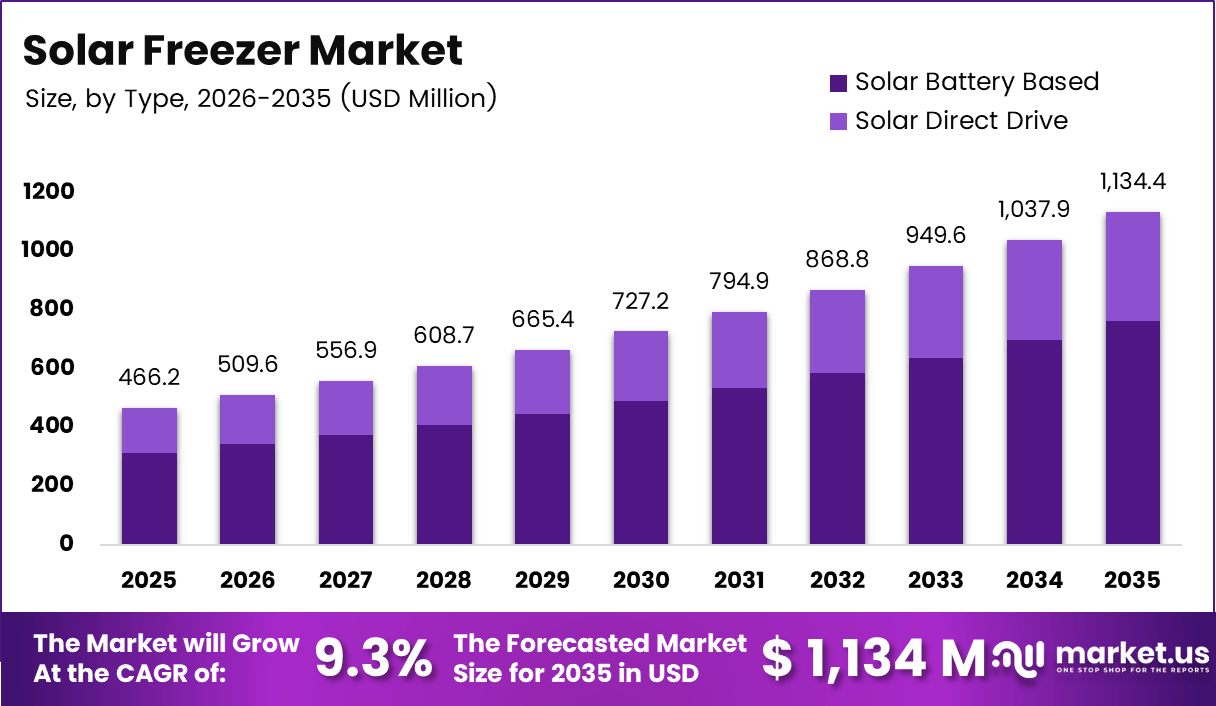
The Global Solar Freezer Market size is expected to be worth around USD 1,134 million by 2035, from USD 466.2 Million in 2025, growing at a CAGR of 9.3% during the forecast period from 2026 to 2035.
The Solar Freezer Market refers to the commercial ecosystem of solar powered refrigeration and freezing systems designed for off grid and weak grid environments. These systems support vaccine storage, blood banks, food preservation, and medical cold chains. Consequently, demand rises where electricity access remains unreliable yet temperature sensitive storage remains mission critical.
From an analyst viewpoint, solar freezers represent a convergence of renewable energy, cold chain logistics, and public health infrastructure. Moreover, adoption accelerates as organizations prioritize energy independent refrigeration solutions. Therefore, purchasing decisions increasingly balance lifecycle cost, thermal reliability, and compliance with healthcare storage regulations.
Market growth remains strongly linked to rural healthcare expansion, immunization programs, and decentralized food distribution networks. Additionally, solar freezer demand aligns with sustainability targets and emissions reduction goals. As a result, procurement increasingly shifts toward direct drive and DC powered freezer technologies supporting long duration autonomy.
Government investment plays a defining role in market scalability across emerging economies. Multilateral agencies and national ministries allocate funding for solar cold storage under healthcare resilience and climate adaptation programs. Furthermore, regulatory frameworks increasingly mandate temperature controlled storage for vaccines, blood, and biological samples, reinforcing long term demand stability.
Opportunities expand as solar freezer applications diversify beyond healthcare into fisheries, dairy, retail, and agricultural aggregation points. Meanwhile, falling solar module costs improve affordability for small enterprises. Consequently, solar freezer manufacturers focus on modular capacity designs, faster pull down performance, and improved insulation for extreme climate resilience.
According to manufacturer technical specifications, advanced DC solar freezer systems operate on 12 or 24Vdc, enabling flexible system design and future expansion. These systems deliver high performance storage within compact footprints, supporting households and businesses in solar rich regions with limited grid access.
According to product performance data, 100L solar freezer units achieve refrigeration below 8°C in under 20 minutes and freezing to 0°C within 1 hour. Moreover, built in energy storage of 1600 Whr sustains cooling for up to 40 hours during blackouts or low sunlight conditions.
According to laboratory and field testing reports, high efficiency systems using 225W compressors maintain temperature precision of 0.5°C and perform reliably up to 43°C ambient conditions. Importantly, these systems demonstrate 2x faster cooling autonomy compared to conventional solar refrigeration, strengthening value propositions across healthcare and commercial cold storage segments.
Key Takeaways
- The global Solar Freezer Market is projected to reach USD 1,134 million by 2035, growing from USD 466.2 million in 2025 at a CAGR of 9.3%.
- Solar Battery Based systems dominate the market by type with a 67.2% share, driven by extended cooling autonomy in off-grid environments.
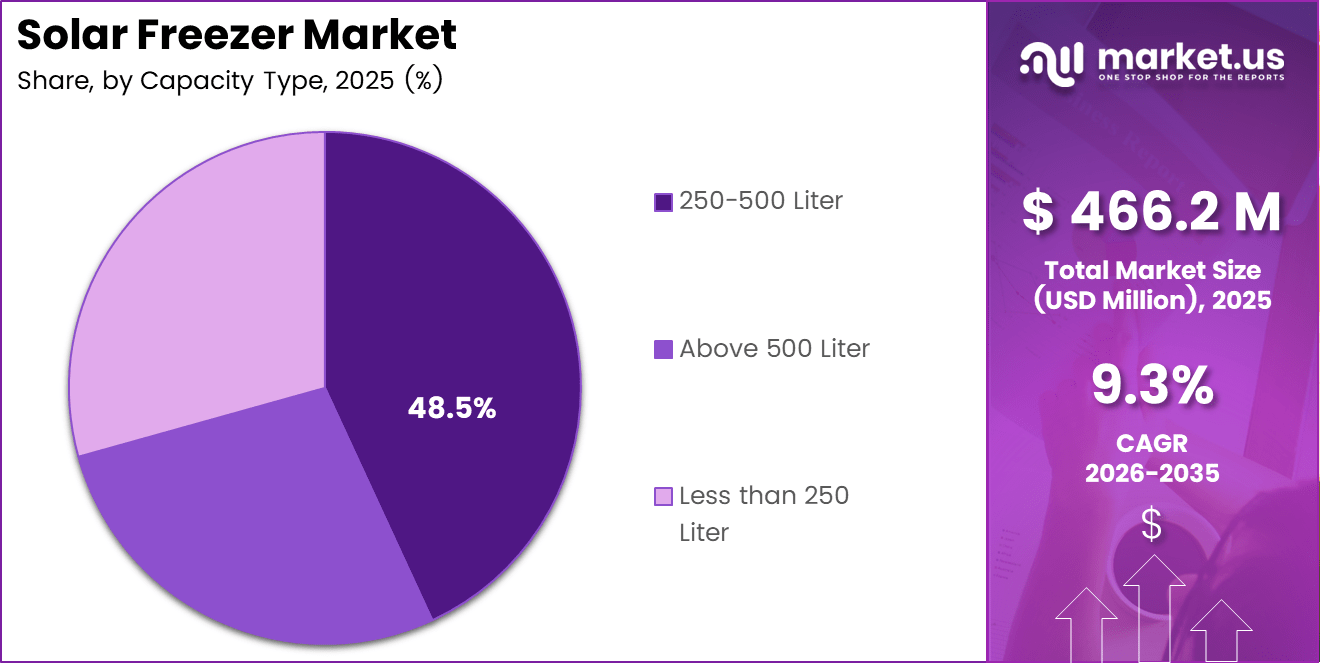
- The 250–500 Liter capacity segment leads with a 48.5% share, reflecting strong adoption across healthcare and small commercial storage applications.
- Hospitals & Blood Bank account for the largest application share at 49.6%, supported by strict medical cold-chain compliance requirements.
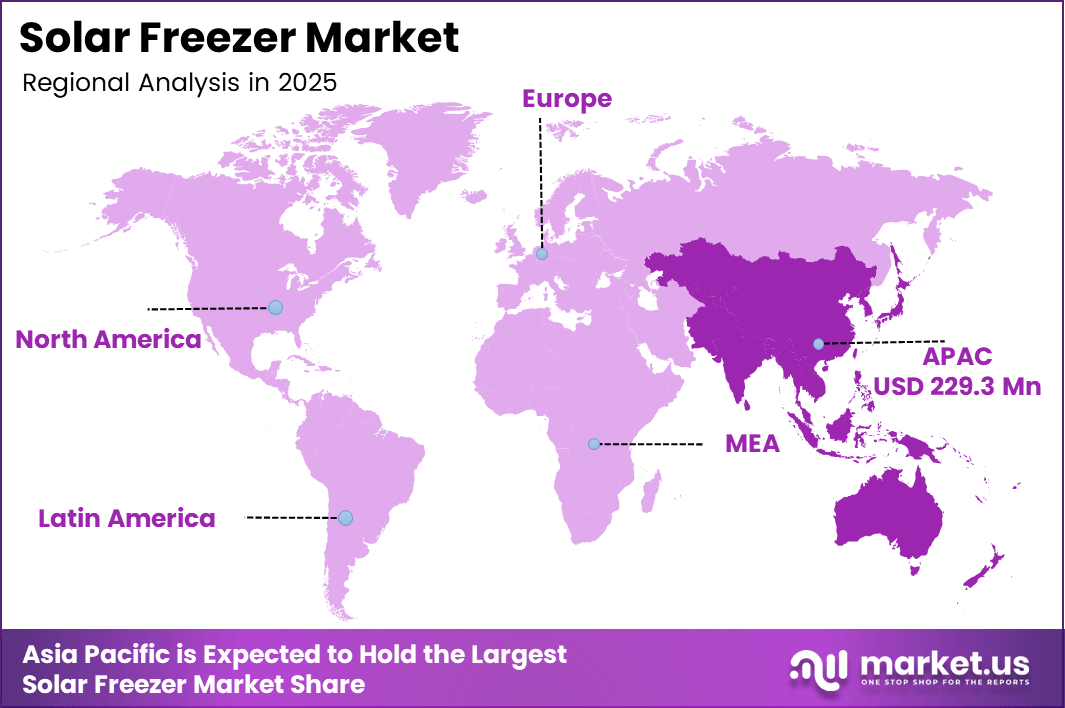
- Asia Pacific leads regionally with a 49.2% market share, valued at USD 229.3 million, backed by rural healthcare expansion and high solar potential.
- Performance benchmarks show 100L solar freezers cooling below 8°C in 20 minutes and sustaining up to 40 hours using 1600 Whr energy storage.
By Type Analysis
Solar Battery Based dominates with 67.2% due to its flexibility in off-grid energy storage and extended cooling autonomy.
In 2025, Solar Battery Based held a dominant market position in the By Type Analysis segment of the Solar Freezer Market, with a 67.2% share. This dominance reflects strong demand from healthcare and commercial users requiring uninterrupted cooling despite inconsistent sunlight availability. Battery integration supports night-time operation and cloudy-day reliability.
Solar Battery Based systems appeal to buyers seeking scalable installations. Moreover, these systems allow future capacity expansion and hybrid energy configurations. Therefore, procurement agencies and institutions prefer battery-backed solutions for mission-critical cold storage, particularly in regions with unstable solar irradiation patterns.
In contrast, Solar Direct Drive systems address cost sensitivity and maintenance simplicity. These systems operate without batteries, relying on real-time solar input. Consequently, adoption remains concentrated in high-sunlight regions where daily temperature control suffices without overnight storage requirements.
Solar Direct Drive continues gaining traction in agricultural and small retail applications. However, performance dependency on daylight restricts use in healthcare settings. As a result, this sub-segment complements rather than challenges the leadership of battery-based solar freezer systems.
By Capacity Analysis
250–500 Liter dominates with 48.5% as it balances storage volume, energy efficiency, and deployment versatility.
In 2025, the 250–500 Liter segment held a dominant market position in the By Capacity Analysis of the Solar Freezer Market, with a 48.5% share. This capacity range aligns with healthcare centers, pharmacies, and small commercial users managing moderate cold storage volumes efficiently.
250–500 Liter solar freezers deliver optimal trade-offs between footprint, power consumption, and operational autonomy. Moreover, buyers favor this segment due to easier transportation and installation in remote areas. Consequently, public health programs widely specify this capacity range in procurement tenders.
Less than 250 Liter units serve households, small clinics, and mobile health units. These compact systems emphasize portability and lower upfront investment. However, limited volume restricts suitability for centralized storage, which moderates their overall market contribution.
Above 500 Liter systems target large hospitals, blood banks, and commercial cold storage hubs. While offering high throughput, these units require higher solar capacity and space. Therefore, adoption remains selective, supporting specialized use cases rather than mass deployment.
By Application Analysis
Hospitals & Blood Bank dominates with 49.6% driven by strict temperature compliance and critical cold chain requirements.
In 2025, Hospitals & Blood Bank held a dominant market position in the By Application Analysis of the Solar Freezer Market, with a 49.6% share. This leadership stems from mandatory cold storage standards for blood, plasma, and medical supplies across public healthcare systems.
Hospitals and blood banks prioritize reliability, redundancy, and regulatory compliance. As a result, solar freezers increasingly integrate into backup and primary cold chain infrastructure, especially in regions facing frequent power disruptions and rising healthcare coverage mandates.
Pharmacies & Vaccine applications represent steady demand, driven by immunization programs and decentralized medicine distribution. Solar freezers support last-mile vaccine storage in rural and semi-urban locations. However, smaller storage volumes limit their overall share compared to hospital deployments.
Commercial and Other applications include food retail, fisheries, agriculture, and humanitarian storage. These segments benefit from solar refrigeration cost savings and sustainability goals. Nevertheless, variable temperature tolerance and diverse use cases result in fragmented demand patterns across non-medical applications.
Key Market Segments
By Type
- Solar Battery Based
- Solar Direct Drive
By Capacity
- Less than 250 Liter
- 250–500 Liter
- Above 500 Liter
By Application
- Hospitals & Blood Bank
- Pharmacies & Vaccine
- Commercial
- Others
Drivers
Expansion of Off-Grid Healthcare Infrastructure Drives Solar Freezer Market Growth
The expansion of off-grid healthcare infrastructure across rural and semi-urban regions remains a primary driver of the Solar Freezer Market. Many clinics operate in areas with unreliable electricity, making solar-powered cold storage essential for daily operations. As healthcare access expands, dependable refrigeration becomes a basic requirement.
Increasing immunization and blood storage needs further strengthen demand in low-electrification zones. Vaccines, blood units, and temperature-sensitive medicines require stable cooling conditions to maintain efficacy. Solar freezers enable healthcare providers to meet medical storage standards without depending on grid availability.
Rising dependence on renewable-powered cold chain systems also supports last-mile delivery models. Solar freezers help preserve medical and pharmaceutical supplies during transport and storage in remote areas. This reliability improves healthcare outreach and reduces wastage across distribution networks.
Government and multilateral funding support accelerates adoption through public health and sustainability programs. Development agencies prioritize solar-based refrigeration to strengthen healthcare resilience. As a result, funding-backed deployments continue to drive consistent market expansion.
Restraints
High Upfront Investment Challenges Limit Wider Solar Freezer Adoption
High upfront capital costs remain a key restraint for the Solar Freezer Market. Solar panels, batteries, compressors, and controllers increase initial investment compared to conventional freezers. Budget constraints often delay purchasing decisions for small clinics and businesses.
Limited availability of skilled technicians affects installation and maintenance quality. In remote regions, trained service personnel remain scarce, increasing downtime risks. This challenge raises concerns about long-term reliability and operational continuity.
Performance variability due to inconsistent solar irradiation also impacts adoption. Regions with seasonal sunlight fluctuations experience uneven cooling performance. Buyers often hesitate where weather conditions reduce system efficiency.
Battery lifecycle management presents additional cost pressure. Replacement and disposal expenses increase total ownership costs over time. These financial uncertainties restrict broader penetration, especially among price-sensitive end users.
Growth Factors
International Aid Programs Create New Growth Opportunities for Solar Freezers
Scaling deployment through international aid programs presents major growth opportunities. Humanitarian tenders increasingly specify solar freezers to support healthcare, disaster response, and nutrition programs. These initiatives expand large-scale procurement volumes.
Integration into agricultural and fisheries cold storage networks further diversifies applications. Solar freezers help preserve produce, dairy, and seafood at aggregation points. This reduces spoilage and improves income stability for rural producers.
Growing adoption by small clinics and pharmacies in remote locations strengthens decentralized demand. Solar freezers enable safe medicine storage where grid power remains unreliable. This trend supports steady expansion beyond large institutional buyers..
Emerging Trends
Shift Toward Direct-Drive Technology Shapes Solar Freezer Market Trends
The shift toward direct-drive solar freezer systems represents a key market trend. These systems eliminate battery dependency, reducing maintenance complexity and lifecycle costs. Buyers favor simpler designs with fewer replacement components.
Adoption of IoT-enabled temperature monitoring improves operational transparency. Remote diagnostics help users track performance and prevent temperature excursions. This trend enhances reliability, especially for medical storage applications.
Increasing use of eco-friendly refrigerants aligns with global climate norms. Manufacturers focus on low-global-warming-potential refrigerants to meet environmental regulations. Sustainability considerations increasingly influence purchasing decisions.
Customization of freezer capacities for vaccines, blood, and biological samples also gains traction. Tailored designs improve storage efficiency and compliance. These innovations collectively shape future Solar Freezer Market development.
Regional Analysis
Asia Pacific Dominates the Solar Freezer Market with a Market Share of 49.2%, Valued at USD 229.3 million
Asia Pacific represents the dominant region in the Solar Freezer Market, driven by large rural populations and limited grid connectivity. In this region, the market accounted for 49.2% share, reaching USD 229.3 million, supported by expanding healthcare access and cold-chain requirements. Governments increasingly prioritize solar refrigeration to support immunization, blood storage, and food preservation. Strong solar irradiance further supports large-scale deployment across healthcare and commercial applications.
North America Solar Freezer Market Trends
North America shows steady adoption of solar freezers, primarily across disaster preparedness, remote healthcare, and sustainability-driven applications. The region benefits from advanced renewable energy policies and growing interest in resilient cold storage solutions. Demand also increases from rural clinics and emergency response infrastructure. Technological innovation supports performance reliability in varied climatic conditions.
Europe Solar Freezer Market Trends
Europe’s Solar Freezer Market growth aligns with strict environmental regulations and low-emission cold storage initiatives. The region emphasizes eco-friendly refrigeration and energy-efficient systems. Solar freezers gain traction in healthcare outreach programs and agricultural storage. Policy-backed renewable adoption continues to support gradual market expansion.
Middle East and Africa Solar Freezer Market Trends
The Middle East and Africa region experiences rising demand due to weak grid infrastructure and extreme climate conditions. Solar freezers support vaccine storage, humanitarian aid, and food security initiatives. High solar potential improves system viability across remote areas. Public-sector investments play a key role in regional market development.
Latin America Solar Freezer Market Trends
Latin America demonstrates growing adoption of solar freezers across rural healthcare and agricultural supply chains. The market benefits from increasing focus on renewable energy and cold-chain modernization. Remote communities rely on solar refrigeration for medicine and food storage. Gradual infrastructure improvements support long-term demand growth.
U.S. Solar Freezer Market Trends
The U.S. Solar Freezer Market shows selective adoption focused on emergency preparedness, rural healthcare, and off-grid commercial use. Sustainability goals and resilience planning encourage solar refrigeration deployment. Demand also emerges from mobile clinics and remote research facilities. Technological advancements improve system efficiency and reliability.
Key Regions and Countries
North America
- US
- Canada
Europe
- Germany
- France
- The UK
- Spain
- Italy
- Rest of Europe
Asia Pacific
- China
- Japan
- South Korea
- India
- Australia
- Rest of APAC
Latin America
- Brazil
- Mexico
- Rest of Latin America
Middle East & Africa
- GCC
- South Africa
- Rest of MEA
Key Solar Freezer Company Insights
The global Solar Freezer Market in 2025 reflects a transition from pilot deployments toward scaled, application-driven adoption. Market momentum remains closely tied to healthcare cold chains, food preservation, and off-grid sustainability goals. Leading players increasingly differentiate through system reliability, thermal performance, and adaptability to harsh operating environments rather than price competition alone.
Amped Innovation positions itself around modular, energy-efficient solar refrigeration solutions tailored for off-grid communities. The company emphasizes system flexibility and resilience, aligning well with decentralized healthcare and rural commercial use cases. Its approach supports scalable deployments where infrastructure constraints remain significant.
B Medical Systems maintains strong relevance through a focus on medical-grade cold storage reliability. The company aligns closely with regulatory-driven demand from vaccine, blood, and pharmaceutical storage applications. Its emphasis on temperature stability and compliance strengthens trust among institutional buyers and public health programs.
Connexa Energy approaches the market through integrated solar energy and cooling solutions. The company’s strategy centers on combining power generation with refrigeration, addressing both energy access and cold storage gaps simultaneously. This integrated model supports long-term operational efficiency in remote and weak-grid regions.
Dometic brings experience from portable and off-grid cooling applications into the solar freezer segment. The company leverages design efficiency and durability to serve mobile, commercial, and remote-use scenarios. Its solutions resonate with users seeking compact yet reliable solar-powered freezing systems.
Collectively, these players illustrate how the Solar Freezer Market evolves beyond basic refrigeration into a specialized infrastructure solution. Their strategies highlight growing emphasis on reliability, lifecycle performance, and application-specific customization. As procurement increasingly favors proven operational outcomes, such positioning strengthens competitive standing.
Looking ahead, analyst expectations suggest that market leadership will depend on adaptability across healthcare, commercial, and humanitarian applications. Companies aligning solar freezer technology with real-world usage conditions remain best positioned to capture sustained demand growth through 2025 and beyond.
Top Key Players in the Market
- Amped Innovation
- B Medical Systems
- Connexa Energy
- Dometic
- DULAS
- ECOSOLARCOOL
- SUNDANZER
- Kyocera
- Steca
- UNIQUE APPLIANCES
- VESTFROST SOLUTIONS
Recent Developments
- In Dec 2025, the United Nations Development Programme (UNDP) published a tender in Burkina Faso, Africa, for the acquisition and installation of solar freezers aimed at supporting transmission groups and strengthening cold-chain infrastructure.
- In Jun 2026, the tender remains open as the final deadline for bid submission, targeting companies operating in solar installation, freezer manufacturing, and allied renewable cold-storage solutions.
Report Scope
Report Features Description Market Value (2025) USD 466.2 Million Forecast Revenue (2035) USD 1,134 million CAGR (2026-2035) 9.3% Base Year for Estimation 2025 Historic Period 2020-2024 Forecast Period 2026-2035 Report Coverage Revenue Forecast, Market Dynamics, Competitive Landscape, Recent Developments Segments Covered By Type (Solar Battery Based, Solar Direct Drive), By Capacity (Less than 250 Liter, 250–500 Liter, Above 500 Liter), By Application (Hospitals & Blood Bank, Pharmacies & Vaccine, Commercial, Others) Regional Analysis North America (US and Canada), Europe (Germany, France, The UK, Spain, Italy, and Rest of Europe), Asia Pacific (China, Japan, South Korea, India, Australia, and Rest of APAC), Latin America (Brazil, Mexico, and Rest of Latin America), Middle East & Africa (GCC, South Africa, and Rest of MEA) Competitive Landscape Amped Innovation, B Medical Systems, Connexa Energy, Dometic, DULAS, ECOSOLARCOOL, SUNDANZER, Kyocera, Steca, UNIQUE APPLIANCES, VESTFROST SOLUTIONS Customization Scope Customization for segments, region/country-level will be provided. Moreover, additional customization can be done based on the requirements. Purchase Options We have three licenses to opt for: Single User License, Multi-User License (Up to 5 Users), Corporate Use License (Unlimited User and Printable PDF) 
-
-
- Amped Innovation
- B Medical Systems
- Connexa Energy
- Dometic
- DULAS
- ECOSOLARCOOL
- SUNDANZER
- Kyocera
- Steca
- UNIQUE APPLIANCES
- VESTFROST SOLUTIONS
Our Clients

- 172951
- Jan 2026






