


Global Solar Control Glass Market By Type (Reflective, Selective, and Absorptive), By Coating Type (Hard Coat and Soft Coat), By Glazing Type (Single Glazing, Double Glazing, and Triple Glazing), By Installation (New Construction and Replacement), By End-Use (Building And Construction, Automotive, and Others), By Region and Companies - Industry Segment Outlook, Market Assessment, Competition Scenario, Trends and Forecast 2025-2034
- Published date: Feb 2026
- Report ID: 177374
- Number of Pages: 295
- Format:
-
keyboard_arrow_up
Quick Navigation
Report Overview
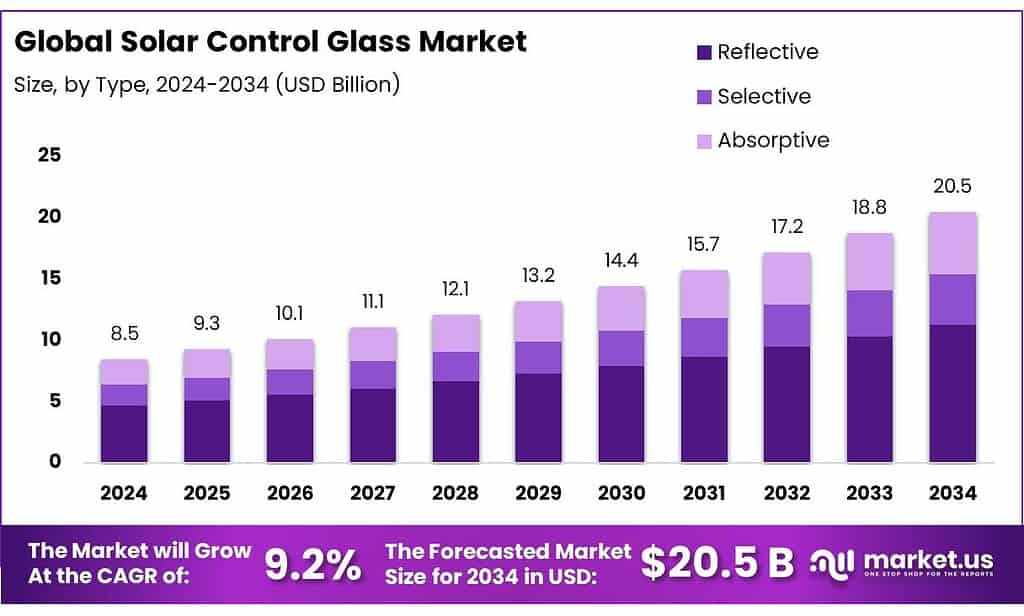
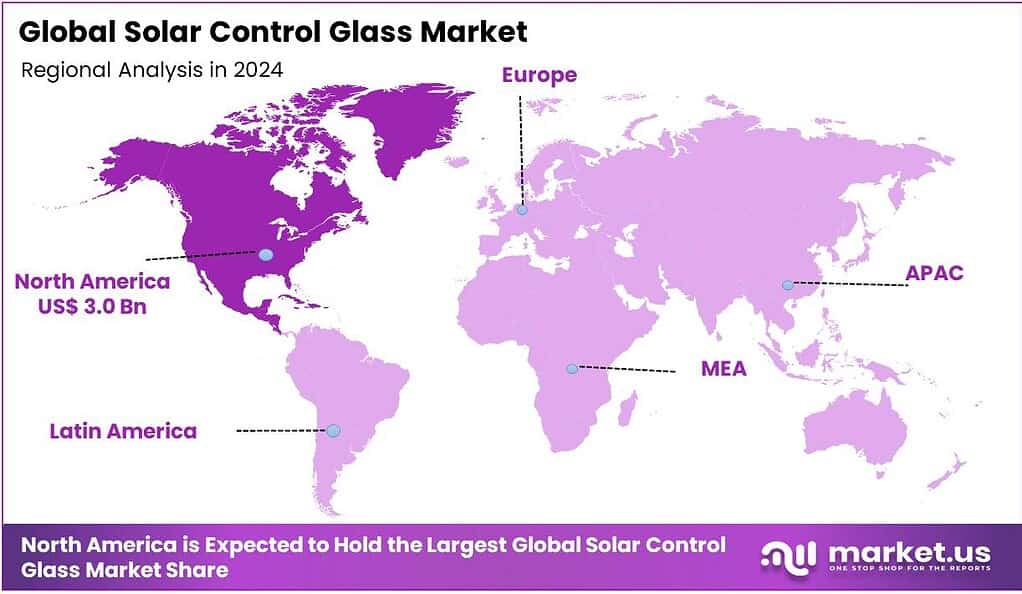
The Global Solar Control Glass Market is expected to be worth around USD 20.5 Billion by 2034, up from USD 8.5 Billion in 2024, and is projected to grow at a CAGR of 9.2% from 2025 to 2034. The North America segment maintained 35.8%, supporting a Solar Control Glass value of USD 3.0 Bn.
Solar control glass is a specialized type of glass designed to regulate the amount of heat and light that enters a building by using special coatings or tints that reflect, absorb, or selectively transmit solar radiation. Its market is primarily driven by the growing demand for energy-efficient buildings and automotive applications, with increasing emphasis on sustainability and regulatory compliance.
- According to the World Business Council for Sustainable Development (WBCSD), buildings account for 40% of global carbon emissions, over 30% of global energy consumption, and almost half of the world’s natural resources. It is crucial to shift the built environment towards net-zero emissions, healthy, and resilient, creating demand for energy-efficient products, such as solar control glass.
In the building and construction sector, solar control glass plays a critical role in reducing cooling loads, improving thermal comfort, and meeting energy codes such as LEED and Energy Star. Its reflective properties make it ideal for enhancing building performance, while soft-coated varieties offer better aesthetics and higher efficiency than hard-coated alternatives.
- Advanced glazing systems in internal combustion engine vehicles can lower the CO₂ emissions caused by the energy demand of mobile air-conditioning by about 8.5%, which translates into a reduction of roughly 1.2 gCO₂ per kilometer for an average light-duty vehicle.
Similarly, in automotive applications, solar control glass is valued for improving fuel efficiency and passenger comfort by reducing the reliance on air conditioning systems. However, it is predominantly used in new construction due to its cost-effectiveness and ease of integration. Despite its widespread adoption in buildings, the market is somewhat constrained in the automotive sector due to specific design limitations. This sector is expected to grow with advancements in electrochromic glass and smart glazing technologies.
- According to the National Renewable Energy Laboratory (NREL), the advanced glazed windshields can reduce front-seat temperatures by up to 15°C, or 27°F, and air-breathing temperatures by 9°C, or 16°F.
Key Takeaways
- The global solar control glass market was valued at USD 8.5 billion in 2024.
- The global solar control glass market is projected to grow at a CAGR of 9.2% and is estimated to reach USD 20.5 billion by 2034.
- On the basis of types of glass, reflective glass dominated the market, constituting 55.1% of the total market share.
- Based on the type of coating, soft coat dominated the solar control glass market, with a substantial market share of around 63.9%.
- Based on the type of glazing, double-glazed solar control glass led the market, comprising 56.3% of the total market.
- Among the installations, new constructions held a major share in the solar control glass market, 70.4% of the market share.
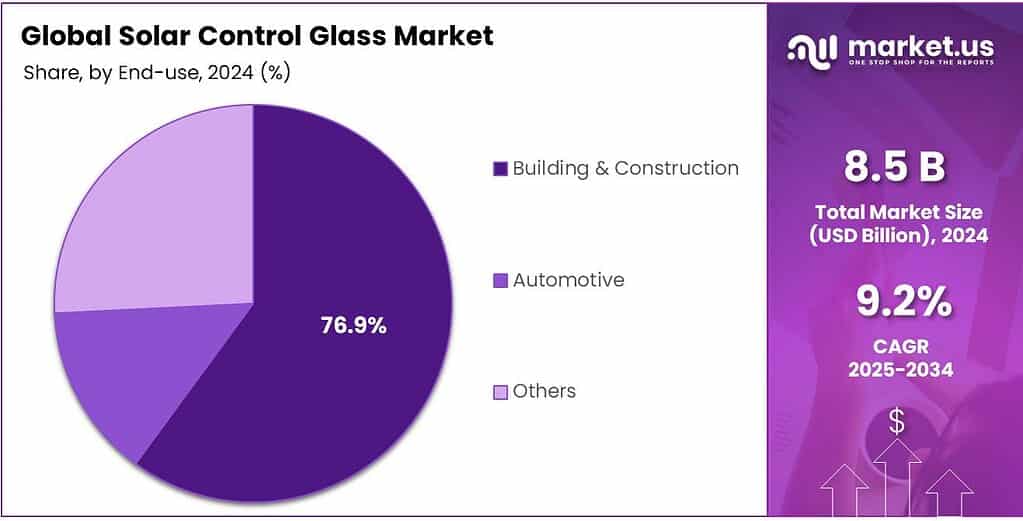
- Among the end-uses of the solar control glass, the building & construction industry is the most considerable end-use of the product, accounting for around 76.9% of the revenue.
- In 2024, North America was the most dominant region in the solar control glass market, accounting for 35.8% of the total global consumption.
Type Analysis
Reflective Glass is a Prominent Segment in the Market.
The market is segmented based on types of solar control glass into reflective, selective, and absorptive. The reflective glass led the market, comprising 55.1% of the market share, due to its superior efficiency in blocking solar heat while maintaining optical clarity. Reflective coatings reflect a significant portion of solar radiation, helping reduce cooling loads and energy consumption without compromising visibility. This makes reflective glass highly suitable for commercial buildings and automobiles, where both aesthetic appeal and energy performance are essential.
In contrast, selective glass often limits visible light transmission, and absorptive glass can absorb heat, leading to higher thermal stress and potential damage. Reflective glass offers a more durable and cost-effective solution, delivering high performance across a range of applications with fewer trade-offs in overall functionality.
Coating Type Analysis
Soft Coated Solar Control Glass Dominated the Market.
On the basis of the coating type, the solar control glass market is segmented into hard coat and soft coat. The soft-coated solar control glass dominated the market, comprising 63.9% of the market share, as it offers superior performance and aesthetic flexibility. Soft coatings are applied in a vacuum deposition process, creating a thin, precise layer that provides better solar heat rejection and higher optical clarity without compromising light transmission.
This makes soft-coated glass ideal for applications in high-performance buildings and automobiles where both energy efficiency and visual appeal are critical. In contrast, hard-coated glass tends to have a thicker, more visible layer that can negatively impact appearance and durability. Additionally, soft-coated glass generally allows for greater design flexibility, enabling architects and designers to meet strict building codes and energy standards without sacrificing style or performance.
Glazing Type Analysis
Double Glazed Solar Control Glass Are Most Widely Utilized.
The double-glazed solar control glass dominated the market, with a notable market share of 56.3%. Double-glazed solar control glass is more widely used than single or triple-glazed versions due to its optimal balance of performance, cost, and energy efficiency. It offers superior insulation compared to single glazing, reducing heat loss and improving thermal comfort while still maintaining good solar heat rejection and light transmission.
Additionally, double glazing provides effective sound insulation and can help meet energy efficiency standards without the higher costs and weight of triple glazing. While triple-glazed glass offers better insulation, it is often more expensive and may result in a bulkier design that is less suitable for certain applications. Double glazing strikes a practical compromise for residential and commercial buildings, delivering reliable performance at a more accessible price point.
Installation Analysis
New Constructions Held a Major Share of the Solar Control Glass Market.
Based on the installations, the solar control glass market is segmented into new construction and replacement. Among the installations, 70.4% of the solar control glass consumed globally is for new constructions. The retrofit costs can be high, as replacing existing windows with solar control glass often requires new glazing and adjustments to window frames and insulation systems, making it a more complex and expensive process.
However, in new builds, architects and developers can easily incorporate solar control glass as part of the initial design, ensuring seamless integration with other energy-efficient features. Additionally, building codes and green building standards often prioritize the use of high-performance glazing in new constructions, incentivizing the use of solar control glass from the outset.
End-Uses Analysis
Solar Control Glass Products Are Mostly Utilized in the Building & Construction Sector.
Among the end-uses of the solar control glass, 76.9% of the total global consumption of solar control glass is utilized in the building & construction sector, due to its higher demand for energy efficiency and building regulations. Buildings account for a large portion of global energy consumption, and solar control glass helps reduce cooling loads by minimizing solar heat gain while maintaining natural light.
In contrast, automotive and other applications face more specific, design-driven limitations in terms of glass size, shape, and integration. The larger surface areas of buildings make solar control glass a more practical and cost-effective solution for achieving energy efficiency. Moreover, building codes and sustainability standards further drive its widespread use in new construction and retrofits.
Key Market Segments
By Type
- Reflective
- Selective
- Absorptive
By Coating Type
- Hard Coat
- Soft Coat
By Glazing Type
- Single Glazing
- Double Glazing
- Triple Glazing
By Installation
- New Construction
- Replacement
By End-Use
- Building & Construction
- Residential
- Family Houses
- Apartments
- Commercial
- Office Buildings
- Retail Spaces
- Hospitality
- Healthcare
- Others
- Industrial
- Manufacturing
- Warehouse and Distribution
- Flex Space
- Residential
- Automotive
- Passenger Cars
- Commercial Vehicles
- Others
Drivers
Shift Towards Energy-Efficient Buildings Drives the Solar Control Glass Market.
Demand for solar control glass in the building sector is increasingly driven by the push towards energy-efficient buildings and stringent government carbon-emission regulations anchored in formal, primary policy frameworks. The buildings contribute a substantial share of energy use and emissions, necessitating regulatory responses that improve envelope performance.
In the United States and India, building energy codes such as ASHRAE 90.1 and India’s Energy Conservation Building Code (ECBC) set mandatory minimum energy performance standards for building envelopes and fenestration systems, implicitly promoting high-performance glazing with lower solar heat gain to reduce cooling loads.
Similarly, in the European Union, the Energy Performance of Buildings Directive mandates nearly-zero energy buildings for all new construction, with enhanced zero-emission buildings targets by 2030, reflecting explicit carbon-emission compliance objectives. The compliance with solar heat-gain control provisions can lead to dramatic reductions in electricity consumption and pollution emissions by lowering cooling demand. These policy-anchored energy and emission reduction requirements create measurable demand for solar control glazing solutions in new builds and major renovations.
Restraints
High Upfront Costs and Performance Limitations Pose Challenges to the Solar Control Glass Market.
Demand for solar control glass is constrained by high initial investment costs and performance limitations. High-performance glazing systems for solar control glass in building applications entail significant upfront expense due to specialized manufacturing processes. These variants utilize advanced deposition techniques, such as vacuum sputtering for thin-film metallic stacks, which require substantial capital expenditure for coating lines and inspection systems. Furthermore, raw materials and fuel power can account for up to 80% of total glass production costs.
Performance trade-offs are inherent in fenestration technologies, with solar heat gain coefficient (SHGC) and visible transmittance (VT) metrics varying across glazing types. Government energy standards and building code frameworks demonstrate that optimization of thermal performance often involves balancing competing criteria, which can limit design flexibility and occupant satisfaction when stringent solar control is paired with high daylight requirements. While solar control glass reduces cooling loads in summer, it can increase winter heating consumption by blocking beneficial solar thermal gains.
Opportunity
Adoption of Solar Control Glass in the Automotive Sector Creates Opportunities in the Solar Control Glass Market.
Rising adoption of solar control glass in the automotive sector is emerging as an opportunity tied to fuel efficiency and passenger comfort. Solar control glazing can substantially reduce vehicle interior heat gain, lowering reliance on air-conditioning (A/C) systems, which are known to account for 3-7% of fuel use in light-duty vehicles and up to 20% in hot and congested conditions.
The infrared-reflective glazing can lower interior temperatures and reject solar power, lowering cooling loads during both soak and driving conditions. Reduced cooling loads translate into significant improvements in fuel economy. For instance, in battery electric vehicles, advanced glazing systems can reduce energy consumption and extend driving range by approximately 3% to 9%, depending on the vehicle model.
Beyond energy use, solar control glass enhances thermal comfort by moderating cabin heat, reducing heat stress for occupants, and limiting material degradation due to UV and infrared exposure. These technical effects underline automotive solar control glass as an engineering lever for energy efficiency and occupant comfort in modern vehicles.
Trends
Shift Towards Electrochromic Smart Glass.
The shift towards electrochromic smart glass in the solar control glass market reflects growing demand for dynamic, energy-efficient solutions in buildings and automotive applications. Electrochromic glass changes its light transmittance and solar heat gain properties in response to electrical voltage, allowing for on-demand control of light and heat entering a space.
The electrochromic glass can achieve a visible light transmission (VLT) range from approximately 62% in its clear state to less than 1% when fully tinted, which leads to substantial energy reductions. Similarly, field evaluations by the U.S. General Services Administration (GSA) validated a 9% to 10% decrease in annual HVAC cooling electricity use compared to high-performance Low-E windows. Furthermore, by maximizing natural daylight when heat gain is low, electrochromic systems can reduce artificial lighting energy requirements by up to 60%.
Electrochromic glass’s growing appeal stems from its ability to maintain visual comfort while managing thermal loads. The occupants prefer smart windows in office environments, noting greater comfort and better light control. The electrochromic glass aligns with energy reduction targets and user experience enhancement, making it a key technology within the solar control glass.
Geopolitical Impact Analysis
Geopolitical Tensions Have Led to Increased Prices of Solar Control Glass.
The geopolitical tensions significantly impact the solar control glass market, particularly through disruptions in global supply chains, material costs, and policy shifts. For instance, the Russia–Ukraine conflict has led to increased prices for key materials used in glass production, such as rare earth metals and energy-intensive chemicals, due to sanctions and disrupted trade routes.
According to the European Commission’s Joint Research Centre (JRC), such disruptions can lead to material shortages that affect the construction and automotive industries, both of which are major end-users of solar control glass. Glass manufacturing is highly energy-intensive, with fuel and electricity representing up to 80% of total production costs. Geopolitical instability is baked into energy pricing, leading to persistent upward pressure on manufacturing expenses. For instance, energy price surges in Europe have prompted regulatory bodies such as the EU Commission to push for domestic sourcing of materials, including those used in glass production, to mitigate dependency on volatile regions.
Simultaneously, trade tensions have led to policy shifts that affect import/export tariffs, altering the availability of low-cost solar control glass products in various markets, especially in countries with trade dependencies. The U.S.-China trade conflict has had direct implications on supply chain efficiency and costs in North American and European markets. Such volatility emphasizes the role of geopolitical dynamics in shaping industry trends.
Regional Analysis
North America Held the Largest Share of the Global Solar Control Glass Market.
In 2024, North America dominated the global solar control glass market, holding about 35.8% of the total global consumption, driven by stringent building codes and increasing demand for energy-efficient solutions in residential and commercial sectors. The U.S. Department of Energy underscores that buildings in North America consume approximately 40% of total energy, with significant focus on reducing heating, ventilation, and air-conditioning (HVAC) loads.
The solar control glass plays a critical role in meeting energy efficiency goals, specifically through its ability to minimize solar heat gain while allowing natural light. The U.S. Green Building Council has highlighted that LEED-certified buildings often feature high-performance glazing, including solar control glass, to adhere to strict energy standards.
Moreover, the U.S. Energy Independence and Security Act has incentivized the use of advanced glazing technologies, bolstering demand in regions such as the Pacific Northwest and Northeast, where building energy codes are particularly stringent. These policies solidify North America’s leadership in adopting high-performance, solar-controlling glazing solutions.
Key Regions and Countries
- North America
- The US
- Canada
- Europe
- Germany
- France
- The UK
- Spain
- Italy
- Russia & CIS
- Rest of Europe
- APAC
- China
- Japan
- South Korea
- India
- ASEAN
- Rest of APAC
- Latin America
- Brazil
- Mexico
- Rest of Latin America
- Middle East & Africa
- GCC
- South Africa
- Rest of MEA
Key Players Analysis
Manufacturers of solar control glass invest in R&D to develop advanced materials and coatings that enhance performance, such as better solar heat rejection and light transmission balance. In addition, they focus on product differentiation, offering customized solutions for specific architectural and automotive requirements. Similarly, the companies adopt sustainability practices, aligning with green building codes and environmental standards such as LEED and Energy Star.
Furthermore, they strengthen supply chains with manufacturers focusing on local sourcing and reducing production costs. Moreover, strategic partnerships with architectural firms and automotive manufacturers are emphasized to secure long-term contracts and foster innovation tailored to specific customer needs.
The Major Players in The Industry
- AGC Group
- Saint-Gobain
- Guardian Industries Holdings
- Central Glass Co., Ltd.
- Cardinal Glass Industries Inc.
- CSG Holding Co., Ltd.
- Şişecam
- Xinyi Glass Holdings Limited
- Vitro
- Euroglas
- Schott AG
- Morley Glass & Glazing Ltd.
- Jinjing (Group) Co., Ltd.
- Asahi India Glass Ltd.
- Other Key Players
Key Development
- In June 2023, AGC broadened its solar control glass portfolio to address rising demand for highly neutral solar control glazing. AGC Glass Europe introduced three Stopray products designed to offer high selectivity, a neutral color aesthetic, and reduced reflectivity.
- In November 2025, Saint-Gobain Glass introduced COOL-LITE XTREME 51/23 and COOL-LITE XTREME 51/23 II as additions to its solar control portfolio. These high-performance, triple silver-coated glasses offer exceptional selectivity, enhanced processing versatility, and a neutral appearance suited to contemporary architectural design.
Report Scope
Report Features Description Market Value (2024) USD 8.5 Bn Forecast Revenue (2034) USD 20.5 Bn CAGR (2025-2034) 9.2% Base Year for Estimation 2024 Historic Period 2020-2023 Forecast Period 2025-2034 Report Coverage Revenue Forecast, Market Dynamics, Competitive Landscape, Recent Developments Segments Covered By Type (Reflective, Selective, and Absorptive), By Coating Type (Hard Coat and Soft Coat), By Glazing Type (Single Glazing, Double Glazing, and Triple Glazing), By Installation (New Construction and Replacement), By End-Use (Building & Construction, Automotive, and Others) Regional Analysis North America – The US & Canada; Europe – Germany, France, The UK, Spain, Italy, Russia & CIS, Rest of Europe; APAC– China, Japan, South Korea, India, ASEAN & Rest of APAC; Latin America– Brazil, Mexico & Rest of Latin America; Middle East & Africa– GCC, South Africa, & Rest of MEA Competitive Landscape AGC Group, Saint-Gobain, Guardian Industries Holdings, Central Glass Co., Ltd., Cardinal Glass Industries Inc., CSG Holding Co., Ltd., Şişecam, Xinyi Glass Holdings Limited, Vitro, Euroglas, Schott AG, Morley Glass & Glazing Ltd., Jinjing (Group) Co., Ltd., Asahi India Glass Ltd., and Other Players. Customization Scope Customization for segments, region/country-level will be provided. Moreover, additional customization can be done based on the requirements. Purchase Options We have three licenses to opt for: Single User License, Multi-User License (Up to 5 Users), Corporate Use License (Unlimited Users and Printable PDF) 
-
-
- AGC Group
- Saint-Gobain
- Guardian Industries Holdings
- Central Glass Co., Ltd.
- Cardinal Glass Industries Inc.
- CSG Holding Co., Ltd.
- Şişecam
- Xinyi Glass Holdings Limited
- Vitro
- Euroglas
- Schott AG
- Morley Glass & Glazing Ltd.
- Jinjing (Group) Co., Ltd.
- Asahi India Glass Ltd.
- Other Key Players
Our Clients

- 177374
- Feb 2026






