


Global Smart Textile Market Size, Share, Growth Analysis By Type (Passive, Active, Ultra-smart), By Form (Wearable, Non-Wearable), By Functionality (Sensing, Actuating, Energy Harvesting & Power Generating, Communication / Data Transmission, Thermoregulation, Luminescence & Aesthetics, Others), By Technology (Nanotechnology, Biosensors, RFID, Others), By Fabric Type (Cotton, Nylon, Conductive Polymers, Wool, Silk, Others), By End-Use (Healthcare & Medical Textiles, Military & Defense, Sports & Fitness, Automotive & Transportation, Fashion & Lifestyle, Industrial & Safety, Others), By Region and Companies - Industry Segment Outlook, Market Assessment, Competition Scenario, Statistics, Trends and Forecast 2026-2035
- Published date: Feb 2026
- Report ID: 179184
- Number of Pages: 386
- Format:
-
keyboard_arrow_up
Quick Navigation
Report Overview
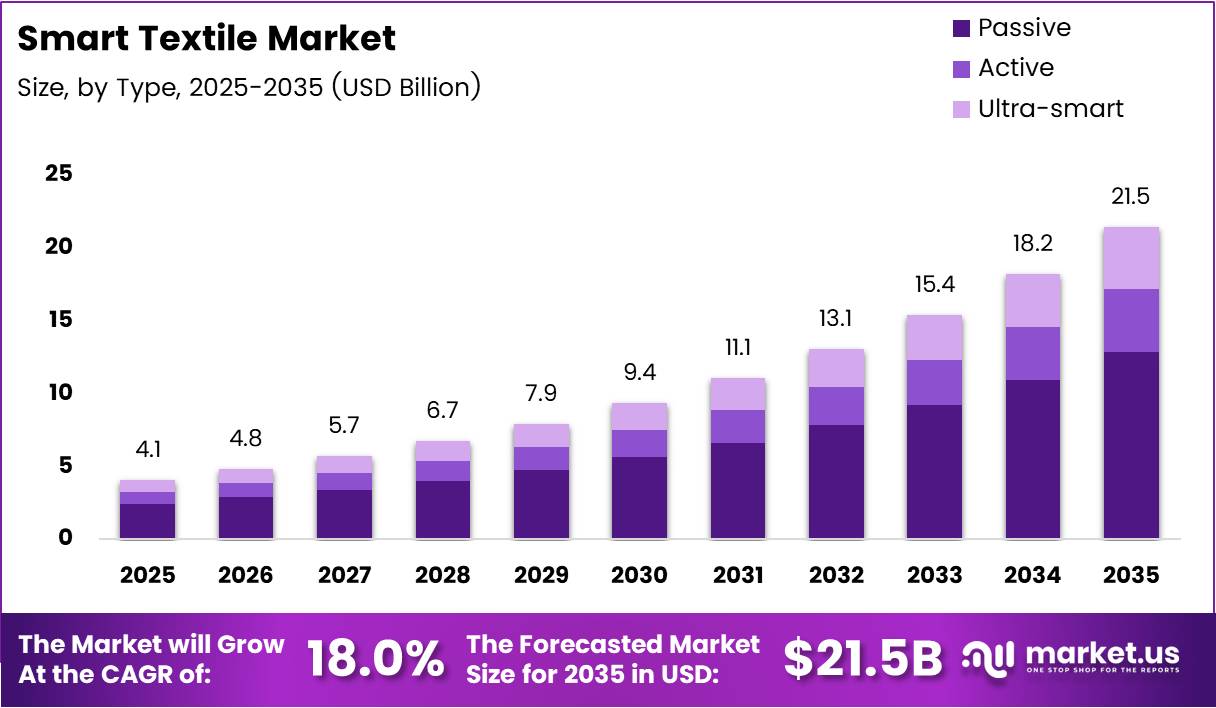
Global Smart Textile Market size is expected to be worth around USD 21.5 Billion by 2035 from USD 4.1 Billion in 2025, growing at a CAGR of 18.0% during the forecast period 2026 to 2035.
Smart textiles embed electronic and functional components directly into fabric structures. These advanced materials enable real-time sensing, thermoregulation, and data transmission. Unlike conventional fabrics, smart textile solutions respond to environmental and physiological stimuli, making them active participants in performance management rather than passive materials.
Healthcare institutions, defense contractors, and sportswear manufacturers drive adoption across distinct verticals. Each sector applies smart fabric capabilities differently — from continuous vital-sign monitoring in hospitals to ballistic protection systems in military gear. This cross-sector demand creates multiple independent revenue channels, reducing the market’s exposure to any single end-use downturn.
Research investment in conductive and e-textile technologies reinforces the market’s long-term trajectory. Manufacturers actively fund nanotechnology integration and biosensor development to improve fabric washability and durability — two factors that historically blocked commercialization. Solving these barriers unlocks mass-market channels including consumer fashion and automotive interiors.
Government procurement in military and aerospace sectors provides a stable, high-margin demand base for advanced wearable systems. Defense agencies across North America and Europe prioritize soldier performance monitoring and thermal management, giving established smart textile suppliers predictable long-cycle contracts that smaller entrants cannot easily access.
According to arXiv, ensemble deep transfer learning for textile manufacturing improved prediction accuracy by 5.66% and model robustness by 3.96% compared to conventional deep neural networks. This improvement signals that AI-assisted manufacturing is closing the efficiency gap that kept smart textile production costs prohibitively high for mid-market buyers.
According to ScienceDirect, capacitive textile pressure sensors retained consistent electrical performance with less than 6.32% variation after 1,000 loading cycles. This durability benchmark directly addresses the washability concern that deters both retailers and institutional buyers, meaning commercially viable mass-market products are closer than many investors assume.
Key Takeaways
- The Global Smart Textile Market was valued at USD 4.1 Billion in 2025 and is forecast to reach USD 21.5 Billion by 2035.
- The market advances at a CAGR of 18.0% from 2026 to 2035.
- By Type, Passive textiles lead with a 48.4% share in 2025.
- By Form, Wearable smart textiles dominate with a 78.2% share.
- By Functionality, Sensing holds the largest share at 33.7%.
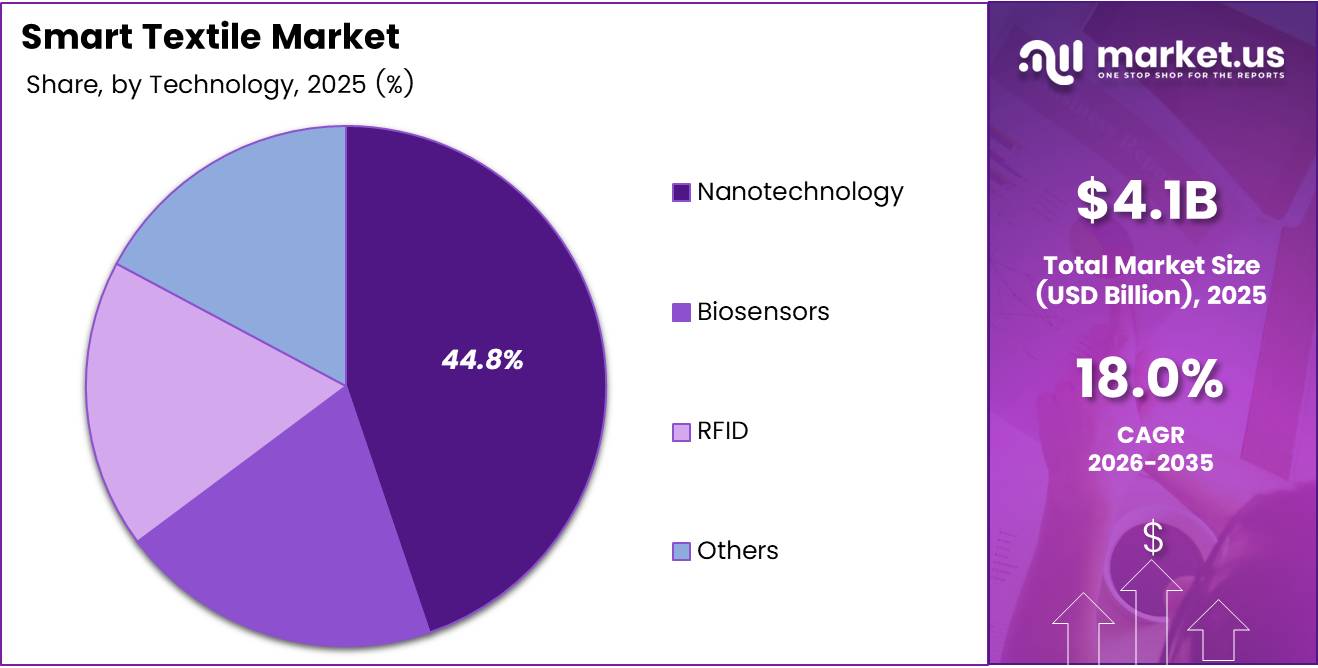
- By Technology, Nanotechnology leads with a 44.8% share.
- By Fabric Type, Cotton holds the top position with a 31.6% share.
- By End-Use, Healthcare and Medical Textiles command a 29.3% share.
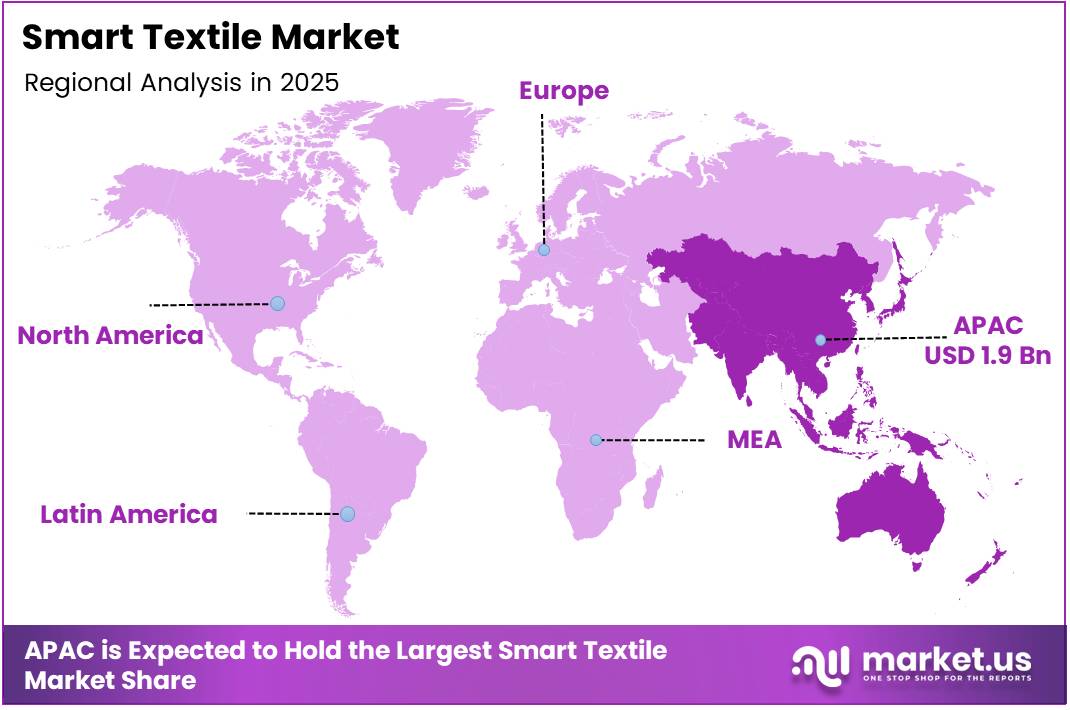
- Asia Pacific dominates regionally with a 47.8% share, valued at USD 1.9 Billion in 2025.
Type Analysis
Passive Smart Textiles dominate with 48.4% due to lower cost and simpler integration.
In 2025, Passive Smart Textiles held a dominant market position in the By Type segment of the Smart Textile Market, with a 48.4% share. Passive fabrics require no external power source, making them easier to manufacture and integrate into standard supply chains. Consequently, mass-market apparel brands adopt passive smart textiles first, giving them the broadest commercial footprint.
Active Smart Textiles carry higher unit value and command premium pricing across healthcare and defense verticals. These fabrics embed power-dependent components such as actuators and heating elements, enabling dynamic responses to body or environment signals. However, battery management and wash-cycle durability remain unresolved barriers that limit their penetration beyond specialized institutional buyers.
Ultra-Smart Textiles represent the highest tier of functional integration, combining sensing, actuating, and communication in a single fabric system. Their development remains largely research-led, with commercial deployments concentrated in military prototyping and advanced medical monitoring. As component miniaturization costs fall, ultra-smart textiles will move from lab settings into niche premium markets within the forecast window.
Form Analysis
Wearable Smart Textiles dominate with 78.2% due to direct consumer and clinical utility.
In 2025, Wearable Smart Textiles held a dominant market position in the By Form segment of the Smart Textile Market, with a 78.2% share. Wearables attach directly to the human body, enabling continuous biometric capture and thermoregulation without additional hardware. This direct utility across sports, healthcare, and fashion verticals makes wearables the primary revenue engine for smart fabric suppliers.
Non-Wearable Smart Textiles serve industrial, automotive, and architectural applications where embedded sensing and responsive materials improve structural performance. This segment grows as automotive OEMs integrate pressure-sensitive seat fabrics and heating elements into vehicle interiors. Although non-wearables trail significantly in volume, they carry higher average selling prices and longer contract cycles than consumer wearables.
Functionality Analysis
Sensing Smart Textiles dominate with 33.7% due to broad healthcare and fitness applicability.
In 2025, Sensing held a dominant market position in the By Functionality segment of the Smart Textile Market, with a 33.7% share. Sensing fabrics capture physiological data including heart rate, temperature, and movement, making them the backbone of wearable health monitoring. Their versatility across clinical, sports, and military applications gives sensing the widest buyer base of any functionality category.
Actuating textiles translate electrical signals into physical responses such as compression, vibration, or shape change. These fabrics serve rehabilitation medicine and adaptive sportswear, where real-time physical feedback improves patient outcomes or athletic performance. Their higher complexity means production costs remain elevated, slowing volume adoption compared to sensing-only alternatives.
Energy Harvesting and Power Generating fabrics capture kinetic or thermal energy from the wearer’s body or environment. This functionality eliminates battery dependency — the single largest durability constraint in wearable electronics. Vendors that solve energy harvesting integration at commercial scale will unlock a structural cost advantage that reshapes the wearable electronics supply chain.
Communication and Data Transmission textiles embed wireless communication capabilities directly into the fabric substrate. They enable real-time data relay between wearable sensors and external platforms without discrete hardware modules. This category links tightly to IoT platform investment cycles, meaning its growth follows enterprise connectivity budgets rather than textile manufacturing trends.
Thermoregulation fabrics actively manage body temperature by responding to heat flux changes. Military, outdoor sports, and occupational safety buyers prioritize thermoregulation because extreme temperature exposure directly affects human performance and safety outcomes. This functional clarity gives thermoregulation textiles a well-defined procurement rationale that accelerates institutional sales cycles.
Luminescence and Aesthetics smart textiles integrate light-emitting or color-changing properties into fashion and safety applications. High-visibility work garments and runway fashion represent opposite ends of the buyer spectrum, but both value the visual differentiation these fabrics provide. Their commercial trajectory depends on reducing production cost per meter rather than advancing new technical capabilities.
Others in functionality include filtration, antimicrobial action, and chemical detection fabrics. These niche applications serve industrial safety and defense buyers with highly specific procurement requirements. Although small in volume, they generate above-average margins because buyers prioritize performance specifications over price sensitivity.
Technology Analysis
Nanotechnology dominates with 44.8% due to superior conductivity and miniaturization.
In 2025, Nanotechnology held a dominant market position in the By Technology segment of the Smart Textile Market, with a 44.8% share. Nanotechnology enables conductivity, strength, and sensing capability without adding measurable weight or stiffness to fabric. According to arXiv, deep learning architectures for textile systems achieved up to 22× fewer parameters, reflecting how nano-enabled miniaturization reduces both hardware and computational overhead simultaneously.
Biosensors embedded in textiles monitor biochemical markers including glucose, cortisol, and hydration levels directly through skin contact. Clinical and sports performance buyers represent the primary demand base, as real-time biochemical data enables faster intervention and performance optimization. Biosensor textiles command premium pricing, but regulatory approval timelines in healthcare markets extend the sales cycle significantly.
RFID integration in smart textiles enables item-level tracking, authentication, and supply chain transparency across retail, logistics, and healthcare. Hospitals use RFID-embedded linen to track asset utilization, while luxury fashion brands embed RFID tags to combat counterfeiting. This application maturity makes RFID the most commercially proven technology tier in the smart textile stack today.
Others in technology include conductive inks, phase-change materials, and photonic fiber systems. Each addresses a specific performance requirement that mainstream technologies cannot fully satisfy. Their role in the market is to expand the total addressable use-case landscape, even if individual technology volumes remain small relative to nanotechnology-led solutions.
Fabric Type Analysis
Cotton dominates with 31.6% due to established supply chains and consumer comfort preference.
In 2025, Cotton held a dominant market position in the By Fabric Type segment of the Smart Textile Market, with a 31.6% share. Cotton’s natural fiber structure integrates with conductive coatings and nano-treatments more reliably than most synthetic alternatives. Its consumer acceptance and global supply chain maturity make it the default substrate for entry-level smart textile product lines.
Nylon offers superior tensile strength and moisture-wicking properties, making it the preferred base fabric for high-performance sportswear and military wearables. Its synthetic structure accommodates conductive yarn weaving more consistently than natural fibers under mechanical stress. Consequently, sportswear brands building smart garment lines default to nylon when durability and stretch recovery are primary specifications.
Conductive Polymers serve as both the fabric substrate and the functional conductive layer in advanced smart textile applications. This dual role eliminates the need for separate conductive thread integration, simplifying the manufacturing process and reducing per-unit production steps. Their adoption signals a structural shift toward purpose-built smart materials rather than retrofitted conventional fabrics.
Wool retains natural thermoregulation and moisture management properties that synthetic fabrics replicate only partially. Smart textile developers integrate wool into premium outdoor and military gear where passive thermal performance must coexist with embedded sensor functionality. Its higher raw material cost positions wool-based smart textiles firmly in the premium price tier.
Silk offers unmatched smoothness and biocompatibility, making it the preferred substrate for medical-grade wearables that require direct skin contact over extended periods. Research institutions developing bio-integrated electronics consistently favor silk for implantable and epidermal sensing applications. However, its fragility and cost limit silk-based smart textiles to research prototypes and ultra-premium medical devices.
Others in fabric type include polyester, aramid, and carbon fiber substrates. These materials serve industrial and defense applications where thermal resistance, cut protection, or electromagnetic shielding supersedes comfort considerations. Their specialized performance profiles command niche but high-margin procurement from safety and defense buyers globally.
End-Use Analysis
Healthcare and Medical Textiles dominate with 29.3% due to continuous monitoring clinical demand.
In 2025, Healthcare and Medical Textiles held a dominant market position in the By End-Use segment of the Smart Textile Market, with a 29.3% share. Hospitals and remote patient monitoring programs deploy smart garments to track vital signs continuously without wired equipment. This operational advantage over traditional monitoring hardware gives smart medical textiles a clear clinical ROI that justifies premium procurement budgets.
Military and Defense buyers invest in smart textiles for soldier physiological monitoring, ballistic protection enhancement, and thermal management. Defense procurement cycles are long but highly predictable, giving suppliers stable revenue visibility across multi-year programs. Additionally, military-grade durability requirements push technical performance standards that ultimately benefit commercial product development downstream.
Sports and Fitness brands deploy biometric-sensing garments to deliver performance analytics directly to athletes and coaches. Consumer appetite for data-driven training tools creates a high-volume commercial channel that complements the lower-volume but higher-margin medical sector. Smart sportswear also benefits from fashion industry investment, which broadens retail distribution beyond specialist athletic channels.
Automotive and Transportation integrates smart textiles into seat covers, steering wheel wraps, and cabin interior surfaces for occupant comfort monitoring and heating control. OEMs view embedded textile sensing as a cost-efficient alternative to discrete sensor hardware. As electric vehicle platforms expand, thermal management fabrics gain additional relevance for battery-adjacent interior temperature control.
Fashion and Lifestyle applications translate smart textile technology into consumer wearables that prioritize aesthetic appeal alongside functional performance. Collaboration between technology firms and apparel brands accelerates product development timelines and broadens retail reach. However, fashion’s trend-driven purchasing cycle creates demand volatility that requires flexible manufacturing capacity.
Industrial and Safety buyers use smart textiles for worker health monitoring, hazardous environment detection, and protective equipment enhancement. Regulatory pressure on occupational health and safety standards strengthens procurement mandates for sensor-embedded workwear in mining, construction, and chemical processing. This regulatory tailwind provides a structural floor for industrial smart textile revenue.
Others in end-use include aerospace, agriculture, and smart home applications. These emerging verticals test smart textile capabilities in non-traditional environments, expanding the market’s total addressable use-case portfolio. While individually small today, their combined exploration creates the application breadth that attracts sustained R&D investment from material science firms.
Key Market Segments
By Type
- Passive
- Active
- Ultra-smart
By Form
- Wearable
- Non-Wearable
By Functionality
- Sensing
- Actuating
- Energy Harvesting & Power Generating
- Communication / Data Transmission
- Thermoregulation
- Luminescence & Aesthetics
- Others
By Technology
- Nanotechnology
- Biosensors
- RFID
- Others
By Fabric Type
- Cotton
- Nylon
- Conductive Polymers
- Wool
- Silk
- Others
By End-Use
- Healthcare & Medical Textiles
- Military & Defense
- Sports & Fitness
- Automotive & Transportation
- Fashion & Lifestyle
- Industrial & Safety
- Others
Drivers
Wearable Health Monitoring and R&D Investment Drive Smart Textile Adoption Across High-Value Sectors
Healthcare providers and fitness platforms now require continuous, non-invasive biometric data that traditional wearables cannot deliver comfortably at scale. Smart textiles address this gap by embedding sensors directly into garments. According to arXiv, full-body NFC smart textiles support large-scale body coverage with an NFC-enabled area of approximately 70–80% of the body, confirming that fabric-integrated networks can replace device clusters in clinical monitoring environments.
This coverage capability signals a structural shift in remote patient monitoring procurement. Hospitals replacing wired monitoring setups with smart garments reduce both equipment cost and patient discomfort simultaneously. Moreover, the clinical ROI from continuous data capture shortens the payback period for institutional buyers, making budget approval faster than for conventional medical device upgrades.
Simultaneously, rising R&D expenditure in conductive and e-textile materials addresses the durability and functionality constraints that historically limited commercial rollout. Manufacturers fund nanotechnology integration to enable sensing and thermoregulation in a single fabric layer. Automotive and aerospace sectors also channel dedicated R&D budgets toward smart textile integration, expanding the supplier base beyond traditional apparel and textile manufacturers.
Restraints
High Production Costs and Washability Limitations Constrain Mass-Market Smart Textile Commercialization
Advanced smart textile materials — particularly those embedding conductive polymers, biosensors, and nano-coatings — carry significantly higher per-unit production costs than conventional fabrics. This cost gap prevents mainstream retail brands from adopting smart textile lines at competitive price points. Consequently, market penetration remains concentrated in premium and institutional segments rather than achieving the volume distribution that sustains long-term market scale.
Electronic components embedded in fabrics degrade under repeated washing, heat exposure, and mechanical flexing. Standard consumer wash cycles damage conductive threads and sensor connections, raising product replacement frequency and reducing buyer confidence. This durability gap forces manufacturers to choose between compromising wash resistance or using encapsulation methods that add bulk and reduce the fabric’s inherent wearing comfort.
Together, these two constraints create a commercialization ceiling. Even when technical performance meets clinical or athletic specifications, cost and durability barriers prevent the retail-scale distribution needed to recover R&D investment. Vendors that solve both constraints simultaneously — rather than optimizing one at the expense of the other — will define the commercial viability threshold for the next generation of smart garments.
Growth Factors
IoT Connectivity, Biometric Fabrics, and Sustainable Innovation Open New Smart Textile Revenue Channels
IoT-connected clothing platforms allow smart textiles to transmit real-time biometric data to cloud analytics systems without discrete hardware modules. This connectivity transforms garments from passive data collectors into active nodes in broader health and performance management ecosystems. According to arXiv, textile capacitive motion capture systems achieved real-time inference at 42 frames per second on an embedded edge platform, confirming that edge computing in fabric is commercially viable today.
Biometric-sensing fabrics unlock a personalized healthcare segment that hospital-grade devices cannot reach cost-effectively. Garments that continuously monitor glucose, hydration, or cardiac rhythm enable preventive care models that reduce acute intervention costs. In January 2025, researchers from the University of Southampton and UWE Bristol developed biodegradable electronic textiles called “SWEET” that reliably monitor health signals while biodegrading effectively — demonstrating that sustainable performance monitoring is technically achievable, not just aspirational.
Military and defense procurement provides a high-margin, stable growth channel for advanced smart textile developers. Defense agencies invest in soldier performance monitoring, thermal regulation, and communication fabrics as force multipliers. Additionally, rising interest in eco-friendly and sustainable smart textile innovations opens consumer and regulatory channels that traditional performance textiles cannot access, creating a parallel commercial pathway for environmentally certified fabric systems.
Emerging Trends
AI-Enabled Fabrics and Cross-Industry Collaboration Redefine Smart Textile Product Development
Fashion brands now co-develop smart clothing lines directly with semiconductor and software firms, compressing the product development cycle from years to months. This collaboration model transfers technology risk to the tech partner while giving apparel brands differentiated product lines. According to ScienceDirect, a multi-functional textile strain and shielding sensor showed fast electrical response time of approximately 40 ms and recovery time of approximately 54 ms, demonstrating sensor responsiveness that meets real-time fashion and performance applications simultaneously.
Flexible, lightweight energy-harvesting fabrics eliminate the battery dependency that restricts smart sportswear to short usage cycles. Garments that harvest kinetic energy during athletic movement can power embedded sensors indefinitely, removing the recharging friction that limits mainstream adoption. This capability shifts the consumer value proposition from “smart garment” to “always-on performance coach,” fundamentally changing how brands market and price smart textile products.
AI-enabled fabrics analyze biometric data patterns to predict health events and performance plateaus before they manifest clinically. This predictive capability appeals to elite sports programs and corporate wellness platforms where early intervention has measurable ROI. Smart textiles also enter VR and AR applications as haptic feedback layers, opening an entirely new hardware category where fabric serves as the human-machine interface rather than rigid controllers.
Regional Analysis
Asia Pacific Dominates the Smart Textile Market with a Market Share of 47.8%, Valued at USD 1.9 Billion
Asia Pacific commands 47.8% of the global Smart Textile Market, valued at USD 1.9 Billion in 2025. The region’s dominance reflects its integrated textile manufacturing base, strong electronics supply chains, and government-backed smart manufacturing programs in China, South Korea, and Japan. These structural advantages give APAC producers a cost-to-market lead that other regions cannot replicate through technology investment alone.
North America Smart Textile Market Trends
North America maintains a strong position driven by early adoption of wearable health monitoring across its mature healthcare system and active defense procurement programs. The U.S. military’s investment in soldier performance textiles sustains above-average demand for advanced fabric systems. Moreover, a dense startup ecosystem in Boston and Silicon Valley continuously introduces new biosensor and IoT-connected garment products to clinical and consumer channels.
Europe Smart Textile Market Trends
Europe advances through a combination of regulatory pressure on occupational safety standards and strong academic-industry collaboration in e-textile research. Germany and the UK lead institutional smart textile deployment, particularly in automotive interiors and industrial workwear. The EU’s sustainability mandates additionally steer investment toward eco-certified smart fabric production, accelerating the development of biodegradable and recyclable e-textile platforms.
Latin America Smart Textile Market Trends
Latin America represents an early-stage adoption market where healthcare infrastructure gaps create demand for remote patient monitoring solutions, including smart garments. Brazil leads regional development through its expanding medical device sector and university-led research programs. However, import dependency on advanced conductive materials and electronics slows local production scale-up and keeps end-product costs above mass-market thresholds.
Middle East and Africa Smart Textile Market Trends
The Middle East and Africa market develops through government investment in smart city infrastructure and military modernization programs, particularly across Gulf Cooperation Council states. Extreme climate conditions in the region create functional demand for advanced thermoregulation fabrics in both consumer and industrial applications. Africa’s market remains nascent, primarily accessing smart textile products through imported goods rather than local manufacturing.
Key Regions and Countries
North America
- US
- Canada
Europe
- Germany
- France
- The UK
- Spain
- Italy
- Rest of Europe
Asia Pacific
- China
- Japan
- South Korea
- India
- Australia
- Rest of APAC
Latin America
- Brazil
- Mexico
- Rest of Latin America
Middle East & Africa
- GCC
- South Africa
- Rest of MEA
Key Company Insights
DuPont De Nemours, Inc. anchors its smart textile strategy on advanced materials science, supplying conductive fibers and protective fabric systems to industrial, defense, and healthcare buyers. Its materials reach end-product manufacturers rather than consumers directly, giving DuPont a platform position in the value chain. This upstream positioning insulates the company from retail demand volatility while capturing margin across multiple end-use verticals simultaneously.
Jabil Inc. applies its electronics manufacturing services expertise to smart textile component integration, bridging the gap between semiconductor fabrication and garment assembly. Its advantage lies in scale — Jabil can produce sensor-embedded textile modules at volumes that pure-play smart textile startups cannot match. This manufacturing depth makes Jabil the preferred partner for brands that require consistent quality at consumer retail quantities.
AIQ Smart Clothing Inc. specializes in conductive yarn and smart garment design, targeting medical monitoring and sports performance with washable, integrated electronic systems. Its focus on washability as a primary design constraint directly addresses the durability barrier that slows institutional adoption. Consequently, AIQ’s product architecture positions it well for healthcare procurement cycles where long-term garment reliability is a non-negotiable specification.
Adidas leverages its global retail distribution and brand equity to commercialize smart textile products at consumer scale, a capability that pure-play technology firms cannot replicate independently. Its collaboration model — partnering with sensor and materials firms rather than developing all components in-house — reduces R&D risk while accelerating time-to-market. This approach gives Adidas a structural speed advantage in the high-volume sports and lifestyle smart garment segment.
Key Players
- DuPont De Nemours, Inc.
- Jabil Inc.
- AIQ Smart Clothing Inc.
- Adidas
- Interactive Wear
- Hexoskin
- Gentherm Incorporated
- Nike, Inc.
- Outlast Technologies GmbH
- Sensoria, Inc.
Recent Developments
- January 2025 — Sensoria Inc. secured a USD $25 million Series B funding round to expand its smart textile manufacturing capacity. This investment signals investor confidence in the commercial scalability of biometric-sensing garment platforms and accelerates Sensoria’s ability to fulfill institutional healthcare and sports performance contracts at greater volume.
- April 2025 — Ohmatex ApS introduced washable, stretchable conductive yarns tailored for sportswear and medical wearables, gaining traction across EU and North American markets. The launch directly addresses the washability constraint that limits smart textile commercialization, offering fabric manufacturers a proven conductive yarn solution that survives standard consumer and clinical laundering protocols.
Report Scope
Report Features Description Market Value (2025) USD 4.1 Billion Forecast Revenue (2035) USD 21.5 Billion CAGR (2026-2035) 18.0% Base Year for Estimation 2025 Historic Period 2020-2024 Forecast Period 2026-2035 Report Coverage Revenue Forecast, Market Dynamics, Competitive Landscape, Recent Developments Segments Covered By Type (Passive, Active, Ultra-smart), By Form (Wearable, Non-Wearable), By Functionality (Sensing, Actuating, Energy Harvesting & Power Generating, Communication / Data Transmission, Thermoregulation, Luminescence & Aesthetics, Others), By Technology (Nanotechnology, Biosensors, RFID, Others), By Fabric Type (Cotton, Nylon, Conductive Polymers, Wool, Silk, Others), By End-Use (Healthcare & Medical Textiles, Military & Defense, Sports & Fitness, Automotive & Transportation, Fashion & Lifestyle, Industrial & Safety, Others) Regional Analysis North America (US and Canada), Europe (Germany, France, The UK, Spain, Italy, and Rest of Europe), Asia Pacific (China, Japan, South Korea, India, Australia, and Rest of APAC), Latin America (Brazil, Mexico, and Rest of Latin America), Middle East & Africa (GCC, South Africa, and Rest of MEA) Competitive Landscape DuPont De Nemours, Inc., Jabil Inc., AIQ Smart Clothing Inc., Adidas, Interactive Wear, Hexoskin, Gentherm Incorporated, Nike, Inc., Outlast Technologies GmbH, Sensoria, Inc. Customization Scope Customization for segments, region/country-level will be provided. Moreover, additional customization can be done based on the requirements. Purchase Options We have three licenses to opt for: Single User License, Multi-User License (Up to 5 Users), Corporate Use License (Unlimited User and Printable PDF) 
-
-
- DuPont De Nemours, Inc.
- Jabil Inc.
- AIQ Smart Clothing Inc.
- Adidas
- Interactive Wear
- Hexoskin
- Gentherm Incorporated
- Nike, Inc.
- Outlast Technologies GmbH
- Sensoria, Inc.
Our Clients

- 179184
- Feb 2026






