


Global Paraffins Market Size, Share, And Enhanced Productivity By Type (Paraffin Wax, Liquid, Kerosene, Petroleum Jelly), By Application (Cosmetics and Personal Care, Paperboard and Packaging, Fuel, Rubber, Lubricants, Other), By Region and Companies - Industry Segment Outlook, Market Assessment, Competition Scenario, Trends, and Forecast 2026-2035
- Published date: March 2026
- Report ID: 180169
- Number of Pages: 354
- Format:
-
keyboard_arrow_up
Quick Navigation
Report Overview
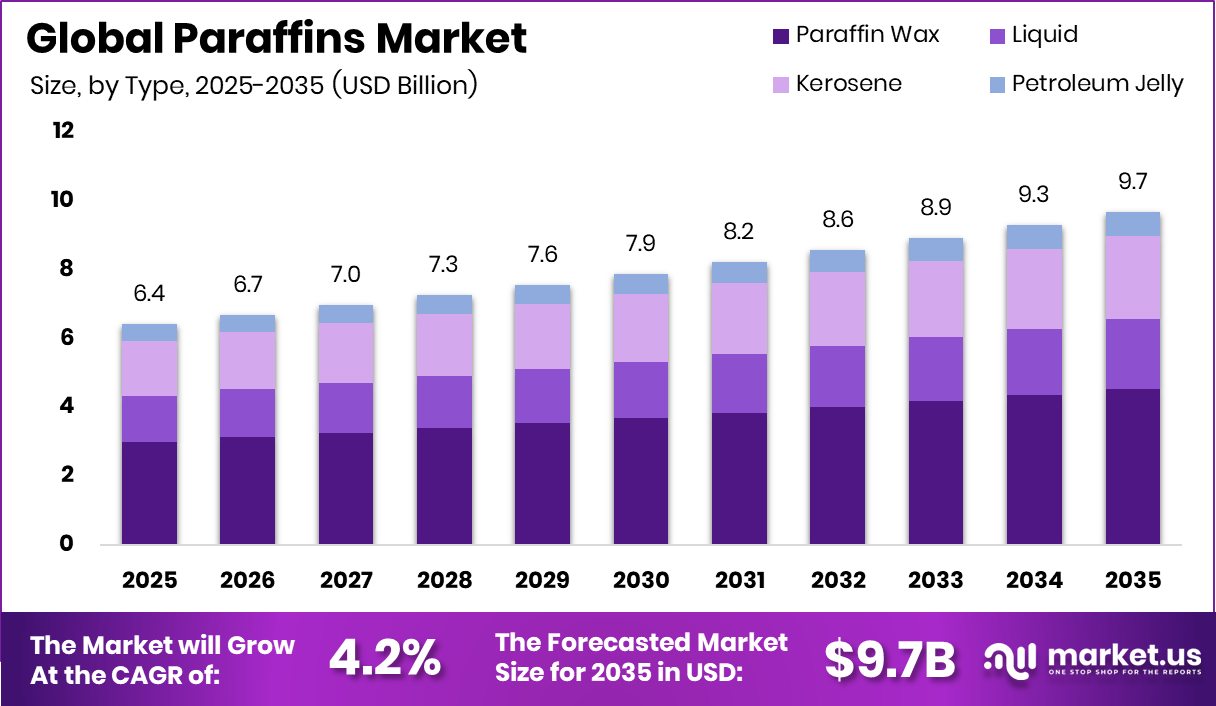
The Global Paraffins Market is expected to be worth around USD 9.7 billion by 2035, up from USD 6.4 billion in 2025, and is projected to grow at a CAGR of 4.2% from 2026 to 2035. Strong industrial demand helped Asia Pacific capture 43.1%, with the paraffin market value reaching USD 2.7 Bn.
Paraffins are hydrocarbon compounds mainly obtained during crude oil refining. They appear in different forms such as paraffin wax, liquid paraffin, kerosene, and petroleum jelly. These materials are valued for their stability, moisture resistance, and smooth texture, which makes them useful in many industries. Paraffins are commonly used in cosmetics, packaging coatings, lubricants, fuels, and rubber processing. Because they are easy to refine and relatively affordable, they remain widely used in consumer goods and industrial manufacturing across global markets.
The Paraffins Market represents the global trade and production of paraffin-based products used across several applications, including cosmetics and personal care, paperboard and packaging, fuels, rubber, lubricants, and other industrial uses. Market activity is closely connected to petroleum refining capacity and the demand for downstream chemical materials. Industries rely on paraffins for their protective and sealing properties, particularly in packaging and skincare formulations, where product stability and moisture control are important.
The market continues to expand due to steady industrial consumption and energy-related investments worldwide. Government and institutional support for energy innovation is also shaping related hydrocarbon value chains. For example, Germany recently supported a green hydrogen e-SAF plant with €349 million in public funding, while a final EU funding decision is expected for a €350 million German eSAF project. Such initiatives encourage advancements in refining and fuel technologies, indirectly supporting paraffin-derived materials used in industrial and energy applications.
Demand for paraffins is strongly linked to packaging, consumer products, and fuel applications. Expanding rural energy access and technology development are creating new opportunities for hydrocarbon-related products. Programs such as One Acre Fund and GreenLight Planet targeting 100,000 solar lamps in Kenya show the growing focus on energy accessibility.
Meanwhile, investment in financial technology like Verteva’s $33 million funding and energy initiatives such as the $10 million U.S. Department of Energy grant in Maine highlight broader infrastructure and industrial development that can support future demand for paraffin-based materials.
Key Takeaways
- The Global Paraffins Market is expected to be worth around USD 9.7 billion by 2035, up from USD 6.4 billion in 2025, and is projected to grow at a CAGR of 4.2% from 2026 to 2035.
- Paraffin Wax held 46.8% share in the Paraffins Market, driven by strong demand from candles, packaging, and coatings industries.
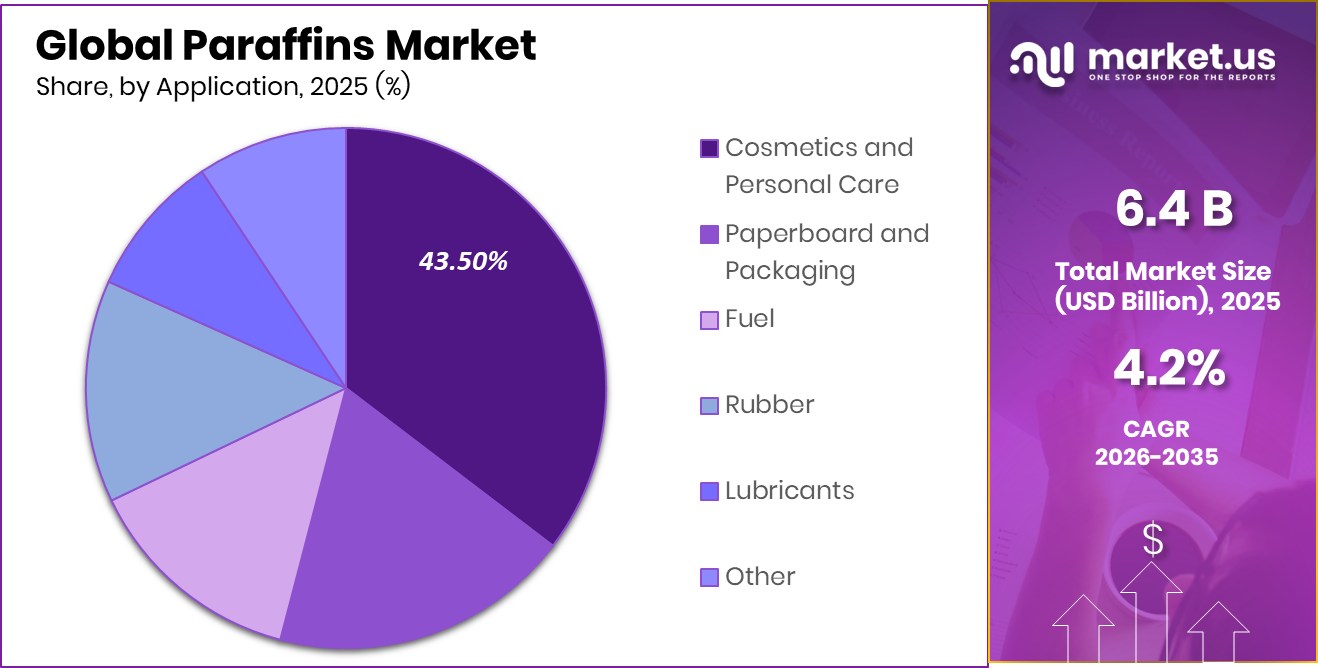
- Cosmetics and Personal Care accounted for 43.50% of the Paraffins Market, supported by rising skincare, ointment, and beauty product usage.
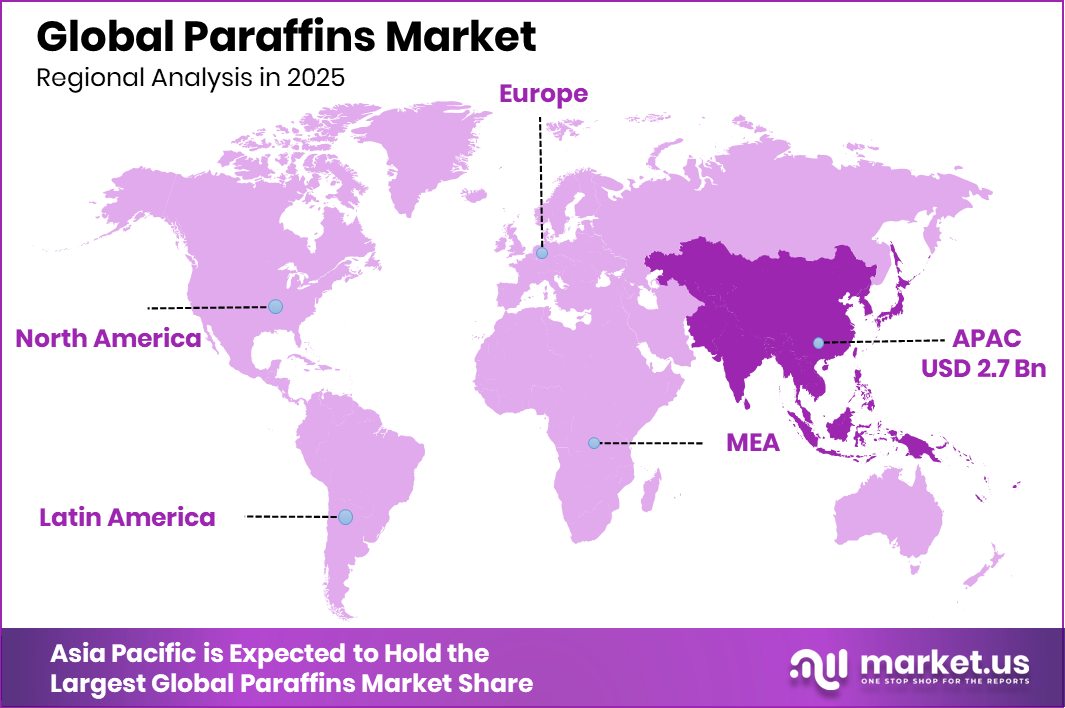
- In 2025, the Asia Pacific region accounted for 43.1% share, generating around USD 2.7 Bn revenue.
By Type Analysis
Paraffins Market shows Paraffin Wax type dominating with a strong 46.8% global share.
In 2025, paraffin wax held a leading share of about 46.8% in the Paraffins Market, reflecting its strong demand across multiple industrial and consumer applications. Paraffin wax is widely used due to its stable chemical structure, low cost, and versatile performance in products such as candles, packaging coatings, rubber processing, and cosmetics. The material is mainly derived from petroleum refining, making it readily available through global refinery networks.
Growing candle consumption for home décor and religious uses, especially in emerging economies, continues to support market growth. In addition, paraffin wax plays a key role in packaging industries where it improves moisture resistance and product protection. Manufacturers are also improving refining processes to enhance wax purity and consistency. These factors together keep paraffin wax as one of the most widely used and commercially important segments in the paraffin industry.
By Application Analysis
Paraffins Market sees Cosmetics and Personal Care applications leading with a notable 43.50% share.
In 2025, the cosmetics and personal care segment accounted for nearly 43.5% of the Paraffins Market, highlighting the strong use of paraffin-based ingredients in skincare and beauty products. Paraffins are commonly used in creams, lotions, lip balms, and hair care formulations because they provide smooth texture, moisture retention, and protective skin barriers. The growth of the global beauty and skincare industry has significantly increased demand for cosmetic-grade paraffins.
Rising consumer focus on skincare routines, anti-aging products, and dermatological treatments is further boosting the application of these materials. In professional beauty therapy, paraffin wax treatments are also widely used for skin hydration and relaxation therapies. Many cosmetic manufacturers continue to rely on highly refined paraffins due to their stability and compatibility with other ingredients, making this application segment one of the most influential drivers in the overall paraffins market.
Key Market Segments
By Type
- Paraffin Wax
- Liquid
- Kerosene
- Petroleum Jelly
By Application
- Cosmetics and Personal Care
- Paperboard and Packaging
- Fuel
- Rubber
- Lubricants
- Other
Driving Factors
Rising cosmetics industry increases paraffin consumption
The Paraffins Market continues to grow due to rising demand from the global cosmetics and personal care industry. Paraffins are widely used in skincare creams, lotions, lip balms, and beauty treatments because they help retain moisture and create a protective layer on the skin. As consumer spending on beauty and grooming products increases, manufacturers continue to rely on refined paraffin ingredients for stable product formulations.
The influence of new beauty brands and innovation in skincare products also contributes to stronger consumption of paraffin-based materials. Investment activity in the beauty industry further supports this trend. For instance, Seoul Beauty Club secured $2 million in pre-seed funding, highlighting increasing entrepreneurial activity and product development in beauty markets, which indirectly drives the use of paraffin-based ingredients across cosmetics and personal care formulations worldwide.
Restraining Factors
Environmental concerns limit petroleum-derived paraffins
Environmental concerns associated with petroleum-derived products are gradually influencing the Paraffins Market, particularly in sectors where sustainability is becoming a key purchasing factor. Paraffins are produced from petroleum refining processes, and growing attention to environmental impact has led some manufacturers to explore alternative ingredients. Regulatory pressures and consumer awareness regarding sustainable cosmetics and environmentally friendly materials may limit the pace of paraffin adoption in certain applications.
At the same time, companies investing in plant-based technologies are expanding competition within the personal care industry. For example, RAFIQ secured $11 million in Series B funding to construct a CGMP facility focused on plant-based cosmetic technology, indicating a shift toward alternative ingredient platforms. Such developments highlight the evolving landscape of cosmetic manufacturing, which may challenge the long-term growth of traditional petroleum-based paraffin products.
Growth Opportunity
Growing personal care products increase paraffins
The growing popularity of skincare routines and personal grooming products continues to create new opportunities for the Paraffins Market. Paraffin-based ingredients are commonly used in moisturizers, ointments, and therapeutic skincare treatments because they provide long-lasting hydration and help protect the skin barrier. Increasing demand for affordable and effective skincare products across emerging markets is expected to support consistent consumption of paraffin-based materials.
Beauty companies are also expanding product lines and targeting new consumer segments through innovation and branding strategies. However, financial performance and investment decisions within the beauty sector can influence market sentiment. For example, Revolution Beauty shares dropped around 40% after declining sales and the start of a funding review, highlighting the dynamic nature of the cosmetics industry. Despite such challenges, ongoing product innovation continues to present opportunities for paraffin usage in personal care formulations.
Latest Trends
Increasing refined paraffin usage in cosmetics
One of the noticeable trends in the Paraffins Market is the increasing use of highly refined paraffin ingredients in cosmetics and skincare products. Cosmetic manufacturers prefer purified paraffins due to their stability, smooth texture, and compatibility with other formulation ingredients. These refined materials are commonly used in creams, facial treatments, lip care products, and therapeutic wax treatments offered in beauty spas. The beauty industry’s focus on premium skincare experiences is also encouraging innovation in product formulations and treatment solutions that incorporate paraffin-based ingredients.
Strong investment activity within the beauty sector further reflects this evolving trend. For instance, Molly Sims’ YSE Beauty closed a $15 million Series A funding round, aimed at expanding skincare product development and brand growth. Such developments show how rising innovation and funding within beauty markets continue to influence demand for refined paraffin materials.
Regional Analysis
Asia Pacific dominated the Paraffins Market with 43.1% share, reaching USD 2.7 Bn in 2025.
The Paraffins Market shows varied growth patterns across key regions, including North America, Europe, Asia Pacific, the Middle East & Africa, and Latin America, driven by differences in industrial demand and refining capacity.
Asia Pacific dominates the global market, accounting for 43.1% of the total share with a market value of USD 2.7 billion. The region’s leadership is supported by strong manufacturing activities, growing cosmetics production, and expanding packaging industries in countries such as China, India, and Southeast Asian economies. Large-scale petroleum refining operations in the region also ensure a steady paraffin supply for downstream industries.
North America remains an important market due to its established petroleum refining sector and consistent demand from packaging, candle manufacturing, and personal care industries. Europe follows with stable consumption, supported by advanced chemical processing industries and strong regulatory standards for refined paraffin products.
In the Middle East & Africa, paraffin production benefits from abundant crude oil resources and growing downstream chemical industries. Meanwhile, Latin America shows gradual expansion as industrial development and consumer product manufacturing increase regional demand for paraffin-based materials across several applications.
Key Regions and Countries
- North America
- US
- Canada
- Europe
- Germany
- France
- The UK
- Spain
- Italy
- Rest of Europe
- Asia Pacific
- China
- Japan
- South Korea
- India
- Australia
- Rest of APAC
- Latin America
- Brazil
- Mexico
- Rest of Latin America
- Middle East & Africa
- GCC
- South Africa
- Rest of MEA
Key Players Analysis
In 2025, Calumet Specialty Products Partners continues to play a notable role in the global paraffins market through its focus on specialty hydrocarbons and refined wax products. The company is known for producing high-purity paraffin and specialty waxes used in packaging, personal care, rubber processing, and industrial applications. Calumet’s integrated refining and specialty product capabilities allow it to supply tailored paraffin grades that meet the requirements of different downstream industries. Its operational strength lies in specialty refining assets that emphasize value-added products rather than commodity fuels.
In Europe and international energy markets, Cepsa holds an important position in paraffin and wax production through its refining and petrochemical operations. The company benefits from large refinery complexes and advanced processing technologies that enable efficient paraffin extraction from petroleum streams. Cepsa’s downstream operations support several industries, including cosmetics, packaging, lubricants, and coatings. The company’s strategic presence in Europe, the Middle East, and parts of Asia helps maintain a steady supply of paraffin products across global markets.
Meanwhile, ENEOS Corporation contributes to the paraffin market through its extensive refining capacity and diversified petroleum product portfolio. The company operates large refining facilities in Japan that produce various petroleum derivatives, including paraffin and related hydrocarbon products. ENEOS maintains strong relationships with manufacturing sectors such as automotive, chemicals, and personal care, which indirectly support demand for refined paraffin materials.
Top Key Players in the Market
- Calumet Specialty Products Partners
- Cepsa
- ENEOS Corporation
- Exxon Mobil Corporation
- Farabi Petrochemicals Company
- H&R Group
- HollyFrontier Refining & Marketing LLC
- Hywax GmbH
- Indian Oil Corporation Ltd
- Kemipex
- LANXESS
- NIPPON SEIRO CO., LTD
Recent Developments
- In July 2024, Calumet Specialty Products Partners, which produces specialty hydrocarbons including paraffin-based products, completed its conversion from a master limited partnership to a C-Corporation. The restructuring allowed broader investor participation and strengthened the company’s specialty products business that supplies paraffin and related wax solutions.
- In June 2024, Cepsa, which produces paraffin waxes and specialty hydrocarbons, expanded its Paraffins product portfolio, including macrocrystalline and microcrystalline wax grades for cosmetics, packaging, and pharmaceutical applications. The development supports industries requiring refined paraffin solutions for coatings and personal-care formulations.
Report Scope
Report Features Description Market Value (2025) USD 6.4 Billion Forecast Revenue (2035) USD 9.7 Billion CAGR (2026-2035) 4.2% Base Year for Estimation 2025 Historic Period 2020-2024 Forecast Period 2026-2035 Report Coverage Revenue Forecast, Market Dynamics, Competitive Landscape, Recent Developments Segments Covered By Type (Paraffin Wax, Liquid, Kerosene, Petroleum Jelly), By Application (Cosmetics and Personal Care, Paperboard and Packaging, Fuel, Rubber, Lubricants, Other) Regional Analysis North America – US, Canada; Europe – Germany, France, The UK, Spain, Italy, Rest of Europe; Asia Pacific – China, Japan, South Korea, India, Australia, Singapore, Rest of APAC; Latin America – Brazil, Mexico, Rest of Latin America; Middle East & Africa – GCC, South Africa, Rest of MEA Competitive Landscape Calumet Specialty Products Partners, Cepsa, ENEOS Corporation, Exxon Mobil Corporation, Farabi Petrochemicals Company, H&R Group, HollyFrontier Refining & Marketing LLC, Hywax GmbH, Indian Oil Corporation Ltd, Kemipex, LANXESS, NIPPON SEIRO CO., LTD Customization Scope Customization for segments, region/country-level will be provided. Moreover, additional customization can be done based on the requirements. Purchase Options We have three licenses to opt for: Single User License, Multi-User License (Up to 5 Users), Corporate Use License (Unlimited User and Printable PDF) 
-
-
- Calumet Specialty Products Partners
- Cepsa
- ENEOS Corporation
- Exxon Mobil Corporation
- Farabi Petrochemicals Company
- H&R Group
- HollyFrontier Refining & Marketing LLC
- Hywax GmbH
- Indian Oil Corporation Ltd
- Kemipex
- LANXESS
- NIPPON SEIRO CO., LTD
Our Clients

- 180169
- March 2026






