


Report Overview
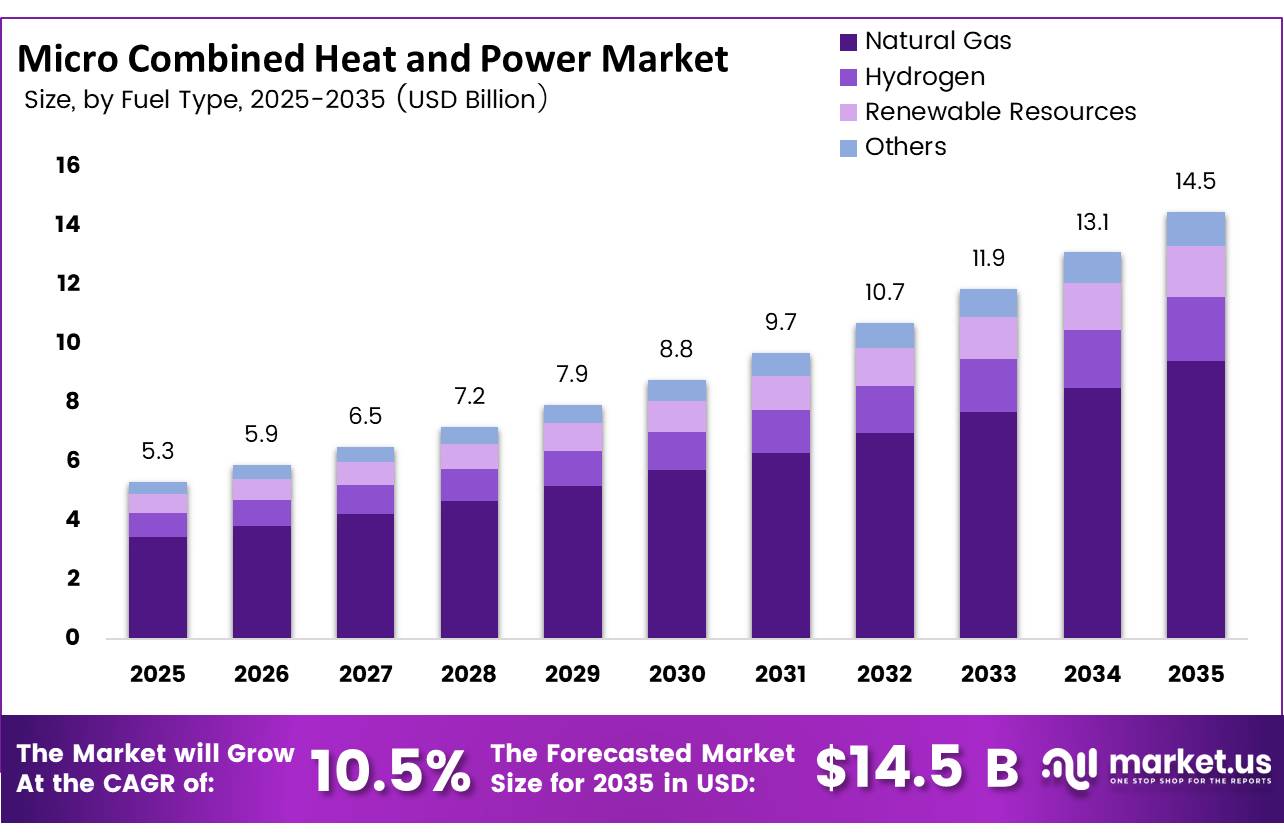
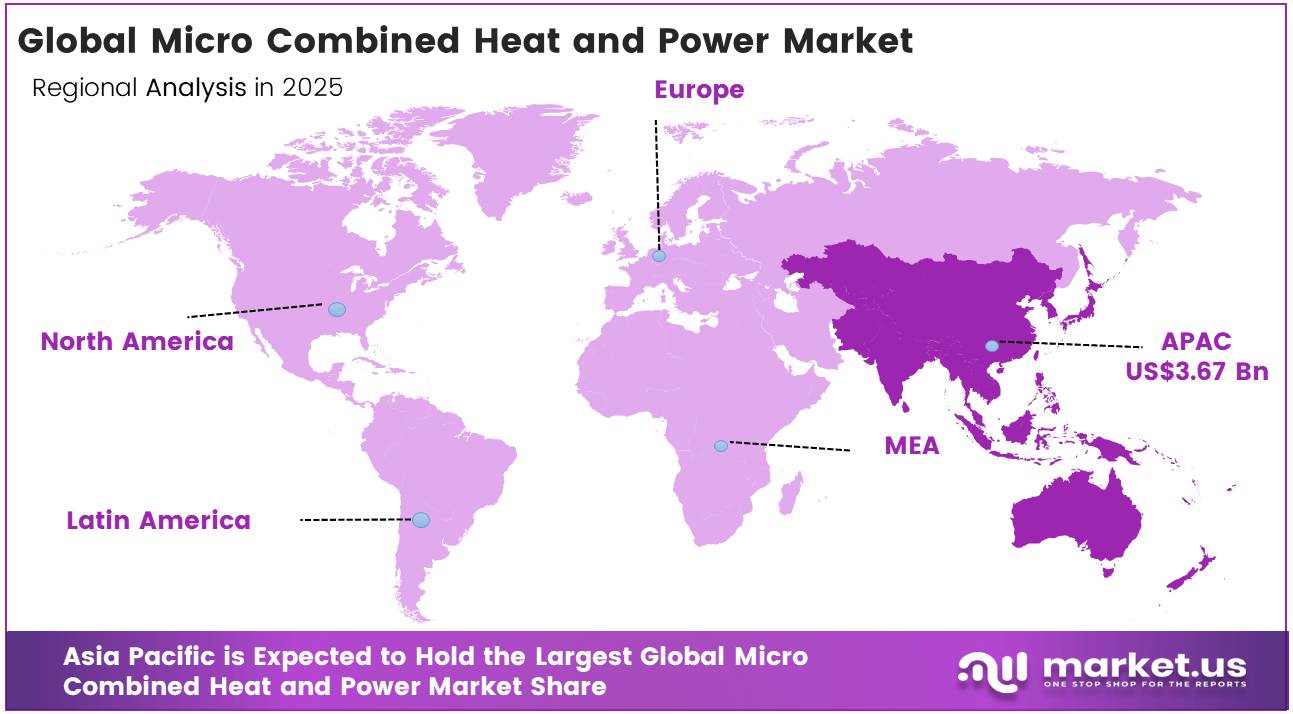
In 2025, the Global Micro Combined Heat and Power Market was valued at USD 5.3 billion. The market is projected to grow at a CAGR of 10.5% during 2026–2035, reaching approximately USD 14.5 billion by 2035. Asia Pacific dominated the market in 2025, accounting for more than 68.9% of the global share and generating approximately USD 3.67 billion in revenue.
Micro combined heat and power (micro-CHP) systems generate electricity and heat simultaneously at the point of consumption, for homes, apartment buildings, small businesses and light-industrial sites. Technologies include gas engines, Stirling engines, microturbines and fuel cells, while fuels include natural gas, biomethane, biogas and hydrogen blends. European practice classifies micro-cogeneration at up to 50 kWe, whereas the United Kingdom’s Feed-in Tariff framework applied a 2 kW ceiling.
- According to the U.S. Environmental Protection Agency, traditional power plants waste nearly 66% of the energy used during electricity generation, whereas CHP systems achieve efficiencies of over 80%. The U.S. Department of Energy also states that CHP systems typically deliver 65–75% efficiency, compared with around 50% when electricity and heat are produced separately. Reflecting this shift, the International Energy Agency (IEA) reported that global energy efficiency investments reached nearly USD 800 billion in 2025, while global energy intensity improved by 1.8%, up from 1.0% in 2024.
In addition, the European Union’s Energy Efficiency Directive (EU/2023/1791) requires an 11.7% reduction in energy consumption by 2030, encouraging wider adoption of high-efficiency cogeneration technologies that can achieve up to 90% efficiency. These policies are accelerating Micro-CHP deployment across residential and small commercial applications.
- Government policy supports high-efficiency cogeneration, although competition from heat pumps, rooftop solar and batteries remains strong. The European Union’s Energy Efficiency Directive targets at least an 11.7% reduction in final energy consumption by 2030 compared with the 2020 projection and requires assessment of high-efficiency cogeneration potential. In the United Kingdom, Ofgem’s 2025 Smart Export Guarantee report recorded 19 micro-CHP installations among non-solar registrations, confirming that the technology remains specialised rather than mass market.
The IEA’s Electricity 2026 report forecasts global electricity demand to grow at 3.6% CAGR through 2030, with India expanding by 6.4% annually and adding more than 570 TWh of electricity demand over the next five years. Emerging economies are expected to contribute nearly 80% of additional global electricity demand through 2030. According to the COGEN World Coalition, CHP systems currently generate 4,398 TWh of electricity and 12,642 TWh of heat annually, while CHP heat output capacity increased by 37.5% between 2011 and 2021. These trends, combined with rising energy demand, grid constraints, and decarbonization targets, continue to strengthen the adoption of Micro-CHP systems across the region.
Key Takeaways
- The global Micro Combined Heat and Power market was valued at US$5.3 billion in 2025.
- The market is projected to grow at a CAGR of 10.5% and is estimated to reach US$14.5 billion by 2035.
- On the basis of capacity, the Up to 2 kW dominated the market, constituting 45% of the Micro Combined Heat and Power market share.
- Based on the Fuel type, the natural gas dominated the Micro Combined Heat and Power market, with a substantial market share of around 65%.
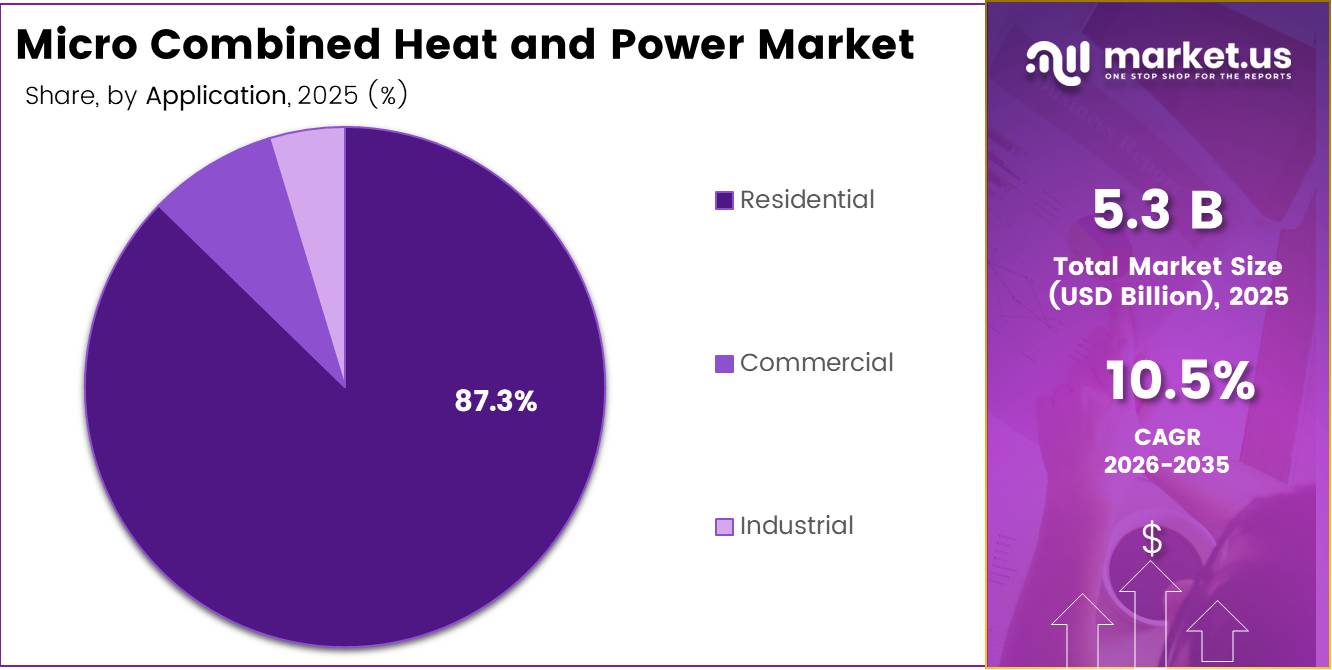
- Based on the Application, Residential led the market, comprising 87.3% of the total market.
- In 2025, the Asia Pacific was the most dominant region in the Micro Combined Heat and Power market, accounting for 68.9% of the total global consumption
Capacity Analysis
Up to 2 kW represents dominant Segment in the Market.
The Up to 2 kW segment dominated the global Micro-CHP market in 2025, accounting for more than 45% of the market share. This leadership is primarily driven by strong demand from the residential sector. According to UN-Habitat’s 2024 Annual Report, more than 2.8 billion people still lack adequate housing, and around 96,000 new homes need to be built every day through 2030 to meet global housing demand. This continuous expansion of the residential sector is creating long-term demand for compact and energy-efficient heating systems.
- The IEA Energy Efficiency 2025 report states that residential buildings account for nearly 70% of total building energy consumption worldwide, with space and water heating representing the largest share. In addition, the IEA Solar Heating and Cooling Programme estimates that around 16% of residential energy use in IEA member countries is dedicated to space heating. Micro-CHP systems with capacities of up to 2 kW are well suited for this requirement, as they efficiently provide both electricity and heat for individual homes.
The 2 kW to 10 kW segment was the fastest growing segment in 2025, supported by rising demand from commercial buildings and multi-family residential complexes. These systems provide reliable heating and power for facilities that operate continuously, including hospitals, schools, offices, and apartment buildings. According to the REN21 Global Status Report 2025, heat accounted for 74% of total energy consumption in the buildings sector in 2024, highlighting the growing need for efficient heating technologies. Their ability to deliver stable energy output makes 2–10 kW systems well suited for these applications.
Fuel Type Analysis
Natural Gas a significant fuel type.
Natural gas accounted for more than 65% of the global Micro-CHP market in 2025, supported by its extensive infrastructure and strong adoption in residential and commercial heating. According to the International Gas Union (IGU) Global Gas Report 2025, global natural gas demand reached 4,122 billion cubic meters (bcm) in 2024, increasing 1.9% year-over-year. This growth is supported by a well-established supply network. The Global Energy Monitor’s Gas Infrastructure Tracker reports that more than 1.5 million kilometers of gas pipelines are currently in operation worldwide, ensuring reliable fuel availability for Micro-CHP systems.
- Hydrogen is expected to be the fastest-growing fuel segment, supported by the rapid expansion of low-emissions hydrogen production worldwide. According to the International Energy Agency (IEA) Global Hydrogen Review 2025, global hydrogen demand reached nearly 100 million tonnes in 2024, while low-emissions hydrogen production increased by 10% during the year and is expected to reach 1 million tonnes in 2025. Global installed electrolyser capacity also expanded to around 5 GW by the end of 2024, compared with almost zero a decade ago.
The IEA projects low-emissions hydrogen production capacity to reach approximately 37 million metric tonnes per year by 2030, with Southeast Asia contributing around 430,000 tonnes per year from announced projects. This growing production capacity is improving hydrogen availability and lowering fuel-cell system costs, supporting the commercial adoption of hydrogen-based Micro-CHP systems, particularly proton exchange membrane (PEM) fuel cells. In addition, increasing hydrogen blending into natural gas networks across Europe, Japan, and Australia is allowing hydrogen-compatible Micro-CHP systems to use existing gas infrastructure, accelerating market adoption and long-term demand.
Application Analysis
Residential Are the Most Widely Used Separators.
The Residential segment accounted for more than 65% of the global Micro-CHP market in 2025, supported by the large and growing number of households worldwide and their high demand for heating and electricity. According to Helgi Library (2025), the global household base reached 2.193 billion, expanding at an annual rate of approximately 0.88%. This growing household population continues to increase the need for efficient systems that can provide both heat and power. Eurostat (2024) reported that households in the European Union consumed 9.54 million terajoules of energy in 2024, with 61.5% used for space heating and 15.6% for water heating. Together, these applications accounted for more than 77% of total residential energy consumption, making Micro-CHP systems highly suitable because they generate electricity and heat from a single fuel source.
- According to Enerdata’s EU Household Efficiency Report, space heating represented 64% of total household energy use in 2023, remaining the largest residential energy application for many years. Since Micro-CHP systems are specifically designed to supply electricity while recovering heat for space and water heating, they closely match the energy needs of households. This strong alignment between household energy demand and Micro-CHP technology continues to make the residential sector the largest application segment in the global market.
According to the U.S. Energy Information Administration (EIA) Commercial Buildings Energy Consumption Survey (CBECS), the 5.9 million commercial buildings in the U.S. consumed 6.8 quadrillion British thermal units (quads) of energy and spent USD 141 billion on energy in 2018, highlighting the importance of reducing operating costs. In addition, REN21’s Global Status Report 2025 states that the buildings sector contributed nearly 60% of global electricity demand growth in 2024, driven by higher cooling needs, increased appliance use, and expansion of commercial services.
Commercial facilities such as hotels, healthcare clinics, schools, universities, and retail buildings require a continuous supply of both heat and electricity, making Micro-CHP systems a suitable solution. These systems generate power on-site, reduce transmission losses, improve energy efficiency, and provide backup power during outages. Growing electricity prices and stricter green building standards, including LEED and BREEAM certifications, are encouraging building owners to invest in energy-efficient technologies. As a result, Micro-CHP installations are increasingly becoming part of long-term energy management and sustainability strategies, supporting the steady growth of the commercial segment.
Key Market Segments
By Capacity
- Up to 2 kW
- 2 kW to 10 kW
- 10 kW to 50 kW
By Fuel Type
- Natural Gas
- Hydrogen
- Renewable Resources
- Others
By Application
- Residential
- Commercial
- Industrial
Driver Analysis
Technology cost curves in fuel cells, microturbines, and digital controls
Proton-exchange membrane fuel cells, solid oxide systems, and small gas microturbines have historically carried high bill-of-materials costs driven by expensive stacks, catalysts, ceramics, and precision components, but learning rates and scale effects across stationary and mobility applications are steadily reducing per-kilowatt capital cost and improving durability beyond 30,000–40,000 operating hours for some systems.
Business models evolve as well: vendors can offer long-term performance guarantees, lease or service-based offerings, and modular upgrades, improving bankability and financing options. Over ≥4 years, these combined cost and technology trends are estimated to contribute about +1.5 percentage points to Micro CHP CAGR by opening new segments, reducing total cost of ownership, and enabling more sophisticated, software-driven value capture in EU, Japan, Korea, North America, and pilot APAC markets.
Drivers Impact Analysis
| Driver | (~) % Impact on CAGR | Geographic Relevance | Impact Timeline |
|---|---|---|---|
| Decentralized energy demand and grid resilience push Micro CHP adoption | +2.0% | North America core, EU, Japan, APAC microgrid corridors | Medium term (2-4 years) |
| Energy efficiency and carbon policy tightening boost cogeneration economics | +1.8% | EU regulatory hubs, UK, North America, advanced APAC | Long term (≥ 4 years) |
| Residential electrification, heat decarbonization, and hybrid solar-storage-CHP systems | +1.6% | EU, North America, Japan, urban China | Medium term (2-4 years) |
| Technology cost curves in fuel cells, microturbines, and digital controls | +1.5% | EU, Japan, Korea, North America, pilot APAC markets | Long term (≥ 4 years) |
| Utility and ESCO business-model innovation for behind-the-meter CHP services | +1.3% | North America core, EU, select APAC utilities | Medium term (2-4 years) |
| Industrial and commercial onsite heat-demand clustering in SMEs and campuses | +1.2% | EU, Japan, North America, India urban-industrial belts | Short term (≤ 2 years) |
Restraint Analysis
Complex permitting, grid interconnection, and regulatory fragmentation
In North America, interconnection standards differ across states and utilities, with requirements related to anti-islanding, protection relays, and net metering eligibility, while in EU regulatory hubs, compliance with grid codes, efficiency labeling, and safety directives brings additional documentation and testing costs; this complexity can raise soft costs by 20–40% of hardware price and lead to abandonment of smaller projects where owners lack time or advisers.
Regulatory conferences and industry discussions in 2026 continue to highlight navigation of complex regulatory environments as a central priority, implying that fragmentation persists despite policy recognition of distributed generation’s role. The consequence is that a noticeable share of potential Micro CHP projects never move from feasibility to commissioning, shaving an estimated -1.7 percentage points off achievable CAGR over a 2–4 year horizon until permitting and interconnection processes are standardized and streamlined.
Restraint Impact Analysis
| Restraint | (~) % Impact on CAGR | Geographic Relevance | Impact Timeline |
|---|---|---|---|
| High upfront system and installation capex | -2.1% | EU, North America core, Japan, advanced APAC | Medium term (2-4 years) |
| Complex permitting, grid interconnection, and regulatory fragmentation | -1.7% | EU regulatory hubs, North America, urban APAC corridors | Medium term (2-4 years) |
| Limited end-user awareness and perceived technology risk | -1.4% | North America residential, EU SMEs, emerging APAC | Short term (≤ 2 years) |
| Gas infrastructure dependence amid decarbonization pressures | -1.6% | EU, UK, North America, Japan | Long term (≥ 4 years) |
| OEM and component supply-chain concentration | -1.2% | EU, Japan, Korea, global export corridors | Short term (≤ 2 years) |
| Financing barriers and conservative utility procurement practices | -1.5% | North America core, EU, selected APAC utilities | Medium term (2-4 years) |
Opportunity Analysis
Hydrogen-ready and low-carbon fuel Micro CHP platforms
Hydrogen-ready and low-carbon fuel Micro CHP platforms constitute a future opportunity because most installed units today are optimized for natural gas or conventional fuels, while policy and technology trajectories up to 2035 point to emerging hydrogen and renewable gas supply that is not yet fully monetized at the micro-scale, creating upside TAM that sits outside current driver-based forecasts.
A Micro CHP portfolio explicitly designed to be hydrogen-ready stack metallurgy, seals, controls, and combustion optimized for variable blends or pure hydrogen could tap into incremental decarbonization budgets and ESG-oriented capital, with potential price premia of 10–20% versus standard gas-only units and margin expansion of 3–5 percentage points at scale, while accessing grants and green-finance lines that currently focus on hydrogen infrastructure.
If by 2035 even 15–25% of new micro-scale CHP deployments in EU, UK, Japan, and parts of North America shift to low-carbon fuels, the unlocked TAM could be equivalent to several billion dollars in additional equipment and service revenue, particularly in building and campus segments where direct electrification is complex. Because today’s baseline drivers largely assume conventional fuel usage, this pivot represents additive upside and could lift market CAGR by roughly +2.0 percentage points over ≥4 years as hydrogen and renewable gas ecosystems mature enough to justify hydrogen-ready Micro CHP investment.
Opportunity Impact Analysis
| Opportunity | (~) % Potential CAGR | Geographic Relevance | Execution Window |
|---|---|---|---|
| Hydrogen-ready and low-carbon fuel Micro CHP platforms | +2.0% | EU, UK, Japan, North America core | Long term (≥ 4 years) |
| DER orchestration and “CHP-as-a-service” platform monetization | +1.8% | North America core, EU, APAC emerging DER markets | Medium term (2-4 years) |
| Urban multi-family and campus decarbonization retrofit programs | +1.5% | EU cities, North America metros, Japan | Medium term (2-4 years) |
| SME process-heat bundling with efficiency contracts | +1.4% | EU industrial belts, India, Southeast Asia, Latin America | Short term (≤ 2 years) |
| OEM–installer M&A roll-ups and global Micro CHP distribution networks | +1.6% | EU, Japan, Korea, North America, high-growth APAC | Long term (≥ 4 years) |
| Digital twins, predictive O&M, and performance-guarantee insurance | +1.3% | EU, North America, Japan, high-regulation hubs | Medium term (2-4 years) |
Challenges Analysis
Prime mover turndown and part-load efficiency limits
Engineering literature on micro-CHP acknowledges that efficient turndown in small systems is problematic, with internal combustion engines, microturbines, and fuel cells typically optimized around specific design points; as load drops below 50–60% of rated capacity, electrical efficiency can decline by several percentage points, and combined heat-and-power utilization can fall if surplus heat cannot be absorbed.
Quantitatively, part-load penalties can erode expected energy savings from the nominal 15–40% range cited for well-utilized CHP down towards lower teens in poorly matched applications, effectively reducing project IRRs by multiple percentage points and making some potential sites marginal investments.
Strategically, OEMs and system designers must refine modulation capabilities, thermal storage integration, and hybridization with other technologies to better align prime mover output with dynamic load profiles, but this requires R&D cycles, field data, and control-system sophistication that will take ≥4 years to widely deploy; until then, the challenge imposes an estimated -1.3 percentage-point drag on achievable CAGR by limiting the share of sites where Micro CHP can operate near design efficiency for sufficient hours.
Challenges Impact Analysis
| Challenge | (~) % CAGR Friction | Geographic Relevance | Mitigation Horizon |
|---|---|---|---|
| Prime mover turndown and part-load efficiency limits | -1.3% | EU regulatory hubs, Japan, North America core | Long term (≥ 4 years) |
| Decentralized asset complexity and system-integration risk | -1.2% | North America core, EU, APAC DER corridors | Medium term (2-4 years) |
| Skilled installer and CHP engineering talent gaps | -1.1% | EU, North America, Japan, emerging APAC | Medium term (2-4 years) |
| Fuel price volatility and heat-load profile uncertainty | -1.4% | EU, UK, North America, Asia-Pacific urban belts | Long term (≥ 4 years) |
| Reliability, O&M standardization, and spare-parts logistics | -1.0% | EU, Japan, Korea, global export corridors | Short term (≤ 2 years) |
| Policy signal noise and decentralized energy transition pacing | -1.5% | EU regulatory hubs, North America, global cities | Long term (≥ 4 years) |
Geopolitical Impact Analysis
Supply Chain Concentration, Trade Tariffs & Component Cost Pressures
Geopolitical developments are increasing cost and supply risks across the Micro-CHP market by disrupting the availability of critical electronic components and energy minerals. According to the Yale Budget Lab (May 2025), recent U.S. tariff measures increased the average effective tariff rate by 19.5% points, the highest level since 1909.
These measures are expected to raise overall consumer prices by 2.2% in the short term, while increasing the cost of affected electronic products by 15% or more. Micro-CHP manufacturers are particularly affected because printed circuit boards (PCBs) imported from China face tariffs of 25–30%, while semiconductors used in power electronics, control systems, and smart-grid interfaces are subject to duties of up to 50%. These higher costs are directly increasing manufacturing expenses and product prices.
Supply chain concentration is adding further pressure. According to the IEA Global Critical Minerals Outlook 2025, China accounts for 60–90% of the global processing and refining capacity for lithium, cobalt, graphite, and rare earth elements, and is the leading refiner of 19 out of 20 critical energy minerals. Hydrogen fuel cell-based Micro-CHP systems also rely on platinum group metals (PGMs), where Russia and South Africa together supply more than 90% of global primary platinum and palladium production, while Russia alone contributes over 40% of global mined palladium output.
Logistics Disruptions, Freight Cost Inflation & the Accelerating Case for Decentralized Energy
Global shipping disruptions are adding further pressure to Micro-CHP supply chains. According to the IMF, security issues in the Red Sea, through which about 15% of global maritime trade normally passes, increased shipping times by 10 days or more during 2024. The ITF/OECD reported that Far East-Europe container freight rates increased by 220% between December 2023 and early 2024, while rerouting through the Cape of Good Hope added 4,000–6,000 nautical miles per voyage and increased fuel costs by more than USD 1 million per trip.
The World Bank also reported that Suez Canal container traffic declined by 90% between December 2023 and March 2024. These disruptions have increased transportation costs and delivery times for Micro-CHP components shipped from Asia to Europe and North America. According to UNCTAD, global goods trade reached a record USD 26.5 trillion in 2025, but higher logistics costs are encouraging manufacturers to diversify suppliers, build larger inventories, and invest in regional supply chains. At the same time, concerns over energy security and grid reliability are supporting greater demand for decentralized Micro-CHP systems in residential and commercial applications.
Regional Analysis
Asia Pacific Held the Largest Share of the Global Micro Combined Heat and Power Market.
In 2025, Asia-Pacific held a dominant position in the global Micro Combined Heat and Power (Micro-CHP) market, accounting for 68.9% of total market share and reaching a market value of USD 3.67 billion. The region’s leadership was supported by rapid urbanization, increasing electricity demand, and strong investments in decentralized energy infrastructure. According to the International Energy Agency (IEA), emerging and developing economies in Asia accounted for more than 60% of global electricity demand growth in 2024, reflecting the region’s expanding energy requirements. Countries across the region have also intensified efforts to improve energy efficiency and reduce transmission losses through localized power generation technologies.
North America emerged as a steadily growing region. Growth was supported by increasing adoption of energy-efficient technologies and investments in resilient power systems. According to the U.S. Environmental Protection Agency (EPA), CHP systems can achieve overall efficiency levels above 80%, encouraging broader deployment across residential and commercial buildings. Continued government support for efficient energy technologies and distributed generation is expected to support regional market expansion through 2026 and beyond.
Key Regions and Countries Covered
- North America
- The US
- Canada
- Europe
- Germany
- France
- The UK
- Spain
- Italy
- Russia & CIS
- Rest of Europe
- APAC
- China
- Japan
- South Korea
- India
- ASEAN
- Rest of APAC
- Latin America
- Brazil
- Mexico
- Rest of Latin America
- Middle East & Africa
- GCC
- South Africa
- Rest of MEA
Key Players Analysis
Micro Combined Heat and Power (Micro-CHP) manufacturers focus on strengthening technological capabilities, system efficiency, and fuel flexibility to maintain competitiveness in the evolving distributed energy market. A key priority is continuous innovation in fuel cell and engine-based technologies, including the development of hydrogen-ready systems, advanced heat recovery units, and compact designs that enhance energy efficiency, operational reliability, and emissions performance.
Strategic collaboration with utility providers, energy service companies, and building technology firms helps improve market access and support integrated energy solutions. Capacity expansion and localization of manufacturing operations remain important for reducing production costs and meeting growing demand from decentralized energy applications.
The Major Players In The Industry
- Viessmann Manufacturing Company Inc.
- Aisin Corporation
- BDR Thermea Group
- Yanmar Holdings Co., Ltd.
- G Energy AG
- General Electric Company
- Siemens AG
- Vaillant Group
- Marathon Engine Systems
- Micro Turbine Technology B.V.
- Veolia Environnement S.A.
- Honda Motor Co., Ltd.
- Toshiba Corporation
- Panasonic Corporation
- Doosan Corporation
- Others
Key Development
- In January 2025, Aisin signed a merger agreement to absorb Aisin Chemical, effective 1 April 2025; the subsidiary had 1,032 employees, capital of ¥2.12 billion and fiscal 2024 sales of ¥53.0 billion, although the transaction was not directly related to Micro CHP.
- In 2026, BDR Thermea Group expanded its industrial network by opening a flexible manufacturing facility in Slovakia powered by 100% renewable electricity. BDR Thermea reported €1.9 billion in 2025 net sales, €151.4 million in EBITDA and a 7.8% EBITDA margin, supporting further investment in connected, hybrid and lower-carbon energy systems.
Report Scope
| Report Features | Description |
|---|---|
| Market Value (2025) | USD 5.3 Bn |
| Forecast Revenue (2035) | USD 14.5 Bn |
| CAGR (2026-2035) | 10.5% |
| Base Year for Estimation | 2025 |
| Historic Period | 2020-2024 |
| Forecast Period | 2026-2035 |
| Report Coverage | Revenue Forecast, Market Dynamics, Competitive Landscape, Recent Developments |
| Segments Covered | Market By Capacity (Up to 2 kW, 2 kW to 10 kW, 10 kW to 50 kW), By Fuel Type (Natural Gas, Hydrogen, Renewable Resources, Others), By Application (Residential, Commercial, Industrial) |
| Regional Analysis | North America – The US & Canada; Europe – Germany, France, The UK, Spain, Italy, Russia & CIS, Rest of Europe; APAC– China, Japan, South Korea, India, ASEAN & Rest of APAC; Latin America– Brazil, Mexico & Rest of Latin America; Middle East & Africa– GCC, South Africa, & Rest of MEA |
| Competitive Landscape | Viessmann Manufacturing Company Inc., Aisin Corporation, BDR Thermea Group, Yanmar Holdings Co., Ltd., G Energy AG, General Electric Company, Siemens AG, Vaillant Group, Marathon Engine Systems, Micro Turbine Technology B.V., Veolia Environnement S.A., Honda Motor Co., Ltd., Toshiba Corporation, Panasonic Corporation, Doosan Corporation, Others, |
| Customization Scope | Customization for segments, region/country-level will be provided. Moreover, additional customization can be done based on the requirements. |
| Purchase Options | We have three licenses to opt for: Single User License, Multi-User License (Up to 5 Users), Corporate Use License (Unlimited Users and Printable PDF) |





































