


Global Maize Seed Treatment Market Size, Share, And Enhanced Productivity By Chemical Origin (Synthetic, Biological), By Product Type (Insecticides, Fungicides, Others), By Application (Farm-level, Commercial), By Region and Companies - Industry Segment Outlook, Market Assessment, Competition Scenario, Trends, and Forecast 2025-2034
- Published date: March 2026
- Report ID: 180800
- Number of Pages: 207
- Format:
-
keyboard_arrow_up
Quick Navigation
Report Overview
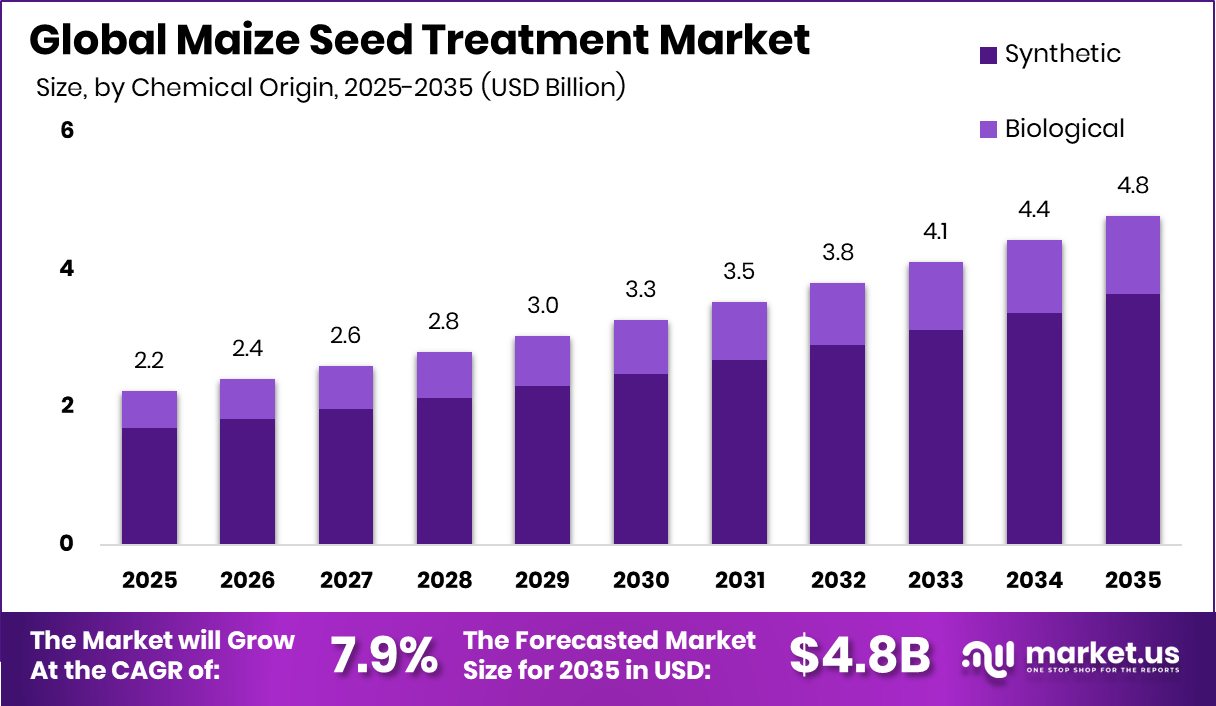
The Global Maize Seed Treatment Market is expected to be worth around USD 4.8 billion by 2034, up from USD 2.2 billion in 2024, and is projected to grow at a CAGR of 7.9% from 2025 to 2034. Advanced farming technologies support the North America Maize Seed Treatment Market, accounting for 38.9%, valued at USD 0.8 Bn.
Maize seed treatment refers to the process of applying protective substances such as insecticides, fungicides, or biological agents directly onto maize seeds before planting. This treatment helps safeguard seeds from soil-borne pests, fungal infections, and other early-stage threats that may reduce germination or weaken seedlings. By protecting seeds during the initial growth phase, seed treatment improves crop establishment, promotes healthier plant development, and supports more stable maize yields in different farming environments.
The Maize Seed Treatment Market includes the production and use of chemical and biological products applied to maize seeds to improve crop protection and early plant growth. The market is structured across segments such as chemical origin, including synthetic and biological treatments, product types, including insecticides, fungicides, and other protective formulations, and applications across farm-level and commercial seed treatment practices. These solutions are used to ensure seed quality, reduce crop loss risks, and improve productivity in maize cultivation.
The market is supported by an increasing focus on protecting seeds at the earliest stage of crop development. Farmers globally use nearly $60 billion of pesticides each year, highlighting the scale of crop protection needs and encouraging the development of more efficient treatment technologies. Research support is also expanding, as two Cornell research teams received grants totalling nearly $900,000 from the U.S. Department of Agriculture’s National Institute of Food and Agriculture (NIFA) to study crop viruses and insecticide impacts on insects. These efforts contribute to advancements in seed protection solutions and improved agricultural practices.
Demand for maize seed treatment solutions is rising as farmers seek practical ways to protect crops while improving productivity. Seed treatments provide a targeted protection approach by treating seeds before planting, reducing early pest damage and improving germination rates. The growing shift toward environmentally responsible crop protection is also influencing demand. For example, Solasta Bio secured £10.7 million in investment to develop bioinsecticides, reflecting increasing interest in innovative biological solutions that support sustainable agriculture while maintaining crop protection effectiveness.
Opportunities in the maize seed treatment market are expanding with the development of next-generation biological technologies and eco-friendly crop protection solutions. Innovation in green insecticides and biological treatments is attracting strong investment and research support. For instance, Glasgow-based Solasta Bio raised $14 million in Series A funding to advance green insecticide development, highlighting the growing momentum behind sustainable pest management technologies. In addition, new scientific approaches, such as technologies developed by two MIT scientists that could potentially reduce global pesticide use by half, indicate long-term opportunities for more efficient and environmentally responsible seed treatment solutions.
Key Takeaways
- The Global Maize Seed Treatment Market is expected to be worth around USD 4.8 billion by 2034, up from USD 2.2 billion in 2024, and is projected to grow at a CAGR of 7.9% from 2025 to 2034.
- Synthetic chemicals dominate the Maize Seed Treatment Market, accounting for 76.1% due to strong pest protection.
- Insecticides lead product demand in the Maize Seed Treatment Market, capturing 49.8% share for pest control.
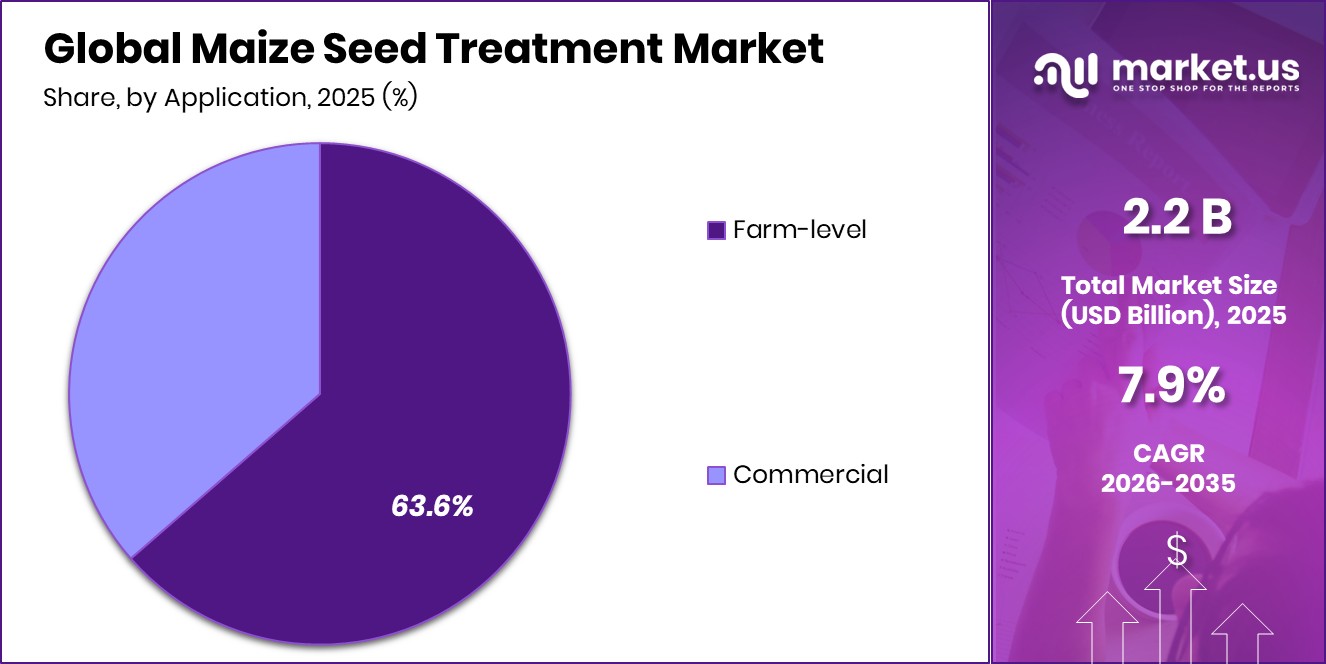
- Farm-level applications dominate the Maize Seed Treatment Market with a 63.6% share, driven by on-field seed protection.
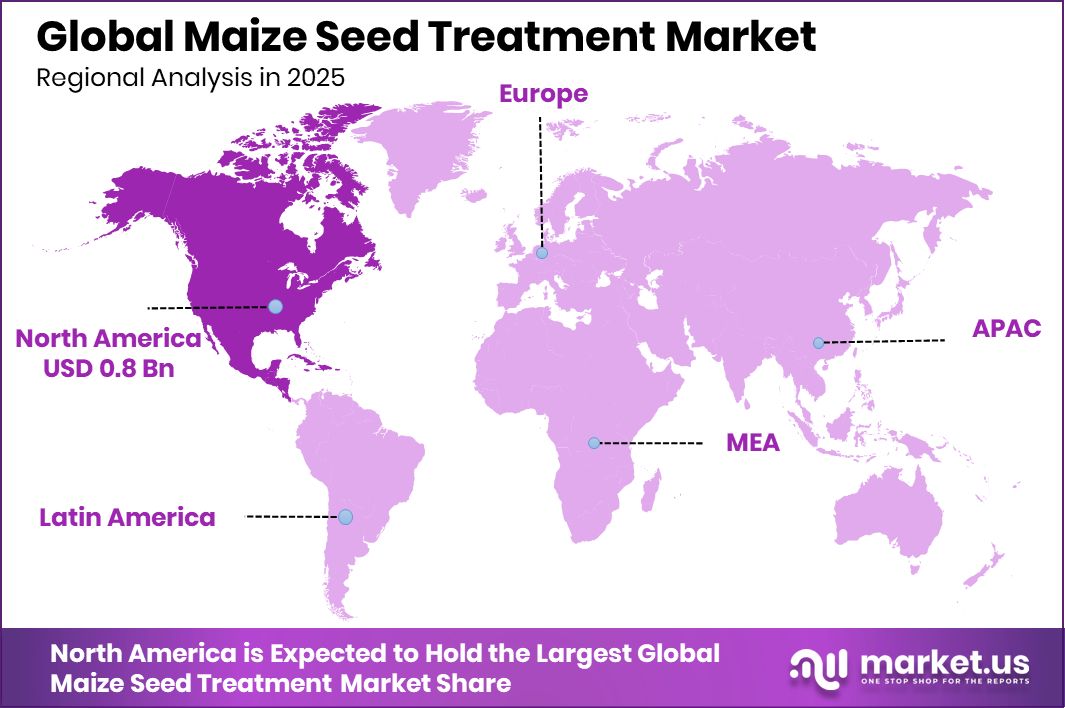
- Strong maize cultivation drives the North America Maize Seed Treatment Market growth, reaching 38.9%, USD 0.8 Bn.
By Chemical Origin Analysis
Synthetic chemicals dominate the Maize Seed Treatment Market, accounting for 76.1% share globally.
In 2025, synthetic formulations dominate the Maize Seed Treatment Market, accounting for 76.1% of the total share due to their consistent effectiveness, longer shelf life, and strong protection against early-stage pests and diseases affecting maize crops. Farmers and commercial seed producers widely adopt synthetic seed treatment chemicals because they provide reliable germination support, improved seedling vigour, and broad-spectrum control of pathogens and soil-borne insects that can significantly reduce maize yield potential.
The continued dominance of synthetic products is also supported by advancements in agrochemical research, improved formulation technologies, and large-scale adoption across major maize-producing regions such as North America, Asia-Pacific, and Latin America, where maximising crop productivity and protecting seeds during early growth stages remain critical priorities for agricultural sustainability.
By Product Type Analysis
Insecticides lead product types in the Maize Seed Treatment Market, capturing 49.8% demand worldwide.
In 2025, insecticides represent the leading product type in the Maize Seed Treatment Market, capturing 49.8% of the market share as they play a crucial role in protecting maize seeds from early-stage insect attacks and soil-dwelling pests. These treatments are widely used to safeguard maize crops from threats such as wireworms, seedcorn maggots, and grubs that damage seeds before or shortly after germination, potentially causing significant yield losses.
The strong demand for insecticidal seed treatments is driven by increasing pest pressure, rising maize cultivation globally, and farmers’ preference for preventive crop protection solutions that reduce the need for multiple foliar pesticide applications later in the growing season while ensuring healthier plant establishment and improved crop productivity.
By Application Analysis
Farm-level application drives the Maize Seed Treatment Market, representing 63.6% usage across agricultural operations.
In 2025, farm-level application accounts for 63.6% of the Maize Seed Treatment Market, reflecting the widespread practice of farmers applying seed treatments directly on farms to ensure timely protection against pests and diseases before planting. This approach allows growers greater flexibility in selecting treatment combinations tailored to local soil conditions, pest pressures, and climatic factors, helping improve seed performance and crop establishment.
The growth of farm-level seed treatment is further supported by increasing awareness among farmers about crop protection technologies, the availability of easy-to-use treatment formulations, and the rising adoption of precision farming practices that encourage on-site seed preparation to enhance germination rates and optimise maize yield potential.
Key Market Segments
By Chemical Origin
- Synthetic
- Biological
By Product Type
- Insecticides
- Fungicides
- Others
By Application
- Farm-level
- Commercial
Driving Factors
Rising maize cultivation increases seed treatment demand
The expansion of maize cultivation across major agricultural regions continues to strengthen demand for seed treatment solutions that protect seeds during early crop development. Farmers increasingly rely on seed treatments to reduce losses from soil-borne pests and diseases while ensuring stronger germination and seedling establishment. As maize production expands to meet food, feed, and industrial demand, seed protection before planting has become a practical step to maintain crop productivity. Technology innovation is also supporting this trend.
Greeneye Technology closed a $20 million funding round and announced new solutions in AI precision spraying, reflecting growing investment in advanced crop protection technologies that help farmers apply treatments more efficiently. Such technological developments are influencing modern farming practices and encouraging the adoption of improved seed protection approaches within the Maize Seed Treatment Market.
Restraining Factors
Strict pesticide regulations limit chemical treatments
Regulatory pressure surrounding the use of chemical pesticides is becoming a key restraint for the Maize Seed Treatment Market, as many governments strengthen rules on crop protection products to address environmental and health concerns. Restrictions on certain chemical ingredients can limit the availability of traditional seed treatment formulations, forcing producers and farmers to adjust to new compliance requirements. Approval timelines for new treatments are also becoming longer, which may slow product availability in some regions.
At the same time, the industry is exploring technological alternatives to conventional pesticide use. For instance, Switzerland’s Ecorobotix raised $52 million to bring crop protection robots to the Americas, highlighting how automation and precision technologies are emerging as alternative approaches to crop protection where chemical regulations are tightening.
Growth Opportunity
Increasing demand for biological seed treatments
The growing interest in sustainable agriculture is creating strong opportunities for biological seed treatment solutions within the Maize Seed Treatment Market. Farmers and agricultural stakeholders are increasingly exploring biological options that support pest and disease management while reducing dependence on synthetic chemicals. Biological seed treatments derived from natural microorganisms or plant-based compounds can help improve seed health, protect crops during early growth, and support environmentally responsible farming practices.
Research and innovation are also expanding rapidly in this area. For example, the University of Exeter launched a global research network and awarded £1.7 million toward antifungal resistance innovations, supporting the development of new scientific approaches to manage crop diseases. Such research initiatives are expected to encourage further advancements in biological crop protection technologies.
Latest Trends
Adoption of eco-friendly biological seed treatments
A significant trend shaping the Maize Seed Treatment Market is the increasing adoption of environmentally friendly seed protection technologies that reduce chemical dependency while maintaining crop performance. Biological treatments and innovative crop protection methods are gaining attention as farmers look for sustainable alternatives that align with evolving agricultural practices and regulatory expectations.
Advanced technologies are also supporting this transition. For example, Saga Robotics raised $11.2 million to expand its fleet of robots that control powdery mildew using UV-C light, demonstrating how non-chemical approaches are emerging alongside biological solutions in modern crop protection. These innovations highlight the broader shift toward environmentally responsible farming methods that focus on precision, sustainability, and improved crop health from the earliest stages of plant development.
Regional Analysis
In 2025, North America leads the maize seed treatment market with a 38.9% share, valued at USD 0.8 Bn.
The Maize Seed Treatment Market demonstrates varied regional performance across North America, Europe, Asia Pacific, the Middle East & Africa, and Latin America, reflecting differences in maize cultivation intensity, adoption of crop protection technologies, and agricultural practices.
North America represents the dominating region in the global maize seed treatment market, accounting for 38.9% of the market share, valued at USD 0.8 Bn, supported by large-scale maize production and widespread adoption of seed treatment technologies to protect crops from pests and diseases during early growth stages. The region benefits from highly mechanised farming systems, strong awareness among growers regarding crop protection solutions, and the extensive use of treated hybrid maize seeds across major maize-producing areas.
Europe maintains a steady presence in the market, driven by structured agricultural practices and consistent demand for high-quality seed treatment solutions that improve germination and crop establishment. Asia Pacific is experiencing increasing adoption due to expanding maize cultivation and the gradual shift toward improved seed technologies among farmers.
Meanwhile, the Middle East & Africa and Latin America are emerging regions where maize farming continues to expand, supporting the gradual uptake of seed treatment products to improve crop productivity and protect seeds during early development stages.
Key Regions and Countries
- North America
- US
- Canada
- Europe
- Germany
- France
- The UK
- Spain
- Italy
- Rest of Europe
- Asia Pacific
- China
- Japan
- South Korea
- India
- Australia
- Rest of APAC
- Latin America
- Brazil
- Mexico
- Rest of Latin America
- Middle East & Africa
- GCC
- South Africa
- Rest of MEA
Key Players Analysis
In 2025, BASF SE continues to play an influential role in the global market for maize seed treatments through its strong expertise in agricultural chemistry and seed protection technologies. The company focuses on developing innovative treatment formulations designed to protect maize seeds from early-stage pests and soil-borne diseases while supporting healthy seedling establishment. BASF’s integrated approach combines advanced chemical solutions with seed enhancement technologies that improve seed performance and crop resilience. Its strong research capabilities and global agricultural presence allow the company to collaborate closely with seed producers and growers, helping deliver effective treatment solutions tailored for maize cultivation environments.
Bayer AG remains a key participant in the market for maize seed treatments, supported by its broad crop science portfolio and deep expertise in seed technologies. The company emphasises the development of advanced seed treatment products that provide protection during the critical germination and early growth stages of maize crops. Bayer’s approach integrates seed protection with agronomic innovation, enabling farmers to improve crop establishment and manage early pest pressures more effectively. Its strong global footprint and partnerships with seed companies strengthen its position in delivering high-performance treatment solutions to maize growers.
Syngenta maintains a significant presence in maize seed treatment through its focus on crop protection and seed innovation. The company prioritises developing solutions that safeguard maize seeds against insects and diseases while enhancing early plant vigour. Syngenta’s seed treatment offerings are designed to support consistent crop emergence and improved field performance, helping growers protect yield potential from the earliest stages of maize cultivation.
Top Key Players in the Market
- BASF SE
- Bayer AG
- Syngenta
- Adama
- UPL Limited
- Advanced Biological Marketing Inc.
- Corteva
- Incotec Group BV
Recent Developments
- In March 2025, Bayer AG opened a new maize seed production facility in Kabwe, Zambia, to increase the high-quality maize seed supply for farmers. The company develops crop science solutions, including seed technologies and treatments that improve seed performance and early crop protection. The new site increases the capacity for maize seed production and supports millions of smallholder farmers with improved seeds for better crop establishment and productivity.
- In January 2024, BASF SE launched the Ceremevo fungicide designed for chemical seed treatments used in crops, including maize. The product improves protection against seed-borne fungal diseases and supports stronger seedling growth and crop productivity for farmers.
Report Scope
Report Features Description Market Value (2025) USD 2.2 Billion Forecast Revenue (2035) USD 4.8 Billion CAGR (2026-2035) 7.9% Base Year for Estimation 2025 Historic Period 2020-2024 Forecast Period 2026-2035 Report Coverage Revenue Forecast, Market Dynamics, Competitive Landscape, Recent Developments Segments Covered By Chemical Origin (Synthetic, Biological), By Product Type (Insecticides, Fungicides, Others), By Application (Farm-level, Commercial) Regional Analysis North America – US, Canada; Europe – Germany, France, The UK, Spain, Italy, Rest of Europe; Asia Pacific – China, Japan, South Korea, India, Australia, Singapore, Rest of APAC; Latin America – Brazil, Mexico, Rest of Latin America; Middle East & Africa – GCC, South Africa, Rest of MEA Competitive Landscape BASF SE, Bayer AG, Syngenta, Adama, UPL Limited, Advanced Biological Marketing Inc., Corteva, Incotec Group BV Customization Scope Customization for segments, region/country-level will be provided. Moreover, additional customization can be done based on the requirements. Purchase Options We have three licenses to opt for: Single User License, Multi-User License (Up to 5 Users), Corporate Use License (Unlimited User and Printable PDF)  Maize Seed Treatment MarketPublished date: March 2026add_shopping_cartBuy Now get_appDownload Sample
 -
-
- BASF SE
- Bayer AG
- Syngenta
- Adama
- UPL Limited
- Advanced Biological Marketing Inc.
- Corteva
- Incotec Group BV
Our Clients

- 180800
- March 2026






