


Global Lodophors Market Size, Share, And Enhanced Productivity By Type (Iodine Tincture, Iodine Ointment, Iodine Solution, Iodine Swabs, Iodine Spray), By Application (Antiseptic, Disinfectant, Wound Care, Veterinary Care, Food Safety, Others), By End-Use (Healthcare, Pharmaceutical, Food and Beverage, Agriculture, Animal Health, Others), By Region and Companies - Industry Segment Outlook, Market Assessment, Competition Scenario, Trends, and Forecast 2026-2035
- Published date: March 2026
- Report ID: 180264
- Number of Pages: 332
- Format:
-
keyboard_arrow_up
Quick Navigation
Report Overview
The Global Lodophors Market is expected to be worth around USD 6.1 billion by 2035, up from USD 3.6 billion in 2025, and is projected to grow at a CAGR of 5.4% from 2026 to 2035. The iodophors market in North America reached USD 1.5 Bn, capturing 41.9% regional share.
Iodophors are iodine-based compounds formed by combining iodine with a solubilizing agent or carrier. This combination allows iodine to be released slowly, making it effective for antimicrobial use while reducing irritation compared with pure iodine solutions. Iodophors are widely used for skin preparation, wound cleaning, and surface sanitation because they help control bacteria, fungi, and viruses. Common forms include iodine tincture, iodine ointment, iodine solutions, iodine swabs, and iodine sprays. These formulations are applied across healthcare, veterinary treatment, and sanitation processes where dependable microbial control is required.

The Iodophors Market refers to the commercial production, distribution, and use of iodine-based disinfectant and antiseptic products across multiple sectors. Products within this market serve applications such as antiseptic care, disinfectant use, wound treatment, veterinary care, and food safety and sanitation. End-use industries include healthcare facilities, pharmaceutical operations, food and beverage processing, agriculture, and animal health services. The market reflects demand for reliable hygiene solutions that support infection control, sanitation compliance, and microbial safety in both medical and industrial environments.
Growth in the iodophors market is largely influenced by the continued focus on hygiene and infection control across healthcare and industrial environments. Hospitals, laboratories, and sanitation-sensitive industries rely on iodine-based solutions for routine disinfection and wound treatment. Expansion of healthcare infrastructure, growing clinical procedures, and increased awareness of microbial safety practices continue to encourage the use of dependable antiseptic formulations.
Demand for iodophors is driven by their versatility and effectiveness in multiple applications. Healthcare facilities use them for surgical preparation and wound care, while food processing operations rely on iodine-based disinfectants to maintain sanitation standards. Veterinary care and agriculture sectors also depend on iodophors for infection prevention and animal treatment, supporting consistent demand across diverse end-use industries.
Opportunities in the broader healthcare technology landscape are also shaping supportive innovation environments. For example, Waystar finalized a $1.25 billion acquisition of Iodine Software to strengthen AI-enabled revenue cycle management capabilities. Additionally, Advent acquired a significant stake in Iodine Software, raising its valuation to $1 billion, while CodaMetrix secured $40 million in Series B funding at HIMSS24 to advance AI-driven revenue cycle tools. Such investments highlight growing interest in healthcare efficiency and digital solutions that indirectly support improved clinical operations and infection management practices.
Key Takeaways
- The Global Lodophors Market is expected to be worth around USD 6.1 billion by 2035, up from USD 3.6 billion in 2025, and is projected to grow at a CAGR of 5.4% from 2026 to 2035.
- Iodine Tincture dominates the iodophors market by type with a 37.3% share.
- Antiseptic applications lead the Iodophors Market, accounting for 41.5% of total demand.
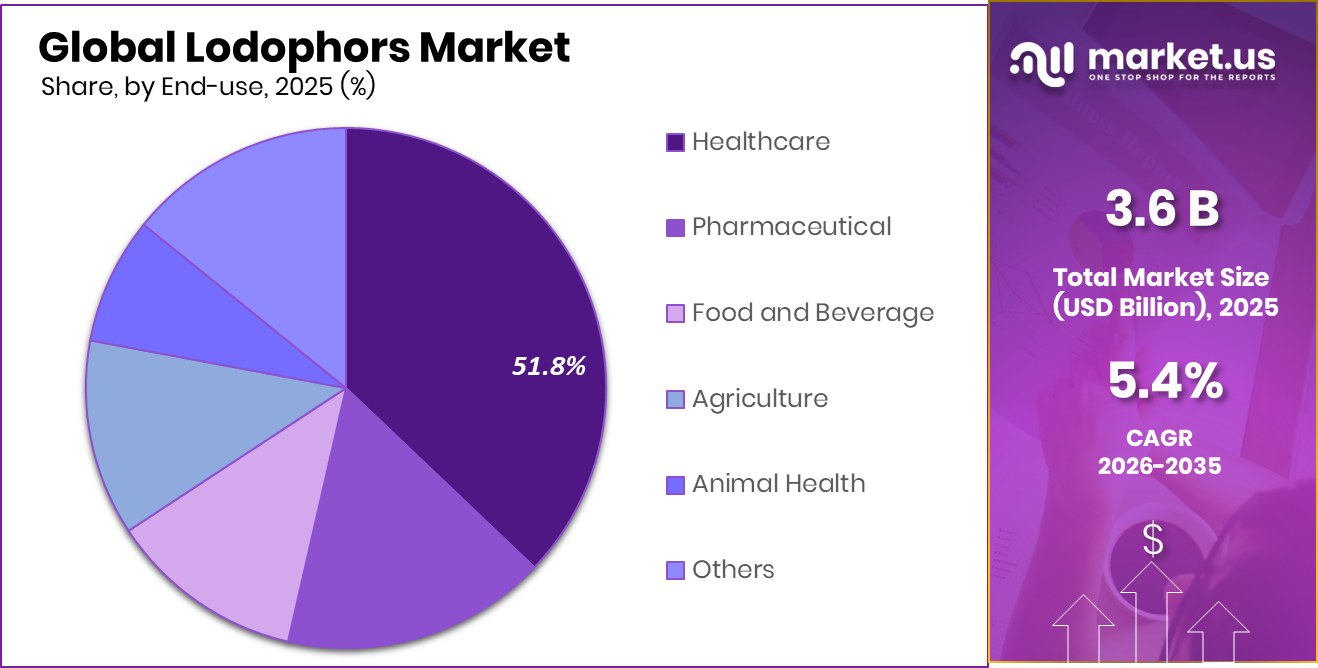
- Healthcare end-use dominates the iodophors market with a significant 51.8% market share globally.
- North America accounted for 41.9% of the iodophors market, with a valuation of around USD 1.5 Bn.
By Type Analysis
Iodine tincture accounts for 37.3% share in the Iodophors Market.
In 2025, iodine tincture accounted for a significant 37.3% share of the Iodophors market, reflecting its long-standing reliability and effectiveness as a disinfectant. This formulation is widely recognized for its strong antimicrobial properties, making it a preferred option across medical and sanitation settings. Healthcare professionals continue to rely on iodine tincture for wound cleaning, surgical site preparation, and general infection control due to its rapid action against bacteria, fungi, and viruses.
The growth of this segment is also supported by increasing awareness regarding hygiene and infection prevention, particularly in clinical environments. Additionally, iodine tincture remains cost-effective and readily available, which encourages its use in both developed and developing healthcare systems. As healthcare infrastructure expands globally, demand for iodine tincture within the broader Iodophors market is expected to remain steady.
By Application Analysis
Antiseptic applications dominate the Iodophors Market, holding 41.5% usage share globally.
In 2025, antiseptic applications represented the largest share of the Iodophors market at 41.5%, highlighting the widespread use of iodine-based solutions for infection prevention. Iodophors are commonly utilized as antiseptics in hospitals, clinics, and first-aid settings due to their broad-spectrum antimicrobial activity. These formulations help reduce the risk of contamination during medical procedures, wound treatment, and skin disinfection before surgery. Their ability to release iodine gradually improves effectiveness while minimizing irritation compared to traditional iodine solutions.
The growing emphasis on patient safety and hospital hygiene has further strengthened demand for iodophor antiseptics. In addition, increased awareness of infection control practices across both professional healthcare facilities and home care environments continues to drive adoption. As healthcare providers prioritize reliable disinfection solutions, antiseptic applications remain a major contributor to the Iodophors market.
By End-Use Analysis
Healthcare end-use leads the Iodophors Market with a 51.8% share worldwide.
In 2025, the healthcare sector dominated the Iodophors market with a 51.8% share, driven by the extensive use of iodine-based disinfectants in hospitals, clinics, and diagnostic centers. Healthcare facilities rely heavily on iodophors for surgical preparation, wound management, and equipment sanitation due to their proven effectiveness against a wide range of microorganisms. The increasing number of medical procedures and the growing focus on infection prevention have significantly supported demand within this sector.
Furthermore, strict hygiene protocols implemented by healthcare institutions and regulatory authorities continue to encourage the use of reliable antiseptic solutions. The expansion of healthcare infrastructure, particularly in emerging economies, has also contributed to market growth. As medical services continue to expand and infection control remains a priority, the healthcare segment is expected to maintain its leading role in the Iodophors market.
Key Market Segments
By Type
- Iodine Tincture
- Iodine Ointment
- Iodine Solution
- Iodine Swabs
- Iodine Spray
By Application
- Antiseptic
- Disinfectant
- Wound Care
- Veterinary Care
- Food Safety
- Others
By End-Use
- Healthcare
- Pharmaceutical
- Food and Beverage
- Agriculture
- Animal Health
- Others
Driving Factors
Rising healthcare hygiene awareness globally
Growing awareness about hygiene and infection prevention continues to support demand in the Lodophors Market. Healthcare facilities, laboratories, and sanitation-sensitive environments are placing greater focus on reliable antimicrobial solutions for daily disinfection and wound care. Lodophor-based products are commonly used because they release iodine gradually and provide effective microbial control.
The increasing emphasis on hospital cleanliness and surface sanitation has also drawn attention from innovation-focused companies. For instance, Kinnos raised another $15M to ensure hospital surfaces are properly disinfected, highlighting the ongoing push toward stronger infection-prevention practices. Such developments reflect the broader industry movement toward improving sanitation reliability in clinical environments, which indirectly supports consistent use of iodophor antiseptic products across healthcare settings where microbial control remains essential.
Restraining Factors
Skin irritation concerns from iodine products
Despite their effectiveness, some iodophor formulations may cause mild skin irritation or sensitivity in certain individuals, which can influence product selection in sensitive medical or consumer applications. Healthcare providers sometimes evaluate alternative disinfection approaches when treating patients with iodine sensitivities or when repeated exposure is involved. In parallel, other sanitation technologies are being developed that compete with chemical disinfectants.
A notable example is Germitec raising €28.8 million to advance UV-C high-level disinfection technology used in ultrasound equipment sanitation. Innovations like this demonstrate how healthcare facilities are exploring additional disinfection methods alongside traditional iodine-based antiseptics. While iodophors remain widely used, the availability of alternative technologies may slightly limit adoption in environments where non-chemical disinfection approaches are preferred.
Growth Opportunity
Expanding healthcare infrastructure in developing regions
Expansion of healthcare infrastructure in emerging and developing regions is creating new opportunities for the Lodophors Market. As hospitals, clinics, and diagnostic centers continue to grow, the need for dependable antiseptic and disinfectant solutions increases. Lodophor products are frequently used in wound care, surgical preparation, and equipment sanitation, making them important in expanding healthcare systems. Government and institutional investments in research and healthcare technology are also encouraging broader innovation in medical safety.
For example, the U.S. Army awarded a $1 million grant to the University of Central Florida for the development of a semiconductor light source, supporting advanced medical and technology research. Additionally, lawmakers have provided $170 billion in funding to K-12 schools and colleges to help reopen classrooms safely, further highlighting the importance of sanitation and infection control across public environments.
Latest Trends
Rising adoption of ready-to-use iodine formulations
One of the emerging trends in the Lodophors Market is the increasing use of ready-to-use iodine formulations designed to simplify disinfection procedures. Pre-prepared iodophor solutions, sprays, and swabs help healthcare workers apply antiseptics quickly without additional mixing or preparation, improving workflow efficiency. These formats are gaining attention in hospitals, clinics, and veterinary settings where quick and consistent antimicrobial application is required. Alongside this trend, the sanitation technology sector is seeing strong investment interest.
For instance, disinfection robotics company PeroPure raised nearly $10 million in new funding to expand automated sanitation systems. Developments like this highlight the growing focus on advanced disinfection approaches while reinforcing the continued importance of dependable antimicrobial solutions, including iodine-based disinfectants used across healthcare and sanitation environments.
Regional Analysis
In 2025, North America held a 41.9% share in the iodophors market, reaching USD 1.5 Bn.
.The Iodophors market demonstrates varied regional performance across North America, Europe, Asia Pacific, the Middle East & Africa, and Latin America, reflecting differences in healthcare infrastructure, sanitation standards, and industrial hygiene practices.
In 2025, North America emerged as the dominating region, accounting for 41.9% of the global market with a value of USD 1.5 Bn. The region’s strong position is supported by well-established healthcare systems, high adoption of advanced antiseptic solutions, and strict infection control standards across hospitals, laboratories, and food processing industries. Continuous demand for reliable disinfectants in clinical and pharmaceutical environments also contributes to sustained consumption of iodophor-based products across the United States and Canada.
Meanwhile, Europe represents another significant regional market, supported by strong regulatory frameworks and widespread use of antiseptic and sanitation solutions across medical and industrial applications.
The Asia Pacific region is witnessing expanding adoption due to increasing healthcare awareness and growing sanitation requirements across healthcare facilities and food processing sectors. In contrast, the Middle East & Africa and Latin America markets are developing steadily, supported by improving healthcare services, expanding hygiene practices, and growing utilization of iodine-based disinfectants across healthcare and industrial environments.

Key Regions and Countries
- North America
- US
- Canada
- Europe
- Germany
- France
- The UK
- Spain
- Italy
- Rest of Europe
- Asia Pacific
- China
- Japan
- South Korea
- India
- Australia
- Rest of APAC
- Latin America
- Brazil
- Mexico
- Rest of Latin America
- Middle East & Africa
- GCC
- South Africa
- Rest of MEA
Key Players Analysis
In 2025, Becton Dickinson and Company continues to play an important role in the global Iodophors market through its strong presence in healthcare and infection prevention solutions. The company’s focus on safety, sterilization practices, and clinical efficiency supports the use of iodine-based antiseptic formulations within healthcare environments. Its long-standing relationships with hospitals, laboratories, and healthcare providers allow it to maintain consistent demand for disinfectant and antiseptic products used in clinical procedures. By emphasizing product reliability and healthcare safety standards, the company strengthens its position in environments where effective microbial control is essential.
Ecolab Inc. holds a strategic position in the Iodophors market through its expertise in sanitation, cleaning technologies, and infection prevention systems. The company’s operational focus on hygiene management across healthcare, food processing, and institutional sectors aligns closely with the practical applications of iodophor-based disinfectants. Its integrated sanitation solutions support consistent disinfection protocols, particularly in environments requiring strict hygiene compliance. Through its broad service network and technical support capabilities, the company maintains a stable role in promoting effective sanitation practices across professional facilities.
Hygiena LLC contributes to the Iodophors market by emphasizing microbial monitoring and hygiene verification technologies. The company’s focus on contamination detection and sanitation validation encourages the adoption of reliable disinfectant solutions within regulated environments. Its solutions help organizations monitor hygiene standards more effectively, supporting the broader use of disinfectants such as iodophors in sanitation programs. By aligning microbial testing with sanitation practices, the company supports improved infection control and cleanliness management across healthcare and industrial settings.
Top Key Players in the Market
- Becton Dickinson and Company
- Ecolab Inc.
- Hygiena LLC
- Steris plc
- Kao Corporation
- B. Braun Melsungen AG
Recent Developments
- In December 2024, Hygiena LLC, which develops microbial detection and sanitation monitoring solutions, acquired Nexcor Food Safety Technologies in December 2024. Nexcor created the KLEANZ and CAMS-PM sanitation management software used in food and beverage facilities. The deal helps Hygiena strengthen sanitation monitoring and food safety management solutions.
- In March 2024, Ecolab Inc. strengthened its iodine-based disinfection portfolio used in healthcare and hygiene applications. The company continued promoting povidone-iodine disinfectant solutions designed for hand and skin disinfection in healthcare settings, helping control bacteria, yeast, and viruses.
Report Scope
Report Features Description Market Value (2025) USD 3.6 Billion Forecast Revenue (2035) USD 6.1 Billion CAGR (2026-2035) 5.4% Base Year for Estimation 2025 Historic Period 2020-2024 Forecast Period 2026-2035 Report Coverage Revenue Forecast, Market Dynamics, Competitive Landscape, Recent Developments Segments Covered By Type (Iodine Tincture, Iodine Ointment, Iodine Solution, Iodine Swabs, Iodine Spray), By Application (Antiseptic, Disinfectant, Wound Care, Veterinary Care, Food Safety, Others), By End-Use (Healthcare, Pharmaceutical, Food and Beverage, Agriculture, Animal Health, Others) Regional Analysis North America – US, Canada; Europe – Germany, France, The UK, Spain, Italy, Rest of Europe; Asia Pacific – China, Japan, South Korea, India, Australia, Singapore, Rest of APAC; Latin America – Brazil, Mexico, Rest of Latin America; Middle East & Africa – GCC, South Africa, Rest of MEA Competitive Landscape Becton Dickinson and Company, Ecolab Inc., Hygiena LLC, Steris plc, Kao Corporation, B. Braun Melsungen AG Customization Scope Customization for segments, region/country-level will be provided. Moreover, additional customization can be done based on the requirements. Purchase Options We have three licenses to opt for: Single User License, Multi-User License (Up to 5 Users), Corporate Use License (Unlimited User and Printable PDF) 
-
-
- Becton Dickinson and Company
- Ecolab Inc.
- Hygiena LLC
- Steris plc
- Kao Corporation
- B. Braun Melsungen AG
Our Clients

- 180264
- March 2026






