


Global Friction Modifiers Market Size, Share, And Enhanced Productivity By Type of Modifiers (Organic Friction Modifiers, Organomolybdenum Friction Modifiers, Polymer Friction Modifiers), By Compound Type (Organic, Inorganic), By Application (Commercial Vehicles, Passenger Vehicles, Others), By Region and Companies - Industry Segment Outlook, Market Assessment, Competition Scenario, Trends, and Forecast 2026-2035
- Published date: February 2026
- Report ID: 179679
- Number of Pages: 291
- Format:
-
keyboard_arrow_up
Quick Navigation
Report Overview
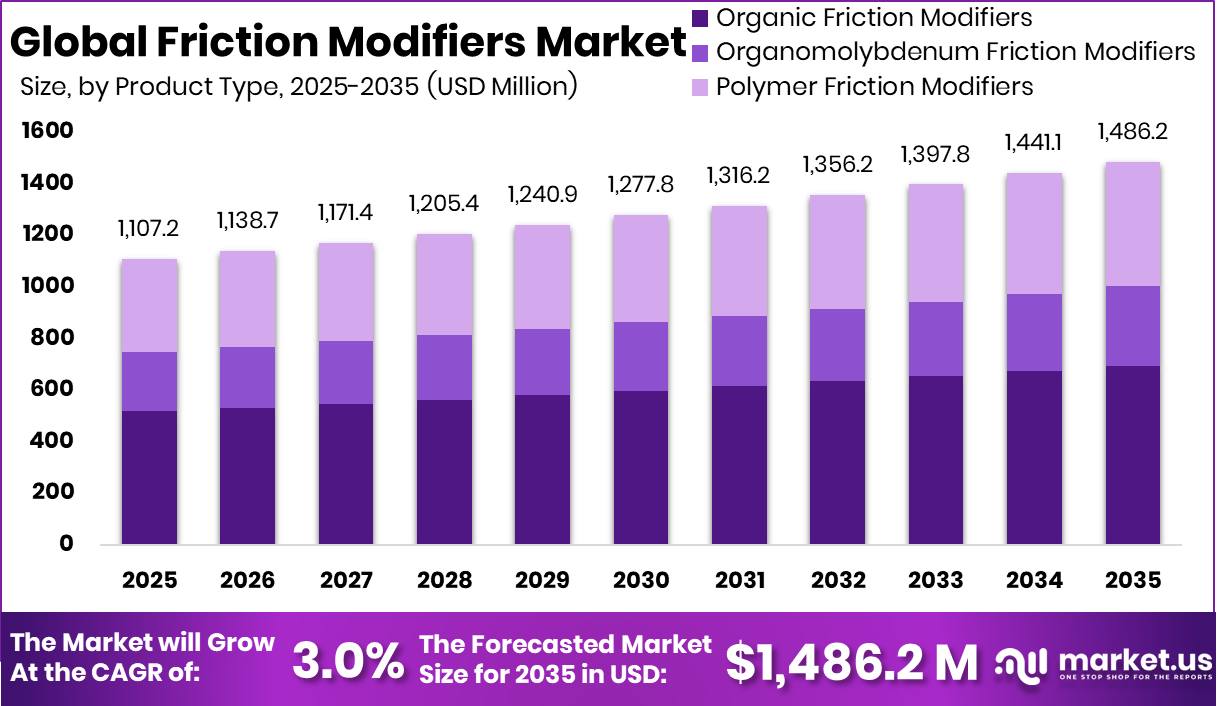
The Global Friction Modifiers Market is expected to be worth around USD 1,486.2 million by 2035, up from USD 1,107.2 million in 2025, and is projected to grow at a CAGR of 3.0% from 2026 to 2035. Asia Pacific accounted for 45.2% market share, totaling USD 500.4 Mn overall.
Friction modifiers are specialty additives used in lubricants to reduce surface resistance between moving parts, helping engines and machinery run smoothly. They work by forming a protective layer that minimizes wear, improves fuel efficiency, and supports longer equipment life. These additives appear in forms such as organic friction modifiers, organomolybdenum compounds, and polymer-based solutions, each offering unique performance benefits across automotive and industrial uses.
The Friction Modifiers Market refers to the commercial ecosystem that develops, manufactures, and supplies these additives for different compound types—primarily organic and inorganic. Demand is shaped by the need for efficient lubrication in commercial vehicles, passenger vehicles, and various other mechanical applications where smoother motion and durability matter.
Market growth is supported by rising interest in cleaner mobility solutions and greater efficiency across transport fleets. Recent funding activities, such as Mitra EV raising $27 million to scale fleet electrification, highlight the momentum in improving energy efficiency. This supports broader demand for advanced friction-reducing additives.
Opportunities also rise as charging and clean-transport infrastructure expands. Investments such as EV Realty securing $75 million, Nevoya raising $9.3 million, and Glid receiving $3.1 million for road-to-rail autonomy reflect a strong push toward optimized energy use, creating space for friction modifiers that enhance performance in evolving mobility systems.
Key Takeaways
- The Global Friction Modifiers Market is expected to be worth around USD 1,486.2 million by 2035, up from USD 1,107.2 million in 2025, and is projected to grow at a CAGR of 3.0% from 2026 to 2035.
- The friction modifiers market was dominated by organic friction modifiers, holding a strong 46.7% share globally.
- In the compound type, the Friction Modifiers Market was dominated by organic compounds with 67.9% share.
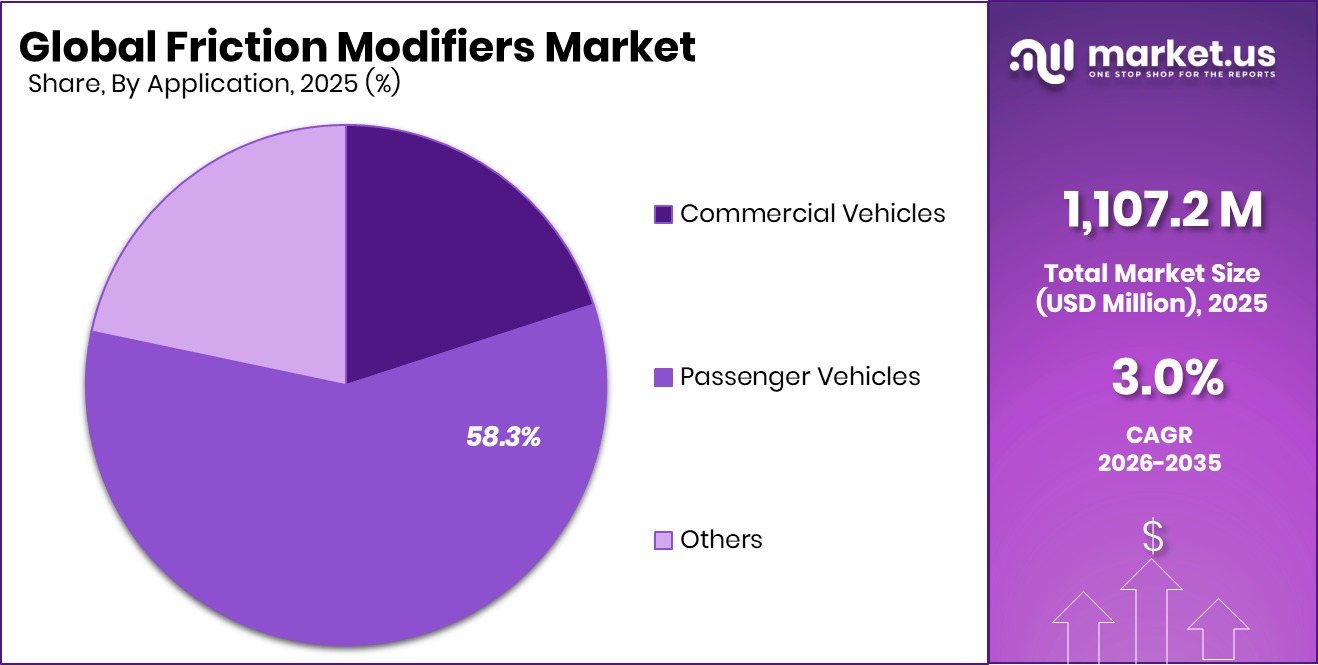
- Passenger vehicles dominated the Friction Modifiers Market applications segment, capturing a significant 58.3% overall share.
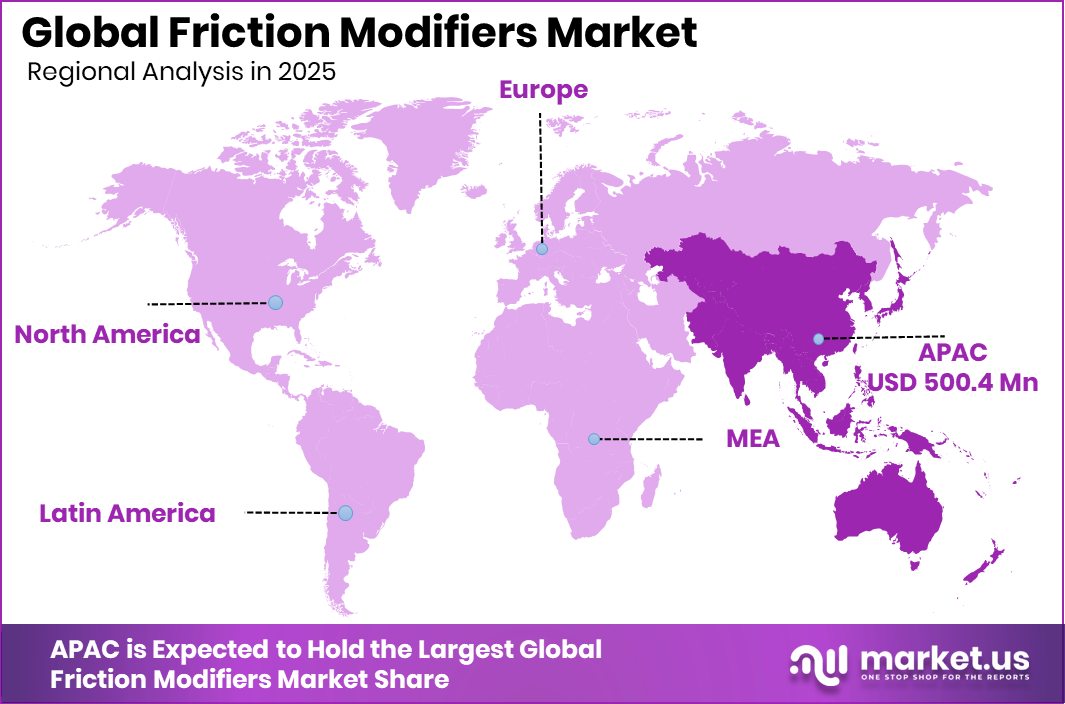
- Friction Modifiers Market in Asia Pacific reached USD 500.4 Mn with 45.2% dominance.
By Type of Modifiers Analysis
Friction Modifiers Market is dominated by Organic Friction Modifiers, holding a strong 46.7% share.
In 2025, the Friction Modifiers Market continued to evolve as manufacturers focused on efficiency, durability, and sustainability across automotive and industrial systems. Within this landscape, organic friction modifiers dominated the market with a strong 46.7% share, reflecting increasing preference for cleaner, biodegradable, and performance-oriented additives. Their ability to reduce wear, enhance fuel economy, and support emission-reduction goals made them the first choice for lubricant formulators globally.
Growing demand from transportation fleets and heavy-duty machinery further strengthened their presence. As regulations pushed OEMs to adopt low-viscosity lubricants, organic modifiers gained wider acceptance due to their compatibility and stability. This steady shift signaled a long-term transition toward environmentally aligned lubrication chemistry.
By Compound Type Analysis
Organic compound type dominated the Friction Modifiers Market with a significant 67.9% share.
In 2025, the market structure showed a clear preference for advanced chemical compositions as industries sought consistent performance under varied temperature and load conditions. Organic compounds dominated the Friction Modifiers Market, accounting for 67.9% of the overall share, supported by their strong bonding capability, stable friction control, and adaptability in modern engine oils. Their growing use in synthetic and semi-synthetic lubricants reinforced their leadership.
Manufacturers leaned toward organic formulations due to fewer environmental concerns and superior additive synergy when blended with detergents, dispersants, and anti-wear agents. This dominance was also fueled by rising automotive production, tighter fuel economy standards, and the need for smooth operation in hybrid engines, where controlled friction is essential.
By Application Analysis
Passenger vehicles dominated the Friction Modifiers Market, accounting for a leading 58.3% share.
In 2025, the Friction Modifiers Market saw major traction from the transportation sector, reflecting rapid consumer mobility trends and the global shift toward cleaner vehicle technologies. Passenger vehicles held the dominant position with a 58.3% market share, driven by expanding car ownership, growing hybrid model adoption, and increasing demand for high-performance lubricants.
OEM recommendations for low-friction engine oils further boosted consumption, ensuring improved fuel efficiency and lower CO₂ emissions. Passenger car engines, transmissions, and drivetrains rely heavily on friction-adjusting additives for durability, especially under urban stop-and-go driving conditions. With electrification rising, even EV-specific fluids incorporate friction modifiers to optimize thermal management and extend component life, reinforcing this segment’s continued leadership.
Key Market Segments
By Type of Modifiers
- Organic Friction Modifiers
- Organomolybdenum Friction Modifiers
- Polymer Friction Modifiers
By Compound Type
- Organic
- Inorganic
By Application
- Commercial Vehicles
- Passenger Vehicles
- Others
Driving Factors
Growing need for enhanced engine efficiency
The Friction Modifiers Market is strengthened by a growing need for enhanced engine efficiency as automakers, fleet operators, and industrial users aim to reduce wear, improve mileage, and extend component life. This requirement becomes more visible as traffic density and operating hours increase, putting pressure on engines to deliver smoother and cleaner performance.
A unique external influence also shapes this segment, such as the recent decision in Missouri, where $370 million in highway construction funds were forfeited due to a legal change allowing passengers to drink alcohol. While unrelated on the surface, such policy disruptions highlight how transportation systems face shifting cost allocations, indirectly encouraging users to safeguard vehicle longevity through efficient lubrication practices.
Restraining Factors
High formulation costs limit adoption
High formulation costs continue to limit adoption in the Friction Modifiers Market, as manufacturers must balance performance with affordability while navigating changing lubricant standards. Producing advanced additives requires precise chemistry, testing, and compliance checks, making it challenging for price-sensitive industries to shift toward premium friction-reducing products.
External funding events, such as ABK Biomedical securing US$35 million in Series D financing, demonstrate how investment tends to favor medical and high-tech sectors over industrial lubrication. This contrast shows how capital flows can bypass chemical additive development, slowing broader market penetration for friction modifiers when budgets are redirected toward other innovation-heavy industries.
Growth Opportunity
Expansion of hybrid vehicle lubricant requirements
Expansion of hybrid vehicle lubricant requirements presents a strong growth opportunity as hybrid engines operate under mixed mechanical and electrical loads, requiring additives that can balance efficiency, heat control, and durability. This creates space for specialized friction modifiers designed for variable-speed, stop-start, and temperature-shifting environments.
Supporting scientific advancement, photochemist Alexis Ostrowski, securing $850,000 in research grants, highlights how innovation-driven funding can accelerate material science capabilities. These developments indirectly benefit lubricant formulation research by encouraging chemical experimentation, improved surface interaction studies, and new additive pathways that can be adapted for hybrid powertrains, strengthening prospects for friction-reducing technologies.
Latest Trends
Shift toward bio-based friction modifiers
A key trend in the Friction Modifiers Market is a consistent shift toward bio-based formulations as industries search for cleaner, more renewable additives that reduce environmental impact. These materials offer lower toxicity, better biodegradability, and compatibility with modern low-viscosity lubricants. The trend is fueled by regulatory encouragement and rising consumer expectations for sustainable industrial practices.
Bio-derived chemistry enables improved friction behavior while reducing dependence on petroleum-based compounds. This transition also reflects stronger alignment with global sustainability goals, making bio-based friction modifiers an increasingly preferred choice for both automotive and industrial lubricant developers seeking long-term performance with reduced ecological footprint.
Regional Analysis
The Asia Pacific region held 45.2% share in the Friction Modifiers Market, worth USD 500.4 Mn.
In the Friction Modifiers Market, regional performance reflects varying industrial strengths and automotive activity across global economies. Asia Pacific remained the dominant region, securing 45.2% of the total market and reaching USD 500.4 million, supported by expanding manufacturing, rising vehicle production, and strong demand for efficiency-enhancing lubrication additives.
North America continued to show steady uptake driven by technologically advanced automotive fleets and a mature lubricant industry focused on performance optimization. Europe maintained consistent traction due to strict emission standards and high adoption of premium engine oils in passenger and commercial vehicles.
The Middle East & Africa region experienced moderate progress as industrial activities and transportation networks expanded across key economies. Latin America recorded gradual growth supported by a recovering automotive sector and increasing consumer mobility.
Across all regions, rising awareness of fuel efficiency and equipment durability supported market participation, but Asia Pacific maintained a clear lead in both value and share, reinforcing its position as the core growth hub for friction modifier applications.
Key Regions and Countries
- North America
- US
- Canada
- Europe
- Germany
- France
- The UK
- Spain
- Italy
- Rest of Europe
- Asia Pacific
- China
- Japan
- South Korea
- India
- Australia
- Rest of APAC
- Latin America
- Brazil
- Mexico
- Rest of Latin America
- Middle East & Africa
- GCC
- South Africa
- Rest of MEA
Key Players Analysis
In 2025, INX International Ink Co. continued to position itself as a reliable contributor to the global Friction Modifiers Market through its strong expertise in specialty formulations and industrial ink chemistry. The company’s ability to blend performance, consistency, and application-specific customization supported its role in high-demand industries where friction-modifying additives improve smoothness, reliability, and operational efficiency. Its ongoing focus on industrial-grade solutions positioned it well for customers seeking stable material behavior in demanding environments.
Kornit Digital strengthened its market presence by developing advanced digital inkjet technologies that rely on precision material performance, including additives that influence surface interaction and reliability. In the friction modifiers space, its innovation-oriented approach supported consistent coating behavior across textile and industrial printing platforms. By prioritizing durability and consistent flow characteristics, Kornit Digital aligned well with manufacturers requiring friction-optimized materials that enhance equipment longevity and print uniformity.
Marabu GmbH & Co. KG and Nutec digital Ink contributed to market development through their specialized ink systems designed for controlled interaction with various substrates. Their product lines rely on additives that stabilize performance under heat, pressure, and movement—an essential function related to friction modification. Both companies maintained strong portfolios tailored to industrial printing environments, ensuring dependable material behavior and reinforcing their relevance within the broader friction modifiers ecosystem.
Top Key Players in the Market
- INX International Ink Co.
- Kornit Digital Marabu GmbH & Co. KG
- Nutec digital Ink
- Siegwerk Druckfarben AG & Co. KgaA
- Sun Chemical
- Whitmore Manufacturing, LLC.
- HARVES Co., Ltd.
- Cosmo Films Ltd.
- Curtiss-Wright Corporation.
Recent Developments
- In May 2025, INX International Ink Co. successfully acquired Servicom New Zealand Limited and moved to acquire Galaxy Inks & Coatings Australia to strengthen its presence in Oceania. This development expanded INX’s global footprint, bringing both companies’ local ink and coating expertise into INX’s network, enabling quicker delivery and broader support for regional customers. This move reflects INX’s effort to grow production and distribution capabilities outside North America.
- In March 2024, Kornit Digital showcased its latest sustainable digital textile printing solutions at the global FESPA Print Expo, highlighting improvements in its digital production technology for apparel and custom printing markets. This helped reinforce the company’s push into sustainable on-demand textile production systems.
Report Scope
Report Features Description Market Value (2025) USD 1,107.2 Million Forecast Revenue (2035) USD 1,486.2 Million CAGR (2026-2035) 3.0% Base Year for Estimation 2025 Historic Period 2020-2024 Forecast Period 2026-2035 Report Coverage Revenue Forecast, Market Dynamics, Competitive Landscape, Recent Developments Segments Covered By Type of Modifiers (Organic Friction Modifiers, Organomolybdenum Friction Modifiers, Polymer Friction Modifiers), By Compound Type (Organic, Inorganic), By Application (Commercial Vehicles, Passenger Vehicles, Others) Regional Analysis North America – US, Canada; Europe – Germany, France, The UK, Spain, Italy, Rest of Europe; Asia Pacific – China, Japan, South Korea, India, Australia, Singapore, Rest of APAC; Latin America – Brazil, Mexico, Rest of Latin America; Middle East & Africa – GCC, South Africa, Rest of MEA Competitive Landscape INX International Ink Co., Kornit DigitalMarabu GmbH & Co. KG, Nutec digital Ink, Siegwerk Druckfarben AG & Co. KgaA, Sun Chemical, Whitmore Manufacturing, LLC., HARVES Co., Ltd., Cosmo Films Ltd., Curtiss-Wright Corporation. Customization Scope Customization for segments, region/country-level will be provided. Moreover, additional customization can be done based on the requirements. Purchase Options We have three licenses to opt for: Single User License, Multi-User License (Up to 5 Users), Corporate Use License (Unlimited User and Printable PDF)  Friction Modifiers MarketPublished date: February 2026add_shopping_cartBuy Now get_appDownload Sample
 -
-
- INX International Ink Co.
- Kornit Digital Marabu GmbH & Co. KG
- Nutec digital Ink
- Siegwerk Druckfarben AG & Co. KgaA
- Sun Chemical
- Whitmore Manufacturing, LLC.
- HARVES Co., Ltd.
- Cosmo Films Ltd.
- Curtiss-Wright Corporation.
Our Clients

- 179679
- February 2026






