


Global Fischer-Tropsch Wax Market Size, Share, And Enhanced Productivity By Wax Type (Paraffin Wax, Microcrystalline Wax, Synthetic Wax), By Feedstock Type (Natural Gas, Coal, Biomass), By Application (Candles, Polishes, Cosmetics, Lubricants, Packaging, Others), By Region and Companies - Industry Segment Outlook, Market Assessment, Competition Scenario, Trends, and Forecast 2026-2035
- Published date: February 2026
- Report ID: 179571
- Number of Pages: 339
- Format:
-
keyboard_arrow_up
Quick Navigation
Report Overview
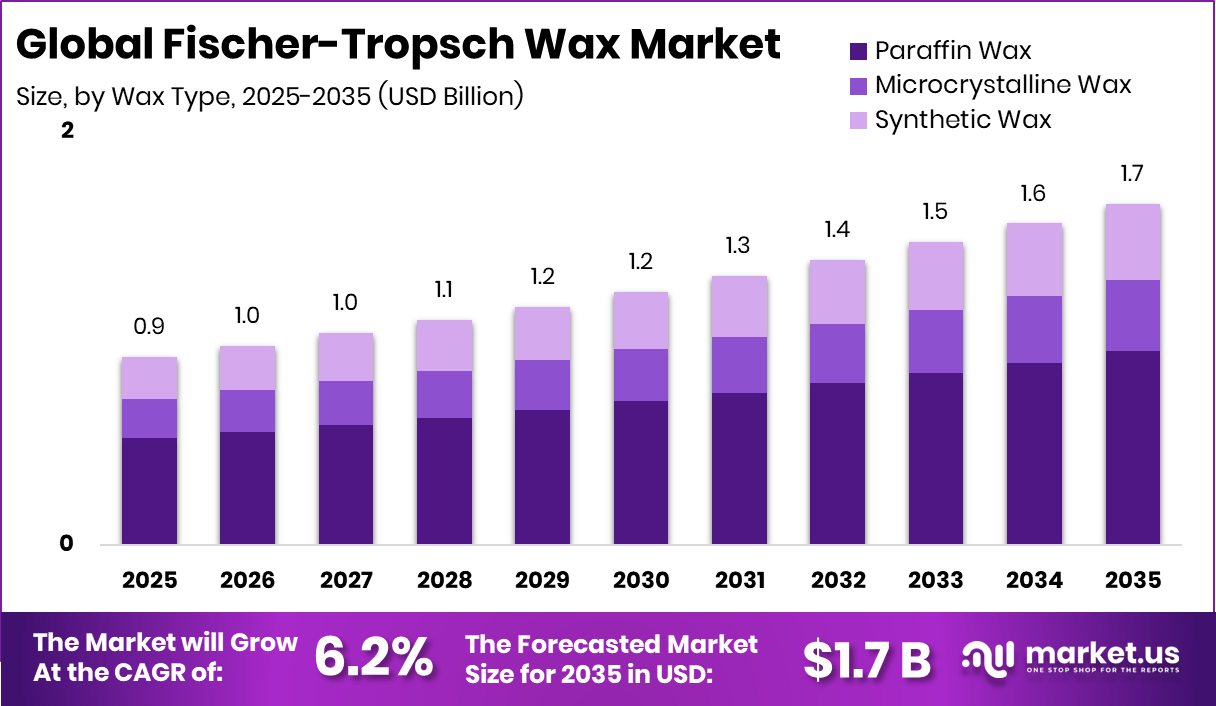
The Global Fischer-Tropsch Wax Market is expected to be worth around USD 1.7 billion by 2035, up from USD 0.9 billion in 2025, and is projected to grow at a CAGR of 6.2% from 2026 to 2035. The Asia Pacific 49.1% share and USD 0.4 Bn value highlight rapid growth.
The Fischer-Tropsch wax used in global industries is a high-purity synthetic wax produced through the Fischer-Tropsch process, where carbon monoxide and hydrogen are converted into long-chain hydrocarbons. This wax is known for its consistent structure, high melting point, and clean-burning characteristics.
The Fischer-Tropsch Wax Market refers to the commercial landscape that develops, produces, and supplies these synthetic waxes for applications such as candles, polishes, cosmetics, lubricants, packaging, and specialty industrial uses. It includes key segments like paraffin, microcrystalline, and synthetic waxes, supported by feedstocks such as natural gas, coal, and biomass.
Growth in the market is strongly shaped by increasing investments and activities in the natural gas sector, which remains a major feedstock for Fischer-Tropsch production. Recent developments, such as Axip receiving approval to access $32 million in Chapter 11 funds, Australia shipping LNG over 25,000 kilometres to Eastern Canada, and Boom Supersonic securing $300 million in new natural gas–powered turbine funding, highlight expanding supply and technological capacity.
Rising demand for high-purity wax in cosmetics, packaging, and industrial applications further supports long-term consumption. Opportunities continue to strengthen through large-scale financing moves, including ADNOC’s $11 billion natural gas funding, Transgaz pursuing EUR 336 million for strategic projects, and Texas establishing a $7.2 billion gas plant fund, all of which collectively reinforce the market’s future expansion potential.
Key Takeaways
- The Global Fischer-Tropsch Wax Market is expected to be worth around USD 1.7 billion by 2035, up from USD 0.9 billion in 2025, and is projected to grow at a CAGR of 6.2% from 2026 to 2035.
- Fischer-Tropsch Wax Market sees paraffin wax leading with 56.7%, highlighting strong segment dominance globally.
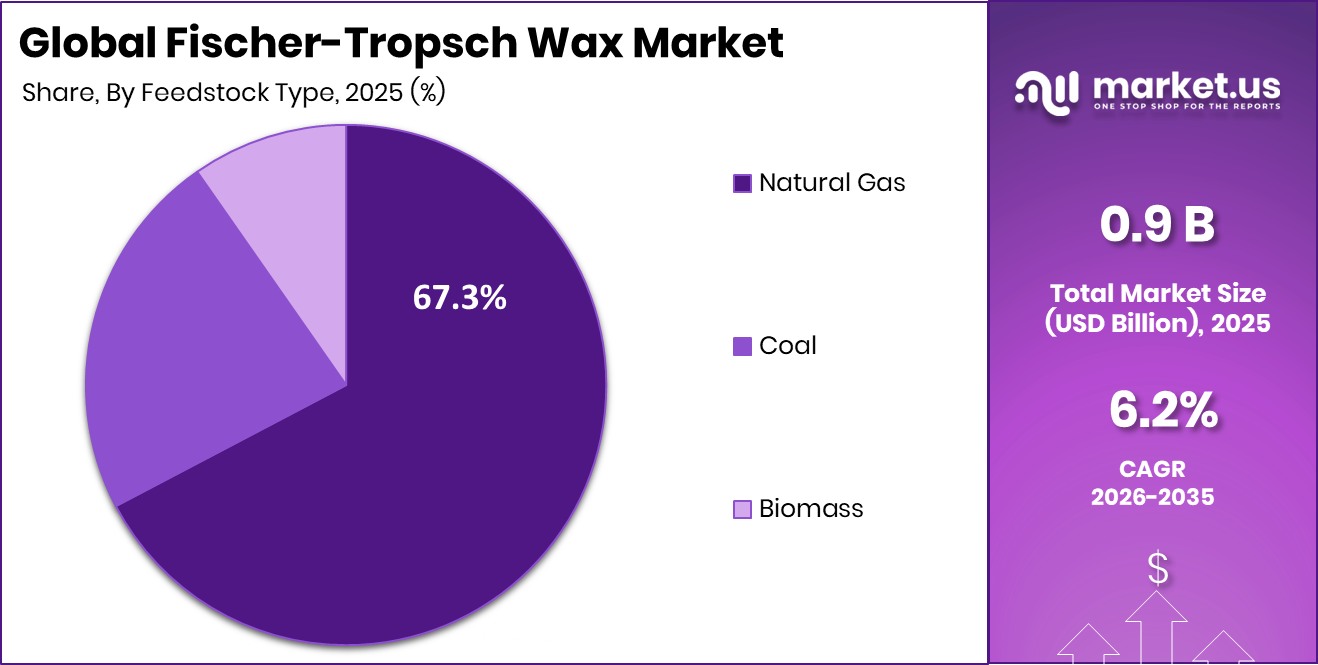
- Fischer-Tropsch Wax Market growth accelerates as natural gas feedstock reaches 67.3%, boosting cleaner production efficiency.
- Fischer-Tropsch Wax Market demand rises with cosmetics applications holding 26.8%, reflecting expanding premium formulation usage.
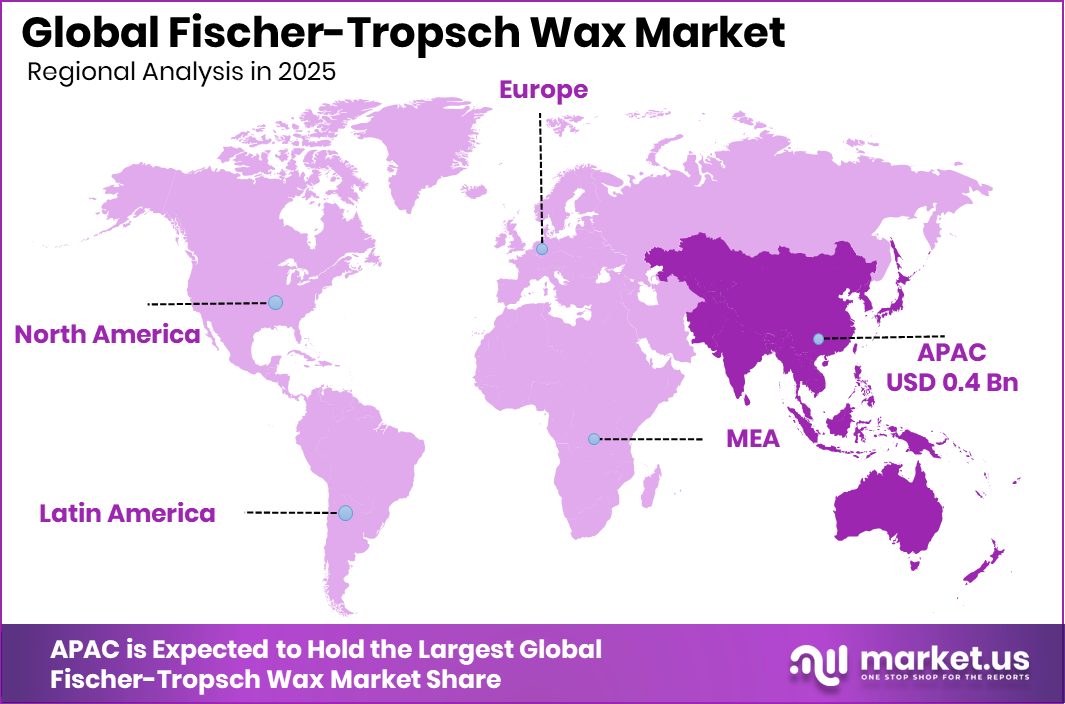
- Asia Pacific Fischer-Tropsch Wax Market value reaches USD 0.4 Bn, reflecting rising industrial demand.
By Wax Type Analysis
Fischer-Tropsch Wax Market sees paraffin wax leading demand with a strong 56.7% share.
In 2025, the Fischer-Tropsch Wax Market is seeing strong momentum as paraffin wax secures a dominant 56.7% share, reflecting its widespread use in premium coatings, packaging blends, hot-melt adhesives, and textile treatments. Manufacturers are leaning toward Fischer-Tropsch-derived paraffin because of its superior purity, higher melting point, and consistent performance compared to conventional petroleum grades. This shift is further supported by industries seeking cleaner and more uniform wax inputs for industrial processing.
Paraffin wax continues to anchor demand patterns, backed by rising consumption across cosmetics, printing inks, PVC processing, and rubber applications. As end-use sectors expand globally, paraffin wax maintains its role as the largest and most stable contributor to overall Fischer-Tropsch wax demand in 2025.
By Feedstock Type Analysis
Natural gas dominates Fischer-Tropsch wax market feedstock preferences, accounting for a notable 67.3%.
In 2025, the Fischer-Tropsch Wax Market is heavily shaped by natural gas-based production, which accounts for 67.3% of total feedstock usage and highlights the industry’s preference for cleaner, more efficient synthesis routes. Gas-to-liquid (GTL) facilities continue to expand capacity because natural gas provides higher yield, lower sulfur content, and superior quality wax output compared to coal or biomass routes.
Global players are prioritizing long-term investments in natural gas infrastructure to stabilize supply, reduce impurities, and meet environmental compliance targets. This strong dependency is also tied to volatile crude markets, with natural gas serving as a cost-effective and reliable alternative. As sustainability pressures rise, natural gas remains the primary backbone of Fischer-Tropsch wax manufacturing in 2025.
By Application Analysis
Cosmetics applications significantly influence the Fischer-Tropsch Wax Market, contributing around 26.8% global usage.
In 2025, the Fischer-Tropsch Wax Market is experiencing notable growth in the cosmetics segment, which holds a solid 26.8% share driven by the rising shift toward premium, highly purified wax ingredients. Cosmetic formulators increasingly prefer Fischer-Tropsch wax for its smooth texture, controlled crystallinity, and hypoallergenic properties that enhance product stability.
Its use is expanding across lip care, skin creams, balms, depilatory products, and high-performance makeup formulations. Consumer preference for clean-label and dermatologically safe materials is reinforcing the adoption of synthetic waxes with consistent quality. As beauty and personal care brands emphasize luxurious feel and performance, Fischer-Tropsch wax continues gaining traction as a preferred structuring agent in 2025.
Key Market Segments
By Wax Type
- Paraffin Wax
- Microcrystalline Wax
- Synthetic Wax
By Feedstock Type
- Natural Gas
- Coal
- Biomass
By Application
- Candles
- Polishes
- Cosmetics
- Lubricants
- Packaging
- Others
Driving Factors
Rising natural gas availability boosts production
Rising natural gas availability boosts production in the Fischer-Tropsch Wax Market, particularly as industries look for consistent and high-purity wax inputs across applications such as packaging, coatings, cosmetics, and industrial formulations. The momentum is strengthened by wider energy-sector advancements, where improved access to gas feedstock supports uninterrupted synthesis processes.
Alongside this, broader investment activity influences market confidence, including developments like Cyted raising £13.4m in a Series A round, which, although focused on healthcare, reflects a broader environment of innovation and capital flow that indirectly supports supportive industrial ecosystems. Together, these factors help maintain steady growth for Fischer-Tropsch wax manufacturing and demand globally.
Restraining Factors
High production costs limit scalability
High production costs limit scalability in the Fischer-Tropsch Wax Market, as the technology requires significant capital, advanced catalysts, and controlled processing conditions that increase operational expenses. These factors make it harder for smaller producers to enter the market, especially when competing with conventional petroleum-based waxes.
Market expansion also faces pressure from shifting chemical industry investments, with cases such as Nimir Industrial Chemicals investing Rs1.6 billion in expansion projects, signaling that capital may move toward other chemical streams rather than synthetic wax production. As a result, high cost structures remain a key barrier to wide-scale Fischer-Tropsch wax adoption.
Growth Opportunity
Expanding cosmetics applications increase consumption
Expanding cosmetics applications increase consumption, as Fischer-Tropsch wax offers desirable qualities like smooth texture, stability, and high purity, making it suitable for skin-care formulations, balms, creams, and color cosmetics. As beauty brands look for cleaner and more consistent raw materials, synthetic waxes gain more traction.
Wider economic activities also influence opportunity landscapes, including developments such as the $8.9m investment supporting the Sunshine Coast’s racing industry, which signals ongoing regional growth and consumer-driven spending. Such market vitality contributes to improved demand for packaged goods and personal care items, supporting broader opportunities for Fischer-Tropsch wax producers.
Latest Trends
Shift toward cleaner gas-based waxes
A shift toward cleaner gas-based waxes is emerging as companies and manufacturers prioritize materials produced from natural gas, given their low sulfur content, consistent purity, and reduced environmental load compared to traditional waxes. This trend supports adoption across high-value applications where quality and regulatory compliance are important.
The industry climate is also influenced by broader corporate activities, such as the lawsuit involving Trecora Resources’ ex-CEO over a $247 million Balmoral buyout, which reflects increasing scrutiny across specialty chemical transactions. Such developments encourage companies to strengthen transparency, compliance, and technology-driven reliability, reinforcing the move toward cleaner Fischer-Tropsch wax solutions.
Regional Analysis
Fischer-Tropsch Wax Market in the Asia Pacific holds 49.1% share, showing strong regional dominance.
In the Fischer-Tropsch Wax Market, regional performance in 2025 shows clear demand variations across North America, Europe, Asia Pacific, the Middle East & Africa, and Latin America, with Asia Pacific standing out as the dominating region. Asia Pacific leads the global landscape with a 49.1% market share and a market value of USD 0.4 Bn, driven by strong industrial consumption and expanding manufacturing activity.
North America continues to show steady uptake supported by mature end-use sectors and stable specialty wax demand. Europe maintains consistent growth momentum with wider use across cosmetics, packaging blends, and industrial processing applications. Meanwhile, the Middle East & Africa benefit from rising downstream synthetic production capacities, supporting the gradual adoption of Fischer-Tropsch wax across emerging industries.
Latin America contributes moderately, aligned with expanding local manufacturing and increasing demand for high-purity wax in consumer and industrial goods. Collectively, these regions form a diverse market landscape, but Asia Pacific remains the primary growth engine, reflecting the highest concentration of consumption and the strongest regional share globally.
Key Regions and Countries
- North America
- US
- Canada
- Europe
- Germany
- France
- The UK
- Spain
- Italy
- Rest of Europe
- Asia Pacific
- China
- Japan
- South Korea
- India
- Australia
- Rest of APAC
- Latin America
- Brazil
- Mexico
- Rest of Latin America
- Middle East & Africa
- GCC
- South Africa
- Rest of MEA
Key Players Analysis
In 2025, Sasol continues to reinforce its position as a central force in the global Fischer-Tropsch wax landscape, supported by its long-standing expertise in gas-to-liquids and large-scale synthetic wax production. Analysts view Sasol’s strength as stemming from its established operational base, consistent product purity, and strong supply reliability, which together sustain its influence across industrial, cosmetic, adhesive, and coatings applications. Its strategic focus on efficiency and production stability enables the company to maintain steady market relevance even as global demand patterns evolve.
For Shell, 2025 reflects the ongoing consolidation of its capabilities in Fischer-Tropsch wax through advanced GTL technology and strong global distribution networks. Shell’s operational footprint in synthetic wax production allows it to meet high-performance requirements across regions, giving the company a competitive edge in markets where quality, consistency, and low impurity levels remain critical. Analysts highlight Shell’s balanced portfolio strategy and deep integration of upstream and downstream operations as key pillars that support its durability in the market.
Meanwhile, Deurex AG stands out in 2025 as a specialized producer with a strong reputation for tailored wax solutions. Its focus on niche, high-purity Fischer-Tropsch wax grades gives it a distinctive position compared to large-volume players. Analysts note that Deurex AG’s emphasis on product customization, technical expertise, and responsive client support continues to strengthen its appeal across specialty applications where performance precision and material refinement drive purchasing decisions.
Top Key Players in the Market
- Sasol
- Shell
- Deurex AG
- Evonik Industries AG
- Nippon Seiro Co. Ltd.
- KPL International Limited
- King Honor International
- Brenntag
- Ter Hell and Co. Gmbh
- Michel man
- Industrial Raw Materials LLC
- Globalwax LLC.
Recent Developments
- In July 2025, Sasol signed a Letter of Intent to supply next-generation Fischer-Tropsch catalysts to INERATEC that are expected to increase e-kerosene yield by about 15 % once developed in 2026, enhancing sustainability outputs.
- In July 2024, Shell celebrated the 30th anniversary of its Middle Distillate Synthesis (MDS) process and officially launched its Shell GTL Microcrystalline Wax globally. This product is made using Fischer-Tropsch/GTL technology and brings a high-quality synthetic wax to international markets, expanding Shell’s wax product offering
Report Scope
Report Features Description Market Value (2025) USD 0.9 Billion Forecast Revenue (2035) USD 1.7 Billion CAGR (2026-2035) 6.2% Base Year for Estimation 2025 Historic Period 2020-2024 Forecast Period 2026-2035 Report Coverage Revenue Forecast, Market Dynamics, Competitive Landscape, Recent Developments Segments Covered By Wax Type (Paraffin Wax, Microcrystalline Wax, Synthetic Wax), By Feedstock Type (Natural Gas, Coal, Biomass), By Application (Candles, Polishes, Cosmetics, Lubricants, Packaging, Others) Regional Analysis North America – US, Canada; Europe – Germany, France, The UK, Spain, Italy, Rest of Europe; Asia Pacific – China, Japan, South Korea, India, Australia, Singapore, Rest of APAC; Latin America – Brazil, Mexico, Rest of Latin America; Middle East & Africa – GCC, South Africa, Rest of MEA Competitive Landscape Sasol, Shell, Deurex AG, Evonik Industries AG, Nippon Seiro Co. Ltd., KPL International Limited, King Honor International, Brenntag, Ter Hell and Co. Gmbh, Michel man, Industrial Raw Materials LLC, Globalwax LLC. Customization Scope Customization for segments, region/country-level will be provided. Moreover, additional customization can be done based on the requirements. Purchase Options We have three licenses to opt for: Single User License, Multi-User License (Up to 5 Users), Corporate Use License (Unlimited User and Printable PDF)  Fischer-Tropsch Wax MarketPublished date: February 2026add_shopping_cartBuy Now get_appDownload Sample
 -
-
- Sasol
- Shell
- Deurex AG
- Evonik Industries AG
- Nippon Seiro Co. Ltd.
- KPL International Limited
- King Honor International
- Brenntag
- Ter Hell and Co. Gmbh
- Michel man
- Industrial Raw Materials LLC
- Globalwax LLC.
Our Clients

- 179571
- February 2026






