


Global Drilling Lubricants Market Size, Share, And Enhanced Productivity By Technique (Down The Hole Drills (DTH)/ Rotary Air Blast Drilling (RAB), Diamond Drilling, Top Hammer Drilling, Reverse Circulation Drilling, Others), By End-use (Mining, Oil and Gas, Construction, Others), By Region and Companies - Industry Segment Outlook, Market Assessment, Competition Scenario, Trends, and Forecast 2026-2035
- Published date: March 2026
- Report ID: 179861
- Number of Pages: 199
- Format:
-
keyboard_arrow_up
Quick Navigation
Report Overview
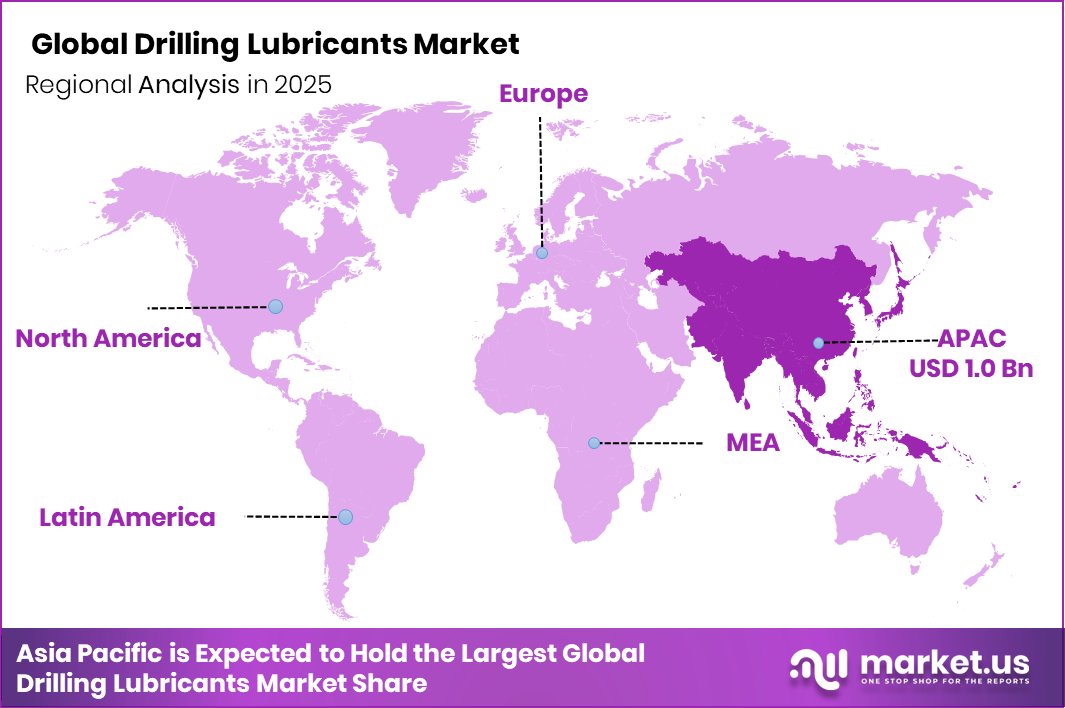
The Global Drilling Lubricants Market is expected to be worth around USD 3.6 billion by 2035, up from USD 2.4 billion in 2025, and is projected to grow at a CAGR of 3.9% from 2026 to 2035. Asia Pacific strengthens market expansion, maintaining a 44.1% share and a USD 1.0 Bn size.
The Global Drilling Lubricants Market supports a wide range of drilling techniques including Down-The-Hole (DTH), Rotary Air Blast (RAB), diamond drilling, top hammer, reverse circulation, and other specialized methods used across mining, oil and gas, and construction. Drilling lubricants are fluids or greases designed to reduce friction, cool drill bits, prevent equipment wear, and improve penetration efficiency in different geological formations. The Drilling Lubricants Market refers to the demand, supply, and usage of these products across industries that rely on continuous drilling activity, with growth shaped by exploration intensity, drilling depth, and equipment needs.
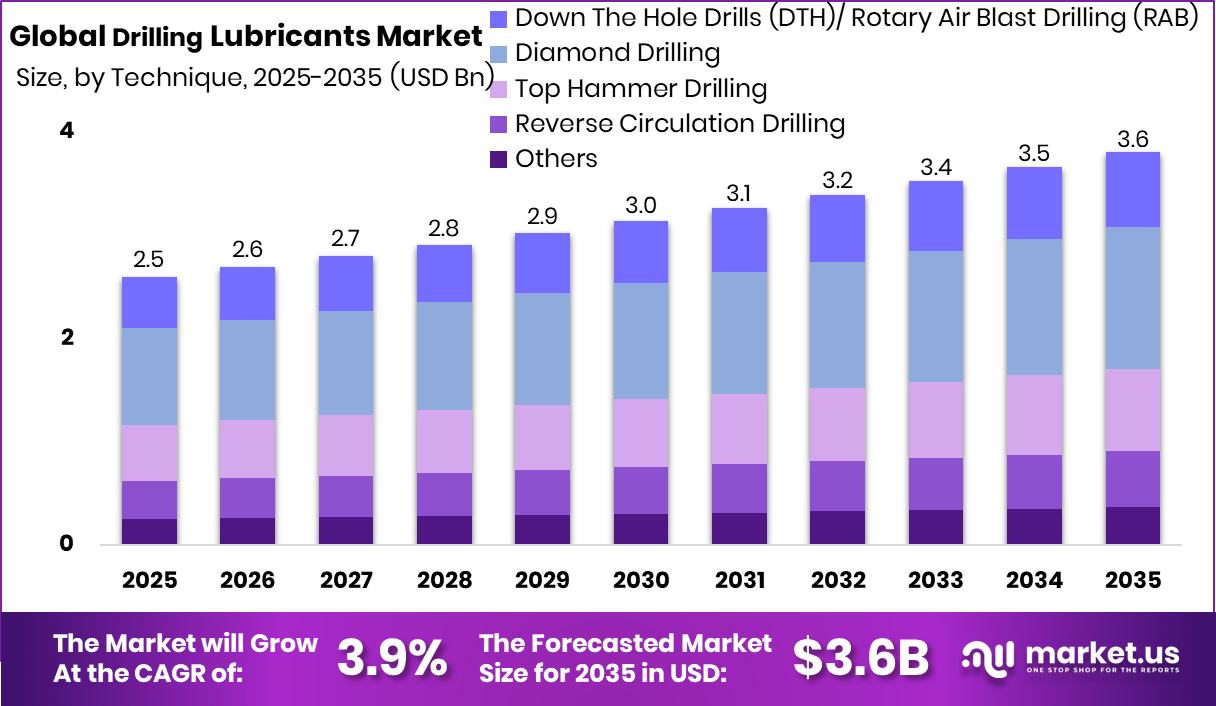
Growth in the market is supported by rising global drilling programs, where companies continue to expand mineral and resource exploration. Recent funding flows further strengthen demand—for example, Placement raising A$3.75 million to fund drilling at Cabin Lake signals ongoing exploration momentum. These activities translate into higher lubricant consumption as operators aim to run drills more efficiently and protect machinery under constant load.
Demand also grows as governments support early-stage exploration, such as Great Southern receiving $337,000 in grants and another $337,500 for high-priority drilling programs. Each new drilling initiative increases the need for reliable lubricants that help drills withstand pressure and abrasive rock conditions.
Opportunities expand as smaller exploration companies secure funding. Grants like Flynn Gold’s $130,000 EDGI support and Western Mines’ $180,000 EIS grant indicate a steady pipeline of drilling projects. With more rigs operating and more meters drilled, the requirement for high-performance lubricants rises, supporting consistent long-term market growth.
Key Takeaways
- The Global Drilling Lubricants Market is expected to be worth around USD 3.6 billion by 2035, up from USD 2.4 billion in 2025, and is projected to grow at a CAGR of 3.9% from 2026 to 2035.
- Diamond drilling accounts for 37.8%, highlighting its strong influence on the global drilling lubricants market growth.
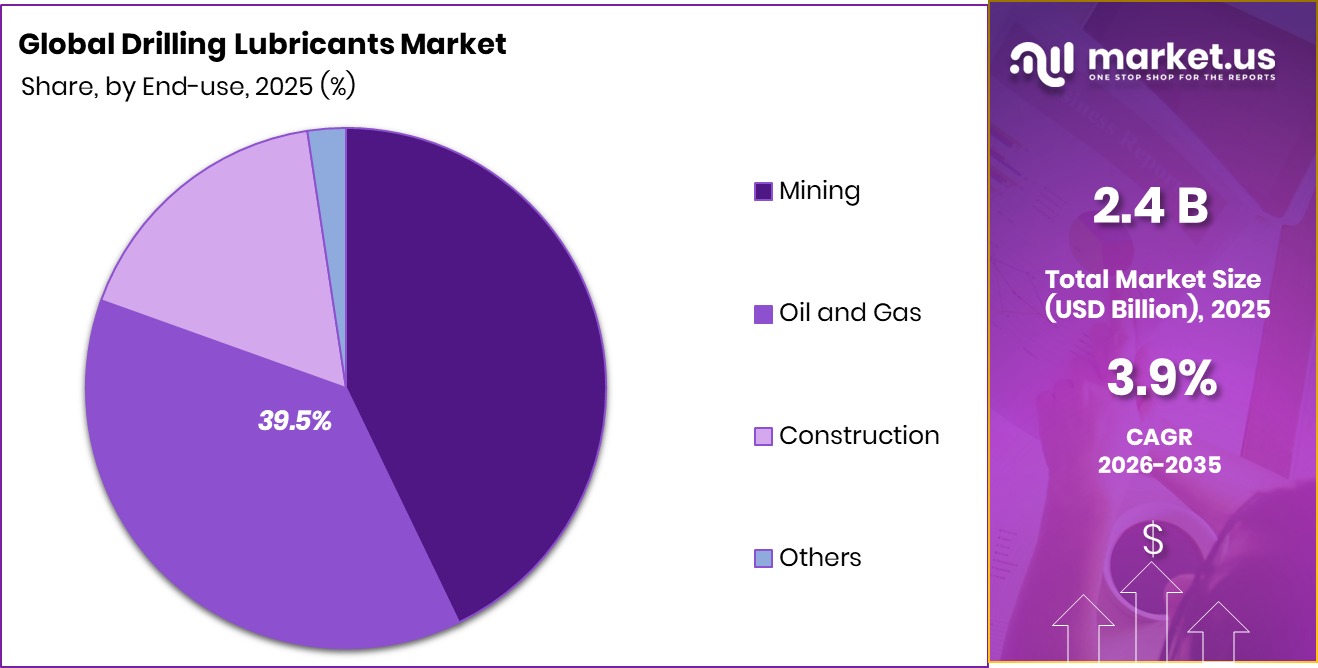
- Oil and gas end-use holds 39.5%, reinforcing its dominant demand within the drilling lubricants market worldwide.
- The Asia Pacific 44.1% dominance supports steady growth toward a USD 1.0 Bn value.
By Technique Analysis
Diamond drilling captures 37.8% share, strengthening performance across the Drilling Lubricants Market.
In 2025, the Drilling Lubricants Market continues to see strong traction in diamond drilling, which holds nearly 37.8% share thanks to its precision, reduced vibration, and ability to cut through hard geological formations. Companies working in mining, geothermal, and deep-earth exploration rely heavily on diamond drilling because it improves bit life and lowers downtime, making high-performance lubricants essential for smoother penetration rates.
The rising push for mineral diversification, including battery metals, is also expanding lubricant demand in this technique. As drilling depths increase and rigs encounter harsher temperature and pressure conditions, operators prefer advanced lubricants that reduce friction, prevent bit seizure, and maintain stability across extended drilling cycles, supporting consistent market growth.
By End-use Analysis
Oil and gas end-use holds 39.5% dominance within the Drilling Lubricants Market.
In 2025, the oil and gas sector remains the dominant end-use segment for the Drilling Lubricants Market, accounting for about 39.5% of global demand. Upstream exploration activity continues to expand across offshore, shale, and tight-reservoir projects, raising the need for lubricants that can withstand abrasive cuttings, extreme torque, and long drilling hours.
With many producers reopening exploration blocks and increasing capital spending, the market benefits from higher rig utilization and complex well architectures that require stable, high-temperature lubricant formulations. Environmental norms are also pushing companies toward more biodegradable and low-toxicity lubricants, shaping product innovation. Overall, oil and gas drilling activity directly drives consistent volume consumption and long-term market stability.
Key Market Segments
By Technique
- Down The Hole Drills (DTH)/ Rotary Air Blast Drilling (RAB)
- Diamond Drilling
- Top Hammer Drilling
- Reverse Circulation Drilling
- Others
By End-use
- Mining
- Oil and Gas
- Construction
- Others
Driving Factors
Rising drilling activities increase lubricant consumption
Rising drilling activities continue to increase lubricant consumption as more exploration programs move forward across mining, geothermal, and energy fields. The push for deeper and more technically challenging drilling operations naturally raises the need for stable, high-performance lubricants that can reduce wear and maintain drilling efficiency. At the same time, global investment shifts are influencing how drilling activity evolves.
For example, Norway’s $1 trillion fund reducing its oil and gas investments signals a broader redirection of capital, encouraging companies to optimize operational efficiency where drilling continues. This environment makes effective lubrication more important, as operators rely on quality products to keep equipment productive under changing economic conditions.
Restraining Factors
High product costs limit widespread usage
High product costs still limit widespread usage, particularly among smaller drilling contractors managing tight budgets where lubricant selection is often influenced by pricing pressure rather than performance needs. The overall cost of drilling operations continues to rise, making consumables an area where companies attempt to minimize spending. In parallel, public funding decisions impact drilling directions.
For instance, the Alaska governor awarding $1 million in state funds to an Indigenous group supporting oil drilling reflects regional support but doesn’t change overall cost sensitivity. Together, these pressures slow broader adoption of premium drilling lubricants.
Growth Opportunity
Expanding mineral exploration creates lubricant demand
Expanding mineral exploration is creating new demand for drilling lubricants as more projects begin early-stage drilling to secure resource potential. Growing interest in critical minerals and alternative energy drilling fuels consistent market expansion. Beyond traditional sectors, the geothermal segment is becoming a strong contributor.
A clear example is geothermal startup Quaise raising $40 million for ultra-deep drilling, highlighting how new technologies and advanced drilling methods open additional opportunities for lubricant suppliers. Ultra-deep and high-heat drilling requires superior lubrication, creating a niche yet growing market for specialized formulations.
Latest Trends
Shift toward biodegradable drilling lubricant solutions
A major trend shaping the market is the shift toward biodegradable drilling lubricant solutions as companies prioritize safer, cleaner, and more environmentally conscious drilling practices. Operators working in sensitive ecosystems increasingly choose low-toxicity lubricants to meet stricter operational guidelines.
Government-backed environmental programs also influence the direction of lubricant use, such as California’s initiative receiving a $35 million boost to plug abandoned oil wells, which reinforces the focus on responsible drilling and remediation. These efforts encourage adoption of greener lubricants that align with environmental stewardship goals across the industry.
Regional Analysis
Asia Pacific holds a 44.1% share, driving Drilling Lubricants Market toward USD 1.0 Bn.
The Drilling Lubricants Market shows a varied regional performance across North America, Europe, Asia Pacific, the Middle East & Africa, and Latin America, with each region contributing to demand according to its drilling activity and industrial maturity. North America maintains steady lubricant consumption due to continuous drilling operations across shale regions, while Europe reflects moderate adoption supported by established offshore fields.
The Asia Pacific region leads the global market, holding a dominant 44.1% share valued at USD 1.0 billion, driven by strong drilling activity in countries with expanding exploration programs. The Middle East & Africa market remains supported by ongoing oilfield development across major producing nations, while Latin America continues to grow gradually with increasing upstream activity.
Although all regions contribute meaningfully, the Asia Pacific stands out as the key market, supported by large-scale drilling requirements and higher lubricant usage across varied geological conditions. This dominance emphasizes the region’s strong influence on global demand, supported by sustained exploration, development drilling, and technological adoption across drilling fleets, positioning Asia Pacific as the central hub in the Drilling Lubricants Market landscape.
Key Regions and Countries
- North America
- US
- Canada
- Europe
- Germany
- France
- The UK
- Spain
- Italy
- Rest of Europe
- Asia Pacific
- China
- Japan
- South Korea
- India
- Australia
- Rest of APAC
- Latin America
- Brazil
- Mexico
- Rest of Latin America
- Middle East & Africa
- GCC
- South Africa
- Rest of MEA
Key Players Analysis
In 2025, Imdex Limited continues to strengthen its role in the global Drilling Lubricants Market through its technology-centric approach and continuous product optimization. The company’s focus on enhancing drilling efficiency, reducing equipment wear, and improving real-time operational visibility positions it as a preferred partner for drilling contractors. Its lubricant-related solutions align with the industry’s shift toward higher-performance formulations capable of supporting deeper, more complex well structures. Imdex’s strategy of integrating digital tools with drilling consumables helps operators achieve consistent lubrication performance across challenging formations, reinforcing the company’s influence in the broader drilling ecosystem.
SINO MUD maintains strong relevance in 2025 by offering drilling lubricants designed for smoother bit rotation, reduced torque, and extended equipment life. Its portfolio serves both mineral exploration and energy-sector drilling, giving it a balanced market presence. The company benefits from its ability to supply cost-effective and application-specific formulations that meet performance expectations in diverse geological conditions. SINO MUD’s operational model emphasizes reliability, bulk availability, and formulation stability, allowing it to stay competitive as drilling intensifies across developing regions seeking efficient and consistent lubricant performance.
Baroid Industrial Drilling Products remains a key contributor to lubrication solutions within industrial drilling applications in 2025. Known for its technical depth and extensive product lineup, the company supports drilling operations that require stable lubricity, improved circulation, and controlled frictional resistance. Its longstanding presence in the drilling consumables space gives it strong credibility among contractors prioritizing operational continuity and equipment protection. Baroid’s focus on dependable lubrication products ensures that operators working in demanding formations can maintain drilling performance with reduced downtime.
Top Key Players in the Market
- Imdex Limited
- SINO MUD
- Baroid Industrial Drilling Products
- Baker Hughes, Inc.
- Halliburton, Inc.
- Chevron Corporation
- Schlumberger Limited
Recent Developments
- In January 2026, SINO MUD showcased a new extra-tacky drilling grease, engineered for tough drilling conditions. While this product is not a traditional liquid drilling lubricant, it supports lubrication by enhancing component protection and adhesion in challenging operations, such as mineral exploration drilling. The release highlights the company’s ongoing focus on product performance in difficult formations.
- In July 2025, Imdex acquired Earth Science Analytics AS, a Norway-based company with data analytics technology for earth sciences. This development expands Imdex’s digital capabilities, allowing better integration of advanced analytics with drilling and subsurface data—although not specific to lubricants, it supports improved drilling planning and performance.
Report Scope
Report Features Description Market Value (2025) USD 2.4 Billion Forecast Revenue (2035) USD 3.6 Billion CAGR (2026-2035) 3.9% Base Year for Estimation 2025 Historic Period 2020-2024 Forecast Period 2026-2035 Report Coverage Revenue Forecast, Market Dynamics, Competitive Landscape, Recent Developments Segments Covered By Technique (Down The Hole Drills (DTH)/ Rotary Air Blast Drilling (RAB), Diamond Drilling, Top Hammer Drilling, Reverse Circulation Drilling, Others), By End-use (Mining, Oil and Gas, Construction, Others) Regional Analysis North America – US, Canada; Europe – Germany, France, The UK, Spain, Italy, Rest of Europe; Asia Pacific – China, Japan, South Korea, India, Australia, Singapore, Rest of APAC; Latin America – Brazil, Mexico, Rest of Latin America; Middle East & Africa – GCC, South Africa, Rest of MEA Competitive Landscape Imdex Limited, SINO MUD, Baroid Industrial Drilling Products, Baker Hughes, Inc., Halliburton, Inc., Chevron Corporation, Schlumberger Limited Customization Scope Customization for segments, region/country-level will be provided. Moreover, additional customization can be done based on the requirements. Purchase Options We have three licenses to opt for: Single User License, Multi-User License (Up to 5 Users), Corporate Use License (Unlimited User and Printable PDF)  Drilling Lubricants MarketPublished date: March 2026add_shopping_cartBuy Now get_appDownload Sample
 -
-
- Imdex Limited
- SINO MUD
- Baroid Industrial Drilling Products
- Baker Hughes, Inc.
- Halliburton, Inc.
- Chevron Corporation
- Schlumberger Limited
Our Clients

- 179861
- March 2026






