


Dairy Protein Ingredients Market Size, Share Analysis Report By Dairy Protein (Milk Protein Concentrates/Isolates, Whey Protein Concentrates, Whey Protein Isolates, Casein), By Content (30%-70%, 70%-85%, 85%-90%), By Form (Liquid, Dry), By Application (Foods And Beverages, Infant Formulations, Personal Care And Cosmetics, Animal Feed, Others)
- Published date: Mar 2026
- Report ID: 183428
- Number of Pages: 290
- Format:
-
keyboard_arrow_up
Quick Navigation
Report Overview
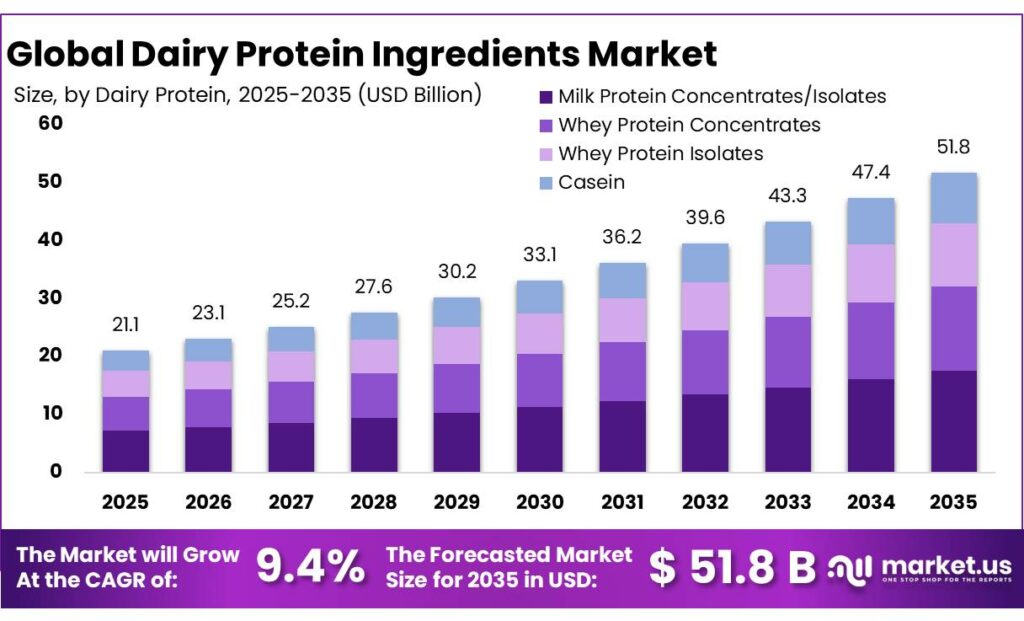
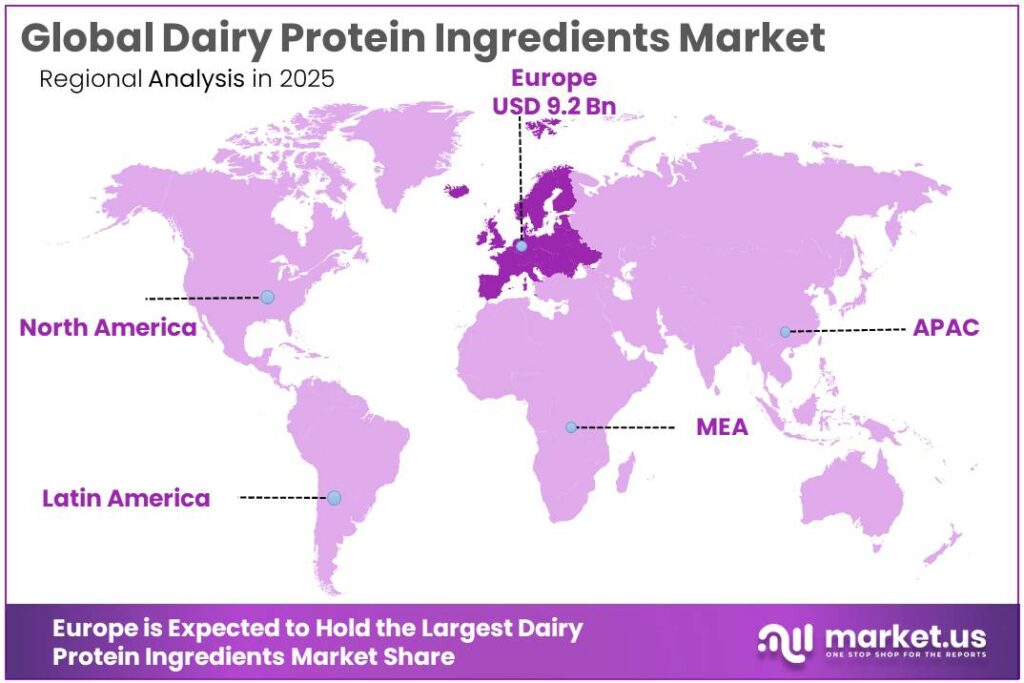
The Global Dairy Protein Ingredients Market size is expected to be worth around USD 51.8 Billion by 2035, from USD 21.1 Billion in 2025, growing at a CAGR of 9.4% during the forecast period from 2026 to 2035. In 2025, Europe held a dominant market position, capturing more than a 43.7% share, holding USD 9.2 Billion revenue.
Dairy protein ingredients comprise casein, caseinates, milk protein concentrates and isolates, whey protein concentrates and isolates, and related fractions used in sports nutrition, clinical nutrition, infant formula, bakery, confectionery, beverages, and cultured dairy applications.
The industrial scenario remains favorable because the upstream milk base is still expanding globally. FAO forecast world milk production at 992.7 million tonnes in 2025, up 1.0% year on year, while the OECD-FAO Outlook projects world milk production to grow at 1.8% per year to 1,146 million tonnes by 2034. That supply outlook matters for dairy protein ingredients because larger milk pools support more skim solids, cheese output, and whey stream availability for concentration and fractionation.
The European Union remains structurally important. Eurostat reported that EU farms produced 161.8 million tonnes of raw milk in 2024, of which 150.8 million tonnes were delivered to dairies. Out of that milk pool, 10.8 million tonnes of cheese were produced in 2024 using 59.9 million tonnes of whole milk plus 17.0 million tonnes of skimmed milk. This is commercially important because cheese manufacturing generates whey streams that feed whey protein concentrate and isolate production, keeping Europe central to dairy ingredient supply.
The United States also shows the same value-conversion logic. USDA reported that in 2024 U.S. total cheese production reached 14.2 billion pounds, while dry whey production totaled 853 million pounds and whey protein concentrate production totaled 495 million pounds. In other words, the industry is not growing only through fluid dairy consumption; it is growing through deeper valorization of cheese co-products into higher-functionality proteins for nutrition and food formulation.
Demand-side drivers are becoming more diversified. ADM’s 2025 Alternative Protein Landscape Report said 49% of consumers globally fall into a “carefree” cohort that eats both animal and plant proteins, 67% of that cohort believes eating more plant proteins can improve health, and 73% believes it is healthier to obtain protein from a wider variety of sources. For dairy protein ingredients, that is positive rather than negative: it suggests a blended-protein future in which dairy proteins retain a premium role because of amino-acid quality, solubility, and functionality, especially in hybrid beverages, satiety-focused foods, and medical nutrition.
Government support is also helping industrial depth. In India, the National Programme for Dairy Development is being implemented through 2025-26 to strengthen infrastructure for milk production, procurement, processing, and marketing, while official 2025 statistics show India’s milk output reached 247.87 million tonnes in 2024-25, up 3.58% from the previous year. In the United States, USDA’s Dairy Business Innovation Initiatives issued an FY25 program framework running through 2028 to provide technical assistance and subgrants for dairy product development and processing innovation.
Key Takeaways
- Dairy Protein Ingredients Market size is expected to be worth around USD 51.8 Billion by 2035, from USD 21.1 Billion in 2025, growing at a CAGR of 9.4%.
- Milk Protein Concentrates/Isolates held a dominant market position, capturing more than a 34.7% share.
- 30%-70% held a dominant market position, capturing more than a 43.8% share.
- Dry held a dominant market position, capturing more than a 84.1% share.
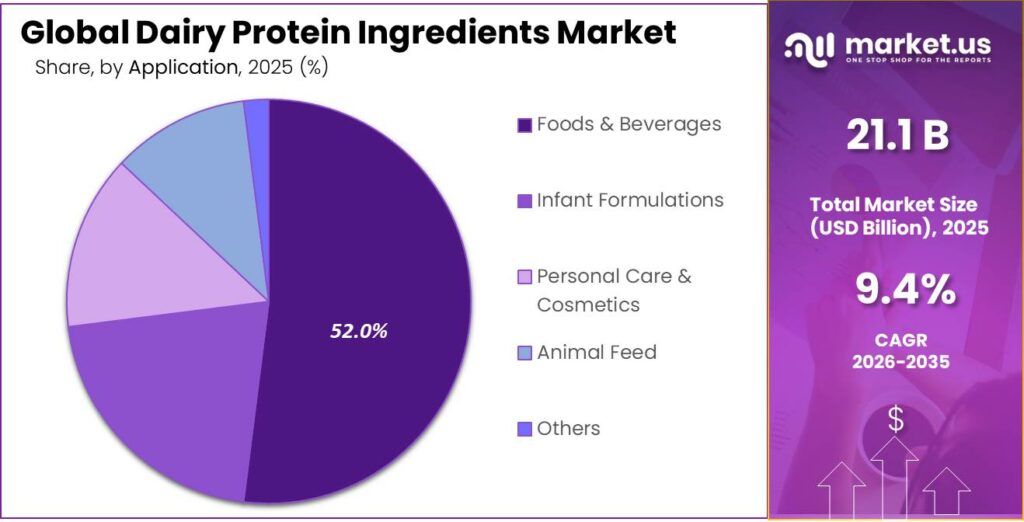
- Foods & Beverages held a dominant market position, capturing more than a 52.6% share.
- Europe held the dominant position in the Dairy Protein Ingredients Market, accounting for 43.70% of the global share and reaching USD 9.2 billion.
By Dairy Protein Analysis
Milk Protein Concentrates/Isolates dominates with 34.7% share due to strong use in high-protein nutrition and everyday food formulations.
In 2025, Milk Protein Concentrates/Isolates held a dominant market position, capturing more than a 34.7% share. This leading position was mainly supported by their wide use across protein beverages, nutritional powders, dairy-based drinks, yogurt enrichment, infant nutrition, and clinical food products. These ingredients are widely preferred because they offer a high protein content, balanced amino acid profile, and excellent functionality in food processing, including solubility, emulsification, and texture improvement.
By Content Analysis
30%–70% protein content dominates with 43.8% share as it offers the best balance of nutrition, cost, and formulation flexibility.
In 2025, 30%-70% held a dominant market position, capturing more than a 43.8% share. This segment led the market because it fits well with the needs of large-scale food and beverage manufacturers looking for a practical balance between protein enrichment and cost efficiency. Ingredients in this protein range are widely used in dairy drinks, yogurt fortification, bakery mixes, confectionery fillings, meal replacements, and everyday nutritional products where moderate-to-high protein levels are required without the higher cost of ultra-pure isolates. Their broad acceptance also comes from better processing ease, as this concentration range generally performs well in blending, texture enhancement, and moisture control across multiple applications.
By Form Analysis
Dry form dominates with 84.1% share because it offers longer shelf life, easier storage, and better use across large-scale food processing.
In 2025, Dry held a dominant market position, capturing more than a 84.1% share. This segment remained far ahead because dry dairy protein ingredients are the most practical and widely preferred format for manufacturers working across foods, beverages, infant nutrition, and sports nutrition. Powdered forms such as whey protein concentrate, milk protein concentrate, caseinates, and isolates are easier to transport, store, blend, and dose accurately during production, making them highly suitable for industrial-scale use.
By Application Analysis
Foods & Beverages leads with 52.6% share driven by rising demand for protein-rich everyday products and convenient nutrition formats.
In 2025, Foods & Beverages held a dominant market position, capturing more than a 52.6% share. This segment remained the largest because dairy protein ingredients are widely used across everyday food categories where nutrition, texture, and taste all matter. Manufacturers continued to increase their use in ready-to-drink shakes, flavored milk, yogurt, cheese spreads, bakery items, desserts, cereal mixes, and protein-enriched snacks. The strong demand was mainly supported by consumers choosing convenient foods that offer added protein for daily wellness, fitness support, and satiety.
Key Market Segments
By Dairy Protein
- Milk Protein Concentrates/Isolates
- Whey Protein Concentrates
- Whey Protein Isolates
- Casein
By Content
- 30%-70%
- 70%-85%
- 85%-90%
By Form
- Liquid
- Dry
By Application
- Foods & Beverages
- Infant Formulations
- Personal Care & Cosmetics
- Animal Feed
- Others
Emerging Trends
High-Protein Ready-to-Drink Dairy Beverages are the Biggest Latest Trend
One of the most important latest trends in dairy protein ingredients is the rapid rise of high-protein ready-to-drink (RTD) dairy beverages and yogurt-based nutrition shakes. In 2025 and moving into 2026, consumers increasingly preferred convenient protein formats that fit daily routines, whether for breakfast, post-workout recovery, weight management, or healthy ageing.
This trend is pushing strong demand for whey protein concentrates, milk protein isolates, and milk protein concentrates because these ingredients deliver smooth texture, fast absorption, and clean dairy taste in bottled beverages. A strong industry signal comes from CoBank, which reported that sales of ready-to-drink dairy nutritionals and protein shakes grew 71% in just four years, showing how quickly this category is expanding in mainstream retail.
Government Nutrition Focus and Healthy Ageing Demand are Supporting the Trend
Another reason this trend is becoming stronger is the support coming from public health nutrition priorities and ageing-focused food programs. Governments and healthcare systems are paying more attention to protein intake for elderly populations, recovery nutrition, and muscle preservation. The OECD-FAO Agricultural Outlook projects global milk production to reach 1,146 million tonnes by 2034, growing at 1.8% annually, which provides a stable long-term supply base for advanced dairy protein beverages and fortified dairy foods.
This stronger milk availability supports large-scale whey and milk protein extraction needed for RTD product growth. In 2025, the trend also expanded beyond gym users into older consumers and meal-replacement users, where easy-to-drink protein formats are preferred over powders. The rise of lactose-free high-protein milk drinks, spoonable yogurt beverages, and clinical nutrition shakes clearly shows how dairy protein ingredients are moving into more personalized health and wellness spaces. This makes RTD dairy beverages one of the most commercially promising and visible trends shaping the dairy protein ingredients industry right now.
Drivers
Rising Health-Focused Consumption is the Strongest Growth Driver
One major driving factor for dairy protein ingredients is the steady rise in health-focused protein consumption across everyday foods and beverages. Consumers are no longer looking at protein only for sports nutrition; it is now widely linked with daily wellness, muscle maintenance, satiety, healthy ageing, and balanced meal choices.
This shift is directly increasing the use of milk protein concentrates, whey proteins, and casein ingredients in ready-to-drink shakes, yogurt, dairy snacks, and fortified bakery products. The broader dairy ecosystem supports this trend strongly. FAO highlights that global milk production increased from 524 million tonnes in 1992 to 930 million tonnes in 2022, showing the long-term expansion of the dairy base needed for protein extraction.
Government Support and Dairy Infrastructure Expansion are Strengthening Future Demand
The second major growth force comes from government-backed dairy modernization and processing infrastructure expansion, which directly improves the supply chain for dairy protein ingredients. India’s dairy sector is a strong example, where the National Programme for Dairy Development (NPDD) is being implemented through 2025–26 to improve milk procurement, processing, and quality infrastructure.
At the same time, the Rashtriya Gokul Mission has an allocation of ₹3,400 crore for 2021–22 to 2025–26, aimed at improving bovine productivity and milk yields. These initiatives are already showing results, with India’s milk production rising from 146.3 million tonnes in 2014–15 to 239.2 million tonnes in 2023–24, a 63.56% increase over the decade.
Restraints
Raw Milk Price Volatility is a Major Restraining Factor
One major restraining factor for the dairy protein ingredients market is the high volatility in raw milk prices and dairy feed costs, which directly affects production economics for whey proteins, milk protein concentrates, and casein ingredients. Since milk is the core raw material, even small fluctuations in farmgate prices can sharply change processing margins for ingredient manufacturers. FAO reported that global dairy prices increased in 2024, mainly supported by stronger butter and milk fat values, which created cost pressure across the wider dairy ingredient chain.
At the farm level, USDA price data shows U.S. all-milk prices moved from around USD 17 per cwt in early 2024 to nearly USD 25 per cwt during 2025 peaks, highlighting how quickly procurement costs can shift for processors. For dairy protein producers, this makes pricing contracts difficult, especially for long-term supply agreements in sports nutrition, infant formula, and clinical foods. When raw milk prices rise suddenly, manufacturers either absorb the cost pressure or pass it to food brands, which can slow product adoption in price-sensitive applications.
Feed Cost Pressure and Government Risk Programs Add Operational Challenges
The restraint becomes stronger when feed cost inflation and weather-linked supply shifts are added to the milk price cycle. USDA Economic Research Service noted that dairy producers have faced increasing milk price and feed cost volatility over the last 20 years, largely because of weather disruptions, export dependence, and fluctuating grain markets. These pressures eventually flow into ingredient pricing, making whey and milk proteins less predictable for food manufacturers. Governments have tried to reduce this risk through support mechanisms.
In the U.S., USDA’s Dairy Margin Coverage program and broader dairy risk tools help protect farmer margins when milk-feed spreads tighten, which supports raw milk supply stability. Even with these initiatives, the supply chain still faces periodic shocks that can tighten whey availability from cheese production and raise concentrate costs. For dairy protein ingredient manufacturers, this remains a key restraint because unstable input pricing reduces visibility on margins, weakens budgeting accuracy, and makes it harder to maintain competitive pricing in mainstream food and beverage formulations.
Opportunity
Clinical Nutrition and Healthy Ageing Create the Biggest Growth Opportunity
One of the biggest growth opportunities for dairy protein ingredients is the fast expansion of clinical nutrition, healthy ageing products, and high-protein medical foods. As populations age and consumers focus more on strength, recovery, and immunity, milk proteins and whey ingredients are becoming more important in daily nutrition solutions.
Their complete amino acid profile and fast absorption make them highly suitable for senior nutrition drinks, recovery formulas, meal replacements, and hospital nutrition products. The long-term dairy supply outlook strongly supports this opportunity. The OECD-FAO Agricultural Outlook 2025–2034 projects global milk production to reach 1,146 million tonnes by 2034, growing at 1.8% annually, which ensures a stronger raw material base for whey and milk protein extraction.
Whey Valorization and Government Nutrition Programs Open New Long-Term Potential
A second strong opportunity comes from better whey utilization and public nutrition support programs, which are helping convert dairy by-products into high-value ingredients. Whey, once treated mainly as a by-product of cheese production, is now increasingly used in protein powders, medical nutrition blends, and functional foods. A 2025 peer-reviewed review on whey valorization explains that whey has shifted from an environmental burden to a high economic-value raw material for functional food production, opening new avenues for ingredient makers.
At the policy level, government nutrition programs and dairy modernization schemes are also supporting future demand. For example, the OECD-FAO 2025–2034 dairy outlook notes stronger demand growth in nutrient-rich dairy products across developing economies, especially in regions improving organized dairy processing capacity.
Regional Insights
Europe Dominates the Dairy Protein Ingredients Market with 43.70% Share, Reaching USD 9.2 Billion
Europe held the dominant position in the Dairy Protein Ingredients Market, accounting for 43.70% of the global share and reaching USD 9.2 billion, supported by its strong dairy farming base, advanced protein extraction infrastructure, and well-established cheese and whey processing industry. The region’s leadership is closely linked to the scale of milk production and the ability to convert dairy streams into high-value proteins such as whey protein concentrates, isolates, caseinates, and milk protein concentrates.
According to Eurostat, EU farms produced 161.8 million tonnes of raw milk in 2024, with 150.8 million tonnes delivered to dairies, creating a highly stable supply base for dairy protein ingredient manufacturing.
A major strength for Europe is its deep integration with cheese production, which continuously generates whey streams used in protein concentration. In 2024, EU dairies produced 10.8 million tonnes of cheese and 5.2 million tonnes of whey, directly supporting large-scale whey protein ingredient output across sports nutrition, infant formula, and clinical foods.
Key Regions and Countries Insights
- North America
- US
- Canada
- Europe
- Germany
- France
- The UK
- Spain
- Italy
- Rest of Europe
- Asia Pacific
- China
- Japan
- South Korea
- India
- Australia
- Rest of APAC
- Latin America
- Brazil
- Mexico
- Rest of Latin America
- Middle East & Africa
- GCC
- South Africa
- Rest of MEA
Key Players Analysis
ADM is one of the strongest protein ingredient companies globally, with a major role in dairy-adjacent protein systems, nutritional blends, and functional beverage solutions. In 2025, ADM’s protein consumer research showed 49% of consumers globally follow mixed protein diets, while 73% prefer a wider variety of protein sources, reinforcing demand for dairy proteins in hybrid nutrition products. ADM’s broad nutrition platform supports milk protein fortification, RTD beverages, and performance nutrition, where ingredients commonly range between 30%–90% protein content, giving the company strong positioning in scalable dairy protein formulations.
Bunge’s role in protein ingredients is supported by its large-scale global ingredient network and specialized protein systems business. The company has expanded strongly in value-added food proteins, including concentrates used in texture-rich food and dairy-style applications. With operations spanning 40+ countries and a deep processing network, Bunge supports manufacturers working on dairy protein blends, fortified snacks, and high-protein bakery systems. Its strength is particularly visible in commercial formulations where protein concentration bands of 30%–70% are widely used for cost-effective enrichment. This gives Bunge a practical edge in mass-market dairy protein food applications requiring stable texture and controlled formulation costs.
Top Key Players Outlook
- DuPont Solae
- ADM
- Cargill, Incorporated
- Bunge
- Mead Johnson
- Scoular
- Danone
- Arla Foods amba
Recent Industry Developments
ADM is less about selling commodity whey alone and more about solution-based dairy protein systems used in RTD shakes, spoonable yogurt, meal-replacement drinks, and hybrid dairy beverages. A strong numerical signal from ADM’s July 2025 Protein Report shows that 49% of global consumers fall into the “carefree” group, meaning they consume both dairy and plant proteins, while 73% believe it is healthier to get protein from a wider variety of sources.
In 2025, Mead Johnson’s work in the dairy protein ingredients space remained focused on infant formula, premature baby nutrition, and specialized pediatric products rather than on selling bulk dairy proteins to food companies. The company, now part of Reckitt, reported that Mead Johnson Nutrition generated £2,119 million in net revenue in 2025 and delivered 3.8% like-for-like growth, showing that its nutrition business is still commercially strong.
DuPont’s numerical project footprint also shows strong industrial relevance, with dairy installations ranging from 840 m³/day in Belgium, 1,560 m³/day in Denmark, and up to 120,000 m³/day in Australia, highlighting its scale in commercial milk concentration and whey valorization systems.
Report Scope
Report Features Description Market Value (2025) USD 21.1 Bn Forecast Revenue (2035) USD 51.8 Bn CAGR (2026-2035) 9.4% Base Year for Estimation 2025 Historic Period 2020-2024 Forecast Period 2026-2035 Report Coverage Revenue Forecast, Market Dynamics, Competitive Landscape, Recent Developments Segments Covered By Dairy Protein (Milk Protein Concentrates/Isolates, Whey Protein Concentrates, Whey Protein Isolates, Casein), By Content (30%-70%, 70%-85%, 85%-90%), By Form (Liquid, Dry), By Application (Foods And Beverages, Infant Formulations, Personal Care And Cosmetics, Animal Feed, Others) Regional Analysis North America – US, Canada; Europe – Germany, France, The UK, Spain, Italy, Rest of Europe; Asia Pacific – China, Japan, South Korea, India, Australia, Singapore, Rest of APAC; Latin America – Brazil, Mexico, Rest of Latin America; Middle East & Africa – GCC, South Africa, Rest of MEA Competitive Landscape DuPont Solae, ADM, Cargill, Incorporated, Bunge, Mead Johnson, Scoular, Danone, Arla Foods amba Customization Scope Customization for segments, region/country-level will be provided. Moreover, additional customization can be done based on the requirements. Purchase Options We have three licenses to opt for: Single User License, Multi-User License (Up to 5 Users), Corporate Use License (Unlimited User and Printable PDF)  Dairy Protein Ingredients MarketPublished date: Mar 2026add_shopping_cartBuy Now get_appDownload Sample
 -
-
- DuPont Solae
- ADM
- Cargill, Incorporated
- Bunge
- Mead Johnson
- Scoular
- Danone
- Arla Foods amba
Our Clients

- 183428
- Mar 2026






