


Global Chainsaw Market Size, Share, And Enhanced Productivity By Product Type (Gas-Powered, Electric-Powered, Battery-Powered, Pneumatic/Hydraulic), By Bar Length (Less Than 14 inch, 16-18 inch, 20-24 inch, More Than 26 inch), By Application (Forestry and Logging, Construction and Demolition, Landscaping and Arboriculture, Emergency and Disaster Relief), By End-User (Residential, Commercial/Professional, Industrial (Forestry and Construction)), By Distribution Channel (Offline Retail, Online Platforms), By Region and Companies - Industry Segment Outlook, Market Assessment, Competition Scenario, Trends, and Forecast 2026-2035
- Published date: February 2026
- Report ID: 178990
- Number of Pages: 331
- Format:
-
keyboard_arrow_up
Quick Navigation
- Report Overview
- Key Takeaways
- By Product Type Analysis
- By Bar Length Analysis
- By Application Analysis
- By End-User Analysis
- By Distribution Channel Analysis
- Key Market Segments
- Driving Factors
- Restraining Factors
- Growth Opportunity
- Latest Trends
- Regional Analysis
- Key Players Analysis
- Recent Developments
- Report Scope
Report Overview
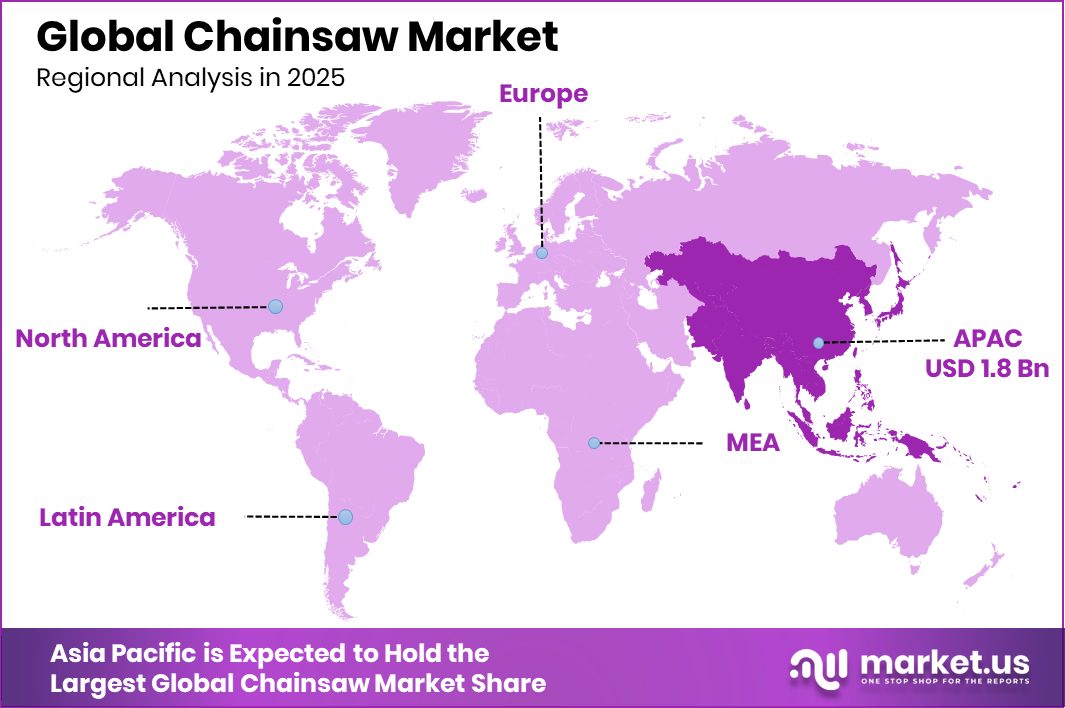
The Global Chainsaw Market is expected to be worth around USD 5.7 billion by 2035, up from USD 3.9 billion in 2025, and is projected to grow at a CAGR of 3.8% from 2026 to 2035. The chainsaw market in the Asia Pacific achieved a 46.5% share, totaling USD 1.8 Bn regionally.
The chainsaw is a powered cutting tool designed for felling trees, trimming limbs, clearing land, and handling construction-related cutting tasks. It operates with a rotating chain fitted with sharp teeth, enabling fast and controlled cutting across forestry, landscaping, demolition, and emergency applications. The Chainsaw Market represents the commercial ecosystem around manufacturing, distributing, and adopting these tools across residential, commercial, and industrial sectors. It includes gas, electric, battery, and hydraulic models, each serving different workloads, bar lengths, and user needs across offline and online channels.
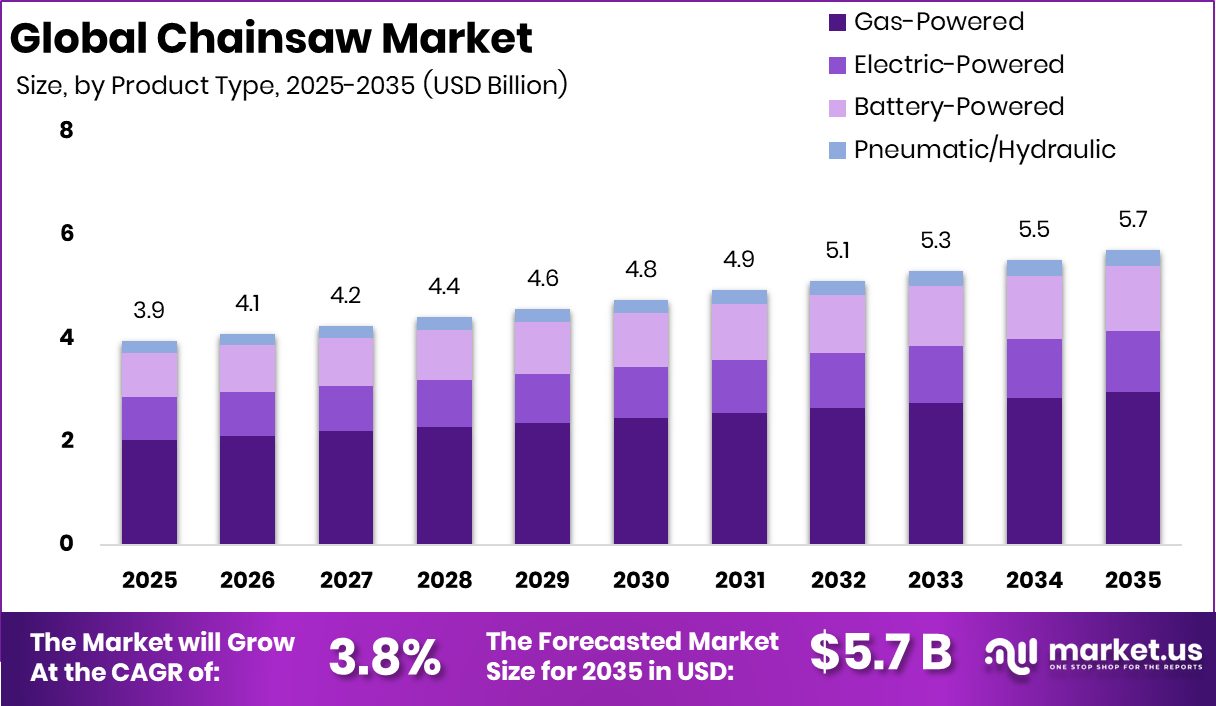
Market growth is supported by rising forestry activity and stronger investments in wood-based industries. Recent announcements, such as Pingree’s $1.6 million support for Maine’s logging and forest products industries and Oregon state forests generating more than $97 million in timber revenue, reflect growing dependence on timber operations where chainsaw usage remains essential.
Increasing concerns around forest preservation have also led to new opportunities. Initiatives like B.C.’s $300 million fund to protect old-growth forests and expanded logging deferrals across 2.1 million hectares are driving safer, more responsible land-management practices that still rely on chainsaw operations for controlled clearing.
At the same time, public spending debates influence demand patterns. Reports mentioning $1.8 million in security enhancements at Mar-a-Lago and discussions about government spending cuts highlight the changing policy environment that indirectly affects procurement cycles. Overall, expanding forestry activity, land-clearing needs, and sustainable forest management programs continue to shape future opportunities in the Chainsaw Market.
Key Takeaways
- The Global Chainsaw Market is expected to be worth around USD 5.7 billion by 2035, up from USD 3.9 billion in 2025, and is projected to grow at a CAGR of 3.8% from 2026 to 2035.
- The Chainsaw Market sees strong dominance of gas-powered models, capturing a notable 51.7% share.
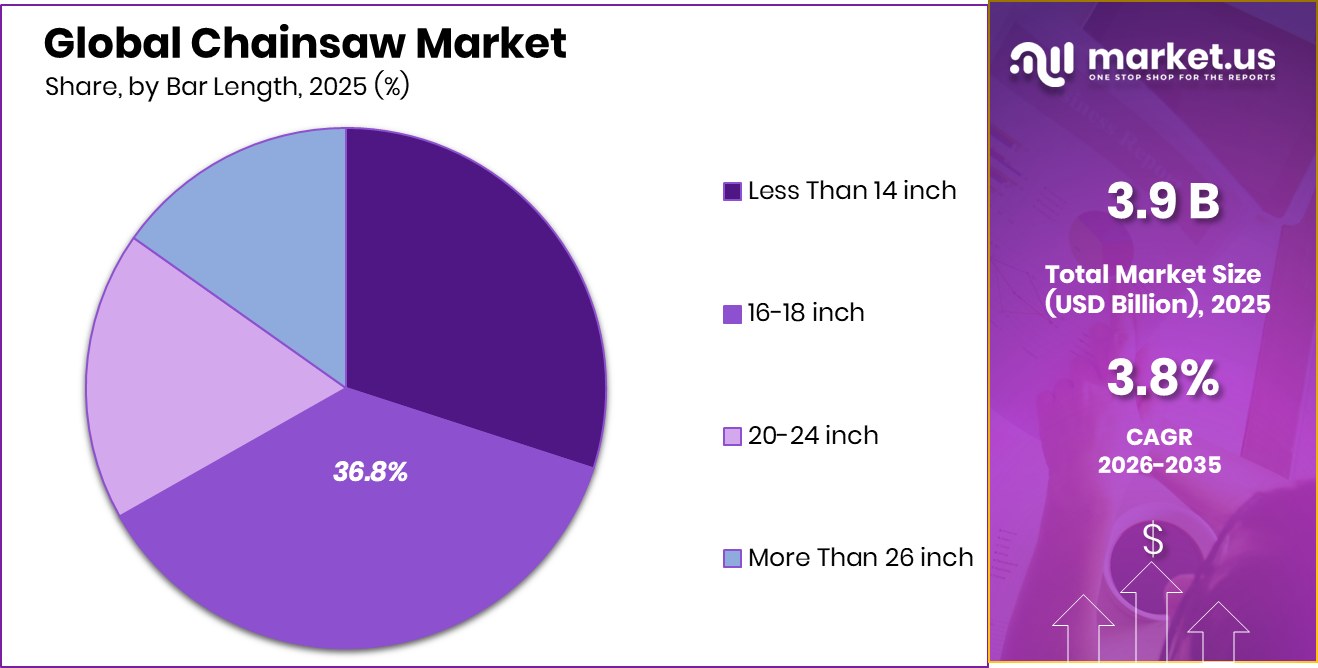
- In the Chainsaw Market, 16–18 inch bar lengths remain preferred, accounting for 36.8% usage globally.
- Forestry and logging applications drive the Chainsaw Market, contributing significantly with a 46.3% market share.
- Commercial and professional users continue leading the Chainsaw Market, representing a substantial 48.6% share overall.
- Offline retail channels dominate the Chainsaw Market, maintaining a powerful 71.2% distribution share worldwide.
- In the Asia Pacific, the Chainsaw Market reached USD 1.8 Bn with 46.5% dominance.
By Product Type Analysis
Chainsaw Market is dominated by gas-powered products, holding a strong 51.7% share.
In 2025, the Chainsaw Market continues to be shaped strongly by its product mix, with gas-powered models dominating at 51.7%. This leadership reflects their unmatched cutting power, longer runtime, and suitability for demanding outdoor tasks where consistent performance is essential. Gas-powered chainsaws remain the preferred choice for heavy-duty forestry, construction clearing, and maintenance work, especially in regions with rugged terrains and large-scale timber operations.
While electric and battery-powered variants are growing, the durability and torque delivered by gas units still appeal to professionals who rely on reliable output. As infrastructure development and timber extraction increase globally, gas-powered chainsaws maintain their competitive edge, ensuring they stay the dominant category entering 2025.
By Bar Length Analysis
Chainsaw Market remains dominated by 16–18 inch bars with 36.8% share.
In 2025, the Chainsaw Market shows a strong preference for the 16–18 inch bar length, which holds a 36.8% share and remains the dominant size range across most user groups. This bar length strikes an ideal balance between maneuverability and cutting capability, making it suitable for medium-scale felling, trimming, and firewood preparation.
Both homeowners and professionals favor this segment because it offers enough power for substantial tasks without compromising handling comfort. The rise in residential landscaping, small-scale farm maintenance, and forestry support work further reinforces this segment’s prominence. As versatility becomes a key purchasing factor in 2025, chainsaws in the 16–18 inch category continue to lead due to their reliability and broad application reach.
By Application Analysis
Chainsaw Market is dominated by forestry logging applications, capturing a 46.3% share.
In 2025, forestry and logging hold a commanding 46.3% share of the Chainsaw Market, making it the leading application segment. The global focus on timber production, land clearing, and forest management drives strong demand in this category. Chainsaws remain indispensable tools in both commercial and government forestry operations, where efficiency and precision are critical.
Increased harvesting activities in emerging economies, along with sustainable forest management programs, contribute to this segment’s dominance. Professional loggers rely on high-performance models capable of handling intense workloads, reinforcing the consistent need for durable and robust equipment. As wood-based industries continue expanding worldwide, forestry and logging remain the central force propelling chainsaw utilization in 2025.
By End-User Analysis
Chainsaw Market continues to be dominated by commercial professionals, maintaining a 48.6% global share.
In 2025, the commercial and professional segment leads the Chainsaw Market with a 48.6% share, reflecting the high reliance on chainsaws in specialized industries. Professional contractors, arborists, landscapers, and forestry workers consistently demand high-power, durable equipment suitable for rigorous daily use. This segment’s dominance is driven by expanding construction projects, rising forestry activities, and increased landscaping services across developed and emerging economies.
Professional users prioritize performance, safety features, and long-term operational reliability, prompting manufacturers to design advanced models tailored for heavy workloads. With ongoing urban development, road maintenance, and timber operations, the commercial and professional category remains the most influential end-user group shaping chainsaw demand in 2025.
By Distribution Channel Analysis
Chainsaw Market is dominated by offline retail channels, leading with 71.2% share.
In 2025, offline retail maintains a substantial leadership position in the Chainsaw Market, dominating with a 71.2% share. Chainsaws, being technical and safety-intensive equipment, encourage buyers to inspect products physically before purchasing, which strengthens traditional retail demand. Hardware stores, equipment dealers, and specialty outdoor power centers remain the primary sales channels due to their hands-on demonstrations, product guidance, and after-sales service.
Professional buyers especially value personalized support and immediate availability, further boosting offline sales. Although online channels are expanding, offline retail continues its dominance because chainsaw purchases often require expert advice, model comparison, and accessory compatibility checks. As a result, physical stores remain the preferred purchasing hub throughout 2025.
Key Market Segments
By Product Type
- Gas-Powered
- Electric-Powered
- Battery-Powered
- Pneumatic/Hydraulic
By Bar Length
- Less Than 14 inch
- 16-18 inch
- 20-24 inch
- More Than 26 inch
By Application
- Forestry and Logging
- Construction and Demolition
- Landscaping and Arboriculture
- Emergency and Disaster Relief
By End-User
- Residential
- Commercial/Professional
- Industrial (Forestry and Construction)
By Distribution Channel
- Offline Retail
- Online Platforms
Driving Factors
Rising forestry activities boost chainsaw adoption
Rising forestry activities boost chainsaw adoption, especially as timber operations expand and land-clearing work grows across both commercial and industrial sectors. Chainsaws remain core equipment for felling, trimming, and processing wood, making them essential for ongoing forestry programs. Supportive public spending also indirectly strengthens operational environments.
For instance, Allegheny County’s plan to spend $4.1 million on clean air projects signals broader environmental oversight, encouraging responsible forest management and controlled clearing practices where chainsaw use remains necessary.
As land authorities invest in sustainable programs and monitoring systems, forestry teams continue to rely on efficient cutting tools to maintain forest health, manage growth cycles, and support timber supply chains. This consistent operational need remains a key driver of chainsaw demand.
Restraining Factors
Safety concerns limit widespread chainsaw usage
Safety concerns limit widespread chainsaw usage, as the equipment requires skill, training, and strict operational caution. Misuse can lead to serious injuries, prompting many residential users and small operators to avoid regular use. Professional sectors often enforce certifications, which increases operational barriers. Safety-related funding also highlights the ongoing need for better preparedness.
The We Energies Foundation, awarding a record $100,000 to help first responders strengthen public safety, reflects increasing attention toward risk response and accident prevention. Such initiatives emphasize that chainsaw operations still present hazards requiring improved training and protective measures. As safety protocols tighten, adoption becomes more cautious, particularly among non-professional users who prioritize lower-risk alternatives.
Growth Opportunity
Expanding landscaping services create new demand
Expanding landscaping services create new demand, as homeowners, commercial property managers, and municipal teams increasingly focus on vegetation control, garden maintenance, and aesthetic land shaping. Chainsaws support pruning, branch removal, and broader outdoor maintenance tasks, stimulating adoption across seasonal and ongoing service contracts. Community-level funding also contributes to operational enhancements.
The W.Va. American Water awarding $26,000 in grants to area fire departments underscores the continuous need for equipment used in clearing debris, improving access, and managing emergency vegetation removal—tasks where chainsaws play a supporting role. As outdoor maintenance rises in both residential and commercial settings, service providers look for reliable cutting tools, creating growth potential in mid-range and professional-grade chainsaws.
Latest Trends
Shift toward quieter battery-powered models
A shift toward quieter battery-powered models is becoming increasingly visible in the market as users prioritize low-noise operation, reduced emissions, and ease of handling. Battery-driven chainsaws appeal to homeowners, municipal crews, and commercial landscapers seeking cleaner alternatives to traditional gas-powered units. Improvements in battery efficiency, compact motor design, and lightweight ergonomics support this transition.
Municipal areas with noise restrictions and environmentally conscious communities are particularly responsive to these developments, further encouraging manufacturers to broaden cordless product lines. As market preferences evolve, quieter and cleaner chainsaws continue gaining traction across professional and residential applications.
Regional Analysis
Asia Pacific holds 46.5% share, driving the Chainsaw Market value to USD 1.8 Bn.
In the global Chainsaw Market, regional performance shows clear variation across demand patterns and operational intensity.
North America remains a mature market driven by strong landscaping activities and steady forestry operations, while Europe reflects stable adoption supported by safety-focused regulations and consistent use in professional logging environments.
Asia Pacific stands out as the dominating region, holding 46.5% of the market and reaching USD 1.8 Bn, supported by extensive forestry, rising construction work, and expanding rural land-clearing needs across developing economies.
The Middle East & Africa demonstrate gradual growth as infrastructure expansion and agricultural development increase chainsaw usage across commercial segments. Latin America benefits from widespread forestry and agricultural activities, supporting moderate but steady demand across both professional and small-scale users.
Across all regions, professional applications continue to influence purchasing behavior, yet Asia Pacific’s strong economic activity and fast-growing land-management requirements firmly position it as the leading contributor to global chainsaw revenue.
Key Regions and Countries
- North America
- US
- Canada
- Europe
- Germany
- France
- The UK
- Spain
- Italy
- Rest of Europe
- Asia Pacific
- China
- Japan
- South Korea
- India
- Australia
- Rest of APAC
- Latin America
- Brazil
- Mexico
- Rest of Latin America
- Middle East & Africa
- GCC
- South Africa
- Rest of MEA
Key Players Analysis
In 2025, STIHL Holding AG & Co. KG continues to reinforce its position as a major force in the global Chainsaw Market through its strong engineering legacy and emphasis on professional-grade performance. The company’s longstanding focus on durable construction, ergonomic handling, and reliability keeps it firmly aligned with the needs of forestry professionals and commercial contractors. STIHL’s broad product mix and consistent enhancement of power tools strengthen customer trust, allowing it to maintain steady demand in both mature and developing regions.
Husqvarna AB holds a strategic advantage in the market by balancing high-performance chainsaws with user-oriented designs that appeal to forestry workers, landscapers, and advanced residential users. The company’s expertise in outdoor equipment supports its competitive positioning, with chainsaws engineered for precision, safety, and operational ease. Husqvarna’s continued emphasis on robust product development ensures strong relevance in regions where forestry and land maintenance remain essential economic activities.
Makita Corporation contributes significantly to the market with its strong technical foundation and reliable power tool ecosystem. Its chainsaws are recognized for operational efficiency, solid build quality, and suitability across varied cutting tasks. Makita’s integration of user-friendly features enhances its appeal to both professionals and serious do-it-yourself users. In 2025, the company’s steady refinement of performance tools helps maintain its competitive presence across global chainsaw demand.
Top Key Players in the Market
- STIHL Holding AG & Co. KG
- Husqvarna AB
- Makita Corporation
- Robert Bosch GmbH
- Techtronic Industries Company Limited
- Yamabiko Corporation
- The Toro Company
- Emak S.p.A.
- STIGA S.p.A.
- Einhell Germany AG
- Oregon Tool, Inc.
Recent Developments
- In January 2026, Husqvarna expanded its garden tool lineup by introducing two cordless battery chainsaws — the 230i and 242i — as part of its 36V system. These models are easier to use, lighter, and ideal for everyday trimming and cutting tasks.
- In December 2025, Makita released the UC030G 40VMax 500mm Brushless XGT® Cordless Chainsaw. This professional cordless saw offers petrol-like power with fast chain speeds, improved safety, and strong cutting performance for demanding outdoor work.
- In April 2025, STIHL announced its financial results for 2024, reporting increased sales and reaffirming its focus on innovative product solutions and battery-powered products. This highlights STIHL’s continued investment in technologies that support future chainsaw and outdoor tool development.
Report Scope
Report Features Description Market Value (2025) USD 3.9 Billion Forecast Revenue (2035) USD 5.7 Billion CAGR (2026-2035) 3.8% Base Year for Estimation 2025 Historic Period 2020-2024 Forecast Period 2026-2035 Report Coverage Revenue Forecast, Market Dynamics, Competitive Landscape, Recent Developments Segments Covered By Product Type (Gas-Powered, Electric-Powered, Battery-Powered, Pneumatic/Hydraulic), By Bar Length (Less Than 14 inch, 16-18 inch, 20-24 inch, More Than 26 inch), By Application (Forestry and Logging, Construction and Demolition, Landscaping and Arboriculture, Emergency and Disaster Relief), By End-User (Residential, Commercial/Professional, Industrial (Forestry and Construction)), By Distribution Channel (Offline Retail, Online Platforms) Regional Analysis North America – US, Canada; Europe – Germany, France, The UK, Spain, Italy, Rest of Europe; Asia Pacific – China, Japan, South Korea, India, Australia, Singapore, Rest of APAC; Latin America – Brazil, Mexico, Rest of Latin America; Middle East & Africa – GCC, South Africa, Rest of MEA Competitive Landscape STIHL Holding AG & Co. KG, Husqvarna AB, Makita Corporation, Robert Bosch GmbH, Techtronic Industries Company Limited, Yamabiko Corporation, The Toro Company, Emak S.p.A., STIGA S.p.A., Einhell Germany AG , Oregon Tool, Inc. Customization Scope Customization for segments, region/country-level will be provided. Moreover, additional customization can be done based on the requirements. Purchase Options We have three licenses to opt for: Single User License, Multi-User License (Up to 5 Users), Corporate Use License (Unlimited User and Printable PDF) 
-
-
- STIHL Holding AG & Co. KG
- Husqvarna AB
- Makita Corporation
- Robert Bosch GmbH
- Techtronic Industries Company Limited
- Yamabiko Corporation
- The Toro Company
- Emak S.p.A.
- STIGA S.p.A.
- Einhell Germany AG
- Oregon Tool, Inc.
Our Clients

- 178990
- February 2026






