


Global Bulk Food Ingredients Market Size, Share Analysis Report By Category (Primary Processed, Secondary Processed), By Application (Bakery And Confectionery, Snacks And Spreads, Ready Meals, Beverages, Others) , By Region and Companies - Industry Segment Outlook, Market Assessment, Competition Scenario, Trends and Forecast 2026-2035
- Published date: April 2026
- Report ID: 183642
- Number of Pages: 217
- Format:
-
keyboard_arrow_up
Quick Navigation
Report Overview
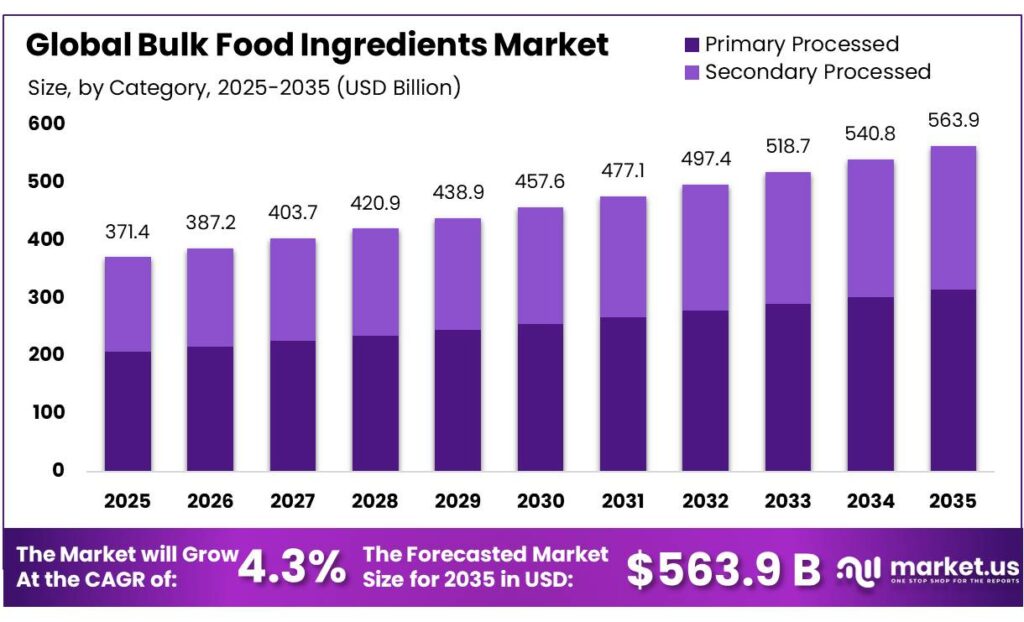
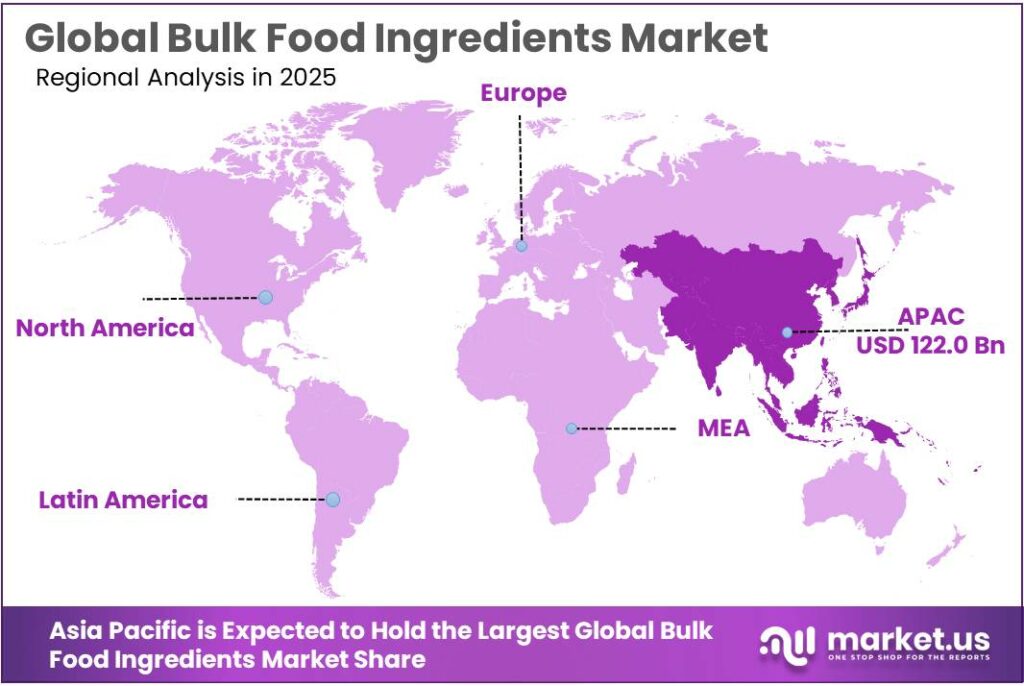
The Global Bulk Food Ingredients Market size is expected to be worth around USD 563.9 Billion by 2035, from USD 371.4 Billion in 2025, growing at a CAGR of 4.3% during the forecast period from 2026 to 2035. In 2025, Asia Pacific held a dominant market position, capturing more than a 38.5% share, holding USD 122.0 Billion revenue.
Bulk food ingredients comprise high-volume commodity and semi-processed inputs such as cereals, oilseeds, vegetable oils, sugar, starches, cocoa, dairy powders, proteins, fibers, and texturants that feed large-scale food manufacturing, foodservice, and private-label retail.
FAO forecasts world cereal production at 3,036 million tonnes in 2025, while world cereal utilization in 2025/26 is projected at 2,943 million tonnes. In parallel, USDA projects global vegetable oil production to reach nearly 235 million tons in 2025/26, showing that the backbone categories used in bakery, snacks, confectionery, sauces, ready meals, and dairy alternatives remain well supplied at scale.
The sector is increasingly shaped by the expansion of processed foods, quick-service channels, and contract manufacturing. USDA reports that total U.S. food spending reached $2.58 trillion in 2024, up from $2.48 trillion in 2023. Within that, food-away-from-home spending rose to $1.52 trillion, while food-at-home spending reached $1.06 trillion.
The main growth drivers are population expansion, urbanization, rising incomes in middle-income economies, and reformulation-led innovation. OECD-FAO states that global agricultural and fish production is projected to expand by 14% over the next decade, while global cereal production is expected to grow by about 1.1% annually through 2034. The same outlook projects global sugar consumption to rise by 1.2% per year to 202 million tonnes by 2034.
Government and institutional actions are also reshaping the market. In the United States, FDA’s latest sodium-reduction guidance sets 3-year voluntary targets across 163 food categories, with an intake goal of about 2,750 mg/day, which supports demand for salt-reduction systems, yeast extracts, mineral salts, and flavor modulators. FDA traceability requirements are also pushing ingredient suppliers toward tighter lot control and digital documentation.
ADM’s 2025 positioning remained focused on higher-value nutrition solutions: its trend research highlighted demand across sweeteners, proteins, flours, starches, texturants, fats, and oils, and the company was also recognized at the 2025 BIS Awards for innovative human nutrition solutions. These developments indicate that leading players are moving beyond bulk supply into application-led, health-oriented, and functionality-driven ingredient portfolios.
Key Takeaways
- Bulk Food Ingredients Market size is expected to be worth around USD 563.9 Billion by 2035, from USD 371.4 Billion in 2025, growing at a CAGR of 4.3%.
- Primary Processed held a dominant market position, capturing more than a 56.8% share.
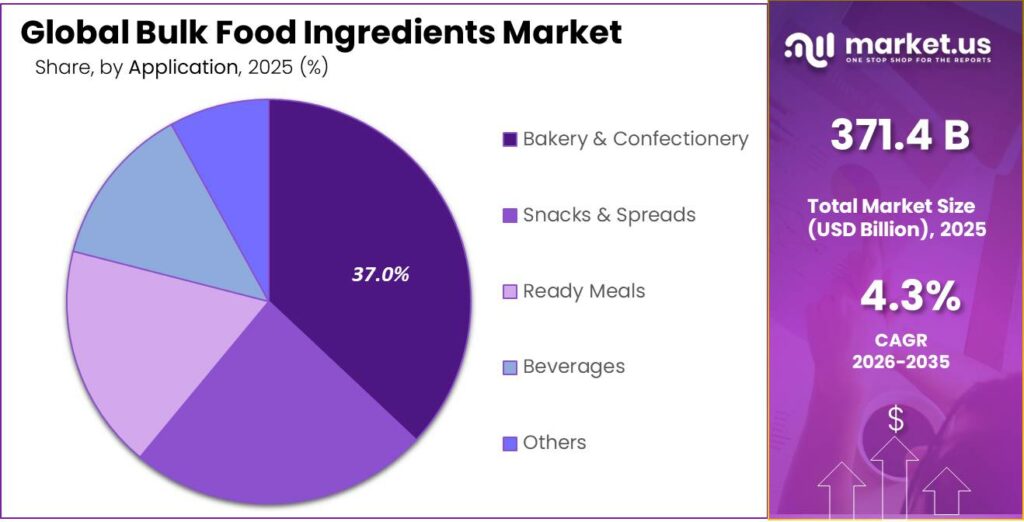
- Bakery & Confectionery held a dominant market position, capturing more than a 37.4% share.
- Asia Pacific emerged as the dominating region in the bulk food ingredients market, accounting for 38.5% of the global share and reaching USD 122.0 billion.
By Category Analysis
Primary Processed leads the bulk food ingredients market with 56.8% share, supported by its everyday use across staple food production.
In 2025, Primary Processed held a dominant market position, capturing more than a 56.8% share. This strong position was mainly supported by the steady demand for essential food ingredients that go through basic processing steps such as cleaning, grading, milling, drying, and sorting before reaching food manufacturers. These ingredients are widely used in bakery, dairy, snacks, beverages, and packaged food products, making them a core part of large-scale food production. Their easy availability, consistent quality, and suitability for further food preparation helped this segment remain the preferred choice among manufacturers.
By Application Analysis
Bakery & Confectionery stays ahead with 37.4% share, driven by strong demand for everyday baked snacks and sweet products.
In 2025, Bakery & Confectionery held a dominant market position, capturing more than a 37.4% share. This leadership was supported by the high-volume use of bulk ingredients such as flour, sugar, cocoa, starch, dairy powders, and specialty fats across bread, cakes, biscuits, pastries, chocolates, and sugar-based confectionery products. The segment continued to benefit from steady consumer demand for ready-to-eat baked goods, indulgent snacks, festive sweets, and packaged confectionery items sold through retail and foodservice channels. Large-scale manufacturers preferred bulk ingredient sourcing in this application because it helps maintain product consistency, supports faster production cycles, and improves cost control in high-output operations.
Key Market Segments
By Category
- Primary Processed
- Grains, Pulses and Cereals
- Tea, Coffee and Cocoa
- Herbs and Spices
- Oilseeds
- Sugar & Salt
- Others
- Secondary Processed
- Processed Grains, Pulses and Cereals
- Processed herbs and spices
- Dry Fruit & nuts
- Sugar & Sweetener
- Others
By Application
- Bakery & Confectionery
- Snacks & Spreads
- Ready Meals
- Beverages
- Others
Emerging Trends
High-protein and clean-label ingredients are becoming the clearest trend in bulk food ingredients
Bulk food ingredients are increasingly moving toward high-protein use, and this is one of the clearest latest trends in 2025. Food makers are using more protein-rich raw materials in cereals, bakery mixes, snack bases, beverage powders, and nutrition products because consumer eating habits are shifting in that direction. The 2025 IFIC Food & Health Survey shows that 57% of Americans followed a specific eating pattern in the past year, up from 54% in 2024 and 36% in 2018.
The same survey found that 23% followed a high-protein diet in 2025, making it the most common diet tracked, while 70% said protein is the nutrient they actively try to consume. It also found that 38% now describe a healthy food as a “good source of protein.” For bulk ingredient suppliers, this clearly supports stronger demand for dairy proteins, plant proteins, pulses, grains, seeds, and fortified dry blends used at scale in packaged foods and beverage manufacturing.
The 2025 IFIC survey found that 28% of consumers define healthy food as having minimal or no processing, while 25% look for foods with limited or no artificial ingredients or preservatives. It also reported that 53% of consumers would check the ingredient list when deciding whether a food fits their understanding of ultra-processed foods.
On the regulatory side, this trend is being reinforced by public policy. India’s Food Safety and Standards Regulations, 2020, updated in September 2025, continue to tighten labeling expectations for packaged foods, while the U.S. FDA announced a new approach to “no artificial colors” claims in February 2026. Together, these signals are pushing food manufacturers toward cleaner bulk ingredients, natural colors, and simpler formulations.
Drivers
Rising processed food demand is strongly pushing bulk food ingredient consumption
One of the biggest drivers for the bulk food ingredients market is the steady rise in processed and packaged food consumption worldwide. As more consumers move toward ready-to-cook meals, bakery snacks, confectionery, instant beverages, and convenience foods, manufacturers need large and reliable volumes of grains, sweeteners, cocoa, starches, dairy solids, oils, and spices.
This directly lifts demand for bulk ingredients because these products are the base materials used in high-volume food production. A strong sign of this trend comes from the Food and Agriculture Organization, which reported that global fisheries and aquaculture production is expected to rise by 1.7%, while per capita aquaculture food consumption is projected to grow by 2.5%, reflecting the broader rise in processed and packaged food ingredient use across value-added food systems.
Government-backed industry updates show that the share of processed food in agri-food exports increased from 13.7% in 2014–15 to 20.4% in 2024–25, while sector gross value added rose by 67%, reaching Rs 2.24 lakh crore from Rs 1.34 lakh crore. This kind of expansion creates a direct need for bulk sourcing of flour, sugar, edible oils, pulses, herbs, and dry ingredients at industrial scale.
Government support and supply chain modernization are accelerating ingredient demand
Another major growth factor is the strong push from governments and food agencies toward food processing infrastructure, storage, and value addition. Bulk food ingredients move in very large quantities, so better warehousing, grading, cold chains, and transport systems directly improve their market demand. In India, the Ministry of Food Processing Industries continues to support infrastructure creation, waste reduction, and modernization to improve farm-to-factory movement of agricultural produce.
At the global level, the OECD-FAO Agricultural Outlook also highlights long-term production expansion across cereals, oilseeds, sugar, dairy, and fish commodities through 2034, which supports a stronger raw material base for ingredient processors.
Restraints
Raw material price volatility remains a major restraint for bulk food ingredients
One of the biggest restraining factors for the bulk food ingredients market is the constant fluctuation in raw material prices. Since this market depends heavily on agricultural commodities such as wheat, sugar, oils, dairy solids, cocoa, and spices, even a small shift in crop yield, weather, fuel cost, or trade movement can quickly change procurement costs. This directly affects food manufacturers that buy in bulk contracts and work on tight margins. A strong example comes from the FAO Food Price Index, which averaged 128.5 points in March 2026, showing a 2.4% monthly increase and the second straight month of price rise across cereals, dairy, meat, vegetable oils, and sugar.
This issue becomes more serious when food companies need to plan annual sourcing volumes. A sudden rise in sugar, edible oil, or grain prices can reduce profit margins or force manufacturers to pass on higher prices to consumers, which may lower demand. In many developing food-processing regions, import dependence for oils, cocoa, nuts, and specialty ingredients increases this risk further. Government trade restrictions, export curbs, and climate-linked crop damage also add pressure.
Supply chain disruptions and food inflation increase cost pressure across processors
Another major restraint linked to the same issue is the wider effect of food inflation and unstable logistics. Trusted global food agencies noted that food price inflation remains a challenge for processors, especially where transport, storage, and international sourcing costs are high. The 2025 global food security report from FAO and partner agencies specifically focused on high food price inflation as a major concern for supply stability and affordability.
For example, when freight rates or fuel costs rise, bulk shipments of grains, pulses, sweeteners, and dehydrated ingredients become expensive, directly affecting large food factories. These disruptions are especially difficult for products with seasonal sourcing cycles such as cocoa, coffee, nuts, and spices. Even when supply is available, unstable landed costs reduce pricing confidence for long-term buyers. In practical terms, manufacturers may reduce order volumes, delay expansion, or shift to substitute ingredients, which slows demand momentum in the overall market.
Opportunity
Expansion of processed food exports creates a strong growth opportunity for bulk food ingredients
One of the strongest growth opportunities for the bulk food ingredients market is the rapid expansion of processed food exports and cross-border food trade. As countries increase shipments of bakery mixes, dairy products, snack bases, sauces, confectionery, and ready-to-cook foods, the demand for industrial-scale ingredients such as flour, sugar, starches, cocoa, milk powders, edible oils, and spice blends rises in parallel. FAO’s 2025 Food Outlook highlighted that production and trade of nearly all major food commodities are expected to increase, showing a supportive supply environment for ingredient processors and exporters.
Government-backed export promotion and food processing infrastructure schemes are adding further momentum. In emerging economies, policy support for mega food parks, cold chain logistics, and agri-processing clusters is helping manufacturers scale ingredient procurement faster. As global brands continue to expand into Asia, the Middle East, and Africa, bulk ingredient suppliers have a wider chance to serve regional manufacturing hubs.
Rising cereal, oilseed, and dairy output opens new volume opportunities for suppliers
Another major opportunity comes from the steady rise in agricultural commodity output, which strengthens the raw material base for bulk ingredient suppliers. The OECD-FAO Agricultural Outlook 2025–2034 shows continued long-term expansion in cereals, oilseeds, dairy, sugar, and vegetable oils, creating a more reliable flow of source materials for ingredient processing industries.
Governments are also encouraging value addition at the farm level through storage modernization, traceability systems, and food safety upgrades, which further improves ingredient quality for industrial buyers. As food brands increasingly launch fortified, plant-based, and convenience products, suppliers that secure large agricultural volumes can expand margins and enter higher-value applications. This production-side strength offers a clear growth path for the bulk food ingredients market over the next few years.
Regional Insights
Asia Pacific dominated the bulk food ingredients market with a 38.5% share, reaching USD 122.0 Billion
Asia Pacific emerged as the dominating region in the bulk food ingredients market, accounting for 38.5% of the global share and reaching USD 122.0 billion. The region’s leadership is strongly supported by its massive population base, rising middle-class spending, and the fast expansion of packaged food, bakery, beverage, dairy, and ready-to-cook product consumption across China, India, Japan, Indonesia, and Southeast Asia.
Governments in major countries are expanding food processing infrastructure, grain storage, and cold-chain systems to reduce wastage and improve industrial supply continuity. For example, India’s grain storage capacity expansion plan aims to raise total capacity beyond 200 million tonnes, creating stronger support for large-scale bulk ingredient handling and stable supply flows across flour, rice, pulses, sugar, and oilseed categories.
Key Regions and Countries Insights
- North America
- US
- Canada
- Europe
- Germany
- France
- The UK
- Spain
- Italy
- Rest of Europe
- Asia Pacific
- China
- Japan
- South Korea
- India
- Australia
- Rest of APAC
- Latin America
- Brazil
- Mexico
- Rest of Latin America
- Middle East & Africa
- GCC
- South Africa
- Rest of MEA
Key Players Analysis
Cargill remains one of the most influential players in the bulk food ingredients market, supported by its vast global network in grains, edible oils, sweeteners, starches, cocoa, and protein ingredients. In fiscal 2025, the company reported USD 154 billion in revenue, reflecting its deep reach across industrial food manufacturing and supply chains. Its scale in agricultural sourcing, ingredient processing, and logistics gives it strong control over bulk supply continuity. The company’s investment of USD 110 million in communities and large operational modernization efforts further strengthen its long-term position in global ingredient trade.
Bunge is a key supplier of oilseed-based and grain-derived bulk ingredients, with strong exposure to edible oils, flours, and milling inputs. In 2025, Bunge reported USD 36.3 billion in net sales from soybean processing and refining alone, while total segment EBIT reached USD 2.329 billion.
Associated British Foods has a strong position in yeast, bakery ingredients, enzymes, emulsifiers, and sugar-based bulk ingredients. In 2025, its ingredients division generated GBP 2.041 billion in revenue, while total group revenue stood at GBP 19.459 billion. The company’s ingredient business benefits from steady demand in bakery and food processing applications.
Top Key Players Outlook
- Cargill, Incorporated
- Archer-Daniels-Midland Company
- Bunge Limited
- Associated British Foods plc
- Olam International
- Tate & Lyle
- DUPONT DE NEMOURS, INC
- Essex Food Ingredients
- Ingredients Inc.
- Corbion
- Koninklijke DSM N.V
- EHL Ingredients
- McCormick & Company, Inc
- GCL Food Ingredients
- Dmh Ingredients, Inc.
Recent Industry Developments
Cargill remains a leading global supplier of starches, sweeteners, edible oils, cocoa, texturizers, plant proteins, and grain-based ingredients used across bakery, confectionery, beverages, dairy, and convenience foods. In fiscal 2025, Cargill reported USD 154 billion in total revenue, highlighting its strong scale in industrial food ingredient sourcing and processing.
In 2025, ABF’s Ingredients division reported revenue of £2,041 million and adjusted operating profit of £257 million, showing that the company continues to hold a solid position in industrial ingredient supply.
Report Scope
Report Features Description Market Value (2025) USD 371.4 Bn Forecast Revenue (2035) USD 563.9 Bn CAGR (2026-2035) 4.3% Base Year for Estimation 2025 Historic Period 2020-2024 Forecast Period 2026-2035 Report Coverage Revenue Forecast, Market Dynamics, Competitive Landscape, Recent Developments Segments Covered By Category (Primary Processed, Secondary Processed), By Application (Bakery And Confectionery, Snacks And Spreads, Ready Meals, Beverages, Others) Regional Analysis North America – US, Canada; Europe – Germany, France, The UK, Spain, Italy, Rest of Europe; Asia Pacific – China, Japan, South Korea, India, Australia, Singapore, Rest of APAC; Latin America – Brazil, Mexico, Rest of Latin America; Middle East & Africa – GCC, South Africa, Rest of MEA Competitive Landscape Cargill, Incorporated, Archer-Daniels-Midland Company, Bunge Limited, Associated British Foods plc, Olam International, Tate & Lyle, DUPONT DE NEMOURS, INC, Essex Food Ingredients, Ingredients Inc., Corbion, Koninklijke DSM N.V, EHL Ingredients, McCormick & Company, Inc, GCL Food Ingredients, Dmh Ingredients, Inc. Customization Scope Customization for segments, region/country-level will be provided. Moreover, additional customization can be done based on the requirements. Purchase Options We have three licenses to opt for: Single User License, Multi-User License (Up to 5 Users), Corporate Use License (Unlimited User and Printable PDF)  Bulk Food Ingredients MarketPublished date: April 2026add_shopping_cartBuy Now get_appDownload Sample
 -
-
- Cargill, Incorporated
- Archer-Daniels-Midland Company
- Bunge Limited
- Associated British Foods plc
- Olam International
- Tate & Lyle
- DUPONT DE NEMOURS, INC
- Essex Food Ingredients
- Ingredients Inc.
- Corbion
- Koninklijke DSM N.V
- EHL Ingredients
- McCormick & Company, Inc
- GCL Food Ingredients
- Dmh Ingredients, Inc.
Our Clients

- 183642
- April 2026






