


Global Biocides Market Size, Share, And Enhanced Productivity By Product Type (Halogen Compounds, Metallic Compounds, Organosulfur, Organic acids, Quaternary Ammonium Compounds, Phenolic, Nitrogen, Glutaraldehyde), By End Use (Water Treatment, Food and Beverage, Personal Care, Wood Preservation, Paints and Coatings, Oil and Gas, Pulp and Paper, Others), By Region and Companies - Industry Segment Outlook, Market Assessment, Competition Scenario, Trends, and Forecast 2026-2035
- Published date: February 2026
- Report ID: 180336
- Number of Pages: 234
- Format:
-
keyboard_arrow_up
Quick Navigation
Report Overview
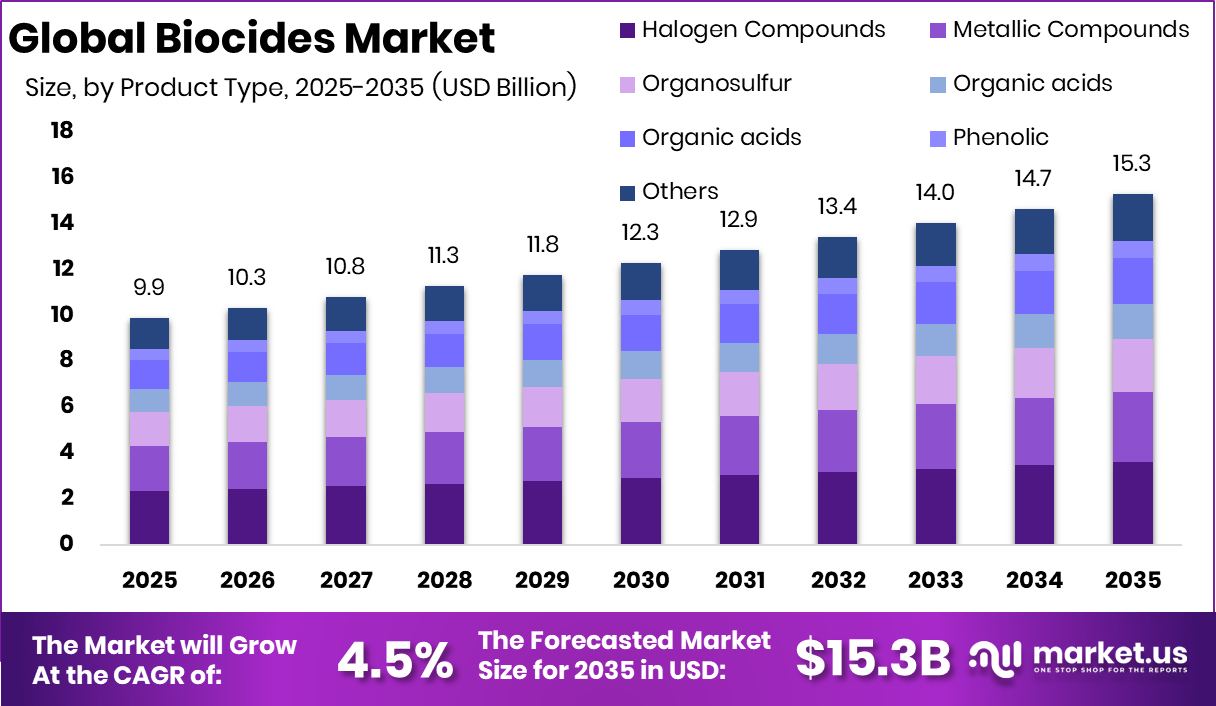
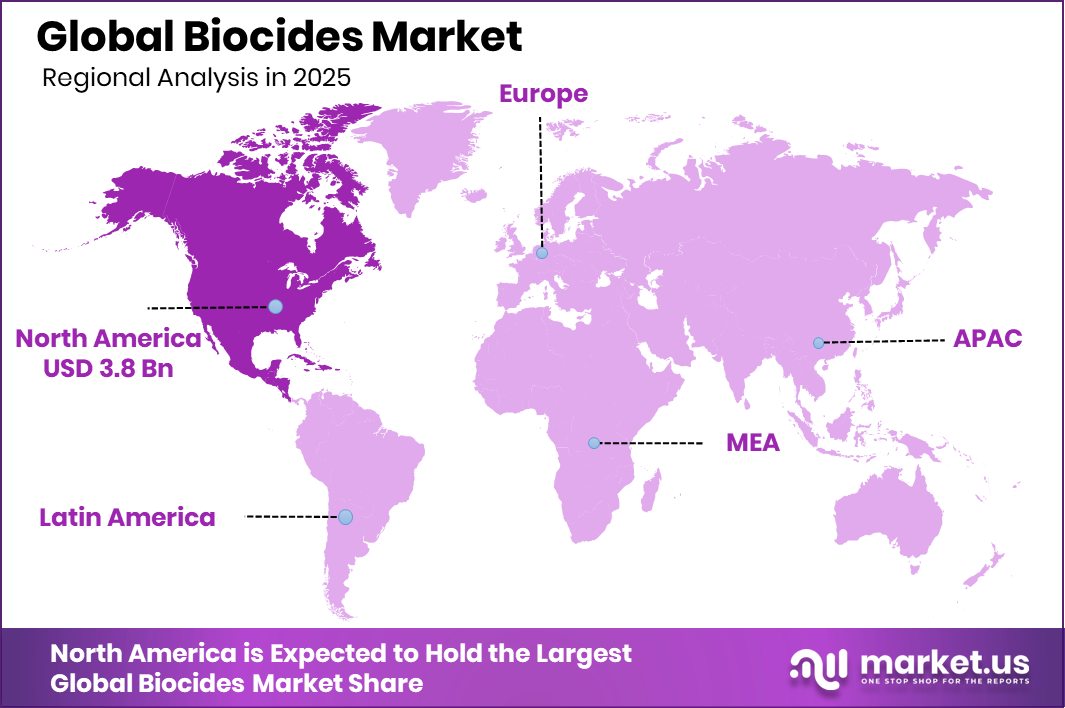
The Global Biocides Market is expected to be worth around USD 15.3 billion by 2035, up from USD 9.9 billion in 2025, and is projected to grow at a CAGR of 4.5% from 2026 to 2035. The biocide market in North America represented a 39.1% share, totaling USD 3.8 Bn.
Biocides are chemical substances used to control harmful microorganisms such as bacteria, fungi, algae, and other biological organisms that can damage materials or affect hygiene. These compounds are widely applied to maintain cleanliness, protect industrial systems, and extend the life of products exposed to microbial activity. In sectors such as water treatment, wood preservation, and paints and coatings, biocides help prevent biological growth that may cause contamination, corrosion, or degradation. Different product types, including halogen compounds, metallic compounds, organosulfur, organic acids, quaternary ammonium compounds, phenolic compounds, nitrogen-based chemicals, and glutaraldehyde, are designed to address specific microbial challenges across industrial and commercial environments.
The Biocides Market refers to the global trade and use of antimicrobial and preservative chemicals applied across various industries to manage microbial growth. These products are commonly used in applications such as water treatment, food and beverage processing, personal care manufacturing, wood preservation, paints and coatings production, oil and gas operations, and pulp and paper processing. The market reflects the demand for microbial control solutions that help maintain product stability, protect infrastructure, and support hygiene standards across multiple industrial processes.
Market growth is supported by increasing attention to hygiene, material protection, and operational efficiency across industries. Industrial systems often face microbial contamination that can reduce performance and shorten equipment life. Continuous development in chemical technology and research funding is also strengthening innovation within the sector.
For example, a $400,000 NSF grant supporting heavy metal-free synthesis research at the University of Houston highlights ongoing scientific progress in safer chemical processes. Similarly, Floreon securing GBP 250 million to expand bioplastics technology reflects broader investment in sustainable chemical materials that can influence antimicrobial product development.
Demand for biocides continues to expand as industries focus on maintaining clean production environments and protecting infrastructure from biological damage. Water treatment, paints and coatings, and oil and gas operations rely heavily on these chemicals to maintain operational stability. Growing digital and technological investments across the chemical and industrial sectors also present new opportunities for advanced solutions.
Funding initiatives such as Halogen Capital’s RM13.3 million investment round for digital innovation, Metal’s $5 million investment to improve data analysis technologies, and $100 million bond funding proposed to support tourism infrastructure highlight broader economic activity that indirectly supports industrial maintenance, sanitation requirements, and material protection technologies where biocides remain essential.
Key Takeaways
- The Global Biocides Market is expected to be worth around USD 15.3 billion by 2035, up from USD 9.9 billion in 2025, and is projected to grow at a CAGR of 4.5% from 2026 to 2035.
- Halogen compounds hold 23.6% share in the Biocides Market, widely used for effective microbial control.
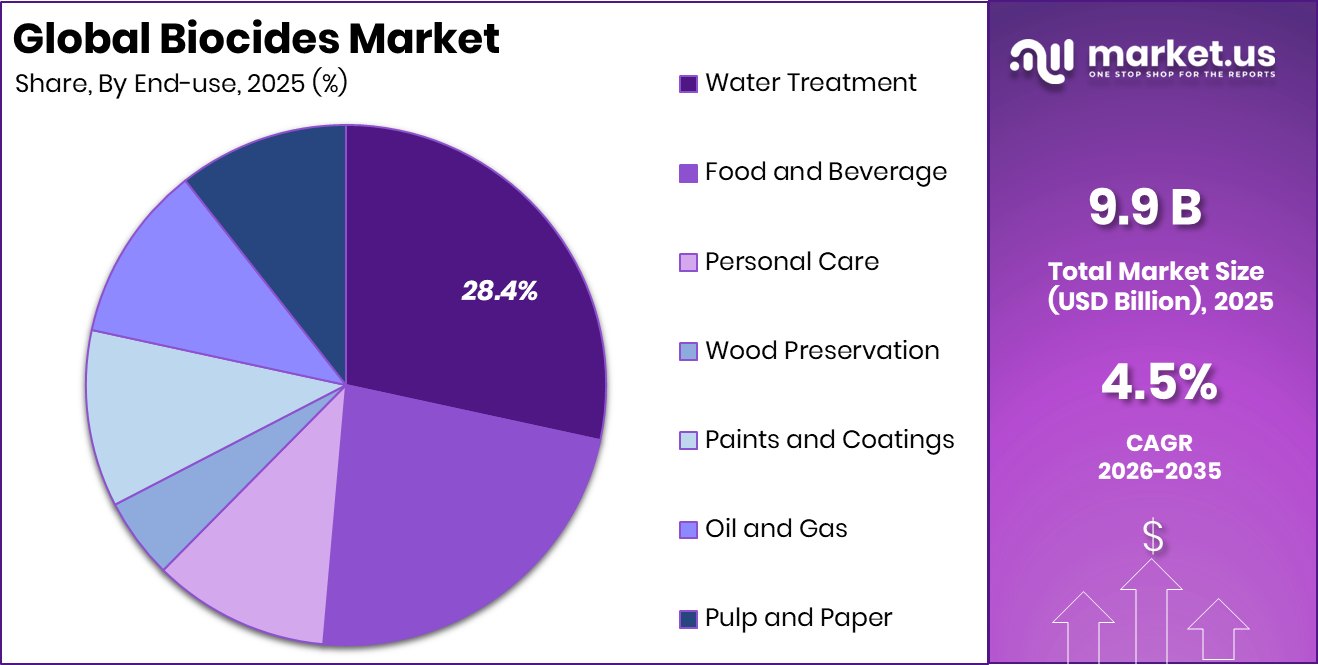
- Water treatment dominates end use with 28.4% share in the Biocides Market, driven by sanitation needs.
- North America held 39.1% share in the biocides market, reaching a USD 3.8 Bn value.
By Product Type Analysis
Halogen compounds dominate the Biocides Market, accounting for a 23.6% product share globally.
In 2025, the Biocides Market by product type is led by halogen compounds, accounting for 23.6% of the total market share. Halogen-based biocides, including chlorine and bromine compounds, are widely used due to their strong antimicrobial effectiveness and cost efficiency. These compounds are particularly effective in controlling bacteria, algae, and fungi in various industrial and commercial applications. Their rapid action and ability to maintain microbial control in water systems make them highly preferred across sectors such as municipal water treatment, cooling towers, and swimming pools.
Growing concerns over waterborne diseases and stricter regulations on water hygiene are also driving the demand for halogen-based biocides. As industries continue to prioritize sanitation and microbial control, halogen compounds remain an essential component of the biocides market.
By End Use Analysis
Water treatment leads the Biocides Market end-use segment with a 28.4% share.
In 2025, the Biocides Market by end use is significantly driven by the water treatment sector, which holds a 28.4% market share. The increasing global demand for clean and safe water has led municipalities and industries to adopt effective microbial control solutions. Biocides play a crucial role in eliminating harmful microorganisms, preventing biofouling, and maintaining water quality in treatment plants, cooling systems, and industrial water processes.
Rapid urbanization, expanding industrial activity, and stricter environmental and public health regulations are contributing to the rising need for advanced water treatment solutions. In addition, the growing focus on sustainable water management and recycling practices is further boosting the use of biocides in this sector, making water treatment the largest end-use segment in the biocides market.
Key Market Segments
By Product Type
- Halogen Compounds
- Metallic Compounds
- Organosulfur
- Organic acids
- Quaternary Ammonium Compounds
- Phenolic
- Nitrogen
- Glutaraldehyde
By End Use
- Water Treatment
- Food and Beverage
- Personal Care
- Wood Preservation
- Paints and Coatings
- Oil and Gas
- Pulp and Paper
- Others
Driving Factors
Rising demand for industrial water treatment
Growing pressure on water resources and the need for reliable treatment systems continue to support demand within the Biocides Market. Industries, municipalities, and utilities increasingly rely on microbial control chemicals to maintain safe water circulation, prevent biofouling, and protect infrastructure. Public investment in water facilities further reinforces this trend. For instance, the City of Roma secured $15 million in funding for water treatment plant upgrades, reflecting continued infrastructure modernization to ensure safe water management.
Similarly, the Illinois Environmental Protection Agency introduced $1.5 million in grants for water facility upgrades, encouraging improvements in treatment processes and system reliability. Such initiatives indicate rising attention toward maintaining clean water systems, where biocides remain essential for controlling microbial contamination and maintaining operational stability across municipal and industrial water networks.
Restraining Factors
Strict environmental regulations on chemical usage
Environmental regulations surrounding chemical handling and discharge are increasingly influencing the operational environment of the Biocides Market. Governments and regulatory bodies are placing stricter oversight on antimicrobial chemicals due to concerns related to ecological impact, toxicity, and long-term environmental exposure. Compliance requirements often demand detailed monitoring, controlled usage, and approval processes for certain formulations. At the same time, large-scale infrastructure projects also draw regulatory attention.
For example, lawmakers have pledged funding support for a $315 million water megaproject, demonstrating the scale of environmental management initiatives that often require strict oversight on chemical treatment practices. While such investments strengthen water infrastructure, they also reinforce the need for regulated chemical usage. As a result, companies operating within the biocides industry must balance performance requirements with environmental safety standards and regulatory compliance expectations.
Growth Opportunity
Development of eco-friendly antimicrobial solutions
The shift toward environmentally responsible chemical solutions is creating new opportunities for innovation in the Biocides Market. Industries are increasingly exploring antimicrobial technologies that maintain strong microbial control while reducing environmental impact. Research and infrastructure funding also support improvements in treatment facilities and water quality management, indirectly encouraging the adoption of advanced antimicrobial solutions. For instance, Housatonic Water Works received a $250,000 grant from the Massachusetts Department of Environmental Protection for a manganese treatment plant, helping strengthen water purification capabilities.
In addition, Greenville Water secured $1.75 million in community project funding aimed at improving local water infrastructure. Such developments highlight growing attention to sustainable treatment systems. As environmental awareness expands, the development of eco-friendly antimicrobial solutions is expected to open new application areas and encourage the modernization of microbial control technologies.
Latest Trends
Rising adoption of sustainable biocide formulations
Sustainability has become a defining trend influencing the direction of the Biocides Market, particularly as governments and communities prioritize resilient water infrastructure and responsible chemical usage. Modern infrastructure investments are increasingly designed to support efficient treatment processes while minimizing environmental impact. For example, Arkansas advanced $154 million in water and wastewater projects, emphasizing improvements in treatment capacity and system reliability.
Similarly, Ontario announced an investment of $700 million in critical water infrastructure to protect communities and support housing development. These large-scale initiatives highlight the growing focus on sustainable water management and long-term infrastructure planning. As treatment facilities expand and modernize, the demand for advanced and sustainable biocide formulations continues to rise, supporting microbial control while aligning with evolving environmental expectations and infrastructure modernization goals.
Regional Analysis
In 2025, North America accounted for 39.1% of the Biocides Market, valued at USD 3.8 Bn.
The Biocides Market demonstrates varied regional performance across North America, Europe, Asia Pacific, the Middle East & Africa, and Latin America, supported by differences in industrial development, water treatment requirements, and regulatory frameworks.
North America represents the dominating region, accounting for 39.1% of the global biocides market with a value of USD 3.8 Bn. The region’s strong position is supported by extensive use of biocides in water treatment, industrial processing, and sanitation applications across several sectors.
Strict regulatory standards related to water quality, hygiene, and microbial control further sustain the demand for biocide products in this region. Europe maintains a stable market presence driven by established industrial infrastructure and regulatory oversight of chemical usage.
Asia Pacific is characterized by expanding industrial activities and rising demand for water treatment solutions across multiple sectors. The Middle East & Africa continue to adopt biocides primarily in water management and industrial maintenance applications due to increasing infrastructure development.
Latin America also demonstrates steady market participation with growing application of biocides in industrial water systems and sanitation processes, contributing to the overall expansion of the global biocides market.
Key Regions and Countries
- North America
- US
- Canada
- Europe
- Germany
- France
- The UK
- Spain
- Italy
- Rest of Europe
- Asia Pacific
- China
- Japan
- South Korea
- India
- Australia
- Rest of APAC
- Latin America
- Brazil
- Mexico
- Rest of Latin America
- Middle East & Africa
- GCC
- South Africa
- Rest of MEA
Key Players Analysis
In 2025, Troy Corporation continues to play an important role in the global biocides industry through its focus on specialty antimicrobial technologies. The company is recognized for developing preservative and microbial control solutions used across multiple industrial applications. Its product portfolio supports manufacturers seeking reliable protection against bacteria, fungi, and algae in various formulations and materials. Troy Corporation emphasizes consistent product performance and technical expertise, allowing it to maintain strong relationships with industrial customers. The company’s operational approach centers on formulation support and application-specific solutions, enabling users to maintain product stability and quality during storage and use.
Chemtreat, Inc. maintains a strategic presence in the biocides market through its expertise in water treatment technologies and microbial control solutions. The company supports industries requiring effective management of biological growth in complex water systems. Its offerings are designed to improve operational reliability in cooling systems, industrial processes, and facility water management. Chemtreat’s approach integrates chemical treatment solutions with technical service capabilities, helping organizations maintain system efficiency and regulatory compliance. The company’s operational model emphasizes close collaboration with industrial clients, ensuring that microbial control programs align with specific system conditions and operational needs.
Neogen Corporation holds a notable position in the biocides landscape through its emphasis on safety, hygiene, and microbial management technologies. The company provides solutions designed to support sanitation and contamination control across multiple operational environments. Its portfolio focuses on maintaining high standards of cleanliness and microbial prevention, helping organizations manage biological risks effectively. Neogen Corporation’s strategic direction highlights product reliability, regulatory awareness, and scientific development in antimicrobial solutions.
Top Key Players in the Market
- Troy Corporation
- Chemtreat, Inc.
- Neogen Corporation
- Finoric LLC
- Shanghai Zhongxin Yuxiang Chemicals Co. Ltd.
- Iro Group Inc.
- Hubei Jinghong Chemicals Co. Ltd.
- Wuxi Honor Shine Chemical Co. Ltd.
- Albemarle Corporation
- Lubrizol
Recent Developments
- In April 2025, Neogen Corporation, which develops food safety and sanitation solutions, including disinfectants and microbial control products, announced an agreement to sell its global cleaners and disinfectants business to Kersia Group for about $130 million. The move helps the company focus more on food safety diagnostics and core technologies.
- In May 2024, Chemtreat, Inc., a company specializing in industrial water treatment and microbial control solutions, highlighted SurfClean™ 2.0, an advanced halogen stabilizer and biodispersant. The product makes halogen-based biocide programs work better by keeping chlorine stable and getting rid of biofilms in cooling water systems, which helps with controlling microbes and making the system more efficient.
Report Scope
Report Features Description Market Value (2025) USD 9.9 Billion Forecast Revenue (2035) USD 15.3 Billion CAGR (2026-2035) 4.5% Base Year for Estimation 2025 Historic Period 2020-2024 Forecast Period 2026-2035 Report Coverage Revenue Forecast, Market Dynamics, Competitive Landscape, Recent Developments Segments Covered By Product Type (Halogen Compounds, Metallic Compounds, Organosulfur, Organic acids, Quaternary Ammonium Compounds, Phenolic, Nitrogen, Glutaraldehyde), By End Use (Water Treatment, Food and Beverage, Personal Care, Wood Preservation, Paints and Coatings, Oil and Gas, Pulp and Paper, Others) Regional Analysis North America – US, Canada; Europe – Germany, France, The UK, Spain, Italy, Rest of Europe; Asia Pacific – China, Japan, South Korea, India, Australia, Singapore, Rest of APAC; Latin America – Brazil, Mexico, Rest of Latin America; Middle East & Africa – GCC, South Africa, Rest of MEA Competitive Landscape Troy Corporation, Chemtreat, Inc., Neogen Corporation, Finoric LLC, Shanghai Zhongxin Yuxiang Chemicals Co. Ltd., Iro Group Inc., Hubei Jinghong Chemicals Co. Ltd., Wuxi Honor Shine Chemical Co. Ltd., Albemarle Corporation, Lubrizol Customization Scope Customization for segments, region/country-level will be provided. Moreover, additional customization can be done based on the requirements. Purchase Options We have three licenses to opt for: Single User License, Multi-User License (Up to 5 Users), Corporate Use License (Unlimited User and Printable PDF) 
-
-
- Troy Corporation
- Chemtreat, Inc.
- Neogen Corporation
- Finoric LLC
- Shanghai Zhongxin Yuxiang Chemicals Co. Ltd.
- Iro Group Inc.
- Hubei Jinghong Chemicals Co. Ltd.
- Wuxi Honor Shine Chemical Co. Ltd.
- Albemarle Corporation
- Lubrizol
Our Clients

- 180336
- February 2026






