


Global Activated Bleaching Earth Market Size, Share and Report Analysis By Technology (Wet Process, Dry Process, Vapour Phase Process), By Application (Edible Oil and Fats, Mineral Oil and Lubricants, Others) , By Region and Companies - Industry Segment Outlook, Market Assessment, Competition Scenario, Trends and Forecast 2025-2035
- Published date: Mar 2026
- Report ID: 180208
- Number of Pages: 366
- Format:
-
keyboard_arrow_up
Quick Navigation
Report Overview
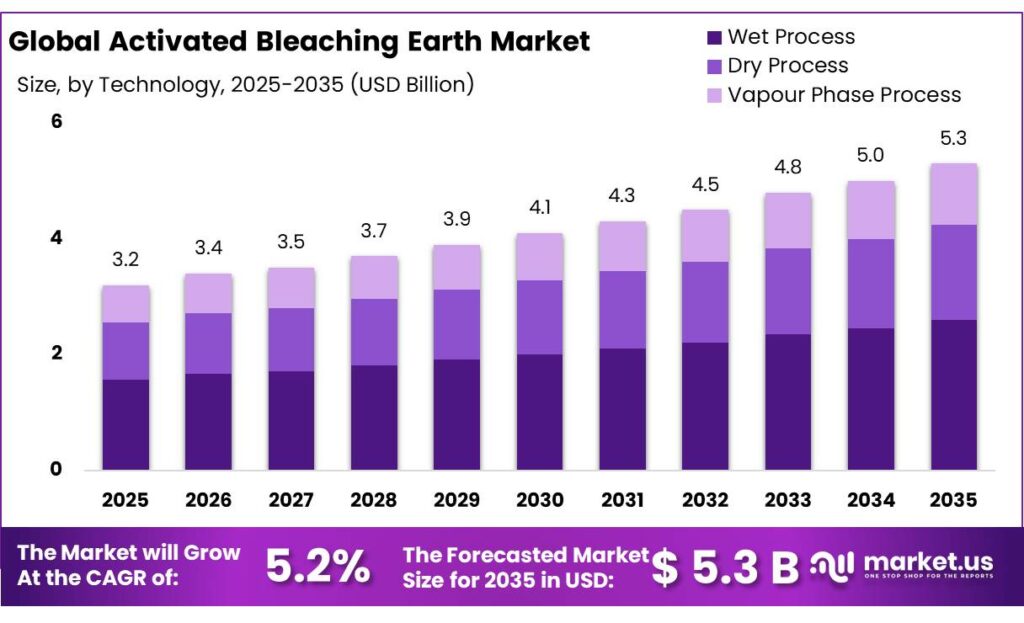
The Global Activated Bleaching Earth Market is expected to be worth around USD 5.3 Billion by 2035, up from USD 3.2 Billion in 2025, at a CAGR of 5.2% from 2026 to 2035. The Asia Pacific segment maintained 45.8%, supporting a Activated Bleaching Earth value of USD 1.4 Bn.
Activated bleaching earth (ABE)—typically acid-activated clay—is a critical “workhorse” input in edible-oil refining because it adsorbs color bodies (chlorophyll, carotenoids), trace metals, soaps, and oxidation by-products to produce a stable, light-colored, food-grade oil. Industrially, bleaching is carried out under vacuum at elevated temperature; FAO technical guidance describes the bleaching step as heating oil to about 103°C under vacuum with the addition of bleaching earth to remove pigments and improve appearance.
USDA’s “Major Vegetable Oils” balance shows total production rising to 222.59 million metric tons (MMT) in 2024/25, with palm oil alone at 78.41 MMT—illustrating the enormous refining base where bleaching media is routinely consumed. At the process level, peer-reviewed refining literature notes that bleaching earth is commonly used around 1–3 g per 100 g of oil, often alongside an acid dose of 0.05–1.2 g per 100 g depending on crude quality and contaminant load.
Key driving factors are increasingly “specification-led.” First, sustainability and traceability programs in palm oil are raising attention to processing quality and consistency: RSPO reports that in 2024 its members represented 39% of global palm oil production (31.4 MMT), and 20.1% (16.2 MMT) was certified as Certified Sustainable Palm Oil (CSPO).
Second, public-health fortification policies lift the importance of controlled refining and vitamin retention/handling. India’s FSSAI notes fortified edible oil can provide 25%–30% of recommended dietary allowances for vitamins A & D, which increases operational emphasis on stable, repeatable refining and blending practices.
The regulation sets maximum levels for glycidyl fatty acid esters (expressed as glycidol) at 1,000 μg/kg for vegetable oils/fats (with specific infant-food related limits at 500 μg/kg). Separately, demand resilience is reinforced by food-system pressures: FAO highlighted that in Least-Developed Countries, expenditures on animal and vegetable oils are estimated to rise by 58% compared with 2024, reflecting both price and quantity effects and keeping attention on edible-oil availability and affordability.
Key Takeaways
- Activated Bleaching Earth Market is expected to be worth around USD 5.3 Billion by 2035, up from USD 3.2 Billion in 2025, at a CAGR of 5.2%.
- Wet Process held a dominant market position, capturing more than a 49.4% share in the Activated Bleaching Earth market.
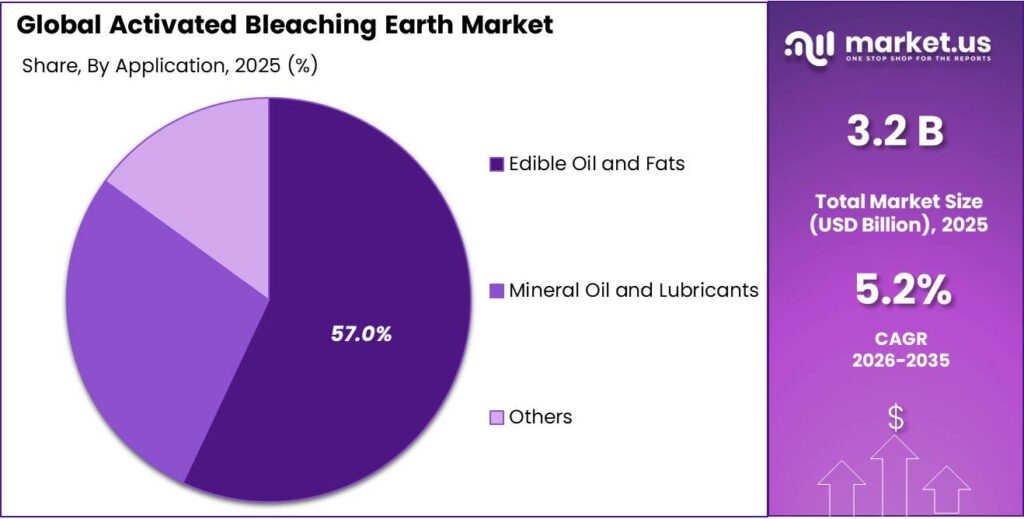
- Edible Oil and Fats held a dominant market position, capturing more than a 57.2% share in the Activated Bleaching Earth market.
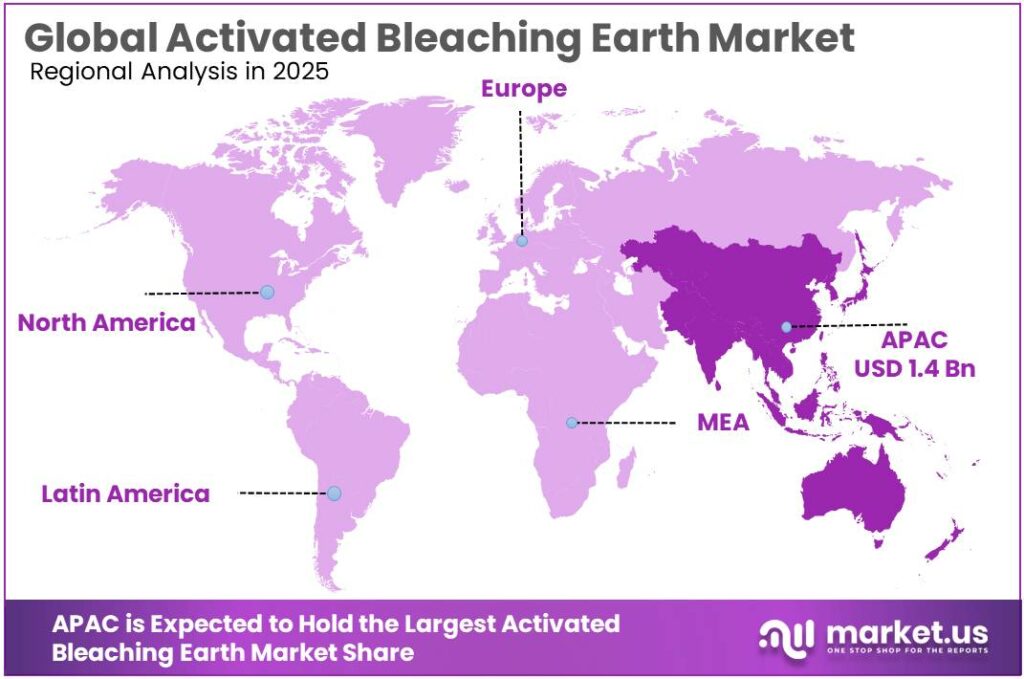
- Asia Pacific accounted for about 45.8% of the global market, valued at nearly USD 1.4 Bn.
By Technology Analysis
Wet Process leads the market with 49.4% share due to consistent purification performance
In 2024, Wet Process held a dominant market position, capturing more than a 49.4% share in the Activated Bleaching Earth market. This technology remains widely used in edible oil refining because it helps improve the adsorption efficiency of bleaching earth during the purification stage.
In the wet process, activated clay is treated and applied in a slurry or moisture-controlled form, which improves the contact between the oil and the bleaching material. This better interaction helps remove color pigments, trace metals, phospholipids, and oxidation compounds more effectively. Many large vegetable oil refineries prefer this process because it supports stable filtration and reduces processing losses during refining.
By Application Analysis
Edible Oil and Fats dominate with 57.2% share driven by strong refining demand
In 2024, Edible Oil and Fats held a dominant market position, capturing more than a 57.2% share in the Activated Bleaching Earth market. This large share mainly reflects the essential role of bleaching earth in the refining of vegetable oils used for food consumption. During oil processing, activated bleaching earth is applied in the bleaching stage to remove pigments, trace metals, soaps, and other impurities that affect oil color, taste, and shelf stability.
As global consumption of edible oils such as palm oil, soybean oil, sunflower oil, and canola oil continues to grow, refineries rely heavily on bleaching materials to maintain quality standards. The edible oil industry therefore represents the most stable and consistent application area for activated bleaching earth.
Key Market Segments
By Technology
- Wet Process
- Dry Process
- Vapour Phase Process
By Application
- Edible Oil and Fats
- Mineral Oil and Lubricants
- Others
Emerging Trends
Growing Focus on Sustainable Oil Refining and Recycling of Bleaching Materials
One of the most noticeable latest trends in the Activated Bleaching Earth industry is the increasing focus on sustainable edible oil refining and recycling of refining by-products. As global vegetable oil production continues to grow, the refining sector is under pressure to reduce waste, improve resource efficiency, and adopt environmentally responsible processing methods. Activated bleaching earth is widely used during the bleaching stage of oil refining to remove pigments, oxidation compounds, and trace contaminants from crude oils.
The need for sustainable refining practices is closely linked with the rapid expansion of the global vegetable oil industry. According to the U.S. Department of Agriculture (USDA), global vegetable oil production reached about 222.8 million tonnes in the 2023–2024 season, marking one of the highest levels recorded in recent years. This large scale of production means that millions of tonnes of crude oils must pass through refining processes before they reach consumers.
Another major factor driving the sustainability trend is the continuous growth of palm oil production, which represents a large share of global vegetable oil supply. Research indicates that global palm oil production is expected to exceed 80 million tonnes in the 2024–2025 period, making it one of the most widely produced vegetable oils in the world. Palm oil alone accounts for more than 35% of global vegetable oil production, highlighting its central role in the edible oil market.
Drivers
Rising Global Vegetable Oil Production Driving Demand for Activated Bleaching Earth
One of the most important driving factors for the Activated Bleaching Earth industry is the steady growth in global vegetable oil production and refining activities. Activated bleaching earth plays a critical role in the purification stage of edible oil processing. It helps remove pigments, oxidation compounds, phospholipids, and trace metals during the bleaching step of oil refining. As global demand for cooking oils and processed food continues to increase, oil refineries are operating at higher capacity, which directly increases the use of bleaching materials. This connection between edible oil refining and bleaching earth consumption makes the vegetable oil industry a key growth engine for the activated bleaching earth sector.
- According to the United States Department of Agriculture (USDA), global vegetable oil production is estimated to reach about 228.3 million metric tons in 2024/25, reflecting a significant increase compared with earlier years. This growth is mainly supported by higher output of major oils such as palm oil, soybean oil, rapeseed oil, and sunflower oil. These oils are widely used in cooking, packaged foods, snacks, and food service operations, which means that almost all of them require refining before reaching consumers.
Production trends also show that vegetable oil output continues to expand beyond 2024. Industry outlook reports indicate that global vegetable oil production could reach around 234.5 million tonnes in the 2025/26 season, which represents an increase of 6.7 million tonnes compared with the previous year. This expansion reflects strong demand from both the food sector and industrial uses such as biodiesel production. As oil production grows, refining facilities must process larger volumes of crude oil to meet quality standards for food safety and consumer expectations. Each ton of oil processed requires purification stages such as degumming, neutralization, bleaching, and deodorization.Consumption patterns also support this trend. Data from USDA shows that total global vegetable oil consumption reached about 218.184 million metric tons during the 2023–2024 marketing year. Among different oils, palm oil consumption alone accounted for about 74.587 million metric tons, while soybean oil reached about 62.859 million metric tons. These two oils together represent a large share of the global edible oil supply. Countries such as China and India remain major consumers due to population growth, urbanization, and rising demand for packaged and fried foods.Restraints
Environmental and Disposal Challenges of Spent Bleaching Earth Limiting Market Expansion
One of the major restraining factors affecting the Activated Bleaching Earth industry is the environmental challenge associated with the disposal of spent bleaching earth (SBE) generated during the edible oil refining process. Activated bleaching earth is widely used to remove pigments, trace metals, and oxidation products from vegetable oils during the bleaching stage. However, once this process is completed, the material becomes a waste product containing residual oil and impurities. Managing this waste has become a significant concern for edible oil refineries because improper disposal can lead to environmental pollution, fire hazards, and regulatory compliance issues.
A key issue is the large volume of spent bleaching earth produced globally. Studies of the vegetable oil refining industry indicate that around 2.5 million tonnes of spent bleaching earth are generated worldwide each year as a by-product of edible oil processing. This massive quantity of waste must be treated, recycled, or disposed of safely, which requires specialized infrastructure and environmental management systems. Many refining facilities, especially in developing regions, face difficulties in handling such large volumes of waste material due to limited recycling facilities or high disposal costs.
Another challenge is the high oil content retained in spent bleaching earth after the refining process. Research shows that SBE can contain about 30% to 50% residual oil by weight, which makes the material unstable and potentially hazardous if not handled properly. Because the oil is spread across the large surface area of clay particles, it can oxidize quickly when exposed to air. This oxidation process can generate heat and may even cause spontaneous combustion, creating safety risks during storage and transportation.
The amount of spent bleaching earth produced during refining also depends on the volume of oil being processed. In many edible oil refineries, SBE waste typically represents about 1% to 5% of the total crude oil processed, depending on oil type and quality. While this percentage may appear small, the large scale of global vegetable oil production means that even a small fraction translates into significant amounts of industrial waste every year.
Opportunity
Expanding Global Edible Oil Processing Industry Creating Growth Opportunities
Global food organizations highlight the growing scale of oilseed and vegetable oil production that supports this opportunity. According to the Food and Agriculture Organization (FAO), the combined global production of major oil crops such as oil palm, soybeans, and rapeseed reached about 893 million tonnes in 2023, reflecting the strong agricultural base that supplies raw materials for edible oil production. These oil crops are processed into vegetable oils that require refining before entering the food supply chain.
These oil crops are processed into vegetable oils that require refining before entering the food supply chain. During refining, bleaching earth is essential for improving the clarity, color, and shelf stability of edible oils. As the cultivation and processing of oil crops expand, the demand for purification materials like activated bleaching earth also grows. These oils represent the largest share of global edible oil consumption, especially in food processing, cooking, and packaged food manufacturing.
Palm oil production, in particular, is expanding rapidly and provides another major opportunity for the bleaching earth industry. Recent production estimates show that global palm oil output reached about 78.25 million metric tons in 2024/2025, with Indonesia and Malaysia accounting for a large share of global supply. Palm oil is widely used in cooking oils, margarine, bakery products, and packaged foods, and nearly all crude palm oil must pass through the refining and bleaching stages before it can be consumed.
Another factor supporting growth is the steady increase in vegetable oil consumption worldwide. FAO data shows that global per-capita vegetable oil consumption increased from about 23.6 kg in 2015 to around 25.3 kg by 2021, demonstrating how edible oils have become an essential part of daily diets across many regions. Rising population, urbanization, and the expansion of food processing industries are further driving this demand.
Regional Insights
Asia Pacific leads the Activated Bleaching Earth Market with 45.8% share valued at USD 1.4 Bn
Asia Pacific dominates the Activated Bleaching Earth market due to its strong edible oil production and refining industry. In 2024, Asia Pacific accounted for about 45.8% of the global market, valued at nearly USD 1.4 Bn, making it the largest regional contributor. The region’s leadership is mainly driven by the presence of large vegetable oil processing hubs in countries such as Indonesia, Malaysia, China, and India.
These nations process significant volumes of crude palm oil, soybean oil, and other vegetable oils, which require bleaching during refining to remove pigments, impurities, and oxidation compounds. As a result, activated bleaching earth is widely used across edible oil refineries throughout the region.
One of the key reasons for Asia Pacific’s strong position is its dominance in palm oil production. According to the U.S. Department of Agriculture (USDA), global palm oil production reached about 78.25 million metric tons in 2024/2025, with Indonesia producing around 46 million metric tons and Malaysia about 19.38 million metric tons, together accounting for the majority of global supply.
Key Regions and Countries Insights
- North America
- US
- Canada
- Europe
- Germany
- France
- The UK
- Spain
- Italy
- Rest of Europe
- Asia Pacific
- China
- Japan
- South Korea
- India
- Australia
- Rest of APAC
- Latin America
- Brazil
- Mexico
- Rest of Latin America
- Middle East & Africa
- GCC
- South Africa
- Rest of MEA
Key Players Analysis
Clariant is a global specialty chemical company involved in adsorbents and additives used in oil purification and bleaching applications. The company was founded in 1995 and is headquartered in Muttenz, Switzerland. In 2023, Clariant reported sales of about CHF 4.377 billion, with around 10,481 employees worldwide and operations in 36 countries. The company operates through 3 main business units including Care Chemicals, Adsorbents & Additives, and Catalysts. Its adsorbent technologies support industrial purification processes such as edible oil refining where activated bleaching earth materials are widely applied.
Ashapura Perfoclay Limited is an important producer of bleaching earth and clay catalysts for edible oil refining and petrochemical purification applications. The company was incorporated in 1997 and operates a major production facility in Bhuj, Gujarat, India. APL expanded its installed manufacturing capacity to 192,000 metric tonnes per year, increasing from 144,000 tonnes earlier to meet rising demand from the edible oil sector. The company also recorded an operating revenue range of INR 100–500 crore in FY2024 and maintains strong export networks across Southeast Asia, Europe, and South America.
Top Key Players Outlook
- Clariant
- Taiko Group of Companies
- Ashapura Perfoclay Limited (APL)
- The W Clay Industries
- AMC (UK) Ltd.
- HRP Industries
- Manek Active Clay Pvt. Ltd.
- Oil-Dri Corporation of America
- EP Minerals
- Pheonix Chemicals (Pvt.) Ltd.
Recent Industry Developments
In 2024, Taiko Bleaching Earth Sdn. Bhd. recorded a net sales revenue increase of about 2.75%, showing stable demand from edible oil processors and related industries. The company’s bleaching earth products are widely used for the purification and decolorization of edible and non-edible oils, fats, petroleum jelly, and waxes.
In 2023, Clariant reported global sales of CHF 4.377 billion, while its Adsorbents & Additives business generated about CHF 1.057 billion in revenue, reflecting the importance of purification products including bleaching earth. The company employed 10,481 people worldwide and operates production and research facilities across Europe, North America, Asia, and Latin America.
Report Scope
Report Features Description Market Value (2025) USD 3.2 Bn Forecast Revenue (2035) USD 5.3 Bn CAGR (2026-2035) 5.2% Base Year for Estimation 2025 Historic Period 2020-2024 Forecast Period 2026-2035 Report Coverage Revenue Forecast, Market Dynamics, Competitive Landscape, Recent Developments Segments Covered By Technology (Wet Process, Dry Process, Vapour Phase Process), By Application (Edible Oil and Fats, Mineral Oil and Lubricants, Others) Regional Analysis North America – US, Canada; Europe – Germany, France, The UK, Spain, Italy, Rest of Europe; Asia Pacific – China, Japan, South Korea, India, Australia, Singapore, Rest of APAC; Latin America – Brazil, Mexico, Rest of Latin America; Middle East & Africa – GCC, South Africa, Rest of MEA Competitive Landscape Clariant, Taiko Group of Companies, Ashapura Perfoclay Limited (APL), The W Clay Industries, AMC (UK) Ltd., HRP Industries, Manek Active Clay Pvt. Ltd., Oil-Dri Corporation of America, EP Minerals, Pheonix Chemicals (Pvt.) Ltd. Customization Scope Customization for segments, region/country-level will be provided. Moreover, additional customization can be done based on the requirements. Purchase Options We have three licenses to opt for: Single User License, Multi-User License (Up to 5 Users), Corporate Use License (Unlimited User and Printable PDF)  Activated Bleaching Earth MarketPublished date: Mar 2026add_shopping_cartBuy Now get_appDownload Sample
 -
-
- Clariant
- Taiko Group of Companies
- Ashapura Perfoclay Limited (APL)
- The W Clay Industries
- AMC (UK) Ltd.
- HRP Industries
- Manek Active Clay Pvt. Ltd.
- Oil-Dri Corporation of America
- EP Minerals
- Pheonix Chemicals (Pvt.) Ltd.
Our Clients

- 180208
- Mar 2026






