


Global Acoustic Insulation Market Size, Share Analysis Report By Material Type (Foamed Plastic, Glass Wool, Rock Wool, Elastomeric Foam, Others), By End Use (Building And Construction, Transportation, Energy And Utilities, Oil And Gas and Petrochemical, Others) , By Region and Companies - Industry Segment Outlook, Market Assessment, Competition Scenario, Trends and Forecast 2026-2035
- Published date: April 2026
- Report ID: 183864
- Number of Pages: 295
- Format:
-
keyboard_arrow_up
Quick Navigation
Report Overview
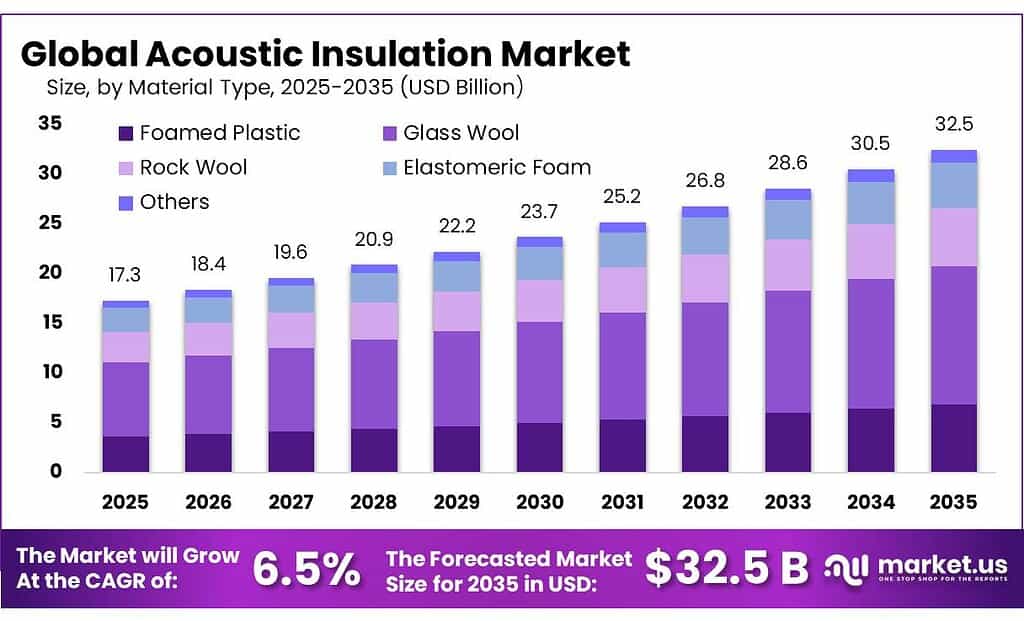
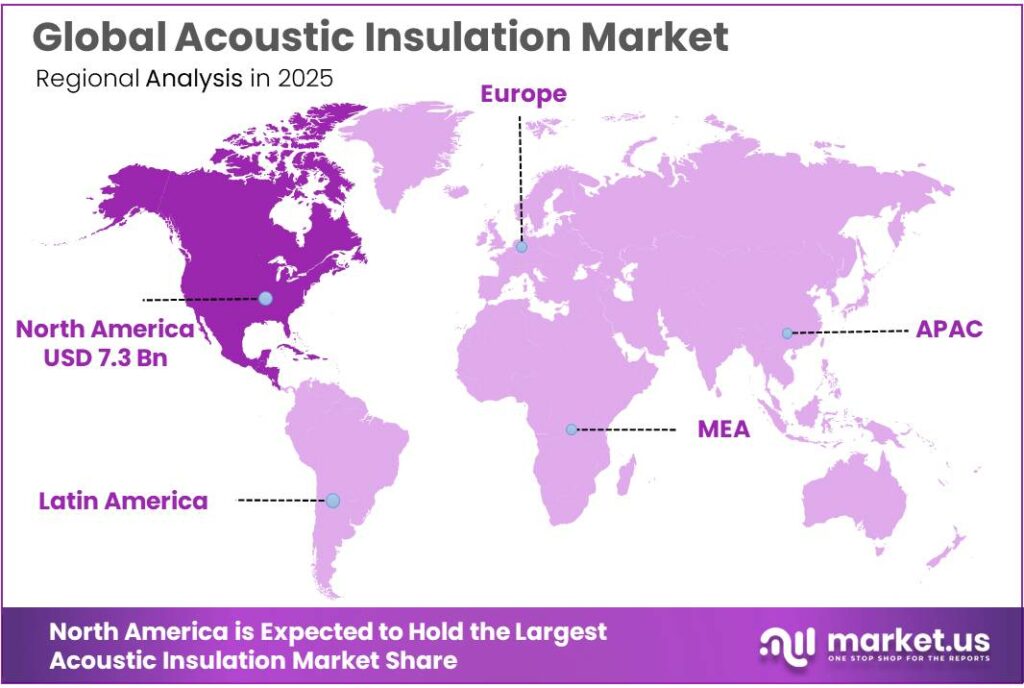
The Global Acoustic Insulation Market size is expected to be worth around USD 32.5 Billion by 2035, from USD 17.3 Billion in 2025, growing at a CAGR of 6.5% during the forecast period from 2026 to 2035. In 2025, North America held a dominant market position, capturing more than a 42.4% share, holding USD 7.3 Billion revenue.
Acoustic insulation is positioned as a performance-led segment within the broader insulation industry, serving buildings, industrial plants, HVAC systems, transportation assets, and temperature-sensitive logistics environments. Its value proposition is no longer limited to occupant comfort; it is increasingly tied to regulatory compliance, worker wellbeing, equipment noise control, and energy efficiency.
In Europe, just over 110 million people are exposed to harmful transport-noise levels, equivalent to more than 20% of the population, while exposure rises to over 30% when measured against stricter WHO recommendations. WHO Europe also states that about 100 million EU citizens face unhealthy road-traffic noise exposure and that at least 392,000 healthy life years are lost annually from transport-related noise. These figures keep acoustic insulation relevant in both retrofit and new-build strategies.
The European Commission’s Renovation Wave aims to renovate 35 million buildings by 2030 and create up to 160,000 additional green jobs, while also targeting at least a doubling of the annual energy-renovation rate. In the United States, buildings account for 74% of electricity use and around $370 billion in annual energy costs, while heating and cooling represent about 35% of all energy consumption. This creates a favorable operating environment for acoustic insulation materials that can simultaneously support sound attenuation, thermal performance, and operating-cost reduction in commercial, institutional, and industrial facilities.
The principal growth drivers are therefore regulatory pressure, urban density, decarbonization targets, and lifecycle efficiency. The EU’s policy direction remains supportive because 85–95% of its buildings are expected to still be standing in 2050, making retrofit insulation a structural opportunity rather than a cyclical one. In the United States, homes and commercial buildings consume about 40% of total energy used, reinforcing the economic case for envelope upgrades and quieter mechanical systems. Government backing also matters in food and rural infrastructure: USDA has stated that insulation is an eligible measure under rural energy-efficiency funding programs, alongside refrigeration and HVAC upgrades.
The U.S. Department of Energy’s Industrial Heat Shot targets cost-competitive industrial heat decarbonization technologies with at least 85% lower greenhouse gas emissions by 2035, a policy direction that supports upgraded insulation around heat- and energy-intensive assets. In parallel, the revised EU Energy Efficiency Directive extends the obligation to renovate 3% of public buildings annually to all public buildings above 250 m², further supporting specification demand in public and semi-industrial estates. These initiatives favor solutions that combine acoustic attenuation, thermal efficiency, moisture resistance, and durability rather than single-function materials.
Key Takeaways
- Acoustic Insulation Market size is expected to be worth around USD 32.5 Billion by 2035, from USD 17.3 Billion in 2025, growing at a CAGR of 6.5%.
- Glass Wool held a dominant market position, capturing more than a 43.6% share.
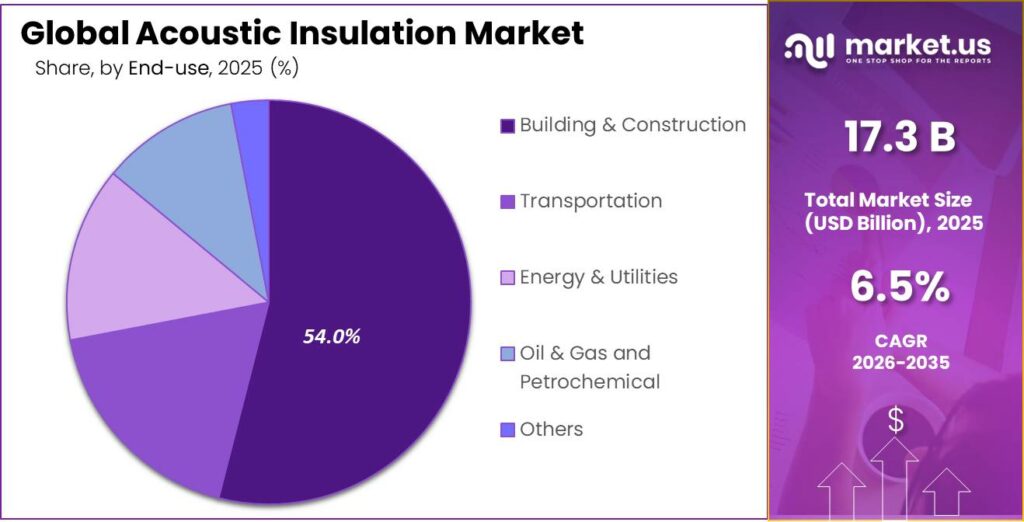
- Building & Construction held a dominant market position, capturing more than a 54.8% share.
- Asia Pacific held the dominant position in the acoustic insulation market, accounting for 42.4% of the global market and reaching USD 7.3 billion.
By Material Type Analysis
Glass Wool dominates with 43.6% share thanks to its strong insulation performance and wide use across buildings.
In 2025, Glass Wool held a dominant market position, capturing more than a 43.6% share. This leadership was mainly supported by its broad use in residential, commercial, and industrial buildings where thermal and acoustic control are both important. Glass wool remained a preferred material because it is lightweight, easy to install, and suitable for walls, roofs, ceilings, and duct insulation. It also continued to see strong demand due to its ability to reduce noise while helping improve indoor comfort.
By End Use Analysis
Building & Construction leads with 54.8% share as demand stays strong for quieter, energy-efficient spaces.
In 2025, Building & Construction held a dominant market position, capturing more than a 54.8% share. This segment led the acoustic insulation market because noise control has become an important part of modern building design across homes, offices, hospitals, schools, and commercial spaces. Acoustic insulation materials were widely used in walls, ceilings, floors, and partitions to improve indoor comfort and reduce unwanted sound between rooms and from outside sources.
Key Market Segments
By Material Type
- Foamed Plastic
- Glass Wool
- Rock Wool
- Elastomeric Foam
- Others
By End Use
- Building & Construction
- Transportation
- Energy & Utilities
- Oil & Gas and Petrochemical
- Others
Emerging Trends
Green building rules are pushing demand for cleaner acoustic insulation materials
One of the clearest latest trends in acoustic insulation is the move toward greener and more sustainable materials. This is happening because builders are now under pressure to improve both sound comfort and environmental performance in the same project. The UN Environment Programme reported in 2025 that buildings and construction account for 32% of global energy consumption and 34% of carbon dioxide emissions. That is a big reason why public programs and building policies are increasingly favoring lower-impact materials.
In Europe, the Renovation Wave aims to renovate 35 million buildings by 2030, which is creating steady demand for insulation products that can support energy efficiency and indoor comfort together. In practical terms, acoustic insulation is no longer being chosen only for noise reduction. It is also being judged by recycled content, material efficiency, and how well it fits into low-carbon construction plans. This shift is turning sustainable acoustic insulation from a niche option into a mainstream product choice in new buildings and renovation work.
Recycled-content insulation is gaining attention as waste reduction becomes more important
Another part of this same trend is the growing use of recycled inputs in insulation materials, especially glass-based products. The U.S. Environmental Protection Agency’s procurement guidance notes that fiberglass insulation can contain 20% to 30% post-consumer recycled glass. That matters because construction is producing huge waste volumes, and the industry is being pushed to use more circular materials. The European Commission says construction and demolition waste accounts for more than one-third of all waste generated in the EU, while the U.S. EPA estimates that 600 million tons of construction and demolition debris were generated in the United States in 2018.
Drivers
Urban growth is pushing the need for quieter indoor spaces
One of the biggest reasons acoustic insulation is growing is simple: cities are getting louder, and people want better indoor comfort. The United Nations said 55% of the world’s population lived in urban areas, and this is expected to reach 68% by 2050. That means more apartments, offices, schools, hospitals, and mixed-use buildings in dense areas where traffic, machinery, and shared walls create daily noise.
The European Environment Agency reported that over 20% of Europeans are exposed to harmful transport noise, and under stricter WHO recommendations this rises to over 30%. These numbers show why builders are giving more attention to sound control inside buildings. Acoustic insulation helps reduce outside noise, improve privacy between rooms, and make indoor spaces more comfortable for living and working. This is especially important in urban housing, healthcare facilities, hotels, and education buildings, where noise directly affects sleep, focus, and wellbeing.
Energy-efficient building rules are also lifting demand
Another strong driver is the push for better-performing buildings. In many projects, acoustic insulation is chosen not only for sound control but also because it supports thermal efficiency. According to UNEP’s 2024/2025 buildings report, the buildings and construction sector uses 32% of global energy and produces 34% of global CO2 emissions.
That is a major reason governments and building authorities continue to support stronger efficiency standards, green construction practices, and better building envelopes. When developers upgrade walls, roofs, ceilings, and floors to meet these goals, acoustic insulation often becomes part of the solution. It helps manage indoor temperature while also cutting unwanted sound.
Restraints
Upfront cost still slows decisions in both new builds and older buildings
One major restraining factor for acoustic insulation is the higher upfront cost, especially in retrofit projects where walls, ceilings, and floors often need to be opened, adjusted, or rebuilt. That makes the work more expensive than many owners first expect. The International Energy Agency said annual investment in energy efficiency, electrification, and renewables in buildings reached USD 380 billion in 2024, showing that building upgrades already require large capital commitments.
The IEA also noted that buildings account for around 30% of global energy demand, which means owners are under pressure to improve building performance, but not every project budget can absorb added acoustic upgrades. In the United States, the Department of Energy says insulation can cut heating and cooling costs by up to 20%, but many buyers still focus on the immediate installation bill instead of the longer-term savings.
Labor shortages and retrofit complexity make acoustic projects harder to scale
The cost issue becomes even more difficult when skilled labor is limited. Acoustic insulation is not only about putting material inside a wall; it often needs correct fitting, sealing, framing changes, and coordination with HVAC or interior finishing work. Eurofound reported that labor shortages in construction are already above the EU average, and around 7 million job openings are expected by 2035 in the sector.
These figures matter because when labor is tight, project timelines stretch and installation costs rise further. That creates a real restraint for acoustic insulation, especially in renovation work where installation is more complex than in new construction. Governments are pushing better buildings through efficiency and renovation programs, but project owners still face the practical challenge of finding enough skilled workers at a cost they can manage.
Opportunity
Large-scale renovation programs are creating fresh demand for acoustic insulation
One clear growth opportunity for acoustic insulation is the rise in building renovation and retrofit activity. A huge share of the world’s buildings were not originally designed for modern sound comfort, energy savings, or stricter building standards. That is changing now. The European Commission’s Renovation Wave aims to renovate 35 million buildings by 2030 and at least double the annual rate of energy renovation across the EU.
This matters for acoustic insulation because renovation work often includes upgrades to walls, floors, roofs, ceilings, and internal partitions, which are the same areas where sound-control materials are installed. At the same time, the IEA says global built floor area is expected to grow by about 45% by 2050, and retrofit rates in many places still remain low, which leaves a very large upgrade gap to be filled over the next decade.
Energy-efficiency programs are increasing the value of sound-control materials in buildings
Another major opportunity comes from the fact that acoustic insulation is often selected together with thermal insulation during building upgrades. This gives it a wider role than just noise control. UNEP reported in 2025 that buildings and construction account for 32% of global energy consumption and 34% of carbon dioxide emissions. Because of this, governments and public agencies are pushing stronger building efficiency programs, green renovation targets, and cleaner materials.
In the United States, the Department of Energy said its Better Buildings Initiative, working with nearly 1,000 partners, helped save USD 13.5 billion in energy costs and cut more than 130 million metric tons of carbon emissions in a year. These kinds of programs make insulation upgrades more attractive overall, and acoustic materials benefit when builders want products that improve both comfort and efficiency. In simple terms, the more buildings get upgraded for performance, the bigger the opening becomes for acoustic insulation in homes, offices, schools, hospitals, hotels, and commercial properties.
Regional Insights
Asia Pacific leads the Acoustic Insulation Market with 42.4% share, reaching USD 7.3 billion on the back of fast urban growth and heavy construction activity.
Asia Pacific held the dominant position in the acoustic insulation market, accounting for 42.4% of the global market and reaching USD 7.3 billion. The region’s lead is mainly supported by strong construction output, rising urban density, and large infrastructure spending across China, India, Southeast Asia, Japan, and Australia. Demand for acoustic insulation remains high in residential towers, offices, transport facilities, hospitals, schools, and industrial buildings, where sound control is becoming part of modern building standards.
The region also benefits from its scale in urban development. UN-Habitat states that 54% of the global urban population, or more than 2.2 billion people, live in Asia, and Asia’s urban population is expected to grow by 50% by 2050, which directly supports long-term demand for quieter and better-insulated buildings. At the same time, ADB estimates that developing Asia will need to invest USD 1.7 trillion per year in infrastructure to maintain growth momentum, showing the size of the region’s ongoing building and transport pipeline.
Key Regions and Countries Insights
- North America
- US
- Canada
- Europe
- Germany
- France
- The UK
- Spain
- Italy
- Rest of Europe
- Asia Pacific
- China
- Japan
- South Korea
- India
- Australia
- Rest of APAC
- Latin America
- Brazil
- Mexico
- Rest of Latin America
- Middle East & Africa
- GCC
- South Africa
- Rest of MEA
Key Players Analysis
Armacell stands out as one of the most global names in insulation. Its 2023 annual report shows €836.1 million in net sales, with €678.9 million coming from its Advanced Insulation division. The company runs 25 manufacturing facilities in 19 countries and serves customers in more than 100 countries. These numbers show strong international scale and a well-balanced product business. In acoustic insulation, Armacell benefits from its technical insulation background, broad geographic coverage, and large installed presence across building and industrial applications.
Fletcher remains important in acoustic insulation through Fletcher Insulation and its established brands in Australia. Fletcher Building reported NZ$6,994 million in revenue for 2025, showing the size of the parent group behind the insulation business. Fletcher Insulation traces its heritage to the 1930s and was formed in 2005. Its glasswool products are made in Melbourne, Australia, and use up to 80% recycled glass. For acoustic applications, brands such as Soundbreak give Fletcher a practical edge in residential and commercial wall and ceiling systems.
Isolatek International is better known for passive fireproofing, but it also has a visible presence in thermal and acoustical systems. The company operates 4 manufacturing facilities in the United States and works with 3 manufacturing licensees outside the Americas. Its thermal-acoustical line was strengthened with Cellu-Shield introduced in 2023, and its broader portfolio expanded again in 2024 through selected Albi asset acquisitions. In acoustic insulation, Isolatek’s strength is technical performance in specialized commercial and industrial projects rather than mass-volume residential demand.
Top Key Players Outlook
- Alleguard
- Armacell
- Fletcher
- Isolatek International
- Johns Manville
- Jushi Group
- Kingspan
- Knauf Insulation
- NSG Group
- Owens Corning
- PPG Industries
- Rockwool
- Saint-Gobain
Recent Industry Developments
In 2025, Armacell remained one of the most visible companies in the acoustic insulation space, supported by its wider insulation and engineered foams business. The company reported €836.1 million in net sales in its latest annual report, including €678.9 million from its Advanced Insulation division, which shows the strength of its insulation-led portfolio.
In 2025, Fletcher remained an established name in the acoustic insulation sector through Fletcher Insulation, supported by the wider scale of Fletcher Building. The parent company reported NZ$6.994 billion in revenue for FY2025, which shows the financial strength behind its insulation operations, even as construction markets in Australia and New Zealand stayed soft.
Report Scope
Report Features Description Market Value (2025) USD 17.3 Bn Forecast Revenue (2035) USD 32.5 Bn CAGR (2026-2035) 6.5% Base Year for Estimation 2025 Historic Period 2020-2024 Forecast Period 2026-2035 Report Coverage Revenue Forecast, Market Dynamics, Competitive Landscape, Recent Developments Segments Covered By Material Type (Foamed Plastic, Glass Wool, Rock Wool, Elastomeric Foam, Others), By End Use (Building And Construction, Transportation, Energy And Utilities, Oil And Gas and Petrochemical, Others) Regional Analysis North America – US, Canada; Europe – Germany, France, The UK, Spain, Italy, Rest of Europe; Asia Pacific – China, Japan, South Korea, India, Australia, Singapore, Rest of APAC; Latin America – Brazil, Mexico, Rest of Latin America; Middle East & Africa – GCC, South Africa, Rest of MEA Competitive Landscape Alleguard, Armacell, Fletcher, Isolatek International, Johns Manville, Jushi Group, Kingspan, Knauf Insulation, NSG Group, Owens Corning, PPG Industries, Rockwool, Saint-Gobain Customization Scope Customization for segments, region/country-level will be provided. Moreover, additional customization can be done based on the requirements. Purchase Options We have three licenses to opt for: Single User License, Multi-User License (Up to 5 Users), Corporate Use License (Unlimited User and Printable PDF)  Acoustic Insulation MarketPublished date: April 2026add_shopping_cartBuy Now get_appDownload Sample
 -
-
- Alleguard
- Armacell
- Fletcher
- Isolatek International
- Johns Manville
- Jushi Group
- Kingspan
- Knauf Insulation
- NSG Group
- Owens Corning
- PPG Industries
- Rockwool
- Saint-Gobain
Our Clients

- 183864
- April 2026






