


Global Food Spreads Market By Product Type (Dairy-based Spreads, Chocolate-based, Nut-based, Fruit-based Spreads, and Others), By End-Use (Residential and Foodservice), By Distribution Channel (Supermarkets and Hypermarkets, Convenience Stores, Specialty Stores, Online, and Others), By Region and Companies - Industry Segment Outlook, Market Assessment, Competition Scenario, Trends and Forecast 2026-2035
- Published date: Mar 2026
- Report ID: 180725
- Number of Pages: 328
- Format:
-
keyboard_arrow_up
Quick Navigation
Report Overview
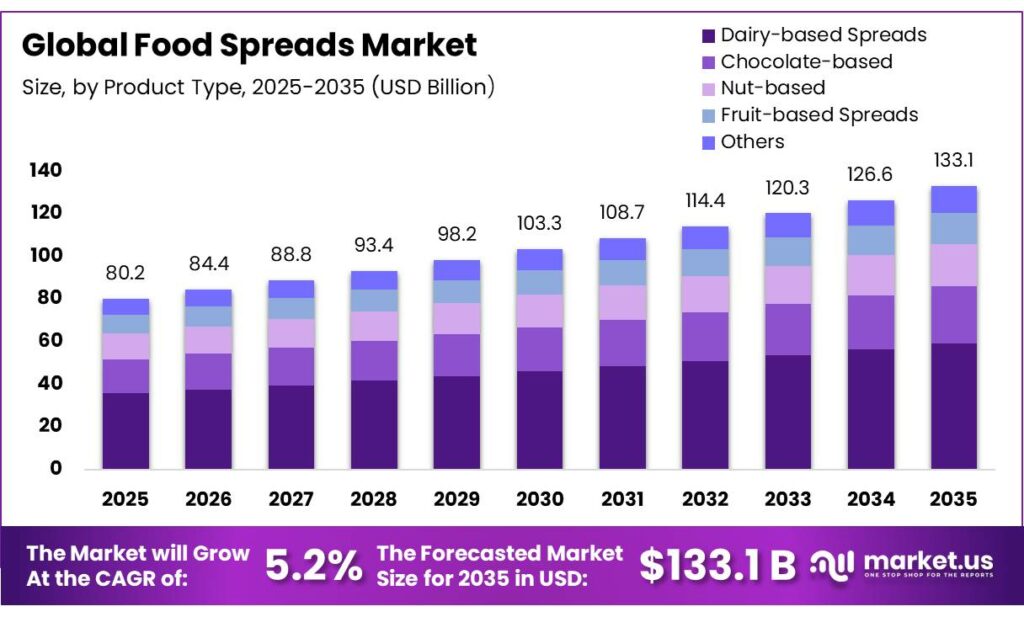
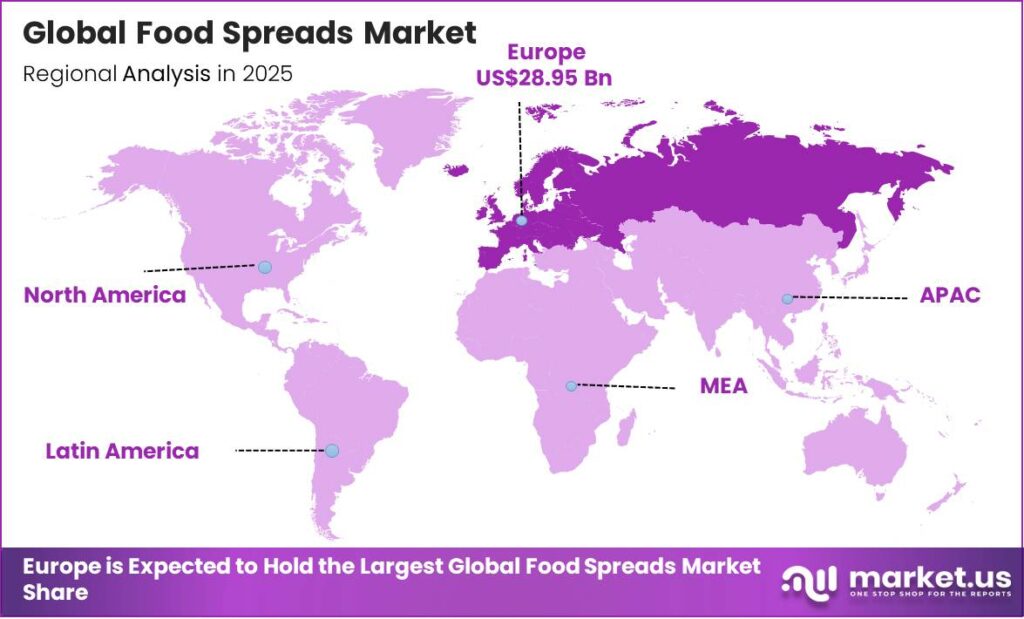
The Global Food Spreads Market size is expected to be worth around USD 133.1 Billion by 2035, from USD 80.2 Billion in 2025, growing at a CAGR of 5.2% during the forecast period from 2026 to 2035. In 2025, Europe held a dominant market position, capturing more than a 36.1% share, holding USD 28.95 billion revenue.
A food spread is a soft, viscous food item meant to be applied, often with a knife or the back of a spoon, onto solid foods such as bread, crackers, or vegetables. They are used to enhance the flavor and texture of otherwise plain base foods. The food spreads market is driven by several key factors, including consumer demand for convenience, health-consciousness, and versatility.
- According to the Bureau of Labor Statistics (BLS), in the United States, 90% of morning meals are prepared in 15 minutes or less, and under 45 minutes are spent on the preparation of the meal, underscoring consumer prioritization of time-efficient options.
Dairy-based spreads dominate due to their long-standing cultural integration, neutral flavor, and cost-effectiveness. These spreads are primarily used in residential settings, where their convenience and versatility make them staples for quick meals. Supermarkets and hypermarkets are the dominant distribution channels, offering a wide range of products to cater to diverse consumer preferences.
- The World Allergy Organization (WAO) reports a global food allergy prevalence of 1% to 10%, with an estimated 2.5% of the world population affected, necessitating the elimination of common food ingredients in everyday diets.
While there is growing interest in alternative protein sources and plant-based spreads, dairy-based options remain the most widely consumed. Additionally, dietary restrictions and allergens pose challenges for manufacturers to ensure safe and inclusive offerings. The food spreads market is shaped by a balance of traditional consumption patterns, evolving consumer needs, and external market dynamics.
Key Takeaways:
- The global food spreads market was valued at USD 80.2 billion in 2025.
- The global food spreads market is projected to grow at a CAGR of 5.2% and is estimated to reach USD 133.1 billion by 2035.
- On the basis of product type, dairy-based food spreads dominated the market, constituting 44.6% of the total market share.
- Based on the end-uses of the food spreads, residential uses led the market, comprising 74.4% of the total market.
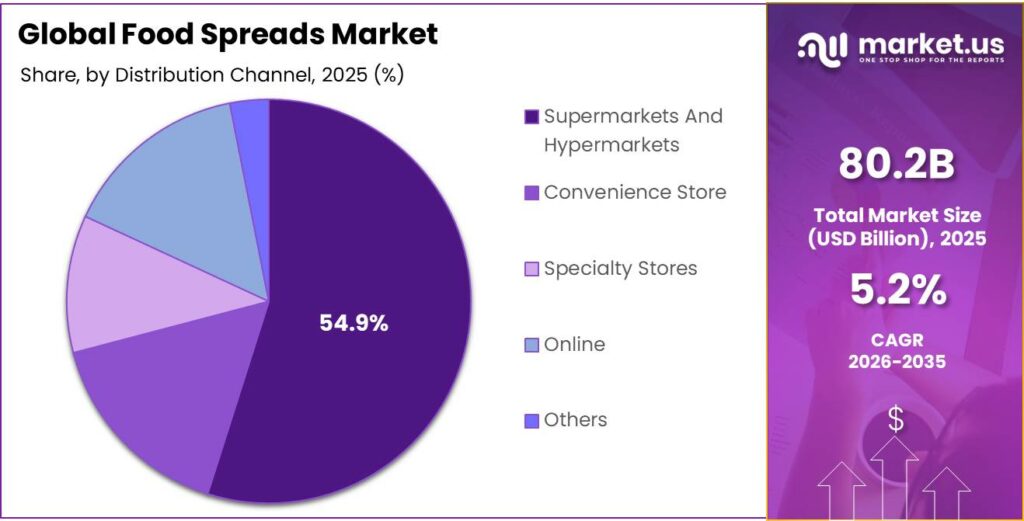
- Among the distribution channels, supermarkets and hypermarkets held a major share of the market, accounting for around 54.9% of the revenue.
- In 2025, Europe was the most dominant region in the food spreads market, accounting for 36.1% of the total global consumption.
Product Type Analysis
Dairy-based Food Spreads Are a Prominent Segment in the Market.
The market is segmented based on the product type into dairy-based spreads, chocolate-based spreads, nut-based spreads, fruit-based spreads, and others. The dairy-based spreads led the market, comprising 44.6% of the market share, due to their established cultural integration and versatility. Dairy products such as butter and cheese spreads have been staple ingredients in many traditional cuisines, particularly in Europe and North America, where they pair easily with a wide range of breads, pastries, and savory dishes.
Additionally, their milder, neutral flavor makes them suitable for sweet and savory applications, further contributing to their broader appeal. Similarly, dairy-based spreads benefit from long-standing consumer familiarity, making them a default choice for breakfast and snack options. Furthermore, dairy spreads are often cost-effective and easier to mass-produce, ensuring consistent availability and affordability compared to specialty chocolate, nut, or fruit spreads, which are typically perceived as premium products.
End-Use Analysis
Residential Uses Dominated the Food Spreads Market.
On the basis of end-uses, the food spreads market is segmented into residential and foodservice. The residential uses dominated the food spreads market, comprising 74.4% of the market share, due to their convenience and ease of use in everyday meals. In households, spreads are typically used for quick, simple applications such as toast, sandwiches, or as toppings, fitting well into busy, on-the-go routines. Their long shelf life and versatility make them ideal for home consumption, where they can be easily stored and incorporated into various meals without much preparation.
In contrast, the foodservice industry often requires larger volumes of specialized ingredients for bulk meal preparation, and many spreads, particularly those with high sugar or fat content, are less suited for mass production in professional kitchens. Additionally, foodservice operators often prefer custom-made spreads tailored to specific menu items, limiting the broader use of pre-made commercial spreads.
Distribution Channel Analysis
Food Spreads Are Mostly Sold Through Supermarkets and Hypermarkets.
Among the distribution channels, 54.9% of the total global consumption of food spreads is sold through supermarkets and hypermarkets, outperforming convenience stores, specialty stores, online, and other channels. Most food spreads are sold through supermarkets and hypermarkets as these large retail formats offer convenience, variety, and affordability to a broad consumer base. Supermarkets and hypermarkets typically provide a wide range of brands and product types, from basic spreads to premium options, allowing consumers to choose according to taste, dietary preferences, or price.
Similarly, these stores attract higher foot traffic, providing a convenient one-stop shopping experience where spreads are often purchased alongside other essential grocery items. Additionally, the economies of scale in large stores enable better pricing, making these products more accessible. In contrast, convenience stores, specialty stores, and online channels generally offer smaller selections or higher prices, limiting their appeal for everyday, budget-conscious consumers.
Key Market Segments:
By Product Type
- Dairy-based Spreads
- Chocolate-based
- Hazelnut Chocolate Spread
- Peanut Chocolate Spread
- Dark Chocolate Spread
- White Chocolate Spread
- Others
- Nut-based
- Almond Butter
- Walnut Butter
- Hazelnut Butter
- Cashew Butter
- Others
- Fruit-based Spreads
- Jams
- Jellies
- Conserve
- Preserve
- Marmalades
- Others
By End-Use
- Residential
- Foodservice
By Distribution Channel
- Supermarkets & Hypermarkets
- Convenience Store
- Specialty Stores
- Online
- Others
Drivers
Demand for Convenience Drives the Food Spreads Market.
The food spreads market is increasingly shaped by the shift toward convenience-oriented breakfast solutions, as modern consumers prioritize time-saving, on-the-go (OTG) options. The demand for quick breakfast solutions is a substantive driver of food spreads usage as spreads are typically paired with portable breakfast formats, such as bread, toast, and cereals, that consumers increasingly choose for speed and ease of preparation.
In the United Kingdom, approximately one in ten breakfasts is consumed on the go, with growth driven by portable products and foodservice alternatives. According to a study, among children and adolescents reporting what they eat at breakfast, many customers consume grain products such as ready-to-eat cereals or bread, with common additions including butter and jelly, indicating frequent pairing with spreads.
Government dietary surveys, such as NHANES, further support that ready-to-eat and portable grain categories dominate breakfast intake patterns. These behaviors reflect broader shifts in consumer meal structuring, rapid breakfast preparation, and preference for easily consumable, transportable food items, which inherently increase occasions where versatile, easy-to-apply spreads are utilized as part of convenient breakfast solutions.
Restraints
Dietary Restrictions and Allergens Might Hamper the Demand for the Food Spreads.
Dietary restrictions and allergen management present significant operational and regulatory challenges for the food spreads market, as manufacturers must navigate increasing prevalence and stringent labeling mandates. In the United States, approximately 25% of consumers actively avoid specific allergens when purchasing food.
The Food Allergen Labeling and Consumer Protection Act (FALCPA) by the U.S. Food and Drug Administration (FDA) legally requires a clear declaration of the big nine allergens, including milk, egg, peanut, tree nuts, soy, wheat, fish, shellfish, and sesame, all common base ingredients for spreads, on packaged food labels to protect sensitive consumers.
There are more than 160 foods that may cause allergic reactions, and regulatory agencies continue to monitor substances, such as gluten and sulfites, that may necessitate specific labeling due to hypersensitivity reactions. These restrictions influence product formulation choices and necessitate rigorous supply-chain allergen controls, constraining straightforward use of common spread ingredients such as nuts and dairy, especially in products intended for broad consumption.
Opportunity
Adoption of Plant-Based & Alternative Proteins Creates Opportunities in the Food Spreads Market.
Adoption of plant-based and alternative proteins serves as a significant structural opportunity in the food spreads market, driven by shifting consumer dietary patterns and environmental sustainability mandates. National dietary intake data analyses from the National Health and Nutrition Examination Survey indicate that the proportion of U.S. adults consuming predominantly plant-sourced protein increased from 14.4% to 17.2% over roughly two decades, reflecting a shift toward diets with a higher plant protein share in total protein intake.
Government nutrition resources, such as the USDA’s Vegetarian Nutrition guides and advisory components of the Dietary Guidelines for Americans, explicitly include vegetarian and vegan dietary patterns and plant protein sources, such as legumes, nuts, seeds, and soy, as nutritionally supported options. Additionally, plant proteins are recognized as sufficient to meet protein adequacy when appropriately combined, according to nutrient evaluations. These dietary patterns suggest growing consumer openness to plant proteins, which can be leveraged in food spread formulations to meet demand for alternative protein content while satisfying evolving dietary guidance and plant-forward nutrition profiles.
Trends
Focus on Health and Wellness.
The focus on health and wellness has transitioned from a niche consumer preference to a structural driver in the food spreads market, characterized by increased scrutiny of nutritional density and ingredient transparency. The U.S. federal nutrition policy emphasizes limiting saturated fat to less than 10% of daily caloric intake, reflecting official guidance on healthy diets that directly bears on spread formulations high in fats. Similarly, the US consumption data from the CDC’s National Health and Nutrition Examination Survey (NHANES) show that 55% of calories consumed by consumers come from ultra-processed foods, which tend to be energy-dense and high in added sugars, salt, and fats.
Furthermore, government nutrition frameworks such as the Eatwell Guide (UK) and comparable national recommendations advocate diets rich in whole foods, such as vegetables, fruits, and whole grains, and lower in high-fat, high-sugar processed items, underscoring healthier patterns that can shift demand toward spreads with improved nutritional attributes. This trend toward diet quality and reduced intake of nutrients linked to chronic disease drives product reformulation and consumer choice toward spreads with lower saturated fat, reduced sugars, and cleaner ingredient profiles, in alignment with institutional health objectives.
Geopolitical Impact Analysis
Geopolitical Tensions Have Led to Severe Disruptions of the Supply Chains of Food Spreads.
The geopolitical tensions, especially the prolonged conflict in Ukraine and disruptions in key maritime regions, have significant effects on the food supply system that extend into commodity inputs relevant to the food spreads market. Russia and Ukraine together historically accounted for significant shares of global grain and oilseed exports, including about 14% of wheat and 52% of global sunflower oil exports, products foundational to many spread ingredients, and their conflict-driven disruption has constrained these flows.
The Ukrainian exports of wheat, corn, and sunflower oil were materially below contracted volumes, with one major port operating at about 20% of capacity due to infrastructure attacks, sharply reducing trade throughput. Furthermore, geopolitical strains affected logistics, where trade routes were rerouted, and average maritime distances have increased, raising transport time and costs under ongoing conflict and tariff pressures. Such disruptions translate into volatility in staple commodity prices. Additionally, tensions around key shipping chokepoints such as the Strait of Hormuz, which handles most of the global urea fertilizer and LNG trade, pose indirect risks to agricultural input costs through energy and fertilizer supply volatility that propagate through crop cost structures. These export bottlenecks, logistical dislocation, and commodity price fluctuations shape the operating environment for raw materials critical to food spreads production and can constrain reliable sourcing of base oils and grains.
Regional Analysis
Europe Held the Largest Share of the Global Food Spreads Market.
In 2025, Europe dominated the global food spreads market, holding about 36.1% of the total global consumption, particularly butter and dairy spreads, underpinned by high consumption volumes across multiple countries. In the EU, Directive (EU) 2024/1438 has significantly increased the minimum fruit content requirements, raising the threshold for jams from 350g/kg to 450g/kg and extra jams to 500g/kg. The market in the region is characterized by high per-capita consumption and a robust regulatory environment that prioritizes ingredient quality and transparency.
The entrenched cultural practices linking spreads with everyday food habits, such as bread and toast consumption, are supported by Europe’s diverse bread traditions. Germany, France, and Ireland are the principal producers of these spreads, collectively contributing over half of the output. The consumption volumes have been relatively stable since 2020, but Europe’s leading role in the food spreads category in terms of absolute consumption and cultural integration in diets remains stable.
Key Regions and Countries
- North America
- The US
- Canada
- Europe
- Germany
- France
- The UK
- Spain
- Italy
- Russia & CIS
- Rest of Europe
- APAC
- China
- Japan
- South Korea
- India
- ASEAN
- Rest of APAC
- Latin America
- Brazil
- Mexico
- Rest of Latin America
- Middle East & Africa
- GCC
- South Africa
- Rest of MEA
Key Players Analysis
Manufacturers of food spreads focus on several strategic activities, including product innovation, such as developing new flavors, low-calorie or sugar-free variants, and plant-based options to cater to evolving consumer preferences for health-conscious and dietary-specific products. In addition, manufacturers emphasize quality assurance and ingredient sourcing, ensuring the use of high-quality, natural, and sustainably sourced ingredients, which appeal to consumers prioritizing health and sustainability.
Also, they invest in brand differentiation through packaging innovation and marketing campaigns that highlight convenience, versatility, and nutritional benefits. Geographic expansion is another key activity, targeting emerging markets where the consumption of spreads is on the rise. Furthermore, manufacturers focus on strategic partnerships with retailers to secure premium shelf space and improve distribution networks.
The Major Players in The Industry
- The J.M. Smucker Company
- Ferrero International SpA
- Hormel Foods Corporation
- The Hershey Company
- B&G Foods, Inc.
- Andros Group
- Kraft-Heinz
- Kellanova
- Orkla ASA
- Oetker Group
- Arla Foods amba
- Fonterra Co-operative Group
- Ornua Co-operative Limited
- Amul
- Hero Group
- Hindustan Unilever Limited
- Post Holdings Inc.
- Groupe Lactalis
- Land O’ Lakes, Inc.
- Nestlé S.A.
- Other Key Players
Key Development:
- In May 2025, Ferrero announced to introduced a Nutella spread infused with peanuts as part of its strategy to drive growth in the United States. The product marked the first flavor innovation for the 61-year-old cocoa and hazelnut brand.
- In June 2025, M. Smucker Co. announced a commitment to remove FD&C colors from its sugar-free fruit spreads, ice cream toppings, and certain Hostess products by the end of 2027.
Report Scope:
Report Features Description Market Value (2025) US$80.2 Bn Forecast Revenue (2035) US$133.1 Bn CAGR (2025-2035) 5.2% Base Year for Estimation 2025 Historic Period 2021-2024 Forecast Period 2025-2035 Report Coverage Revenue Forecast, Market Dynamics, Competitive Landscape, Recent Developments Segments Covered By Product Type (Dairy-based Spreads, Chocolate-based, Nut-based, Fruit-based Spreads, and Others), By End-Use (Residential and Foodservice), By Distribution Channel (Supermarkets And Hypermarkets, Convenience Stores, Specialty Stores, Online, and Others) Regional Analysis North America – The US & Canada; Europe – Germany, France, The UK, Spain, Italy, Russia & CIS, Rest of Europe; APAC– China, Japan, South Korea, India, ASEAN & Rest of APAC; Latin America– Brazil, Mexico & Rest of Latin America; Middle East & Africa– GCC, South Africa, & Rest of MEA Competitive Landscape The J.M. Smucker Company, Ferrero International SpA, Hormel Foods Corporation, The Hershey Company, B&G Foods, Inc., Andros Group, Kraft-Heinz, Kellanova, Orkla ASA, Oetker Group, Arla Foods amba, Fonterra Co-operative Group, Ornua Co-operative Limited, Amul, Hero Group, Hindustan Unilever Limited, Post Holdings Inc., Groupe Lactalis, Land O’ Lakes, Inc., Nestlé S.A., and Other Players. Customization Scope Customization for segments, region/country-level will be provided. Moreover, additional customization can be done based on the requirements. Purchase Options We have three licenses to opt for: Single User License, Multi-User License (Up to 5 Users), Corporate Use License (Unlimited Users and Printable PDF) 
-
-
- The J.M. Smucker Company
- Ferrero International SpA
- Hormel Foods Corporation
- The Hershey Company
- B&G Foods, Inc.
- Andros Group
- Kraft-Heinz
- Kellanova
- Orkla ASA
- Oetker Group
- Arla Foods amba
- Fonterra Co-operative Group
- Ornua Co-operative Limited
- Amul
- Hero Group
- Hindustan Unilever Limited
- Post Holdings Inc.
- Groupe Lactalis
- Land O' Lakes, Inc.
- Nestlé S.A.
- Other Key Players
Our Clients

- 180725
- Mar 2026






