


Global Feed Formulation Software Market Size, Share and Analysis By Component (Software, Services), By Application (Poultry, Ruminants, Swine, Aquaculture, Others), By End-User (Feed Manufacturers, Nutritionists, Farmers, Others), By Regional Analysis, Global Trends and Opportunity, Future Outlook By 2025-2035
- Published date: March 2026
- Report ID: 180676
- Number of Pages: 203
- Format:
-
keyboard_arrow_up
Quick Navigation
- Report Overview
- Key Takeaway
- Role of Generative AI
- By Component: Software
- By Application: Poultry
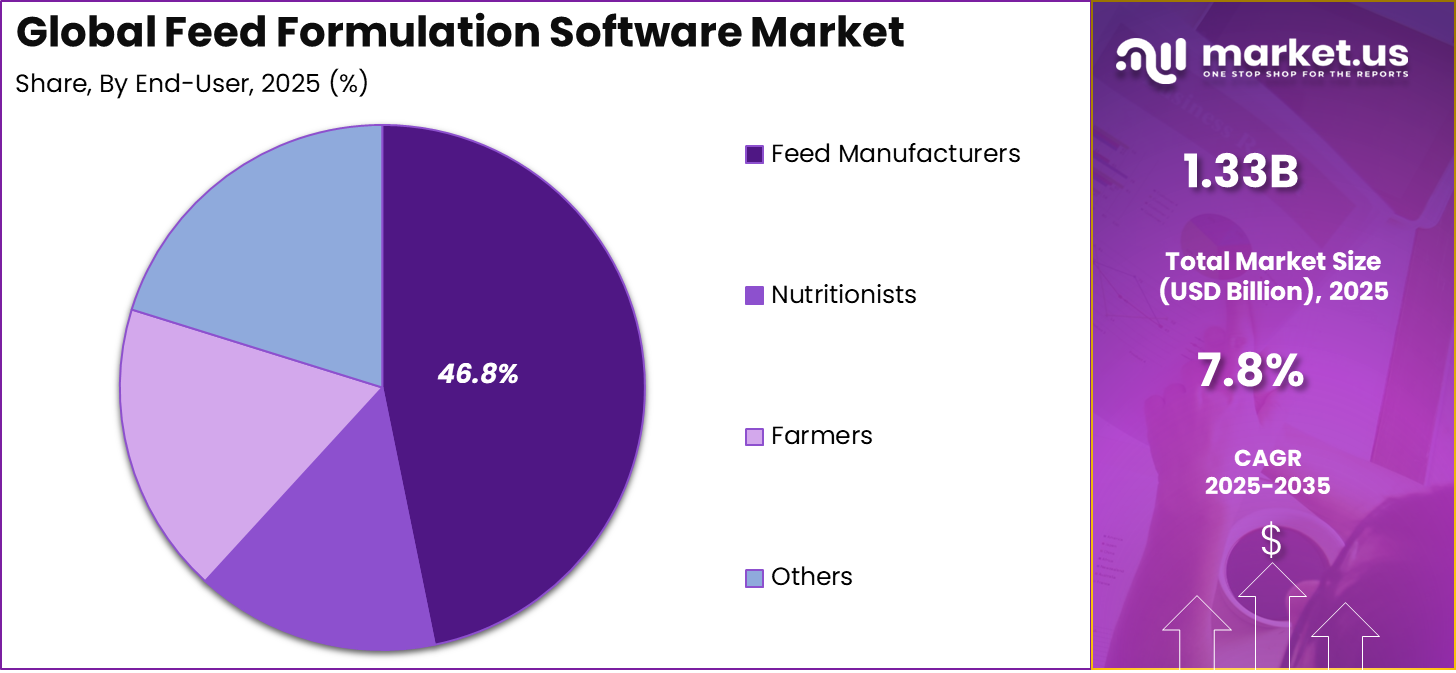
- By End User: Feed Manufacturers
- By Region: Asia Pacific
- Growth Factors
- Emerging Trends
- Driver Analysis
- Restraint Analysis
- Opportunity Analysis
- Challenge Analysis
- Key Market Segments
- Key Players Analysis
- Recent Developments
- Report Scope
Report Overview
The Global Feed Formulation Software Market size is expected to be worth around USD 2.82 billion by 2035, from USD 1.33 billion in 2025, growing at a CAGR of 7.8% during the forecast period from 2025 to 2035. North America held a dominant market position, capturing more than a 37.3% share, holding USD 0.49 billion in revenue.
Feed formulation software is a digital tool used to design and optimize animal feed formulas based on nutritional needs and ingredient prices. The software uses mathematical models and optimization algorithms to calculate the most cost-effective combination of feed ingredients that meets specific nutritional standards. These platforms allow users to manage ingredient databases, evaluate nutrient levels, perform least-cost formulation, and generate feed recipes for different animal species and growth stages.
The Feed Formulation Software Market is expanding steadily as livestock producers and feed manufacturers adopt digital technologies to improve feed quality, optimize production costs, and enhance animal nutrition. Feed formulation software refers to specialized computer programs designed to create balanced feed recipes for animals by considering nutritional requirements, ingredient availability, and cost constraints. These tools are widely used by feed mills, nutritionists, veterinarians, and livestock farmers to develop efficient feeding strategies that support animal health and productivity.
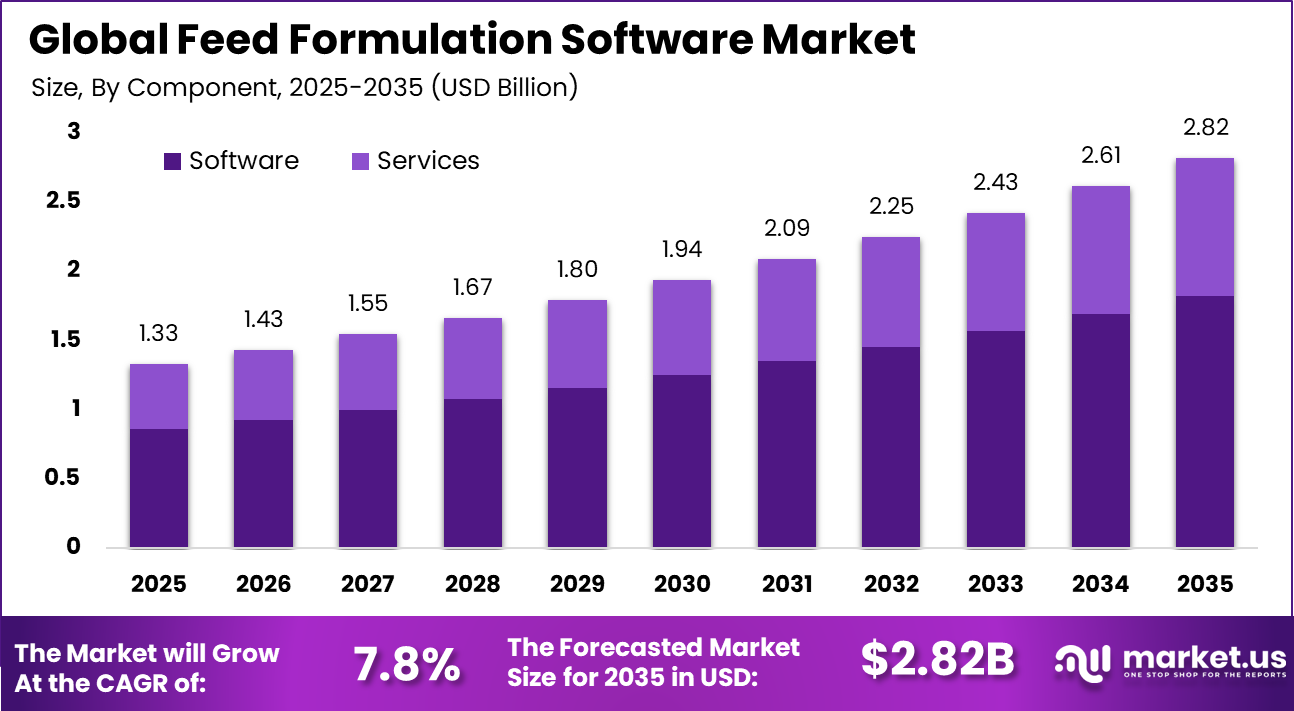
One major factor driving market growth is the increasing global demand for animal protein such as poultry, meat, milk, and eggs. As livestock production expands to meet this demand, producers require advanced tools to ensure animals receive balanced diets that maximize growth and productivity. Another important driver is the rising adoption of digital technologies and automation in the agriculture and animal husbandry sectors.
Feed formulation software allows manufacturers to automate complex calculations, reduce manual errors, and improve feed production efficiency. Demand increases as livestock farms expand and move toward commercial-scale operations. Large producers manage thousands of animals daily and require precise feeding strategies. In poultry and aquaculture regions, software helps farmers improve productivity per animal by around 15 to 25%.
For instance, in October 2025, DuPont de Nemours, Inc. expanded its Enviatec platform through a merger with Prairie Systems, adding advanced dairy ration balancing. The combined solution delivers 20% better milk yield predictions. This strategic consolidation enhances DuPont’s feed tech portfolio significantly.
Key Takeaway
- In 2025, the Software component led the Feed Formulation Software Market, accounting for 64.7% of total share.
- In 2025, Poultry emerged as the dominant application segment, capturing 52.5% of overall demand.
- In 2025, Feed Manufacturers represented the largest end user group with a 46.8% market share.
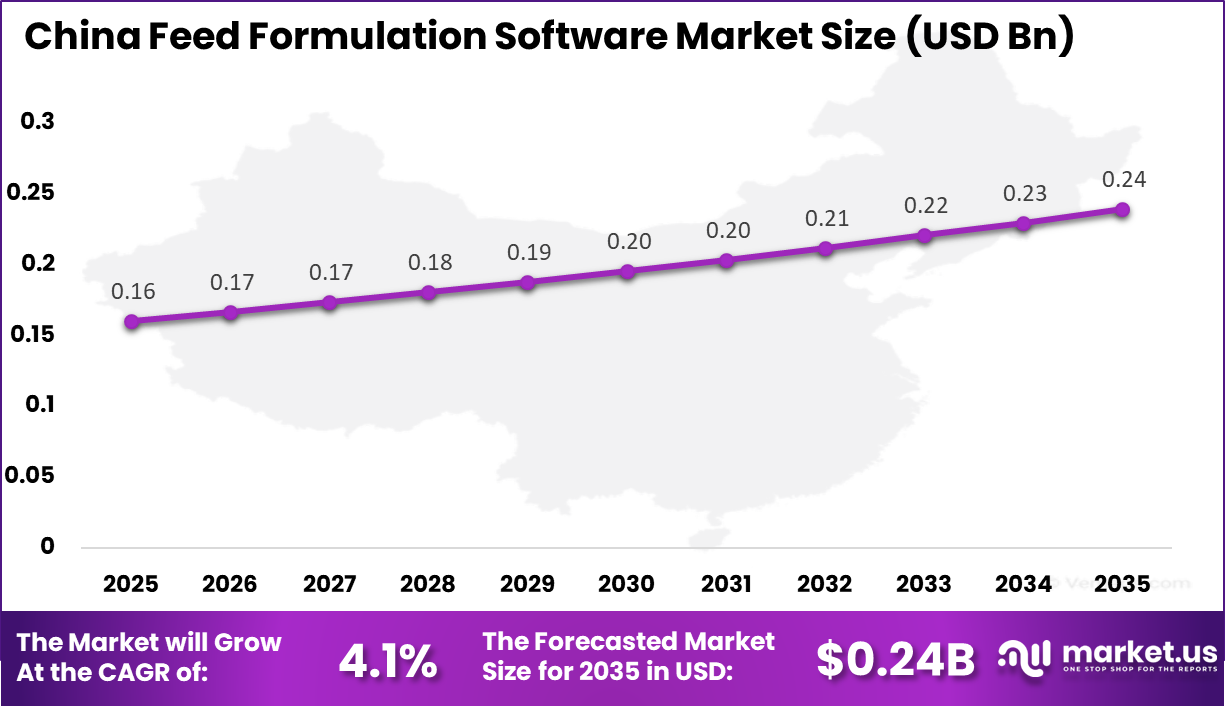
- In 2025, Asia Pacific held a leading regional position with 37.3% share, while the China market reached USD 0.16 billion and recorded a growth rate of 4.1%.
- Adoption of feed formulation software increased daily average milk yield from 8.37 litres to 9.39 litres per animal.
- Daily feed quantity declined from 5.60 kg to 4.88 kg per animal, resulting in lower feed costs.
- Farm management time was reduced from 270 minutes to 235 minutes per day following software implementation.
Role of Generative AI
Generative AI is transforming feed formulation by analyzing large datasets on ingredients, nutrient levels, and animal requirements. Nearly 65% of modern software tools now use AI to predict feed performance before physical trials begin. This approach helps farmers design balanced diets quickly while reducing repeated testing and unnecessary formulation costs.
AI systems also detect patterns in feed efficiency that manual analysis often misses. The technology adjusts formulas automatically when ingredient prices or supply conditions change. Research shows feed recipes can be modified about 40% faster with AI support, allowing producers to maintain consistent feed quality despite market fluctuations.
Investment prospects appear strong as technology expands into mobile-based farm management solutions. Around 60% of rural farms still lack convenient access to digital tools, creating space for app-based platforms. Integrating software with farm sensors also attracts investors, as real-time monitoring of animal growth and feed intake can improve operational efficiency by nearly 20%.
Businesses benefit from stronger supply chain control and better ingredient monitoring through feed formulation platforms. Quality tracking helps avoid contaminated or poor raw materials that can damage 5 to 10% of feed production. The software also speeds up planning by generating reports within minutes, enabling faster decisions while supporting eco-friendly feeding strategies that improve brand credibility.
By Component: Software
Software accounts for 64.7% of the market, reflecting the strong reliance on digital platforms that automate feed formulation calculations and nutritional analysis. These systems allow users to evaluate ingredient combinations, monitor nutrient composition, and generate optimized feed formulas based on production goals. By automating complex nutritional calculations, feed formulation software improves accuracy and efficiency in feed production.
The adoption of software solutions is also supported by their ability to integrate ingredient databases, cost tracking tools, and nutritional modeling capabilities. Feed manufacturers can simulate multiple formulation scenarios and identify the most cost effective feed combinations. As livestock producers seek to improve feed efficiency and productivity, software based formulation platforms continue to gain importance.
For Instance, in January 2026, Adifo Software launched an updated version of its BESTMIX platform with better cloud integration for real time recipe adjustments. Nutritionists now find it easier to handle complex blends and share data across teams, cutting down on errors during peak production times. This move helps mills stay agile with changing ingredient supplies.
By Application: Poultry
Poultry represents 52.5% of the market application due to the large scale global demand for poultry meat and eggs. Poultry production requires precise nutritional formulations to maintain healthy growth rates and improve feed conversion efficiency. Feed formulation software helps producers design balanced diets that meet the specific nutritional needs of poultry at different growth stages.
The poultry industry also faces increasing pressure to maintain consistent feed quality while controlling ingredient costs. Digital formulation tools allow nutritionists to adjust feed mixtures quickly in response to ingredient availability and price fluctuations. As poultry farming continues to expand globally, software assisted feed formulation remains essential for efficient production.
For instance, in November 2025, Alltech introduced a poultry specific module in their formulation tools, aimed at optimizing amino acid profiles for broilers under high density conditions. This helps producers fine tune starter and finisher feeds to boost uniformity and reduce waste, a big win for integrators watching daily gains closely.
By End User: Feed Manufacturers
Feed manufacturers account for 46.8% of the market, reflecting their central role in producing balanced feed for livestock and poultry producers. These organizations manage large volumes of raw materials and must ensure that feed mixtures meet nutritional standards and regulatory requirements. Feed formulation software helps manufacturers maintain consistency and optimize production processes.
Manufacturers also rely on formulation tools to evaluate ingredient alternatives and manage feed costs effectively. By analyzing nutrient profiles and ingredient pricing, producers can design efficient feed solutions that support animal health and farm productivity. As livestock production systems become more data driven, feed manufacturers continue to adopt advanced formulation technologies.
For Instance, in January 2026, Nutreco N.V. upgraded its software for feed makers, adding batch traceability features that speed up audits and customer approvals. This is especially useful for manufacturers serving diverse livestock clients, as it logs every tweak to recipes right from the lab stage.
By Region: Asia Pacific
Asia Pacific accounts for 37.3% of the market share due to its large livestock population and expanding poultry and aquaculture industries. Countries in the region are investing in modern livestock management technologies to improve production efficiency and food security. The increasing demand for animal protein has strengthened the need for optimized feed management systems.
For instance, in October 2025, Evonik rolled out AI-enhanced formulation tools in India, integrating real-time nutrient data for dairy operations to boost milk yields with less waste. The solution fits fragmented farms, driving adoption as urban meat needs grow and push for precise, affordable feeds across Southeast Asia.
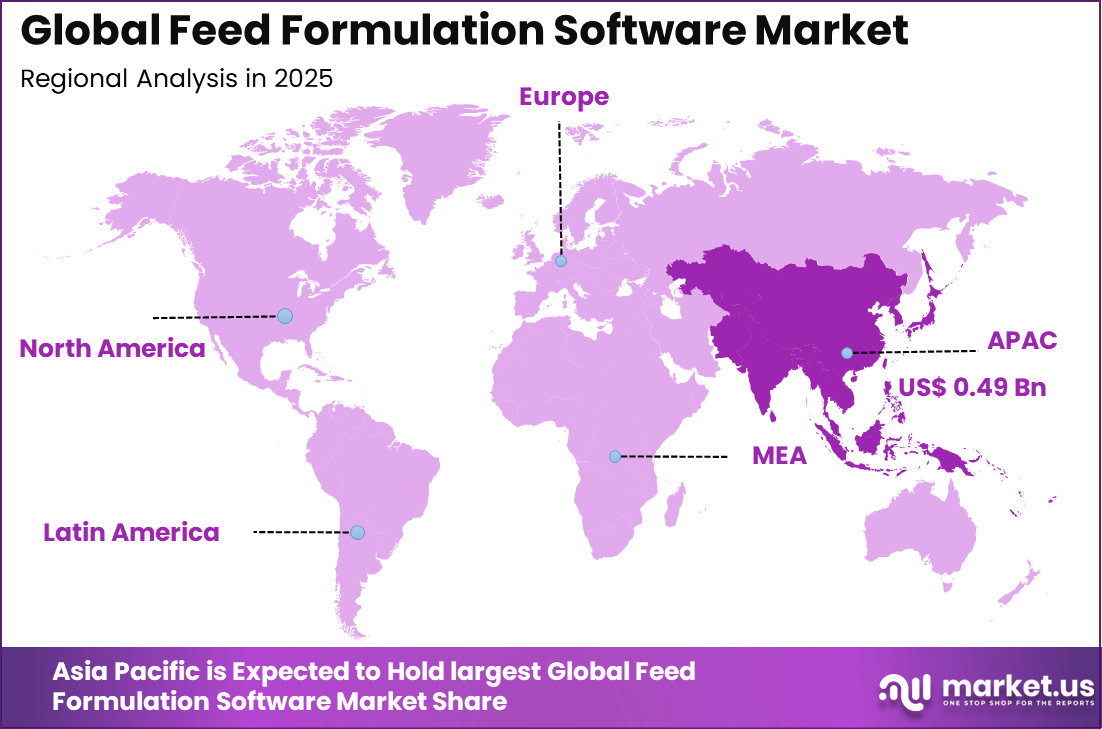
Within Asia Pacific, China contributes USD 0.16 billion with a growth rate of 4.1%. The country’s large scale livestock production and growing feed manufacturing sector support the adoption of feed formulation software. Continued investment in agricultural technology and livestock productivity is expected to support steady market development in the region.
For instance, in March 2026, Adisseo France SAS reinforced China’s dominance in the Feed Formulation Software market by launching an advanced AI-driven formulation platform tailored for Chinese livestock producers. The software optimizes feed efficiency using local ingredient data, reducing costs by 12% for major pig farms.
Growth Factors
One of the primary growth factors driving the feed formulation software market is the rising demand for efficient livestock production. With the global demand for meat, dairy, and aquaculture products increasing, producers must optimize feed quality and cost efficiency. Feed formulation software helps nutritionists develop cost-effective feed formulas that maximize animal growth and productivity while reducing feed waste.
Another important growth factor is the increasing focus on precision livestock farming. Modern farming operations rely on digital tools to monitor animal health, nutrition, and performance. Feed formulation software allows producers to adjust feed compositions according to animal age, production stage, and environmental conditions, supporting more precise nutritional management.
Emerging Trends
One emerging trend in the feed formulation software market is the integration of artificial intelligence and predictive analytics. AI-powered platforms analyze historical feeding data, ingredient availability, and production outcomes to recommend optimized feed formulas. These systems enable nutritionists to make faster and more accurate formulation decisions.
Another trend is the development of cloud-based feed management platforms. Cloud deployment allows feed manufacturers and farms to access formulation tools from multiple locations, share data with nutrition experts, and update ingredient databases in real time. This approach improves collaboration and operational efficiency across feed production networks.
Driver Analysis
Increasing Demand for Animal Nutrition Optimization
A major driver of the feed formulation software market is the growing need to optimize animal nutrition for improved productivity. Livestock producers aim to achieve higher feed conversion efficiency while maintaining animal health and product quality. Feed formulation software provides precise calculations that help nutritionists balance nutrients and reduce unnecessary feed costs.
Another driver is the rising complexity of feed ingredient management. Feed manufacturers must evaluate numerous raw materials including grains, oilseed meals, vitamins, and additives. Software platforms help analyze these ingredients and determine the most suitable combinations based on nutritional value and economic considerations.
For instance, in February 2025, Adifo Software rolled out an upgraded version of its BESTMIX platform, focusing on tools that let nutritionists fine-tune rations for better animal growth and health. Farmers using it report easier ways to match feed to livestock needs, cutting waste while boosting output from each batch. This move taps right into the push for smarter nutrition across feed mills worldwide.
Restraint Analysis
Limited Digital Adoption in Small Farms
One restraint affecting the feed formulation software market is the limited adoption of digital technologies among small and traditional farming operations. Many small-scale farmers rely on manual methods or basic spreadsheets for feed planning. The transition to advanced software solutions may require training, investment, and infrastructure improvements.
Another restraint involves the availability and accuracy of ingredient data. Feed formulation software relies heavily on accurate nutrient composition data for each ingredient. Variations in ingredient quality or incomplete data can affect the accuracy of feed formulas and reduce the effectiveness of software recommendations.
For instance, in January 2026, Cargill shared details on their latest feed optimization system, noting that while it promises big savings long-term, the initial hardware and training setup has slowed rollout for smaller feed mills. Many partners mention budgeting challenges as they weigh these costs against short-term cash needs.
Opportunity Analysis
Expansion of Commercial Feed Production
A significant opportunity in the feed formulation software market lies in the expansion of commercial feed manufacturing industries. As livestock production becomes more industrialized, large feed mills require advanced software to manage formulation processes, inventory, and production planning. These systems enable manufacturers to maintain consistent product quality while optimizing costs.
Another opportunity involves the integration of feed formulation tools with broader farm management systems. By connecting nutrition planning with livestock monitoring systems, producers can analyze the relationship between feed composition and animal performance. This integrated approach supports data-driven decision making and improves farm productivity.
For instance, in March 2026, Evonik Industries AG partnered with farm sensor makers to link their formulation software directly to real-time livestock data. This lets users adjust feeds based on live performance metrics, opening doors for broader digital farm adoption. Producers testing it praise the seamless flow from field insights to ration changes.
Challenge Analysis
Data Management and Nutritional Accuracy
A key challenge in the feed formulation software market is maintaining accurate nutritional databases. Feed ingredients may vary in nutrient composition depending on geographic origin, storage conditions, and processing methods. Continuous data updates are required to ensure that software calculations remain reliable.
Another challenge involves training users to effectively operate advanced formulation tools. Nutritionists and farm managers must understand both animal nutrition principles and software functionality. Providing adequate training and support is essential for maximizing the benefits of feed formulation systems.
For instance, in September 2025, BASF SE updated its software to handle rapid ingredient price swings by adding daily market feeds, but users still struggle with quality variations from suppliers. Nutritionists must verify data often, and testing shows gaps in predictions during shortages. They are working on better alerts to steady formulations amid volatility.
Key Market Segments
By Component
- Software
- On-Premises
- Cloud-Based
- Services
- Professional Services
- Managed Services
By Application
- Poultry
- Ruminants
- Swine
- Aquaculture
- Others
By End-User
- Feed Manufacturers
- Nutritionists
- Farmers
- Others
Key Regions and Countries
North America
- US
- Canada
Europe
- Germany
- France
- The UK
- Spain
- Italy
- Russia
- Netherlands
- Rest of Europe
Asia Pacific
- China
- Japan
- South Korea
- India
- Australia
- Singapore
- Thailand
- Vietnam
- Rest of APAC
Latin America
- Brazil
- Mexico
- Rest of Latin America
Middle East & Africa
- South Africa
- Saudi Arabia
- UAE
- Rest of MEA
Key Players Analysis
The Feed Formulation Software Market is supported by agricultural technology companies and animal nutrition specialists that develop digital tools for optimizing livestock feed composition. Adifo Software, Cargill Incorporated, Alltech, and Evonik Industries AG provide advanced software platforms combined with nutritional databases and feed optimization algorithms. These solutions help feed manufacturers and livestock producers balance cost efficiency with nutritional performance.
Large chemical and life science companies also contribute significantly to feed formulation innovation. DuPont de Nemours, Inc., BASF SE, and Nutreco N.V. integrate nutritional science with advanced analytics to improve feed quality and livestock productivity. Their platforms support ingredient evaluation, nutrient optimization, and regulatory compliance monitoring. These capabilities are widely used in poultry, swine, aquaculture, and dairy feed production systems.
Specialized agricultural software providers further strengthen competition within the market. PerkinElmer Inc., Dalex Livestock Solutions, Format Solutions, Prairie Systems, Land O’Lakes Inc., Easy Automation Inc., Adisseo France SAS, GlobalVetLINK LC, Agentis Innovations, and AgriSoft focus on feed optimization, livestock performance monitoring, and farm management integration.
Top Key Players in the Market
- Adifo Software
- Cargill Incorporated
- Alltech
- Evonik Industries AG
- DuPont de Nemours, Inc.
- BASF SE
- Nutreco N.V.
- PerkinElmer Inc.
- Dalex Livestock Solutions
- Format Solutions
- Prairie Systems
- Land O’Lakes Inc.
- Easy Automation Inc.
- Adisseo France SAS
- GlobalVetLINK LC
- Agentis Innovations
- AgriSoft
- Others
Recent Developments
- In February 2026, Adifo Software launched BESTMIX 2026, integrating real-time sustainability analytics that cut feed carbon footprints by 25%. This upgrade helps nutritionists balance cost, nutrition, and environmental impact seamlessly. It’s gaining traction fast among large feed mills looking to meet stricter ESG standards.
- In December 2025, BASF SE announced the expansion of its feed formulation software with IoT sensor integration for live ingredient monitoring. The update achieves 18% reduction in formulation errors. BASF’s focus on real-time data is winning over large integrated producers.
Report Scope
Report Features Description Market Value (2025) USD 1.3 Bn Forecast Revenue (2035) USD 2.8 Bn CAGR (2025-2035) 7.8% Base Year for Estimation 2025 Historic Period 2020-2024 Forecast Period 2025-2035 Report Coverage Revenue forecast, AI impact on Market trends, Share Insights, Company ranking, competitive landscape, Recent Developments, Market Dynamics and Emerging Trends Segments Covered By Component (Software, Services), By Application (Poultry, Ruminants, Swine, Aquaculture, Others), By End-User (Feed Manufacturers, Nutritionists, Farmers, Others) Regional Analysis North America – US, Canada; Europe – Germany, France, The UK, Spain, Italy, Russia, Netherlands, Rest of Europe; Asia Pacific – China, Japan, South Korea, India, New Zealand, Singapore, Thailand, Vietnam, Rest of Latin America; Latin America – Brazil, Mexico, Rest of Latin America; Middle East & Africa – South Africa, Saudi Arabia, UAE, Rest of MEA Competitive Landscape Adifo Software, Cargill Incorporated, Alltech, Evonik Industries AG, DuPont de Nemours, Inc., BASF SE, Nutreco N.V., PerkinElmer Inc., Dalex Livestock Solutions, Format Solutions, Prairie Systems, Land O’Lakes Inc., Easy Automation Inc., Adisseo France SAS, GlobalVetLINK LC, Agentis Innovations, AgriSoft, Others Customization Scope Customization for segments, region/country-level will be provided. Moreover, additional customization can be done based on the requirements. Purchase Options We have three license to opt for: Single User License, Multi-User License (Up to 5 Users), Corporate Use License (Unlimited User and Printable PDF)  Feed Formulation Software MarketPublished date: March 2026add_shopping_cartBuy Now get_appDownload Sample
 -
-
- Adifo Software
- Cargill Incorporated
- Alltech
- Evonik Industries AG
- DuPont de Nemours, Inc.
- BASF SE
- Nutreco N.V.
- PerkinElmer Inc.
- Dalex Livestock Solutions
- Format Solutions
- Prairie Systems
- Land O’Lakes Inc.
- Easy Automation Inc.
- Adisseo France SAS
- GlobalVetLINK LC
- Agentis Innovations
- AgriSoft
- Others
Our Clients

- 180676
- March 2026









