


Report Overview
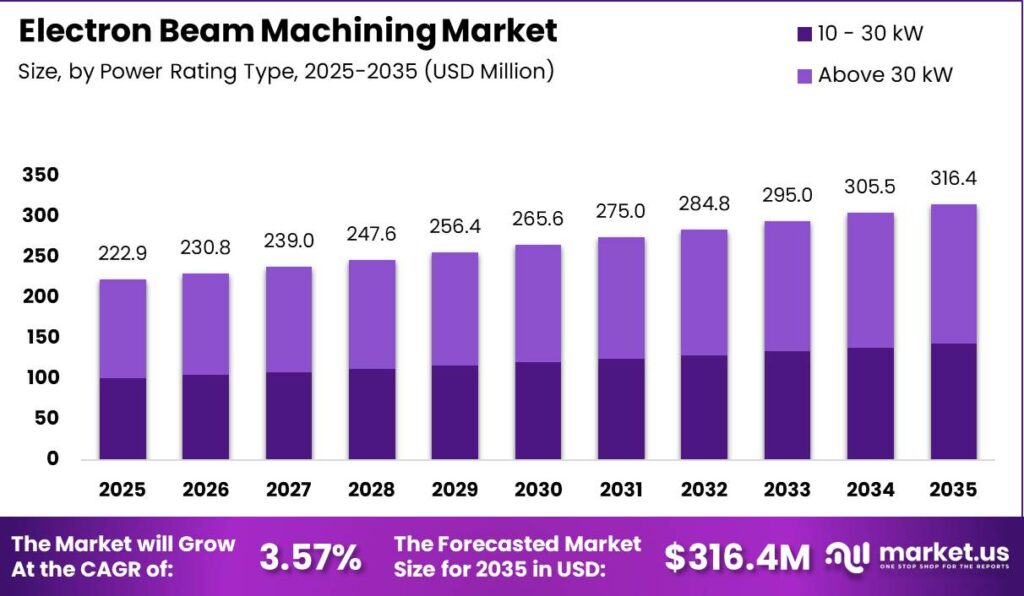
Global Electron Beam Machining Market size is expected to be worth around USD 316.45 Million by 2035 from USD 222.9 Million in 2025, growing at a CAGR of 3.57% during the forecast period 2026 to 2035.
Electron beam machining is a non-contact thermal process that uses a focused, high-velocity beam of electrons to remove, weld, drill, or modify metallic workpieces inside a vacuum chamber. The market spans equipment manufacturers, precision contract shops, and end-use industries including aerospace, automotive, electronics, and medical devices. System configurations range from low-power micro-machining units to high-power deep-penetration welding platforms, serving both serial production and specialty fabrication environments.
Key Takeaways
- The Electron Beam Machining Market was valued at USD 222.9 Million in 2025 and is forecast to reach USD 316.45 Million by 2035.
- The market is growing at a CAGR of 3.57% during the forecast period 2026 to 2035.
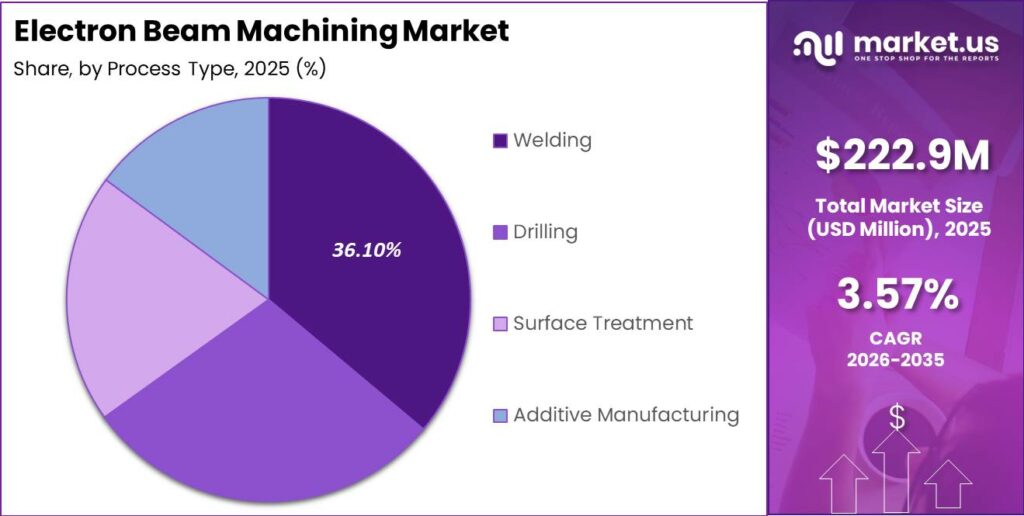
- By Process Type, Welding dominates with a 36.10% share in 2025.
- By Power Rating, the 10 to 30 kW segment holds the largest share at 44.50%.
- By Material, Titanium and Alloys leads with a 33.60% share.
- By End-Use Industry, Aerospace and Defense holds the largest share at 39.20%.
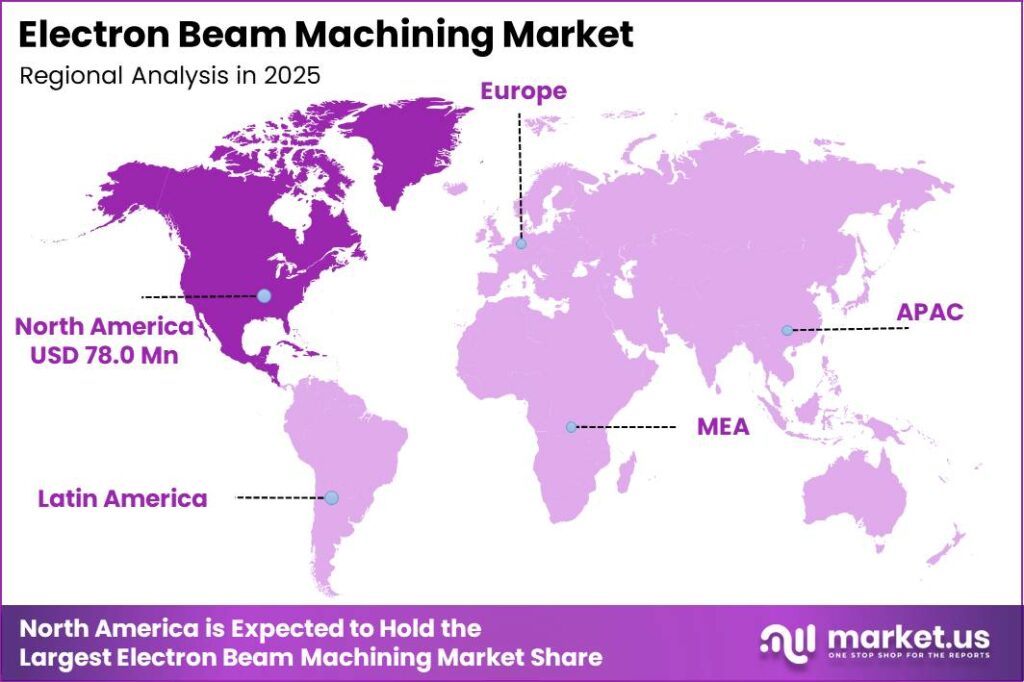
- North America dominates the regional landscape with a 35.00% share, valued at USD 78.00 Million in 2025.
According to the Aerospace Industries Association, the U.S. aerospace industry exported products worth USD 135.9 Billion in 2024. This level of export activity confirms deep structural demand for precision manufacturing technologies used in turbine blades, engine parts, and structural components. Electron beam machining systems positioned within aerospace supply chains benefit directly from this sustained output volume.
As reported by Boeing’s Commercial Market Outlook, commercial aircraft manufacturers will require more than 43,900 new aircraft worldwide by 2043. This long-cycle procurement commitment locks in multi-decade demand for precision drilling and welding of high-performance alloys. Suppliers who establish electron beam capacity now gain a compounding throughput advantage before the delivery ramp intensifies across the next decade.
Process Type Analysis
Welding dominates with 36.10% due to high joint integrity in vacuum environments.
In 2025, Welding held a dominant market position in the By Process Type segment of the Electron Beam Machining Market, with a 36.10% share. Electron beam welding produces deep-penetration joints with minimal heat-affected zones, making it the preferred joining method for titanium and nickel superalloy assemblies. According to the American Welding Society, electron beam welding accounts for a significant share of precision aerospace joining contracts across North America. Buyers seeking zero-filler, low-distortion joints consistently specify this process over conventional fusion welding alternatives, reinforcing volume concentration at the top of this segment.
Drilling covers both Micro-Drilling and Precision Hole Drilling sub-applications and serves industries requiring burr-free, high-aspect-ratio apertures in heat-sensitive materials. According to UNIDO industrial production data, precision drilling of fuel injection components and turbine cooling holes represents one of the fastest-scaling process niches within advanced machining globally. Contract shops that invest in dedicated electron beam drilling capacity gain access to aerospace and automotive tier-one qualification programs that carry multi-year supply agreements and locked pricing structures.
Surface Treatment encompasses Surface Hardening and Surface Alloying and addresses fatigue life extension on critical structural parts. Per trade association reporting from the Surface Engineering Association, electron beam surface hardening installations across Europe have expanded to serve automotive transmission and aerospace landing gear programs. This segment offers recurring process revenue because surface treatment is applied at multiple production stages rather than once per component, improving machine utilization economics for equipment owners.
Additive Manufacturing is the fastest-growing process type, covering Powder Bed Fusion and Wire-Fed EB Additive sub-methods. In October 2025, JEOL Ltd. released a technical publication on the production of titanium alloy components using electron beam metal 3D printing, demonstrating maturing process readiness for serial industrial production. According to the ASTM International Additive Manufacturing Center of Excellence, electron beam powder bed fusion systems have achieved certification entry-points in aerospace structural programs, signaling a shift from prototyping use toward production-grade applications that expand the addressable revenue base for system vendors.
Power Rating Analysis
10 to 30 kW dominates with 44.50% due to broad mid-tier aerospace and medical fit.
In 2025, the 10 to 30 kW segment held a dominant market position in the By Power Rating segment of the Electron Beam Machining Market, with a 44.50% share. This power range aligns with the widest cross-section of aerospace welding, medical implant drilling, and semiconductor micro-machining applications without requiring the facility upgrades that higher-power installations demand. According to national manufacturing statistics from Germany’s Federal Statistical Office, mid-power electron beam installations represent the most common configuration across European precision engineering facilities. Vendors targeting this tier access the broadest installed base and the highest replacement cycle frequency.
The Above 30 kW segment is the fastest-growing power rating category and targets thick-section structural welding for defense, energy, and heavy aerospace applications. According to US Department of Energy industrial technology reports, high-power electron beam systems are being evaluated for fusion reactor component fabrication and nuclear pressure vessel joining, end-uses that require energy densities beyond mid-range system capability. Buyers committing to above-30 kW platforms accept higher capital outlay in exchange for access to sole-source, high-margin contracts that laser systems cannot yet replicate at equivalent penetration depth.
Material Analysis
Titanium and Alloys dominates with 33.60% due to vacuum compatibility and aerospace specification mandates.
In 2025, Titanium and Alloys held a dominant market position in the By Material segment of the Electron Beam Machining Market, with a 33.60% share. Titanium requires inert or vacuum processing to prevent oxidation embrittlement, making electron beam machining one of a limited set of compliant joining and drilling methods. According to the International Titanium Association, global titanium mill product shipments exceeded 200,000 metric tons in 2024, with aerospace consuming the largest share. Shops qualified for titanium electron beam processing operate inside a structurally protected demand corridor that commodity machining alternatives cannot enter.
Stainless Steel and Nickel Super-Alloys serve high-temperature engine and chemical processing applications where electron beam welding provides joint quality superior to arc-based methods. According to UNIDO manufacturing output data, global stainless steel production surpassed 55 million metric tons in 2024, with a growing proportion directed toward precision fabricated components in energy and aerospace. Vendors serving this material tier benefit from long qualification cycles that raise switching costs and create multi-year sole-source revenue visibility once approvals are granted.
Refractory Metals is the fastest-growing material category, covering Tungsten, Niobium, and Tantalum. These materials carry melting points exceeding 2,400 degrees Celsius, making electron beam the only viable non-contact processing method at industrial scale. According to the US Geological Survey Mineral Commodity Summaries, global tungsten production reached approximately 84,000 metric tons in 2024, with defense and energy applications driving the highest-value end-use demand. Processors who develop refractory metal electron beam qualification stand at the entry point of a high-barrier niche with minimal direct competition from alternative machining technologies.
End-Use Industry Analysis
Aerospace and Defense dominates with 39.20% due to mandatory vacuum-grade superalloy joining specifications.
In 2025, Aerospace and Defense held a dominant market position in the By End-Use Industry segment of the Electron Beam Machining Market, with a 39.20% share. This segment covers Turbine Blades and Structural Airframe Components, both of which require joining and drilling methods that produce zero contamination and minimal thermal distortion. According to the Aerospace Industries Association, US defense procurement spending on advanced manufacturing technologies remained at elevated levels through 2024 and 2025. Manufacturers holding electron beam process approvals for these components benefit from qualification moats that block lower-cost laser alternatives from displacing them on existing platforms.
Automotive applications target Battery Housing Components and Transmission Parts, where electron beam welding delivers the hermetic sealing and precision joint geometry required by electrification-driven design standards. According to the International Organization of Motor Vehicle Manufacturers, global vehicle production reached approximately 93 million units in 2024, with battery electric vehicle output expanding as a share of total production. Suppliers who qualify electron beam welding for EV battery enclosures enter a structurally growing sub-market with long program lifetimes and predictable annual volumes.
Electronics applications center on Semiconductor Microfabrication, where electron beam tools support mask writing, lithography support, and burr-free via drilling in conductive substrates. According to the Semiconductor Industry Association, global chip sales reached USD 627 billion in 2024, and capacity expansion programs across Taiwan, South Korea, and the United States are extending fab investment well into the next decade. Equipment vendors positioned in this sub-segment capture recurring tool consumable and service revenue tied to high-utilization fab environments.
Medical Devices and Implants is the fastest-growing end-use industry, covering Orthopedic Implants and Surgical Instruments. According to the US Food and Drug Administration device approval database, submissions for metal implant components requiring micron-level surface and dimensional accuracy increased steadily through 2024 and 2025. Precision medical contract manufacturers who invest in electron beam micro-machining capability gain access to Class III device programs that carry premium unit pricing and multi-year supply commitments.
Key Market Segments
By Process Type
- Welding
- Deep Penetration Welding
- Micro-Welding
- Drilling
- Micro-Drilling
- Precision Hole Drilling
- Surface Treatment
- Surface Hardening
- Surface Alloying
- Additive Manufacturing
- Powder Bed Fusion
- Wire-Fed EB Additive
By Power Rating
- 10 to 30 kW
- Above 30 kW
By Material
- Titanium and Alloys
- Stainless Steel
- Nickel Super-Alloys
- Refractory Metals
- Tungsten
- Niobium
- Tantalum
By End-Use Industry
- Aerospace and Defense
- Turbine Blades
- Structural Airframe Components
- Automotive
- Battery Housing Components
- Transmission Parts
- Electronics
- Semiconductor Microfabrication
- Medical Devices and Implants
- Orthopedic Implants
- Surgical Instruments
Regional Analysis
North America Dominates the Electron Beam Machining Market with a Market Share of 35.00%, Valued at USD 78.00 Million
North America holds the largest regional share of the Electron Beam Machining Market, accounting for 35.00% of global revenue and valued at USD 78.00 Million in 2025. The United States drives this position through concentrated aerospace defense prime contractor networks and a deep base of tier-one precision fabricators holding active electron beam process qualifications. This regional concentration creates a high-value, low-churn customer profile for equipment vendors and service providers operating in the North American market.
Asia Pacific is the fastest-growing regional market, driven by semiconductor fab expansion in Taiwan and South Korea and rising medical device manufacturing output across Japan and India. Government-backed industrial upgrading programs in China and India are accelerating the adoption of vacuum precision equipment in domestic contract shops. Vendors who establish regional service and applications support infrastructure in Asia Pacific now position themselves ahead of the qualification timelines that major fab and aerospace programs in the region will impose over the next five years.
Europe maintains a structurally important position through its concentration of advanced aerospace, energy, and automotive manufacturing clusters in Germany, France, and the United Kingdom. Western European aerospace output sustained double-digit industrial production gains through 2024 and 2025 according to Eurostat indices, creating sustained demand for precision joining and drilling capability. Latin America and the Middle East and Africa regions represent earlier-stage adoption markets where incoming defense and energy infrastructure investment is beginning to create the first qualified electron beam procurement pipelines.
Key Regions and Countries
North America
- US
- Canada
Europe
- Germany
- France
- The UK
- Spain
- Italy
- Rest of Europe
Asia Pacific
- China
- Japan
- South Korea
- India
- Australia
- Rest of APAC
Latin America
- Brazil
- Mexico
- Rest of Latin America
Middle East and Africa
- GCC
- South Africa
- Rest of MEA
Market Dynamics
Market Opportunity Analysis - Underserved process types and emerging end-use verticals offer entry points for new players.
Additive Manufacturing remains the most underexploited process type within the Electron Beam Machining Market despite its fastest-growing classification. Powder Bed Fusion and Wire-Fed EB Additive sub-methods have reached aerospace certification entry points but have not yet penetrated serial production programs at scale. New entrants who build process qualification early capture sole-source positions on programs where switching costs are prohibitively high once a supplier achieves flight-hardware approval.
Medical Devices and Implants is the fastest-growing end-use industry but currently holds a smaller revenue share than Aerospace and Defense, creating a disproportionate growth opportunity relative to current market concentration. Orthopedic Implants and Surgical Instruments require micron-level dimensional accuracy that electron beam micro-machining delivers without post-process contamination risk. Contract manufacturers who invest in medical-grade electron beam certification now enter a segment where premium unit pricing and multi-year supply commitments are standard program terms.
Refractory Metals represent the most structurally protected material niche within the market. Tungsten, Niobium, and Tantalum processing requires melting point capability that no conventional machining alternative can match. This means addressable competition in the refractory metals corridor is limited to a small number of qualified electron beam operators globally. Investors and entrants who fund refractory metal qualification programs access a high-barrier segment with no credible threat of laser substitution at equivalent penetration depth or material integrity.
The Above 30 kW power segment is underpenetrated relative to its long-cycle demand drivers in defense and energy. Nuclear fusion component fabrication and space launch hardware serial production both require above-30 kW energy density that mid-range systems cannot deliver. This means the fastest-growing power tier and the highest-upside opportunity segments are structurally aligned, creating a compounding entry point for vendors who commit capital to high-power system development ahead of the qualification timelines these programs impose.
Technology and Innovation Landscape - AI-driven process control and digital integration redefine competitive advantage in electron beam machining
AI-driven beam parameter optimization is the most operationally impactful technology shift currently active in this market. Real-time machining accuracy and process stability improvements delivered by AI control systems reduce scrap rates and compress operator skill requirements simultaneously. Market.us data indicates that vendors who embed AI beam optimization into their system platforms create a recurring software revenue stream alongside hardware sales, shifting their business model toward higher-margin recurring income rather than one-time capital equipment transactions.
Digital twin technology enables virtual process validation before physical machining begins, eliminating trial-and-error beam setup costs on high-value workpieces. JEOL Ltd. data confirms that electron beam melting systems operate under vacuum levels around 10⁻⁴ to 10⁻⁵ mbar, a process environment where physical re-runs on titanium and tantalum workpieces carry significant material cost penalties per failed attempt. Shops that deploy digital twin validation reduce first-article failure rates and lower the per-unit cost of aerospace and medical qualification programs.
CNC-integrated electron beam machining cells within smart factory environments represent the structural shift from standalone precision tools to networked production assets. CNC integration enables automated job scheduling, real-time throughput monitoring, and predictive maintenance triggers that reduce unplanned downtime across multi-shift operations. This reflects a direct market response to the operator talent deficit identified as the deepest structural friction in this market. Automated control lowers the skill floor required per shift and converts idle capital into active production capacity.
High-frequency pulsed electron beam systems unlock ultra-fine micro-machining applications that continuous-beam platforms cannot address at equivalent precision. This technology is the primary enabler for MEMS and microelectronics manufacturing at production scale, a commercialization pathway identified as a key opportunity in this market. Vendors who develop pulsed beam platforms gain access to semiconductor and MEMS program qualifications that standard electron beam system configurations cannot enter, creating a product tier with structurally higher margin and lower competitive density.
Drivers
Aerospace superalloy component demand is the leading market driver. Global aircraft order books exceeded 17,000 units at the close of 2025 according to the International Air Transport Association, forcing propulsion suppliers to expand titanium and nickel superalloy processing capacity. Electron beam machining reduces post-weld finishing costs by roughly 15% to 20% and cuts distortion-related scrap below 3% on high-value forgings. This converts a legacy capital-goods purchasing cycle into recurring precision-service throughput that improves equipment utilization economics for machine builders.
| Driver | (~) % Impact on CAGR Forecast | Geographic Relevance | Impact Timeline |
|---|---|---|---|
| Aerospace superalloy component demand | +1.4% | North America, Western Europe | Short term (2 years or less) |
| Medical implant micro-machining growth | +0.9% | United States, Germany, Japan | Short term (2 years or less) |
| Electron beam melting additive convergence | +0.8% | Europe, East Asia | Medium term (2 to 4 years) |
| Deep-penetration welding in energy sector | +0.6% | Global | Medium term (2 to 4 years) |
| Reactive metal processing under vacuum | +0.5% | North America, East Asia | Short term (2 years or less) |
| Semiconductor micro-drilling adoption | +0.4% | Taiwan, South Korea, United States | Medium term (2 to 4 years) |
Restraints
High capital equipment outlay is the binding restraint on market expansion. Per World Bank global lending rate indices, the sustained higher-for-longer policy stance through 2025 pushed effective commercial borrowing costs into the 7% to 9% range across major economies. OECD business investment surveys confirm that capital-goods spending intentions among fabricated-metal SMEs softened materially over the same period, extending payback horizons on systems that already carry vacuum pump-down times measured in tens of minutes per cycle.
The combined effect of high financing costs and mandatory vacuum chamber infrastructure compresses gross margin on contract work by an estimated 4% to 6% versus laser alternatives. IMF regional financing condition reports confirm that deferred new-line installations suppress current-year unit sales directly rather than simply slowing the longer-term growth ceiling. Conductive material dependency adds a secondary constraint by excluding non-metallic and electrically insulating substrates from the addressable workpiece pool, narrowing the revenue base available to each installed system.
| Restraint | (~) % Impact on CAGR Forecast | Geographic Relevance | Impact Timeline |
|---|---|---|---|
| High capital equipment outlay | -1.1% | Global | Short term (2 years or less) |
| Elevated financing and interest rates | -0.7% | Global | Short term (2 years or less) |
| Mandatory vacuum chamber infrastructure | -0.6% | Emerging markets, South Asia | Medium term (2 to 4 years) |
| X-ray shielding compliance cost | -0.4% | European Union, North America | Short term (2 years or less) |
| Restricted maximum workpiece thickness | -0.3% | Global | Long term (4 years or more) |
Challenges
The deepest structural friction is the scarcity of technicians fluent in beam optics, vacuum systems, and high-voltage safety. Per US Bureau of Labor Statistics occupational projections, skilled machining and welding trades faced a cumulative replacement shortfall running into hundreds of thousands of openings annually through 2025. Eurostat labour force data confirms the European Union manufacturing vacancy rate held near multi-year highs over the same period, leaving specialist electron beam roles unfilled for lead times that routinely stretch beyond 6 to 9 months.
Idle capital equipment cannot convert order backlog into throughput when operator positions remain vacant. ILO skills-mismatch reporting confirms the required corporate adjustment is a multi-year pivot toward embedded apprenticeship pipelines and automated beam-control software that lowers the operator skill floor. This transition payoff sits well beyond the near-term horizon. Vacuum cycle throughput bottlenecks and laser competitive substitution pressure each add independent friction, collectively constraining the market’s attainable growth ceiling without eliminating existing contract revenue streams.
| Challenge | (~) % CAGR Friction Drag | Geographic Relevance | Mitigation Horizon |
|---|---|---|---|
| Specialized operator talent deficit | -0.8% | Global | Long term (4 years or more) |
| Vacuum cycle throughput bottleneck | -0.6% | Global | Medium term (2 to 4 years) |
| Component supply chain fragility | -0.5% | East Asia, Europe | Medium term (2 to 4 years) |
| Laser competitive substitution pressure | -0.5% | Global | Long term (4 years or more) |
| Process qualification and certification lag | -0.3% | North America, European Union | Long term (4 years or more) |
Opportunities
Space launch hardware serial production is the highest-upside white space. Per US Federal Aviation Administration commercial space transportation records, annual licensed orbital launch attempts climbed past 250 in 2025. European Space Agency and Indian Space Research Organisation launch manifests confirm the shift from bespoke single-build hardware toward repeatable production runs is only now emerging. Electron beam welding of thin-wall combustion and tankage assemblies can lower per-joint finishing labour by roughly 20% to 25% and expand fabrication gross margin by an estimated 5% to 8% once qualified for flight cadence.
Three additional opportunity vectors extend the addressable market beyond aerospace. Integration of electron beam machining with additive manufacturing enables hybrid metal component production that combines net-shape deposition with precision finishing in a single qualified process chain. Expansion into electric vehicle battery component manufacturing creates a high-volume, recurring precision sub-market that rewards early qualification. Commercialization of miniature electron beam platforms for MEMS and microelectronics manufacturing targets a segment where alternative non-contact methods cannot match the spatial resolution electron beam systems deliver at production throughput.
| Opportunity | (~) % Potential CAGR Upside | Geographic Relevance | Execution Window |
|---|---|---|---|
| Space launch hardware serial production | +1.3% | United States, Europe, India | Medium term (2 to 4 years) |
| Machine-as-a-service monetization model | +0.9% | North America, Western Europe | Medium term (2 to 4 years) |
| Nuclear fusion component fabrication | +0.7% | Europe, East Asia, United States | Long term (4 years or more) |
| Emerging-market contract shop roll-ups | +0.6% | South Asia, Southeast Asia | Long term (4 years or more) |
| Micro-electronics adjacent vertical entry | +0.5% | East Asia, United States | Medium term (2 to 4 years) |
Key Company Insights
Pro-Beam GmbH and Co. KGaa operates more than 40 electron beam welding and machining systems worldwide, spanning aerospace, automotive, semiconductor, energy, and medical manufacturing. This multi-sector installed base reduces revenue concentration risk and creates recurring service and consumables revenue streams. However, geographic concentration in European industrial clusters exposes Pro-Beam to regional aerospace cycle volatility and limits near-term penetration of high-growth Asia Pacific contract shop programs.
Sciaky, Inc. holds a differentiated position through its IRISS closed-loop adaptive control system, which delivers real-time beam parameter adjustment during electron beam deposition. This proprietary process feedback capability reduces dimensional variance on large structural parts, a performance attribute that competing vendors without equivalent sensing infrastructure cannot match on high-value defense and aerospace geometries. In May 2026, JEOL Ltd. launched the LazEdge Laser SEM system, signaling that electron beam platform vendors are extending into adjacent inspection and analytical solutions to broaden addressable revenue per customer relationship.
Key Players
- Pro-Beam GmbH and Co. KGaa
- Sciaky, Inc.
- Mitsubishi Electric Corporation
- Cambridge Vacuum Engineering Ltd.
- JEOL Ltd.
- Nikon Corporation
- Hitachi, Ltd.
- ALD Vacuum Technologies GmbH
- Evobeam GmbH
- PTR Prazisionstechnik GmbH
Recent Developments
- January 2025: JEOL Ltd. published a technical update highlighting additive manufacturing of tungsten using its Electron Beam Metal 3D Printer, demonstrating expanded capabilities for high-melting-point metals used in aerospace and energy applications.
- February 2026: JEOL Ltd. updated its Electron Beam Metal 3D Printer JAM-5200EBM product portfolio, reinforcing its electron beam additive manufacturing offerings for industrial metal production across aerospace and energy end-use programs.
- April 2026: JEOL Ltd. announced joint research published in the journal Vacuum, demonstrating continued advancement of electron beam and vacuum-processing technologies with applications in precision industrial manufacturing.
Geopolitical Impact Analysis
Trade friction between the United States and key manufacturing economies is directly affecting electron beam machining supply chains. According to WTO tariff schedule filings, US import duties on precision industrial equipment and high-voltage components from China reached elevated levels through 2025, raising procurement costs for domestic contract shops that source vacuum system sub-components from East Asian suppliers. World Bank commodity price indices show tungsten prices increased by more than 15% over the 2023 to 2025 period, compressing material margins for refractory metal processing operations dependent on imported feedstock.
Supply chain rerouting driven by US-China trade restrictions and Europe’s strategic autonomy directives is lengthening lead times for electron gun assemblies and high-voltage power supplies sourced from concentrated manufacturing clusters in Japan and Germany. According to UNCTAD trade and development reports, global freight transit disruptions through 2024 and 2025 added an average of 12 to 18 days to transoceanic component shipments, delaying new system installations and extending commissioning timelines for buyers. This means buyers in North America and Europe who depend on single-source component suppliers face procurement risk that multi-source qualified supply chains would structurally eliminate.
Report Scope
| Report Features | Description |
|---|---|
| Market Value (2025) | USD 222.9 Million |
| Forecast Revenue (2035) | USD 316.45 Million |
| CAGR (2026-2035) | 3.57% |
| Base Year for Estimation | 2025 |
| Historic Period | 2020-2024 |
| Forecast Period | 2026-2035 |
| Report Coverage | Revenue Forecast, Market Dynamics, Market Opportunity Analysis, Technology and Innovation Landscape, Competitive Landscape, Recent Developments |
| Segments Covered | By Process Type (Welding: Deep Penetration Welding, Micro-Welding; Drilling: Micro-Drilling, Precision Hole Drilling; Surface Treatment: Surface Hardening, Surface Alloying; Additive Manufacturing: Powder Bed Fusion, Wire-Fed EB Additive), By Power Rating (10 to 30 kW, Above 30 kW), By Material (Titanium and Alloys, Stainless Steel, Nickel Super-Alloys, Refractory Metals: Tungsten, Niobium, Tantalum), By End-Use Industry (Aerospace and Defense: Turbine Blades, Structural Airframe Components; Automotive: Battery Housing Components, Transmission Parts; Electronics: Semiconductor Microfabrication; Medical Devices and Implants: Orthopedic Implants, Surgical Instruments) |
| Regional Analysis | North America (US and Canada), Europe (Germany, France, The UK, Spain, Italy, and Rest of Europe), Asia Pacific (China, Japan, South Korea, India, Australia, and Rest of APAC), Latin America (Brazil, Mexico, and Rest of Latin America), Middle East and Africa (GCC, South Africa, and Rest of MEA) |
| Competitive Landscape | Pro-Beam GmbH and Co. KGaa, Sciaky Inc., Mitsubishi Electric Corporation, Cambridge Vacuum Engineering Ltd., JEOL Ltd., Nikon Corporation, Hitachi Ltd., ALD Vacuum Technologies GmbH, Evobeam GmbH, PTR Prazisionstechnik GmbH |
| Customization Scope | Customization for segments, region / country-level will be provided. Additional customization can be done based on requirements. |
| Purchase Options | We have three licenses to opt for: Single User License | Multi-User License (Up to 5 Users) | Corporate Use License (Unlimited User and Printable PDF) |





































