


Global Electric Vehicle Fluids Market Size, Share and Report Analysis By Product (Engine Oil, Coolant, Transmission Fluids, Greases), By Propulsion Type (Battery Electric Vehicle (BEV’s), Hybrid Electric Vehicle (HEV’s)/ Plug-in Hybrid Electric Vehicle (PHEV’s)), By Vehicle Type (Commercial, Passenger) , By Region and Companies - Industry Segment Outlook, Market Assessment, Competition Scenario, Trends and Forecast 2025-2034
- Published date: Feb 2026
- Report ID: 179249
- Number of Pages: 370
- Format:
-
keyboard_arrow_up
Quick Navigation
Report Overview
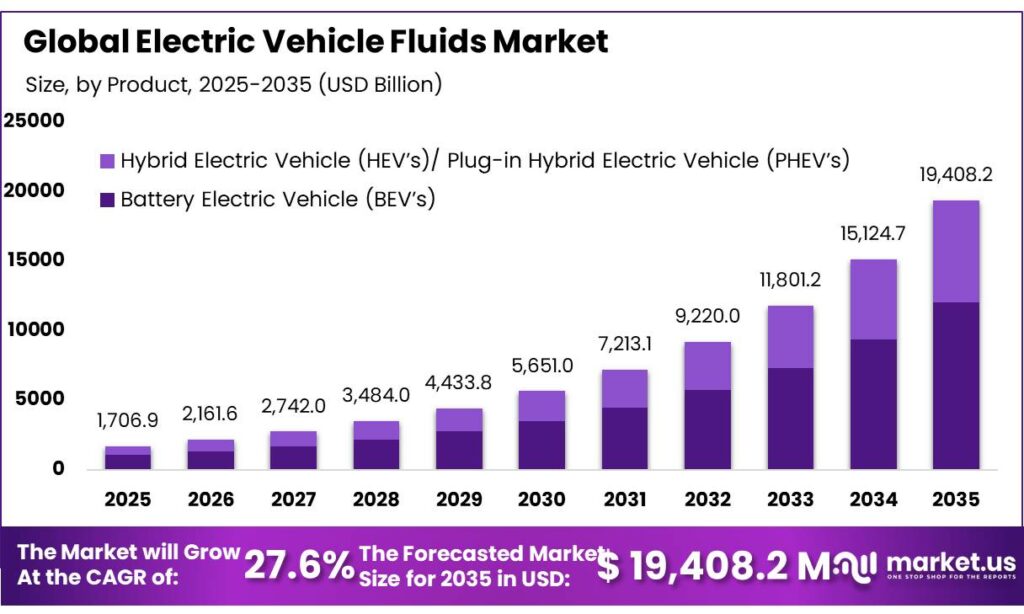
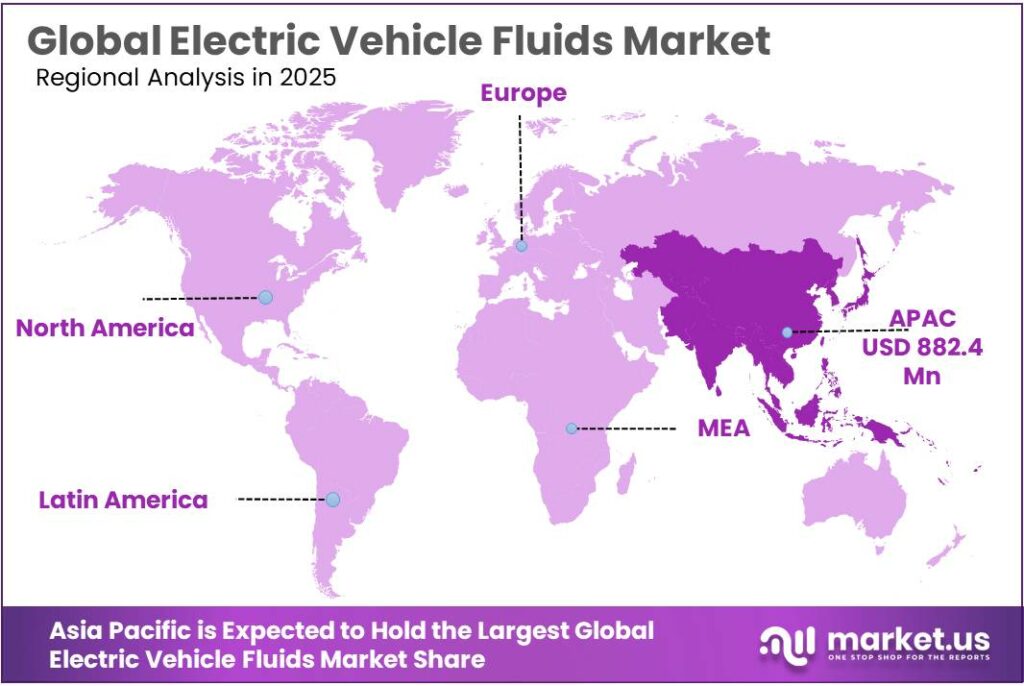
The Global Electric Vehicle Fluids Market is expected to be worth around USD 19408.2 Million by 2035, up from USD 1706.9 Million in 2025, at a CAGR of 27.6% from 2026 to 2035. The Asia Pacific segment maintained 51.7%, supporting a Electric Vehicle Fluids value of USD 882.4 Mn.
Electric vehicle (EV) fluids form a young but strategically important niche within the wider automotive lubricants and chemicals industry. Instead of traditional engine oils, EVs rely on specialized e-axle lubricants, dielectric battery coolants, thermal interface materials, greases and transmission fluids engineered to manage heat, protect high-speed e-motors and ensure electrical safety.
- Demand for these fluids is structurally tied to electrification: global electric car sales exceeded 17 million units in 2024, with the International Energy Agency projecting they will surpass 20 million in 2025 and push EVs to over 40% of global car sales by 2030 under current policies.
The primary industrial growth driver is the accelerating adoption of EVs underpinned by government policy. According to the International Energy Agency, global electric car sales reached 14 million in 2023 and are set to keep rising as more models and stricter CO₂ standards come into force. China has become the dominant zero-emission vehicle market, now contributing over 11 million electric vehicle sales annually, representing more than half of global EV sales, as highlighted by research for the International Council on Clean Transportation.
- In the United States, the ICCT estimates that EV sales reached 1.56 million units in 2024, equal to about 10% of all new light-duty vehicle sales, creating a steadily expanding installed base requiring EV-grade fluids for factory fill and service.
Regulation and government initiatives add a strong policy tailwind. India’s Ministry of Environment, Forest and Climate Change has implemented an Extended Producer Responsibility (EPR) framework for batteries, supported by a centralized online registration system which tracks quantities and weights of EV batteries to promote recycling and responsible end-of-life management. In China, the central government has drafted standard GB 29743.2, which sets maximum dielectric requirements for EV thermal-management liquids to reduce the electrical conductivity of coolants used around high-voltage components, directly pushing the industry toward safer, high-performance dielectric fluids.
Government policy is a central driver of demand for EV fluids. Canada’s federal regulations now target 20 % zero-emission vehicle (ZEV) sales by 2026, 60% by 2030 and 100% by 2035 for new light-duty vehicles. The United Kingdom’s ZEV mandate requires 80% of new cars and 70% of new vans to be zero-emission by 2030, rising to 100 % of new sales by 2035. In the United States, California’s Advanced Clean Cars II framework provides a model for states to ramp ZEV sales to 100% of new light-duty vehicles by 2035.
Policy and investment are reinforcing this technical shift. In the European Union, legislation requires that all new cars and vans sold from 2035 emit zero CO₂, aligning transport with the bloc’s 2050 climate-neutrality goal.
- Building on this, recent statements by the Union Minister for Heavy Industries highlighted that FAME-II, expanded to ₹11,500 crore, has already supported over 16.7 lakh EVs and sanctioned more than 9,000 public charging stations, while the PM e-DRIVE scheme, with a budget of ₹10,900 crore, has enabled sales of over 20 lakh EVs and earmarked ₹2,000 crore for over 70,000 charging stations nationwide.
Key Takeaways
- Electric Vehicle Fluids Market is expected to be worth around USD 19408.2 Million by 2035, up from USD 1706.9 Million in 2025, at a CAGR of 27.6%.
- Coolant held a dominant market position, capturing more than a 41.6% share.
- Battery Electric Vehicle (BEV’s) held a dominant market position, capturing more than a 62.1% share.
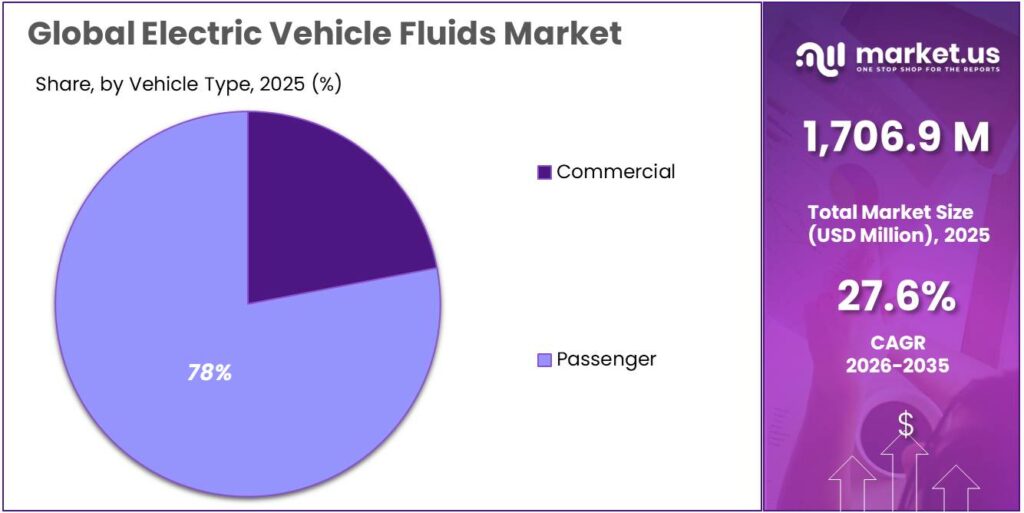
- Passenger vehicles held a dominant market position, capturing more than a 78.3% share.
- Asia Pacific is the clear leader in the Electric Vehicle Fluids Market, dominating around 51.7% of global demand, valued at roughly USD 882.4 million.
By Product Analysis
Coolant leads the EV fluids market with a strong 41.6% share
In 2024, Coolant held a dominant market position, capturing more than a 41.6% share, driven by the growing need for efficient thermal management across battery packs, e-motors, and inverters. As EV architectures move toward higher-density batteries and faster charging systems, manufacturers are relying heavily on advanced coolants that balance heat transfer, dielectric safety, and long-term stability.
The segment’s strength in 2024 is also supported by the rising production of electric cars in major markets, where thermal management is becoming a crucial performance parameter, especially for maintaining battery health and ensuring consistent driving range under high-load conditions.
By Propulsion Type Analysis
Battery Electric Vehicles dominate with a strong 62.1% market share
In 2024, Battery Electric Vehicle (BEV’s) held a dominant market position, capturing more than a 62.1% share, reflecting their growing acceptance as the primary choice for full-scale electrification. This leadership is driven by the increasing global push toward zero-emission mobility, improvements in battery range, and the rapid rollout of charging infrastructure across major markets.
BEVs rely heavily on specialized fluids—such as thermal management coolants, e-axle lubricants, and dielectric fluids—to maintain battery health, regulate system temperatures, and ensure smooth power delivery. As EV platforms shift toward higher power densities and faster charging speeds, the need for advanced fluids becomes even more essential, reinforcing BEVs’ influence on overall fluid demand.
By Vehicle Type Analysis
Passenger vehicles dominate with a strong 78.3% market share
In 2024, Passenger vehicles held a dominant market position, capturing more than a 78.3% share, driven by the rapid expansion of electric cars across both mass-market and premium categories. This segment’s leadership reflects the accelerated shift of consumers toward cleaner mobility, supported by better driving ranges, falling battery prices, and a wider variety of EV models.
Passenger EVs rely heavily on specialized fluids—such as high-performance coolants, e-motor greases, and transmission fluids—to manage heat, reduce friction, and maintain long-term efficiency. As more households adopt electric cars, the demand for these advanced fluids rises sharply, especially with the increasing popularity of long-range models that place greater stress on thermal systems.
Key Market Segments
By Product
- Engine Oil
- Coolant
- Transmission Fluids
- Greases
By Propulsion Type
- Battery Electric Vehicle (BEV’s)
- Hybrid Electric Vehicle (HEV’s)/ Plug-in Hybrid Electric Vehicle (PHEV’s)
By Vehicle Type
- Commercial
- Passenger
Emerging Trends
Rising demand for low-impact EV fluids in food and cold-chain transport
One of the most striking recent trends in Electric Vehicle Fluids is the move toward low-impact thermal and drivetrain fluids designed specifically for food logistics and cold-chain transport. What used to be a niche technical topic—“which coolant goes into an e-axle or battery loop?”—is now tied directly to how the world grows, moves and stores its food. The Food and Agriculture Organization (FAO) estimates that global agrifood systems emitted 16.5 billion tonnes of CO₂-equivalent in 2023, accounting for about 32% of total human-made greenhouse gas emissions.
Food loss and waste numbers add another layer of pressure. FAO and UN partners point out that around 14 % of the world’s food, worth about US $400 billion per year, is lost between harvest and retail, while a further 17% of food is wasted at retail and consumer level. This wasted food is responsible for 8–10% of global greenhouse gas emissions, because energy, transport and refrigeration are used for products that never get eaten.
At the same time, electric mobility is scaling fast. The International Energy Agency (IEA) reports that electric car sales topped 17 million worldwide in 2024, more than 25% higher than 2023, and electric cars made up over one in five new cars sold globally that year. Behind those headline numbers is a growing share of vehicles used directly in food distribution: supermarket delivery vans, urban trucks serving restaurants, and regional cold-chain fleets.
The latest trend is that EV fluids are no longer seen as just technical consumables—they are becoming part of food companies’ climate strategy. When a logistics manager looks at the carbon footprint of moving fruit or frozen meals, they increasingly think about vehicle type, route, electricity source and now also the efficiency and durability of the thermal system. As agrifood systems confront their 16.5 billion-tonne CO₂-equivalent burden and try to shrink the 8–10 % of emissions tied to food loss and waste, the move to electric, well-cooled and more reliable fleets becomes a very practical lever.
Drivers
Global Push To Cut Emissions Across Food And Transport Systems
A major driving factor for the Electric Vehicle Fluids market is the worldwide push to cut greenhouse gas emissions, not only from cars but from entire value chains, including how food is produced and moved. The Food and Agriculture Organization (FAO) estimates that agrifood systems account for about one-third of all human-made greenhouse gas emissions. This includes farming, food processing, transport, retail and waste.
On the mobility side, the scale and speed of EV adoption has changed the game for EV fluids. The International Energy Agency (IEA) reports that electric car sales exceeded 17 million in 2024, giving them more than 20% of global new car sales. The International Council on Clean Transportation (ICCT) similarly finds that light-duty EV sales reached nearly 17 million vehicles in 2024, accounting for about 19 % of all new light-duty vehicles sold worldwide, up from roughly 15 % in 2023.
- Governments are locking this transition in with clear targets. India’s policy roadmap, for example, aims for electric vehicles to reach a 30% share of all vehicles sold by 2030. According to a recent government-linked assessment, EV sales in India increased from about 50 000 units in 2016 to 2.08 million in 2024, highlighting how quickly adoption can accelerate once incentives, public charging and local manufacturing fall into place. At the same time, national schemes such as FAME-II have supported over 1.67 million EVs and approved more than 9 000 public charging stations, creating the ecosystem needed for large-scale electrification of both passenger cars and food-distribution fleets.
This climate and policy context directly boosts demand for Electric Vehicle Fluids. Food manufacturers, retailers and logistics operators now face scrutiny on the carbon footprint of every tonne of produce they move. With agrifood systems already responsible for around 30–40% of global emissions, according to FAO-based analyses, many companies are rethinking diesel-based cold chains and last-mile delivery.
Restraints
High Cost and Technical Complexity of EV Thermal-Management Systems
A major restraining factor for the growth of Electric Vehicle Fluids is the high cost and technical complexity of advanced thermal-management systems, which places pressure on both vehicle manufacturers and fleet operators. These systems rely on specially engineered coolants, dielectric fluids and e-axle lubricants that cost significantly more than conventional automotive fluids.
Another issue is the complexity of maintaining these systems. Food retailers and transporters often operate vehicles in long daily cycles, especially in urban delivery. EV thermal systems must work harder under these conditions, which increases the frequency of fluid checks and replacements.
- The International Energy Agency (IEA) highlights that global electric car sales surpassed 17 million units in 2024, representing over 20% of new vehicle sales worldwide. While this shows strong growth, it also means millions of vehicles entering a service phase where advanced fluids are required—pushing maintenance burdens higher for commercial sectors such as food logistics.
Government initiatives encourage electrification but do not always offset the thermal-management costs. India’s EV roadmap targets 30% EV penetration by 2030, but reports show EV sales climbed from around 50,000 units in 2016 to 2.08 million units in 2024, reflecting rapid adoption. Yet many fleet operators still cite operational costs—including fluid servicing—as a key concern. In cold-chain operations, high-temperature stability fluids are essential to protect both batteries and cooling units, adding additional expenses beyond the vehicle itself.
Opportunity
Cold-Chain And Food Logistics Electrification Opens A Powerful Growth Lane
One major growth opportunity for Electric Vehicle Fluids lies in the quiet but massive shift toward electrifying food logistics and the cold-chain. Agrifood systems today are responsible for about 16.5 billion tonnes of CO₂-equivalent emissions in 2023, which is roughly 32% of total human-made greenhouse gas emissions. Within that, farm-gate emissions from crops and livestock alone make up 8.1 billion tonnes CO₂-equivalent, or 49% of agrifood system emissions.
Food loss and waste add another layer of urgency. FAO estimates that around 14 % of the world’s food is lost after harvest and before retail, and a further 17% of food available to consumers is wasted. Together, food loss and waste account for 8–10% of global greenhouse gas emissions, because energy and resources are used all along the chain to move, cool and store food that never gets eaten. For supermarkets, exporters and logistics providers, cutting these losses increasingly means investing in more reliable, better-controlled cold-chain systems — and this is where electric trucks, vans and refrigerated units start to play a bigger role.
As these fleets electrify, the demand for specialized EV fluids climbs sharply. Electric trucks and buses use high-performance coolants, e-axle lubricants and dielectric thermal fluids to keep batteries, inverters and e-motors within tight temperature windows during long duty cycles and fast charging. The International Energy Agency (IEA) reports that global sales of electric buses reached more than 70 000 units in 2024, up from around 50 000 in 2023, with China no longer the only major buyer as more countries adopt electric fleets.
For suppliers of Electric Vehicle Fluids, this creates a very tangible growth lane. Food and cold-chain companies cannot compromise on uptime: a failed cooling loop or overheated battery can spoil high-value cargo. That means they are willing to pay for fluids that offer better thermal stability, lower electrical conductivity and longer service life. As agrifood systems look for ways to shrink their 32 % share of global emissions without disrupting supply, shifting logistics fleets to electric drivetrains becomes one of the most direct levers.
Regional Insights
Asia Pacific commands 51.7% share, worth about USD 882.4 million in EV fluids
Asia Pacific is the clear leader in the Electric Vehicle Fluids Market, dominating around 51.7% of global demand, valued at roughly USD 882.4 million, supported by its strong EV manufacturing base and accelerating regional adoption. China is the anchor: according to the International Energy Agency, over 9 million electric cars were sold in China in 2024, giving EVs more than 40% of the country’s new car market, and accounting for over half of global EV sales.
This huge production and on-road fleet require large volumes of advanced coolants, e-axle fluids and dielectric thermal fluids for both factory-fill and service. Elsewhere in Asia Pacific, emerging economies are catching up quickly. Electric car sales in emerging and developing economies in Asia grew to around 400,000 units in 2024, up more than 40% year on year, driven by supportive policies and falling battery costs.
Key Regions and Countries Insights
- North America
- US
- Canada
- Europe
- Germany
- France
- The UK
- Spain
- Italy
- Rest of Europe
- Asia Pacific
- China
- Japan
- South Korea
- India
- Australia
- Rest of APAC
- Latin America
- Brazil
- Mexico
- Rest of Latin America
- Middle East & Africa
- GCC
- South Africa
- Rest of MEA
Key Players Analysis
Shell Plc remains one of the leading suppliers of EV-specific fluids through its e-fluids and thermal-management portfolio. With operations in more than 100 countries and 93,000+ employees, Shell recorded USD 323 billion in revenue. Its EV-Plus thermal fluids are designed to support ultra-fast charging and higher battery densities. Shell also operates over 40,000 public charging points globally, enabling real-world testing and wider commercialization of advanced coolants, dielectric liquids, and e-lubricants tailored for modern EV architectures.
TotalEnergies develops specialized EV fluids under its Quartz EV and dedicated thermal-management lines. Operating in over 130 countries with 100,000+ employees, the company reported USD 237 billion in revenue (2023). Its formulations focus on dielectric strength, long-life thermal stability, and compatibility with compact e-drivelines. TotalEnergies also supports the deployment of over 40,000 charging points globally, allowing EV fluid technologies to be validated under demanding real-world conditions, particularly in high-temperature regions across Asia and the Middle East.
Petroliam Nasional Berhad (PETRONAS) continues expanding its EV-focused fluid technologies through the PETRONAS Iona range. The company operates across 50+ countries and recorded RM 343 billion (≈USD 72 billion) revenue in 2023. Its research centres develop battery-cooling fluids, e-transmission lubricants, and dielectric solutions engineered for high-efficiency EV systems. PETRONAS’ fluid data highlights gains in heat-transfer efficiency and reduced power losses in high-speed electric drivetrains, supporting OEM adoption across Asia Pacific’s fast-growing EV manufacturing base.
Top Key Players Outlook
- BP Plc
- Shell Plc
- FUCHS
- TotalEnergies
- Petroliam Nasional Berhad (PETRONAS)
- Saudi Arabian Oil Co.
- Repsol
- ENEOS Corp.
- Gulf Oil International Ltd.
Recent Industry Developments
In 2025, Shell announced and demonstrated new EV-Plus thermal fluids that enable a 34 kWh battery pack to charge from 10% to 80% in under 10 minutes, by improving heat transfer and keeping cells within a safe temperature window during ultra-fast charging.
In July 2024, TotalEnergies also launched “Source”, a 50/50 joint venture with SSE in the UK and Ireland, with a plan to install up to 3,000 high-power charge points (150 kW and above) grouped into about 300 hubs over five years, targeting around 20% market share in those fast-charging markets.
Report Scope
Report Features Description Market Value (2025) USD 1706.9 Mn Forecast Revenue (2035) USD 19408.2 Mn CAGR (2026-2035) 27.6% Base Year for Estimation 2025 Historic Period 2020-2024 Forecast Period 2026-2035 Report Coverage Revenue Forecast, Market Dynamics, Competitive Landscape, Recent Developments Segments Covered By Product (Engine Oil, Coolant, Transmission Fluids, Greases), By Propulsion Type (Battery Electric Vehicle (BEV’s), Hybrid Electric Vehicle (HEV’s)/ Plug-in Hybrid Electric Vehicle (PHEV’s)), By Vehicle Type (Commercial, Passenger) Regional Analysis North America – US, Canada; Europe – Germany, France, The UK, Spain, Italy, Rest of Europe; Asia Pacific – China, Japan, South Korea, India, Australia, Singapore, Rest of APAC; Latin America – Brazil, Mexico, Rest of Latin America; Middle East & Africa – GCC, South Africa, Rest of MEA Competitive Landscape BP Plc, Shell Plc, FUCHS, TotalEnergies, Petroliam Nasional Berhad (PETRONAS), Saudi Arabian Oil Co., Repsol, ENEOS Corp., Gulf Oil International Ltd. Customization Scope Customization for segments, region/country-level will be provided. Moreover, additional customization can be done based on the requirements. Purchase Options We have three licenses to opt for: Single User License, Multi-User License (Up to 5 Users), Corporate Use License (Unlimited User and Printable PDF)  Electric Vehicle Fluids MarketPublished date: Feb 2026add_shopping_cartBuy Now get_appDownload Sample
 -
-
- BP Plc
- Shell Plc
- FUCHS
- TotalEnergies
- Petroliam Nasional Berhad (PETRONAS)
- Saudi Arabian Oil Co.
- Repsol
- ENEOS Corp.
- Gulf Oil International Ltd.
Our Clients

- 179249
- Feb 2026






