


Global Edible Water Bottle Market Size, Share, Growth Analysis By Material (Seaweed Extract, Alginate, Gelatin), By Type (Plain Water, Mineral Water, Sparkled Water, Flavored Water, Others), By Application (Beverages, Pharmaceuticals, Personal Care, Others), By Distribution Channel (Offline, Online), By Region and Companies - Industry Segment Outlook, Market Assessment, Competition Scenario, Statistics, Trends and Forecast 2025-2034
- Published date: Dec 2025
- Report ID: 172658
- Number of Pages: 370
- Format:
-
keyboard_arrow_up
Quick Navigation
Report Overview
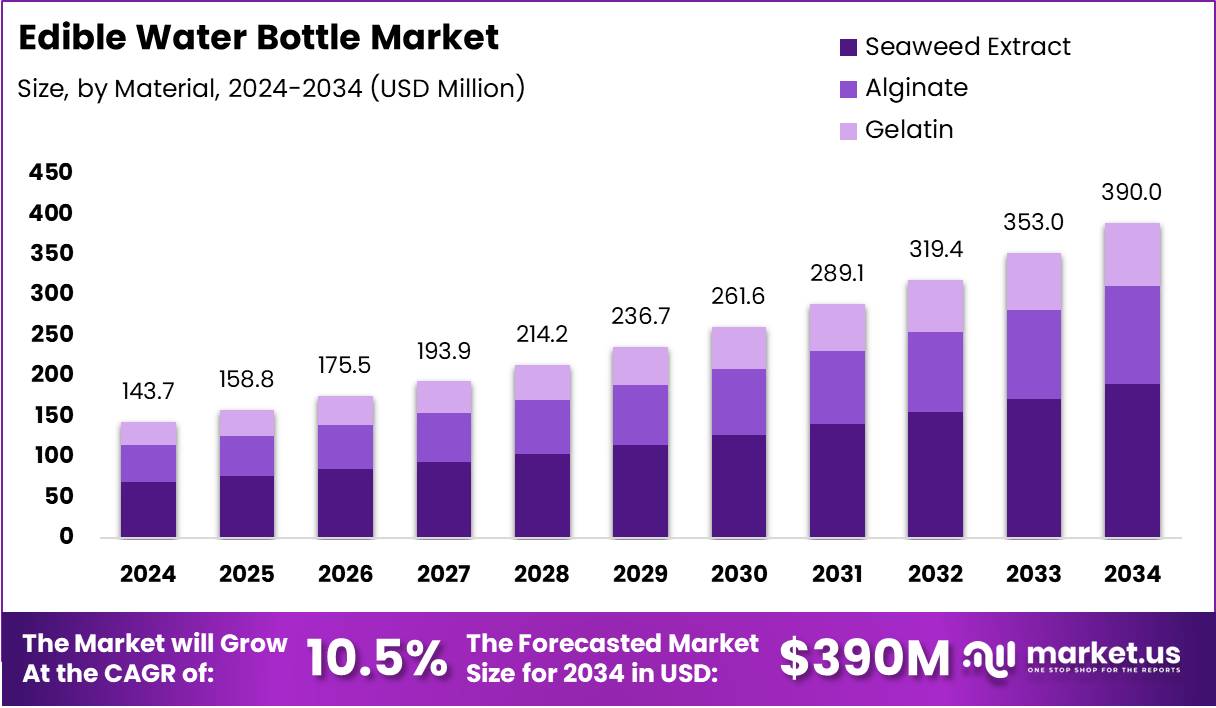
The Global Edible Water Bottle Market size is expected to be worth around USD 390 Million by 2034, from USD 143.7 Million in 2024, growing at a CAGR of 10.5% during the forecast period from 2025 to 2034.
The Edible water bottle market represents an innovative solution addressing global plastic pollution through biodegradable packaging alternatives. These sustainable containers utilize natural membrane technology, primarily derived from seaweed extract, to encapsulate drinking water. Consequently, this emerging sector attracts environmentally conscious consumers seeking plastic-free hydration options while reducing single-use packaging waste significantly.
Market growth accelerates as consumer awareness regarding environmental sustainability intensifies worldwide. Subsequently, manufacturers invest in developing scalable production methods for edible water packaging solutions. This transition towards biodegradable alternatives demonstrates significant commercial viability, particularly within event management and outdoor recreational sectors where convenience meets ecological responsibility effectively.
Regulatory frameworks increasingly support sustainable packaging innovations through favorable environmental policies globally. Governments worldwide implement stricter plastic waste regulations, thereby creating substantial opportunities for alternative packaging solutions. Furthermore, public sector initiatives encourage research development investments in biodegradable materials, strengthening market expansion prospects considerably.
Commercial adoption gains momentum across large-scale events demonstrating practical implementation potential. Notably, London Marathon organizers replaced 200,000 plastic bottles with edible, biodegradable water pods, showcasing real-world application feasibility. This landmark initiative validates the technology’s scalability while highlighting environmental impact reduction capabilities effectively.
Consumer acceptance research indicates strong market receptivity towards edible water packaging alternatives. Approximately 70% of survey respondents expressed willingness to adopt edible water bubbles replacing conventional plastic bottles, primarily driven by environmental concerns. Additionally, these innovative containers demonstrate remarkable biodegradability, decomposing completely within 4-6 weeks compared to traditional plastic requiring centuries for decomposition.
Investment opportunities expand as sustainability-focused ventures attract venture capital and governmental funding alike. Therefore, market participants anticipate accelerated innovation cycles improving production efficiency and cost-effectiveness. The convergence of environmental necessity, regulatory support, and consumer demand positions the edible water bottle market for substantial growth throughout upcoming years, transforming beverage packaging paradigms fundamentally.
Key Takeaways
- The Global Edible Water Bottle Market is projected to grow from USD 143.7 Million in 2024 to USD 390 Million by 2034, registering a 10.5% CAGR globally.
- By material, Seaweed Extract leads the market with a 48.9% share in 2024, driven by biodegradable and sustainable packaging demand worldwide.
- By type, Plain Water dominates with a 37.3% market share in 2024, reflecting strong consumer preference for basic hydration solutions.
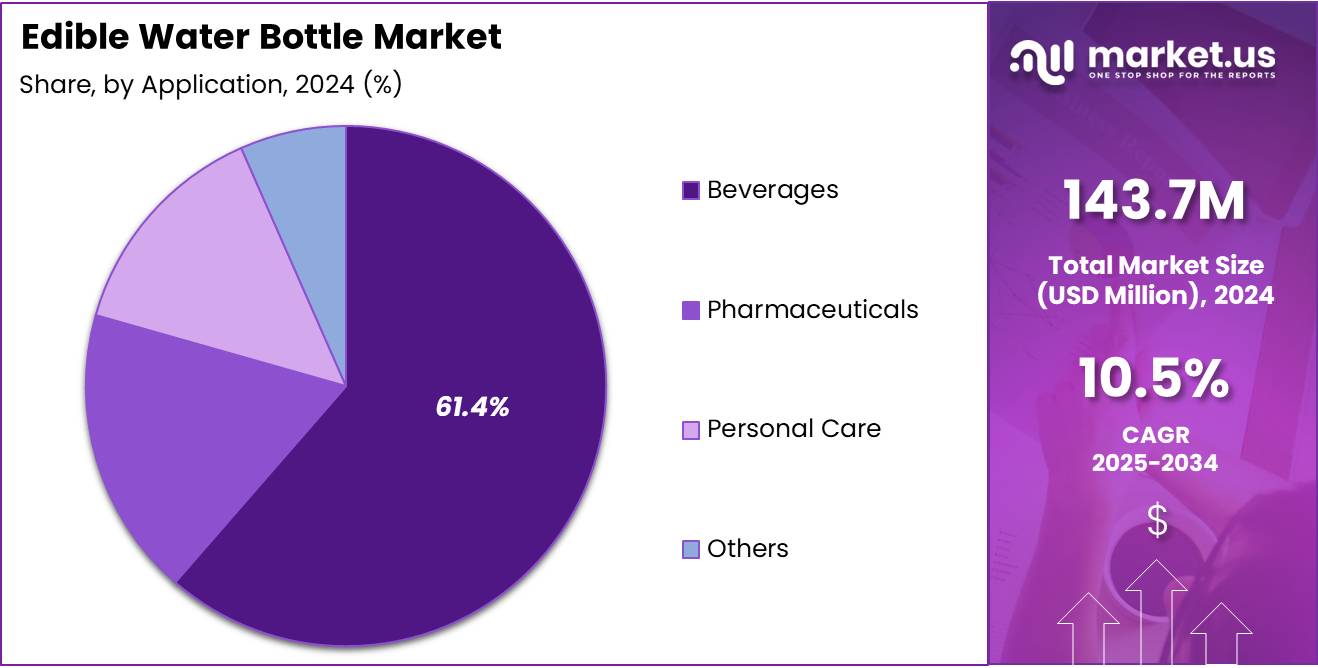
- By application, the Beverages segment accounts for 61.4% of the global market in 2024, highlighting its primary use in sustainable hydration.
- By distribution channel, Offline sales hold a 56.2% share in 2024, supported by physical retail and event-based consumption.
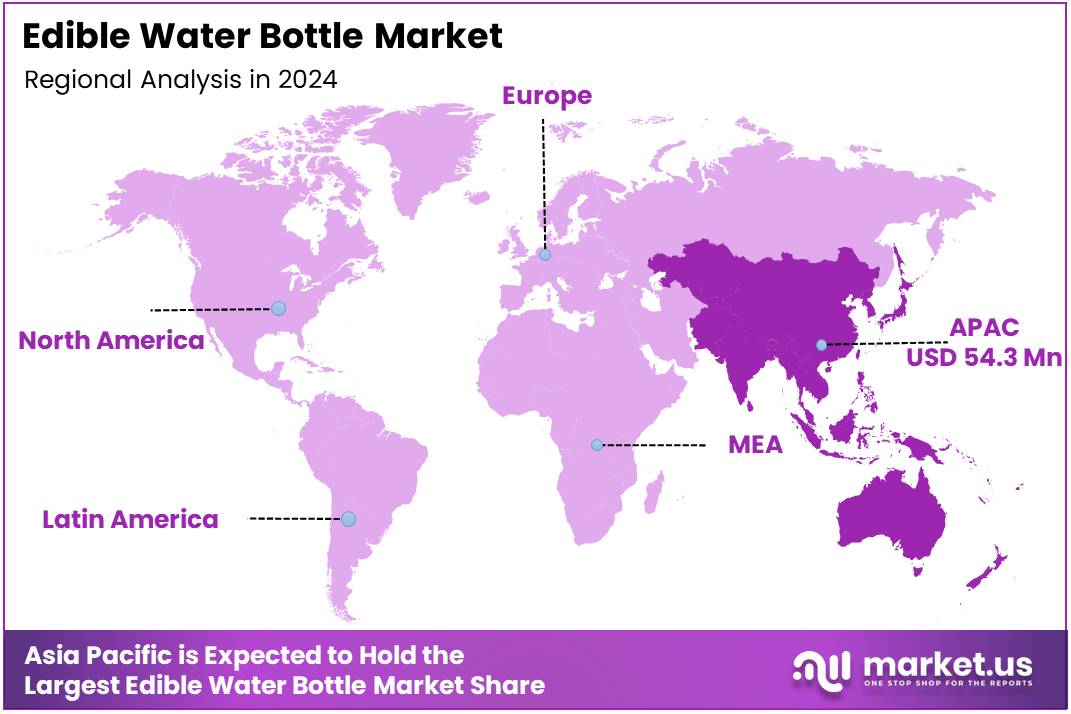
- Regionally, Asia Pacific leads with a 37.8% market share, positioning it as the largest regional market for edible water bottles globally.
By Material Analysis
Seaweed Extract dominates with 48.9% due to its superior biodegradability and sustainable sourcing capabilities.
Seaweed Extract commands the largest market share at 48.9% in 2024, establishing itself as the preferred material for edible water bottle production. This dominance stems from its exceptional biodegradability, renewable nature, and minimal environmental impact. Seaweed extract offers excellent gel-forming properties, creating sturdy yet edible membranes that effectively contain liquids while remaining cost-effective for large-scale production.
Alginate represents a significant segment within the material category, derived primarily from brown seaweed. This polysaccharide demonstrates remarkable water-retention capabilities and forms flexible, transparent films suitable for beverage packaging. Its compatibility with various additives enables manufacturers to customize bottle properties, strengthening its position among health-conscious consumers.
Gelatin serves as an alternative material option, particularly appealing for specific applications requiring enhanced protein content. Though holding a smaller market share, gelatin-based bottles offer unique textural properties and nutritional benefits. This material provides excellent film-forming characteristics and dissolves easily, making it suitable for pharmaceutical applications.
By Type Analysis
Plain Water dominates with 37.3% due to its universal appeal and fundamental hydration purpose.
Plain Water holds a commanding 37.3% market share in 2024, reflecting consumer preference for pure, unflavored hydration solutions. This segment’s dominance is attributed to growing health consciousness among consumers seeking zero-calorie, additive-free drinking options. Plain water-filled edible bottles appeal to environmentally aware individuals prioritizing sustainability without compromising basic hydration needs.
Mineral Water represents a premium segment within the edible water bottle market, catering to consumers seeking enhanced nutritional benefits. These bottles contain water enriched with essential minerals like calcium, magnesium, and potassium. The mineral water segment attracts health-enthusiasts and athletes who value electrolyte replenishment, particularly in sports contexts.
Sparkled Water addresses the growing demand for carbonated alternatives to traditional soft drinks. This segment offers consumers a refreshing, fizzy experience while maintaining the environmental benefits of edible packaging. Sparkled water appeals particularly to younger demographics seeking novel beverage experiences without artificial additives.
Flavored Water introduces taste variety to the edible water bottle market, incorporating natural fruit essences and botanical extracts. This segment attracts consumers who find plain water monotonous, offering them flavored hydration without artificial sweeteners. Manufacturers leverage natural flavoring techniques to maintain health-focused positioning while enhancing appeal.
Others encompasses niche applications including vitamin-infused water, functional beverages, and specialized hydration solutions. This diverse category serves specific consumer needs, from energy-boosting formulations to relaxation-promoting ingredients. It captures experimental consumers willing to explore innovative hydration alternatives beyond conventional offerings.
By Application Analysis
Beverages dominates with 61.4% due to its direct alignment with sustainable hydration solutions.
Beverages captures an impressive 61.4% market share in 2024, establishing itself as the primary application for edible water bottles. This dominance reflects the technology’s core purpose of providing eco-friendly hydration solutions for everyday consumption. The segment benefits from increasing consumer awareness about plastic pollution and sustainable alternatives, particularly at events and outdoor activities.
Pharmaceuticals represents a growing application segment where edible water bottles serve as innovative delivery systems for liquid medications and supplements. This segment leverages biocompatible materials to create single-dose packaging that eliminates medication waste. Pharmaceutical companies explore this technology for pediatric medications and geriatric applications requiring convenient packaging.
Personal Care encompasses applications in cosmetics and hygiene products, where edible bottle technology provides sustainable packaging for serums, essential oils, and sample-sized products. This segment appeals to beauty brands emphasizing natural ingredients and zero-waste initiatives, particularly beneficial for travel-sized offerings and promotional samples.
Others includes diverse applications such as condiment packaging, sauce sachets, and specialty food products. This category explores innovative uses beyond traditional hydration, including single-serve edible containers for salad dressings and cooking oils. These applications demonstrate the technology’s versatility for broader food service industries.
By Distribution Channel Analysis
Offline dominates with 56.2% due to consumer preference for tangible product examination and immediate availability.
Offline channels command a substantial 56.2% market share in 2024, reflecting the importance of physical retail presence for edible water bottles. This dominance is attributed to consumers’ desire to physically examine this innovative product before purchase. Offline distribution encompasses supermarkets, convenience stores, and event venues where direct consumer interaction facilitates education about proper consumption and storage.
Online channels represent the rapidly growing digital distribution segment, leveraging e-commerce platforms, direct-to-consumer websites, and subscription services. This channel appeals to tech-savvy, environmentally conscious consumers who research sustainable alternatives online. Online distribution offers advantages including detailed product information, customer reviews, and convenient home delivery despite shipping challenges.
Key Market Segments
By Material
- Seaweed Extract
- Alginate
- Gelatin
By Type
- Plain Water
- Mineral Water
- Sparkled Water
- Flavored Water
- Others
By Application
- Beverages
- Pharmaceuticals
- Personal Care
- Others
By Distribution Channel
- Offline
- Online
Drivers
Rising Consumer Demand for Eco-Friendly and Sustainable Edible Water Bottles
The edible water bottle market is experiencing strong growth as consumers increasingly seek sustainable alternatives to traditional plastic packaging. Environmental consciousness is reshaping purchasing decisions, with buyers actively looking for products that minimize their ecological footprint. This shift in consumer behavior is creating substantial demand for edible water bottles that can be consumed or naturally decompose without harming the environment.
Growing awareness about plastic pollution is accelerating the adoption of edible packaging solutions. Media coverage of ocean plastic waste and landfill concerns has made consumers more receptive to innovative alternatives. Edible water bottles offer a practical solution by eliminating plastic waste entirely, appealing to environmentally conscious buyers who want to make responsible choices.
The food and beverage industry is embracing these innovative solutions as brands seek to differentiate themselves through sustainability. Manufacturers are investing in edible water bottle technology to meet consumer expectations and regulatory pressures for reduced plastic use. Major beverage companies are exploring partnerships with edible packaging developers to incorporate these solutions into their product lines, particularly for events, festivals, and retail channels where sustainability messaging resonates strongly with target audiences.
Restraints
Limited Consumer Awareness and Acceptance of Edible Water Bottles in Emerging Markets
The edible water bottle market faces significant challenges due to limited consumer familiarity with this novel concept, particularly in emerging markets. Many potential buyers remain unaware of edible packaging technology and its benefits, creating hesitation toward purchasing unfamiliar products. This knowledge gap slows market penetration as consumers typically prefer traditional bottled water they recognize and trust.
Cultural preferences and established consumption habits present additional barriers to acceptance. In many regions, consumers associate quality and safety with conventional plastic bottles, making them skeptical of edible alternatives. Education efforts require substantial investment and time to change deeply rooted perceptions about beverage packaging.
Regulatory challenges surrounding food-grade edible packaging materials further restrict market expansion. Different countries maintain varying standards for edible materials, creating complexity for manufacturers seeking international distribution. Approval processes for new food-contact substances can be lengthy and expensive, delaying product launches.
Safety certifications and compliance requirements add layers of difficulty for companies entering this market. Manufacturers must navigate complex regulatory frameworks to ensure their edible water bottles meet food safety standards, ingredient labeling requirements, and health regulations across multiple jurisdictions, slowing overall market development.
Growth Factors
Expansion of Edible Water Bottles in Ready-to-Drink and Functional Beverages Market
The ready-to-drink and functional beverages sector presents substantial growth opportunities for edible water bottles. Health-conscious consumers seeking convenient hydration solutions are receptive to sustainable packaging innovations. Functional beverage brands can leverage edible bottles as a unique selling point that aligns with their wellness positioning and environmental values.
Strategic partnerships with restaurants, cafes, and hospitality sectors offer promising expansion avenues. These establishments are increasingly prioritizing sustainability in their operations and seeking ways to reduce single-use plastic waste. Edible water bottles provide an attractive solution for hotels, event venues, and food service providers wanting to enhance their eco-friendly credentials while offering guests a memorable experience.
Development of flavored, nutrient-enhanced, and customized edible water bottles creates additional market potential. Manufacturers can differentiate their products by incorporating vitamins, minerals, or natural flavors into the edible membrane itself. This innovation transforms packaging from a passive container into an active component of the beverage experience.
Customization options for corporate events, weddings, and branded promotions represent another growth opportunity. Companies can design edible bottles with specific colors, shapes, or nutritional profiles, appealing to clients seeking unique, sustainable alternatives for special occasions and marketing campaigns.
Emerging Trends
Rising Use of Plant-Based and Biodegradable Ingredients in Edible Water Bottle Production
Plant-based and biodegradable ingredients are becoming the foundation of edible water bottle manufacturing, reflecting broader consumer trends toward natural products. Manufacturers are utilizing seaweed extracts, algae derivatives, and other botanical materials to create packaging that is both edible and environmentally safe. This ingredient innovation addresses consumer concerns about synthetic materials while ensuring complete biodegradability.
Sports events and outdoor activities are emerging as key adoption channels for edible water bottles. Marathon organizers, music festivals, and sporting venues are implementing these solutions to reduce waste management challenges and environmental impact. Athletes and event participants appreciate the convenience of consuming or discarding bottles without generating plastic waste during competitions or recreational activities.
Social media marketing is significantly driving awareness and acceptance of sustainable water packaging solutions. Viral videos demonstrating edible water bottles generate millions of views, creating curiosity and positive associations with the technology. Influencer partnerships and user-generated content campaigns effectively communicate the environmental benefits and novelty of edible packaging.
Digital platforms enable brands to reach environmentally conscious consumers directly, building communities around sustainable consumption. Visual storytelling on Instagram and TikTok showcases the unique properties of edible water bottles, transforming them from niche products into mainstream conversation topics that appeal to younger demographics prioritizing sustainability.
Regional Analysis
Asia Pacific Dominates the Edible Water Bottle Market with a Market Share of 37.8%, Valued at USD 54.3 million
Asia Pacific commands the global edible water bottle market with a market share of 37.8%, valued at USD 54.3 million. The region’s dominance is attributed to stringent plastic regulations, high population density, and growing environmental awareness among consumers. Strong manufacturing capabilities in biopolymer materials and government initiatives promoting sustainable packaging have accelerated market adoption, positioning Asia Pacific as the leading region for edible water bottle innovation and consumption.
North America Edible Water Bottle Market Trends
North America represents a significant market driven by strong environmental consciousness and consumer demand for sustainable alternatives to single-use plastics. The region benefits from advanced retail infrastructure, supportive regulatory frameworks, and substantial investments in biodegradable packaging research. Increasing adoption at sporting events, festivals, and among eco-conscious millennials and Gen Z consumers continues to fuel market growth across the region.
Europe Edible Water Bottle Market Trends
Europe demonstrates strong market potential owing to aggressive EU directives against single-use plastics and widespread consumer commitment to sustainability. The region’s well-established circular economy initiatives and advanced waste management systems create a favorable environment for edible packaging adoption. Growing partnerships between municipalities, event organizers, and sustainable packaging providers are driving market penetration across major European markets.
Middle East and Africa Edible Water Bottle Market Trends
The Middle East and Africa region shows emerging growth opportunities driven by increasing water scarcity concerns and rising awareness about plastic pollution. Government initiatives focused on environmental sustainability, particularly in Gulf Cooperation Council countries, are encouraging adoption of innovative packaging solutions. The region’s expanding tourism industry and large-scale events are creating niche demand for edible water bottles as premium, eco-friendly hydration options.
Latin America Edible Water Bottle Market Trends
Latin America presents a developing market characterized by growing environmental activism and increasing urbanization driving demand for sustainable packaging alternatives. The region faces significant challenges from plastic waste accumulation, particularly in coastal areas, prompting governmental and non-governmental organizations to explore biodegradable solutions. Rising middle-class populations and expanding retail networks are gradually facilitating market penetration, though price sensitivity remains a key consideration for widespread adoption.
Key Regions and Countries
North America
- US
- Canada
Europe
- Germany
- France
- The UK
- Spain
- Italy
- Rest of Europe
Asia Pacific
- China
- Japan
- South Korea
- India
- Australia
- Rest of APAC
Latin America
- Brazil
- Mexico
- Rest of Latin America
Middle East & Africa
- GCC
- South Africa
- Rest of MEA
Key Edible Water Bottle Company Insights
The global Edible Water Bottle Market in 2024 is witnessing significant innovation from pioneering companies dedicated to reducing plastic waste through sustainable packaging solutions.
Notpla stands at the forefront of this revolution with its seaweed-based packaging technology that naturally biodegrades within weeks. The London-based company has successfully commercialized its edible water pods, partnering with major events and retailers to demonstrate the viability of plastic-free beverage containers at scale.
Evoware, an Indonesian social enterprise, has carved a unique niche by transforming seaweed into edible and dissolvable packaging materials. The company’s innovative approach not only addresses environmental concerns but also supports local seaweed farmers, creating a sustainable economic ecosystem while offering flavorless, nutrient-rich edible films that can contain liquids effectively.
Water Wand has emerged as a notable player by focusing on practical applications of edible water bottle technology for sports and outdoor activities. Their product development emphasizes durability during transport while maintaining the edible properties that eliminate waste, appealing particularly to environmentally conscious consumers and event organizers seeking zero-waste solutions.
Nomaco brings its extensive expertise in foam and polymer technologies to the edible packaging sector, leveraging decades of materials science knowledge to develop innovative biodegradable solutions. The company’s entry into this market signals growing interest from established packaging manufacturers in sustainable alternatives, potentially accelerating mainstream adoption of edible water bottles through improved manufacturing processes and distribution networks.
Top Key Players in the Market
- Notpla
- Evoware
- Water Wand
- Nomaco
- Others
Recent Developments
- In January 2024, Generation Food Rural Partners I (GFRP), managed by Big Idea Ventures, acquired DisSolves to strengthen its presence in edible packaging solutions.The deal focuses on scaling biodegradable, water-soluble pods for water, nutraceuticals, and beverage applications, supporting wider adoption of plastic-free formats.
- In September 2024, Notpla secured £20 Million in Series A+ funding to accelerate innovation in sustainable packaging materials.The funding is directed toward expanding production capacity and commercial deployment of edible and compostable alternatives to single-use plastics.
Report Scope
Report Features Description Market Value (2024) USD 143.7 Million Forecast Revenue (2034) USD 390 Million CAGR (2025-2034) 10.5% Base Year for Estimation 2024 Historic Period 2020-2023 Forecast Period 2025-2034 Report Coverage Revenue Forecast, Market Dynamics, Competitive Landscape, Recent Developments Segments Covered By Material (Seaweed Extract, Alginate, Gelatin), By Type (Plain Water, Mineral Water, Sparkled Water, Flavored Water, Others), By Application (Beverages, Pharmaceuticals, Personal Care, Others), By Distribution Channel (Offline, Online) Regional Analysis North America (US and Canada), Europe (Germany, France, The UK, Spain, Italy, and Rest of Europe), Asia Pacific (China, Japan, South Korea, India, Australia, and Rest of APAC), Latin America (Brazil, Mexico, and Rest of Latin America), Middle East & Africa (GCC, South Africa, and Rest of MEA) Competitive Landscape Notpla, Evoware, Water Wand, Nomaco, Others Customization Scope Customization for segments, region/country-level will be provided. Moreover, additional customization can be done based on the requirements. Purchase Options We have three licenses to opt for: Single User License, Multi-User License (Up to 5 Users), Corporate Use License (Unlimited User and Printable PDF) 
-
-
- Notpla
- Evoware
- Water Wand
- Nomaco
- Others
Our Clients

- 172658
- Dec 2025






