Global E-sports Data Service Market Size, Share and Analysis Report By Service Type (Data Analytics, Performance Tracking, Market Intelligence, Betting Data Services, Others), By Data Source (In-game Data, Player Statistics, Match Results, Viewership Data, Others), By End-User (Esports Teams, Tournament Organizers, Broadcasters, Others), By Regional Analysis, Global Trends and Opportunity, Future Outlook By 2025-2035
- Published date: Feb. 2026
- Report ID: 177404
- Number of Pages: 283
- Format:
-
keyboard_arrow_up
Quick Navigation
- Report Overview
- Key Takeaway
- Adoption Rates and Market Penetration
- Usage Statistics and Engagement
- Drivers Impact Analysis
- Restraint Impact Analysis
- Investor Type Impact Matrix
- Technology Enablement Analysis
- By Service Type Analysis
- By Data Source Analysis
- By End-User Analysis
- Regional Analysis
- Emerging Trends Analysis
- Growth Factors Analysis
- Opportunity Analysis
- Challenge Analysis
- Key Market Segments
- Key Regions and Countries
- Key Players Analysis
- Recent Developments
- Report Scope
Report Overview
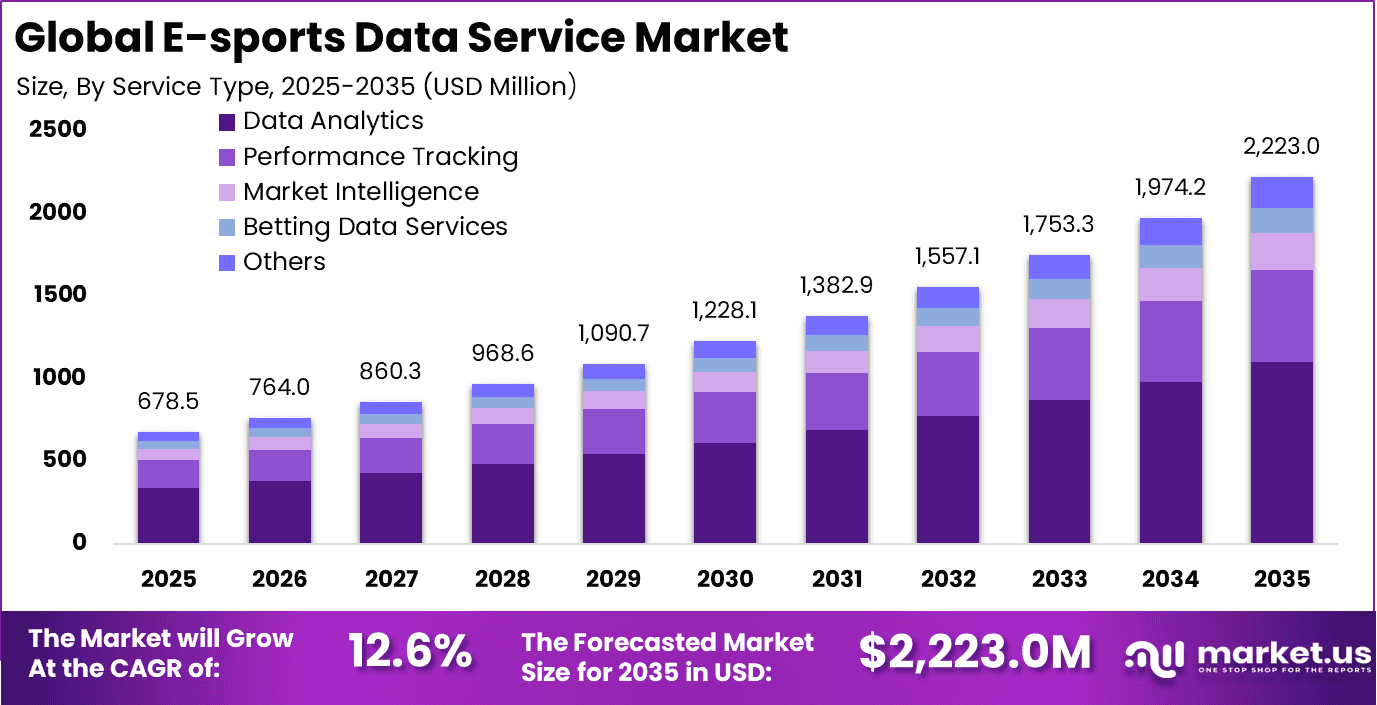
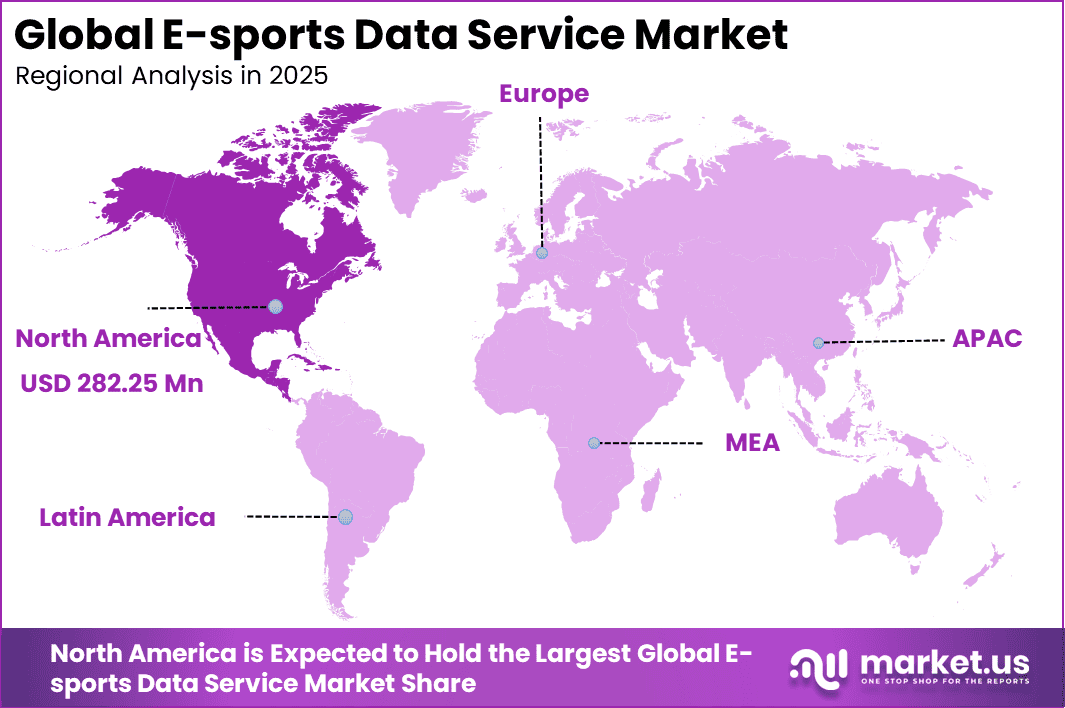
The Global E-sports Data Service Market size is expected to be worth around USD 2,223.0 million by 2035, from USD 678.5 million in 2025, growing at a CAGR of 12.6% during the forecast period from 2025 to 2035. North America held a dominant market position, capturing more than a 41.6% share, holding USD 282.2 million in revenue.
The E-sports Data Service Market refers to platforms and services that collect, process, analyze, and distribute structured data generated from competitive gaming activities. This includes match statistics, player performance metrics, team analytics, audience behavior, and broadcast related data. These services support teams, leagues, media platforms, betting ecosystems, and sponsors by converting raw gameplay and viewing data into actionable insights.
As esports matures into a structured digital sport, data services are treated as essential infrastructure rather than optional tools. E-sports data services operate across online competitions, live tournaments, and streaming platforms. Data is generated continuously from games, APIs, broadcasts, and user interactions. Industry observations indicate that more than 75% of professional esports teams now rely on data driven performance analysis to guide training and strategy.
One of the main driving factors is the professionalization of esports competition. Teams are under pressure to optimize player performance, drafting decisions, and in game tactics. Data services provide objective performance benchmarks that reduce reliance on intuition alone. This shift toward measurable outcomes has increased demand for high quality analytics.
For instance, in June 2025, Dojo Madness launched Shadow.LoL, a SaaS analytics tool for pro League of Legends teams with advanced visualizations. Backed by Team Liquid’s Steve Arhancet, it moves teams beyond spreadsheets to data-driven strategies for competitive edge.
Demand for esports data services is strongest among professional teams, tournament organizers, and content platforms. These stakeholders manage large volumes of performance and engagement data. Internal industry analysis suggests that data guided training programs can improve team win rates by more than 15% over time. This competitive advantage sustains demand at the top tier of esports.
Key Takeaway
- In 2025, the Data Analytics segment led the Global E-sports Data Service Market with a 49.7% share, supported by demand for performance insights and competitive analysis.
- In 2025, Viewership Data accounted for 37.2% of the market, reflecting the importance of audience measurement and engagement tracking.
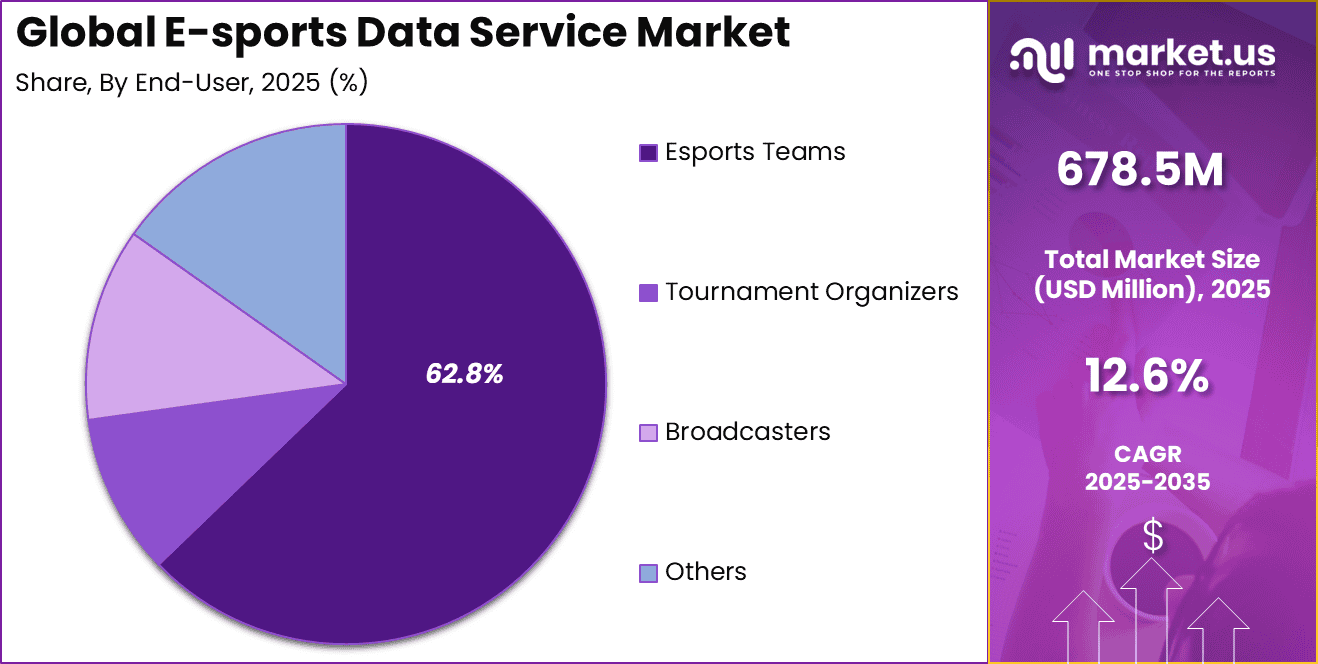
- In 2025, Esports Teams represented the largest end user group, capturing 62.8% of total market demand.
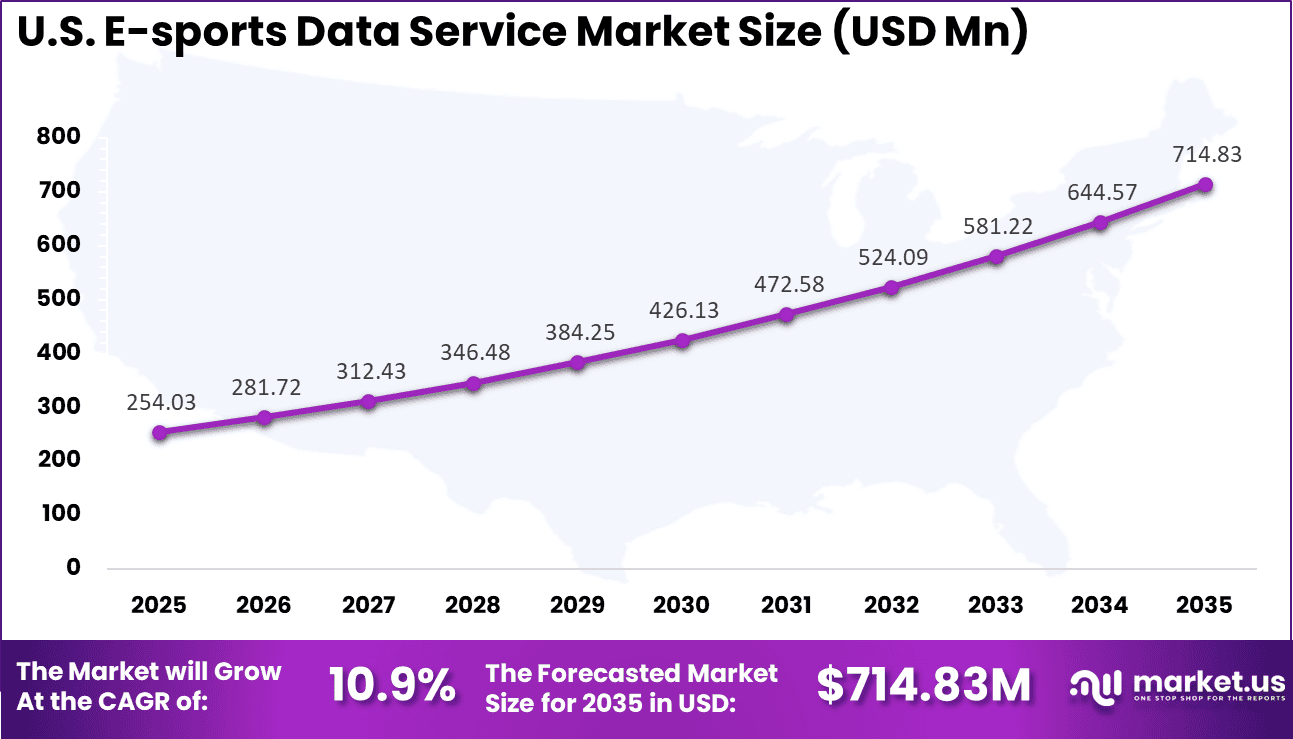
- In 2025, the US E-sports Data Service Market was valued at USD 254.03 million and recorded a CAGR of 10.9%, supported by expanding professional leagues and sponsorship activity.
- In 2025, North America held a dominant regional position, accounting for more than 41.6% of the Global E-sports Data Service Market.
Adoption Rates and Market Penetration
- Adoption has expanded beyond professional analysts, reaching casual fans through data driven storytelling and interactive viewing tools.
- Global E-sports user penetration is projected at 10.2% in 2026, reflecting steady mainstream acceptance.
- More than 80% of gaming enterprises are expected to use generative AI APIs or AI enabled applications by 2026 to manage real time data and player analytics.
- In the US, around 50% of game studios are using AI driven data tools to improve game development and live operations.
- Approximately 81.77% of esports data processing is expected to be cloud based in 2026, enabling low latency telemetry and scalable analytics.
Usage Statistics and Engagement
- Data usage remains concentrated in betting and professional training, while viewer facing statistics continue to expand.
- The betting and fantasy segment is projected to grow at a CAGR of 5.53% through 2026, supported by heavy reliance on real time data feeds.
- Around 74.3 million users participate in online E-sports betting, depending on live performance metrics for in play wagering.
- In the US, average E-sports viewing sessions last about 41 minutes, often supported by data rich second screen experiences.
- Leading analytics platforms now track more than 81,000 tournaments and 343,000 matches, providing extensive historical data for competitive benchmarking.
Drivers Impact Analysis
Key Driver Impact on CAGR Forecast (~%) Geographic Relevance Impact Timeline Rapid growth of professional esports leagues and tournaments +3.2% North America, Asia Pacific Short to medium term Increasing demand for real-time match statistics and analytics +2.8% Global Medium term Expansion of esports betting and fantasy gaming platforms +2.4% Europe, North America Medium term Rising media rights and broadcasting partnerships +2.1% North America, Europe Medium term Growing sponsorship and brand engagement analytics needs +1.7% Global Medium to long term Restraint Impact Analysis
Key Restraint Impact on CAGR Forecast (~%) Geographic Relevance Impact Timeline Limited standardization of esports data formats -2.4% Global Medium term Dependency on publisher partnerships for official data access -2.1% Global Short to medium term Data rights and intellectual property constraints -1.9% Europe, North America Medium term Volatility in game popularity and tournament cycles -1.6% Global Medium term Infrastructure gaps in emerging esports markets -1.3% Asia Pacific, Latin America Medium to long term Investor Type Impact Matrix
Investor Type Growth Sensitivity Risk Exposure Geographic Focus Investment Outlook Esports data analytics providers Very High Medium North America, Europe Scalable subscription revenue Media and broadcasting technology firms High Medium Global Data-driven viewer engagement Betting and fantasy gaming platforms High Medium to High Europe, North America Revenue optimization via analytics Private equity firms Medium Medium North America, Europe Consolidation of niche data vendors Venture capital investors High High North America Innovation in real-time data services Technology Enablement Analysis
Technology Enabler Impact on CAGR Forecast (~%) Primary Function Geographic Relevance Adoption Timeline Real-time data capture and API distribution platforms +3.4% Instant match statistics delivery Global Short to medium term AI-driven performance analytics and predictive modeling +2.9% Advanced insights North America, Europe Medium term Cloud-based scalable data infrastructure +2.5% High-volume data processing Global Medium term Automated video tagging and event recognition tools +2.0% Enhanced content analytics Global Medium to long term Data visualization and dashboard platforms +1.8% Commercial and team analysis Global Long term By Service Type Analysis
By service type, data analytics accounted for 49.7% of adoption. Analytics services transform raw match and audience data into structured insights. These insights are used to evaluate performance trends, strategy effectiveness, and competitive gaps. Teams and organizers rely on analytics to gain measurable advantages.
Advanced analytics tools support pattern recognition across large datasets. Player movements, reaction timing, and tactical decisions are analyzed in detail. This enables coaching staff to refine training and in game strategies. Over time, analytics driven preparation has become standard practice.
Demand has also increased for predictive insights. Analytics services are used to forecast performance outcomes and identify risk factors. This improves planning and resource allocation. As competition intensifies, analytics remains the most valuable service category.
For Instance, in January 2026, Mobalytics rolled out new analytics tools for League of Legends Season 2026, including updated item guides and performance trackers. These features help players analyze builds and stats in real-time, boosting their ranks with data-driven tweaks. The platform’s focus on personalized insights keeps it at the forefront of esports analytics growth.
By Data Source Analysis
By data source, viewership data represented 37.2% of usage. Viewership metrics include audience size, engagement duration, and geographic distribution. This data is critical for monetization and content planning. Broadcasters and organizers use it to optimize schedules and formats.
Viewership data also supports sponsor alignment. Brands evaluate audience demographics and engagement quality before partnerships. Accurate data improves campaign effectiveness and return expectations. This has increased reliance on standardized viewership measurement.
Real time audience tracking has added further value. Live data allows adjustments during broadcasts. Content pacing and interaction features can be refined instantly. As streaming platforms evolve, viewership data continues to gain importance.
For instance, in December 2025, Esports Charts updated its top games list for 2026 viewership trends. Tracking peaks for Mobile Legends and CS2, the reports provide organizers and sponsors with key metrics on live engagement, driving decisions for streaming and marketing strategies.
By End-User Analysis
By end user, e-sports teams accounted for 62.8% of demand. Teams use data services to improve competitive performance and player development. Detailed match analysis supports strategic planning. This has become essential in high level tournaments.
Data services also assist in talent evaluation. Player consistency, adaptability, and fatigue indicators are monitored over time. Teams use this data to guide roster decisions. Objective metrics reduce reliance on subjective assessment.
Operational planning has also benefited. Teams analyze travel schedules, practice loads, and recovery patterns. This improves long term performance sustainability. As professional standards rise, teams remain the primary users of data services.
For Instance, in September 2025, GRID acquired Bayes Esports assets after its insolvency, bolstering data feeds for teams in LoL, Valorant, and CS2. As official partner for ESL FACEIT and Riot, GRID now offers teams reliable real-time stats for scouting and in-game tactics, filling a key gap in the market.
Regional Analysis
North America accounted for 41.6% of market adoption, supported by strong e-sports infrastructure and high digital media consumption. The region hosts major leagues, tournaments, and streaming audiences. Data driven decision making is well established across teams and organizers.
For instance, in March 2025, ESL FACEIT Group acquired Mobalytics, the Santa Monica-based analytics platform, strengthening North America’s dominance in E-sports Data Services. This strategic move enhances data-driven player performance tools for games like League of Legends and Marvel Rivals. Mobalytics operates independently while integrating with ESL FACEIT’s ecosystem, deepening ties with developers and organizations.
The market for E-sports Data Service within the U.S. is growing tremendously and is currently valued at USD 254.03 million; the market has a projected CAGR of 10.9%. The market is growing rapidly due to the strong growth of professional leagues, franchised tournaments, and large scale live streaming ecosystems.
Rising demand for real time match analytics, player performance insights, and audience engagement metrics from teams, broadcasters, and betting platforms is accelerating adoption. Increased investment from media companies, sportsbooks, and brand sponsors, along with advanced AI-driven data analytics and widespread high speed internet access, continues to strengthen market momentum across the U.S.
For instance, in February 2026, Esports One, headquartered in Santa Monica, California, continues to drive U.S. dominance in the E-sports Data Service Market through its innovative fantasy esports platform powered by computer vision, machine learning, and custom datasets. The company enables real-time player performance tracking and fan engagement across major titles.
Emerging Trends Analysis
An emerging trend in the e-sports data service market is the use of artificial intelligence and machine learning for predictive insights. These models analyse historical and in-game data to forecast performance trends, player behaviour patterns, and match outcomes. Predictive analytics enhances both competitive strategy for teams and engagement features for fans.
Another trend is the integration of fan generated and social engagement data. Platforms capture viewer sentiment, interaction patterns, and social metrics to deliver richer profiles of audience behaviour. This data helps tailor content and personalise experiences, increasing commercial monetisation opportunities.
Growth Factors Analysis
One of the key growth factors for the e-sports data service market is expanding global audience reach. E-sports viewership continues to grow across regions, age groups, and platforms, increasing the value of structured data insights for content producers and advertisers. Larger audiences drive greater commercial interest in data driven enhancements.
Another growth factor is institutional investment in e-sports infrastructure. Organisations such as universities, professional leagues, and broadcast networks are formalising competitive leagues and data usage frameworks. This institutionalisation supports stable demand for reliable analytics and data services as foundational components of e-sports operations.
Opportunity Analysis
A significant opportunity in the e-sports data service market lies in expansion of analytics-led fan engagement tools. Platforms that deliver personalised insights, predictive commentary, and interactive dashboards improve the spectator experience. These features can be embedded in streaming services, mobile applications, and event interfaces to deepen viewer involvement and increase time-on-platform.
Another opportunity is integration with fantasy esports, betting ecosystems, and interactive gaming experiences. Data services that support real-time odds, performance projections, and dynamic metrics add commercial value to fantasy and wagering platforms. Regulated betting environments, where permitted, create additional demand for reliable e-sports data feeds.
Challenge Analysis
A major challenge for the e-sports data service market is maintaining intellectual property compliance and rights management. Game publishers often control access to competitive data and broadcast feeds. Negotiating access rights and ensuring compliance with publisher policies requires careful legal and technical work. Data providers must align with publisher guidelines to avoid disruptions.
Another challenge is scalability across global events and languages. E-sports tournaments operate in different regions with varying infrastructure, broadcast standards, and data formats. Scaling consistent data services across regions while managing local variability remains complex.
Key Market Segments
By Service Type
- Data Analytics
- Performance Tracking
- Market Intelligence
- Betting Data Services
- Others
By Data Source
- In-game Data
- Player Statistics
- Match Results
- Viewership Data
- Others
By End-User
- Esports Teams
- Tournament Organizers
- Broadcasters
- Others
Key Regions and Countries
North America
- US
- Canada
Europe
- Germany
- France
- The UK
- Spain
- Italy
- Russia
- Netherlands
- Rest of Europe
Asia Pacific
- China
- Japan
- South Korea
- India
- Australia
- Singapore
- Thailand
- Vietnam
- Rest of APAC
Latin America
- Brazil
- Mexico
- Rest of Latin America
Middle East & Africa
- South Africa
- Saudi Arabia
- UAE
- Rest of MEA
Key Players Analysis
Data analytics and performance-focused platforms such as Mobalytics, Esports One, and GRID play a central role in the e-sports data service market. Their services include real-time match data, player performance metrics, and advanced analytics dashboards. These platforms are widely used by teams, coaches, and fantasy gaming operators. Demand is driven by the need for data-driven strategy and competitive insights across professional leagues.
Betting and media-focused data providers such as Bayes Esports, Abios, and PandaScore specialize in structured feeds for sportsbooks and media platforms. Statscore and Esports Charts focus on audience metrics and engagement tracking. These players benefit from growing esports betting markets and sponsorship valuation needs. Adoption is strong in Europe and North America where data monetization is advanced.
Market intelligence and engagement analytics firms such as Newzoo and Blinkfire provide audience insights and brand impact measurement. Gfinity and Esports Insider contribute through content and ecosystem data. Emerging players such as NGame expand regional coverage. Other vendors enhance competition and innovation, supporting steady growth of esports data services globally.
Top Key Players in the Market
- Esports One
- Mobalytics
- Shadow
- Grid
- Bayes Esports
- Abios
- PandaScore
- Esports Charts
- Newzoo
- Statscore
- Blinkfire
- Gfinity
- NGame
- Esports Insider
- Others
Recent Developments
- In September 2025, GRID snapped up Bayes Esports’ intellectual property assets after the company’s financial woes, adding advanced data capabilities for titles like League of Legends and Valorant. This acquisition strengthens GRID’s role as a top data provider for betting and media, especially with partnerships like ESL FACEIT Group.
- In March 2025, PandaScore partnered with Playbook Engineering via Sporting Solutions to bring esports odds and data to more sportsbooks. This integration lets operators offer competitive betting on popular games, tapping into rising demand and expanding PandaScore’s reach.
Report Scope
Report Features Description Market Value (2025) USD 678.5 Mn Forecast Revenue (2035) USD 2,223 Mn CAGR(2025-2035) 12.6% Base Year for Estimation 2024 Historic Period 2020-2024 Forecast Period 2025-2035 Report Coverage Revenue forecast, AI impact on Market trends, Share Insights, Company ranking, competitive landscape, Recent Developments, Market Dynamics and Emerging Trends Segments Covered By Service Type (Data Analytics, Performance Tracking, Market Intelligence, Betting Data Services, Others), By Data Source (In-game Data, Player Statistics, Match Results, Viewership Data, Others), By End-User (Esports Teams, Tournament Organizers, Broadcasters, Others) Regional Analysis North America – US, Canada; Europe – Germany, France, The UK, Spain, Italy, Russia, Netherlands, Rest of Europe; Asia Pacific – China, Japan, South Korea, India, New Zealand, Singapore, Thailand, Vietnam, Rest of Latin America; Latin America – Brazil, Mexico, Rest of Latin America; Middle East & Africa – South Africa, Saudi Arabia, UAE, Rest of MEA Competitive Landscape Esports One, Mobalytics, Shadow, Grid, Bayes Esports, Abios, PandaScore, Esports Charts, Newzoo, Statscore, Blinkfire, Gfinity, NGame, Esports Insider, Others Customization Scope Customization for segments, region/country-level will be provided. Moreover, additional customization can be done based on the requirements. Purchase Options We have three license to opt for: Single User License, Multi-User License (Up to 5 Users), Corporate Use License (Unlimited User and Printable PDF)  E-sports Data Service MarketPublished date: Feb. 2026add_shopping_cartBuy Now get_appDownload Sample
 -
-
- Esports One
- Mobalytics
- Shadow
- Grid
- Bayes Esports
- Abios
- PandaScore
- Esports Charts
- Newzoo
- Statscore
- Blinkfire
- Gfinity
- NGame
- Esports Insider
- Others
Our Clients

- 177404
- Feb. 2026