Global Dock Scheduling Software Market Size, Share and Analysis By Component (Solution, Services), By Deployment (Cloud-based, On-premises), By Enterprise Size (Large Enterprises, Small & Mid-Sized Enterprises (SMEs), By Application (Warehouse Management, Transportation Management, Yard Management, Cross-docking Operations, Others), By End-use (Logistics and Transportation, Retail and e-commerce, Manufacturing, Food and Beverage, Healthcare and Pharmaceuticals, Wholesale and Distribution, Others), By Regional Analysis, Global Trends and Opportunity, Future Outlook By 2025-2035
- Published date: March 2026
- Report ID: 181142
- Number of Pages: 290
- Format:
-
keyboard_arrow_up
Quick Navigation
Report Overview
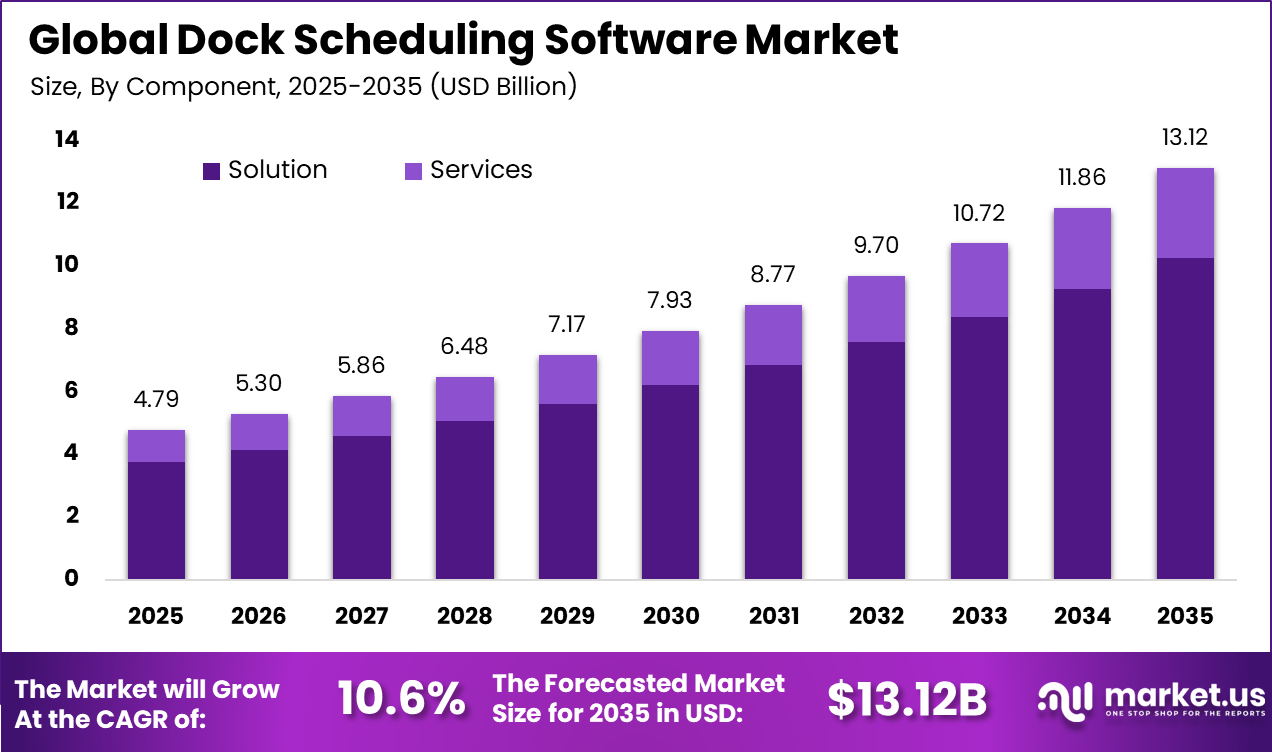
The Global Dock Scheduling Software Market size is expected to be worth around USD 13.12 billion by 2035, from USD 4.79 billion in 2025, growing at a CAGR of 10.6% during the forecast period from 2025 to 2035. North America held a dominant market position, capturing more than a 41.67% share, holding USD 1.99 billion in revenue.
The Dock Scheduling Software Market refers to digital platforms used by warehouses, distribution centers, and manufacturing facilities to manage and coordinate the arrival and departure of trucks at loading docks. These software systems allocate specific time slots and dock doors for inbound and outbound shipments, ensuring that trucks arrive at the correct dock at the right time. This structured scheduling reduces congestion, improves resource utilization, and helps logistics teams maintain smooth warehouse operations.
According to industry data, inefficient dock operations remain a major challenge in logistics facilities. Drivers often experience average waiting times of around 2.5 hours at warehouses before loading or unloading begins, creating delays across the supply chain. Digital dock scheduling solutions help reduce these inefficiencies by coordinating arrival times and dock capacity, while advanced scheduling tools can improve loading and unloading performance by nearly 30% through better operational planning.
One major factor driving the adoption of dock scheduling software is the growing complexity of global logistics operations. Warehouses often manage dozens or even hundreds of truck arrivals each day, and uncoordinated arrivals can create bottlenecks, delays, and inefficient use of dock resources. By assigning trucks to specific time windows, dock scheduling software helps maintain a balanced flow of freight and reduces operational disruption.
Demand for dock scheduling software is rising as logistics companies adopt digital tools to improve warehouse productivity and supply chain coordination. Large distribution centers handling high freight volumes require precise scheduling systems to manage incoming and outgoing shipments effectively. Digital scheduling platforms enable carriers to reserve dock time slots online, improving coordination between warehouses and transportation partners.
For instance, in October 2025, Infor released a cloud dock scheduler with embedded ESG reporting for sustainable operations. North American food distributors embraced it for 15% reduced idling emissions, aligning efficiency gains with green mandates prevalent in U.S. logistics networks.
Key Takeaway
- In 2025, the Solution segment led the Dock Scheduling Software Market, accounting for 78.26% of total share.
- In 2025, Cloud based deployment dominated with a 64.35% market share.
- In 2025, Large Enterprises represented the primary customer segment, capturing 67.8% of overall demand.
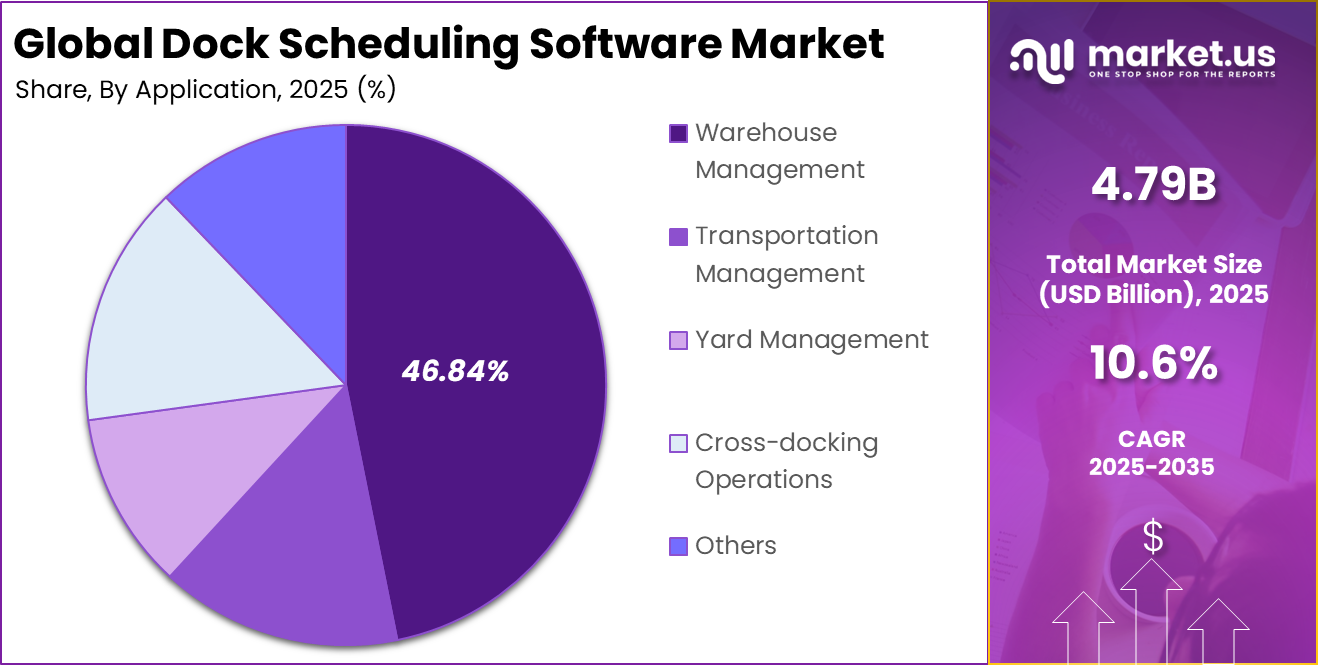
- In 2025, Warehouse Management emerged as the leading application area, contributing 46.84% of the market.
- In 2025, the Logistics and Transportation sector held the largest end use share at 34.31%.
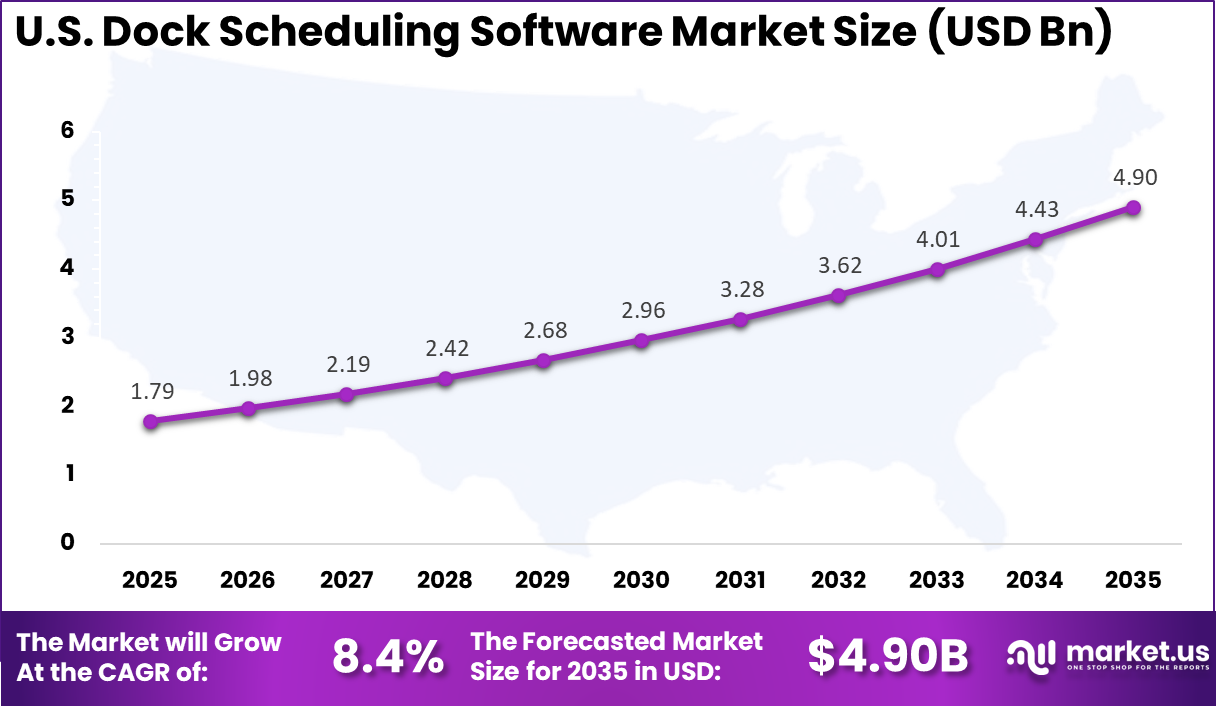
- In 2025, North America secured a 41.67% regional share, while the U.S. market reached USD 1.79 billion and recorded a growth rate of 8.4%.
- Users report a 90% reduction in time spent on phone calls, emails, and fax based coordination after implementing digital scheduling systems.
- Average annual savings related to scheduling processes reach approximately USD 57,000.
- Eliminating detention fees generates savings of nearly USD 1,150 per month, as about 12% of loads typically face excessive wait times exceeding 2 hours.
- Automated systems help manage no show rates of around 5%, improving dock utilization and operational flow.
- More than 60,000 carriers and 2,500 facilities use digital appointment platforms, with over 7 million appointments scheduled annually.
Role of Generative AI
According to research, generative AI is increasingly improving dock scheduling operations by analyzing multiple real time logistics variables simultaneously. These systems process factors such as traffic conditions, shipment arrival patterns, warehouse capacity, and weather updates to determine the most efficient dock assignments and delivery windows. By evaluating large volumes of operational data within seconds, generative AI enables more accurate scheduling decisions.
Early adopters have reported wait time reductions of approximately 25% to 30%, while maintaining the ability to manage increasing shipment volumes more efficiently. Generative AI platforms are also enhancing communication and reporting capabilities within logistics operations. Automated systems can generate operational reports, analyze scheduling patterns, and communicate directly with truck drivers through conversational chat interfaces.
Drivers receive instant notifications about delays, dock availability, or revised arrival times, which helps minimize idle time and congestion at warehouse facilities. Industry estimates indicate that nearly 40% of modern dock scheduling platforms now integrate AI driven features that identify operational patterns and inefficiencies that traditional systems may overlook, enabling logistics teams to improve overall coordination and facility productivity.
By Component
Solutions account for 78.26% of the market, reflecting the strong reliance on integrated software platforms that manage dock appointments, shipment coordination, and resource allocation. These systems enable warehouse operators to schedule inbound and outbound deliveries efficiently while reducing waiting times for trucks. Automated scheduling tools also help coordinate activities among carriers, warehouse teams, and logistics managers.
The dominance of solution platforms is also supported by their ability to provide real time visibility into dock availability and shipment schedules. Advanced analytics tools allow organizations to evaluate operational performance and identify inefficiencies within loading and unloading processes. As logistics operations become increasingly data driven, dock scheduling solutions remain essential for efficient warehouse management.
For Instance, in February 2026, Blue Yonder rolled out a new solution update that sharpens dock booking with AI predictions. This move helps warehouses assign doors faster by spotting patterns in truck arrivals, cutting down on empty slots. Teams now handle busy days with less stress, as the tool pulls in data from carriers to keep flows tight. It’s a practical step that fits right into core operations without overhauling setups.
By Deployment
Cloud based deployment represents 64.35% of the market, indicating strong enterprise preference for scalable and centralized scheduling platforms. Cloud systems allow organizations to manage dock appointments across multiple facilities through unified dashboards. This approach enables logistics teams to monitor scheduling activities from different geographic locations.
Cloud deployment also supports integration with transportation management and warehouse management systems. Organizations benefit from improved accessibility and reduced infrastructure costs. As digital supply chain platforms expand, cloud based dock scheduling software continues to gain widespread adoption.
For instance, in March 2026, Oracle launched a cloud upgrade that lets managers access schedules from any site. It syncs across devices so remote teams can check in without delays, perfect for spread-out operations. The shift to cloud here means quicker rollouts and updates that match growing needs. Firms find it simple to scale up during peaks without extra hardware.
By Enterprise Size
Large enterprises account for 67.8% of market adoption due to the scale and complexity of their logistics operations. These organizations manage large distribution networks that require coordinated scheduling across multiple warehouses and transportation partners. Dock scheduling platforms help consolidate operational data and improve coordination across these networks.
Large companies also rely on analytics tools to optimize warehouse performance and reduce transportation delays. By implementing automated scheduling systems, enterprises can improve resource utilization and streamline delivery operations. As global supply chains continue to expand, large enterprises remain the primary adopters of dock scheduling technologies.
For Instance, in January 2026, Epicor Software released tools for enterprise-wide integration. Big firms use it to unify dock data with ERP, cutting manual checks. The focus on handling heavy traffic keeps large users ahead, as they layer in analytics for smarter decisions. Growth here comes from fitting their massive workflows just right.
By Application
Warehouse management represents 46.84% of the market application segment because dock scheduling plays a critical role in maintaining efficient warehouse operations. Scheduling software enables warehouse managers to plan loading and unloading activities based on available dock capacity and delivery schedules. This improves workflow coordination within warehouse facilities.
Efficient dock scheduling also reduces congestion and improves turnaround times for transportation vehicles. By aligning warehouse operations with delivery schedules, organizations can improve inventory handling and distribution efficiency. As warehouses adopt more advanced digital management systems, dock scheduling software remains a key operational tool.
For Instance, in March 2026, Zebra Technologies updated its warehouse app for dock-to-stock flows. It matches loads to space and staff, avoiding jams at receiving ends. Managers tweak in real time, which boosts throughput in tight quarters. This keeps warehouse apps central by solving everyday pileups that slow the floor.
By End Use
The logistics and transportation sector accounts for 34.31% of market adoption due to its reliance on efficient cargo movement and delivery coordination. Logistics companies manage large volumes of shipments that must be synchronized with warehouse operations and delivery schedules. Dock scheduling systems help carriers coordinate arrival times and reduce delays at distribution facilities.
Transportation providers also benefit from improved route planning and reduced idle time through structured scheduling systems. These platforms allow logistics companies to monitor shipment progress and maintain better communication with warehouse operators. As freight transportation networks expand, logistics organizations increasingly adopt dock scheduling software to enhance operational efficiency.
For Instance, in December 2025, Transporeon Group expanded its transport network tool. Logistics ops book across hubs, factoring in routes and loads for tight timing. Drivers check in digitally, which trims detention time. It’s built for the road-heavy side, helping chains run leaner amid tight schedules.
By Region
North America holds 41.67% of the market share due to strong adoption of digital logistics technologies and advanced supply chain infrastructure. Companies in the region actively invest in software platforms that improve warehouse coordination and transportation planning. The presence of large logistics providers and distribution networks further supports regional market development.
For instance, in November 2025, Descartes Systems expanded its dock scheduling platform through a partnership with three leading Canadian 3PLs. The collaboration introduced cross-border appointment syncing, cutting detention fees by 20% and reinforcing North America’s edge in seamless U.S.-Canada supply chain coordination.
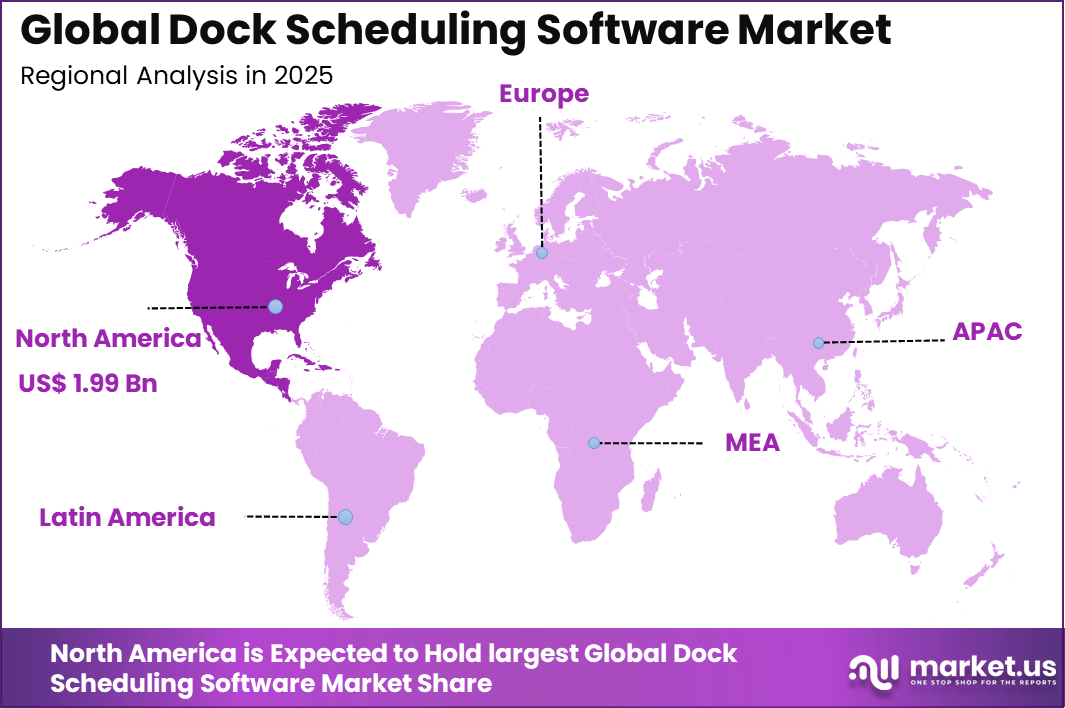
Within North America, the United States contributes USD 1.79 billion with a growth rate of 8.4%. The country’s extensive logistics infrastructure and high freight volumes have increased demand for automated scheduling platforms. Continued investment in digital supply chain management systems is expected to sustain market growth across the region.
For instance, in January 2026, Blue Yonder rolled out AI-powered dock scheduling enhancements that cut appointment conflicts by 30% for major U.S. distributors. This upgrade integrates real-time carrier updates with warehouse capacity, helping North American logistics firms handle peak season surges more smoothly while boosting on-time dock utilization.
Growth Factors
One major growth factor driving the dock scheduling software market is the expansion of global logistics and e-commerce operations. Warehouses and distribution centers handle increasing volumes of inbound and outbound shipments, which creates pressure on loading dock infrastructure. Scheduling software allows facilities to manage truck arrivals efficiently, improving throughput and reducing operational bottlenecks.
Another growth factor is the need to reduce truck dwell times and detention costs. When trucks arrive simultaneously or without prior scheduling, congestion at warehouse docks can cause delays and operational inefficiencies. Dock scheduling platforms ensure trucks arrive during assigned time slots, improving dock utilization and reducing waiting time for drivers.
Emerging Trends
One emerging trend in the dock scheduling software market is the adoption of cloud-based scheduling platforms. Cloud deployment allows logistics partners such as carriers, suppliers, and warehouse operators to access scheduling systems remotely and coordinate appointments in real time. This digital connectivity enhances collaboration across supply chain stakeholders.
Another trend is the integration of dock scheduling software with broader logistics management systems such as warehouse management systems, transportation management systems, and yard management systems. These integrations provide a unified view of logistics operations and enable better planning of transportation and warehouse activities.
Key Market Segments
By Component
- Solution
- Standalone Dock Scheduling Software
- Integrated Supply Chain Management Software
- Warehouse Management System (WMS) Integrated
- Transportation Management System (TMS) Integrated
- Services
By Deployment
- Cloud-based
- On-premises
By Enterprise Size
- Large Enterprises
- Small & Mid-Sized Enterprises (SMEs)
By Application
- Warehouse Management
- Transportation Management
- Yard Management
- Cross-docking Operations
- Others
By End-use
- Logistics and Transportation
- Retail and e-commerce
- Manufacturing
- Food and Beverage
- Healthcare and Pharmaceuticals
- Wholesale and Distribution
- Others
Key Regions and Countries
North America
- US
- Canada
Europe
- Germany
- France
- The UK
- Spain
- Italy
- Russia
- Netherlands
- Rest of Europe
Asia Pacific
- China
- Japan
- South Korea
- India
- Australia
- Singapore
- Thailand
- Vietnam
- Rest of APAC
Latin America
- Brazil
- Mexico
- Rest of Latin America
Middle East & Africa
- South Africa
- Saudi Arabia
- UAE
- Rest of MEA
Drivers
Growth of E-commerce Logistics
The expansion of online retail continues to increase shipment volumes across distribution centers and fulfillment hubs. Warehouses now handle frequent deliveries and pickups throughout the day, creating pressure on dock operations. Dock scheduling software helps organize truck arrivals and loading activities so facilities can maintain steady cargo movement and avoid congestion at dock doors.
Retailers and logistics providers focus on faster delivery cycles and reliable order fulfillment. Coordinated dock scheduling supports smoother inbound and outbound freight flow while reducing driver waiting time. As e-commerce networks expand across regional distribution centers, companies adopt scheduling tools to manage growing transportation activity more efficiently.
For instance, in January 2025, Manhattan Associates rolled out a new update to its dock management tool that syncs seamlessly with rising online order flows. Warehouses using it saw trucks move faster during peak shopping seasons, easing the rush from e-commerce surges. This helped keep delivery slots tight and operations humming without extra staff strain.
Restraint
Integration Complexity with Legacy Systems
Many warehouses still rely on older management systems that were designed before advanced scheduling platforms became common. Integrating modern dock scheduling software with these legacy systems can create technical challenges. Data compatibility issues and system customization often require additional time and technical support during the deployment process.
Operational teams also face difficulties when connecting scheduling tools with warehouse management and transportation systems. If systems do not communicate effectively, planning accuracy can decline. This integration complexity slows adoption in some facilities, especially where existing technology infrastructure has limited flexibility.
For instance, in February 2026, Infor faced pushback when clients struggled to link their dock software with decades-old warehouse trackers. The setup needed custom coding sessions that stretched weeks, leaving some sites stuck with manual logs. IT crews worked overtime to bridge the gaps without halting daily loads.
Opportunities
Expansion of Smart Warehousing
Warehouses continue to invest in digital tools that improve coordination across logistics operations. Smart warehousing initiatives encourage the use of connected systems that manage inventory, transportation, and dock activities in a unified environment. Dock scheduling software supports these developments by improving visibility of truck movements and loading schedules.
Modern distribution centers aim to create data driven operations that respond quickly to supply chain changes. Scheduling platforms help managers align dock availability with workforce planning and shipment priorities. As automated warehouses and connected logistics networks grow, scheduling systems become valuable tools for maintaining organized freight handling.
For instance, in March 2026, Zebra Technologies added IoT tags to its scheduling app, letting smart shelves signal dock needs ahead. A large facility tested it and gained visibility across zones, speeding up restocking cycles. The move highlighted how such tools fit into broader warehouse upgrades.
Challenges
Resistance to Operational Change
Some warehouse teams remain comfortable with traditional scheduling methods such as phone calls, spreadsheets, or manual appointment logs. Introducing new software systems requires adjustments in daily routines, which can lead to hesitation among employees and operational managers.
External carriers may also resist structured appointment systems if they are unfamiliar with digital booking platforms. Training staff and partners to follow new scheduling procedures takes time and consistent communication. Without proper change management, organizations may struggle to gain full benefits from scheduling technology.
For instance, in September 2025, Descartes Systems launched training for their dock tool, but drivers at a key depot balked at app check-ins over clipboards. Shift leads held extra meetings to show time savings, yet adoption lagged until incentives kicked in. Old routines proved tough to shake in fast-paced yards.
Key Players Analysis
The Dock Scheduling Software Market is supported by supply chain technology providers that develop platforms for managing warehouse dock operations and transportation coordination. Blue Yonder, Descartes Systems Group, Epicor Software, Infor, Oracle, and SAP provide advanced warehouse and transportation management platforms that integrate dock scheduling with broader supply chain operations. Their systems enable real time coordination between warehouses, carriers, and distribution centers.
Industrial technology and warehouse automation providers also contribute to dock scheduling innovation. Zebra Technologies, NCR, and Roper Technologies through the IntelliTrans platform deliver data driven logistics solutions that improve yard management and shipment visibility. These systems combine IoT sensors, barcode scanning, and analytics to monitor loading dock performance.
Specialized logistics software vendors further strengthen competition in the market. C3 Solutions, Transporeon Group, Open Systems, and platforms such as 4SIGHT Connect, Exotrac, and ALC Logistics focus on cloud based dock appointment management tools. These solutions enable carriers and warehouse operators to manage inbound and outbound shipments through centralized scheduling systems.
Top Key Players in the Market
- 4SIGHT Connect
- Blue Yonder
- C3 Solutions
- Descartes Systems
- Epicor Software
- Infor
- Manhattan Associates
- Oracle
- SAP
- Zebra Technologies
- Open Systems (ProcessPro)
- ALC Logistics
- Roper Technologies (IntelliTrans)
- DataDriven Recycling
- NCR
- Exotrac
- Transporeon Group
- Others
Recent Developments
- In January 2026, Blue Yonder rolled out AI-powered dock scheduling enhancements that cut appointment conflicts by 30% for major U.S. distributors. This upgrade integrates real-time carrier updates with warehouse capacity, helping North American logistics firms handle peak season surges more smoothly while boosting on-time dock utilization.
- In March 2026, C3 Solutions launched a mobile-first dock scheduling app with geofencing alerts, adopted rapidly by 15 Midwest warehouses. Carriers now self-schedule with 95% accuracy, reducing gate wait times significantly and showcasing U.S. innovation in carrier-friendly logistics tools.
Report Scope
Report Features Description Market Value (2025) USD 4.7 Bn Forecast Revenue (2035) USD 13.1 Bn CAGR (2025-2035) 10.6% Base Year for Estimation 2025 Historic Period 2020-2024 Forecast Period 2025-2035 Report Coverage Revenue forecast, AI impact on Market trends, Share Insights, Company ranking, competitive landscape, Recent Developments, Market Dynamics and Emerging Trends Segments Covered By Component (Solution, Services), By Deployment (Cloud-based, On-premises), By Enterprise Size (Large Enterprises, Small & Mid-Sized Enterprises (SMEs), By Application (Warehouse Management, Transportation Management, Yard Management, Cross-docking Operations, Others), By End-use (Logistics and Transportation, Retail and e-commerce, Manufacturing, Food and Beverage, Healthcare and Pharmaceuticals, Wholesale and Distribution, Others) Regional Analysis North America – US, Canada; Europe – Germany, France, The UK, Spain, Italy, Russia, Netherlands, Rest of Europe; Asia Pacific – China, Japan, South Korea, India, New Zealand, Singapore, Thailand, Vietnam, Rest of Latin America; Latin America – Brazil, Mexico, Rest of Latin America; Middle East & Africa – South Africa, Saudi Arabia, UAE, Rest of MEA Competitive Landscape 4SIGHT Connect, Blue Yonder, C3 Solutions, Descartes Systems, Epicor Software, Infor, Manhattan Associates, Oracle, SAP, Zebra Technologies, Open Systems (ProcessPro), ALC Logistics, Roper Technologies (IntelliTrans), DataDriven Recycling, NCR, Exotrac, Transporeon Group, Others Customization Scope Customization for segments, region/country-level will be provided. Moreover, additional customization can be done based on the requirements. Purchase Options We have three license to opt for: Single User License, Multi-User License (Up to 5 Users), Corporate Use License (Unlimited User and Printable PDF)  Dock Scheduling Software MarketPublished date: March 2026add_shopping_cartBuy Now get_appDownload Sample
 -
-
- 4SIGHT Connect
- Blue Yonder
- C3 Solutions
- Descartes Systems
- Epicor Software
- Infor
- Manhattan Associates
- Oracle
- SAP
- Zebra Technologies
- Open Systems (ProcessPro)
- ALC Logistics
- Roper Technologies (IntelliTrans)
- DataDriven Recycling
- NCR
- Exotrac
- Transporeon Group
- Others
Our Clients

- 181142
- March 2026