


Global Digital Mining Market By Technology (Automation & Robotics, Real-time Analytics, Cybersecurity, Others), By Application (Iron & Ferro Alloys, Non-ferrous Metals, Precious Metals, Others), By Regional Analysis, Global Trends and Opportunity, Future Outlook By 2025-2035
- Published date: Mar. 2026
- Report ID: 180233
- Number of Pages: 302
- Format:
-
keyboard_arrow_up
Quick Navigation
- Report Overview
- Top Market Takeaways
- Key Insights Summary
- Drivers Impact Analysis
- Restraints Impact Analysis
- By Technology
- By Application
- Investor Type Impact Analysis
- Technology Enablement Analysis
- Key Challenges
- Emerging Trends
- Growth Factors
- Key Market Segments
- Regional Analysis
- Competitive Analysis
- Future Outlook
- Recent Developments
- Report Scope
Report Overview
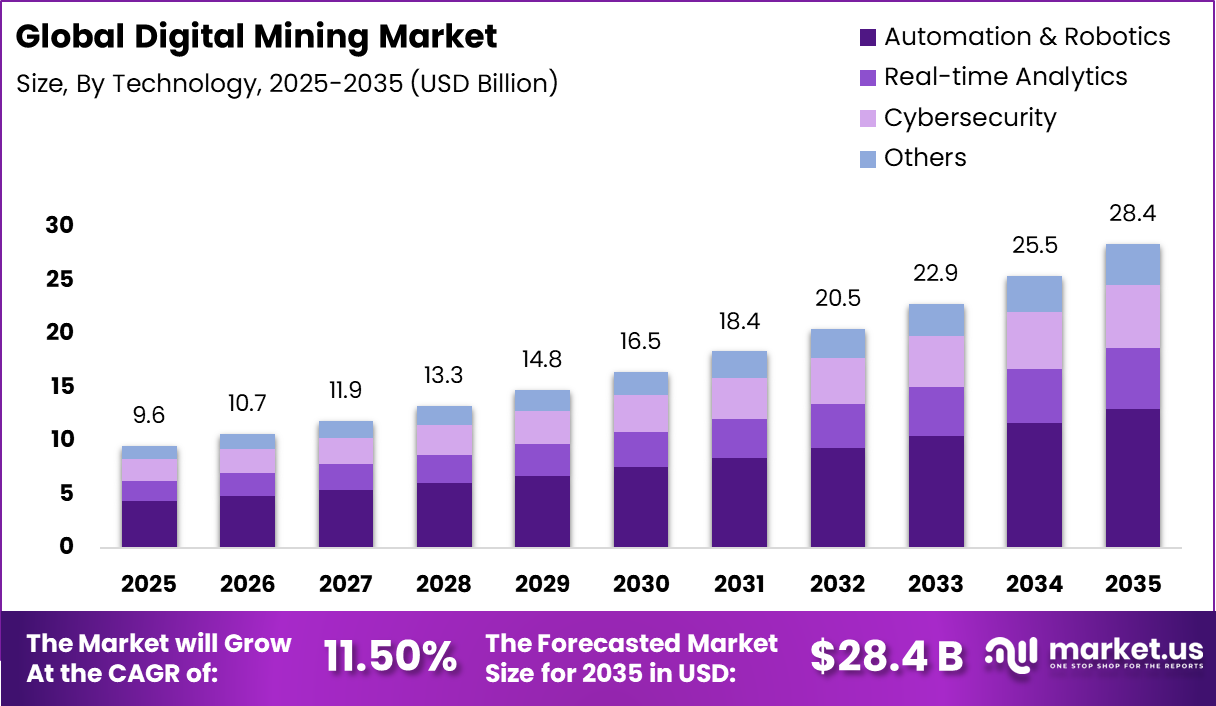
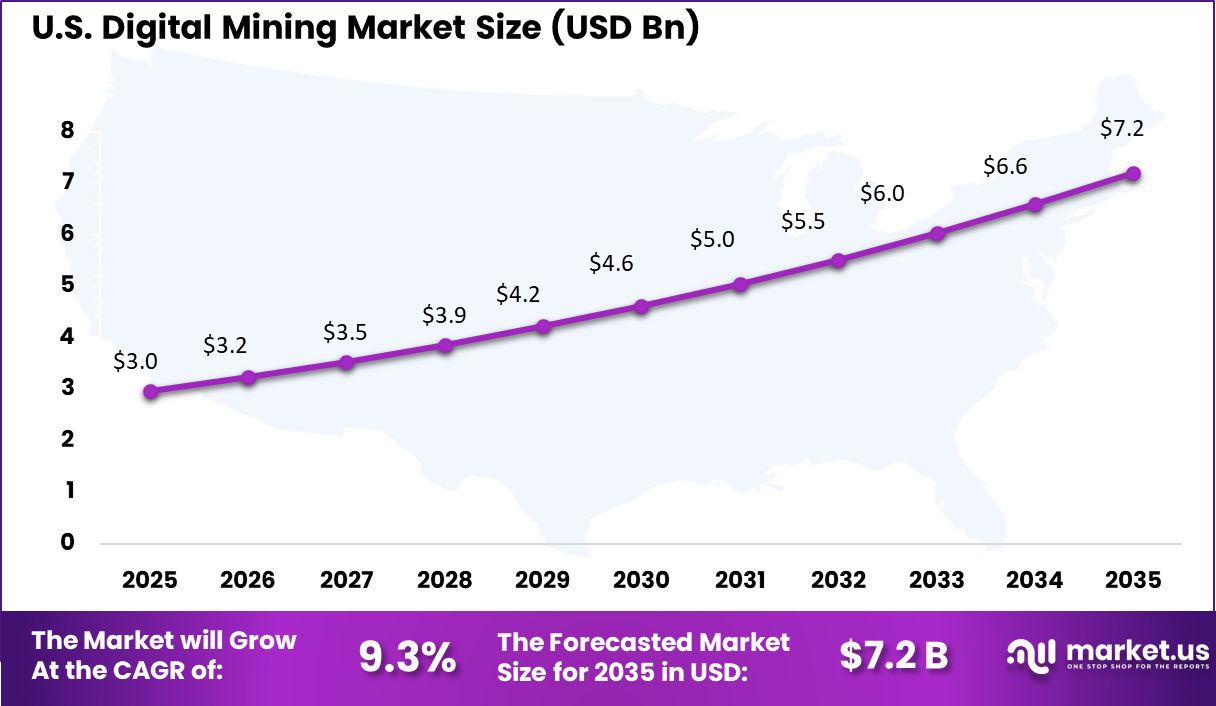
The Global Digital Mining Market generated USD 9.6 billion in 2025 and is predicted to register growth from USD 10.7 billion in 2026 to about USD 28.4 billion by 2035, recording a CAGR of 11.50% throughout the forecast span. In 2025, North America held a dominan market position, capturing more than a 36.5% share, holding USD 3.49 Billion revenue.
The digital mining market focuses on the use of advanced digital technologies to improve exploration, extraction, and operational management in the mining industry. These technologies include data analytics, connected sensors, automation systems, and digital platforms that monitor equipment and production activities.
Digital mining solutions help companies gain real time visibility into operations, allowing them to manage resources more efficiently and maintain safer working environments. The market is shaped by mining organizations seeking higher productivity and better control over complex industrial processes.
A key driving factor is the increasing need for operational efficiency in mining operations. Mining projects often involve large scale equipment, remote locations, and complex supply chains, which make coordination difficult without digital tools.
Traditional manual monitoring methods limit the ability to detect performance issues or equipment failures early. Digital systems enable continuous monitoring of machinery, production output, and environmental conditions, helping operators respond quickly to operational challenges.
Growth in the digital mining market is supported by the broader shift toward automation and data driven decision making in heavy industries. Mining companies are investing in connected infrastructure that allows machines, sensors, and control systems to share information across centralized platforms. These capabilities improve predictive maintenance and production planning.
Top Market Takeaways
- By Technology, automation & robotics dominate with 45.7% share, deploying autonomous haul trucks, drill rigs, and AI-orchestrated site optimization to minimize human exposure in hazardous zones.
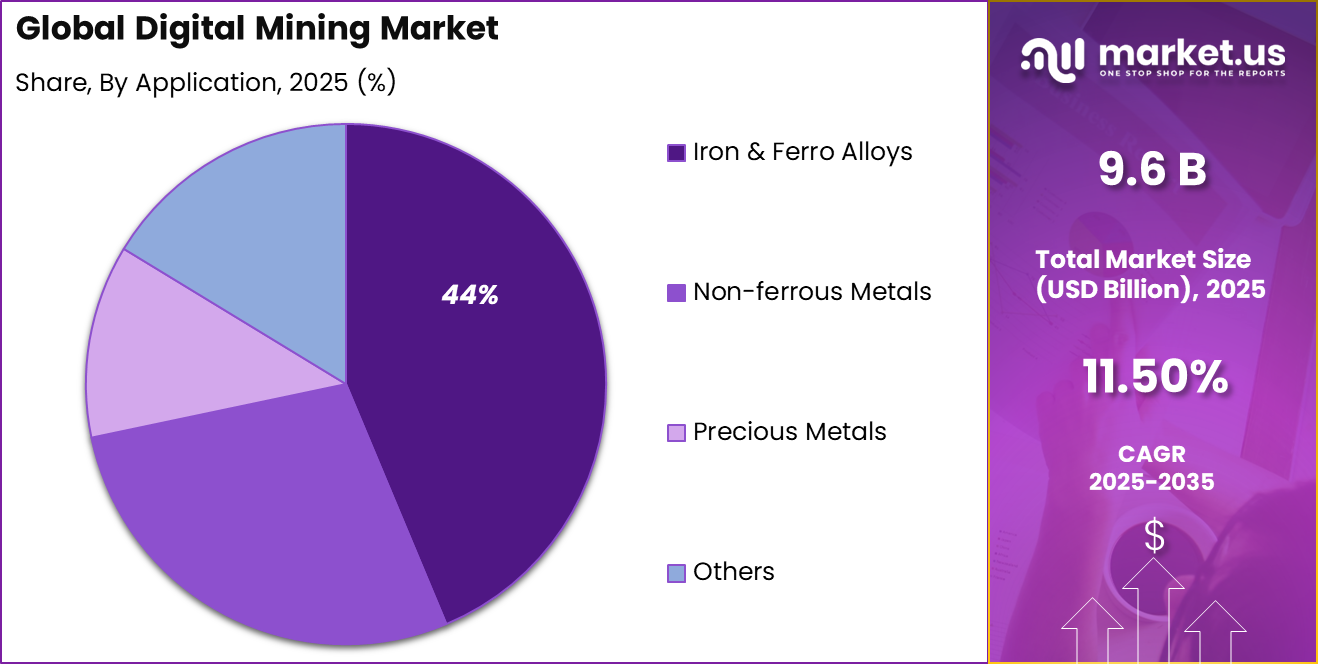
- By Application, iron & ferro alloys capture 43.7%, leveraging digital twins, predictive maintenance, and real-time ore grade analytics for steel supply chain resilience.
- Regionally, North America accounts for 36.5% global share, with the U.S. market valued at USD 2.96 billion and a CAGR of 9.3%, driven by critical minerals demand and mine modernization funding.
Key Insights Summary
- In 2025, global adoption of digital mining technologies increased by 26%, with 75% of firms utilizing cloud based AI solutions.
- The integration of digital systems improved operational efficiency by an average of 28% and reduced equipment downtime by 25% to 28%.
- Smart mining technologies, including remote monitoring, contributed to a 30% to 35% reduction in workplace safety incidents.
- Around 70% of small and medium sized mining firms postponed digital transformation in 2024, as initial investment costs often exceeded USD 2 million.
- Approximately 65% of operators reported deployment delays due to shortages of personnel with digital and technical expertise.
Drivers Impact Analysis
Key Drivers Impact on CAGR Forecast (~%) Geographic Relevance Impact Timeline Strategic Importance Increasing Adoption of Mining Automation Technologies +2.9% North America, Australia Medium to Long Term Improves operational efficiency and safety Growing Demand for Mineral and Metal Resources +2.5% Global Long Term Expands production capacity requirements Integration of Data Analytics in Mining Operations +2.2% North America, Europe Medium Term Enhances predictive maintenance and planning Expansion of Smart Mining and Connected Equipment +1.9% APAC, North America Medium to Long Term Supports real-time operational monitoring Rising Focus on Worker Safety and Operational Transparency +1.6% Global Medium Term Encourages deployment of digital monitoring systems Restraints Impact Analysis
Key Restraints Impact on CAGR Forecast (~%) Geographic Relevance Impact Timeline Market Constraint Level High Capital Investment for Digital Infrastructure -2.1% Emerging Markets Short to Medium Term Limits adoption among smaller mining firms Connectivity Challenges in Remote Mining Locations -1.7% Africa, Latin America Medium Term Slows digital integration Resistance to Technology Adoption in Traditional Operations -1.4% Global Medium Term Organizational transition barriers Data Integration Challenges Across Legacy Systems -1.1% Global Medium Term Limits interoperability between digital platforms By Technology
Automation and robotics account for 45.7% of adoption in the digital mining market, as mining operators increasingly deploy automated equipment to improve safety and operational efficiency. Robotics systems are used for drilling, hauling, and equipment inspection in hazardous mining environments. These technologies reduce direct human exposure to dangerous working conditions.
Automated systems also enable continuous operations and improved precision in resource extraction. Sensors and control software support real time monitoring of machinery performance. This combination of productivity improvement and worker safety continues to position automation and robotics as the leading technology segment.
By Application
Iron and ferro alloys represent 44% of application demand, driven by strong industrial use in steel production and infrastructure development. Mining companies apply digital technologies to monitor ore quality, optimize extraction processes, and improve resource utilization. Advanced analytics helps operators manage production more efficiently.
Digital monitoring tools also support predictive maintenance and supply chain coordination within mining operations. Improved data visibility enhances operational planning and cost control. These advantages sustain strong demand for digital mining technologies in iron and ferro alloy extraction.
Investor Type Impact Analysis
Investor Type Growth Sensitivity Risk Exposure Geographic Focus Investment Outlook Venture Capital Medium to High Medium North America, Australia Focus on mining technology startups Private Equity Medium Medium North America, Europe Infrastructure modernization investments Strategic Mining Equipment Manufacturers Medium to High Low to Medium Global Integration of digital platforms with equipment Institutional Investors Medium Medium Developed Markets Long-term resource sector investments Government-backed Infrastructure Funds Medium Low APAC, Latin America Support for sustainable mining initiatives Technology Enablement Analysis
Technology Enabler Impact on CAGR Forecast (~%) Geographic Relevance Impact Timeline Adoption Momentum Internet of Things Sensors for Equipment Monitoring +3.1% North America, Australia Medium to Long Term Enables real-time equipment tracking AI-driven Predictive Maintenance Systems +2.7% North America, Europe Medium Term Reduces operational downtime Autonomous Mining Vehicles and Machinery +2.3% Australia, North America Long Term Enhances productivity and safety Cloud-based Mining Data Platforms +1.8% Global Medium Term Supports centralized data management Digital Twin Technology for Mine Planning +1.4% Europe, North America Long Term Improves simulation and operational planning Key Challenges
- High cost of deploying digital systems and connected mining equipment
- Limited network connectivity in remote mining locations
- Difficulty in integrating digital tools with existing mining machinery
- Shortage of skilled professionals to manage advanced mining technologies
- Data security concerns when connecting mining operations to digital platforms
Emerging Trends
In the Digital Mining market, a notable trend is the growing integration of connected technologies that help operators monitor and manage mining activities with greater clarity. Mining companies are adopting digital platforms that collect information from equipment, sensors, and operational systems to create a clearer picture of what is happening across a mine site.
This approach helps teams observe production conditions, equipment performance, and environmental factors in near real time. Another visible trend is the use of remote monitoring and digital dashboards that allow engineers and supervisors to review operational data from central control rooms, improving coordination and supporting more informed operational decisions.
Growth Factors
A key growth factor in this market is the rising need to improve operational efficiency in mining activities. Mining operations involve complex processes such as drilling, hauling, and material processing, where small inefficiencies can affect productivity and cost control.
Digital systems help organisations analyse operational data, identify delays, and improve coordination between different stages of production. This ability to better understand site performance encourages companies to adopt digital tools that strengthen planning and operational visibility.
Key Market Segments
By Technology
- Automation & Robotics
- Real-time Analytics
- Cybersecurity
- Others
By Application
- Iron & Ferro Alloys
- Non-ferrous Metals
- Precious Metals
- Others
Regional Analysis
North America accounts for 36.5% of the digital mining market, supported by strong adoption of advanced technologies across large-scale mining operations. Mining companies in the region are increasingly using digital platforms to monitor equipment performance, optimize resource extraction, and improve operational visibility across sites. Demand is driven by the need to enhance productivity, reduce operational downtime, and strengthen safety management through data-driven decision systems.
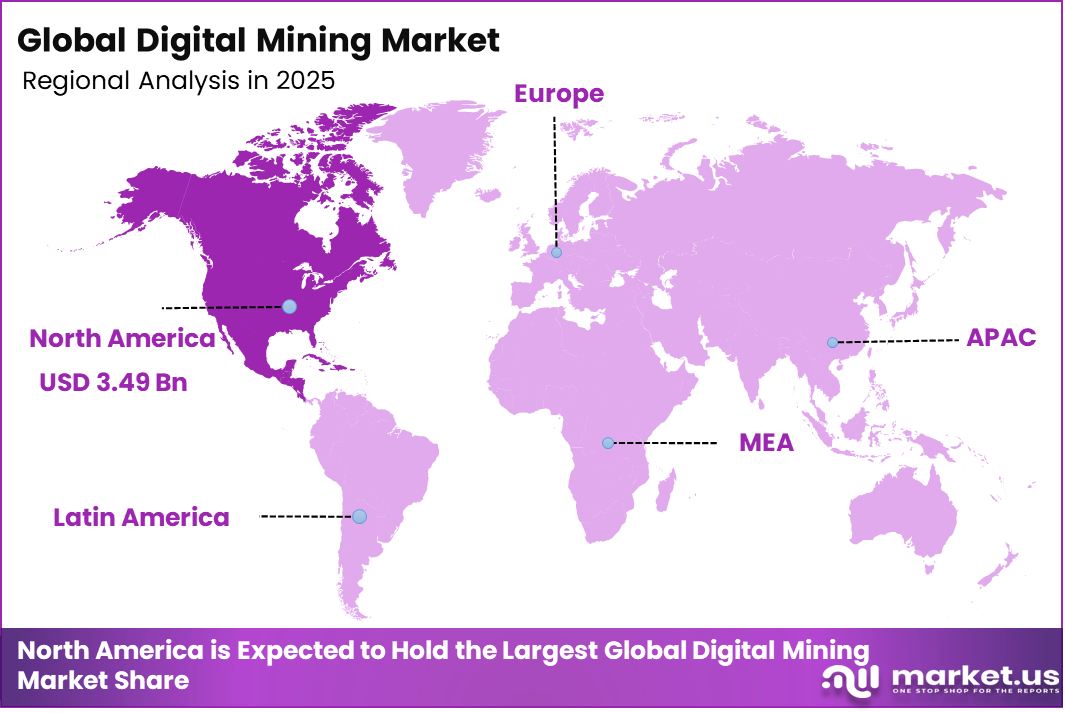
The U.S. market is valued at USD 2.96 Bn and is expanding at a CAGR of 9.3%, reflecting steady investment in automation and digital infrastructure within mining operations. Adoption is influenced by increasing use of predictive maintenance systems, real-time monitoring tools, and connected mining equipment. Growth is further supported by integration of advanced analytics, remote operations capabilities, and digital platforms that help mining operators improve efficiency and long-term resource management.
Key Regions and Countries
- North America
- US
- Canada
- Europe
- Germany
- France
- The UK
- Spain
- Italy
- Russia
- Netherlands
- Rest of Europe
- Asia Pacific
- China
- Japan
- South Korea
- India
- Australia
- Singapore
- Thailand
- Vietnam
- Rest of APAC
- Latin America
- Brazil
- Mexico
- Rest of Latin America
- Middle East & Africa
- South Africa
- Saudi Arabia
- UAE
- Rest of MEA
Competitive Analysis
The Digital Mining market is supported by large industrial equipment and technology providers such as Caterpillar, Sandvik AB, Komatsu Mining Corp., ABB, Siemens, GE, Rockwell Automation, SAP, IBM, and Hexagon AB.
These companies compete on integrated digital solutions that combine mining equipment, automation systems, and data analytics. Their platforms are widely used by large mining operators that require real time monitoring of machinery, production performance, and operational safety across complex mining environments.
Competition in this market is driven by the ability to connect heavy equipment with digital control systems and advanced analytics tools. Leading vendors focus on improving equipment productivity, reducing operational downtime, and enhancing worker safety through connected mining technologies.
Top Key Players in the Market
- Caterpillar
- Sandvik AB
- SAP
- ABB
- Rockwell Automation, Inc.
- GE, Siemens
- Komatsu Mining Corp.
- IBM
- Hexagon AB
- Others
Future Outlook
The future outlook for the Digital Mining Market is positive as mining companies increasingly adopt digital technologies to improve efficiency and safety. Tools such as automation, sensors, and data analytics help monitor equipment, manage operations, and reduce downtime. These technologies support better decision making and improve productivity across mining sites. Overall, the market is expected to grow as the industry focuses on digital transformation, operational efficiency, and safer mining operations.
Recent Developments
- Caterpillar drives digital mining with autonomous haul trucks and fleet analytics that keep operations humming around the clock. In January 2026, they rolled out an AI-enhanced Cat Command system, cutting downtime by 25% across 50+ global sites through predictive upkeep on massive equipment. Miners count on them for rugged tech that scales from open pits to underground hauls.
- Sandvik AB excels in automated drilling and tunneling gear fused with real-time data streams. Their February 2026 AutoMine upgrade integrated 5G for remote control, boosting ore recovery rates by 18% in Swedish copper mines. It’s the kind of reliable innovation that frontline teams swear by for safer, faster shifts.
- SAP brings ERP muscle to mining with cloud modules for supply chain and asset tracking. A late 2025 Digital Mine Blueprint launch helped 30 operators unify sensor data, trimming inventory costs by 15%. They make complex logistics feel straightforward for planners juggling global ops.
Report Scope
Report Features Description Market Value (2025) USD 9.6 Billion Forecast Revenue (2035) USD 28.4 Billion CAGR(2025-2035) 11.50% Base Year for Estimation 2024 Historic Period 2020-2024 Forecast Period 2025-2035 Report Coverage Revenue forecast, AI impact on Market trends, Share Insights, Company ranking, competitive landscape, Recent Developments, Market Dynamics and Emerging Trends Segments Covered By Technology (Automation & Robotics, Real-time Analytics, Cybersecurity, Others), By Application (Iron & Ferro Alloys, Non-ferrous Metals, Precious Metals, Others) Regional Analysis North America – US, Canada; Europe – Germany, France, The UK, Spain, Italy, Russia, Netherlands, Rest of Europe; Asia Pacific – China, Japan, South Korea, India, New Zealand, Singapore, Thailand, Vietnam, Rest of Latin America; Latin America – Brazil, Mexico, Rest of Latin America; Middle East & Africa – South Africa, Saudi Arabia, UAE, Rest of MEA Competitive Landscape Caterpillar, Sandvik AB, SAP, ABB, Rockwell Automation, Inc., GE, Siemens, Komatsu Mining Corp., IBM, Hexagon AB, Others Customization Scope Customization for segments, region/country-level will be provided. Moreover, additional customization can be done based on the requirements. Purchase Options We have three license to opt for: Single User License, Multi-User License (Up to 5 Users), Corporate Use License (Unlimited User and Printable PDF) 
-
-
- Caterpillar
- Sandvik AB
- SAP
- ABB
- Rockwell Automation, Inc.
- GE, Siemens
- Komatsu Mining Corp.
- IBM
- Hexagon AB
- Others
Our Clients

- 180233
- Mar. 2026









