


Global Cyromazine Market By Form (Granules, Powder, and Others), By Application (Agriculture, Pharmaceuticals, and Others), By Region and Companies - Industry Segment Outlook, Market Assessment, Competition Scenario, Trends and Forecast 2025-2035
- Published date: Mar 2026
- Report ID: 179927
- Number of Pages: 225
- Format:
-
keyboard_arrow_up
Quick Navigation
Report Overview
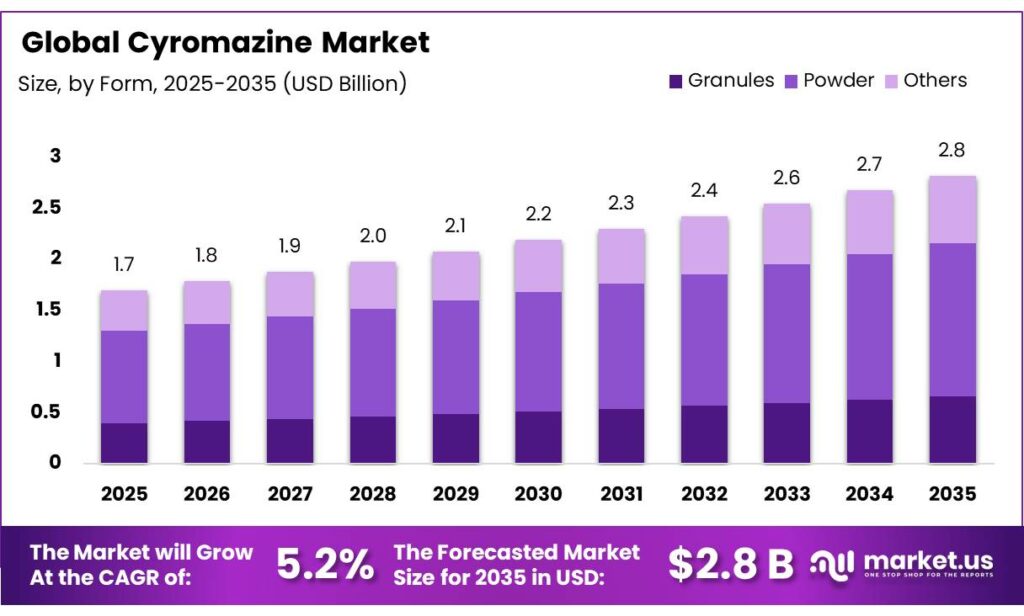
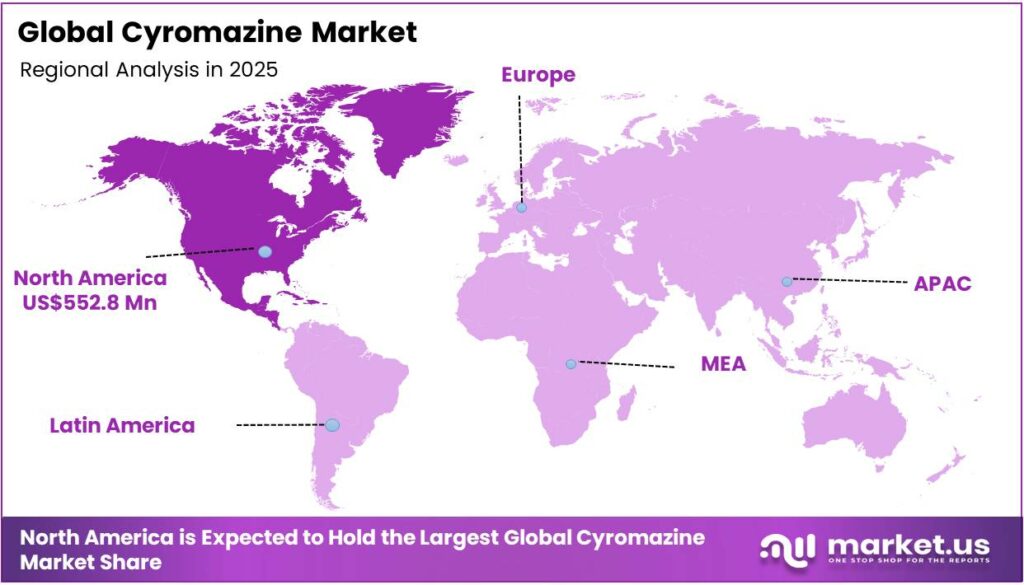
The Global Cyromazine Market is expected to be worth around USD 2.8 Billion by 2035, up from USD 1.7 Billion in 2025, at a CAGR of 5.2% from 2026 to 2035. The North America segment maintained 33.5%, supporting a Cyromazine value of USD 552.8 Mn.
Cyromazine is a triazine-based insect growth regulator (IGR) primarily used as an insecticide and acaricide. Unlike traditional insecticides that attack the nervous system of adult insects, cyromazine targets the immature larval stages, specifically interfering with the molting process. The cyromazine market is defined by its use as an insect growth regulator in agriculture, primarily targeting dipteran pests in crops and livestock systems.
- According to a study by the National Institutes of Health (NIH), in the United States, stable flies alone cause an estimated US$2 billion annual loss in cattle production due to reduced weight gain and milk output.
Key drivers include the growing livestock sector, crop protection needs, and adoption of integrated pest management programs. Challenges stem from insecticide resistance development and regulatory compliance. Manufacturers focus on strategic activities such as formulation improvements, registration transfers, and stewardship initiatives. Supply chain and trade disruptions linked to geopolitical tensions further shape distribution and availability, reinforcing cyromazine’s positioning primarily within the agriculture sector.
- According to the Food and Agriculture Organization (FAO), agricultural value added went up 96% between 2000 and 2023, to US$4.0 trillion, creating a significant demand for crop protection through insecticides, propelling the demand for cyromazine.
Key Takeaways:
- The global cyromazine market was valued at USD 1.7 billion in 2025.
- The global cyromazine market is projected to grow at a CAGR of 5.2% and is estimated to reach USD 2.8 billion by 2035.
- Based on the forms of cyromazine, powdered cyromazine dominated the market, with a market share of around 53.2%.
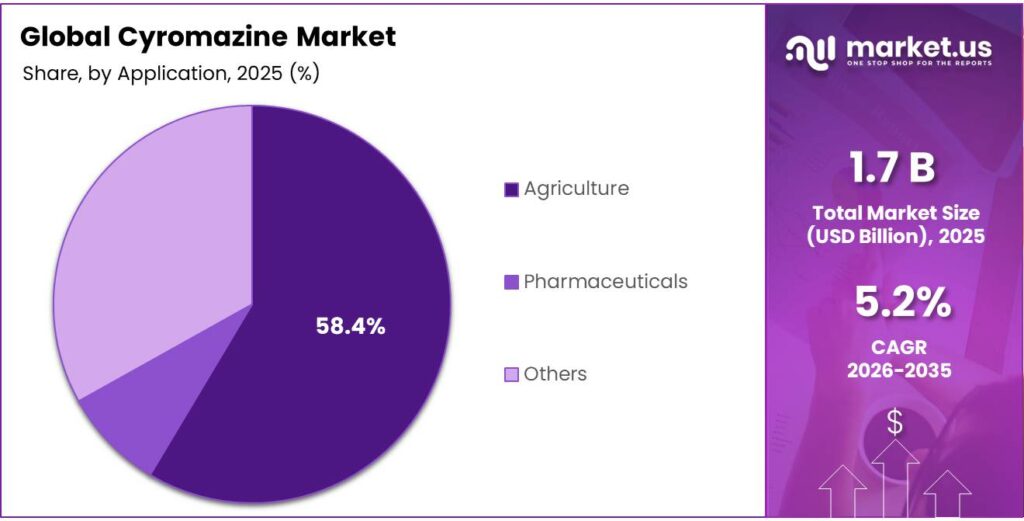
- Among the applications of cyromazine, the agriculture industry held a major share in the market, 58.4% of the market share.
- In 2025, North America was the most dominant region in the cyromazine market, accounting for around 33.5% of the total global consumption.
Form Analysis
Powdered Cyromazine Held the Largest Share in the Market.
The cyromazine market is segmented based on forms into granules, powder, and others. The powdered cyromazine dominated the market, comprising around 53.2% of the market share, as it facilitates flexible, uniform dosing in diverse applications. The powders can be mixed thoroughly into animal feeds to deliver the active ingredient systemically so that it is excreted in manure, where dipteran larvae develop, a key control strategy in livestock operations.
Premix powders such as 1% cyromazine are designed for direct incorporation into layer or breeder feeds, allowing continuous larvicide presence with straightforward handling and dosing instructions. Additionally, powdered formulations disperse uniformly when mixed with water, enabling consistent application to targeted sites, and are compatible with standard spray equipment upon reconstitution.
In contrast, granules or encapsulated forms can be less amenable to precise integration into feed or spray solutions, and their slower release or coating technologies may alter residue behavior and uptake. The mixability, dosing flexibility, and ease of integration of powdered cyromazine into established application methods underpin its preference in many institutional uses.
Application Analysis
Cyromazine is Mostly Utilized in the Agriculture Industry.
Based on the applications of cyromazine, the market is divided into agriculture, pharmaceuticals, and others. The agriculture sector dominated the market, with a market share of 58.4%, as its mode of action and regulatory approvals are aligned with pest control in crops and livestock. Cyromazine is an insect growth regulator that disrupts molting in diptera larvae, making it effective against leaf miners in vegetables and flies developing in animal manure.
There are no corresponding approvals by drug regulatory authorities for cyromazine as a human or veterinary pharmaceutical active ingredient. Its toxicological data packages, residue limits, and label directions are structured around environmental and food safety risk assessments typical of pesticides. Consequently, institutional authorization frameworks channel their production, distribution, and stewardship primarily toward agricultural pest management rather than pharmaceutical sectors.
Key Market Segments:
By Form
- Granules
- Powder
- Others
By Application
- Agriculture
- Pharmaceuticals
- Others
Drivers
Growing Livestock Industry Needs Drive the Cyromazine Market.
The growing livestock sector has accentuated demand for effective fly-control agents such as cyromazine, an insect growth regulator used to interrupt Diptera larval development in manure and animal housing environments. It is authorized to use across diverse livestock categories in professional farming settings, covering dairy cows, swine, poultry, sheep, goats, horses, and other species where manure accumulation fosters nuisance and biting flies.
Cyromazine’s mechanism, chitin synthesis inhibition, prevents immature insects from molting, offering residual activity in organic substrates where many pesticides rapidly degrade, which is crucial in confined cattle and swine production systems where fly breeding can exceed one million flies per hay feeding site in a season without control measures.
- According to the US Department of Agriculture, global chicken production, a primary application area for cyromazine feed-through additives, reached approximately 104.3 million metric tons.
The cyromazine can be effectively applied as a feed-through or environmental treatment to suppress stable fly emergence from manure substrates common in intensive livestock operations. The livestock industry needs, driven by animal welfare, productivity impacts of filth flies, and regulatory approval frameworks, are a significant driver of cyromazine deployment in agriculture.
Restraints
Insecticide Resistance Development Might Pose a Significant Threat to the Demand for Cyromazine.
Insecticide resistance emergence poses a challenge to the sustained efficacy of cyromazine, an insect growth regulator used chiefly against dipteran pests. The development of resistance in target dipteran species, such as the housefly (Musca domestica) and the Australian sheep blowfly (Lucilia cuprina), necessitates increased application frequencies or the integration of alternative chemical classes, potentially impacting the product’s long-term utility.
Controlled selection experiments with the house fly (Musca domestica) demonstrated that resistance ratios (RR) can escalate markedly. A field strain with an initial 8.8-fold RR to cyromazine increased to 211-fold after seven generations of laboratory selection under cyromazine pressure, evidencing a rapid adaptive response to continued exposure. When selection pressure was removed, RR declined to 81-fold, indicating resistance may be unstable but persistent under use conditions.
To mitigate these challenges, government agencies such as the U.S. EPA emphasize integrated pest management (IPM), which mandates the rotation of cyromazine with different modes of action (MoA) to preserve its effectiveness.
Opportunity
Agricultural Productivity & Crop Protection Creates Opportunities in the Market.
Cyromazine presents significant opportunities for enhancing agricultural productivity by mitigating losses caused by dipterous pests, particularly leafminers (Liriomyza spp.). These pests are a primary threat to high-value horticultural crops, where uncontrolled infestations can lead to total crop failure. Its usage in crop protection is supported by regulatory authorizations and residue assessments that link its pest control properties to potential productivity benefits.
The European Food Safety Authority (EFSA) Reasoned Opinion on modifying maximum residue levels (MRLs) for cyromazine established quantitative limits for use on several leafy vegetables and herbs, 3 mg/kg for lettuce, brassica and spinach groups, and up to 15 mg/kg for lamb’s lettuce and certain herbs, reflecting authorized agronomic applications where larval insect pests are targeted to protect plant health and marketability.
With the global population projected to reach 9.8 billion by 2050, according to FAO, increasing yield per unit area is critical. By reducing larval-driven damage in intensive greenhouse and field settings, cyromazine serves as a vital tool for ensuring both food security and food safety through targeted, reduced-risk chemical intervention.
Trends
Adoption of the Integrated Pest Management (IPM).
Integrated Pest Management (IPM) frameworks, as defined by regulatory authorities such as the U.S. Department of Agriculture (USDA) and the European Commission, emphasize the integration of multiple pest control, cultural, biological, physical, and chemical, to manage pests while minimizing risks to health and the environment. IPM combines monitoring and action thresholds with sanitation and targeted interventions, using pesticides only when necessary and in ways that reduce evolutionary pressure on pest populations.
Cyromazine is predominantly registered for use in animal pest control rather than as a plant protection product in the European Union. However, IPM principles are broadly applicable to their application in livestock systems. For instance, the guidance on fly control recommends combining chemical larvicides with sanitation and non-chemical tactics as part of an integrated program to manage house and stable flies in animal housing.
The USDA and EU directives mandate or promote IPM adoption in professional pest management, underlining that pesticides should be used judiciously within integrated strategies rather than as standalone solutions. This regulatory context illustrates IPM as an institutional trend shaping how tools such as cyromazine are deployed to minimize reliance on chemicals, delay resistance, and align with sustainable pest management objectives.
Geopolitical Impact Analysis
Geopolitical Tensions Are Impacting the Cyromazine Market Due to Disrupted Supply Chains in Agrochemicals Industry.
Geopolitical instability, characterized by trade disputes and regional conflicts, serves as a significant disruptive force for the cyromazine market, primarily through supply chain fragmentation and input cost volatility. As an agrochemical dependent on specialized chemical synthesis, cyromazine production is sensitive to shifts in international trade policy and energy security.
Tariffs and trade restrictions between major chemical exporters, notably China and the U.S., impact the flow of triazine-based precursors. General agrochemical exports from China, a key global supplier, have faced volatility; for instance, regulatory shifts and trade tensions contributed to a 25% increase in the price index for certain technical-grade pesticides during peak tension periods.
Additionally, the geopolitical conflicts in energy-producing regions directly affect the cost of natural gas, a critical feedstock for nitrogen-based chemistry used in triazine synthesis. Global fertilizer and pesticide prices saw an upsurge in some regions following the 2022 escalation of the Russia-Ukraine conflict.
Moreover, disruptions in international logistics and maritime routes tied to regional conflicts and climate-linked geopolitical pressures have empirically demonstrated how external shocks can delay shipment of agricultural inputs and raw materials, elevating delivery times and costs.
Regional Analysis
North America Held the Largest Share of the Global Cyromazine Market.
In 2025, North America dominated the global cyromazine market, holding about 33.5% of the total global consumption. The region exhibits a notable regulatory and use framework for cyromazine that underpins its prominence within the region’s agrochemical landscape. In the United States, the U.S. Environmental Protection Agency (EPA) maintains comprehensive residue tolerances for cyromazine under 40 CFR 180.414, with quantitative limits established on a wide variety of commodities, reflecting legally enforceable residue thresholds for food and feed commodities resulting from legally applied cyromazine use.
- In the U.S., the poultry industry, a primary consumer of cyromazine as a feed-through additive, produced about 20% of the total global chicken meat production, reaching 21.34 million metric tons.
Similarly, in Canada, Health Canada’s Pest Management Regulatory Agency (PMRA) completed a re-evaluation of cyromazine in 2021 under the Pest Control Products Act, determining that certain uses (on potatoes and some leafy vegetables) be cancelled while others remain acceptable under revised label conditions, demonstrating an evolving regulatory environment that shapes permissible cyromazine applications in the Canadian market.
Key Regions and Countries
- North America
- The US
- Canada
- Europe
- Germany
- France
- The UK
- Spain
- Italy
- Russia & CIS
- Rest of Europe
- APAC
- China
- Japan
- South Korea
- India
- ASEAN
- Rest of APAC
- Latin America
- Brazil
- Mexico
- Rest of Latin America
- Middle East & Africa
- GCC
- South Africa
- Rest of MEA
Key Players Analysis
Manufacturers of cyromazine pursue several strategic activities to enhance competitive positioning and expand share within pest-control portfolios. A major focus is on the acquisition of global rights to the cyromazine active ingredient and associated product registrations and trademarks, enabling control over intellectual property and regulatory labels across geographies and strengthening product ownership for growers and distributors.
Additionally, manufacturers focus on portfolio and formulation development, including new compositions and combinations that integrate cyromazine with other insecticides, indicating efforts to broaden mode-of-action profiles and application contexts. Furthermore, regulatory engagement and stewardship, securing and maintaining registrations in key jurisdictions, remain central, as transfer of labels and orderly transition plans are highlighted during strategic rights acquisitions.
The Major Players in The Industry
- Syngenta AG
- ADAMA Ltd.
- Elanco Animal Health Incorporated
- AdvaCare Pharma
- Angle Bio Pharma
- Global Chemicals Ltd.
- Jigs Chemical Limited
- K. Vet Chem
- National Analytical Corporation
- Nanjing Aceagrochem Co., Ltd.
- CIE Chemical
- Elanco Animal Health Inc.
- Topsen Biotech Co., Ltd.
- Other Key Players
Key Development:
- In January 2024, Gowan Crop Protection, an affiliate of Gowan Company, announced that it had entered into definitive agreements with Syngenta Crop Protection AG to acquire the worldwide rights to the active ingredient cyromazine.
Report Scope:
Report Features Description Market Value (2025) US$1.7 Bn Forecast Revenue (2035) US$2.8 Bn CAGR (2026-2035) 5.2% Base Year for Estimation 2025 Historic Period 2021-2024 Forecast Period 2026-2035 Report Coverage Revenue Forecast, Market Dynamics, Competitive Landscape, Recent Developments Segments Covered By Form (Granules, Powder, and Others), By Application (Agriculture, Pharmaceuticals, and Others) Regional Analysis North America – The US & Canada; Europe – Germany, France, The UK, Spain, Italy, Russia & CIS, Rest of Europe; APAC– China, Japan, South Korea, India, ASEAN & Rest of APAC; Latin America– Brazil, Mexico & Rest of Latin America; Middle East & Africa– GCC, South Africa, & Rest of MEA Competitive Landscape Syngenta AG, ADAMA Ltd., Elanco Animal Health Incorporated, AdvaCare Pharma, Angle Bio Pharma, Global Chemicals Ltd., Jigs Chemical Limited, U.K. Vet Chem, National Analytical Corporation, Nanjing Aceagrochem Co., Ltd., CIE Chemical, Elanco Animal Health Inc., Topsen Biotech Co., Ltd., and Other Players. Customization Scope Customization for segments, region/country-level will be provided. Moreover, additional customization can be done based on the requirements. Purchase Options We have three licenses to opt for: Single User License, Multi-User License (Up to 5 Users), Corporate Use License (Unlimited Users and Printable PDF) 
-
-
- Syngenta AG
- ADAMA Ltd.
- Elanco Animal Health Incorporated
- AdvaCare Pharma
- Angle Bio Pharma
- Global Chemicals Ltd.
- Jigs Chemical Limited
- K. Vet Chem
- National Analytical Corporation
- Nanjing Aceagrochem Co., Ltd.
- CIE Chemical
- Elanco Animal Health Inc.
- Topsen Biotech Co., Ltd.
- Other Key Players
Our Clients

- 179927
- Mar 2026






