Report Overview
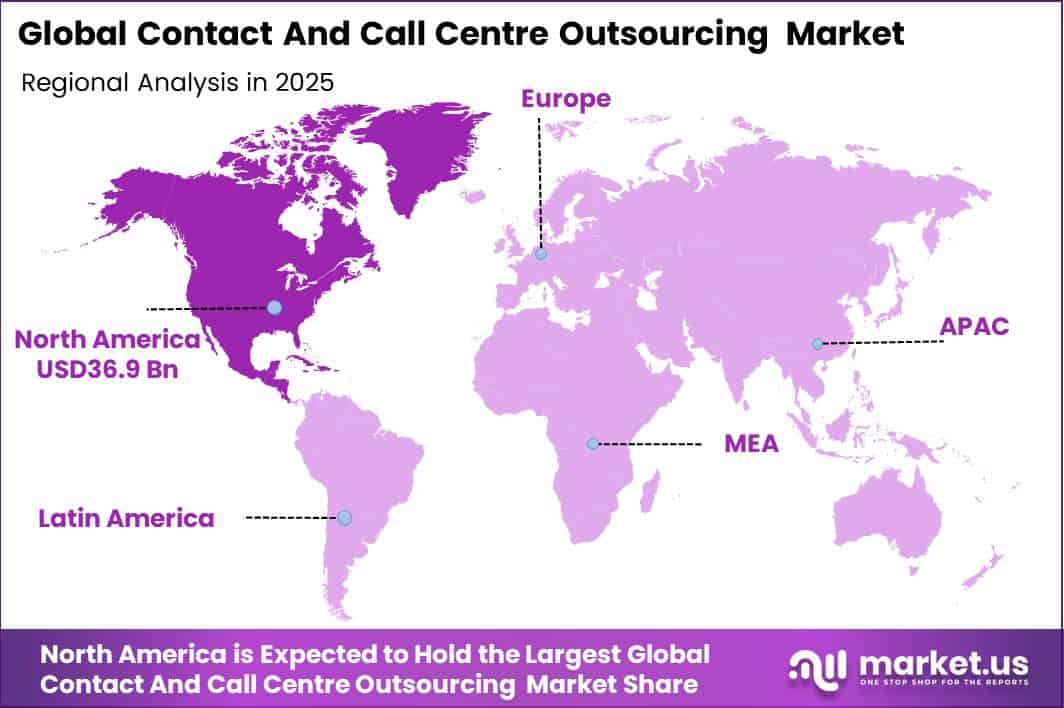
In 2025, the Global Contact And Call Centre Outsourcing Market was valued at USD 107.1 billion. The market is projected to grow at a CAGR of 9.4% during 2026–2035, reaching approximately USD 263.0 billion by 2035. North America dominated the global market in 2025, accounting for more than 34.5% of the total market share and generating approximately USD 36.9 billion in revenue.
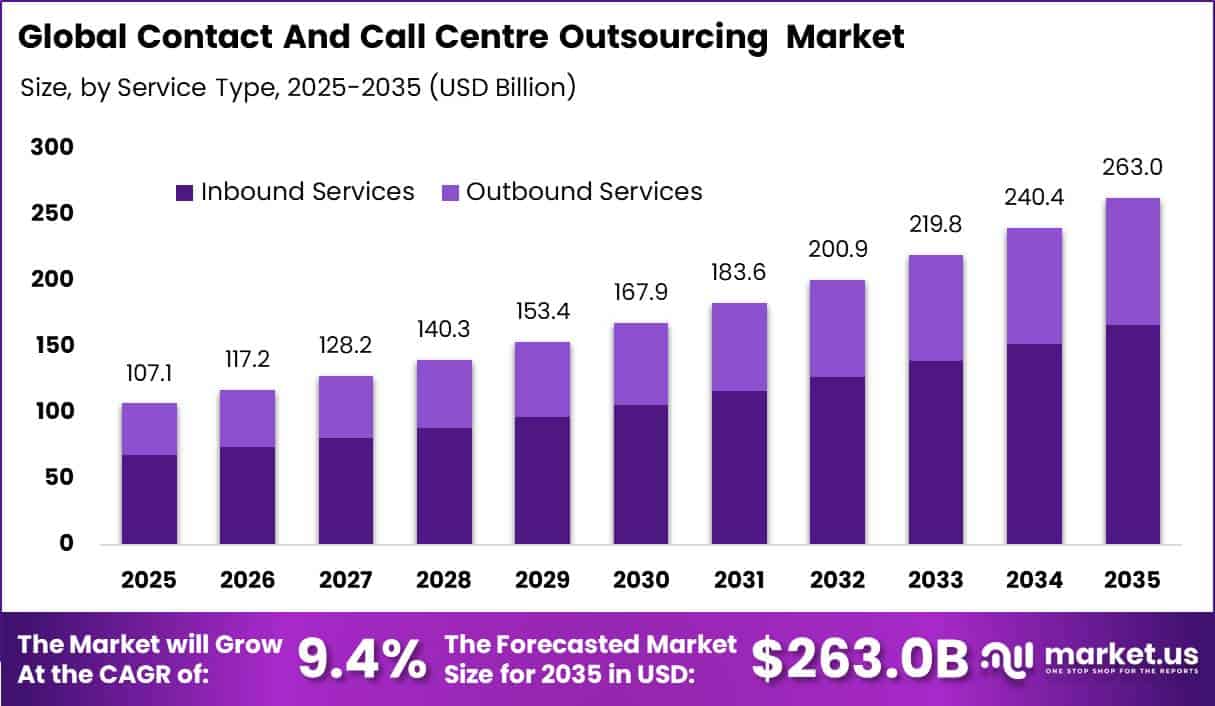
Market growth is supported by the rapid expansion of e-commerce, digital banking, telecom services, online travel bookings, and app-based services, which are increasing customer interactions across multiple channels. According to the ITU, around 6 billion people, representing 74% of the global population, used the internet in 2025, compared with 5.8 billion in 2024.
This growing digital population is increasing demand for customer support through voice, chat, email, social media, and messaging platforms. UNCTAD also reported that business e-commerce sales across 43 economies increased from USD 17 trillion in 2016 to nearly USD 27 trillion in 2022, creating higher service volumes related to orders, payments, returns, deliveries, and account management.
U.S. retail e-commerce sales reached USD 316.1 billion in the fourth quarter of 2025, increasing 5.3% year-on-year and accounting for 16.6% of total retail sales. In addition, customer service representatives earned a median annual wage of USD 42,830 in May 2024, encouraging companies to use outsourcing providers to control costs while gaining flexible staffing, multilingual services, automation capabilities, and round-the-clock customer support.
Key Takeaway
- The Contact And Call Centre Outsourcing Market was valued at USD 107.1 billion in 2025 and is projected to reach USD 263.0 billion by 2035, growing at a CAGR of 9.4%.
- Inbound services were dominated by service type with a 63.3% share, driven by high volumes of customer-initiated requests.
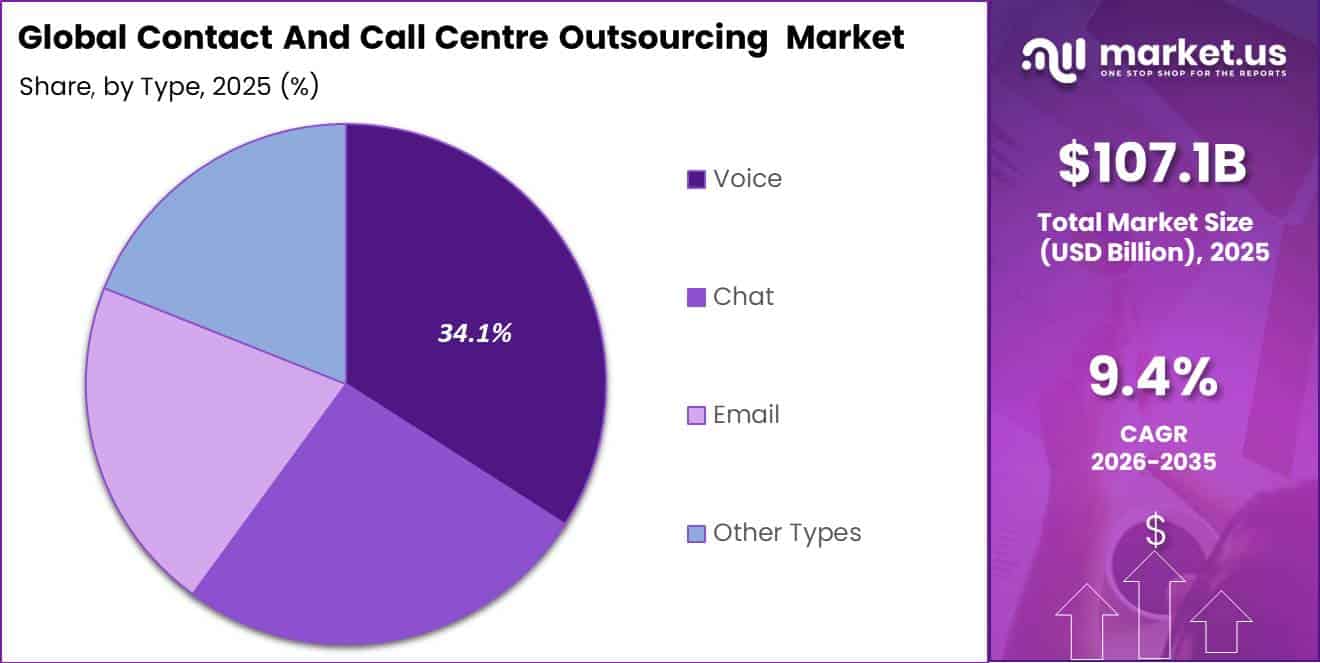
- The voice segment was led by type with a 34.1% share, supported by demand for live assistance in complex cases.
- Onshore outsourcing was dominated by the outsourcing type with a 61.9% share, driven by data security and compliance needs.
- IT and telecommunications led by industry vertical with a 27.1% share, driven by high volumes of technical and account enquiries.
- North America led the market in 2025 with a 34.5% share, generating approximately USD 36.9 billion in revenue.
By Service Type
Inbound services dominated the Contact and Call Centre Outsourcing Market with a 63.3% share, supported by the high volume of customer-initiated service requests that require quick and reliable responses. These services cover payment enquiries, account access, technical problems, insurance claims, fraud alerts, order tracking, and complaint management. The scale of inbound demand is reflected in U.S. public-service operations.
During the 2025 filing season, the U.S. Internal Revenue Service received 38.6 million calls through its enterprise telephone lines, while customer service representatives answered 12.4 million calls. In fiscal year 2024, IRS representatives handled nearly 20 million live calls. These figures highlight the need for large and flexible inbound support teams, particularly during periods of high customer activity.
Demand is also strong in financial and consumer services. The U.S. Federal Trade Commission’s Consumer Sentinel Network recorded 6.5 million consumer reports in 2024, covering fraud, identity theft, banking, lending, and credit-related concerns. Such cases often require fast, secure, and human-assisted support.
By Type
The voice segment dominated the Contact and Call Centre Outsourcing Market with a 34.1% market share, supported by the continued need for live customer assistance in urgent, complex, and sensitive situations. Voice support remains important for banking disputes, fraud cases, insurance claims, technical problems, healthcare enquiries, identity verification, and government services.
Live agents can understand customer concerns, explain solutions, and resolve difficult issues in real time. In fiscal year 2024, the U.S. Internal Revenue Service handled approximately 20 million live telephone calls through customer service representatives, showing the continued importance of large-scale voice support even as digital services expand.
During the 2025 tax filing season, IRS enterprise telephone lines received 38.6 million calls, further highlighting strong demand for voice-based customer assistance. Voice channels also improve accessibility for customers who may find chat, self-service portals, or other digital channels difficult to use.
By Outsourcing Type
Onshore outsourcing dominated the Contact and Call Centre Outsourcing Market with a 61.9% share, mainly due to the growing need for secure data handling, local-language support, and compliance with domestic regulations. This model is widely used across financial services, healthcare, government, utilities, and telecommunications, where customer interactions often involve sensitive information and strict requirements for privacy, identity verification, call recording, and complaint management.
In 2024, the U.S. Federal Trade Commission received 6.4 million consumer reports related to fraud, identity theft, credit, banking, and other consumer concerns. These cases highlight the importance of local regulatory knowledge, secure access to customer information, and agents who understand national consumer-protection procedures.
By Industry Vertical
The IT and telecommunications segment dominated the Contact and Call Centre Outsourcing Market with a 27.1% share, driven by the need to manage large volumes of technical and account-related customer enquiries. Telecom companies regularly handle network issues, device activation, billing, plan changes, roaming, broadband installation, and cybersecurity concerns.
Similarly, IT service providers support customers with software access, password resets, cloud-service problems, and system failures. According to the International Telecommunication Union, around 6 billion people used the internet in 2025, representing 74% of the global population. This large connected population creates significant demand for continuous customer and technical support.
Key Market Segments
By Service Type
- Inbound Services
- Outbound Services
By Type
- Voice
- Chat
- Other Types
By Outsourcing Type
- Onshore Outsourcing
- Offshore Outsourcing
By Industry Vertical
- IT and Telecommunications
- BFSI
- Retail and E-Commerce
- Healthcare
- Government
- Other Industry Verticals
Geopolitical Impact Analysis
Geopolitical tensions are affecting the Contact and Call Centre Outsourcing Market by increasing technology, energy, and service-delivery costs. Contact centre operators depend on laptops, servers, networking systems, backup-power equipment, cooling systems, and telecom infrastructure to maintain secure and continuous customer support.
The World Trade Organization estimated that global merchandise trade volume could decline by 0.2% in 2025 under existing tariff conditions, while a more severe trade scenario could result in a 1.5% decline. Higher tariffs and supply-chain disruptions can raise the cost of imported IT equipment and delay the replacement of essential systems.
Energy instability and regional conflicts create additional operating risks, particularly for offshore contact centres that require reliable electricity and data connectivity. According to the International Energy Agency, global electricity demand increased by 4.3% in 2024, while average annual electricity demand growth is projected at 4.0% through 2027.
Higher electricity and fuel costs can increase spending on backup generators, cooling systems, servers, and other digital infrastructure. To reduce these risks, companies are increasingly spreading customer-service operations across onshore, nearshore, and offshore locations. They are also investing in backup telecom connections and disaster-recovery systems.
Regional Analysis
North America dominated the Contact and Call Centre Outsourcing Market with a 34.5% share, generating approximately USD 36.9 billion in 2025. This represents a global market value of about USD 107.0 billion. The region benefits from a strong presence of customer-focused industries such as banking, insurance, healthcare, retail, telecommunications, software, and public services.
Demand is particularly high for voice, onshore, and nearshore services that manage payments, fraud, claims, technical issues, and account security. The U.S. Internal Revenue Service reported that customer service representatives answered around 20 million live calls. The U.S. Federal Trade Commission also recorded 6,471,708 consumer reports in 2024, including fraud, identity theft, financial services, and unwanted-call complaints.
Asia Pacific is expected to be the fastest-growing region, supported by a large skilled workforce, competitive operating costs, multilingual capabilities, and rapidly expanding digital services. India and the Philippines remain major outsourcing locations, while China, Japan, Australia, South Korea, and Southeast Asia generate growing domestic demand.
According to the International Telecommunication Union, Asia Pacific had approximately 2.9 billion internet users in 2024. Rising use of mobile applications, online payments, broadband, cloud services, and digital commerce is increasing customer enquiries related to billing, technical support, onboarding, deliveries, and security.
Key Regions and Countries
North America
- US
- Canada
Europe
- Germany
- France
- The UK
- Spain
- Italy
- Rest of Europe
Asia Pacific
- China
- Japan
- South Korea
- India
- Australia
- Rest of APAC
Latin America
- Brazil
- Mexico
- Rest of Latin America
Middle East & Africa
- GCC
- South Africa
- Rest of MEA
Market Dynamics
Drivers
| Driver | (~) % CAGR | Geographic Relevance | Impact Timeline |
|---|---|---|---|
| Digital-service support volumes | +2.1% | Global; strongest in North America and Asia Pacific | Short term (2 years or less) |
| Regulated-service complexity | +1.5% | North America and Europe | Short term (2 years or less) |
| fraud | +1.3% | Global | Medium term (2 to 4 years) |
| Multilingual support demand | +0.9% | Asia Pacific, Europe and Middle East | Medium term (2 to 4 years) |
| Flexible workforce requirements | +0.8% | Global | Short term (2 years or less) |
Digital-service support volumes
Digital service expansion is increasing demand for outsourced customer support as more online transactions require help with billing, delivery, identity checks, fraud review, technical issues, and returns. The International Telecommunication Union estimated that 6 billion people, or 74% of the global population, used the internet in 2025, compared with 5.8 billion in 2024.
UN Trade and Development reported business e-commerce sales of about USD 27 trillion across 43 economies in 2022, up from USD 17 trillion in 2016. U.S. retail e-commerce sales also grew 5.3% year-on-year in the fourth quarter of 2025. Rising digital transaction volumes are encouraging companies to use flexible outsourced support, contributing an estimated +2.1% upside to the market’s 9.4% baseline CAGR.
Restraints
| Restraint | (~) % CAGR | Geographic Relevance | Impact Timeline |
|---|---|---|---|
| Cross-border data restrictions | -1.7% | Europe, North America and Asia Pacific | Short term (2 years or less) |
| Client insourcing mandates | -1.1% | North America and Europe | Medium term (2 to 4 years) |
| Public-sector procurement limits | -0.8% | North America and Europe | Medium term (2 to 4 years) |
| Minimum-wage escalation | -0.7% | North America, Europe and Asia Pacific | Short term (2 years or less) |
| Client budget freezes | -0.6% | Global | Short term (2 years or less) |
Cross-border data restrictions
Cross-border data restrictions create challenges for offshore outsourcing when customer records, payment details, health information, and call recordings move between countries. Under the European Union’s GDPR, companies can face fines of up to EUR 20 million or 4% of worldwide annual turnover, whichever is higher. This increases compliance risk for both outsourcing providers and their clients.
The U.S. Federal Trade Commission recorded 6.47 million consumer reports in 2024, showing the large volume of sensitive fraud, identity, and financial data handled through customer-service operations. Data-localisation rules can require providers to maintain separate storage, security teams, and operating controls in each country.
Challenges
| Challenge | (~) % CAGR | Geographic Relevance | Mitigation Horizon |
|---|---|---|---|
| Cybersecurity threat escalation | -1.4% | Global | Medium term (2 to 4 years) |
| Agent attrition pressure | -1.0% | Global | Short term (2 years or less) |
| Voice fraud evolution | -0.9% | North America, Europe and Asia Pacific | Medium term (2 to 4 years) |
| Legacy-platform integration | -0.7% | Global | Medium term (2 to 4 years) |
| Power reliability exposure | -0.5% | Asia Pacific, Africa and Latin America | Long term (4 years or more) |
Cybersecurity threat escalation
Cybersecurity risk remains a key challenge because contact centres handle identity data, payment information, login credentials, call recordings, and account changes across several digital channels. The International Telecommunication Union reported that global internet use reached 6 billion people in 2025, increasing the number of possible targets for fraud, account takeover, and data theft.
The FBI’s Internet Crime Complaint Center recorded more than USD 16.6 billion in reported losses in 2024, up 33% from the previous year, while the U.S. Federal Trade Commission received 6.4 million consumer reports. As a result, providers must spend more on monitoring, identity verification, security testing, agent training, and incident response.
Opportunities
| Opportunity | (~) % CAGR | Geographic Relevance | Execution Window |
|---|---|---|---|
| Outcome-based AI services | +2.0% | Global | Medium term (2 to 4 years) |
| Public-sector citizen experience | +1.4% | North America, Europe and Asia Pacific | Medium term (2 to 4 years) |
| Healthcare navigation services | +1.2% | North America and Europe | Medium term (2 to 4 years) |
| Fraud-prevention support platforms | +1.0% | Global | Short term (2 years or less) |
| Emerging-market language hubs | +0.8% | Asia Pacific, Africa and Latin America | Long term (4 years or more) |
Outcome-based AI services
Outcome-based AI services offer a strong growth opportunity as many contact centre contracts are still priced by agent seat, transaction, or labour hour rather than by measurable business results. The International Energy Agency projects global electricity demand to grow by about 4.0% annually through 2027, with data centres and AI among the key growth drivers.
The U.S. Bureau of Labor Statistics reported a median annual wage of USD 42,830 for customer service representatives in 2024, strengthening the business case for automating routine tasks. Providers that redesign workflows around AI-assisted resolution can potentially reduce cost per resolved interaction by around 15% to 30%. This model can improve margins and may provide up to +2.0% CAGR upside above the market’s 9.4% baseline CAGR.
Key Players Analysis
The Contact and Call Centre Outsourcing Market is led by two large Tier-1 providers, Teleperformance and Concentrix, whose revenue scale is significantly larger than most competitors. Teleperformance reported €10.2 billion in 2025 group revenue, including €8.7 billion from Core Services, representing about 85.5% of total revenue. The company operates across nearly 100 countries, supporting large multinational contracts.
Concentrix generated USD 9.8 billion in fiscal 2025 revenue, up 2.2%. Its technology and consumer electronics business contributed USD 2.6 billion, retail/travel/e-commerce USD 2.4 billion, communications and media USD 1.5 billion, and BFSI USD 1.456 billion. Against the stated USD 107.1 billion market, both companies represent an estimated high-single-digit share, although their revenues also include related digital services.
Tier-2 competitors include TTEC, Capita, HGS, Infosys, Alorica, Atento, Arvato, and ibex. TTEC reported USD 2.1 billion in 2025 revenue, including USD 1.6 billion, or 78%, from TTEC Engage and USD 469 million from TTEC Digital. Adjusted EBITDA reached USD 213.7 million, with a 10.0% margin, while goodwill impairment stood at USD 205.4 million.
Capita’s Contact Centre unit generated £536.7 million in 2025 revenue, down 17.5%, compared with £2.2 billion in group adjusted revenue. HGS reported ₹44.04 billion in FY2025 revenue from operations and ₹49.5 billion in total income, with technology, media and telecom contributing 53.7% of revenue.
Top Key Players in the Market
- Teleperformance SE
- Concentrix Corporation
- Alorica, Inc.
- Atento S.A.
- Infosys Limited
- TTEC Holdings, Inc.
- HGS
- Capita plc
- Arvato Ltd.
- ibex Limited
Recent Developments
- In 2025, Teleperformance (TP) completed the acquisition of ZP Better Together, a U.S.-based provider of language solutions and communication technology for deaf and hard-of-hearing users. The final acquisition price was USD 500.9 million, and the transaction was fully financed through debt, with transaction costs of approximately EUR 0.9 million.
- In 2025, Teleperformance (TP) acquired AI-enabled crowdsourcing platform Agents Only to strengthen TP.ai Data Services. The acquisition had a total cash consideration of USD 19.2 million, including USD 14.6 million, or approximately EUR 13.1 million, paid during the first half of the year and USD 4.6 million in deferred price adjustments.
- Agents Only generated approximately EUR 4.7 million in 2025 revenue. The transaction also formed part of TP’s EUR 100 million AI investment program, supporting scalable data annotation, AI training, and human-in-the-loop services.
Report Scope
| Report Features | Description |
|---|---|
| Market Value (2025) | USD 107.1 Billion |
| Forecast Revenue (2035) | USD 263.0 Billion |
| CAGR (2026-2035) | 9.4% |
| Base Year for Estimation | 2025 |
| Historic Period | 2020-2024 |
| Forecast Period | 2026-2035 |
| Report Coverage | Revenue Forecast, Market Dynamics, Competitive Landscape, Recent Developments |
| Segments Covered | By Service Type (Inbound Services, Outbound Services); By Type (Voice, Chat, Email, Other Types); By Outsourcing Type (Onshore Outsourcing, Offshore Outsourcing); By Industry Vertical (IT and Telecommunications, BFSI, Retail and E-Commerce, Healthcare, Government, Other Industry Verticals) |
| Regional Analysis | North America – US, Canada; Europe – Germany, France, The UK, Spain, Italy, Rest of Europe; Asia Pacific – China, Japan, South Korea, India, Australia, Singapore, Rest of APAC; Latin America – Brazil, Mexico, Rest of Latin America; Middle East & Africa – GCC, South Africa, Rest of MEA |
| Competitive Landscape | Teleperformance SE, Concentrix Corporation, Alorica, Inc., Atento S.A., Infosys Limited, TTEC Holdings, Inc., HGS, Capita plc, Arvato Ltd., ibex Limited |
| Customization Scope | Customization for segments and region/country-level will be provided. Moreover, additional customization can be done based on the requirements. |
| Purchase Options | We have three licenses to opt for: Single User License, Multi-User License (Up to 5 Users), Corporate Use License (Unlimited Users and Printable PDF) |