Market Overview
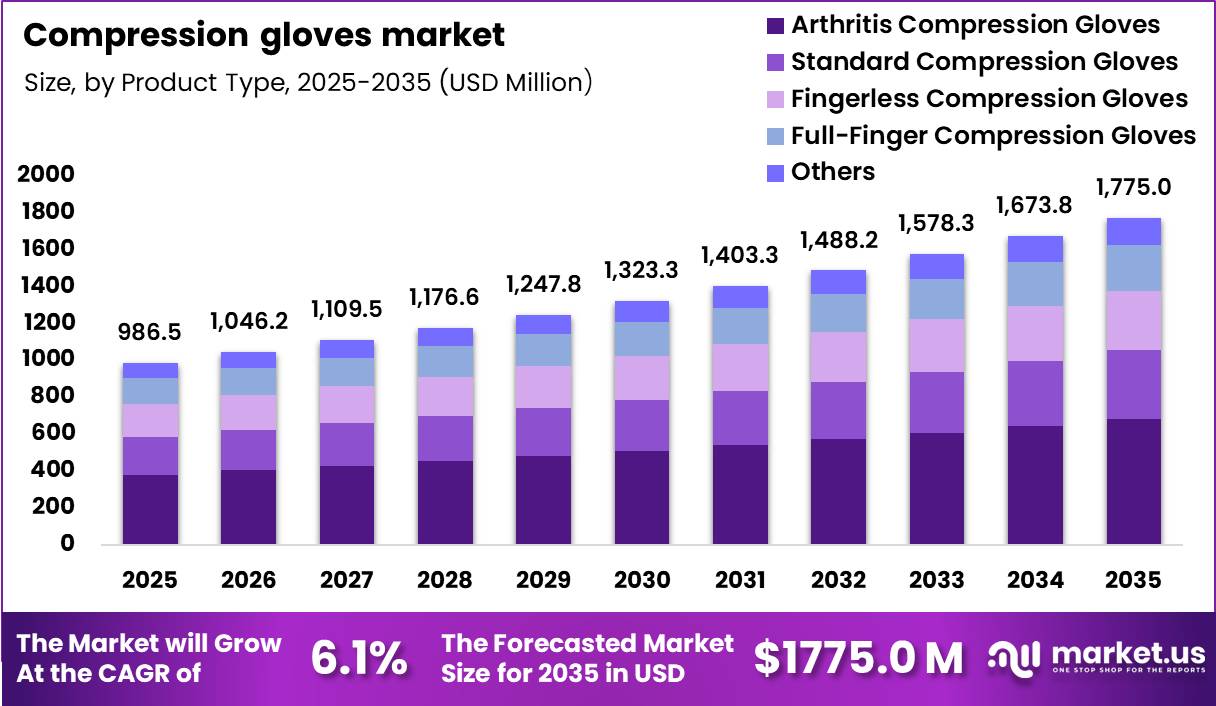
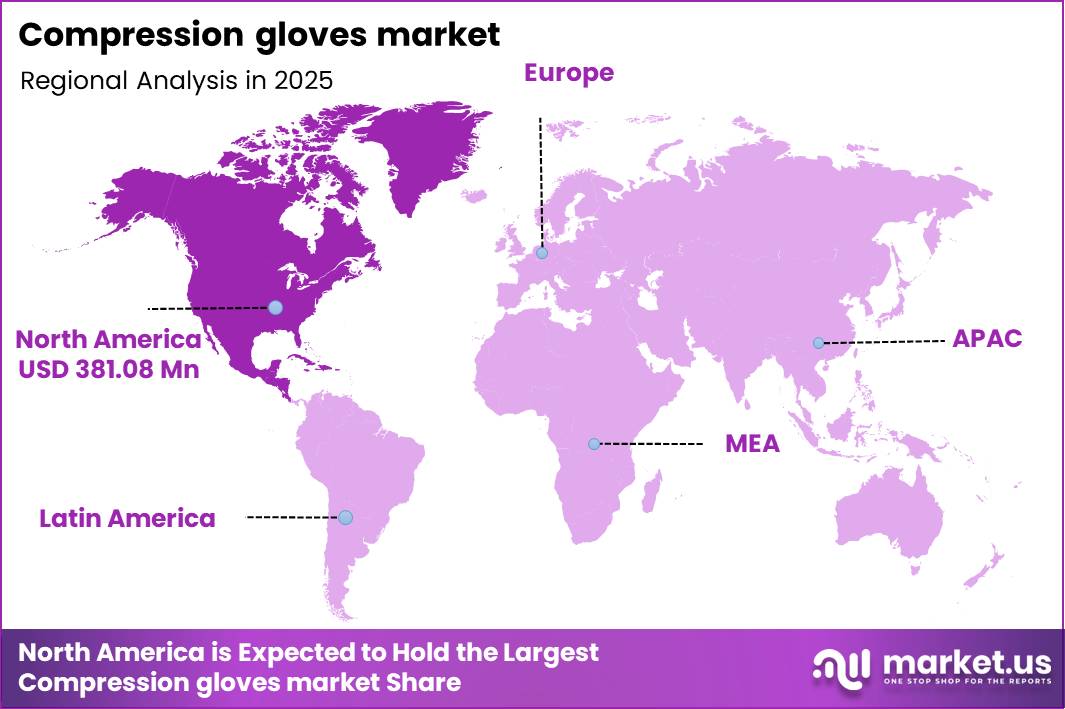
The Global Compression Gloves Market size is expected to be worth around US$ 1,775.0 Million by 2035 from US$ 986.5 Million in 2025, growing at a CAGR of 6.1% during the forecast period from 2026 to 2035. In 2025, North America led the market, achieving over a 38.63% share with a revenue of US$ 381.08 Million.
The Compression Gloves Market is expanding due to increasing demand for supportive healthcare products used in arthritis management, rehabilitation, and hand mobility improvement. Compression gloves provide graduated pressure to the fingers, hands, and wrists, helping reduce swelling, improve comfort, and support daily activities for individuals experiencing joint stiffness and inflammation. These gloves are widely used by patients with rheumatoid arthritis, osteoarthritis, lymphedema-related swelling, and post-injury rehabilitation needs.
According to the Centers for Disease Control and Prevention (CDC), approximately 53.2 million adults in the United States have been diagnosed with arthritis, creating significant demand for long-term symptom management solutions.
The CDC also highlights that arthritis prevalence increases with age, with higher occurrence among adults aged 65 years and above, supporting the adoption of assistive and therapeutic devices. Source: CDC Arthritis Data and Statistics.
The aging population is another major factor influencing demand. According to the United Nations, the global population aged 60 years and older reached more than 1 billion people in 2020 and is projected to exceed 2.1 billion by 2050, increasing the need for mobility-support products and rehabilitation solutions.
Clinical research has evaluated compression glove benefits in arthritis care, including studies involving 39 rheumatoid arthritis patients that assessed improvements in hand symptoms and comfort. Advances in breathable fabrics, moisture-control materials, open-finger designs, and adjustable compression levels are improving product adoption.
Healthcare organizations continue promoting non-drug approaches, including physical therapy and supportive devices, for managing musculoskeletal conditions. The growing focus on home healthcare, occupational therapy, and personalized rehabilitation is expected to strengthen demand for compression gloves globally.
Key Takeaways
- Market Size: The Global Compression Gloves Market size was US$ 986.5 Million in 2025. The market is estimated to grow to US$ 1,775.0 Million by 2035.
- Market Share: The Compound Annual Growth Rate (CAGR) of the market from 2026 to 2035 will be 6.1%.
- Product Type: Arthritis Compression Gloves has the largest market share, accounting for 38.5% of total sales.
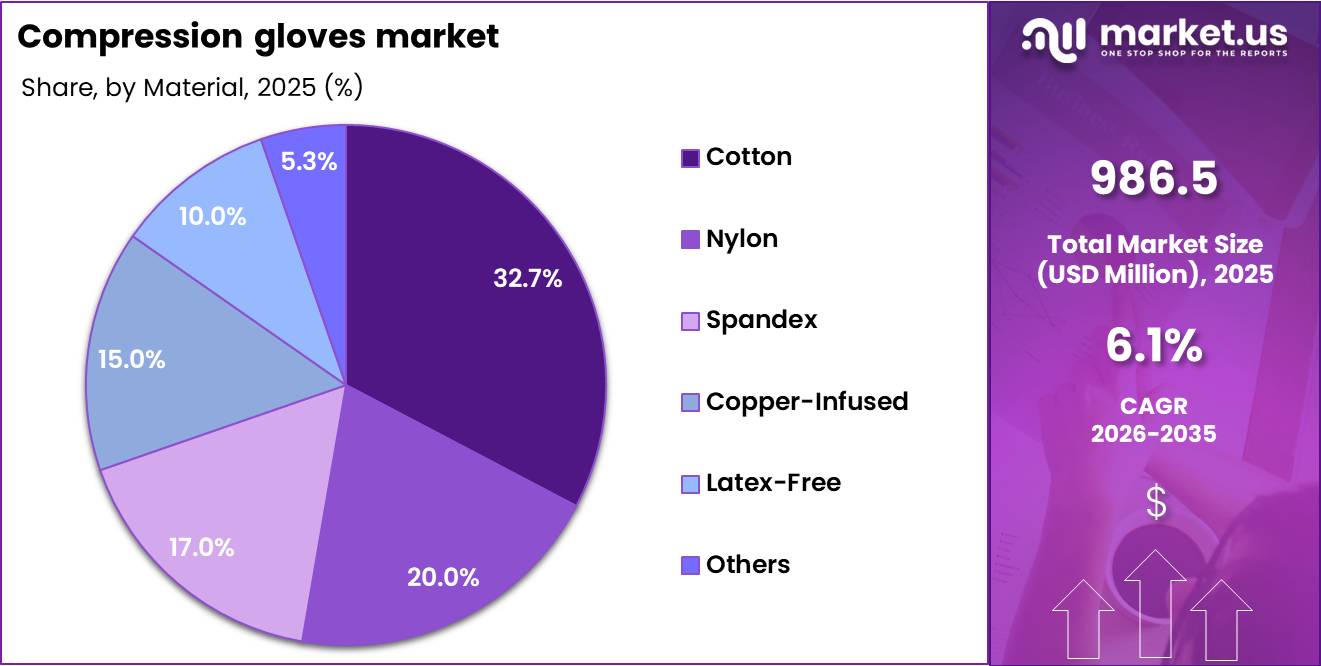
- Material: Cotton dominates the segment, accounting for 32.7% of total revenue.
- Application: Arthritis Relief leads the segment, accounting for 48.6% of total revenue.
- End User: Hospitals dominate the segment, accounting for 41.6% of total revenue.
- Distribution Channel: Online Pharmacies dominate the segment, accounting for 35.8% of total revenue.
- Regional: North America is the dominant regional market, accounting for 38.63% of global sales, holding US$ 381.08 Million in revenue.
Product Type Analysis
The Arthritis Compression Gloves segment dominates the Compression Gloves Market with a 38.5% market share in 2025, driven by the increasing prevalence of arthritis-related hand pain, stiffness, and swelling among aging populations. These gloves are specifically designed to provide gentle compression, improve hand comfort, and support daily activities for individuals suffering from rheumatoid arthritis and osteoarthritis.
Growing awareness of non-drug symptom management approaches is encouraging patients and healthcare professionals to adopt arthritis-focused compression solutions. The Standard Compression Gloves segment holds 21.0% market share in 2025, supported by their affordability, broad availability, and suitability for general hand swelling and circulation support.
Fingerless Compression Gloves account for 18.0% share, gaining popularity among users who require compression support while maintaining finger movement for typing, writing, and household activities. Full-Finger Compression Gloves represent 14.0% share, preferred for users requiring complete hand coverage and uniform pressure distribution.
The Others segment contributes 8.5% share, including specialized designs such as customized compression gloves and condition-specific products. Product innovation focused on comfort, breathability, and adjustable compression levels is expected to support segment growth.
Material Analysis
The Cotton segment dominates the Compression Gloves Market with a 32.7% market share in 2025, primarily due to its softness, breathability, moisture absorption properties, and suitability for long-term wear.
Cotton-based compression gloves are widely preferred among arthritis patients and individuals requiring daily hand support because they provide comfort while maintaining gentle compression. Healthcare providers often recommend breathable materials to improve patient compliance during extended usage.
The Nylon segment captures 20.0% market share in 2025, supported by its durability, lightweight structure, and resistance to wear. Nylon materials help manufacturers produce compression gloves with improved elasticity and shape retention. Spandex-based gloves account for 17.0% share, benefiting from superior stretchability and the ability to deliver consistent compression around fingers and joints.
Copper-Infused Compression Gloves hold 15.0% share, driven by consumer interest in antimicrobial properties and enhanced fabric technologies for comfort and odor control. The Latex-Free segment represents 10.0% share, supported by rising demand from users with latex sensitivities and allergies.
The Others segment contributes 5.3% share, including blended fabrics and advanced textile materials. Increasing focus on skin-friendly, breathable, and durable materials is expected to influence future product development.
Application Analysis
The Arthritis Relief segment dominates the Compression Gloves Market with a 48.6% market share in 2025, supported by the high burden of arthritis and increasing demand for non-invasive pain management solutions.
Compression gloves are commonly used to reduce hand swelling, improve comfort, and support joint mobility among individuals experiencing rheumatoid arthritis and osteoarthritis symptoms. Rising adoption of home-based care solutions is further increasing demand for arthritis-focused compression products.
The Carpal Tunnel Syndrome application segment represents a significant opportunity as individuals seek supportive devices to reduce discomfort, pressure, and hand fatigue associated with repetitive movements. Edema Management applications are expanding due to the use of compression therapy for controlling fluid accumulation and swelling caused by various medical conditions.
The Hand Fatigue segment is gaining attention among office workers, professionals, and individuals involved in repetitive hand activities requiring prolonged support. Post-Surgical Recovery applications are increasing as rehabilitation programs incorporate compression products to support healing and reduce swelling after procedures.
The Others segment includes applications such as sports recovery, injury management, and general hand wellness. Growing awareness of rehabilitation therapies and preventive healthcare is expected to drive broader adoption.
End User Analysis
The Hospitals segment dominates the Compression Gloves Market with a 41.6% market share in 2025, supported by the increasing use of compression therapy products in orthopedic departments, rehabilitation units, and chronic disease management programs.
Hospitals frequently recommend compression gloves for patients recovering from hand injuries, surgeries, arthritis-related conditions, and swelling disorders. Professional guidance from healthcare providers improves patient confidence and adoption of medical-grade compression products.
The Specialty Clinics segment represents a growing share of the market, driven by increasing visits to rheumatology, orthopedic, and pain management clinics. These facilities recommend compression gloves as part of personalized treatment plans for arthritis, joint disorders, and hand mobility issues. Rehabilitation Centers are also contributing significantly, as physical therapists use compression products alongside exercise programs to support recovery, improve function, and manage swelling.
The Others segment includes home healthcare users, occupational therapy centers, and individual consumers purchasing compression gloves for self-care purposes. Increasing healthcare decentralization, rising demand for outpatient rehabilitation, and growth in home-based treatment models are expected to support expansion across end-user categories.
Distribution Channel Analysis
The Online Pharmacies segment dominates the Compression Gloves Market with a 35.8% market share in 2025, driven by increasing consumer preference for convenient healthcare purchases, wider product availability, and easy access to multiple compression glove options. Online platforms allow customers to compare sizes, materials, compression levels, and product features, supporting informed purchasing decisions.
The Hospital Pharmacies segment holds a significant position due to direct recommendations from healthcare professionals and easy availability of medical support products during patient treatment. Hospitals often provide compression gloves as part of rehabilitation and post-treatment care programs.
Retail Pharmacies continue to contribute to market growth by offering easily accessible compression products for patients managing arthritis, swelling, and hand discomfort without hospitalization.
Medical Supply Stores serve specialized users, including rehabilitation patients and healthcare facilities requiring professional-grade compression solutions. E-commerce Platforms are expanding rapidly due to improved digital healthcare adoption, home delivery services, and increasing awareness of self-care products.
Growing internet penetration, rising online healthcare purchases, and increasing demand for home-based treatment solutions are expected to strengthen digital distribution channels in the Compression Gloves Market.
Key Market Segments
By Product Type:
- Standard Compression Gloves
- Fingerless Compression Gloves
- Full-Finger Compression Gloves
- Arthritis Compression Gloves
- Others
By Material:
- Cotton
- Nylon
- Spandex
- Copper-Infused
- Latex-Free
- Others
By Application:
- Arthritis Relief
- Carpal Tunnel Syndrome
- Edema Management
- Hand Fatigue
- Post-Surgical Recovery
- Others
By End User:
- Hospitals
- Specialty Clinics
- Rehabilitation Centers
- Others
By Distribution Channel:
- Hospital Pharmacies
- Retail Pharmacies
- Online Pharmacies
- Medical Supply Stores
- E-Commerce Platforms
Driver
Telehealth, e-commerce and DTC channels reshaping compression glove access and pricing
Telehealth growth and consumer health e-commerce penetration since 2020–2024 have structurally changed how patients purchase low-risk, Class I–like devices such as compression gloves for arthritis and neuropathy symptoms, decoupling access from brick-and-mortar medical supply stores.
Patients who receive an arthritis or neuropathy diagnosis via telemedicine consultations now frequently obtain recommendations for non-pharmacologic adjuncts and subsequently buy directly through digital marketplaces, using product reviews and peer feedback rather than clinician-only guidance, which accelerates adoption for relatively low-ticket items whose regulatory barriers are limited.
While clinical trials for arthritis gloves report inconclusive symptomatic benefits and no cost-effectiveness when provided through formal health systems, the consumer segment often tolerates modest per-unit expenditure in exchange for perceived relief, shifting revenue from reimbursed, low-volume institutional channels to high-volume, direct-to-consumer logistics models.
For companies, this driver reshapes business models: inventory management becomes more dynamic and data-driven, relying on demand forecasting from search and clickstream data rather than purchase orders from hospitals; marketing budgets migrate from detailing to rheumatologists toward digital campaigns targeting age and condition cohorts.
Additionally, e-commerce allows differentiated tiering: basic compression gloves plus premium variants with copper-infused fabrics or targeted compression zones, improving average selling price while keeping production costs anchored in standardized textile processes.
Over the next ≤2 years, this distribution and acquisition shift can materially add 1.5–2% points to CAGR as more of the prevalent arthritis and neuropathy population translates awareness into actual purchases, particularly in North America, Europe and urban APAC corridors with high broadband and digital payment penetration.
| Driver | (~) % Impact on CAGR Forecast | Geographic Relevance | Impact Timeline |
|---|---|---|---|
| Rising hand arthritis & RA/HOA burden driving symptomatic relief demand | +2.2% | North America core, EU, APAC corridors | Medium term (2–4 years) |
| Population ageing and diabetes-linked peripheral neuropathy increasing chronic hand pain pool | +1.9% | North America core, EU, APAC corridors, South America spill-over | Long term (≥ 4 years) |
| Rehabilitation & assistive products integration into arthritis care pathways | +1.4% | EU, North America core, APAC urban clusters | Medium term (2–4 years) |
| Telehealth, e-commerce and DTC channels reshaping compression glove access and pricing | +1.6% | North America core, EU, APAC corridors | Short term (≤ 2 years) |
| Clinical evidence refinement and guideline positioning (RA, HOA, neuropathy) | +0.9% | EU, North America, select APAC | Long term (≥ 4 years) |
| Hospital, specialty clinic and occupational therapy procurement standardization | +1.3% | North America core, EU, APAC corridors | Medium term (2–4 years) |
Challenge
Manufacturing Fragmentation Challenging Compression Glove Quality Standards
Fragmented manufacturing and quality control standards are a persistent supply‑side challenge because compression gloves are produced across diverse APAC textile belts and specialized EU facilities with heterogeneous protocols for pressure testing, seam durability, and skin compatibility, and academic technical reviews emphasize the sensitivity of compression garments to yarn architecture and knitting parameters yet many mid‑tier factories still employ coarse sampling regimes that only test a small subset of production batches for true pressure performance.
This heterogeneity leads to inter‑batch variability in delivered pressure of 10–20%, defect rates in stitching or material integrity of 3–5%, and post‑shipment rejection or rework in international import hubs, extending lead times by 7–14 days and inflating effective cost per usable glove by 5–10% for distributors managing multi‑country portfolios.
The resulting friction drag of about 0.9% points on global CAGR stems from slower product refresh cycles, cautious inventory stocking, and periodic quality scares that erode clinician trust and trigger informal moratoria on specific SKUs; the impact is amplified in APAC production belts supplying EU markets with stricter compliance expectations.
Resolving this fragmentation requires convergence around standardized compression testing methods, routine in‑line measurement of garment pressure profiles, and greater transparency on factory‑level quality statistics however, aligning hundreds of manufacturers across geographies, upgrading equipment to support accurate pressure mapping, and harmonizing labeling claims is a multi‑cycle endeavor, with a realistic normalization horizon of ≥4 years before systemic QC variability is narrowed enough to materially reduce returns and remove this drag on growth.
| Challenge | (~) % CAGR Friction Drag | Geographic Relevance | Mitigation Horizon |
|---|---|---|---|
| Non-uniform clinical indication mapping | -1.2% | North America, EU, East Asia | Medium term (2-4 years) |
| Fit, pressure, and compliance variability | -1.0% | Global urban care hubs | Medium term (2-4 years) |
| Fragmented manufacturing and QC standards | -0.9% | APAC production belts, EU import hubs | Long term (≥ 4 years) |
| Reimbursement and coding opacity | -1.1% | US, EU, selective Middle East | Long term (≥ 4 years) |
| Digital and telehealth channel under-integration | -0.8% | North America, Western Europe, developed APAC | Medium term (2-4 years) |
| Chronic disease demand volatility and inequality | -0.7% | Global aging economies | Long term (≥ 4 years) |
Restraints
Limited Clinical Evidence Restricting Compression Glove Adoption
Suboptimal clinical evidence and conservative treatment guidelines limit the formal positioning of compression gloves within standardized care pathways for osteoarthritis, rheumatoid arthritis, and chronic musculoskeletal pain, creating a perception of optional rather than core therapy among clinicians and payers.
While global organizations such as WHO and national agencies highlight the importance of non-pharmacologic interventions including physical activity, weight management, and assistive products for osteoarthritis and related conditions, the evidence base for hand-specific compression devices remains uneven, with relatively few large randomized trials quantifying outcomes such as pain reduction, grip strength, or functional scores over 6–12-month periods compared with pharmacologic baselines.
Many clinical guidelines, particularly those influenced by rheumatology and rehabilitation bodies, emphasize exercise, education, and weight control as first-line measures, often mentioning assistive devices generically without differentiating between types, compression levels, or specific indications as a result, prescribing rates for compression gloves lag overall disease prevalence, even though knee osteoarthritis alone has a pooled global prevalence of 16% in individuals aged 15 and above and nearly 23% in those over 40.
In practice, this weak evidence-to-guideline linkage means that only a fraction of the 595 million osteoarthritis patients and 17.6 million rheumatoid arthritis patients are systematically offered compression gloves as part of standard care, and many clinicians rely on anecdotal use or patient-driven purchase rather than formal prescription and follow-up.
Strategically, this constrains manufacturers’ ability to command premium pricing based on demonstrated clinical value, limits access to reimbursement channels that require strong comparative effectiveness data, and slows hospital and clinic adoption, collectively imposing an estimated 0.8 % point drag on global compression glove CAGR over the medium term until more robust clinical trial data and guideline endorsements emerge.
| Restraint | (~) % Impact on CAGR Forecast | Geographic Relevance | Impact Timeline |
|---|---|---|---|
| Stringent device regulation & compliance costs | -1.2% | North America, EU, select APAC | Medium term (2-4 years) |
| Raw material price volatility & manufacturing cost inflation | -0.9% | North America, EU, APAC corridors | Short term (≤ 2 years) |
| Limited clinical reimbursement & weak payer coverage | -1.1% | North America core, EU | Long term (≥ 4 years) |
| Suboptimal clinical evidence & conservative guidelines | -0.8% | North America, EU | Medium term (2-4 years) |
| Supply chain fragmentation & distribution bottlenecks | -0.7% | APAC corridors, Latin America, EMEA periphery | Short term (≤ 2 years) |
| Patient adherence, comfort, and safety concerns | -0.6% | Global | Long term (≥ 4 years) |
Opportunity
Digital Therapy Bundles Creating New Compression Glove Revenue Streams
Compression glove vendors can unlock a distinct upside by bundling physical products with digital musculoskeletal and neuropathic therapy programs tele-rehabilitation, remote therapeutic monitoring, and app-based coaching creating hybrid “device service” offerings that monetize beyond one-off glove sales and tap into the fast-growing digital MSK care market.
Evidence from telemedicine and telerehabilitation for musculoskeletal disorders shows high diagnostic and treatment-plan concordance between remote and in-person assessments, and the global digital-health MSK segment is estimated to grow from single-digit billions in the mid-2020s to well over USD 10 billion before 2030, driven by home-based, opioid-free pain management and AI-enabled physiotherapy.
Compression glove players currently participate only as hardware suppliers; they do not capture subscription revenue, remote monitoring reimbursements, or data‑driven upsell opportunities, leaving a significant monetization gap.
If 8–12% of existing glove users in North America, the EU, and developed APAC migrate to bundled offerings priced at USD 10–15 per month for digital support plus hardware refresh, annual ARPU could increase 3–4x, improving gross margins by 8–10% points due to software economics and boosting overall market CAGR by roughly 1.9% points versus a pure hardware trajectory.
This is a future opportunity rather than a baseline driver because reimbursement codes for remote therapeutic monitoring in rheumatologic and MSK care only recently emerged, digital pathways are still being standardized, and most glove brands lack the integration, regulatory compliance, and data governance infrastructure.
It necessary to offer reimbursable bundled care building app ecosystems, partnering with virtual clinics, and aligning with emerging CMS or private-payer frameworks by 2030 can convert today’s fragmented usage into recurring, medically anchored revenue streams.
| Opportunity | (~) % Potential CAGR Upside | Geographic Relevance | Execution Window |
|---|---|---|---|
| Diabetic neuropathy segment entry | +2.3% | North America, EU, APAC urban | Medium term (2-4 years) |
| Integrated digital-therapy bundles | +1.9% | North America core, EU, developed APAC | Medium term (2-4 years) |
| Occupational & productivity-focused SKUs | +1.6% | North America, EU, APAC emerging | Short term (≤ 2 years) |
| Clinical-grade, reimbursable gloves | +2.0% | North America, EU | Long term (≥ 4 years) |
| Aging-at-home and long-term care channels | +1.4% | North America, EU, Japan | Medium term (2-4 years) |
| Emerging-market diabetic & arthritis access programs | +1.7% | APAC emerging, Latin America, Middle East & Africa | Long term (≥ 4 years) |
Regional Analysis
In 2025, North America led the market, achieving over 38.63% share with a revenue of US$ 381.08 Million. The North America region dominates the Global Compression Gloves Market, supported by the high prevalence of arthritis, strong healthcare infrastructure, and increasing adoption of rehabilitation and home-care products.
According to the Centers for Disease Control and Prevention (CDC), more than 53 million U.S. adults are affected by arthritis, creating significant demand for supportive devices such as compression gloves. Growing awareness of non-invasive pain management solutions and availability through hospitals, specialty clinics, and online pharmacies further strengthen regional growth.
Europe represents a significant market, driven by an aging population, rising cases of musculoskeletal disorders, and increasing focus on rehabilitation therapies.
According to the World Health Organization (WHO), musculoskeletal conditions affect approximately 1.71 billion people globally, increasing the need for supportive treatment solutions across European healthcare systems. Countries with advanced healthcare networks are adopting compression products for arthritis relief and post-surgical recovery.
Asia-Pacific is expected to witness strong growth due to increasing healthcare awareness, expanding elderly populations, and improving access to medical devices. The region is experiencing rising demand for affordable compression solutions through retail pharmacies and e-commerce platforms. According to the United Nations, the number of people aged 60 years and older is projected to reach 2.1 billion globally by 2050, supporting long-term demand.
Latin America and the Middle East & Africa regions are gradually expanding due to improving healthcare access, growing rehabilitation services, and increasing awareness of supportive orthopedic products. These regions offer opportunities for manufacturers focusing on affordable and comfortable compression glove solutions.
Key Regions and Countries
North America
- The US
- Canada
Europe
- Germany
- France
- The U.K.
- Italy
- Spain
- Russia & CIS
- Rest of Europe
Asia Pacific
- China
- India
- Japan
- South Korea
- ASEAN
- Australia & New Zealand
- Rest of Asia Pacific
Middle East & Africa
- GCC
- South Africa
- Rest of Middle East & Africa
Latin America
- Brazil
- Mexico
- Rest of Latin America
Key Player Analysis
Competitive advantage in the global compression gloves market is achieved through broad product type portfolio coverage spanning standard, fingerless, full-finger, and arthritis-specific compression glove designs across multiple material formulations, established relationships with hospital, specialty clinic, and rehabilitation center.
Institutional buyers, and continued investment in copper-infused and moisture-wicking material technology development addressing growing consumer demand for therapeutic and performance-enhancing compression glove properties.
Major strategic priorities for leading manufacturers include expansion of arthritis compression glove product lines addressing the dominant application and product type segments, development of copper-infused and antimicrobial material formulations commanding premium pricing among health-conscious consumers
Growing investment in online pharmacy and e-commerce platform distribution channels supporting the structural shift toward direct-to-consumer compression glove purchasing beyond traditional hospital and retail pharmacy channels.
Strong hospital and specialty clinic institutional procurement relationships, combined with expanding online and e-commerce distribution presence, represent a critical competitive differentiator for manufacturers serving the dominant arthritis relief application segment globally.
Top Key Players
- 3M Company
- medi GmbH & Co. KG
- Bauerfeind AG
- BSN Medical GmbH
- Sigvaris AG
- Juzo (Julius Zorn GmbH)
- Thuasne Group
- 2XU Pty Ltd.
- CompressionZ
- Sockwell (Kayser-Roth Corporation)
- Dr. Arthritis
- Vive Health
- TechWare Pro
- Copper Compression
- CEP
- Other Key Players
Recent Developments
- In January 2026, Bauerfeind AG launched an expanded arthritis compression glove line featuring enhanced copper-infused cotton blend material, targeting hospital rheumatology department and specialty clinic institutional buyers seeking improved therapeutic compression performance for rheumatoid and osteoarthritis patient hand pain management.
- In February 2026, medi GmbH & Co. KG introduced a new medical-grade fingerless compression glove series for carpal tunnel syndrome and edema management applications, targeting rehabilitation center and hospital occupational therapy department buyers seeking clinically validated hand compression solutions for post-surgical and chronic condition patient management.
- In March 2026, Copper Compression expanded its e-commerce direct-to-consumer compression glove portfolio with new full-finger and arthritis-specific product launches, targeting online pharmacy and e-commerce platform buyers seeking premium copper-infused compression glove solutions for arthritis relief and hand fatigue management.
- In April 2026, BSN Medical GmbH secured a multi-year institutional supply agreement with a leading Asian hospital and rehabilitation center network covering its medical compression glove portfolio, expanding its institutional presence across arthritis relief, post-surgical recovery, and edema management patient care programs in the Asia Pacific region.
Report Scope
| Report Features | Description |
|---|---|
| Market Value (2025) | US$ 986.5 Million |
| Forecast Revenue (2035) | US$ 1,775.0 Million |
| CAGR (2026-2035) | 6.1% |
| Base Year for Estimation | 2025 |
| Historic Period | 2020-2024 |
| Forecast Period | 2026-2035 |
| Report Coverage | Revenue Forecast, Market Dynamics, Competitive Landscape, Recent Developments |
| Segments Covered | By Product Type (Standard Compression Gloves, Fingerless Compression Gloves, Full-Finger Compression Gloves, Arthritis Compression Gloves, Others), By Material (Cotton, Nylon, Spandex, Copper-Infused, Latex-Free, Others), By Application (Arthritis Relief, Carpal Tunnel Syndrome, Edema Management, Hand Fatigue, Post-Surgical Recovery, Others), By End User (Hospitals, Specialty Clinics, Rehabilitation Centers, Others), By Distribution Channel (Hospital Pharmacies, Retail Pharmacies, Online Pharmacies, Medical Supply Stores, E-Commerce Platforms) |
| Regional Analysis | North America – The US, Canada; Europe – Germany, France, U.K., Italy, Spain, Russia & CIS, Rest of Europe; Asia Pacific – China, India, Japan, South Korea, ASEAN, Australia & New Zealand, Rest of Asia Pacific; Middle East & Africa – GCC, South Africa, Rest of Middle East & Africa; Latin America – Brazil, Mexico, Rest of Latin America |
| Competitive Landscape | 3M Company, medi GmbH & Co. KG, Bauerfeind AG, BSN Medical GmbH, Sigvaris AG, Juzo (Julius Zorn GmbH), Thuasne Group, 2XU Pty Ltd., CompressionZ, Sockwell (Kayser-Roth Corporation), Dr. Arthritis, Vive Health, TechWare Pro, Copper Compression, CEP, Other Key Players |
| Customization Scope | Customization for segments, region/country-level will be provided. Moreover, additional customization can be done based on the requirements. |
| Purchase Options | We have three licenses to opt for: Single User License, Multi-User License (Up to 5 Users), Corporate Use License (Unlimited User and Printable PDF) |