Global Column-Level Data Lineage Market By Component (Software/Solutions, Services), By Deployment Mode (Cloud-based, On-premises), By Organization Size (Large Enterprises, Small and Medium-sized Enterprises), By Application (Impact Analysis for Schema Changes, Data Quality Issue Root-Cause Analysis, Others), By End-User Industry (Banking, Financial Services, and Insurance, Healthcare and Life Sciences, Others), By Regional Analysis, Global Trends and Opportunity, Future Outlook By 2025-2035
- Published date: Feb. 2026
- Report ID: 178148
- Number of Pages: 233
- Format:
-
keyboard_arrow_up
Quick Navigation
- Report Overview
- Top Market Takeaways
- Drivers Impact Analysis
- Restarints Impact Analysis
- By Component
- By Deployment Mode
- By Organization Size
- By Application
- By End User Industry
- Investor Type Impact Matrix
- Technology Enablement Analysis
- Emerging Trends
- Growth Factors
- Key Market Segments
- Regional Analysis
- Competitive Analysis
- Future Outlook
- Recent Developments
- Report Scope
Report Overview
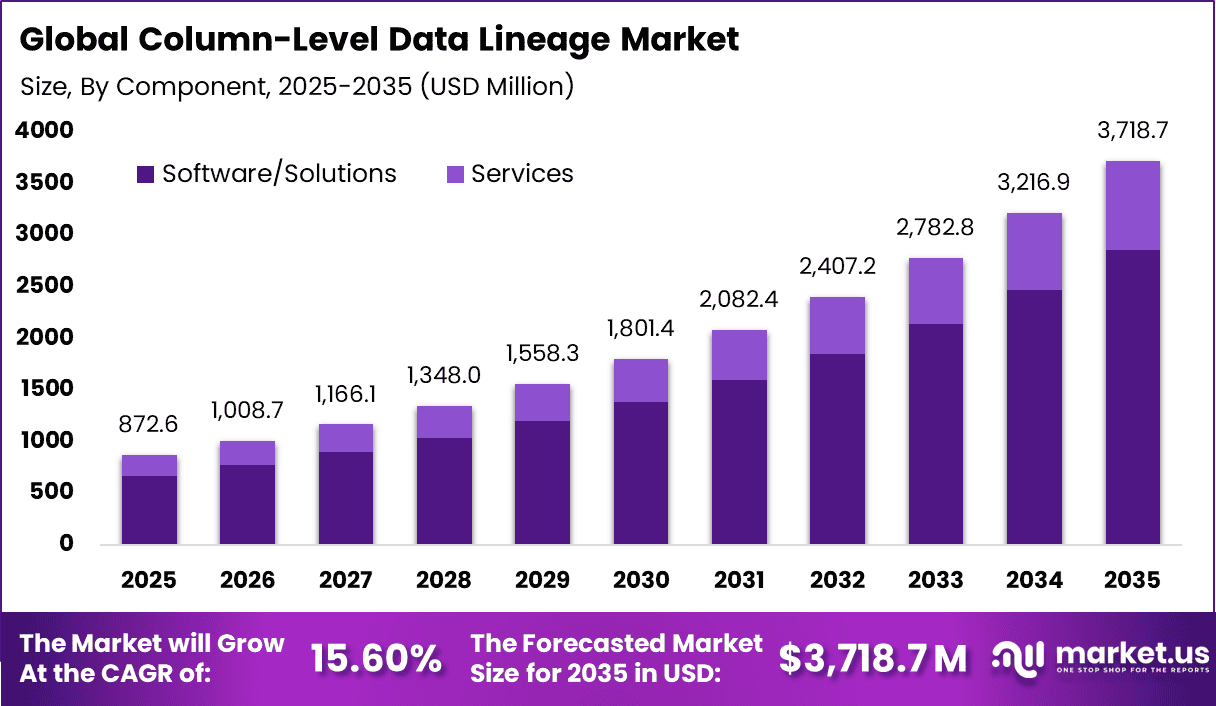
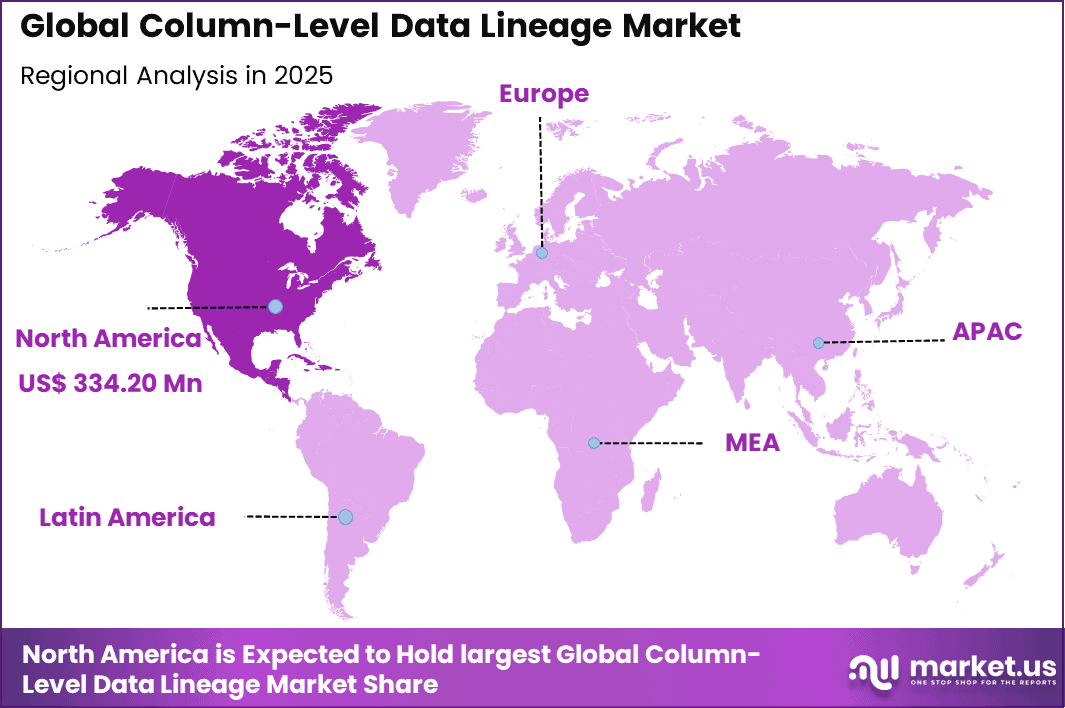
The Global Column-Level Data Lineage Market generated USD 872.6 Million in 2025 and is predicted to register growth from USD 1,008.7 million in 2026 to about USD 3,418.7 million by 2035, recording a CAGR of 15.60% throughout the forecast span. In 2025, North America held a dominan market position, capturing more than a 38.7% share, holding USD Million revenue.
The Column-Level Data Lineage Market refers to solutions that track the flow and transformation of data at the most detailed level within databases and analytical systems. These solutions map how individual data columns originate, move, change, and are consumed across data pipelines, applications, and reports. Detailed lineage supports data quality, impact analysis, regulatory compliance, and transparency in enterprise data environments.
This market has grown as enterprises confront complex data architectures that span on-premises databases, cloud platforms, and distributed processing frameworks. Traditional lineage approaches that focus on tables or systems are insufficient for deep insights into transformations and attribute-level dependencies. Column-level lineage addresses this gap, enabling fine-grained visibility into how data attributes evolve across ETL (extract, transform, load) processes and analytical models.
One major driving factor for the Column-Level Data Lineage Market is increasing regulatory scrutiny on data accuracy and traceability. Compliance requirements in financial services, healthcare, and consumer privacy regimes demand demonstrable control over data processes. Detailed lineage enables organizations to show regulators how specific data attributes are handled from source to report. This level of transparency reduces compliance risk and supports audit readiness.
Demand for column-level data lineage solutions is strongest in industries with high stakes for data quality and compliance. Financial institutions require fine-grained lineage to support risk models, regulatory reporting, and audit transparency. Healthcare organizations also prioritize detailed lineage to ensure patient data integrity and secure analytics workflows. Enterprises undergoing digital transformation are increasingly investing in lineage as a foundational capability for data governance and trusted analytics.
Top Market Takeaways
- By component, software/solutions account for 76.8% of the market, enabling granular tracking of individual data columns across ETL pipelines, transformations, and downstream reports.
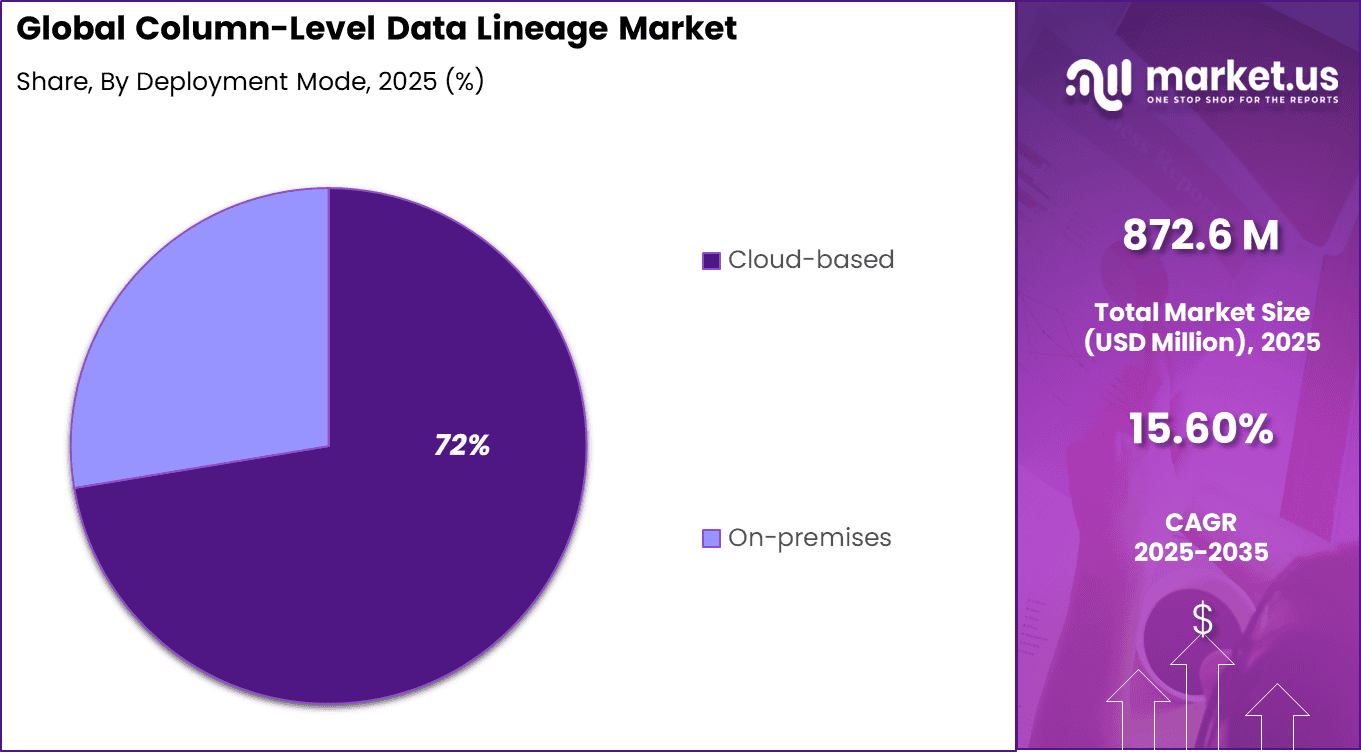
- By deployment mode, cloud-based platforms represent 72.4%, offering scalability and automated metadata capture in hybrid/multi-cloud data estates.
- By organization size, large enterprises hold 88.2% share, requiring precise lineage for complex data flows and governance at enterprise scale.
- By application, regulatory compliance and audit reporting captures 54.3%, providing audit trails and impact analysis for financial regulations like SOX and Basel.
- By end-user industry, banking, financial services, and insurance (BFSI) command 61.7%, leveraging column-level visibility for risk reporting, model validation, and data quality assurance.
Drivers Impact Analysis
Key Driver Impact on CAGR Forecast (~%) Geographic Relevance Impact Timeline Increasing regulatory requirements for granular data traceability +4.1% North America, Europe Short to medium term Rising adoption of cloud data warehouses and lakehouse platforms +3.5% Global Medium term Growing need for audit-ready financial and risk reporting +3.0% North America, Europe Medium term Expansion of AI and advanced analytics requiring trusted data pipelines +2.7% Global Medium term Enterprise focus on improving data governance frameworks +2.3% Global Medium to long term Restarints Impact Analysis
Key Restraint Impact on CAGR Forecast (~%) Geographic Relevance Impact Timeline High implementation complexity across legacy data systems -3.2% Global Short to medium term Integration challenges across multi-cloud and hybrid environments -2.7% North America, Europe Medium term Limited metadata standardization across enterprises -2.3% Global Medium term Budget constraints among mid-sized organizations -1.9% Asia Pacific, Latin America Medium term Shortage of skilled data governance professionals -1.6% Global Medium to long term By Component
Software and solutions account for 76.8% of the column-level data lineage market. Organizations increasingly require precise tracking of how individual data fields move across systems, databases, and reports. Column-level lineage tools provide detailed visibility into data transformations, mappings, and dependencies. This granular insight is critical for ensuring transparency and accuracy within complex data environments.
As enterprises strengthen governance frameworks, demand for advanced lineage software continues to rise. These solutions typically include metadata management, impact analysis, and automated lineage mapping capabilities. They enable data teams to trace errors back to their source at the column level rather than at a broader table level. This improves troubleshooting efficiency and reduces operational risk. Integration with data warehouses, analytics tools, and regulatory reporting systems enhances usability.
By Deployment Mode
Cloud-based deployment represents 72.4% of the market, reflecting the strong alignment between lineage tools and cloud data ecosystems. As organizations migrate data warehouses and analytics platforms to the cloud, lineage tracking must adapt to distributed and dynamic environments. Cloud-based lineage systems provide scalable infrastructure to monitor large and evolving datasets.
Real-time updates ensure that changes in schemas or pipelines are captured immediately. This strengthens governance across cloud-native architectures. Cloud deployments also offer centralized dashboards accessible across global teams.
Automated metadata discovery within cloud environments reduces manual documentation efforts. Enterprises benefit from faster implementation cycles and lower infrastructure management requirements. Security controls embedded in cloud platforms further support compliance objectives. These operational advantages continue to drive strong cloud-based adoption within the lineage segment.
By Organization Size
Large enterprises hold 88.2% of the column-level data lineage market. These organizations manage vast volumes of structured and semi-structured data across multiple departments and regions. Ensuring accuracy at the column level is essential for reporting consistency and regulatory compliance.
Enterprise-scale systems require comprehensive tracking to prevent discrepancies in analytics outputs. This complexity drives significant investment in detailed lineage capabilities. Large enterprises also operate under strict audit and governance requirements.
Column-level tracking enables precise documentation of how data fields are transformed before appearing in executive dashboards or regulatory submissions. Automated lineage mapping reduces dependency on manual documentation processes. Integration with enterprise governance frameworks enhances risk management. The scale and regulatory exposure of large organizations explain their dominant share.
By Application
Regulatory compliance and audit reporting account for 54.3% of market share. Financial and regulated industries require complete transparency into how data is sourced, transformed, and reported. Column-level lineage ensures that each data element used in reports can be traced back to its origin. This level of granularity supports audit readiness and reduces compliance risk.
Organizations increasingly rely on lineage tools to meet evolving regulatory standards. Audit processes demand clear documentation of data transformations across systems. Automated lineage solutions provide visual maps and impact analysis reports for regulators and internal audit teams.
This reduces the time required for compliance verification. Continuous monitoring also helps detect inconsistencies before regulatory submission. The growing emphasis on governance accountability drives strong demand within this application segment.
By End User Industry
The Banking, Financial Services, and Insurance sector accounts for 61.7% of the column-level data lineage market. Financial institutions manage highly sensitive transactional and customer data. Regulatory frameworks require precise reporting and validation of financial metrics. Column-level lineage ensures that each reported value is supported by traceable and verified data sources. This strengthens regulatory confidence and internal risk management.
Banks and financial firms often operate across multiple legacy and modern systems. Data transformations occur across risk, compliance, and analytics platforms. Column-level visibility reduces reconciliation errors and improves reporting accuracy. Automated tracking also supports fraud detection and financial transparency initiatives. The sector’s strict compliance environment explains its leading adoption share.
Investor Type Impact Matrix
Investor Type Growth Sensitivity Risk Exposure Geographic Focus Investment Outlook Data governance and lineage platform providers Very High Medium North America, Europe Strong SaaS scalability Cloud data warehouse vendors High Medium Global Embedded lineage capability expansion Enterprise analytics and BI vendors Medium Medium Global Integration-driven growth Private equity firms Medium Medium North America, Europe Consolidation of governance platforms Venture capital investors High High North America Innovation in automated lineage discovery Technology Enablement Analysis
Technology Enabler Impact on CAGR Forecast (~%) Primary Function Geographic Relevance Adoption Timeline Automated metadata harvesting and mapping engines +4.4% Granular data traceability Global Short to medium term AI-driven lineage discovery and dependency tracking +3.8% Faster impact analysis North America, Europe Medium term Integration with ETL, ELT, and streaming pipelines +3.2% End-to-end visibility Global Medium term Cloud-native lineage platforms with API integration +2.6% Scalability and flexibility Global Medium to long term Real-time lineage visualization dashboards +2.1% Audit and governance reporting Global Long term Emerging Trends
In the Column-Level Data Lineage market, a strong trend is the move toward detailed tracking of how data values flow and change from source to destination at the column level. Organisations are shifting from broad table-level lineage views to more precise models that show how each individual data field is transformed, filtered, or joined across systems.
This approach helps analysts and auditors understand the origin and transformation history of critical data elements, especially when data is used for reporting or compliance purposes. Another emerging pattern is the inclusion of simple visual maps that show lineage paths clearly, so teams in technical and business roles can follow data journeys without confusion.
Growth Factors
A key growth factor in this market is the need for strong data trust and transparency across business processes. As organisations depend more on data for decision making, it becomes essential to know exactly how each data field was derived and whether any changes were applied along the way. Column-level lineage provides this clarity, which improves confidence in reported results and supports better governance practices.
Another important driver is increasing compliance expectations, where regulators and auditors require clear traceability of data used in financial, operational, or risk reports. By documenting how data moves and changes at the column level, organisations can respond to inquiries and reviews with confidence, strengthening accountability and oversight within data operations.
Key Market Segments
By Component
- Software/Solutions
- Services
By Deployment Mode
- Cloud-based
- On-premises
By Organization Size
- Large Enterprises
- Small and Medium-sized Enterprises
By Application
- Impact Analysis for Schema Changes
- Data Quality Issue Root-Cause Analysis
- Regulatory Compliance and Audit Reporting
- Data Governance and Cataloging
- Others
By End-User Industry
- Banking, Financial Services, and Insurance
- Healthcare and Life Sciences
- Technology and Software
- Government and Public Sector
- Others
Regional Analysis
North America accounts for 38.3% of the column-level data lineage market, supported by strong regulatory focus on data transparency, auditability, and governance. Enterprises across banking, healthcare, retail, and technology sectors are adopting granular lineage tools to track data movement at the column level across complex data warehouses and analytics pipelines. Demand is driven by increasing compliance requirements, the need for accurate impact analysis during data changes, and rising adoption of cloud-based data platforms.
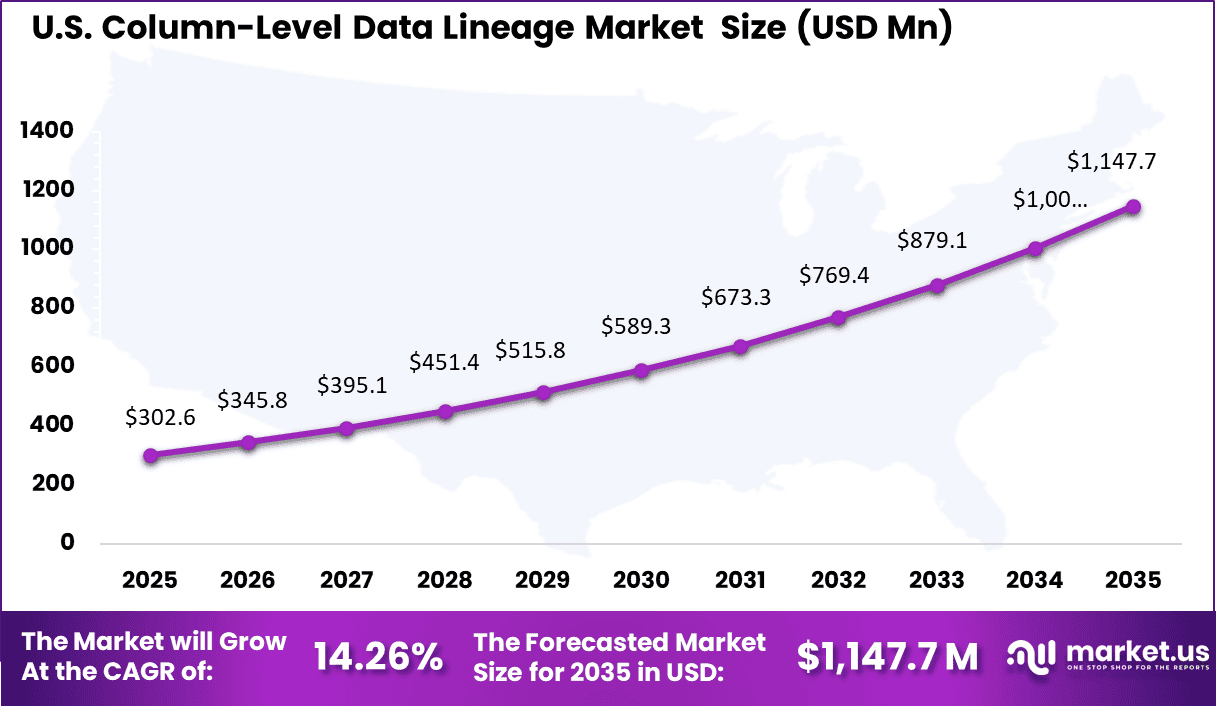
The United States market is valued at USD 302.6 Mn and is expanding at a CAGR of 14.26%, reflecting growing investment in advanced data governance frameworks. Adoption is influenced by rising volumes of structured and semi-structured data, stricter reporting standards, and the need to ensure traceability in financial and operational analytics. Growth is further supported by integration of lineage capabilities with data catalogs, quality monitoring systems, and compliance reporting tools to strengthen enterprise-wide data control and accountability.
Key Regions and Countries
- North America
- US
- Canada
- Europe
- Germany
- France
- The UK
- Spain
- Italy
- Russia
- Netherlands
- Rest of Europe
- Asia Pacific
- China
- Japan
- South Korea
- India
- Australia
- Singapore
- Thailand
- Vietnam
- Rest of APAC
- Latin America
- Brazil
- Mexico
- Rest of Latin America
- Middle East & Africa
- South Africa
- Saudi Arabia
- UAE
- Rest of MEA
Competitive Analysis
Specialized lineage and metadata management providers such as MANTA Software and Solidatus play a central role in the column-level data lineage market. These platforms focus on granular tracking of data movement across tables, fields, and transformation layers. Their solutions support regulatory reporting, audit readiness, and impact analysis. Alex Solutions and TimeXtender enhance automated discovery and mapping.
Enterprise data governance and integration vendors such as Collibra, Informatica, IBM, Oracle, and SAP integrate column-level lineage into broader data management frameworks. Microsoft strengthens lineage tracking within cloud ecosystems. Adoption is strong in banking, healthcare, and public sector organizations.
Data catalog and intelligence providers such as Alation, Atlan, data.world, erwin, and Precisely support visibility and collaboration across analytics teams. These vendors emphasize automated lineage capture and business glossary integration. Other players expand innovation and regional presence, supporting steady growth in column-level data lineage solutions.
Top Key Players in the Market
- MANTA Software
- Solidatus
- Collibra
- Informatica
- IBM
- Oracle
- SAP
- Alex Solutions
- erwin
- data.world
- Atlan
- Alation
- Microsoft
- Precisely
- TimeXtender
- Others
Future Outlook
The future outlook for the Column-Level Data Lineage Market is positive as organizations increasingly need clear visibility into how data flows and changes across systems. Demand for column-level data lineage solutions is expected to grow because these tools help track the movement and transformation of specific data elements, improve data quality, and support compliance requirements.
Adoption of analytics, automation, and integration with data governance platforms will enhance accuracy and operational trust. Growth can be attributed to rising data volumes, stronger regulatory standards, and the need for transparent and reliable data management. Overall, the market is expected to expand as businesses prioritize detailed data traceability and governance.
Recent Developments
- January 2026: Collibra rolled out stronger AI-powered lineage tracing across ETL and BI sources, making it easier to explain column transformations and build trust in reports for regulated setups. This builds on their governance focus, letting stewards spot issues faster in hybrid clouds.
- August 2025: Precisely added clickable column diagrams in their Data Integrity Suite, so you can hop straight from lineage views to actual pipelines and related assets without switching apps.
Report Scope
Report Features Description Market Value (2025) USD 872.6 Million Forecast Revenue (2035) USD 3,718.7 Million CAGR(2025-2035) 15.60% Base Year for Estimation 2024 Historic Period 2020-2024 Forecast Period 2025-2035 Report Coverage Revenue forecast, AI impact on Market trends, Share Insights, Company ranking, competitive landscape, Recent Developments, Market Dynamics and Emerging Trends Segments Covered By Component (Software/Solutions, Services), By Deployment Mode (Cloud-based, On-premises), By Organization Size (Large Enterprises, Small and Medium-sized Enterprises), By Application (Impact Analysis for Schema Changes, Data Quality Issue Root-Cause Analysis, Others), By End-User Industry (Banking, Financial Services, and Insurance, Healthcare and Life Sciences, Others) Regional Analysis North America – US, Canada; Europe – Germany, France, The UK, Spain, Italy, Russia, Netherlands, Rest of Europe; Asia Pacific – China, Japan, South Korea, India, New Zealand, Singapore, Thailand, Vietnam, Rest of Latin America; Latin America – Brazil, Mexico, Rest of Latin America; Middle East & Africa – South Africa, Saudi Arabia, UAE, Rest of MEA Competitive Landscape MANTA Software, Solidatus, Collibra, Informatica, IBM, Oracle, SAP, Alex Solutions, erwin, data.world, Atlan, Alation, Microsoft, Precisely, TimeXtender, Others Customization Scope Customization for segments, region/country-level will be provided. Moreover, additional customization can be done based on the requirements. Purchase Options We have three license to opt for: Single User License, Multi-User License (Up to 5 Users), Corporate Use License (Unlimited User and Printable PDF)  Column-Level Data Lineage MarketPublished date: Feb. 2026add_shopping_cartBuy Now get_appDownload Sample
 -
-
- MANTA Software
- Solidatus
- Collibra
- Informatica
- IBM
- Oracle
- SAP
- Alex Solutions
- erwin
- data.world
- Atlan
- Alation
- Microsoft
- Precisely
- TimeXtender
- Others
Our Clients

- 178148
- Feb. 2026