


Chemical Digitalization Market Size, Share and Report Analysis By Product (Specialty Chemicals, Petrochemicals And Polymers, Fertilizers And Agrochemicals, Others), By Process (Manufacturing, R&D, Procurement, Supply Chain And Logistics, Packaging), By Technology (Digital Twin, Artificial Intelligence (AI), Internet of Things (IoT), Augmented Reality (AR), Virtual Reality (VR), Others), By Region and Companies - Industry Segment Outlook, Market Assessment, Competition Scenario, Trends and Forecast 2025-2035
- Published date: Mar 2026
- Report ID: 179821
- Number of Pages: 228
- Format:
-
keyboard_arrow_up
Quick Navigation
Report Overview
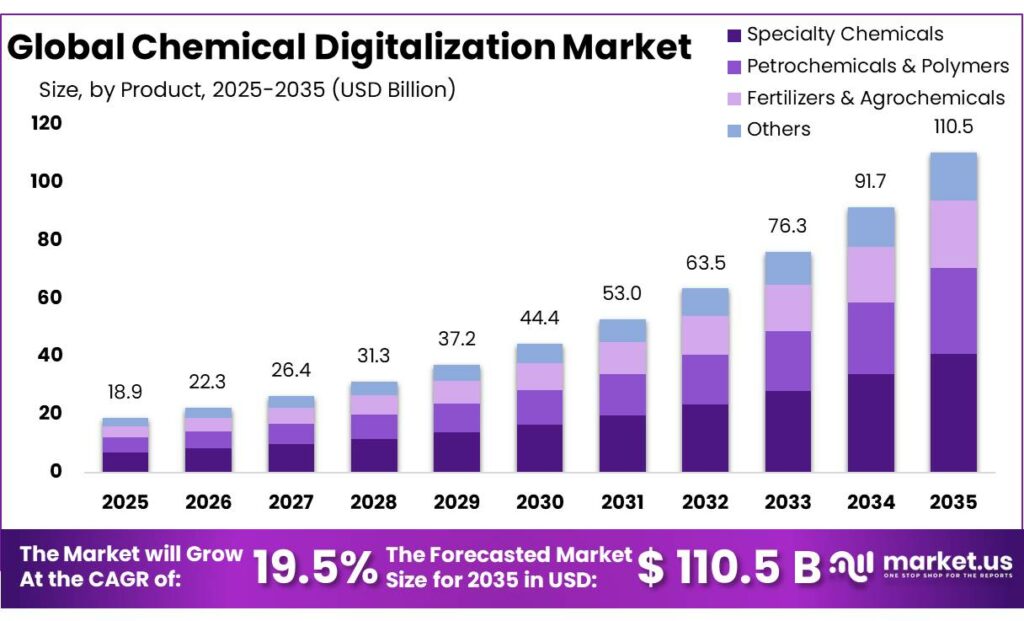
The Global Chemical Digitalization Market is expected to be worth around USD 110.5 Billion by 2035, up from USD 18.9 Billion in 2025, at a CAGR of 19.5% from 2026 to 2035. The North America segment maintained 41.6%, supporting a Chemical Digitalization value of USD 7.8 Bn.
Chemical digitalization refers to the use of connected sensors, advanced process control, digital twins, data platforms and analytics across the chemical value chain—from R&D and plants to logistics and customer interfaces.
The EU-27 chemical industry alone generates around €635 billion in turnover and directly employs about 1.2 million people, making it one of Europe’s largest manufacturing sectors. With roughly 31,000 companies in the EU27 chemical sector, of which about 30,264 are SMEs contributing 28% of sales and 36% of employment, digitalization is not just a “big-player” issue but a structural transformation challenge for thousands of smaller firms as well.
According to the EY DigiChem Survey 2022, digitalization has accelerated by 56% since the pandemic, with more than 65% of chemical players expecting it to have a “revolutionary or disruptive” impact on their business and over 40% already reporting such effects in the last three years.
- In Europe, public–private initiatives such as the SPIRE cPPP have underpinned this shift: by 2020, SPIRE had built a portfolio of 81 projects with a total European Commission budget of €900 million, including more than €100 million specifically for digital projects in process industries.
Driving forces increasingly link chemical digitalization with food security and sustainability. FAO estimates that by 2050 the world will need to produce about 60% more food to feed a projected 9.3 billion people, while around 14% of food is lost post-harvest and 17% is wasted at retail and consumer level. Digital agriculture programs led by FAO emphasize AI, IoT and data platforms across agrifood systems, positioning chemicals within increasingly data-rich value chains.
Government and multilateral initiatives reinforce this push. The Digital Europe Programme allocates over €8.1 billion from 2021–2027 to drive the continent’s digital transformation in areas such as AI, cybersecurity and high-performance computing. Within this, the European Commission has earmarked €1.3 billion for 2025–2027 specifically to support artificial intelligence, cybersecurity and digital skills, signalling a strong policy commitment to digital industrial capabilities, including chemicals.
In the food system, the FAO’s FAOSTAT platform now provides digital access to agricultural and food statistics for over 245 countries and territories, underpinning data-driven decisions along agri-food chains that depend heavily on fertilizers, crop-protection chemicals and packaging materials.
Key Takeaways
- Chemical Digitalization Market is expected to be worth around USD 110.5 Billion by 2035, up from USD 18.9 Billion in 2025, at a CAGR of 19.5%.
- Specialty Chemicals held a dominant market position, capturing more than a 37.5% share.
- Manufacturing held a dominant market position, capturing more than a 43.7% share.
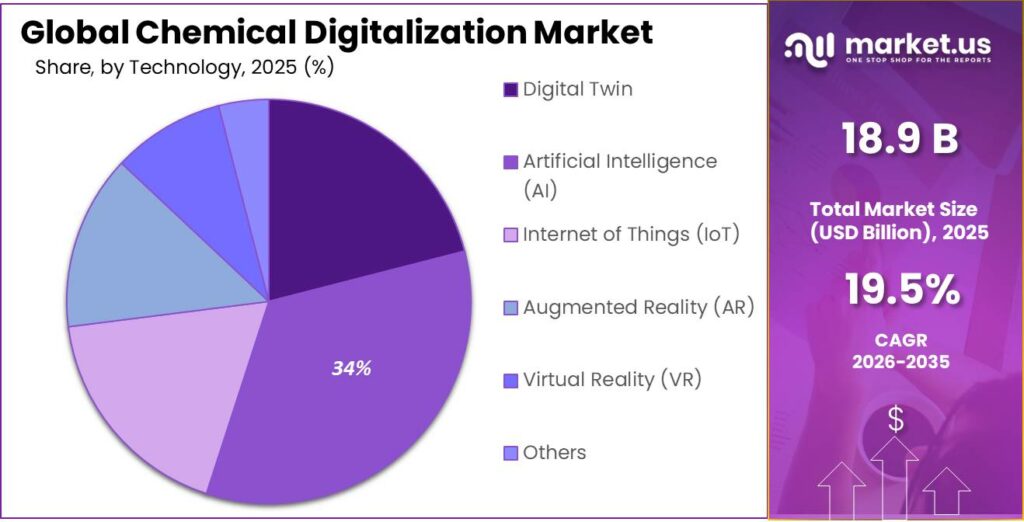
- Artificial Intelligence (AI) held a dominant market position, capturing more than a 34.8% share.
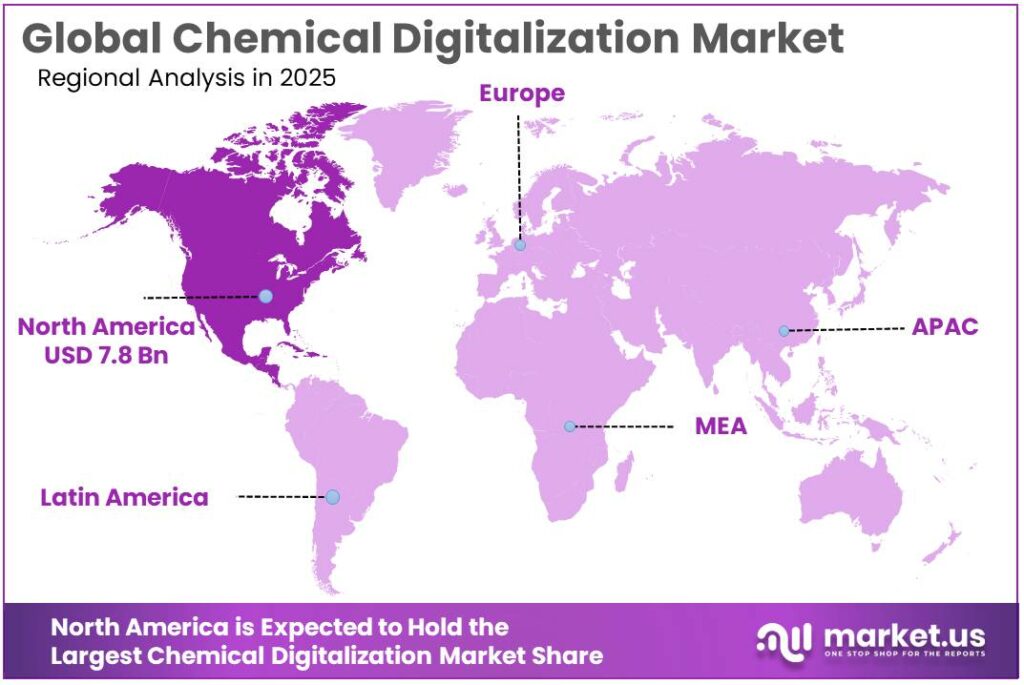
- North America held a dominant position in the Chemical Digitalization Market, capturing around 41.6% of global revenue, valued at roughly USD 7.8 billion.
By Product Analysis
Specialty Chemicals lead Chemical Digitalization with 37.5% share in 2024
In 2024, Specialty Chemicals held a dominant market position, capturing more than a 37.5% share, driven by strong adoption of digital tools in formulation, process optimization and high-value application development. This segment has been quicker to embrace digital twins, automated lab systems, and AI-supported formulation engines because its product portfolio—ranging from additives and adhesives to catalysts and performance enhancers—requires faster innovation cycles and tighter customer-specific customization.
By Process Analysis
Manufacturing leads Chemical Digitalization with a strong 43.7% share in 2024
In 2024, Manufacturing held a dominant market position, capturing more than a 43.7% share as chemical plants accelerated their shift toward automated production, digital monitoring, and connected factory systems. This dominance came from the sector’s need to optimize complex operations, lower energy usage, and ensure compliance with tightening environmental norms.
Many chemical producers upgraded legacy equipment with IoT sensors, real-time process control software, and predictive maintenance platforms, helping them reduce unplanned downtime and improve overall plant output. The push toward safer and cleaner production also encouraged adoption of digital safety systems and end-to-end traceability tools, particularly across large-scale chemical processing units.
By Technology Analysis
Artificial Intelligence takes the lead with a solid 34.8% share in 2024
In 2024, Artificial Intelligence (AI) held a dominant market position, capturing more than a 34.8% share, driven by its growing role in transforming how chemical companies design products, run plants, and manage supply chains. AI became a central tool for predicting equipment failures, optimizing reaction conditions, and supporting faster formulation development across specialty and commodity segments.
Many producers shifted from traditional trial-and-error methods to AI-enabled modeling, which helped reduce development timelines, cut operational losses, and improve consistency in high-precision chemical processes. As chemical operations generated larger volumes of data from sensors, lab systems, and production lines, AI provided the analytical power needed to convert that information into actionable insights.
Key Market Segments
By Product
- Specialty Chemicals
- Petrochemicals & Polymers
- Fertilizers & Agrochemicals
- Others
By Process
- Manufacturing
- R&D
- Procurement
- Supply Chain & Logistics
- Packaging
By Technology
- Digital Twin
- Artificial Intelligence (AI)
- Internet of Things (IoT)
- Augmented Reality (AR)
- Virtual Reality (VR)
- Others
Emerging Trends
AI-enabled, data-driven food systems are reshaping chemical digitalization
One of the clearest recent trends in chemical digitalization is how quickly it is becoming tied into AI-enabled, data-driven food and agriculture systems. Until a few years ago, digital tools in chemicals mostly lived inside plants and labs. Now they increasingly stretch across entire agrifood chains, from the fertilizer plant and crop-protection formulation lab to farms, storage, processing, packaging and retail. This shift is happening because food systems are under huge pressure to use resources better and cut waste, and that cannot be done without both smarter chemistry and better data.
The scale of the food-waste challenge shows why digital, chemistry and data are being pulled together. The latest UNEP figures show that in 2022 about 1.05 billion tonnes of food were wasted, equal to 19% of food available at the consumer level. Households alone generated 60% of this waste, or around 631 million tonnes, and on average each person wastes about 79 kg of food per year. At the same time, FAO and other agencies estimate that hundreds of millions of people still face hunger, so every tonne wasted represents both a social and a climate cost.
International organizations are explicitly framing digital agriculture and AI as tools to transform agrifood systems. FAO notes that digital technologies and artificial intelligence can support precision farming, climate-smart practices, supply-chain optimisation and better market access, helping to build more efficient and resilient agrifood systems.
- Governments are reinforcing the trend with policy and public digital infrastructure. The European Union’s Farm to Fork Strategy, part of the Green Deal, aims by 2030 to reduce the use and risk of chemical pesticides by 50% and make 25% of EU farmland organic. Reaching these targets demands more targeted chemistry and much better data on how inputs behave in the field.
Drivers
Rising food demand and sustainability pressure as a key driver of chemical digitalization
One of the biggest forces pushing chemical digitalization is the urgent need to feed more people with fewer resources and less waste. The Food and Agriculture Organization (FAO) estimates that by 2050 the world will have around 9.3 billion people, and global food production will need to increase by about 60% compared with recent decades to keep up with demand.
At the same time, the world is already wasting a shocking amount of food. FAO and the UN report that about 14% of food produced is lost between harvest and retail, and an estimated 17% of total global food production is wasted at retail and consumer level, together worth around US$400 billion every year. A separate UN Environment Programme study finds that roughly 17% of all food available to consumers is wasted, or about 121 kg per person per year at household, food-service and retail level.
- FAO’s recent analysis shows that global agrifood systems account for about one-third of total human-caused greenhouse gas emissions when farm activities, land-use change and supply-chain steps are added together. Within that, the UNFCCC estimates that food loss and waste alone are responsible for 8–10% of annual global greenhouse gas emissions and cost roughly US$1 trillion each year.
Governments are reading the same signals and building digital programmes that directly connect agriculture and chemicals. In India, the Digital Agriculture Mission (2021–2025) is described as a Government of India initiative that uses AI, IoT, drones, blockchain and data analytics to raise farm productivity, improve resource efficiency and strengthen supply chains.
Restraints
Limited workforce skills and data barriers slow down chemical digitalization
One of the strongest restraints on chemical digitalization today is the shortage of trained people and the difficulty in handling and sharing data across systems. As digital tools become more advanced—with AI, big data analytics, IoT sensors and cloud platforms now part of everyday operations—companies find that they do not have enough skilled workers who understand how to use these technologies effectively. This problem is not unique to chemicals; it is seen across related sectors like food and agriculture as well.
In chemicals, this restraint shows itself in practical ways. Implementing AI and advanced analytics often requires large volumes of clean, structured data. However, many plants still operate with legacy equipment that does not generate usable digital data, or they use isolated systems that cannot communicate with one another. Without high-quality data, digital models perform poorly, undermining confidence in digital investments. A related issue is concern over data privacy and security.
Government policy has also been slower to keep pace than industry needs, which adds to the restraint. While programmes exist to push digital adoption—such as India’s digital agriculture missions that encourage AI, IoT and data analytics for boosting farm productivity—most focus on agriculture or specific downstream applications, not on building broad workforce capabilities or data standards that would support seamless integration in chemistry and allied sectors.
Opportunity
Digital climate-smart solutions for food and agrifood chains as a major growth opportunity
A major growth opportunity for chemical digitalization lies in building climate-smart, data-driven solutions for the global food and agrifood system. The pressure on this system is rising fast. FAO’s latest analysis shows that agrifood systems generated 16.5 billion tonnes of CO₂-equivalent in 2023, accounting for about one-third of total human-made greenhouse gas emissions. At the same time, the world is moving towards a population close to 9.7 billion people by 2050, meaning agriculture will need to produce around 50–70% more food than in the early 2000s, depending on the baseline used.
Food loss and waste highlight this opportunity even more sharply. UNEP’s Food Waste Index shows that around 17% of the food available to consumers is wasted, equal to roughly 121 kg per person per year at household, food-service and retail level. Separate UN and UNEP summaries estimate that food that is produced but not eaten is responsible for 8–10% of global greenhouse gas emissions. Digitalized chemical development can support new shelf-life-extending packaging, smarter post-harvest coatings, more precise refrigerants and cleaning chemistries, and process additives that cut waste during processing.
Policy is pushing in the same direction. Under the European Green Deal’s Farm to Fork Strategy, the EU has set indicative targets to cut the use and risk of chemical pesticides by 50% and reduce more hazardous pesticides by 50% by 2030, alongside goals to expand organic farming and cut environmental impacts from fertilizers.
Emerging government programmes in large agrarian economies add another layer of opportunity. India’s Digital Agriculture Mission (2021–2025) is designed to promote smart farming using AI, IoT, blockchain and data analytics to raise productivity and support farmers.
Regional Insights
North America leads chemical digitalization with 41.6% share and USD 7.8 Bn value in 2024
In 2024, North America held a dominant position in the Chemical Digitalization Market, capturing around 41.6% of global revenue, valued at roughly USD 7.8 billion. This leadership reflects the region’s strong industrial base and early push into data-driven manufacturing. The United States alone remains one of the largest chemical producers worldwide, with USD 639 billion in chemical shipments in 2022, representing about 11% of global chemical production and supporting more than half a million direct jobs.
Canada deepens this regional strength: its chemical industry recorded CAD 74.8 billion (about USD 55–56 billion) in shipments in 2023 and employed 93,300 workers, accounting for around 6% of all manufacturing jobs in the country, with an estimated 559,900 total jobs when indirect employment is included. This scale gives North American players both the resources and the incentive to invest in chemical digitalization across R&D, process control, and supply-chain visibility.
Key Regions and Countries Insights
- North America
- US
- Canada
- Europe
- Germany
- France
- The UK
- Spain
- Italy
- Rest of Europe
- Asia Pacific
- China
- Japan
- South Korea
- India
- Australia
- Rest of APAC
- Latin America
- Brazil
- Mexico
- Rest of Latin America
- Middle East & Africa
- GCC
- South Africa
- Rest of MEA
Key Players Analysis
For chemicals, General Electric’s legacy in industrial software now largely sits inside GE Vernova, which provides grid, power and digital technologies that also serve energy-intensive chemical complexes. In 2024, GE Vernova reported $34.9 billion in revenue and $44.1 billion in orders, with backlog reaching $119 billion and a workforce of roughly 75,000 employees. Its Proficy/Predix-heritage tools support asset performance management, advanced analytics and industrial IoT, enabling chemicals producers to run more reliable, data-driven operations.
ABB is a core automation partner for chemical digitalization, especially in continuous and batch processing. Its System 800xA and ABB Ability platforms integrate control, safety, power and optimization in one environment, ideal for complex chemical units. In 2024, ABB recorded $32.9 billion in revenues and $33.7 billion in orders, delivering income from operations of $5.1 billion, with an operational EBITA margin of 18.1% and a global workforce of about 110,000 employees. This scale underpins sustained investment in digital process technologies.
Emerson Electric is deeply embedded in chemical plants through its DeltaV DCS, AMS asset-management and OSI / AspenTech software, all central to modern chemical digitalization. In fiscal 2024, Emerson reported $17.49 billion in net sales, up from $15.17 billion the prior year, and continued to expand margins through its automation-focused portfolio. By 2025, the company highlighted net sales of about $18.0 billion and a global workforce of roughly 71,000 employees.
Top Key Players Outlook
- Siemens AG
- General Electric
- ABB Ltd.
- Rockwell Automation
- Emerson Electric
- Honeywell International
- Yokogawa Electric Corporation
- Mitsubishi Chemical Group Corporation
- Solvay
Recent Industry Developments
In 2024, ABB reported group revenues of about USD 32.9 billion, with income from operations of roughly USD 5.07 billion and net income attributable to shareholders of around USD 3.94 billion, supported by an operational EBITA margin of 18.1% and a return on capital employed of 22.9%.
In fiscal 2024, Siemens generated about €75.9 billion in revenue, with net income of roughly €9.0 billion, and employed around 312,000 people worldwide, giving it the financial strength and talent base to keep investing in digital industries and process automation.
Report Scope
Report Features Description Market Value (2025) USD 18.9 Bn Forecast Revenue (2035) USD 110.5 Bn CAGR (2026-2035) 19.5% Base Year for Estimation 2025 Historic Period 2020-2024 Forecast Period 2026-2035 Report Coverage Revenue Forecast, Market Dynamics, Competitive Landscape, Recent Developments Segments Covered By Product (Specialty Chemicals, Petrochemicals And Polymers, Fertilizers And Agrochemicals, Others), By Process (Manufacturing, R&D, Procurement, Supply Chain And Logistics, Packaging), By Technology (Digital Twin, Artificial Intelligence (AI), Internet of Things (IoT), Augmented Reality (AR), Virtual Reality (VR), Others) Regional Analysis North America – US, Canada; Europe – Germany, France, The UK, Spain, Italy, Rest of Europe; Asia Pacific – China, Japan, South Korea, India, Australia, Singapore, Rest of APAC; Latin America – Brazil, Mexico, Rest of Latin America; Middle East & Africa – GCC, South Africa, Rest of MEA Competitive Landscape Siemens AG, General Electric, ABB Ltd., Rockwell Automation, Emerson Electric, Honeywell International, Yokogawa Electric Corporation, Mitsubishi Chemical Group Corporation, Solvay Customization Scope Customization for segments, region/country-level will be provided. Moreover, additional customization can be done based on the requirements. Purchase Options We have three licenses to opt for: Single User License, Multi-User License (Up to 5 Users), Corporate Use License (Unlimited User and Printable PDF)  Chemical Digitalization MarketPublished date: Mar 2026add_shopping_cartBuy Now get_appDownload Sample
 -
-
- Siemens AG
- General Electric
- ABB Ltd.
- Rockwell Automation
- Emerson Electric
- Honeywell International
- Yokogawa Electric Corporation
- Mitsubishi Chemical Group Corporation
- Solvay
Our Clients

- 179821
- Mar 2026






