


Global Biocides For Leather Market Size, Share, And Industry Analysis Report By Product (Fungicides, Bactericides), By Application (Tanning and Dyeing, Beamhouse, Finishing, Curing, Others), By Region and Companies - Industry Segment Outlook, Market Assessment, Competition Scenario, Statistics, Trends and Forecast 2026-2035
- Published date: March 2026
- Report ID: 180153
- Number of Pages: 387
- Format:
-
keyboard_arrow_up
Quick Navigation
Report Overview
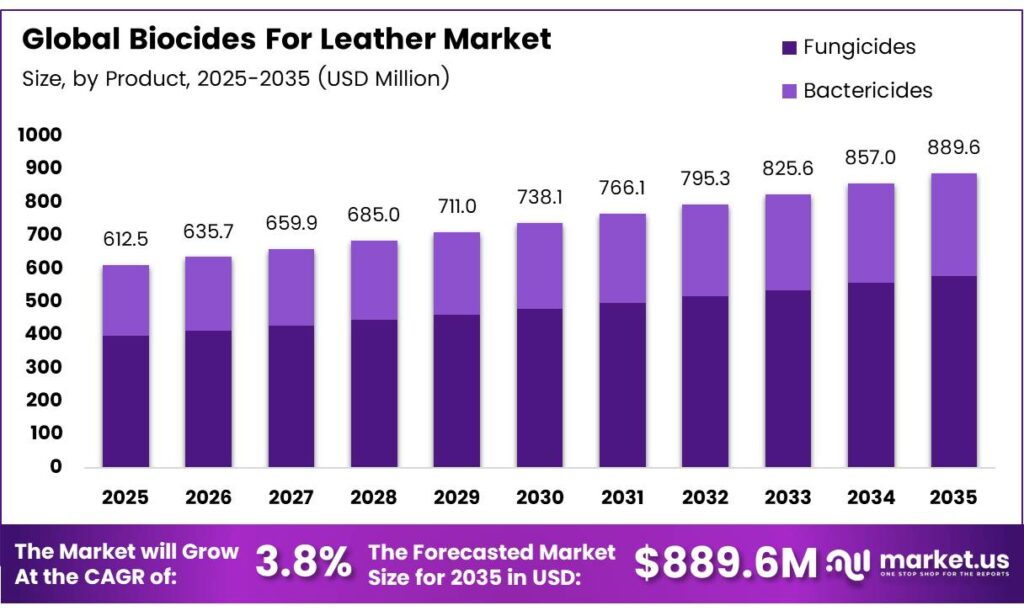
The Global Biocides For Leather Market size is expected to be worth around USD 889.6 million by 2035 from USD 612.5 million in 2025, growing at a CAGR of 3.8% during the forecast period 2026 to 2035.
Biocides for leather are chemical agents used to prevent microbial growth during leather processing. These solutions protect hides and finished leather products from bacteria, fungi, and mold. Leather manufacturers apply them across multiple production stages to ensure quality, durability, and hygiene standards.
The leather industry relies heavily on preservation chemistry to maintain product integrity. Fungicides and bactericides protect raw hides from spoilage during storage and transit. Additionally, biocide treatment remains essential across tanning, dyeing, and finishing operations to deliver market-ready, long-lasting leather goods.
- LANXESS Protection segment recorded sales of €2,081 million in FY2024, reflecting the scale of specialty preservation chemistry supply chains that serve industrial applications, including leather processing. This signals continued commercial investment in biocide-linked product categories globally.
Global demand for premium leather goods continues to drive biocide adoption. Rising disposable incomes push consumer preference for high-quality footwear, automotive interiors, and luxury accessories. Consequently, leather manufacturers invest in advanced preservation solutions to meet evolving quality standards and comply with international chemical regulations.
- India exported $4.32 billion worth of HS 3808 preparations, including industrial biocides and disinfectants used for hide and leather preservation programs. Brazil received a 23% destination share, confirming strong cross-border trade flows for leather-relevant preservation chemistries across emerging markets.
Government regulations across major markets accelerate the shift toward safer and compliant biocide formulations. Regulatory bodies in Europe, North America, and the Asia Pacific enforce strict chemical safety standards for industrial preservation products. Moreover, these frameworks push manufacturers to develop low-toxicity, high-performance biocide alternatives for broader market acceptance.
Key Takeaways
- The Global Biocides For Leather Market is valued at USD 612.5 million in 2025 and is projected to reach USD 889.6 million by 2035, at a CAGR of 3.8% during the forecast period from 2026 to 2035.
- Fungicides dominate the market with a 65.2% share in 2025.
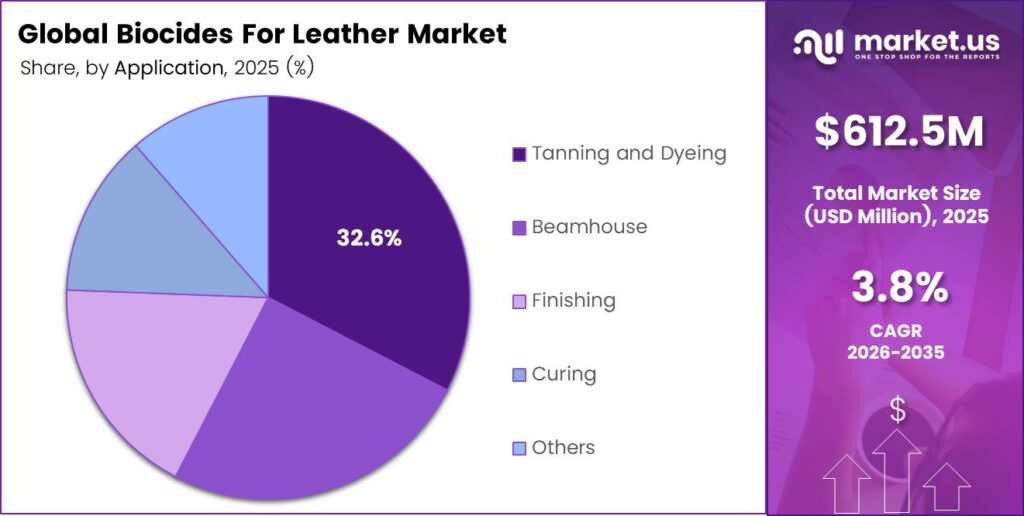
- Tanning and dyeing led with a 32.6% market share in 2025.
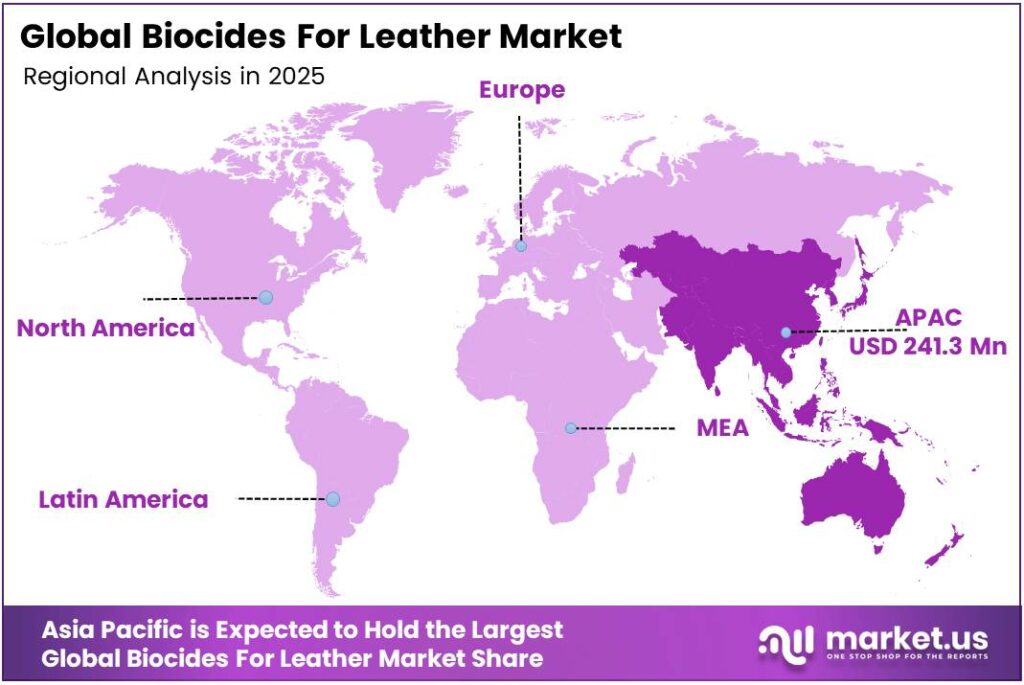
- Asia Pacific holds the largest regional share at 39.4%, valued at USD 241.3 million in 2025.
By Product Analysis
Fungicides dominate with 65.2% due to their critical role in preventing mold and fungal spoilage across all leather processing stages.
In 2025, Fungicides held a dominant market position in the by-product segment of the Biocides For Leather Market, with a 65.2% share. Fungal contamination poses the greatest risk to raw hides during soaking, storage, and early processing. Therefore, fungicides remain the most widely used preservation chemistry across global leather manufacturing operations.
Bactericides represent the second major product category in the biocides for leather market. These agents target bacterial spoilage that occurs during hide soaking, beamhouse operations, and wet processing stages. Moreover, bactericides play a critical supporting role alongside fungicides to deliver comprehensive microbial control throughout the leather production chain.
By Application Analysis
Tanning and dyeing dominate with 32.6% due to the high microbial risk and chemical sensitivity during core leather transformation stages.
In 2025, Tanning and Dyeing held a dominant market position in the By Application segment of the Biocides For Leather Market, with a 32.6% share. This stage involves prolonged exposure of hides to wet conditions, creating ideal environments for microbial growth. Consequently, manufacturers apply higher biocide concentrations here to protect product quality and appearance.
Beamhouse operations represent the initial wet processing stage where raw hides undergo soaking, liming, and unhairing. Microbial risk is especially high at this phase due to the organic content present in untreated hides. Additionally, biocide applications in beamhouse operations directly prevent early-stage spoilage before tanning chemistry begins.
Finishing applications involves the final surface treatment of leather to enhance appearance and tactile properties. Biocides applied during finishing protect the completed product from post-process microbial attack. However, formulations used here require low toxicity and minimal surface impact to preserve aesthetic quality.
Curing is a preservation step applied to raw hides before tanning begins, typically involving salt or biocide treatments to prevent decomposition during storage and transit. Biocide-assisted curing extends hide shelf life significantly. Moreover, this application remains critical for hides sourced from remote regions before processing at central tanneries.
The Others category includes ancillary leather processing stages such as fat liquoring and special treatments that require targeted microbial protection. These applications represent smaller but growing demand segments. Furthermore, specialty biocide formulations for these stages enable manufacturers to address niche quality and safety requirements.
Key Market Segments
By Product
- Fungicides
- Bactericides
By Application
- Tanning and Dyeing
- Beamhouse
- Finishing
- Curing
- Others
Emerging Trends
Eco-Friendly Formulations and Precision Technologies Reshape Biocide Strategies in Leather Processing
Leather manufacturers increasingly adopt multi-functional, eco-friendly biocides that combine preservation with enhanced finishing properties. These advanced formulations reduce the number of chemical treatments required per production cycle. Moreover, they help manufacturers meet both performance targets and rising consumer expectations for sustainably processed leather products.
- Hygiene-driven antimicrobial solutions gain strong traction in medical-grade and high-end leather applications. Manufacturers supplying hospitals, automotive brands, and premium fashion houses demand biocides with certified antimicrobial performance. Evonik reported a ROCE improvement to 7.1% from 3.4%, reflecting the growing commercial value of specialty additives, including antimicrobial chemistries for industrial applications.
Precision monitoring technologies now enable optimized biocide application and reduced consumption in modern tanneries. Digital dosing systems track microbial load in real time and adjust biocide concentration accordingly. Consequently, leather producers achieve better preservation outcomes while lowering chemical costs and minimizing environmental discharge from processing operations.
Drivers
Rising Premium Leather Demand and Regulatory Pressure Drive Biocide Market Growth
Global demand for premium leather goods in footwear, automotive interiors, and fashion accessories drives consistent biocide adoption. Rising disposable incomes across Asia Pacific, Europe, and North America push consumers toward higher-quality leather products. Consequently, manufacturers increase investment in microbial protection solutions to deliver durable and aesthetically superior finished goods.
- Leather processing requires microbial protection across every wet stage, from soaking through tanning to finishing. Biocides prevent bacterial and fungal spoilage that causes hide degradation and product defects. BASF’s recorded income from operations of €1,634 million highlights the commercial scale of specialty chemical suppliers that actively serve leather processing preservation supply chains.
Strict global regulatory frameworks on chemical safety accelerate the shift toward innovative and compliant biocide solutions. Regulatory bodies enforce chemical safety standards that restrict hazardous substances in leather production. Therefore, manufacturers respond by developing high-performance formulations that meet evolving compliance requirements while maintaining effective antimicrobial action throughout the production process.
Restraints
Toxicity Concerns and Raw Material Volatility Limit Biocide Market Expansion
Traditional chemical biocides carry well-documented toxicity and health hazard profiles that attract public and regulatory scrutiny. Environmental agencies in Europe and North America have restricted several established biocide compounds used in leather processing. Moreover, these restrictions force manufacturers to reformulate products, increasing development timelines and raising costs for compliant alternatives.
Volatile raw material costs derived from petrochemical sources significantly impact production economics for biocide manufacturers. Price fluctuations in feedstock affect formulation costs and reduce profit margins across the supply chain. Consequently, smaller manufacturers struggle to absorb cost increases, limiting their ability to invest in product innovation or maintain competitive pricing for end users.
Market fragmentation also creates challenges for standardizing biocide application practices across diverse leather processing regions. Different regulatory environments in the Asia Pacific, Europe, and North America require tailored compliance strategies. Additionally, inconsistent adoption of best-practice guidelines slows the penetration of advanced biocide formulations in developing leather manufacturing markets.
Growth Factors
Bio-Based Innovation, Nanotechnology, and Circular Economy Alignment Accelerate Market Expansion
Research and development activity focuses intensely on bio-based and low-impact biocides that deliver superior efficacy with minimal environmental footprint. Manufacturers invest in plant-derived antimicrobial agents and fermentation-based preservation solutions. BASF’s investment of €1,995 million in R&D expenses, part of which supports preservative and biocide product development for industrial formulation chains.
Nanotechnology integration enables next-generation antimicrobial performance in leather processing applications. Nano-encapsulated biocide delivery systems provide controlled release and extended protection throughout the product lifecycle. BASF’s capacity expansion for alkylpolyglucosides in Bangpakong, Thailand, and Cincinnati, Ohio, signals continued investment in formulation inputs that support advanced leather preservation strategies in key manufacturing regions.
Alignment with circular economy initiatives drives demand for sustainable biocides compatible with chrome-free and eco-conscious tanning processes. Leather brands globally commit to reducing chemical footprint across their supply chains. Therefore, biocide suppliers that develop chrome-free, compatible, and biodegradable formulations position themselves to capture growing demand from environmentally responsible tanneries worldwide.
Regional Analysis
Asia Pacific Dominates the Biocides for Leather Market with a Market Share of 39.4%, Valued at USD 241.3 Million
Asia Pacific leads the global biocides for leather market, commanding a 39.4% share valued at USD 241.3 million in 2025. China, India, and Bangladesh concentrate the world’s largest leather manufacturing capacity, creating substantial and consistent demand for preservation chemistries. Moreover, the rapid expansion of tannery infrastructure across the region continues to drive strong volume growth for biocide suppliers.
North America maintains a strong position in the biocides for leather market, supported by the advanced automotive and luxury leather goods sectors. The United States drives the majority of regional demand through its premium leather manufacturing and processing industry. Additionally, strict EPA and regulatory standards push manufacturers toward high-performance, compliant biocide formulations that meet both safety and efficacy requirements.
Europe represents a mature and highly regulated market for leather biocides, led by Germany, Italy, and France. The European Chemicals Agency enforces strict REACH compliance standards that shape biocide product development across the region. Consequently, European leather manufacturers lead global adoption of eco-friendly and low-toxicity preservation solutions for premium leather goods production.
Latin America shows consistent growth in leather biocide demand, driven by Brazil and Mexico as major hide processing centers. Brazil ranks as one of the world’s largest cattle hide exporters, generating strong upstream demand for preservation treatments. Furthermore, expanding domestic leather goods manufacturing in the region creates additional opportunities for biocide suppliers seeking new markets.
Key Regions and Countries
North America
- US
- Canada
Europe
- Germany
- France
- The UK
- Spain
- Italy
- Rest of Europe
Asia Pacific
- China
- Japan
- South Korea
- India
- Australia
- Rest of APAC
Latin America
- Brazil
- Mexico
- Rest of Latin America
Middle East & Africa
- GCC
- South Africa
- Rest of MEA
Key Players Analysis
Lanxess AG is a leading specialty chemicals company with a significant presence in industrial preservation and biocide chemistry. The company supplies antimicrobial agents and protection chemistries across multiple industrial sectors, including leather processing. Its Consumer Protection segment serves tanneries and chemical formulators globally, supported by a broad portfolio of regulatory-compliant biocide solutions tailored for demanding industrial applications.
Buckman Laboratories International, Inc. specializes in developing high-performance specialty chemicals for the leather, pulp, paper, and water treatment industries. The company offers a comprehensive range of biocide products designed for hide preservation, beamhouse operations, and wet-end leather processing. Buckman’s technical service teams work closely with tanneries to optimize biocide application and reduce chemical consumption while maintaining product quality standards.
Vink Chemicals GmbH and Co. KG focuses exclusively on biocides and preservation solutions for industrial applications, including leather, paints, coatings, and metalworking fluids. The company brings deep formulation expertise to leather preservation, offering products suited for tanning, finishing, and in-can preservation. Additionally, Vink Chemicals develops low-toxicity alternatives that help leather manufacturers align with evolving European chemical regulations.
Troy Corporation is a global provider of performance materials, including antimicrobial agents, biocides, and driers used in leather, coatings, and personal care applications. Troy’s leather biocide portfolio addresses fungal and bacterial contamination across the full hide processing cycle. The company invests in product innovation to deliver compliant, high-efficacy solutions that meet increasingly stringent environmental and safety standards across international markets.
Top Key Players in the Market
- Lanxess AG
- Buckman Laboratories International, Inc.
- Vink Chemicals GmbH and Co. KG
- Troy Corporation
- ICL Performance Products LP
- Archroma Management LLC
- Ashland Global Holdings Inc.
- Huntsman International LLC
Recent Developments
- In 2025, Lanxess AG has two notable recent developments in biocides/fungicides for the leather sector, both tied to its Preventol portfolio, used for mold/fungi protection in leather intermediates and tanning processes. LANXESS introduced and showcased Preventol CT 40, a new preservative for leather intermediates. It combines electrophilic and membrane-active properties for broad-spectrum efficacy against mold and fungi, and enhanced storage stability during manufacturing/storage/transport.
- In 2025, General biocide registrations/authorisations (LANXESS CMIT/MIT 10-year EU authorisation, Nov 2024 for industrial preservation; PT9/PT13 references for leather/polymers) and legislative notes exist, but none tie new 2023–2026 approvals or changes specifically to leather biocides for any listed company beyond the broader regulatory context already noted.
Report Scope
Report Features Description Market Value (2025) USD 612.5 Million Forecast Revenue (2035) USD 889.6 Million CAGR (2026-2035) 3.8% Base Year for Estimation 2025 Historic Period 2020-2024 Forecast Period 2026-2035 Report Coverage Revenue Forecast, Market Dynamics, Competitive Landscape, Recent Developments Segments Covered By Product (Fungicides, Bactericides), By Application (Tanning and Dyeing, Beamhouse, Finishing, Curing, Others) Regional Analysis North America (US and Canada), Europe (Germany, France, The UK, Spain, Italy, and Rest of Europe), Asia Pacific (China, Japan, South Korea, India, Australia, and Rest of APAC), Latin America (Brazil, Mexico, and Rest of Latin America), Middle East & Africa (GCC, South Africa, and Rest of MEA) Competitive Landscape Lanxess AG, Buckman Laboratories International, Inc., Vink Chemicals GmbH and Co. KG, Troy Corporation, ICL Performance Products LP, Archroma Management LLC, Ashland Global Holdings Inc., Huntsman International LLC Customization Scope Customization for segments, region/country-level will be provided. Moreover, additional customization can be done based on the requirements. Purchase Options We have three licenses to opt for: Single User License, Multi-User License (Up to 5 Users), Corporate Use License (Unlimited Users and Printable PDF)  Biocides For Leather MarketPublished date: March 2026add_shopping_cartBuy Now get_appDownload Sample
 -
-
- Lanxess AG
- Buckman Laboratories International, Inc.
- Vink Chemicals GmbH and Co. KG
- Troy Corporation
- ICL Performance Products LP
- Archroma Management LLC
- Ashland Global Holdings Inc.
- Huntsman International LLC
Our Clients

- 180153
- March 2026






