


Global Bacterial Biopesticides Market Size, Share Analysis Report By Product Type (Bacillus Thuringiensis, Bacillus Subtilis, Pseudomonas Fluorescens, Others), By Mode of Application (Foliar Spray, Seed Treatment, Soil Treatment, Post-Harvest Treatment), By Crop Type (Fruits and Vegetables, Cereals and Grains, Oilseeds and Pulses, Turf and Ornamentals, Plantation Crops) , By Region and Companies - Industry Segment Outlook, Market Assessment, Competition Scenario, Trends and Forecast 2026-2035
- Published date: April 2026
- Report ID: 183762
- Number of Pages: 375
- Format:
-
keyboard_arrow_up
Quick Navigation
Report Overview
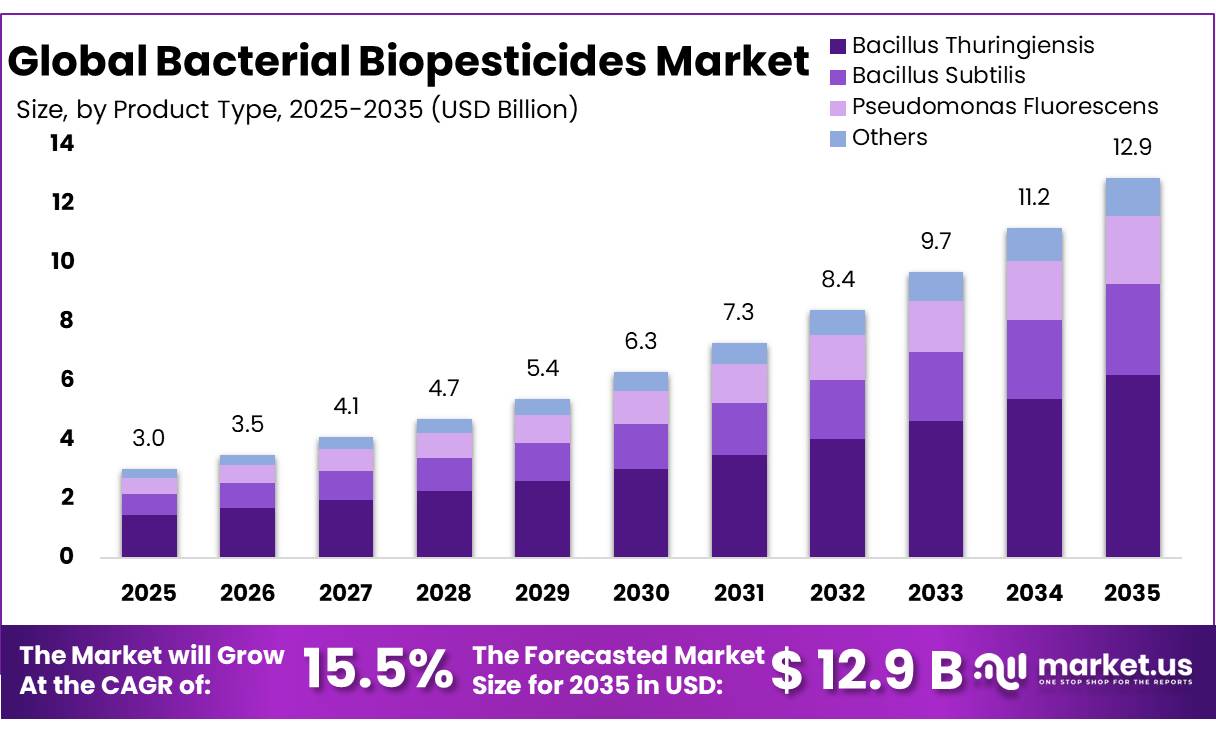
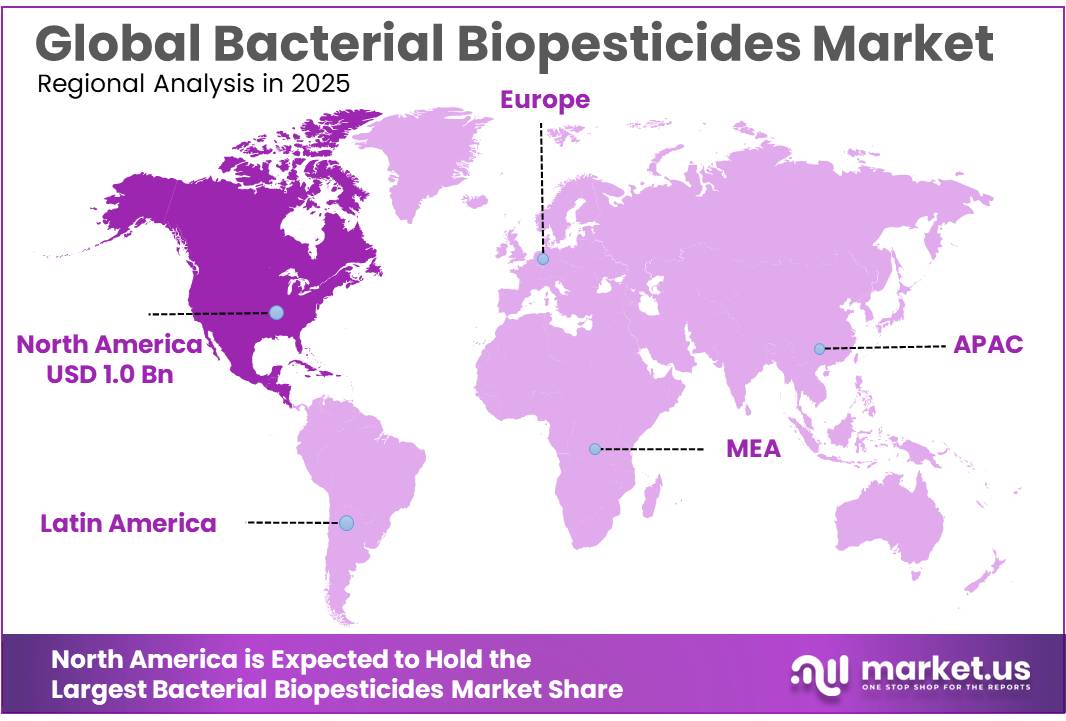
The Global Bacterial Biopesticides Market size is expected to be worth around USD 12.9 Billion by 2035, from USD 3.0 Billion in 2025, growing at a CAGR of 15.5% during the forecast period from 2026 to 2035. In 2025, North America held a dominant market position, capturing more than a 33.8% share, holding USD 1.0 Billion revenue.
Bacterial biopesticides represent one of the most established and commercially proven segments within biological crop protection. These products are based on beneficial bacteria such as Bacillus thuringiensis (Bt), Bacillus amyloliquefaciens, Bacillus subtilis, and related strains that suppress insect pests or plant diseases through targeted biological activity rather than broad-spectrum synthetic chemistry.
Their relevance is increasing because the food system is under mounting stress: the FAO states that up to 40% of global crop production is lost annually to pests and diseases, with economic losses of more than USD 220 billion from plant diseases and at least USD 70 billion from invasive insects. At the same time, FAO projects that feeding the world in 2050 will require overall food production to rise by about 70% versus 2005/07 levels, which reinforces the need for safer and more sustainable crop protection tools.
From an industrial scenario standpoint, bacterial biopesticides are no longer a niche input used only in organics. They are increasingly embedded in integrated pest management, residue management, resistance management, and export-oriented crop systems. The FAO notes that Bt products are the longest-established and best-known microbial pest control agents, with broad use in field vegetables, protected crops, and other high-value cropping systems.
In the United States, the EPA continues to widen the regulatory pipeline for biologicals; its biopesticide active ingredients database shows multiple new biopesticide active ingredients first registered in 2025, while the agency also stated in October 2025 that it had registered 15 new biopesticide active ingredients since January 2025. This signals a favorable commercialization climate for microbial and bacterial platforms.
The main growth drivers are therefore structural rather than cyclical. First, food systems are under pressure to protect yield without amplifying residue risk. Second, resistance management is pushing growers to rotate modes of action and combine chemistry with biologicals. Third, policy support for lower-input farming is widening the addressable market.
In Europe, the EEA reported that organic farming reached 17.4 million hectares or 10.8% of EU agricultural land in 2023; however, to meet the EU’s 25% organic target by 2030, the region would need to convert 3.26 million hectares per year. Separately, the European Commission stated in 2025 that about EUR 19 billion under the CAP is allocated to support organic farming, with average support of EUR 148 per hectare and more than 381,000 organic farmers in the EU.
Valent BioSciences side, the company announced the Biostimulant Innovator of the Year initiative on January 14, 2025, and later disclosed that Valent BioSciences, MGK, and Valent North America would come together under Sumitomo Biorational Company from April 2026, reflecting deeper strategic consolidation around biorational agriculture.
Key Takeaways
- Bacterial Biopesticides Market size is expected to be worth around USD 12.9 Billion by 2035, from USD 3.0 Billion in 2025, growing at a CAGR of 15.5%.
- Bacillus Thuringiensis held a dominant market position, capturing more than a 48.5% share.
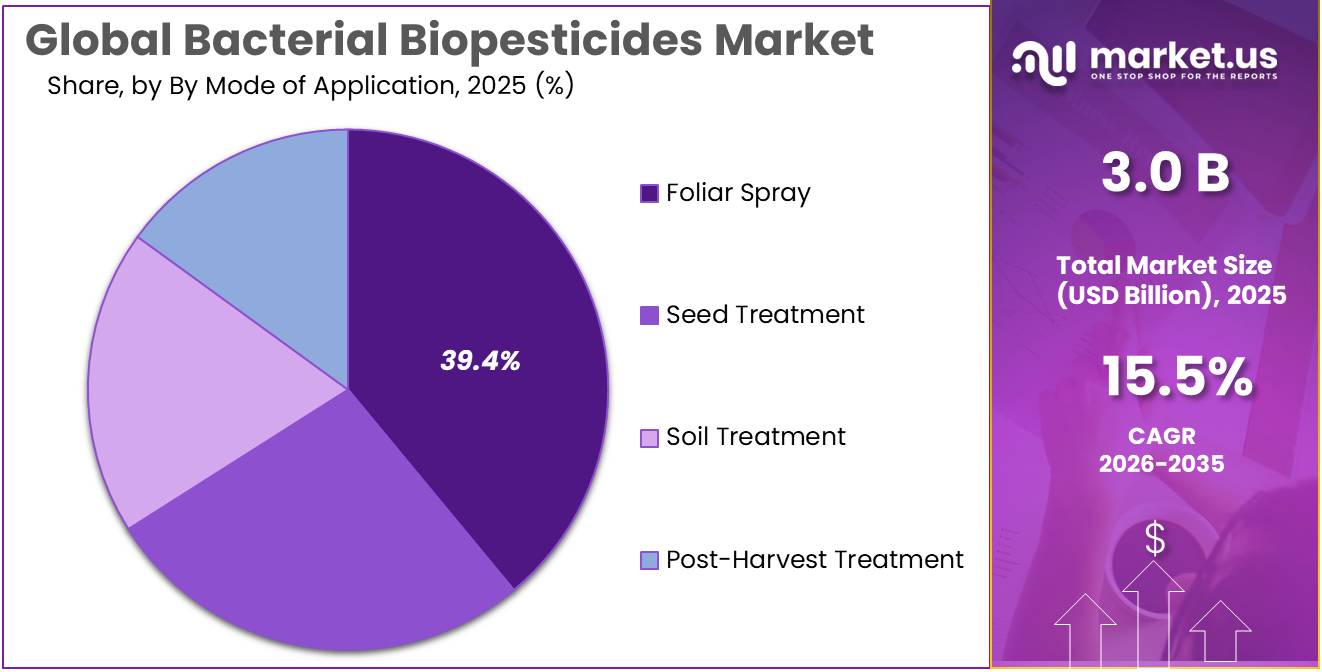
- Self-Propelled held a dominant market position, capturing more than a 39.4% share.
- Fruits and Vegetables held a dominant market position, capturing more than a 37.9% share.
- North America remained the dominant regional market in the bacterial biopesticides industry, accounting for 33.8% share and valued at USD 1.0 Bn.
By Product Type Analysis
Bacillus Thuringiensis dominates with 48.5% share in 2025 due to its proven insect control and strong use across commercial crops.
In 2025, Bacillus Thuringiensis held a dominant market position, capturing more than a 48.5% share in the bacterial biopesticides market by product type. This strong position was mainly supported by its long-standing reputation as one of the most trusted biological insect control solutions in agriculture. Growers continued to prefer Bt-based products because they are highly effective against caterpillars, borers, and other major crop-damaging insects, while remaining safe for beneficial organisms when used correctly. Its wide acceptance in fruits, vegetables, cereals, and plantation crops further strengthened its segment leadership.
By Mode of Application Analysis
Foliar spray leads with 39.4% share in 2025 because it offers easy coverage and quick field-level results.
In 2025, Self-Propelled held a dominant market position, capturing more than a 39.4% share in the bacterial biopesticides market by mode of application, with foliar spray emerging as the most widely preferred method across commercial farming operations. This application format remained the first choice among growers because it allows direct and uniform delivery of bacterial solutions onto crop surfaces where insect pests and foliar diseases are most active. Farmers continued to favor foliar spray due to its simplicity, fast action in field conditions, and easy fit within routine crop protection schedules.
By Crop Type Analysis
Fruits and vegetables lead with 37.9% share in 2025 due to high pest pressure and strong need for residue-safe crop protection.
In 2025, Fruits and Vegetables held a dominant market position, capturing more than a 37.9% share in the bacterial biopesticides market by crop type. This segment remained the largest because fruit and vegetable crops face frequent insect attacks, fungal pressure, and strict quality requirements throughout the growing cycle. Growers in this category continued to rely heavily on bacterial biopesticides as these crops are highly sensitive to visible damage and are often sold into fresh markets where appearance and residue levels directly influence pricing. Products based on bacterial strains were widely used to manage caterpillars, leaf feeders, and surface-borne diseases without affecting crop quality, making them highly suitable for intensive horticulture.
Key Market Segments
By Product Type
- Bacillus Thuringiensis
- Bacillus Subtilis
- Pseudomonas Fluorescens
- Others
By Mode of Application
- Foliar Spray
- Seed Treatment
- Soil Treatment
- Post-Harvest Treatment
By Crop Type
- Fruits and Vegetables
- Cereals and Grains
- Oilseeds and Pulses
- Turf and Ornamentals
- Plantation Crops
Emerging Trends
Precision Agriculture Integration Is Emerging as a Major Trend
One of the latest trends shaping the bacterial biopesticides market is the integration of these products into precision farming and data-led spray programs. In 2025, growers are no longer using bacterial biopesticides only as a replacement for chemicals; instead, they are increasingly applying them through pest forecasting models, drone spraying, and crop-stage specific foliar programs. This trend is especially visible in high-value fruits and vegetables, where targeted spray timing improves bacterial survival and field performance.
At the same time, the U.S. EPA’s 2025–2026 review list shows multiple new microbial and bacterial registrations under evaluation, including Priestia megaterium strain SYM36613 and Methylorubrum populi strain NLS0089, showing how innovation is now focused on more crop-specific and precision-compatible microbial solutions.
New Strain Development and Faster Regulatory Clearances Are Accelerating Innovation
A second major trend in 2025 is the rapid development of next-generation bacterial strains with broader crop labels and better formulation stability. Manufacturers are focusing on bacteria that can survive UV stress, improve shelf life, and perform consistently in tank-mix programs. This is closely supported by government and international initiatives.
The OECD continues to help countries harmonize biological pesticide testing methods, which is making microbial product approvals faster across multiple regions. On the regulatory side, the U.S. EPA listed several microbial products entering public review during late 2025 and early 2026, with new uses spanning berries, vegetables, citrus, cereals, corn, cotton, legumes, and soybeans.
Drivers
Rising Crop Losses and Food Security Pressure Are Driving Bacterial Biopesticide Demand
One of the strongest growth drivers for bacterial biopesticides is the rising need to reduce crop losses while keeping food production stable. Across global agriculture, pest attacks and plant diseases continue to create major pressure on yield quality and farm profitability. The FAO stated in its 2025 integrated pest management guidance that major pests and diseases are causing around USD 220 billion in annual losses to the global agri-food sector.
This level of damage is pushing growers toward safer and more targeted biological solutions, especially bacterial products based on Bacillus strains that work effectively in integrated pest management systems. Because these solutions are highly specific and degrade quickly, they are increasingly being adopted in fruits, vegetables, and field crops where repeated pest outbreaks are common. The driver here is simple: farmers need dependable pest control that protects harvest quality without increasing residue concerns.
Government and Regulatory Support Is Accelerating Commercial Adoption
Another major driving factor is the stronger regulatory and policy support being built around biological crop protection. Governments and international agencies are actively simplifying microbial pesticide approval pathways to reduce dependence on conventional chemicals. The U.S. EPA reported that there were 390 registered biopesticide active ingredients as of August 31, 2020, showing how rapidly the biological regulatory ecosystem has matured. At the policy level, organizations such as the OECD are also working on harmonized guidance for microbial pesticide evaluation, helping countries align safety and registration frameworks.
In 2025, FAO also released updated pest-management guidelines that specifically included biopesticides as part of environmentally sound control solutions for major global crop threats. These initiatives are making it easier for bacterial biopesticide manufacturers to expand product registrations and enter new agricultural markets. In simple terms, better policy support reduces commercialization barriers and directly strengthens grower confidence, making regulation itself a major demand driver for the category.
Restraints
Field Performance Variability and Lower Efficacy Remain a Key Restraint
One major restraining factor for bacterial biopesticides is the inconsistent field performance under changing environmental conditions. While these products work very well in controlled settings, their real-world results in open-field farming can vary with sunlight, temperature, humidity, and spray timing. This becomes a major challenge for growers who need fast and reliable pest control during severe infestations. A trusted 2024 scientific review noted that the efficacy of many microbial biopesticides can fall to around 50%, compared with nearly 80% for conventional chemical pesticides under similar use conditions.
This performance gap directly affects farmer confidence, especially in high-value crops where even small pest damage can reduce market value. In bacterial products, UV exposure and dry weather often reduce microbial survival on leaf surfaces, making repeated sprays necessary. Because of this, many growers still treat bacterial biopesticides as supportive tools rather than primary pest-control products. The restraint is therefore not about product relevance, but about the need for more stable formulations that can deliver predictable results across different climates and field conditions.
Higher Application Sensitivity Increases Operational Challenges
Another strong restraint is the high dependence on correct storage, handling, and application methods, which can make bacterial biopesticides harder to use than synthetic alternatives. The U.S. EPA highlights that although there were 390 registered biopesticide active ingredients, successful use still depends heavily on careful pest management knowledge and strict adherence to label directions.
In practical farming, this means spray timing, water quality, nozzle selection, and weather windows all play a much bigger role in product success. FAO’s integrated pest management framework also emphasizes that healthy agro-ecosystems and correct field practices are the first line of defense, which indirectly shows how biological inputs need stronger agronomic support systems than conventional chemicals.
Opportunity
Expansion of Organic and Residue-Free Food Farming Creates a Strong Growth Opportunity
One of the biggest growth opportunities for bacterial biopesticides is the rapid expansion of organic and residue-free food production systems. As food retailers, exporters, and consumers continue to prefer cleaner produce, farmers are moving toward biological crop protection that can support strict residue standards. Bacterial biopesticides fit this need very well because they break down quickly and can often be used close to harvest.
A strong indicator comes from the European Commission’s Farm to Fork direction, which targets a 50% reduction in chemical pesticide use by 2030, creating a direct opening for microbial alternatives in fruits, vegetables, and protected crops. A recent scientific review also noted that microbial biopesticides still account for less than 10% of the global pesticide market, showing that there is still a very large untapped space for future expansion.
Regulatory Harmonization and Faster Biological Approvals Open New Markets
A second major growth opportunity comes from improving government support and global regulatory harmonization for biological pesticides. The OECD is actively working with countries to improve testing methods and speed up microbial pesticide risk assessments, which can reduce the time needed for bacterial products to enter commercial agriculture markets. The U.S. EPA also continues to maintain one of the most mature ecosystems for biological approvals, with a large and well-established list of registered biopesticide active ingredients.
The real opportunity lies in faster product launches, easier cross-border registrations, and stronger adoption in integrated pest management programs. As governments push for safer pest-control systems and more sustainable farming, bacterial biopesticides are likely to gain wider acceptance in conventional agriculture, not just organic farming, making regulatory support a powerful long-term growth engine.
Regional Insights
North America dominates with 33.8% share, reaching USD 1.0 Bn, supported by strong biological registrations and high-value specialty crop demand.
North America remained the dominant regional market in the bacterial biopesticides industry, accounting for 33.8% share and valued at USD 1.0 Bn, supported by its advanced biological crop protection ecosystem, strong regulatory pathways, and large-scale adoption across specialty crops. The region’s leadership is strongly linked to the United States, where the U.S. EPA continues to maintain one of the world’s most mature microbial pesticide approval systems.
The agency’s current review pipeline for 2025–2026 includes multiple microbial and bacterial active ingredients such as Priestia megaterium strain SYM36613, targeted for cereals, corn, cotton, legumes, peanuts, and soybeans, and Methylorubrum populi strain NLS0089, cleared for fruits, vegetables, herbs, and cotton. This level of ongoing registration activity highlights a highly active commercial environment for bacterial innovation and product expansion.
Key Regions and Countries Insights
- North America
- US
- Canada
- Europe
- Germany
- France
- The UK
- Spain
- Italy
- Rest of Europe
- Asia Pacific
- China
- Japan
- South Korea
- India
- Australia
- Rest of APAC
- Latin America
- Brazil
- Mexico
- Rest of Latin America
- Middle East & Africa
- GCC
- South Africa
- Rest of MEA
Key Players Analysis
Valent BioSciences holds a strong position in bacterial biopesticides through its long-established microbial insecticide and biorational technologies. The company’s well-known DiPel® biological insecticide completed 50 years of commercial presence, highlighting deep product trust and global grower acceptance. Valent’s parent platform under Sumitomo supports operations in 95+ countries, giving the company a strong international distribution advantage for bacterial products based on Bacillus thuringiensis and related strains.
Bayer CropScience AG remains one of the most financially powerful players in the wider crop protection and biologicals ecosystem. In 2025, Bayer Group reported €45,575 million in total sales, reflecting the company’s scale in agriculture, crop science, and sustainable pest management innovation. Its bacterial biopesticide strength comes from strong R&D investment, digital farming integration, and biological partnerships focused on microbial crop protection.
Certis Biologicals remains a focused leader in microbial and bacterial crop protection, with a portfolio built around biofungicides, bioinsecticides, and plant health products. The company’s strength comes from its broad biological product line, with 30+ branded biological solutions used across fruits, vegetables, nuts, and specialty crops, supported by its U.S. manufacturing and formulation network.
Top Key Players Outlook
- Certis Biologicals
- Valent BioSciences
- Bayer CropScience AG
- Syngenta AG
- Corteva Agriscience
- BASF SE
- UPL Limited
- FMC Corporation
- Nufarm Limited
- Koppert Biological Systems
- Novonesis
Recent Industry Developments
In 2025, Bayer’s Crop Science sales reached €21,622 million, while EBITDA before special items stood at €4,188 million, showing the financial strength behind its agricultural platform. Bayer also reported that Corn Seed & Traits sales rose to €7,149 million in 2025 from €6,559 million in 2024, which helped support broader Crop Science growth and gives the company a strong base to cross-sell biological solutions into major crop systems.
In 2025, Syngenta AG strengthened its work in the bacterial biopesticides sector by expanding its wider agricultural biologicals platform, which supports growers with solutions for pest and disease control, soil health, and nutrient use efficiency. The company says it works with farmers in more than 90 countries, giving it a very broad route to market for biological products, including bacterial solutions used in sustainable crop protection programs. Syngenta also states that it has more than 30,000 employees globally, which shows the scale behind its research, production, and commercial reach.
Report Scope
Report Features Description Market Value (2025) USD 3.0 Bn Forecast Revenue (2035) USD 12.9 Bn CAGR (2026-2035) 15.5% Base Year for Estimation 2025 Historic Period 2020-2024 Forecast Period 2026-2035 Report Coverage Revenue Forecast, Market Dynamics, Competitive Landscape, Recent Developments Segments Covered By Product Type (Bacillus Thuringiensis, Bacillus Subtilis, Pseudomonas Fluorescens, Others), By Mode of Application (Foliar Spray, Seed Treatment, Soil Treatment, Post-Harvest Treatment), By Crop Type (Fruits and Vegetables, Cereals and Grains, Oilseeds and Pulses, Turf and Ornamentals, Plantation Crops) Regional Analysis North America – US, Canada; Europe – Germany, France, The UK, Spain, Italy, Rest of Europe; Asia Pacific – China, Japan, South Korea, India, Australia, Singapore, Rest of APAC; Latin America – Brazil, Mexico, Rest of Latin America; Middle East & Africa – GCC, South Africa, Rest of MEA Competitive Landscape Certis Biologicals, Valent BioSciences, Bayer CropScience AG, Syngenta AG, Corteva Agriscience, BASF SE, UPL Limited, FMC Corporation, Nufarm Limited, Koppert Biological Systems, Novonesis Customization Scope Customization for segments, region/country-level will be provided. Moreover, additional customization can be done based on the requirements. Purchase Options We have three licenses to opt for: Single User License, Multi-User License (Up to 5 Users), Corporate Use License (Unlimited User and Printable PDF)  Bacterial Biopesticides MarketPublished date: April 2026add_shopping_cartBuy Now get_appDownload Sample
 -
-
- Certis Biologicals
- Valent BioSciences
- Bayer CropScience AG
- Syngenta AG
- Corteva Agriscience
- BASF SE
- UPL Limited
- FMC Corporation
- Nufarm Limited
- Koppert Biological Systems
- Novonesis
Our Clients

- 183762
- April 2026






