Market Overview
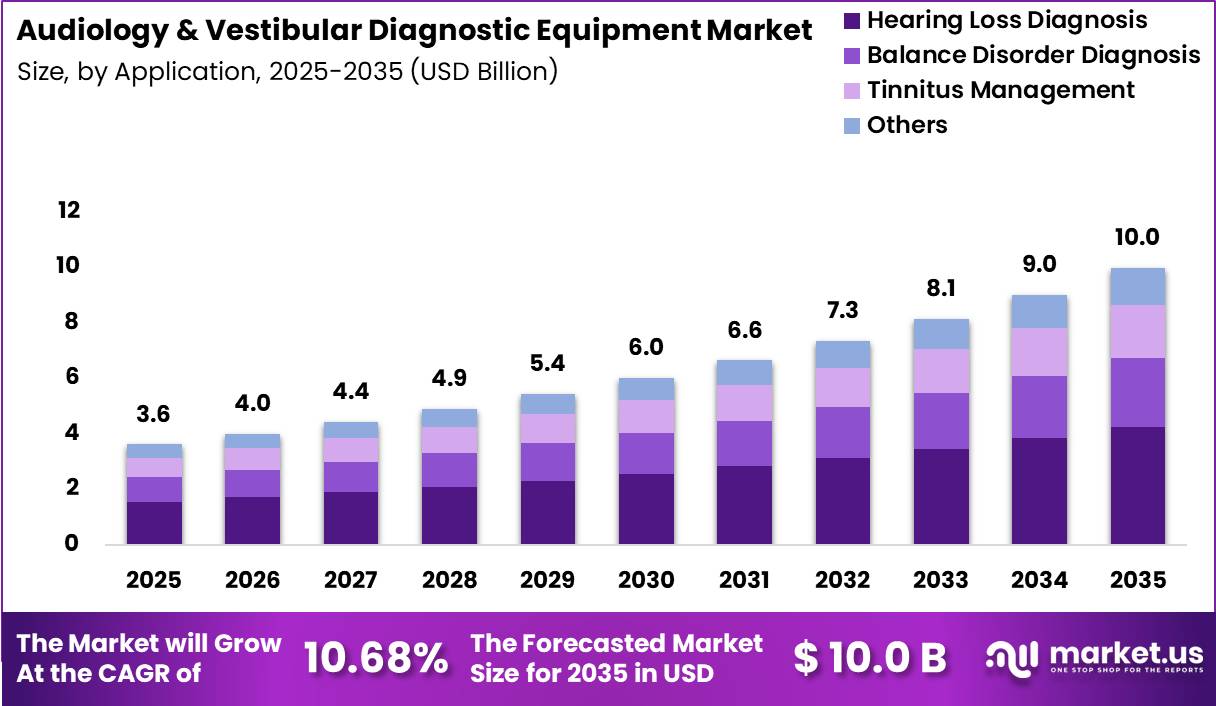
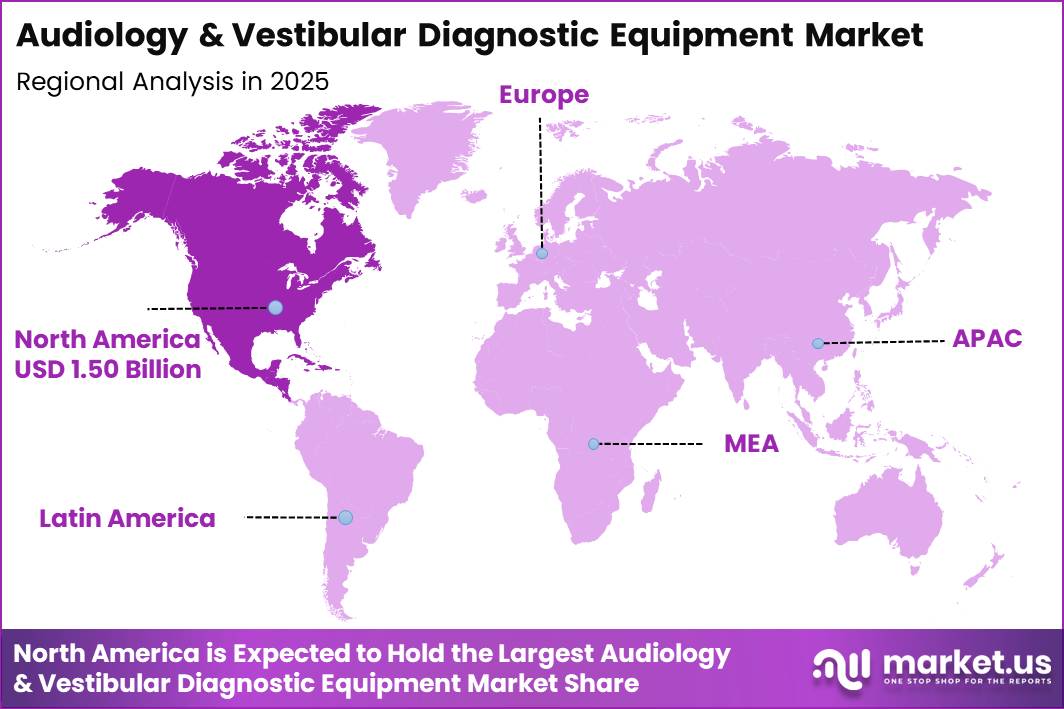
Global Audiology & Vestibular Diagnostic Equipment Market size is expected to be worth around US$ 10.0 Billion by 2035 from US$ 3.6 Billion in 2025, growing at a CAGR of 10.68% during the forecast period from 2026 to 2035. In 2025, North America led the market, achieving over 41.60% share with a revenue of US$ 1.50 Billion.
The global Audiology & Vestibular Diagnostic Equipment Market is expanding steadily as healthcare providers increasingly focus on the early diagnosis of hearing impairment and balance disorders. Growing awareness of hearing health, an aging global population, rising cases of noise-induced hearing loss, and broader access to screening programs are driving demand for advanced diagnostic technologies.
Hospitals, ENT clinics, audiology centers, and ambulatory care facilities are adopting digital audiometers, tympanometers, otoacoustic emission (OAE) systems, auditory brainstem response (ABR) devices, videonystagmography (VNG), and vestibular testing equipment to improve diagnostic accuracy and patient outcomes.
The market is also benefiting from technological advancements such as portable diagnostic devices, AI-enabled hearing assessment software, wireless connectivity, and integrated diagnostic platforms that enhance workflow efficiency and support earlier clinical intervention.
Increasing investments in preventive healthcare and hearing conservation programs are further encouraging the adoption of modern audiology and vestibular diagnostic equipment.
According to the World Health Organization (WHO), more than 430 million people worldwide currently require rehabilitation for disabling hearing loss, and this number is projected to exceed 700 million by 2050, emphasizing the growing need for accessible hearing care and advanced diagnostic solutions.
WHO also estimates that unaddressed hearing loss costs the global economy nearly US$ 1 trillion annually, highlighting the significant healthcare and economic burden associated with delayed diagnosis and treatment. These trends continue to support long-term demand for innovative diagnostic equipment across developed and emerging healthcare markets.
Key Takeaways
- Market Size : Audiology & Vestibular Diagnostic Equipment Market size is expected to be worth around US$ 10.0 Billion by 2035 from US$ 3.6 Billion in 2025.
- Market Share : The market is growing at a CAGR of 10.68% during the forecast period from 2026 to 2035.
- Product Type Analysis : The Audiometers segment dominated the Audiology & Vestibular Diagnostic Equipment Market, accounting for 32.5% of the market share in 2025.
- Application Analysis : The Hearing Loss Diagnosis segment held the largest share of the market, accounting for 42.6% in 2025.
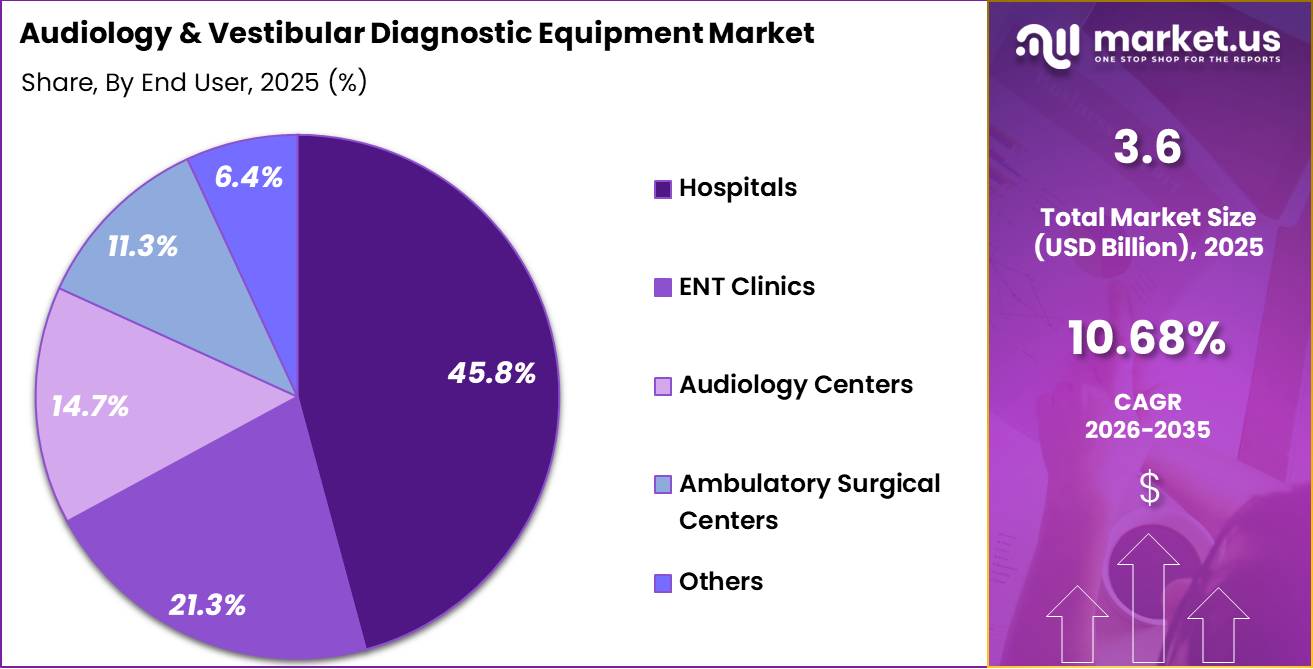
- End User Analysis : The Hospitals segment dominated the Audiology & Vestibular Diagnostic Equipment Market, accounting for 45.8% of the market share in 2025.
- Regional Analysis : In 2025, North America led the market, achieving over 41.60% share with a revenue of US$ 1.50 Billion.
Product Type Analysis
The Audiometers segment dominated the Audiology & Vestibular Diagnostic Equipment Market, accounting for 32.5% of the market share in 2025. This leadership is attributed to the widespread use of audiometers as the primary tool for evaluating hearing thresholds across hospitals, ENT clinics, audiology centers, and occupational health settings.
Their importance in routine hearing assessments, newborn screening follow-ups, and age-related hearing evaluations continues to support strong demand. Modern digital audiometers offer automated testing, wireless connectivity, and integration with electronic medical record systems, improving diagnostic efficiency.
Otoscopes remain essential for examining the ear canal and tympanic membrane before hearing tests, while Impedance Meters/Tympanometers are widely used to evaluate middle ear function and identify conditions such as fluid accumulation or eardrum abnormalities.
Otoacoustic Emissions (OAE) Analyzers and Auditory Brainstem Response (ABR) Systems are increasingly adopted for newborn hearing screening and objective hearing assessments, particularly for infants and patients unable to respond to conventional hearing tests.
The Vestibular Diagnostic Equipment segment is expanding due to the growing diagnosis of dizziness and balance disorders. Cochlear Implant Fitting Systems support implant programming and long-term patient management, while Real Ear Measurement Systems improve hearing aid fitting accuracy.
The Others category, including specialized diagnostic accessories and integrated software, also contributes to market growth by enhancing workflow and diagnostic precision across hearing care facilities.
Application Analysis
The Hearing Loss Diagnosis segment held the largest share of the market, accounting for 42.6% in 2025. The increasing prevalence of hearing impairment across all age groups, coupled with rising awareness of early diagnosis, has significantly increased demand for comprehensive hearing assessment equipment.
Hospitals and audiology clinics routinely use audiometers, tympanometers, OAE analyzers, and ABR systems to detect conductive and sensorineural hearing loss, making this application the largest contributor to market revenue.
The Balance Disorder Diagnosis segment represents another important application area as the number of patients experiencing vertigo, dizziness, and vestibular disorders continues to rise.
Healthcare providers increasingly utilize videonystagmography (VNG), vestibular evoked myogenic potential (VEMP), rotary chair systems, and other vestibular diagnostic equipment to identify inner ear and neurological disorders. Continuous improvements in digital balance testing technologies are further supporting segment growth.
The Tinnitus Management segment is also expanding as clinicians adopt advanced diagnostic tools to evaluate tinnitus-related hearing disorders and guide personalized treatment plans. The Others segment includes auditory monitoring, hearing rehabilitation assessments, occupational hearing evaluations, and research applications.
Growing investments in preventive hearing care, improved diagnostic protocols, and expanding access to audiology services continue to support demand across all application segments.
End User Analysis
The Hospitals segment dominated the Audiology & Vestibular Diagnostic Equipment Market, accounting for 45.8% of the market share in 2025.
Hospitals remain the primary end users because they provide comprehensive diagnostic services for hearing impairment, balance disorders, newborn hearing screening, and pre- and post-operative evaluations for cochlear implant patients. Large healthcare facilities also invest in integrated diagnostic platforms that combine audiometry, tympanometry, OAE, ABR, and vestibular testing within a single clinical workflow.
ENT Clinics represent a significant market segment due to the increasing number of patients seeking specialized diagnosis and treatment for ear disorders. Audiology Centers continue to expand as demand grows for hearing assessments, hearing aid fitting, tinnitus evaluation, and long-term hearing care services. These centers increasingly utilize portable, software-integrated, and cloud-connected diagnostic equipment to improve patient management and testing efficiency.
The Ambulatory Surgical Centers segment is witnessing steady growth with the increasing number of outpatient ENT and cochlear implant procedures requiring preoperative and postoperative hearing assessments.
The Others category includes academic institutions, occupational health centers, community hearing screening programs, and research organizations. Rising awareness of hearing health, expanding screening initiatives, and continuous advancements in diagnostic technologies are expected to support sustained growth across all end-user segments.
Market Segmentations
By Product Type
- Audiometers
- Otoscopes
- Impedance Meters/Tympanometers
- Otoacoustic Emissions (OAE) Analyzers
- Auditory Brainstem Response (ABR) Systems
- Vestibular Diagnostic Equipment
- Cochlear Implant Fitting Systems
- Real Ear Measurement Systems
- Others
By Application
- Hearing Loss Diagnosis
- Balance Disorder Diagnosis
- Tinnitus Management
- Others
By End User
- Hospitals
- ENT Clinics
- Audiology Centers
- Ambulatory Surgical Centers
- Others
Driver
Rising Hearing Loss Burden Accelerating Audiology Diagnostic Demand
Global epidemiology trends indicate a structurally rising pool of patients requiring audiological assessment, which directly lifts the installed base and utilization of audiology diagnostic systems over a multi‑decade horizon.
Around 30% of people over 60 years already have hearing loss, and the share rises further in cohorts above 70 years, implying that rapid population ageing in high‑income markets (EU, Japan, North America) and middle‑income APAC economies (China, South Korea, Thailand) translates into steady volume growth for pure‑tone audiometry, tympanometry, otoacoustic emission (OAE) and auditory brainstem response (ABR) equipment.
Structurally, this driver lengthens the replacement cycle and pushes providers to expand diagnostic capacity per 1,000 older adults, with health systems under pressure to reduce the approximately 980 billion USD annual global economic cost of unaddressed hearing loss, including productivity losses and health system expenditure, by investing in diagnostic infrastructure that allows earlier detection and intervention.
For vendors, the business model shift is toward bundling hardware platforms with recurring calibration, software updates and cloud‑based reporting services, capturing recurring revenue as the addressable patient pool expands; this supports incremental CAGR uplift as unit volumes rise in line with demographic trajectories and as diagnostic pathways become standardized across primary care and specialty settings.
| Driver | (~) % Impact on CAGR Forecast | Geographic Relevance | Impact Timeline |
|---|---|---|---|
| Growing hearing loss & ageing population | +2.0% | North America core, EU, APAC corridors, LMIC clusters | Long term (≥ 4 years) |
| Expansion of newborn, school & occupational screening | +1.5% | North America core, EU, APAC corridors, Latin America nodes | Medium term (2–4 years) |
| Technology upgrades: digital, PC-based & AI diagnostics | +1.8% | North America core, EU, APAC corridors | Medium to long term (2–6 years) |
| Rising vestibular disorder awareness & care pathways | +1.2% | North America core, EU, selected APAC & LATAM urban hubs | Medium term (2–4 years) |
| Policy & reimbursement support for hearing care | +1.3% | North America core, EU, selected APAC & LATAM payers | Medium to long term (2–5 years) |
| Expansion of private hearing care chains & tele-audiology | +1.0% | North America core, EU, APAC corridors, South America spill-over | Short to medium term (≤ 4 years) |
Challenge
Cybersecurity Compliance Challenges Slowing Audiology System Adoption
As audiology and vestibular systems increasingly interface with hospital networks, electronic health records, and cloud-based reporting tools, cybersecurity and data-protection compliance have become a significant operational challenge, particularly in North America and the European Union where regulatory expectations around medical device cybersecurity have tightened materially since 2020.
Vendors must now implement secure-by-design architectures, regular vulnerability patching cycles, and encryption for data in transit and at rest, which can add 5–10% to R&D budgets and increase product release timelines by 6–12 months when extensive penetration testing and regulatory documentation are required.
For providers, integration of diagnostic systems into zero-trust network architectures often triggers unplanned capital costs for network segmentation and security appliances, and cybersecurity incidents even minor ones can lead to preemptive disconnection of non-critical diagnostic equipment from networks for days or weeks, temporarily depressing the utilization of connected platforms by 5–10% annually in organizations that experience repeated alerts.
Collectively, these compliance and security frictions likely exert around a 0.8 % point drag on attainable market CAGR by slowing the deployment of networked, data-rich equipment and by diverting budget from new acquisitions to security retrofits, pushing industry players to invest in standardized secure communication stacks, centralized patch-management infrastructures that reduce downtime windows to hours rather than days, and modular software architectures that allow security updates without full system recertification.
| Challenge | (~) % CAGR Friction Drag | Geographic Relevance | Mitigation Horizon |
|---|---|---|---|
| Chronic audiology workforce gaps | -1.2% | OECD high-income; LMIC urban hubs | Long term (≥ 4 years) |
| Capital-intensive equipment underutilization | -0.9% | North America core; EU hospital networks; APAC metros | Medium term (2-4 years) |
| Escalating cybersecurity and data compliance | -0.8% | North America; EU regulatory hubs; APAC tier-1 | Medium term (2-4 years) |
| Supply chain and component volatility | -0.7% | APAC manufacturing corridors; EU import-dependent; LATAM | Short term (≤ 2 years) |
| Integration with digital health ecosystems | -0.6% | North America; EU; high-income Asia | Long term (≥ 4 years) |
| Reimbursement complexity and workflow friction | -0.5% | North America; selected EU payers | Medium term (2-4 years) |
Restraints
Regulatory Barriers Increasing Audiology Device Development Complexity
A third key restraint is the tightening of regulatory pathways for medical devices, particularly under the European Union Medical Device Regulation (MDR) and ongoing FDA updates, which increases time‑to‑market and compliance costs for audiology and vestibular diagnostic equipment and is expected to shave about 0.7 % points from forecast CAGR over the medium term.
Under MDR, many diagnostic devices require reclassification, expanded clinical evidence, and more frequent surveillance, with notified body capacity constraints causing approval timelines in some categories to stretch from approximately 12–18 months under the old directives to 24–36 months post‑MDR, especially for devices that integrate software, imaging, or AI components.
Manufacturers of audiometers, tympanometers, VNG systems, and posturography platforms face increased documentation requirements, post‑market surveillance obligations, and potentially more rigorous cybersecurity and interoperability expectations, all of which add hundreds of thousands to low single‑digit millions of euros in incremental regulatory and quality assurance spend over a multi‑year cycle.
In the United States, while the FDA has exempted certain lower‑risk hearing‑related devices (such as some tympanometers and calibrators) from 510(k) premarket notification, newer classes of connected or AI‑enabled diagnostic systems must still navigate complex predicate selection and software validation requirements, extending development timelines and raising the risk‑adjusted cost of innovation.
For smaller OEMs serving niche vestibular testing segments, these regulatory frictions can effectively cap product refresh frequency and limit geographic expansion, as the marginal ROI on tailoring a platform for multiple regulatory regimes declines.
Strategically, this slows introduction of next‑generation systems, concentrates share among larger players with the scale to absorb compliance overhead, and narrows the range of differentiated offerings available to providers, thereby dampening competitive intensity but also moderating overall market volume growth.
| Restraint | (~) % Impact on CAGR Forecast | Geographic Relevance | Impact Timeline |
|---|---|---|---|
| Capital budget squeeze in hospitals | -1.0% | North America, EU, LatAm | Short term |
| Reimbursement and coding headwinds | -0.8% | North America core | Medium term |
| Stricter device regulatory pathways | -0.7% | EU, North America, Japan | Medium term |
| Component and logistics cost inflation | -0.6% | APAC corridors, EU, LatAm | Short term |
| Workforce and training bottlenecks | -0.5% | Emerging APAC, Africa, LatAm | Long term |
| Uneven adoption in primary care | -0.4% | Global, esp. low–mid income | Long term |
Opportunity
Tele-Audiology Networks Creating Remote Diagnostic Growth Opportunities
Tele-audiology and remote hearing screening have demonstrated clinical non-inferiority to traditional pathways, yet large-scale integration of tele-diagnostic workflows, especially for vestibular disorders, remains nascent, with reimbursement, platform standardization, and data quality concerns limiting adoption to pilot projects and select systems.
At the same time, CMS has moved intermittently on telehealth coverage for audiology services, and proposed rules from 2025 indicate a trend toward adding more audiology-related CPT codes to permanent telehealth lists, which could stabilize reimbursement for certain remote diagnostic and programming services from 2026 onward but still leaves vestibular diagnostics and broader assessment ecosystems underdeveloped as telehealth offerings.
The opportunity is to build hybrid networks where core audiology and vestibular equipment remains in regional hubs, but patient intake, pre-screening, follow-up, and some test guidance are delivered via telehealth platforms, thereby increasing capacity utilization of existing systems by 25–40% and lowering per-patient access costs by 15–25% through reduced travel and faster triage for rural and mobility-limited populations.
Studies highlight persistent disparities in telehealth access among rural, low-income, and minority groups, which implies that audiology and vestibular OEMs can partner with health systems to offer vertically integrated tele-diagnostic solutions that address these gaps by bundling equipment with secure video, remote calibration modules, and integrated scheduling and reporting, anchored in enterprise contracts rather than fragmented device sales.
If such hybrid networks reach 20–25% of audiology departments and ENT clinics across North America, Europe, and urban APAC by 2030, with each network increasing diagnostic volume by 1.3–1.5x relative to purely in-clinic models, vendors could see network-wide recurring software and service revenue increases of 30–40%, supporting higher EBITDA margins by 3–5 % points and realistically enabling a 2.1 % point CAGR upside versus a baseline driven predominantly by traditional brick-and-mortar utilization.
| Opportunity | (~) % Potential CAGR Upside | Geographic Relevance | Execution Window |
|---|---|---|---|
| Integrated falls-risk vestibular screening platforms | +2.8% | North America, EU, APAC aging hubs | Medium term (2–4 years) |
| Low-cost LMIC audiology & vestibular screening bundles | +3.2% | APAC emerging, Africa, LatAm | Long term (≥ 4 years) |
| Tele-audiology & hybrid vestibular diagnostics networks | +2.1% | North America core, EU, urban APAC | Short–Medium (≤ 4 years) |
| Cognitive–hearing–balance multimodal assessment suites | +1.9% | North America, EU, Japan, South Korea | Medium term (2–4 years) |
| Value-based care and preventive screening contracts | +1.6% | U.S. Medicare/Medicaid, EU public payers | Medium–Long (≥ 3 years) |
| Home and community-based hearing–balance screening kits | +2.3% | Global, focus on rural and older adults | Medium term (2–4 years) |
Regional Analysis
North America dominated the Audiology & Vestibular Diagnostic Equipment Market in 2025, accounting for over 41.60% of the global market and generating US$ 1.50 billion in revenue. The region’s leadership is supported by advanced healthcare infrastructure, widespread availability of specialized audiology clinics, favorable reimbursement systems, and strong adoption of innovative diagnostic technologies.
The United States remains the largest contributor due to the high prevalence of hearing disorders, growing geriatric population, and well-established newborn hearing screening programs. According to the National Institute on Deafness and Other Communication Disorders (NIDCD), approximately 15% of U.S. adults (37.5 million people) report some degree of hearing difficulty, sustaining demand for audiology and vestibular diagnostic equipment.
Europe represented the second-largest regional market, supported by universal healthcare systems, increasing investments in hearing care, and favorable public health initiatives. The region continues to adopt advanced diagnostic solutions across hospitals and ENT centers.
The Asia-Pacific market is projected to register the fastest growth during the forecast period, driven by expanding healthcare infrastructure, improving access to diagnostic services, rising awareness of hearing health, and a large aging population. WHO estimates that the Western Pacific Region has the highest prevalence of hearing loss globally, creating substantial long-term demand for diagnostic technologies.
Meanwhile, Latin America and the Middle East & Africa are expected to witness steady market expansion due to improving healthcare access, increasing government initiatives for early hearing detection, and gradual modernization of diagnostic facilities. Growing investments in ENT services and expanding screening programs are anticipated to support market growth across these emerging regions.
Key Regions and Countries
North America
- The US
- Canada
Europe
- Germany
- France
- The U.K.
- Italy
- Spain
- Russia & CIS
- Rest of Europe
Asia Pacific
- China
- India
- Japan
- South Korea
- ASEAN
- Australia & New Zealand
- Rest of Asia Pacific
Middle East & Africa
- GCC
- South Africa
- Rest of Middle East & Africa
Latin America
- Brazil
- Mexico
- Rest of Latin America
Key Player Analysis
The Audiology & Vestibular Diagnostic Equipment Market is moderately competitive, with leading companies focusing on product innovation, digital technologies, and expanding their global distribution networks. Manufacturers are investing in advanced audiometers, tympanometers, auditory brainstem response (ABR) systems, otoacoustic emission (OAE) devices, and vestibular testing solutions to improve diagnostic accuracy and clinical efficiency.
Many companies are also integrating software platforms, electronic health record (EHR) connectivity, and portable diagnostic systems to meet the growing demand from hospitals, ENT clinics, and audiology centers.
Natus Medical Incorporated offers a broad portfolio of hearing and balance diagnostic solutions and continues to strengthen its audiology business through its Otometrics brand. GN Otometrics A/S is recognized for its reliable audiometers, hearing aid fitting systems, and vestibular diagnostic equipment used by hearing care professionals worldwide.
Interacoustics A/S provides comprehensive audiology and balance testing equipment, including ABR, OAE, audiometers, tympanometers, and vestibular systems, while continuously expanding its digital diagnostic platform.
RION Co., Ltd. specializes in precision audiological instruments and hearing assessment technologies, serving hospitals and research institutions globally. Micro-DSP Technology Co. Ltd. develops digital hearing assessment and diagnostic devices designed for clinical and screening applications.
Medtronic plc supports the market through ENT-related technologies and innovations that complement hearing healthcare. Cochlear Limited focuses on hearing implant solutions and diagnostic technologies that support comprehensive patient care. Sonova Holding AG and WS Audiology A/S continue to expand their hearing care portfolios through advanced diagnostic and hearing assessment solutions.
Otodynamics Ltd. is well known for its OAE screening and diagnostic systems, particularly in newborn hearing screening, while MAICO Diagnostic GmbH offers a wide range of audiometers, tympanometers, and screening devices used in hospitals, clinics, and occupational health programs worldwide.
Top Key Players
- Natus Medical Incorporated
- GN Otometrics A/S
- Interacoustics A/S
- RION Co., Ltd.
- Micro-DSP Technology Co. Ltd.
- Medtronic plc
- Cochlear Limited
- Sonova Holding AG
- WS Audiology A/S
- Otodynamics Ltd.
- MAICO Diagnostic GmbH
- Ear3 (Elephony)
- Path Medical GmbH
- Recorders & Medicare Systems Pvt. Ltd.
- Zehnekar Hearing Solutions
- Others
Recent Developments
- In January 2026, Cochlear Limited announced that the Nucleus® Nexa™ System became available to eligible U.S. military veterans through Veterans Affairs clinics nationwide, expanding access to advanced cochlear implant technology in the United States.
- In October 2025, WS Audiology A/S introduced WSA Advantage in the United States, combining support, audiology expertise, technology access, and business resources to simplify operations for hearing care practices.
- In July 2025, Cochlear Limited launched the Nucleus® Nexa™ System in the United States after receiving FDA approval, introducing a smart cochlear implant platform with internal memory and upgradeable firmware to support future technology improvements.
- In March 2025, WS Audiology A/S launched the Widex Allure™ hearing aid platform, featuring the new W1 chip, Precision Hearing Technology, and cloud-based fitting software to improve speech clarity and hearing care personalization.
Report Scope
| Report Features | Description |
|---|---|
| Market Value (2025) | US$ 3.6 Billion |
| Forecast Revenue (2035) | US$ 10.0 Billion |
| CAGR (2026-2035) | 10.68% |
| Base Year for Estimation | 2025 |
| Historic Period | 2020-2024 |
| Forecast Period | 2026-2035 |
| Report Coverage | Revenue Forecast, Market Dynamics, Competitive Landscape, Recent Developments |
| Segments Covered | Product Type (Audiometers, Otoscopes, Impedance Meters/Tympanometers, Otoacoustic Emissions (OAE) Analyzers, Auditory Brainstem Response (ABR) Systems, Vestibular Diagnostic Equipment, Cochlear Implant Fitting Systems, Real Ear Measurement Systems, Others), By Application (Hearing Loss Diagnosis, Balance Disorder Diagnosis, Tinnitus Management, Others), By End User (Hospitals, ENT Clinics, Audiology Centers, Ambulatory Surgical Centers, Others) |
| Regional Analysis | North America – The US, Canada; Europe – Germany, France, U.K., Italy, Spain, Russia & CIS, Rest of Europe; Asia Pacific – China, India, Japan, South Korea, ASEAN, Australia & New Zealand, Rest of Asia Pacific; Middle East & Africa – GCC, South Africa, Rest of Middle East & Africa; Latin America – Brazil, Mexico, Rest of Latin America |
| Competitive Landscape | Natus Medical Incorporated, GN Otometrics A/S, Interacoustics A/S, RION Co., Ltd., Micro-DSP Technology Co. Ltd., Medtronic plc, Cochlear Limited, Sonova Holding AG, WS Audiology A/S, Otodynamics Ltd., MAICO Diagnostic GmbH, Ear3 (Elephony), Path Medical GmbH, Recorders & Medicare Systems Pvt. Ltd., Zehnekar Hearing Solutions, Others |
| Customization Scope | Customization for segments, region/country-level will be provided. Moreover, additional customization can be done based on the requirements. |
| Purchase Options | We have three licenses to opt for: Single User License, Multi-User License (Up to 5 Users), Corporate Use License (Unlimited User and Printable PDF) |