Market Overview
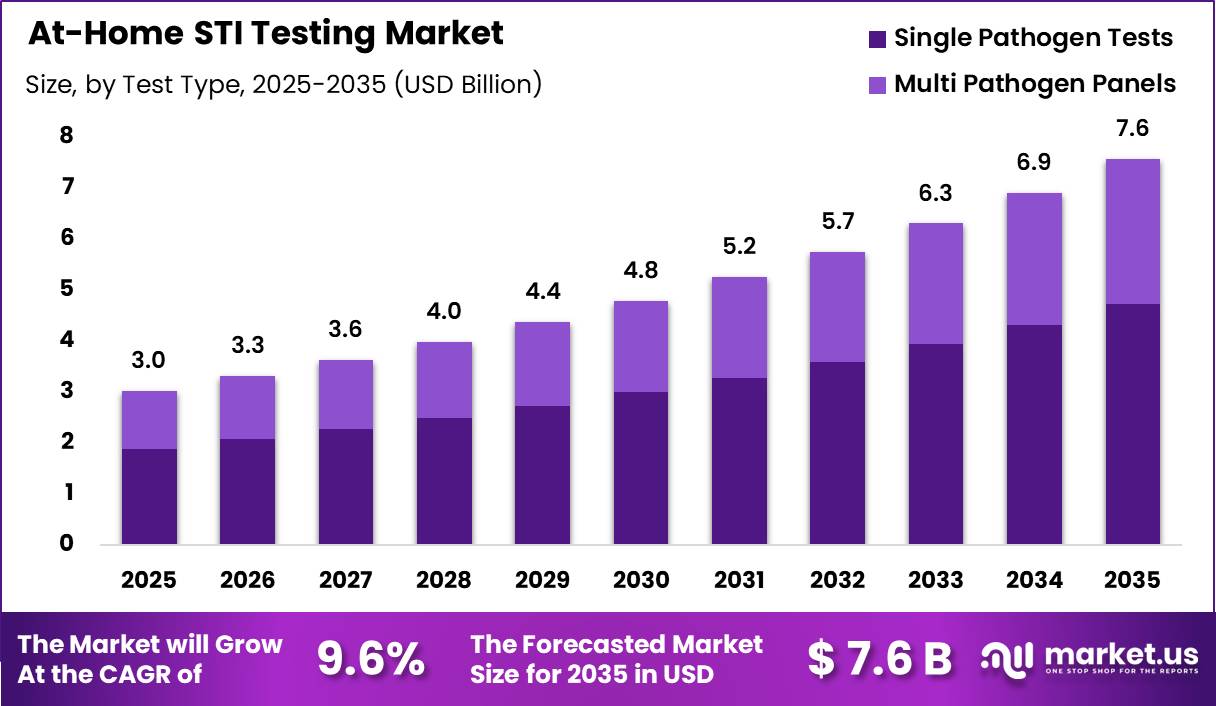
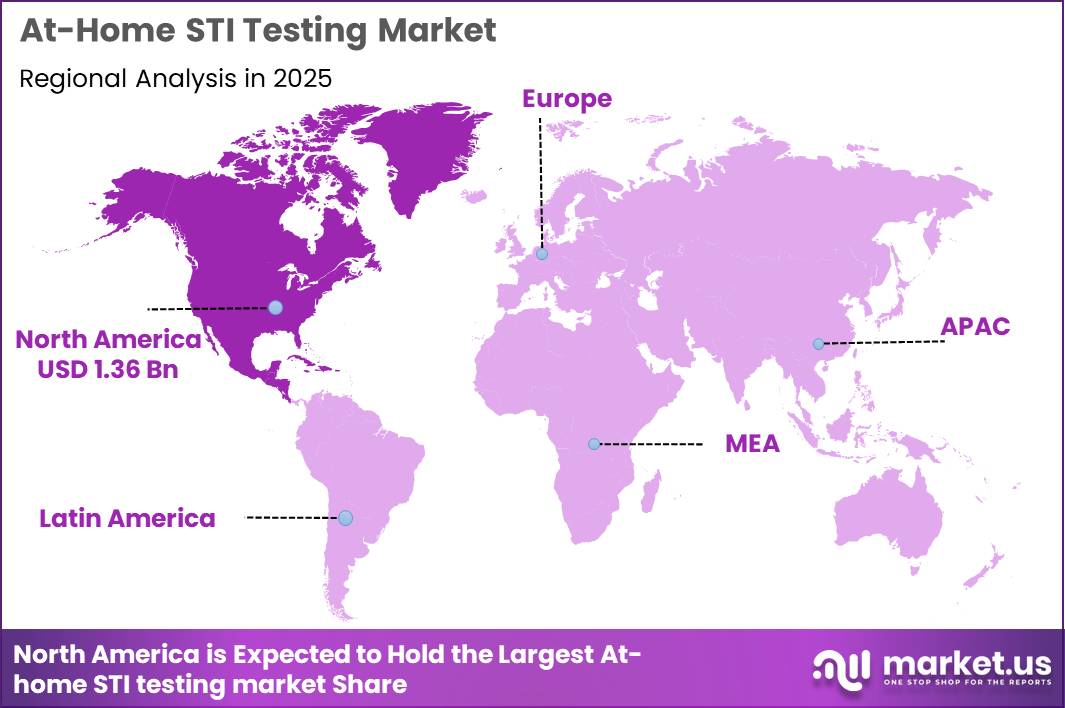
The Global At-Home STI Testing Market size is expected to be worth around US$ 7.6 Billion by 2035 from US$ 3.02 Billion in 2025, growing at a CAGR of 9.6% during the forecast period from 2026 to 2035. In 2025, North America led the market, achieving over 45.62% share with a revenue of US$ 1.38 Billion.
The At-Home STI Testing Market is gaining strong momentum as healthcare systems focus on improving access to sexual health services through convenient, private, and timely diagnostic solutions. Rising awareness of sexually transmitted infections (STIs), expanding telehealth services, and increasing regulatory support for self-testing are encouraging consumers to adopt home-based testing kits.
According to the U.S. Centers for Disease Control and Prevention (CDC), everyone aged 13–64 years should be tested for HIV at least once, while sexually active individuals may require routine screening for infections such as chlamydia, gonorrhea, and syphilis depending on their risk factors.
The CDC also notes that many STIs do not cause symptoms, making regular testing essential for early diagnosis and treatment. Recent regulatory approvals are accelerating market growth. In March 2025, the U.S. Food and Drug Administration (FDA) authorized the first over-the-counter, fully at-home test for chlamydia, gonorrhea, and trichomoniasis, providing results in approximately 30 minutes. Earlier, in 2023, the FDA authorized the first at-home sample collection test for chlamydia and gonorrhea, expanding consumer access to laboratory-quality testing.
The growing disease burden further supports demand. CDC provisional surveillance data reported more than 2.2 million cases of chlamydia, gonorrhea, and syphilis in the United States during 2024, highlighting the continued need for accessible screening solutions.
Additionally, the FDA reports that trichomoniasis affects approximately 2.6 million people in the U.S. These statistics reinforce the importance of accurate at-home STI testing, which can improve early detection, reduce transmission, and support broader public health initiatives.
Key Takeaways
- Market Size: The Global At-Home STI Testing Market size was US$ 3.02 Billion in 2025. The market is estimated to grow to US$ 7.6 Billion by 2035.
- Market Share: The Compound Annual Growth Rate (CAGR) of the market from 2026 to 2035 will be 9.6%.
- Test Type: Single Pathogen Tests have the largest market share, accounting for 62.4% of total sales.
- STI Type: Chlamydia leads the segment, accounting for 28.7% of total revenue.
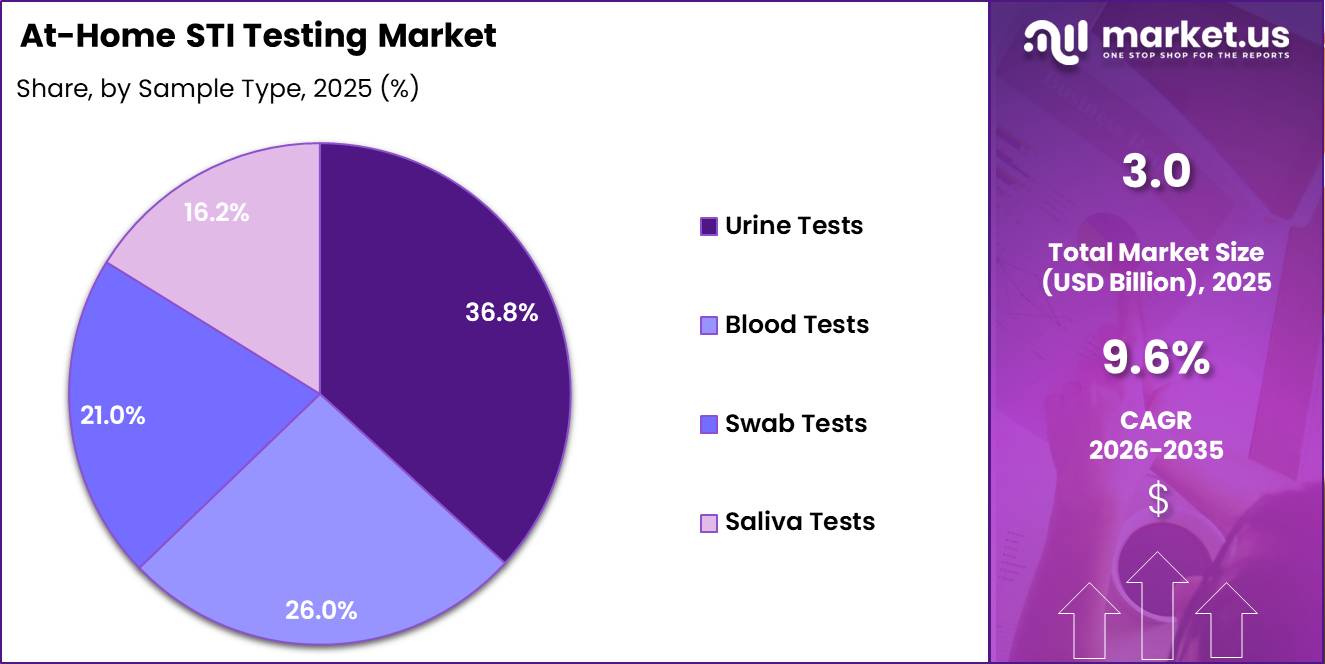
- Sample Type: Urine Tests dominate the segment, accounting for 36.8% of total revenue.
- Regional: North America is the dominant regional market, accounting for 45.62% of global sales, holding US$ 1.38 billion in revenue.
Test Type Analysis
The Single Pathogen Tests segment dominates the at-home STI testing market, accounting for 62.4% market share in 2025. The strong adoption of single pathogen tests is driven by their high accuracy, simple testing workflow, affordability, and suitability for individuals seeking screening for a specific sexually transmitted infection. These tests are widely preferred for common infections such as chlamydia, gonorrhea, and HIV, where targeted detection enables faster diagnosis and timely treatment decisions.
Increasing awareness regarding routine STI screening and the availability of convenient home-based testing solutions are further supporting segment growth. The Multi Pathogen Panels segment holds 37.59% market share in 2025 and is expected to witness significant growth due to rising demand for comprehensive sexual health screening. Multi-pathogen panels allow users to test for multiple infections through a single sample collection process, improving convenience and reducing the need for multiple testing visits.
Growing concerns about asymptomatic infections, increasing preventive healthcare adoption, and technological advancements in multiplex diagnostic platforms are encouraging the use of broader STI screening solutions. As consumers increasingly prioritize early detection and privacy-focused healthcare options, multi pathogen panels are expected to gain market penetration during the forecast period.
STI Type Analysis
Based on STI type, the At-home STI Testing Market is segmented into Chlamydia, Gonorrhea, HIV, Syphilis, Hepatitis B and C, Herpes Simplex Virus, and Others. The Chlamydia segment dominates the market with a 28.7% share in 2025, supported by the high global prevalence of chlamydia infections and increasing demand for early and confidential diagnosis.
According to the Centers for Disease Control and Prevention (CDC), chlamydia remains one of the most frequently reported sexually transmitted infections in the United States, with more than 1.6 million cases reported annually in recent surveillance data.
The high number of asymptomatic infections has increased the importance of accessible screening methods, including at-home testing solutions. The Gonorrhea segment represents a significant market share due to rising infection rates and growing concerns regarding antibiotic resistance.
The HIV segment continues to expand as home-based HIV testing improves access to early diagnosis and supports public health prevention programs. Syphilis testing is gaining attention due to increasing cases and the need for timely detection to prevent severe complications.
The Hepatitis B and C, Herpes Simplex Virus, and Others segments are also contributing to market growth as consumers increasingly seek comprehensive sexual health monitoring. Advancements in rapid diagnostics, telehealth integration, and improved home sample collection methods are expected to support broader adoption of STI-specific testing solutions. Government initiatives promoting routine STI screening and awareness programs further strengthen demand across all infection categories.
Sample Type Analysis
The Urine Tests segment dominates the at-home STI testing market, accounting for 36.8% market share in 2025. Urine-based testing is widely adopted due to its non-invasive nature, ease of sample collection, and suitability for detecting common bacterial infections such as chlamydia and gonorrhea.
Consumers prefer urine tests because they reduce discomfort, require minimal preparation, and can be easily performed in a home environment. The growing availability of mail-in urine testing kits and digital healthcare platforms is further supporting segment expansion.
The Blood Tests segment holds 26.0% market share in 2025 and remains important for detecting infections such as HIV, syphilis, and hepatitis. Advances in finger-prick blood collection methods have improved the convenience and reliability of home blood testing solutions. Swab Tests account for 21.0% market share, supported by their effectiveness in identifying infections from genital, oral, or rectal sites, particularly where urine testing may provide limited detection.
Saliva Tests represent 16.2% market share and are gaining attention due to their simplicity, painless collection process, and growing use in HIV screening applications. Increasing preference for privacy, accessibility, and self-managed healthcare is expected to drive adoption across all sample types in the coming years.
Key Market Segments
By Test Type
- Single Pathogen Tests
- Multi Pathogen Panels
By STI Type
- Chlamydia
- Gonorrhea
- HIV
- Syphilis
- Hepatitis B and C
- Herpes Simplex Virus
- Others
By Sample Type
- Urine Tests
- Blood Tests
- Swab Tests
- Saliva Tests
Driver
OTC multiplex authorization expands direct purchase pathway
The most immediate 2026 demand accelerator is the shift from mail-in collection only to true over-the-counter, device-enabled at-home diagnosis. In March 2025, FDA authorized Visby Medical’s women’s at-home test for chlamydia, gonorrhea, and trichomoniasis as the first nonprescription test in the U.S. that can be purchased and completed entirely at home, while the earlier FDA authorization of LetsGetChecked’s Simple 2 established the at-home sample-collection route for chlamydia and gonorrhea in late 2023.
That matters economically because a full OTC workflow compresses the customer journey from order-to-result from several days to roughly 30 minutes for the Visby product, removing lab logistics, lost-to-follow-up friction, and customer dropout between sampling and result retrieval.
Commercially, this supports a migration from episodic DTC kit sales toward premium-priced, condition-specific rapid diagnostics bundled with app-based counseling, e-prescription referral, and partner notification services; it also raises shelf-placement potential in pharmacy and retail channels that favor immediate-use formats over send-out kits.
The effect is strongest in North America first, because FDA authorization is already creating a reference model for pharmacy distribution, payer discussions, and future line extensions into broader panel testing.
| Driver | (~) % Impact on CAGR Forecast | Geographic Relevance | Impact Timeline |
|---|---|---|---|
| OTC multiplex authorization expands direct purchase pathway | +2.4% | North America core, EU follow-on, APAC urban private-care corridors | Short term |
| High recurring screening need sustains repeat-test demand | +2.1% | North America core, EU, APAC metros, Latin America urban spill-over | Medium term |
| Public health home-collection programs normalize channel adoption | +1.7% | U.S. states, Ireland, UK-style public systems, selected APAC pilots | Medium term |
| Telehealth and reimbursed care integration improve conversion to treatment | +1.5% | North America core, EU digital-care markets, APAC private telehealth hubs | Short term |
| Privacy and convenience shift testing from clinic visits to home workflows | +1.3% | North America, Western Europe, affluent APAC cities, GCC private markets | Short term |
| Expanded adolescent and women-focused access broadens addressable base | +1.1% | U.S. core, EU women’s health channels, APAC private OB-GYN networks | Medium term |
Challenge
Reimbursement gaps slow at-home STI testing adoption and limit market expansion
The lack of consistent reimbursement for at-home STI testing, especially in the United States where many mail-in and self-collection kits remain out-of-pocket and can range from roughly 10–250 dollars per test episode, produces a sustained elasticity drag on adoption, effectively removing 15–25% of potential high-risk users from the addressable demand pool at any given time and imposing an estimated 1.7 % point friction on CAGR.
Even as federal programs and state health departments subsidize limited mail-out HIV and multi-STI kits, eligibility caps and batch-based funding cycles mean that programmatic volumes typically cover only tens of thousands to low hundreds of thousands of tests annually, compared to national STI caseloads exceeding 2.2 million reported chlamydia, gonorrhea, and syphilis cases per year in the United States alone, leaving a structural affordability gap for millions of at-risk individuals.
In lower- and middle-income markets, donor-supported self-testing initiatives for HIV and syphilis emphasize high-priority populations but rarely extend to comprehensive STI panels, so private at-home services remain concentrated in upper-income urban segments with smartphone access and banked payment methods, suppressing penetration in peri-urban and rural areas where incidence often remains highest.
To navigate this friction, companies are experimenting with tiered pricing, subscription models that amortize test costs across 2–4 orders per year, and integrated telehealth-plus-test bundles that can qualify for partial coverage, while simultaneously lobbying payers and public agencies with health-economic models that demonstrate avoided clinic visits, earlier treatment, and reduced congenital syphilis risk; however, reimbursement guideline updates tend to lag evidence by 3–5 years, implying a long-term mitigation horizon before out-of-pocket cost ceases to be a major growth drag.
| Challenge | (~) % CAGR Friction Drag | Geographic Relevance | Mitigation Horizon |
|---|---|---|---|
| Complex multi-agency regulation | -1.4% | North America, EU regulatory hubs | Medium term (2-4 years) |
| Patchy reimbursement & affordability | -1.7% | US payers, emerging markets | Long term (≥ 4 years) |
| Data integration & reporting gaps | -1.1% | US, EU, select APAC | Medium term (2-4 years) |
| Logistics & cold-chain variability | -0.9% | APAC, LatAm, rural markets | Medium term (2-4 years) |
| Digital literacy & stigma drag | -1.3% | Global urban–rural mix | Long term (≥ 4 years) |
| Lab & workforce throughput strain | -1.0% | High-incidence STI regions | Short term (≤ 2 years) |
Restraints
Digital access gaps and health literacy barriers restrict at-home STI testing penetration
The digital divide and limited health literacy among key priority populations create a structural ceiling on the penetration of at-home STI testing, even as digital-first models expand rapidly among digitally fluent users.
Evidence from home-based sexual health programs in Europe and North America shows that while these services successfully reach previously untested MSM and tech-savvy individuals, they often under-serve subgroups with lower education levels, migrants, and those with limited access to reliable internet or smartphones.
For example, a Dutch home-based program found that although roughly 40% of users had never tested before, there was underrepresentation of MSM with less than high school education and non-Western migrants, highlighting inequities that could widen if care becomes too digitally mediated.
Similarly, scoping reviews of postal home-testing services warn that online-only distribution risks amplifying disparities when services are tailored to those who already engage with location-based care, while more vulnerable individuals face barriers such as language, digital navigation, or mistrust of online health platforms.
In emerging markets, these constraints are magnified by lower broadband penetration and less robust postal infrastructure, potentially limiting feasible annual test volumes to a fraction perhaps 20–30% of those achievable via blended clinic-plus-home strategies in high-income settings.
From a growth and unit-economics standpoint, this means that even aggressive DTC marketing cannot fully saturate incidence hotspots; providers must maintain or co-invest in low-threshold physical clinics and outreach, diverting 10–20% of capital budgets away from pure at-home scale-up.
Over the medium to long term, absent concerted investment in multilingual UX, offline ordering channels, and community partnerships, this digital divide is modeled to shave approximately 1.3 % points off global CAGR, as addressable demand in underserved cohorts is only partially converted despite high epidemiological need.
| Restraint | (~) % Impact on CAGR Forecast | Geographic Relevance | Impact Timeline |
|---|---|---|---|
| Regulatory fragmentation and FDA pathway uncertainty | -2.0% | North America, EU | Short–Medium term |
| Reimbursement gaps and out-of-pocket cost sensitivity | -1.8% | North America, EU, select APAC | Short–Medium term |
| Quality, LDT oversight and DTC compliance risk | -1.4% | North America core | Medium term |
| Digital divide and low health literacy in priority groups | -1.3% | North America, EU, emerging markets | Medium–Long term |
| Sample collection, logistics and lab capacity constraints | -1.0% | North America, EU | Short term |
| Data privacy, stigma and trust barriers | -0.8% | Global, with urban focus | Medium–Long term |
Opportunity
Public health contracting for home screening in high-burden regions
Public health agencies at federal, state, and municipal levels represent a distinct opportunity to deploy at-home STI testing as a population-level screening tool in high-burden communities, funded through public budgets rather than individual out-of-pocket payments, thereby creating a new volume pool beyond the baseline private-market trajectory.
CDC’s surveillance data show that while some STI rates are stabilizing, overall burden remains 13% higher than a decade ago and congenital syphilis morbidity is roughly 700% higher, prompting calls for innovative interventions; however, public programs still primarily emphasize clinic-based testing, which faces access and stigma barriers, leaving home-based models relatively unscaled.
If even 5–10% of current public STI testing budgets in North America and selected Latin American and sub-Saharan African markets were allocated to mail-out home test programs, at-home vendors could access incremental TAM of several hundred million dollars annually by 2030, with large contracts providing volume guarantees that support unit cost reductions of 15–25% through scale.
This is not yet a baseline driver because regulatory templates for home collection and home testing have only recently been clarified by FDA and similar bodies, and most RFPs still specify conventional lab workflows leveraging FDA templates for home specimen collection and new de novo approvals for at-home STI diagnostics can help vendors co-develop program designs with agencies, thereby creating a new procurement category rather than simply competing in existing lab tenders.
Strategically, success requires demonstrating that home-based programs can achieve at least a 2–3 times increase in screening uptake among underserved populations compared with clinic-based models, while delivering per-test costs at or below current public lab pricing, meeting reporting requirements to health departments, and aligning with HHS and CMS reimbursement and quality frameworks to ensure sustainable funding beyond initial pilots.
| Opportunity | (~) % Potential CAGR Upside | Geographic Relevance | Execution Window |
|---|---|---|---|
| Employer & payer-integrated STI screening programs | +2.5% | North America, Western Europe | Short term (≤ 2 years) |
| Digital sexual health platforms bundling home STI tests | +3.0% | North America, EU, APAC urban | Medium term (2-4 years) |
| Public health contracting for home screening in high-burden regions | +1.8% | North America, Latin America, SSA | Medium term (2-4 years) |
| Female-focused and adolescent privacy-centric offerings | +2.2% | North America, EU, APAC developed | Short term (≤ 2 years) |
| Emerging-market low-cost multi-pathogen panels | +3.5% | APAC emerging, Africa, Latin America | Long term (≥ 4 years) |
| AI-driven risk triage and dynamic pricing for repeat testing | +1.5% | North America, EU, APAC tier-1 cities | Medium term (2-4 years) |
Regional Analysis
In 2025, North America led the market, achieving over 45.62% share with a revenue of US$ 1.38 billion. The At-home STI Testing Market is witnessing significant growth across North America, Europe, Asia Pacific, Latin America, and the Middle East & Africa, driven by increasing awareness of sexually transmitted infections, rising demand for confidential testing solutions, and expanding digital healthcare services.
North America dominates the market due to strong healthcare infrastructure, high adoption of self-testing technologies, and supportive regulatory initiatives. The U.S. FDA’s approval of at-home STI testing solutions and CDC-led awareness programs promoting regular screening have accelerated consumer adoption. The high prevalence of infections such as chlamydia, gonorrhea, and HIV further supports market expansion in the region.
Europe represents a major market due to government-supported sexual health programs, widespread access to healthcare services, and increasing acceptance of home-based diagnostics. Countries are focusing on improving STI screening accessibility through telemedicine and digital health platforms.
Asia-Pacific is expected to experience rapid growth due to increasing healthcare awareness, rising internet penetration, and improving diagnostic accessibility in emerging economies. Growing concerns regarding undiagnosed STI cases and expanding private healthcare services are encouraging adoption of home testing solutions.
Latin America and the Middle East & Africa are emerging markets with growth opportunities driven by improving healthcare infrastructure, awareness campaigns, and international public health initiatives. However, limited access to advanced diagnostic technologies and lower awareness levels remain challenges. Overall, increasing emphasis on early detection, privacy, and preventive sexual healthcare will continue driving regional growth of the At-home STI Testing Market.
Key Regions and Countries
North America
- The US
- Canada
Europe
- Germany
- France
- The U.K.
- Italy
- Spain
- Russia & CIS
- Rest of Europe
Asia Pacific
- China
- India
- Japan
- South Korea
- ASEAN
- Australia & New Zealand
- Rest of Asia Pacific
Middle East & Africa
- GCC
- South Africa
- Rest of Middle East & Africa
Latin America
- Brazil
- Mexico
- Rest of Latin America
Key Player Analysis
Competitive advantage in the global at-home STI testing market is achieved through broad test type portfolio coverage spanning single pathogen and multi-pathogen panel testing kits, established direct-to-consumer e-commerce and telehealth platform distribution relationships, and continued investment in sample collection simplification and laboratory turnaround time reduction improving consumer testing experience and result delivery speed.
Major strategic priorities for leading providers include expansion of multi-pathogen panel test offerings enabling comprehensive STI screening in a single sample collection kit, development of integrated telehealth physician consultation and treatment prescription services following positive test results, and growing investment in retail pharmacy distribution partnerships expanding at-home STI test kit accessibility beyond direct-to-consumer e-commerce channels.
Strong direct-to-consumer digital marketing and telehealth platform relationships, combined with expanding retail pharmacy channel presence through CVS, Walgreens, and specialty pharmacy networks, represent a critical competitive differentiator for providers serving the dominant chlamydia and single pathogen testing segments globally.
Top Key Players
- Everly Health Inc.
- LetsGetChecked Inc.
- myLAB Box Inc.
- Nurx Inc.
- Walgreens Boots Alliance Inc.
- CVS Health Corporation
- Quest Diagnostics Incorporated
- Laboratory Corporation of America Holdings
- BioReference Laboratories Inc.
- Healthy.io Ltd.
- iDNA Health
- TeleTest.ca
- Vault Health Inc.
- Hims Inc.
- RoDx Inc.
- Other Key Players
Recent Developments
- In January 2026, Everly Health Inc. launched an expanded multi-pathogen STI panel testing kit covering eight simultaneous STI targets including chlamydia, gonorrhea, HIV, syphilis, and herpes, targeting direct-to-consumer and employer wellness program buyers seeking comprehensive sexual health screening in a single at-home sample collection kit.
- In February 2026, LetsGetChecked Inc. introduced an enhanced at-home HIV and hepatitis B and C combination blood test with same-day laboratory result turnaround, targeting health-conscious consumers and telehealth platform buyers seeking rapid confidential viral STI screening with integrated physician consultation services.
- In March 2026, Quest Diagnostics Incorporated expanded its at-home STI testing service through a new retail pharmacy partnership with a leading national pharmacy chain, making its single pathogen and multi-panel STI test kits available across thousands of retail pharmacy locations targeting consumers seeking convenient in-store at-home test kit access beyond online ordering channels.
- In April 2026, Nurx Inc. secured a multi-year telehealth partnership agreement with a leading health insurance network covering at-home STI testing kit reimbursement for insured members, expanding its institutional payer-covered at-home STI screening program presence across North American employer-sponsored health plan beneficiary populations.
Report Scope
| Report Features | Description |
|---|---|
| Market Value (2025) | US$ 3.02 Billion |
| Forecast Revenue (2035) | US$ 7.6 Billion |
| CAGR (2026-2035) | 9.6% |
| Base Year for Estimation | 2025 |
| Historic Period | 2020-2024 |
| Forecast Period | 2026-2035 |
| Report Coverage | Revenue Forecast, Market Dynamics, Competitive Landscape, Recent Developments |
| Segments Covered | By Test Type (Single Pathogen Tests, Multi Pathogen Panels), By STI Type (Chlamydia, Gonorrhea, HIV, Syphilis, Hepatitis B and C, Herpes Simplex Virus, Others), By Sample Type (Urine Tests, Blood Tests, Swab Tests, Saliva Tests) |
| Regional Analysis | North America – The US, Canada; Europe – Germany, France, U.K., Italy, Spain, Russia & CIS, Rest of Europe; Asia Pacific – China, India, Japan, South Korea, ASEAN, Australia & New Zealand, Rest of Asia Pacific; Middle East & Africa – GCC, South Africa, Rest of Middle East & Africa; Latin America – Brazil, Mexico, Rest of Latin America |
| Competitive Landscape | Everly Health Inc., LetsGetChecked Inc., myLAB Box Inc., Nurx Inc., Walgreens Boots Alliance Inc., CVS Health Corporation, Quest Diagnostics Incorporated, Laboratory Corporation of America Holdings, BioReference Laboratories Inc., Healthy.io Ltd., iDNA Health, TeleTest.ca, Vault Health Inc., Hims Inc., RoDx Inc., Other Key Players |
| Customization Scope | Customization for segments, region/country-level will be provided. Moreover, additional customization can be done based on the requirements. |
| Purchase Options | We have three licenses to opt for: Single User License, Multi-User License (Up to 5 Users), Corporate Use License (Unlimited User and Printable PDF) |