Report Overview
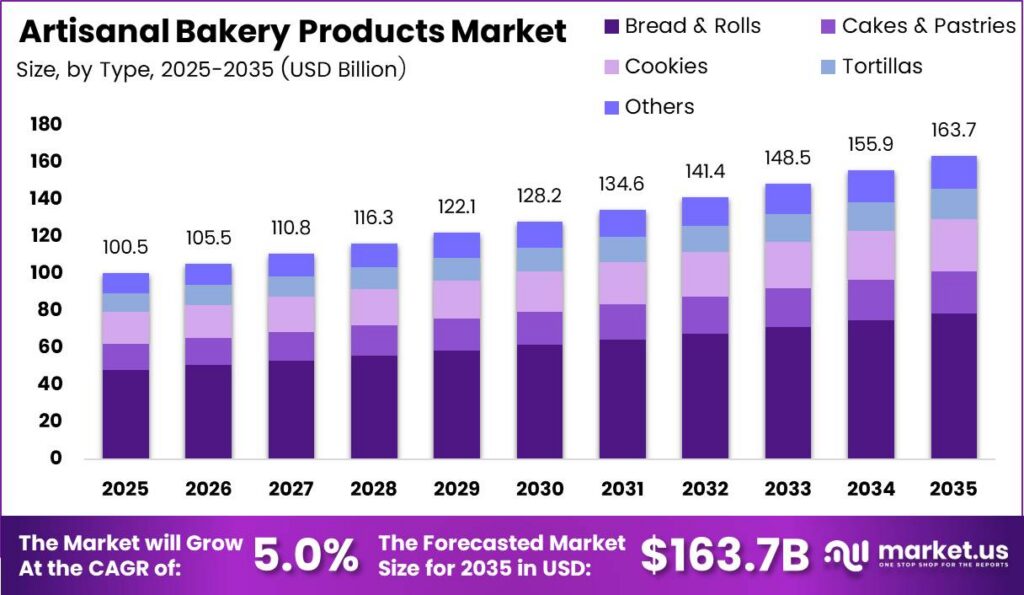
Global Artisanal Bakery Products Market size is expected to be worth around USD 163.7 Billion by 2035 from USD 100.5 Billion in 2025, growing at a CAGR of 5.0% during the forecast period 2026 to 2035. Artisanal bakery products encompass small-batch, slow-fermented breads, laminated pastries, hand-shaped rolls, and specialty cookies made using unbleached flours, wild yeast starters, and minimal chemical preservatives to deliver superior crust texture, natural digestibility, and authentic flavor.
Commercial structure spans independent neighborhood storefront bakeries, regional par-baked frozen dough manufacturers, and hospitality commissaries supplying hotels, cafés, and premium grocers. According to UN Comtrade and ITC Trade Map, global bakery exports under HS Code 1905 rose over 8.6% from USD 38.05 Billion in 2020 to USD 54.40 Billion in 2024. Therefore, cold-chain par-baking lets producers ship authentic artisanal loaves globally, creating high-margin export revenue for scalable specialty bakeries.
Key Takeaways
- The global Artisanal Bakery Products Market was valued at USD 100.5 Billion in 2025.
- Market revenue is projected to reach USD 163.7 Billion by 2035.
- The market expands at a compound annual growth rate of 5.0% during the forecast period from 2026 to 2035.
- In the Type segment, Bread & Rolls held the largest share of 47.34% in 2025 and represents the fastest growing product category.
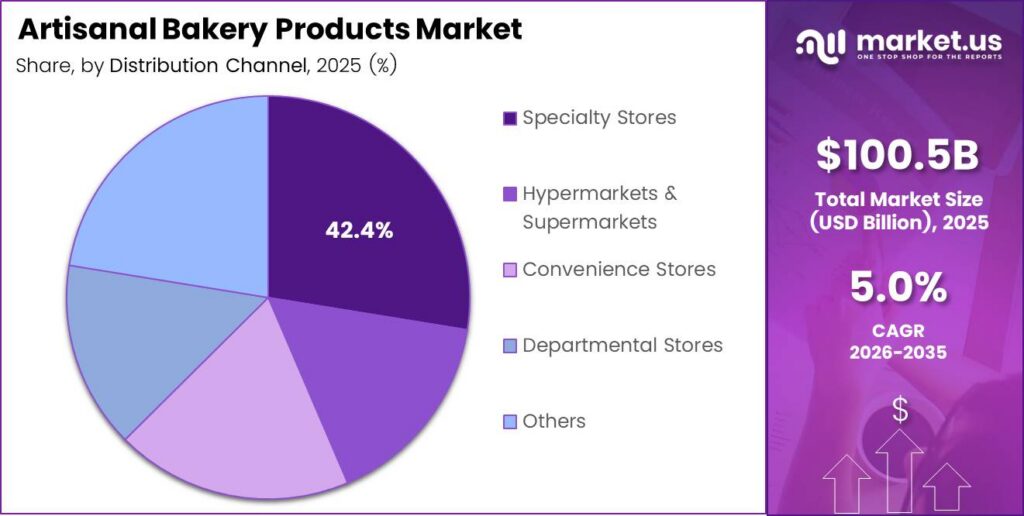
- In the Distribution Channel segment, Specialty Stores led the market with a 27.56% share in 2025, while Hypermarkets & Supermarkets represent the fastest growing channel.
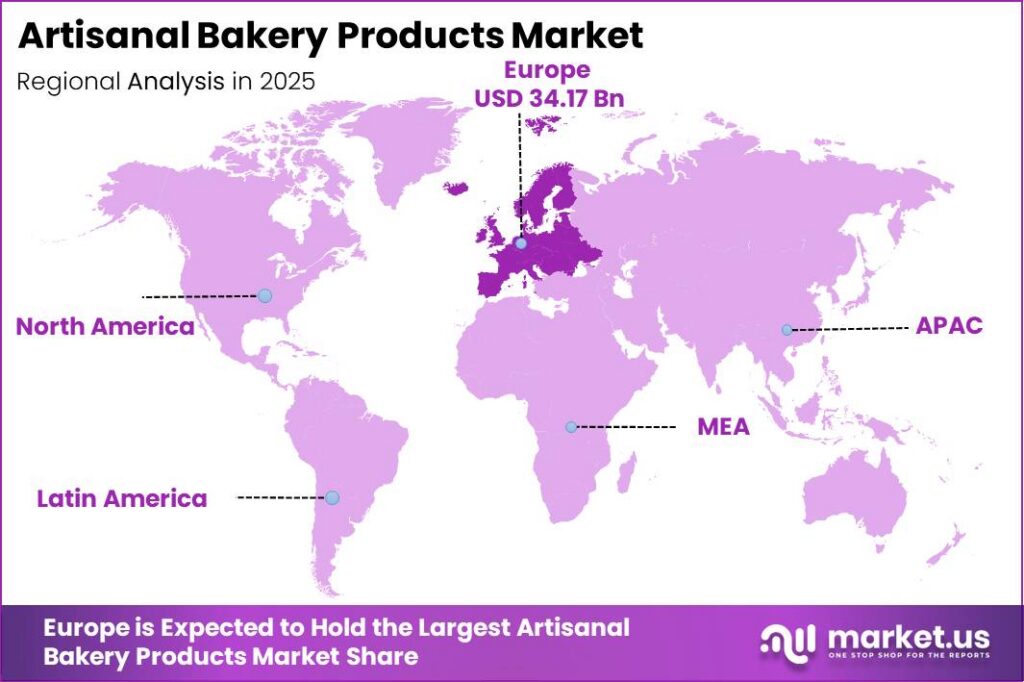
- Europe dominated the global market in 2025 with a 34.11% share, valued at USD 34.17 Billion, while Asia-Pacific is the fastest growing region.
Government agricultural trade programs, tariff-rate quotas, and strict clean-label food standards directly govern how specialty bakers source heritage grains and export finished goods. As reported by the USDA Foreign Agricultural Service, United States baked goods exports reached USD 4.27 Billion across 1.44 Million metric tons in 2025, compared to a 3-year average of USD 4.38 Billion . Consequently, regulatory compliance and bilateral trade access determine margin stability for cross-border producers.
Major baking groups are committing heavy capital expenditure toward automated fermentation lines and zero-emission logistics to scale artisanal quality at industrial volume. In July 2025, a leading Mexican baking group committed over USD 2 Billion across 7 Mexican states through 2028 to upgrade bakery plant technology and electric delivery fleets, creating 2,000 direct and 10,800 indirect jobs. This signals that capital-intensive automation now separates market leaders from regional bakeries.
Europe holds the largest market share at 34.11%, valued at USD 34.17 Billion in 2025, supported by protected regional baking traditions and dense local flour milling infrastructure. Data from the Food and Agriculture Organization shows global cereal production reached a record 3,040 Million tonnes in 2025, rising 6.0%, while world cereal utilization expanded 2.5% to 2,946 Million tonnes . This abundant grain supply stabilizes specialty flour costs and protects European baker margins.
Ingredient and frozen dough suppliers are simultaneously upgrading technical test kitchens to help retail and foodservice operators formulate high-hydration artisanal items without adding skilled store labor. In September 2025, a global family-owned food supplier announced a USD 10 Million investment to expand its Buffalo headquarters campus, acquiring the 42,300-square-foot Curtiss Malt House property . Consequently, collaborative research centers shorten product development cycles and help commercial buyers launch seasonal menus faster.
Type Analysis
Bread & Rolls dominates with 47.34% share in 2025 due to daily staple sourdough consumption.
In 2025, Bread & Rolls held a 47.34% share in the Type segment of the Artisanal Bakery Products Market. The U.S. Census Bureau found that commercial bakeries under NAICS 311812 recorded USD 39,786,314 Thousand, or USD 39.79 Billion, in 2024 shipment value . Extended lactic acid fermentation breaks down gluten networks and phytic acid, making sourdough loaves essential daily staples for health-conscious households. Therefore, industrial bakers investing in automated retarder-proofers capture recurring retail grocery contracts.
Cakes & Pastries serve consumers seeking indulgent, laminated, and fruit-filled baked goods for hospitality dining and social occasions. Based on ITC Trade Map and UN Comtrade data, global exports of specialized bread, pastry, and cakes under subheading HS 190590 rose from USD 23.12 Billion in 2020 to USD 36.61 Billion in 2024. Multi-layer butter lamination requires precise temperature-controlled sheeting equipment that small cafés cannot replicate in-house. Consequently, frozen laminated pastry manufacturers win high-margin foodservice accounts.
Cookies provide shelf-stable, portion-controlled sweet treats that allow artisanal producers to expand beyond local daily delivery radii. UN Comtrade indicates that sweet biscuits and cookies generated USD 349.01 Million, or 57% of India’s USD 611.32 Million bakery exports under HS 1905 in 2024. In February 2025, Flowers Foods acquired Simple Mills, carrying USD 240 Million in 2024 sales across 30,000 stores, for USD 848.6 Million total consideration and USD 795 Million cash . Low moisture activity prevents microbial spoilage, letting premium brands scale nationwide.
Distribution Channel Analysis
Specialty Stores dominates with 27.56% share in 2025 due to fresh on-premise baking appeal.
In 2025, Specialty Stores held a 27.56% share in the Distribution Channel segment of the Artisanal Bakery Products Market. Figures from the U.S. Census Bureau show that retail bakeries under NAICS 311811 comprised 9,219 establishments employing 87,547 workers with a USD 2.4 Billion annual payroll in 2023. Unpackaged crust crispness degrades within hours of oven discharge due to moisture migration from the crumb. Therefore, on-premise boutique bakeries command premium pricing and strong neighborhood customer loyalty.
Hypermarkets & Supermarkets represent the fastest growing distribution channel by installing in-store bake-off ovens that finish frozen par-baked artisanal doughs on demand. According to Eurostat, calendar-adjusted retail trade volume for food, drinks, and tobacco increased 1.6% in the Euro area and 1.4% across the European Union in August 2026 . High supermarket foot traffic lowers customer acquisition costs and guarantees rapid inventory turnover for fresh bakery counters. Consequently, par-baked suppliers gain volume scale through supermarket private-label contracts.
Convenience Stores capture impulse breakfast and commuter snack purchases through single-serve artisanal rolls and pastries. As reported by the U.S. Census Bureau, food and beverage stores under NAICS 445 generated USD 751,682 Million in sales during the first 9 months of 2026, with grocery stores under NAICS 4451 reaching USD 683,438 Million, up 1.0% . In October 2024, Grupo Bimbo agreed to acquire Balkan baker DON DON, with EUR 190 Million sales and 2,400 employees . High-frequency store restocking requires dense regional distribution networks.
Key Market Segments
By Type
- Bread & Rolls
- Loaves
- Baguettes
- Rolls
- Buns
- Sandwich Slices
- Ciabatta
- Others
- Cakes & Pastries
- Pastries
- Cupcakes
- Dessert Cakes
- Sponge Cakes
- Cookies
- Bar
- Molded
- Sandwich
- Drop
- Others
- Tortillas
- Others
By Distribution Channel
- Specialty Stores
- Hypermarkets & Supermarkets
- Convenience Stores
- Departmental Stores
- Traditional Grocery Stores
- Airport Retail Stores
- Online
- Others
Regional Analysis
Europe Dominates the Artisanal Bakery Products Market with a Market Share of 34.11% in 2025, Valued at USD 34.17 Billion
Europe leads the global market with a 34.11% revenue share, valued at USD 34.17 Billion in 2025. Data from Eurostat shows that the European Union bakery and flour confectionery sector comprises over 210,000 operating enterprises, where 98% are small and medium-sized businesses, supported by annual per capita bread intake of 53 kilograms . Deep cultural preference for daily freshly baked crusty bread sustains thousands of neighborhood bakeries. Consequently, European equipment and specialty flour suppliers enjoy stable replacement demand.
Asia-Pacific represents the fastest growing region as urban middle-class households adopt Western bakery-café dining habits and premium packaged baked goods. The Food and Agriculture Organization found that India’s wheat harvest reached a record 117.9 Million tonnes in 2025, while its baked goods exports expanded at a 10% CAGR from USD 346.7 Million in FY2019 to USD 557.6 Million in FY2024. Abundant domestic grain output lowers raw flour costs. Therefore, regional manufacturers can price artisanal bakery items competitively for mass urban retail.
Key Regions and Countries
North America
- US
- Canada
Europe
- Germany
- France
- The UK
- Spain
- Italy
- Rest of Europe
Asia Pacific
- China
- Japan
- South Korea
- India
- Australia
- Rest of APAC
Latin America
- Brazil
- Mexico
- Rest of Latin America
Middle East and Africa
- GCC
- South Africa
- Rest of MEA
Market Dynamics
Raw grain harvest fluctuations, energy-intensive oven operations, and cold-chain logistics costs shape profit margins across the global artisanal baking value chain. Based on Food and Agriculture Organization data, global wheat production will reach 813.9 Million tonnes in 2026, reflecting a 3.3% drop from the prior year, within total world cereal output of 2,979 Million tonnes . Tighter milling wheat supplies raise protein flour premiums. Therefore, commercial bakers must lock in forward grain contracts and reduce end-of-day store waste.
Drivers
Consumer demand for authentic flavor and visible craft shifts spending toward slow-fermented loaves rather than standard pan bread. In September 2024, Puratos surveyed over 20,000 consumers across 50 countries, and its September 2025 update showed 70% linked sourdough with superior taste while online sourdough discussions rose 79%. An outlet shifting 5 percentage points of unit sales into items priced 15% above average lifts revenue by 0.75% at flat volume. This mix shift gives premium bakers strong pricing power.
This sourdough demand contributes an estimated +0.40 percentage points against the 5.0% baseline CAGR through November 4, 2026. Total drivers represent 1.10 percentage points and opportunities represent 0.90 percentage points, whereas restraints and challenges equal 0.80 and 0.65 percentage points. Combining all positive or negative sensitivities yields illustrative bounds of 7.0% and 3.55%. Consequently, investors should prioritize bakery chains that pair long fermentation schedules with café seating and custom pastry programs.
| Driver | (~) % Impact on CAGR Forecast | Geographic Relevance | Impact Timeline |
|---|---|---|---|
| Premium sourdough and fermentation demand | +0.40% | Global; Europe and North America-led | Short term (≤ 2 years) |
| Neighborhood bakery-café consumption | +0.25% | Urban Europe, North America, Asia-Pacific | Short term (≤ 2 years) |
| Celebration and customized pastry purchases | +0.20% | Global; urban consumer markets | Short term (≤ 2 years) |
| Existing hotel and restaurant procurement | +0.15% | Tourism-intensive Europe, Asia-Pacific, Middle East | Short term (≤ 2 years) |
| Established online ordering and pickup | +0.10% | Digitally connected urban markets | Short term (≤ 2 years) |
Restraints
Limited collateral, brief operating histories, and uneven daily cash receipts prevent independent bakeries from funding flour and payroll before customer payments clear. In May 2025, the Federal Reserve reported that credit access challenged over 25% of small firms, while its March 2025 review showed 37% of small employer firms sought credit during 2023. For a bakery with cash outlays at 70% of revenue, a 14-day funding gap equals 2.7% of annual sales across 365 operating days.
When ingredient suppliers demand immediate payment, this liquidity gap forces shorter store hours, canceled baking batches, or shop closures. Working-capital credit exclusion creates a market drag of -0.30 percentage points against the 5.0% baseline CAGR among thinly capitalized operators over a 2-year short-term window, while licensing and cottage-food rules span 2 to 4 years. Therefore, independent bakers must secure customer deposits, align supplier payment terms, and prioritize working liquidity over heavy oven purchases.
| Restraint | (~) % Impact on CAGR Forecast | Geographic Relevance | Impact Timeline |
|---|---|---|---|
| Working-capital credit exclusion | -0.30% | Global; independent and thinly capitalized bakeries | Short term (≤ 2 years) |
| Household affordability and purchase deferral | -0.20% | Price-sensitive developed and emerging markets | Short term (≤ 2 years) |
| Unaffordable storefront leases and closures | -0.15% | High-rent metropolitan retail districts | Short term (≤ 2 years) |
| Premises licensing and occupancy restrictions | -0.10% | Jurisdiction-specific urban markets | Medium term (2–4 years) |
| Home-kitchen wholesale and shipping prohibitions | -0.05% | Restrictive cottage-food jurisdictions | Medium term (2–4 years) |
Challenges
Artisanal baking relies on hands-on skill in dough mixing, proofing, shaping, and oven control, making staff turnover a major productivity drain. The U.S. Bureau of Labor Statistics projects 36,500 annual baker openings from 2025 to 2035 alongside 6% employment growth, driven by career switches and retirements. In an 8-person production team, replacing 1 veteran baker with a trainee at 70% output cuts team capacity by 3.75% before scrap and supervision costs.
This skilled labor turnover creates a -0.25 percentage point CAGR drag by slowing capacity expansion and weakening operating margins across mature labor markets. Over a 2 to 4-year mitigation horizon, bakeries must fund paid apprenticeships, standardize fermentation tolerances, cross-train staff, and automate repetitive dough dividing while keeping master bakers focused on finishing. Consequently, operators that systematize production workflows will scale store counts faster than craft-dependent rivals.
| Challenge | (~) % CAGR Friction Drag | Geographic Relevance | Mitigation Horizon |
|---|---|---|---|
| Skilled Baker Replacement Burden | -0.25% | Global; mature labor markets especially exposed | Medium term (2–4 years) |
| Ingredient Quality And Availability | -0.15% | Global grain, dairy, and cocoa supply chains | Medium term (2–4 years) |
| Freshness Limited Distribution Radius | -0.10% | Dispersed settlements and intercity routes | Medium term (2–4 years) |
| Cross Contact Control Complexity | -0.08% | Mixed-product bakeries across regulated markets | Short term (≤ 2 years) |
| Energy Intensive Batch Scheduling | -0.07% | High-energy-cost and unreliable-grid markets | Medium term (2–4 years) |
Opportunities
Daily baking schedules committed ahead of customer foot traffic often leave unsold edible loaves at closing time, creating revenue upside through timed markdown apps or secondary product conversion. The United Nations Environment Programme 2024 Food Waste Index linked 28% of consumer food waste to foodservice and 12% to retail. A bakery selling 90% of output at full price can sell half its remaining 10% at 40% of regular price, adding 2% of production value or 2.2% of current sales.
When extra packaging and handling take 20% of recovered sales, net contribution equals 1.6% of full-price production value before platform fees. Against a 10% initial operating margin, this recovery yields 1.5 percentage points of margin expansion. Capturing this +0.30 percentage point CAGR upside within a 2-year window requires strict food-safety tracking and late-day pickup windows that prevent full-price buyers from trading down to discounted surplus bundles.
| Opportunity | (~) % Potential CAGR Upside | Geographic Relevance | Execution Window |
|---|---|---|---|
| Incremental surplus-product monetization | +0.30% | Urban bakery clusters across developed and emerging markets | Short term (≤ 2 years) |
| Dedicated clinically targeted nutrition ranges | +0.20% | Health-specialty channels in developed and urban markets | Medium term (2–4 years) |
| Institutional artisanal meal contracts | +0.15% | Corporate campuses, universities, and care facilities | Medium term (2–4 years) |
| Underpenetrated secondary-city expansion | +0.15% | Selected Asia-Pacific, Latin American, and African cities | Long term (≥ 4 years) |
| Heritage-brand licensing and royalties | +0.10% | Fragmented markets with transferable regional brands | Medium term (2–4 years) |
Key Company Insights
Aryzta AG
Aryzta AG operates as a premier global bake-off supplier of sourdough loaves, French baguettes, laminated croissants, and savory pastries across Europe, Asia, and Oceania. The Aryzta AG Annual Report indicates that full-year revenue reached EUR 2.22 Billion in 2025, rising 1.3% from EUR 2,195 Million in 2024, while net income totaled EUR 112.3 Million and new product innovation generated 18% of revenue . High innovation turnover helps Aryzta secure premium supermarket and quick-service restaurant accounts.
Management actively pairs targeted cold-chain distribution acquisitions with manufacturing footprint consolidation to lift operating margins across core European markets. Figures from Aryzta AG show that in October 2026 the company acquired 100% of French frozen bakery distributor Frigegro, adding EUR 35 Million to EUR 40 Million in annualized revenue alongside its June 2026 Société Européenne des Beurres purchase, while consolidating German baking into Eisleben across 5 plants and 23 lines . This lowers unit overhead costs.
Lantmännen Unibake
Lantmännen Unibake ranks among Europe’s largest frozen and fresh bakery manufacturers, operating industrial bakeries across more than 20 countries that supply artisanal baguettes, ciabatta, pastries, and gourmet buns to retail and foodservice buyers. According to Lantmännen Annual and Interim Reports, Lantmännen Unibake generated rolling 12-month net sales of MSEK 16,898 Million as of April 2025 and MSEK 17,051 Million in 2024, within parent cooperative net sales of MSEK 59,931 Million in 2025.
Ownership by an agricultural cooperative gives Lantmännen Unibake direct farm-to-fork traceability and inspires targeted acquisitions in high-margin European bake-off markets. As reported by Lantmännen in November 2026, Lantmännen Unibake completed the acquisition of Italian frozen retail bread producer Panificio San Francesco S.p.A., adding an industrial bakery in Codevilla located 75 kilometers south of Milan with 100 employees . This Italian production hub expands its Mediterranean sourdough export capacity across European supermarkets.
Key Players
- Aryzta AG
- Lantmannen Unibake
- Grupo Bimbo
- Flowers Foods
- Rich Products Corporation
- Yamazaki Baking Co., Ltd.
- Finsbury Food Group Plc (Nicholas & Harris and Kara)
- Poilâne
- Tartine Bakery
- GAIL’s Bakery
- Peter Backwaren OHG
- Other Key Players
Recent Developments
2026
- October 2026: Grupo Bimbo capacity expansion and investment committed MXN 1,760 Million, or USD 101.2 Million, to construct an automated bakery plant in Puebla City and modernize over 30 plants across Mexico according to Grupo Bimbo
- September 2026: Rich Products Corporation innovation and investment completed a USD 3.2 Million redesign of its digitally equipped Customer Innovation Center at its global headquarters in Buffalo, New York according to Rich Products Corporation
- February 2026: Finsbury Food Group product launch and innovation introduced its 2026 Bakery Flavour Trends range and expanded automated proofing and blast-freezing lines at its Kara foodservice site following a December 2025 project according to Finsbury Food Group
- January 2026: Grupo Bimbo acquisition agreed to acquire 100% of Moroccan bread and tortilla producer Joy Food International SARL in Casablanca, adding a modernized CPE-800 line producing 1,300 pieces per hour according to Grupo Bimbo
- January 2026: Yamazaki Baking Co., Ltd. innovation and product launch relaunched its flagship Royal Bread using proprietary dough technology in January 2026 after investing ¥59,942 Million, or USD 380 Million, in 2025 capital projects, up ¥7,892 Million according to Yamazaki Baking Co., Ltd.
2025
- December 2025: GAIL’s Bakery capacity expansion announced plans to open 40 new bakery stores across England by February 2026 after opening 36 stores the prior year, reaching 180 locations as annual sales rose 20% to £278 Million according to GAIL’s Bakery
- September 2025: Grupo Bimbo regulatory approval and acquisition received antitrust clearance from Brazil’s CADE to acquire 6 companies and 4 manufacturing plants of Brazilian baker Wickbold, subject to divesting 2 brands according to CADE and Grupo Bimbo
- September 2025: Lantmännen Unibake acquisition acquired Dutch savoury artisanal bakery specialist Boboli Benelux B.V., which generates EUR 50 Million in annual net sales and employs 200 staff in Bunschoten according to Lantmännen Unibake
- August 2025: Finsbury Food Group acquisition acquired a 70% majority stake in UK direct-to-consumer cake brand Lola’s Cupcakes, generating £26.2 Million, or USD 35.5 Million, in annual revenue across 45 kiosks with 400 employees according to Finsbury Food Group
Geopolitical Impact Analysis
Regional armed conflicts and tariff realignments directly disrupt the cross-border grain and specialty ingredient supply chains that sustain artisanal baking. Data from the World Trade Organization shows world merchandise trade volume grew 4.6% in 2025 and 3.5% in the first half of 2026, prompting an upward revision for full-year 2026 trade growth to 3.9% from the March 2026 estimate of 1.9% . However, the World Bank found that global food commodity prices will rise 10% in 2026 and 7% in 2027, while wheat prices surge 28% in 2026 and 14% in 2027 due to Black Sea shipping disruptions . High-protein bread wheat, malted barley flour, and European butter represent core raw materials for sourdough loaves and laminated pastries. Therefore, commercial bakeries face sharp ingredient cost inflation and must diversify flour milling contracts across North American and domestic grain basins.
Maritime chokepoint attacks in the Red Sea and Panama Canal transit restrictions simultaneously inflate cold-chain shipping rates for frozen par-baked doughs and imported baking ovens. Based on UNCTAD data, the Shanghai Containerized Freight Index averaged 2,496 points in 2024, marking a 149% jump from 2023, while peak spot rates reached USD 3,600 per container as vessels rerouted around the Cape of Good Hope . UNCTAD indicates that global seaborne maritime trade volume will expand 0.5% in 2025 and 1.0% in 2026, while container fleet capacity grows 6.7% in 2025 and 4.0% in 2026 . Reefer containers transporting frozen laminated croissants and deck oven components absorb heavy fuel surcharges during longer sea voyages. Consequently, multinational bakery groups are localizing par-baked dough plants near urban consumption hubs to protect wholesale distributor margins.
Report Scope
| Report Features | Description |
|---|---|
| Market Value (2025) | USD 100.5 Billion |
| Forecast Revenue (2035) | USD 163.7 Billion |
| CAGR (2026-2035) | 5.0% |
| Base Year for Estimation | 2025 |
| Historic Period | 2021-2025 |
| Forecast Period | 2026-2035 |
| Report Coverage | Revenue Forecast, Market Dynamics, Market Opportunity Analysis, Technology and Innovation Landscape, Competitive Landscape, Recent Developments |
| Segments Covered | By Type (Bread & Rolls [Loaves, Baguettes, Rolls, Buns, Sandwich Slices, Ciabatta, Others], Cakes & Pastries [Pastries, Cupcakes, Dessert Cakes, Sponge Cakes], Cookies [Bar, Molded, Sandwich, Drop, Others], Tortillas, Others), By Distribution Channel (Specialty Stores, Hypermarkets & Supermarkets, Convenience Stores, Departmental Stores, Traditional Grocery Stores, Airport Retail Stores, Online, Others) |
| Regional Analysis | North America (US and Canada), Europe (Germany, France, The UK, Spain, Italy, and Rest of Europe), Asia Pacific (China, Japan, South Korea, India, Australia, and Rest of APAC), Latin America (Brazil, Mexico, and Rest of Latin America), Middle East and Africa (GCC, South Africa, and Rest of MEA) |
| Competitive Landscape | Aryzta AG, Lantmannen Unibake, Grupo Bimbo, Flowers Foods, Rich Products Corporation, Yamazaki Baking Co., Ltd., Finsbury Food Group Plc (Nicholas & Harris and Kara), Poilâne, Tartine Bakery, GAIL’s Bakery, Peter Backwaren OHG, Other Key Players |
| Customization Scope | Customization for segments, region / country-level will be provided. Additional customization can be done based on requirements. |
| Purchase Options | We have three licenses to opt for: Single User License | Multi-User License (Up to 5 Users) | Corporate Use License (Unlimited User and Printable PDF) |