


Global Anti-Pollution Skincare Products Market Size, Share, Growth Analysis By Product (Creams, Moisturizer, Face Mask, Others), By Nature (Conventional, Organic), By End-Use (Female, Male), By Distribution Channel (Online, Hypermarkets & Supermarket, Specialty Stores, Others), By Region and Companies - Industry Segment Outlook, Market Assessment, Competition Scenario, Statistics, Trends and Forecast 2026-2035
- Published date: Mar 2026
- Report ID: 182634
- Number of Pages: 346
- Format:
-
keyboard_arrow_up
Quick Navigation
Report Overview
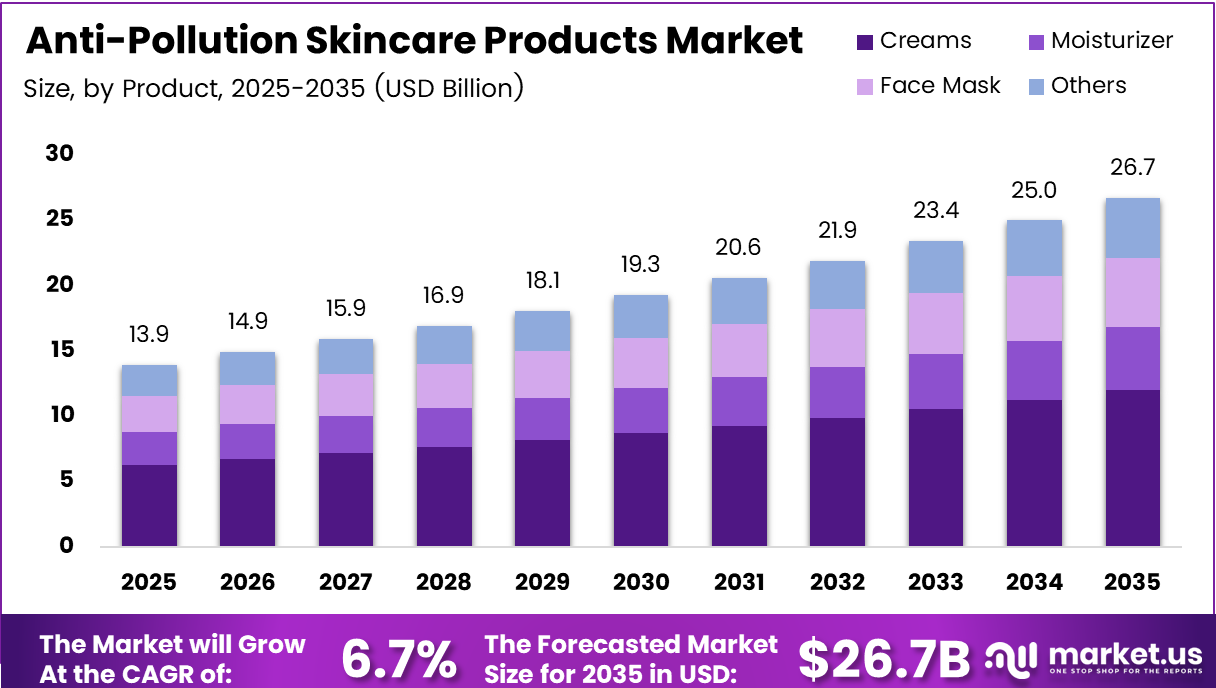
Global Anti-Pollution Skincare Products Market size is expected to be worth around USD 26.7 Billion by 2035 from USD 13.9 Billion in 2025, growing at a CAGR of 6.7% during the forecast period 2026 to 2035.
Anti-pollution skincare refers to formulations designed to protect the skin from environmental aggressors including particulate matter, heavy metals, UV radiation, and blue light. These products work by forming protective barriers, delivering antioxidants, and strengthening the skin’s natural defense mechanisms against urban pollutants.
Urban air quality deterioration directly translates into documented skin damage — including accelerated aging, barrier disruption, and oxidative stress. This causal link has shifted anti-pollution skincare from a niche premium category into a mainstream dermatological priority, especially in high-density Asian and European cities where pollution exposure is measurable and persistent.
Consumer behavior reflects this shift clearly. Female consumers dominate adoption with a 76.2% end-use share, signaling that skincare-literate buyers — who track ingredient efficacy and trust clinical claims — form the core purchasing base. This demographic demands evidence-backed formulations, not just marketing positioning.
Product innovation now centers on active ingredient delivery and clinical validation. According to a clinical study published on PMC NCBI, an anti-pollution film-forming facial spray (FFS1-CCS) with coffee cherry pulp extract improved skin hydration by 11.5% on Day 30 and 18.5% on Day 60. This level of measurable, time-bound efficacy represents the new product differentiation benchmark — brands without comparable clinical data face growing credibility gaps at retail.
Formulation stability is equally critical to commercial success. According to the same PMC NCBI study, chlorogenic acid (CGA) retention in the FFS1-CCS formulation reached 96.0% after thermal stress cycles, while caffeine (CAF) remained at 99% after equivalent stress conditions. These figures confirm that advanced film-forming delivery systems extend active shelf life — reducing waste and supporting premium pricing strategies.
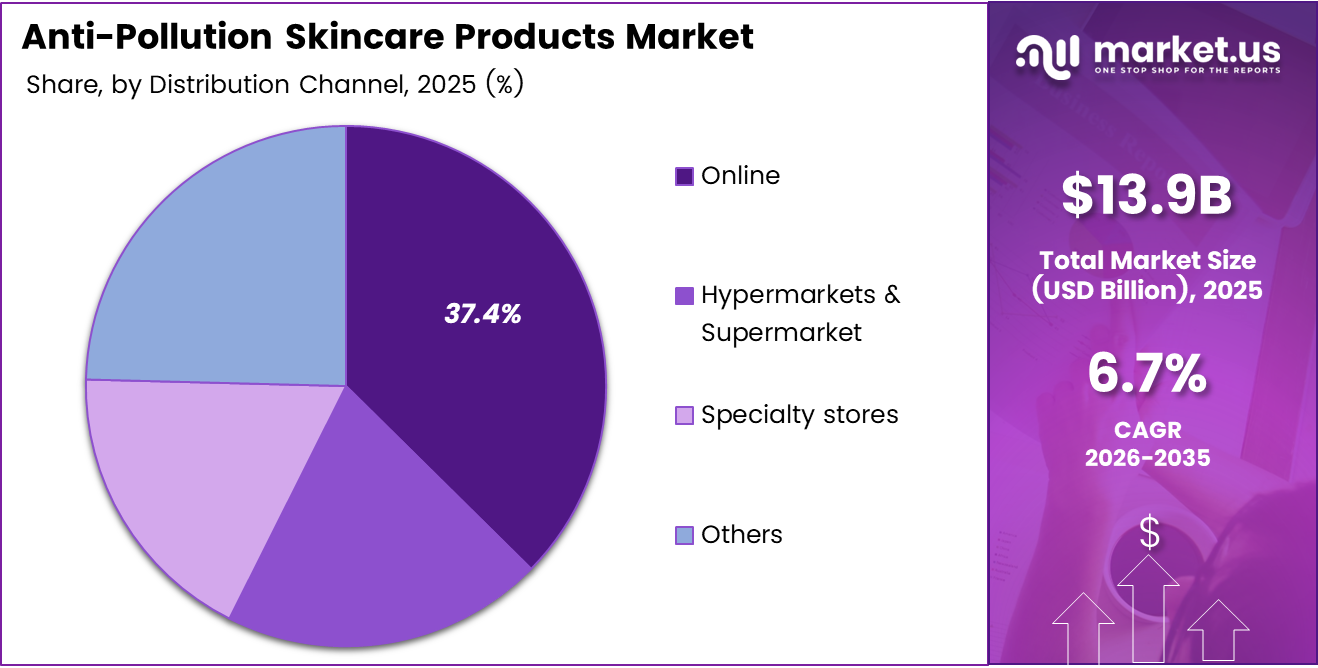
Distribution infrastructure is shifting alongside product development. Online channels now capture 37.4% of sales, enabling brands to directly communicate scientific claims, trial data, and ingredient transparency to informed consumers. This channel advantage favors agile brands over traditional retail-dependent players.
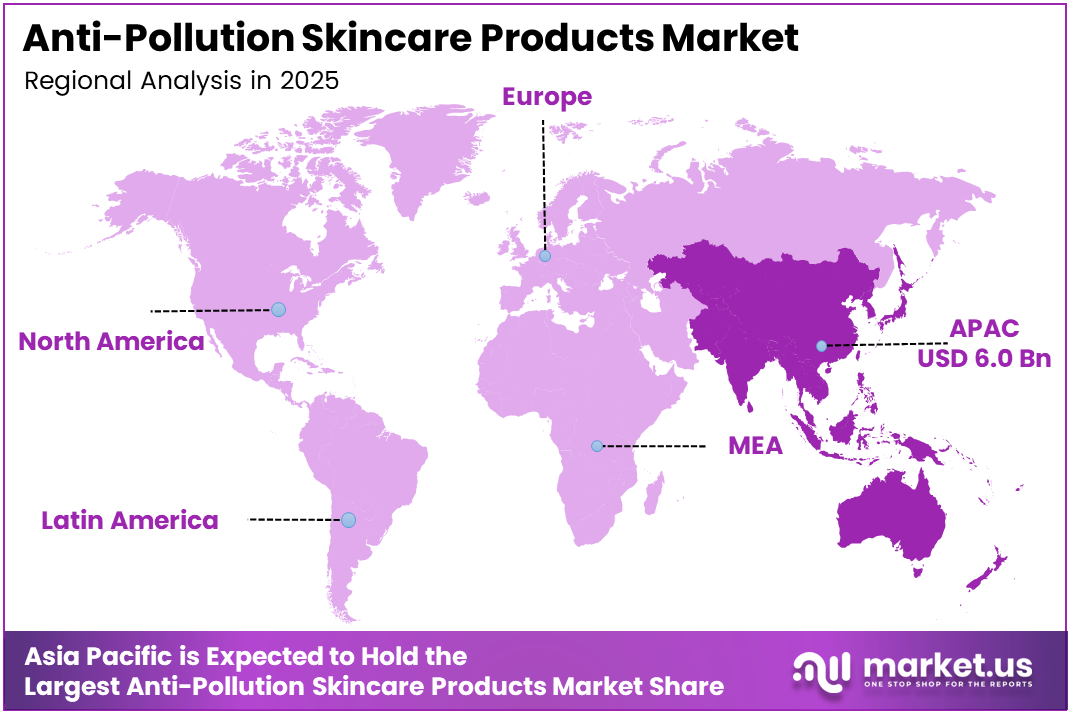
Asia Pacific leads with 43.6% market share, valued at USD 6.0 Billion, driven by severe urban pollution indexes and high skincare consumption cultures in China, Japan, South Korea, and India. The region sets the pace for product launches and clinical benchmarking globally.
Key Takeaways
- The Global Anti-Pollution Skincare Products Market is valued at USD 13.9 Billion in 2025 and is forecast to reach USD 26.7 Billion by 2035 at a CAGR of 6.7%.
- By Product, Creams dominate the market with a 39.6% share in 2025.
- By Nature, Conventional products lead with 72.3% share, while the Organic segment holds the remaining share.
- By End-use, Female consumers account for 76.2% of market share, reflecting strong gender-skewed purchasing behavior.
- By Distribution Channel, Online channels hold the highest share at 37.4%, followed by Hypermarkets and Supermarkets, Specialty Stores, and Others.
- Asia Pacific dominates the global market with 43.6% share, valued at USD 6.0 Billion in 2025.
Product Analysis
Creams dominate with 39.6% due to daily-use habit and barrier function efficacy.
In 2025, Creams held a dominant market position in the By Product segment of the Anti-Pollution Skincare Products Market, with a 39.6% share. Their dominance reflects consumer preference for rich-texture formulations that combine moisturization and pollution defense in a single daily application step, reducing product fatigue and improving compliance.
Moisturizer serves as the entry point for consumers new to anti-pollution skincare. Moisturizers occupy the accessible end of the price spectrum, enabling trial purchase behavior. However, they also represent an upgrade pathway — as consumers experience tangible benefits, they migrate toward specialized creams and serums with targeted anti-pollution actives.
Face Mask carries a high per-use value perception within this category. Face masks deliver concentrated active ingredients in controlled exposure time, making them suitable for weekly intensive treatment routines. Their positioning as a premium ritual product supports margin expansion for brands operating in specialty and direct-to-consumer channels.
Others in the product segment includes face mists, protective sprays, and hybrid SPF formulations. This sub-segment reflects formulation innovation at the edges of the market. Products here capture consumers seeking convenience formats — particularly urban commuters who prefer fast-absorbing protective layers over traditional cream textures.
Nature Analysis
Conventional dominates with 72.3% due to proven formulation efficacy and wider accessibility.
In 2025, Conventional products held a dominant market position in the By Nature segment of the Anti-Pollution Skincare Products Market, with a 72.3% share. Their leadership reflects the trust consumers place in clinically tested synthetic actives — many anti-pollution ingredients such as film-forming polymers and chelating agents perform best in conventional formulation systems.
Organic anti-pollution skincare differentiates through plant-derived antioxidants and biodegradable actives. Consumer appetite for clean-label formulations creates a growing premium sub-segment, but efficacy standardization remains a challenge. Brands that can validate organic active performance through clinical data — as seen in emerging peptide-based launches — will outperform those relying solely on ingredient sourcing claims.
End-Use Analysis
Female dominates with 76.2% due to higher skincare routine engagement and ingredient awareness.
In 2025, Female consumers held a dominant market position in the By End-Use segment of the Anti-Pollution Skincare Products Market, with a 76.2% share. Female buyers demonstrate deeper brand loyalty and higher willingness to pay for clinically substantiated products. This concentration means brands targeting the male segment face a relatively uncontested path — if they can reframe anti-pollution skincare within male grooming vocabulary.
Male consumers represent an underpenetrated segment with visible structural tailwinds. Urban male professionals in Asia Pacific and Europe face equivalent pollution exposure but historically lower skincare adoption. Brands entering this segment with streamlined, functional, low-SKU routines can establish first-mover positioning before the segment reaches mainstream saturation.
Distribution Channel Analysis
Online dominates with 37.4% due to direct ingredient communication and clinical proof delivery.
In 2025, Online channels held a dominant market position in the By Distribution Channel segment of the Anti-Pollution Skincare Products Market, with a 37.4% share. Online platforms give brands control over ingredient storytelling, clinical data presentation, and consumer education — all of which are critical purchase triggers in a market where efficacy claims drive conversion.
Hypermarkets and Supermarkets provide physical discovery and impulse purchase access for mass-market anti-pollution products. This channel remains essential for conventional formulations targeting price-sensitive consumers in emerging markets, where physical retail still drives first-time category adoption.
Specialty Stores serve as the premium validation channel for this market. Dermatology-adjacent retail environments create trust signals that justify higher price points for clinical-grade anti-pollution formulations. Brands with substantiated efficacy data use specialty store placement to establish credibility before scaling through broader channels.
Others encompasses pharmacies, dermatology clinics, and direct-sales networks. This sub-channel is particularly relevant for medically positioned anti-pollution products where dermatologist recommendation is part of the purchase journey — strengthening the clinical framing of barrier-protection formulations.
Key Market Segments
By Product
- Creams
- Moisturizer
- Face Mask
- Others
By Nature
- Conventional
- Organic
By End-Use
- Female
- Male
By Distribution Channel
- Online
- Hypermarkets & Supermarket
- Specialty Stores
- Others
Drivers
Urban Air Pollution and Rising Dermatologist Guidance Accelerate Demand for Barrier-Protection Skincare
Urban particulate matter, nitrogen dioxide, and heavy metal exposure directly compromise the skin barrier, accelerating oxidative stress and visible aging. As more dermatologists document pollution-linked skin conditions, their clinical recommendations for barrier-strengthening products convert medical authority into commercial demand — shortening the consumer decision cycle significantly.
Consumer awareness of pollution-induced skin damage has moved from niche concern to mainstream purchase motivator. Buyers now actively seek products with specific anti-pollution claims, driving a premiumization shift within the broader skincare market. According to PMC NCBI, the FFS1-CCS film-forming facial spray achieved a Primary Irritation Index (PII) of just 0.02 — well below the 0.5 safety threshold — confirming that advanced anti-pollution formulations can deliver efficacy without compromising skin tolerability, a key reassurance for clinical recommendation pathways.
Premium anti-pollution formulations now command pricing power that conventional moisturizers cannot match. Brands that invest in clinical validation, proprietary delivery systems, and dermatologist-endorsed ingredient profiles gain durable margin advantages. Moreover, the expansion of pollution-defense SKUs within established skincare portfolios signals that major players are treating this segment as a long-term product line — not a temporary trend response.
Restraints
Lack of Regulatory Standards for Anti-Pollution Claims Undermines Consumer Trust and Pricing Power
No universal regulatory framework currently defines or validates “anti-pollution” claims in cosmetic products. This absence allows low-efficacy products to use identical terminology as clinically tested formulations, eroding consumer trust across the entire category. For brands investing in genuine R&D, the lack of standards reduces the pricing premium they can credibly maintain.
Higher product pricing compared to conventional skincare creates a real adoption barrier, particularly in price-sensitive emerging markets. Consumers in high-urbanization, high-pollution markets — where anti-pollution products are most needed — often face the steepest affordability gap. Consequently, premium-tier brands experience strong developed-market penetration but structural resistance in the markets with the greatest unmet need.
The combination of unregulated claims and elevated price points creates a credibility trap for the category. Informed consumers demand clinical proof before paying a premium, yet most products lack published efficacy data. Therefore, brands that invest in third-party clinical validation gain both a conversion advantage and a differentiation moat — but the market as a whole absorbs the reputational cost of unsubstantiated competitors.
Growth Factors
Urbanization in Emerging Economies and Multi-Functional Formulation Innovation Open New Revenue Pathways
Rapidly urbanizing markets across South and Southeast Asia, Sub-Saharan Africa, and Latin America are adding millions of new pollution-exposed consumers annually. These consumers represent first-time category buyers — a structural growth pool that existing players have not yet fully addressed through accessible pricing or localized distribution strategies.
Multi-functional formulations combining UV protection, antioxidant delivery, and pollution defense address the consumer desire for simplified routines without compromised performance. According to PMC NCBI, active ingredient retention from coffee cherry pulp extract — including chlorogenic acid at 18.0%, caffeine at 25.7%, and theophylline at 20.6% — demonstrates that advanced delivery systems can sustain multiple actives simultaneously. This validates the commercial case for complex multi-benefit formulations at premium price points.
E-commerce expansion directly reduces the distribution cost disadvantage that smaller, science-led brands face against legacy players. Direct-to-consumer channels allow brands to present clinical data, educate on ingredient science, and build subscription models — all of which support higher lifetime customer value. Additionally, natural and plant-based ingredient innovation continues to widen the formulation toolkit, enabling brands to serve both efficacy-focused and clean-beauty consumer segments within a single product architecture.
Emerging Trends
Microbiome Science, Blue Light Defense, and Novel Biodegradable Actives Redefine Anti-Pollution Skincare Formulation
Antioxidant-rich ingredients including Vitamin C, niacinamide, and green tea extract now anchor product launches across price tiers. These ingredients address pollution-induced free radical damage with documented efficacy, shifting consumer vocabulary toward specific actives rather than broad category claims. Brands that build ingredient recognition around named antioxidants gain faster trust with educated buyers.
Microbiome-friendly formulations represent the next layer of sophistication in this market. Products designed to preserve the skin’s microbial ecosystem while blocking external pollutants appeal to consumers who understand that barrier health depends on both protection and ecological balance. In May 2025, UK startup Kutanios announced the B2B launch of LipoxErase (palmitoyl tetrapeptide-114), a novel biodegradable peptide that binds lipid peroxides caused by atmospheric pollutants and light across all wavelengths — signaling a new generation of targeted molecular defense in anti-pollution actives.
According to PMC NCBI, the FFS1-CCS formulation reduced skin roughness parameters R3 by 3.7% and R5 by 3.6% after 90 days — quantified improvements in wrinkle reduction that validate the anti-aging dimension of anti-pollution skincare. Additionally, blue light protection integration reflects the expansion of pollution definition to include digital environment stressors. Moreover, face mists and protective sprays are gaining traction as convenience-format delivery systems for consumers seeking fast-apply protection during urban commutes.
Regional Analysis
Asia Pacific Dominates the Anti-Pollution Skincare Products Market with a Market Share of 43.6%, Valued at USD 6.0 Billion
Asia Pacific commands 43.6% of the global anti-pollution skincare market, valued at USD 6.0 Billion in 2025. China, Japan, South Korea, and India collectively drive this leadership through a combination of severe urban pollution indexes, deeply embedded skincare routines, and high consumer willingness to pay for clinically validated products. The region sets the global product innovation benchmark.
North America Anti-Pollution Skincare Products Market Trends
North America holds a significant share driven by mature dermatological awareness, premium retail infrastructure, and strong e-commerce penetration. U.S. consumers demonstrate high receptivity to clinical-claim products, supported by an established dermatologist recommendation network. However, urban pollution severity is lower than Asia Pacific, which moderates urgency-driven adoption compared to high-pollution markets.
Europe Anti-Pollution Skincare Products Market Trends
Europe benefits from stringent cosmetic ingredient regulations that inadvertently raise product quality standards across the category. French, German, and UK urban consumers actively seek multi-functional protective skincare. In 2024, French brand Clarins launched its Multi-Active Day Cream featuring a dedicated anti-pollution complex of organic white horehound, furcellaria, and nipplewort extracts — reflecting European consumer demand for plant-derived, scientifically validated urban defense products.
Latin America Anti-Pollution Skincare Products Market Trends
Latin America presents an early-stage opportunity anchored by rapid urbanization in Brazil and Mexico, where air quality in major metros has measurably deteriorated. Consumer skincare expenditure is rising alongside growing middle-class formation. However, price sensitivity remains a structural constraint — product accessibility at accessible price points will determine category penetration speed in this region.
Middle East and Africa Anti-Pollution Skincare Products Market Trends
The Middle East and Africa region shows differentiated dynamics — GCC consumers exhibit high premium skincare spending and UV-pollution combination exposure, while Sub-Saharan Africa represents an emerging long-term opportunity tied to urbanization pace. The region’s arid climate and dual UV and dust particle exposure create a specific formulation need that standard anti-pollution products have not yet fully addressed.
Key Regions and Countries
North America
- US
- Canada
Europe
- Germany
- France
- The UK
- Spain
- Italy
- Rest of Europe
Asia Pacific
- China
- Japan
- South Korea
- India
- Australia
- Rest of APAC
Latin America
- Brazil
- Mexico
- Rest of Latin America
Middle East & Africa
- GCC
- South Africa
- Rest of MEA
Key Company Insights
L’Oréal S.A. holds a structural advantage in this market through its dual investment in proprietary ingredient science and global dermatological partnerships. Its ability to move innovations from R&D labs into mass-market and luxury channels simultaneously allows it to capture both the accessible and premium ends of anti-pollution skincare — a dual-tier strategy few competitors can replicate at scale.
Shiseido Company, Limited leverages deep Asia Pacific roots to align product development directly with the world’s most pollution-exposed consumer base. Its scientific heritage in skin barrier research translates into clinically positioned formulations that resonate with Japan’s and China’s efficacy-demanding consumers. This regional proximity to the dominant market gives Shiseido a first-read advantage on emerging consumer needs.
Kao Corporation approaches anti-pollution skincare through its materials science platform, enabling it to develop film-forming and active delivery technologies that go beyond cosmetic convention. Its B2B ingredient supply capabilities also position it to influence formulation standards across the wider industry — creating both direct-to-consumer revenue and upstream licensing opportunities.
Beiersdorf competes through dermatological credibility anchored by its established skin science platform. Its strategy of aligning anti-pollution claims with clinical skin health outcomes — rather than purely aesthetic messaging — positions it well against the growing segment of medically informed consumers. This evidence-led brand architecture supports premium pricing and specialty channel access.
Key players
- L’Oréal S.A.
- Shiseido Company, Limited
- Avon
- Kao Corporation
- Procter & Gamble
- MARY KAY
- Beiersdorf
- Johnson & Johnson Services, Inc.
- Unilever
Recent Developments
- April 2024 — Clariant completed the acquisition of Lucas Meyer Cosmetics from IFF for an enterprise value of USD 810 million, integrating high-value cosmetic ingredients into its Care Chemicals unit to strengthen anti-pollution and protective skincare formulation capabilities across its global client portfolio.
- September 2025 — DUOLIFE S.A. commercially launched its pro-health Anti-Pollution skincare line, developed in collaboration with Cracow University of Technology, featuring the Anti-Pollution Pro Dermo Boost Day Cream, Repair Night Cream, and Multi-Filter SPF50+ Protective Emulsion — all powered by a patented Ajuga reptans root extract offering defense against pollution, heavy metals, UV, HEV, and blue light.
Report Scope
Report Features Description Market Value (2025) USD 13.9 Billion Forecast Revenue (2035) USD 26.7 Billion CAGR (2026-2035) 6.7% Base Year for Estimation 2025 Historic Period 2020-2024 Forecast Period 2026-2035 Report Coverage Revenue Forecast, Market Dynamics, Competitive Landscape, Recent Developments Segments Covered By Product (Creams, Moisturizer, Face Mask, Others), By Nature (Conventional, Organic), By End-Use (Female, Male), By Distribution Channel (Online, Hypermarkets & Supermarket, Specialty Stores, Others) Regional Analysis North America (US and Canada), Europe (Germany, France, The UK, Spain, Italy, and Rest of Europe), Asia Pacific (China, Japan, South Korea, India, Australia, and Rest of APAC), Latin America (Brazil, Mexico, and Rest of Latin America), Middle East & Africa (GCC, South Africa, and Rest of MEA) Competitive Landscape L’Oréal S.A., Shiseido Company Limited, Avon, Kao Corporation, Procter & Gamble, MARY KAY, Beiersdorf, Johnson & Johnson Services Inc., Unilever Customization Scope Customization for segments, region/country-level will be provided. Moreover, additional customization can be done based on the requirements. Purchase Options We have three licenses to opt for: Single User License, Multi-User License (Up to 5 Users), Corporate Use License (Unlimited User and Printable PDF)  Anti-Pollution Skincare Products MarketPublished date: Mar 2026add_shopping_cartBuy Now get_appDownload Sample
 -
-
- L'Oréal S.A.
- Shiseido Company, Limited
- Avon
- Kao Corporation
- Procter & Gamble
- MARY KAY
- Beiersdorf
- Johnson & Johnson Services, Inc.
- Unilever
Our Clients

- 182634
- Mar 2026






