


Global Anti-Pollution Hair Care Products Market Size, Share, Growth Analysis Product (Shampoo, Conditioners, Oils, Serums & Masks, Others), End-user (Women, Men), Distribution Channel (Hypermarkets & Supermarkets, Pharmacy & Drug Stores, Specialty Stores, Online, Others), Region and Companies - Industry Segment Outlook, Market Assessment, Competition Scenario, Statistics, Trends and Forecast 2026-2035
- Published date: Mar 2026
- Report ID: 180858
- Number of Pages: 302
- Format:
-
keyboard_arrow_up
Quick Navigation
Anti-Pollution Hair Care Products Market Report Overview
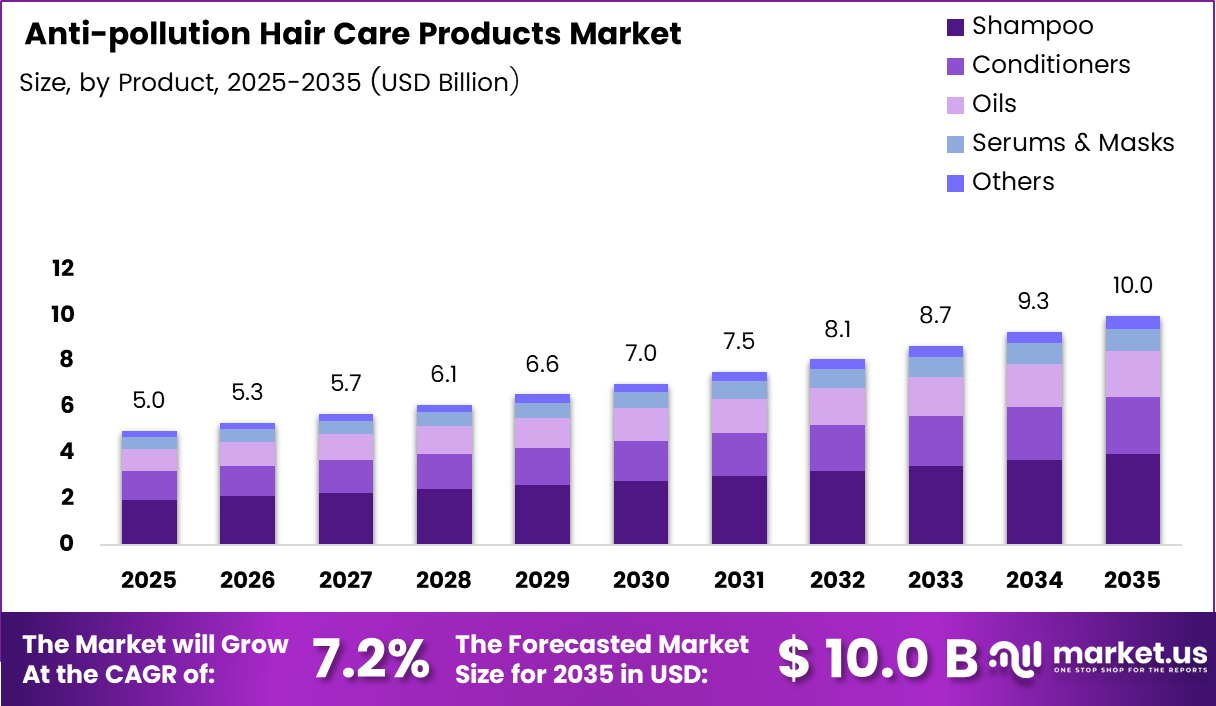
Global Anti-Pollution Hair Care Products Market size is expected to be worth around USD 10.0 Billion by 2035 from USD 5.0 Billion in 2025, growing at a CAGR of 7.2% during the forecast period 2026 to 2035.
The anti-pollution hair care products market refers to a specialized segment of the personal care industry. These products are formulated to protect hair and scalp from environmental stressors such as particulate matter, UV radiation, and heavy metals. Moreover, they help restore hair health damaged by urban pollution and hard water exposure.
Consumer awareness around hair damage caused by environmental pollutants is growing steadily. As urbanization accelerates globally, more individuals are seeking targeted solutions beyond traditional hair care. Consequently, product innovation and premiumization are becoming key strategies for brands operating in this space.
Government regulations around cosmetic ingredient safety and air quality standards are also shaping this market. Stricter environmental policies in regions such as Europe and Asia are pushing manufacturers to develop cleaner, more effective formulations. Additionally, regulatory frameworks are driving transparency in ingredient sourcing and product labeling.
Rising pollution levels in emerging economies such as India, China, and Indonesia are creating significant growth opportunities. Consumers in these regions are increasingly seeking protective and restorative hair care solutions. Therefore, brands are expanding their anti-pollution product portfolios to address region-specific concerns and hair types.
According to Detoxie, the application of 0.5% active ingredient protected hair shafts against urban pollution-induced protein oxidative damage. This supports the functional efficacy claims made by anti-pollution hair care brands globally.
According to the WHO, 91% of the world’s population lives in places where air pollution levels exceed WHO guideline limits. This widespread exposure directly increases demand for protective hair care solutions across both developed and emerging markets.
According to Detoxie, positive results from its Hard Water Relief, Hair Fall Control and Pro Growth Shampoo begin showing as soon as 5 to 6 washes for 80% of users. For the remaining users, visible improvement is seen within 8 to 10 washes.
Key Takeaways
- The global anti-pollution hair care products market was valued at USD 5.0 Billion in 2025.
- The market is projected to reach USD 10.0 Billion by 2035, growing at a CAGR of 7.2%.
- By Product, Shampoo held the dominant share at 39.6% in 2025.
- By End-user, Women represented the largest segment with a share of 67.4%.
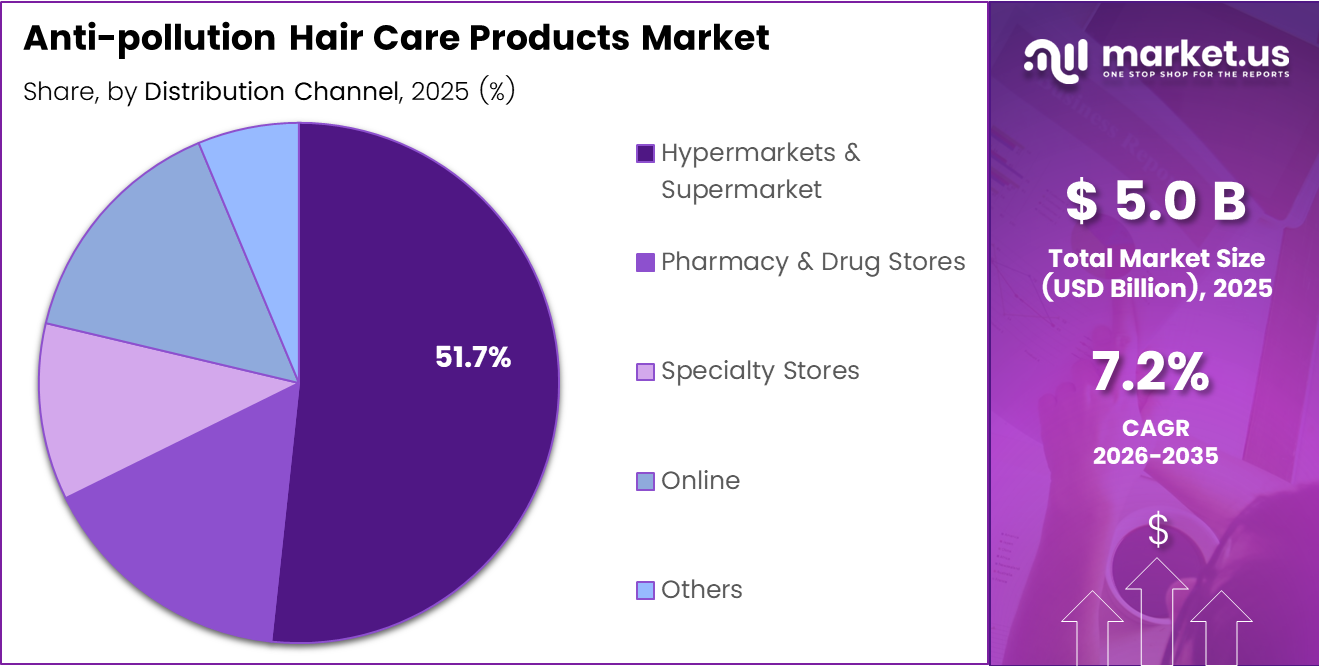
- By Distribution Channel, Hypermarkets & Supermarkets led with a share of 51.7%.
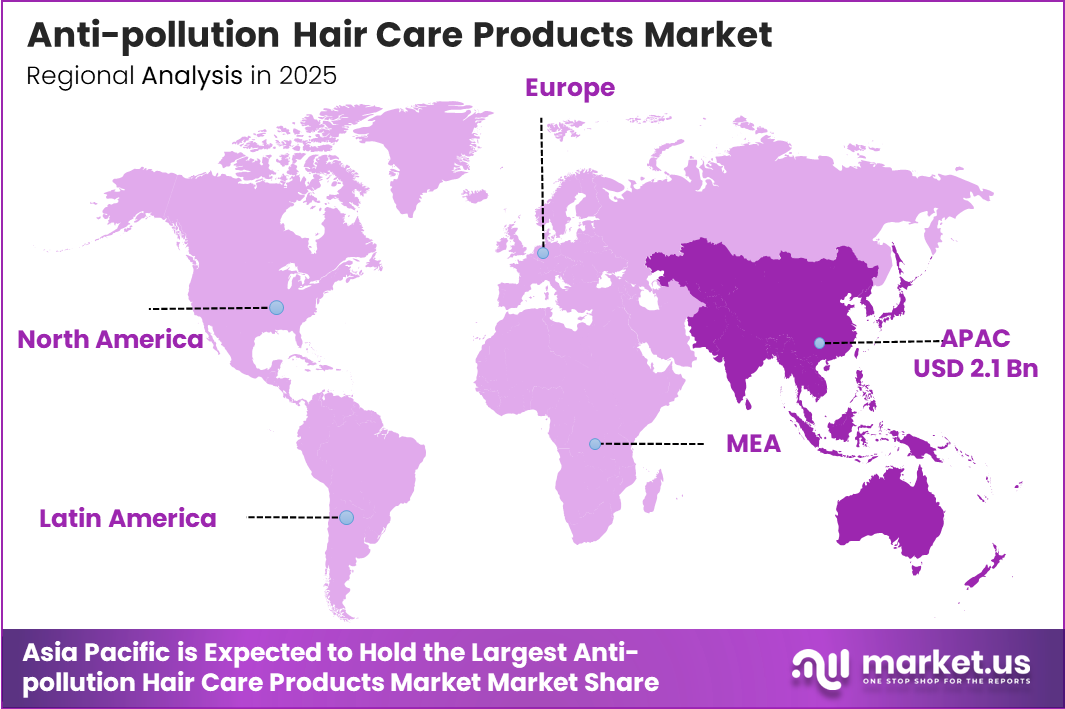
- Asia Pacific dominated the regional landscape with a market share of 43.60%, valued at USD 2.1 Billion.
Product Analysis
Shampoo dominates with 39.6% due to high daily usage and widespread consumer adoption across all demographics.
In 2025, Shampoo held a dominant market position in the Product segment of the Anti-Pollution Hair Care Products Market, with a 39.6% share. Shampoos are the most frequently purchased hair care product globally. Their anti-pollution variants have gained strong traction due to their ability to remove particulate matter, heavy metals, and pollutants while cleansing the scalp effectively.
Conditioners represent a significant secondary segment in this market. Anti-pollution conditioners are formulated to restore moisture and form a protective layer over the hair shaft. Consequently, they are increasingly paired with anti-pollution shampoos as part of complete hair care routines targeting environmentally stressed hair.
Oils are gaining momentum in the anti-pollution hair care category. Traditional hair oiling practices, especially popular in South Asia, are being reimagined with pollution-protective ingredients. Moreover, plant-based and herbal oils infused with detoxifying agents are seeing strong demand among health-conscious consumers.
Serums & Masks are positioned as premium treatment options in this segment. These products offer intensive care and targeted action against oxidative damage. Therefore, they are particularly popular among urban consumers seeking high-performance solutions for severely polluted environments.
Others include sprays, leave-in treatments, and scalp care products. This sub-segment is expanding rapidly as brands explore new delivery formats. Additionally, multifunctional products combining styling and pollution protection are emerging as a key growth category within this broader segment.
End-user Analysis
Women dominate with 67.4% due to higher product awareness and greater spending on personal care routines.
In 2025, Women held a dominant market position in the End-user segment of the Anti-Pollution Hair Care Products Market, with a 67.4% share. Women consistently drive premium personal care spending globally. Their higher awareness of hair health, combined with greater exposure to marketing for anti-pollution products, positions them as the primary consumer group in this market.
Men represent a growing and increasingly important end-user segment. Rising men’s grooming awareness among men, particularly in urban areas, is driving adoption of anti-pollution shampoos and scalp care products. Moreover, brands are launching male-targeted variants with simpler routines to capture this expanding demographic effectively.
Distribution Channel Analysis
Hypermarkets & Supermarkets dominate with 51.7% due to wide product availability and strong consumer footfall.
In 2025, Hypermarkets & Supermarkets held a dominant market position in the Distribution Channel segment of the Anti-Pollution Hair Care Products Market, with a 51.7% share. These retail formats offer consumers the ability to physically examine products before purchase. Additionally, frequent promotional activities and in-store displays help drive impulse purchases in this category.
Pharmacy & Drug Stores serve as a trusted channel for consumers seeking clinically validated or dermatologist-recommended anti-pollution hair care products. This channel benefits from perceived product credibility. Consequently, brands with a therapeutic or science-backed positioning tend to prioritize distribution through pharmacy chains.
Specialty Stores cater to premium and niche anti-pollution hair care brands. These outlets provide personalized consultations and curated product ranges. Therefore, they are particularly effective for targeting high-income urban consumers willing to invest in advanced formulations and expert-led product recommendations.
Online channels are the fastest growing distribution segment in this market. E-commerce platforms enable direct-to-consumer sales and allow brands to reach geographically dispersed audiences efficiently. Moreover, subscription models, influencer marketing, and detailed product reviews are accelerating online adoption among younger demographics.
Others include salons, direct sales, and departmental stores. Salons in particular play a key role in introducing consumers to professional anti-pollution treatments. Additionally, salon recommendations often influence at-home product purchases, making this channel strategically valuable for brand building and consumer education.
Key Market Segments
By Product
- Shampoo
- Conditioners
- Oils
- Serums & Masks
- Others
By End-user
- Women
- Men
By Distribution Channel
- Hypermarkets & Supermarkets
- Pharmacy & Drug Stores
- Specialty Stores
- Online
- Others
Drivers
Rising Urban Pollution Levels Drive Demand for Anti-Pollution Hair Care Products
Rapid urbanization and industrial growth are exposing millions of consumers to elevated levels of air pollution daily. This environmental shift is causing visible damage to hair including dryness, breakage, and scalp irritation. Consequently, consumers are actively seeking hair care products that offer protection against pollutants and particulate matter.
Growing consumer awareness about the harmful effects of pollution on hair health is a critical driver. Dermatologists and trichologists are increasingly recommending anti-pollution formulations as part of preventive care routines. Moreover, the expanding middle class in emerging markets is demonstrating greater willingness to spend on specialized personal care solutions.
Social media and digital marketing are amplifying consumer education around pollution-related hair damage. Influencer campaigns and clinical proof-of-concept content are building trust in anti-pollution product claims. Therefore, brands investing in science-backed communication are seeing stronger consumer engagement and faster market penetration across key geographies.
Restraints
High Product Costs and Limited Consumer Awareness Restrain Market Growth
Anti-pollution hair care products are often priced at a premium compared to conventional hair care options. This pricing barrier limits adoption among price-sensitive consumers, particularly in developing markets. Consequently, widespread penetration remains a challenge for brands trying to scale their anti-pollution product lines beyond urban, high-income demographics.
Limited scientific standardization in anti-pollution claims poses a credibility challenge for the market. Consumers and regulators alike struggle to evaluate the true efficacy of these products without universally accepted testing protocols. Moreover, inconsistent labeling practices and vague ingredient disclosures reduce consumer confidence in product performance.
Supply chain complexities for sourcing specialized active ingredients also restrict market growth. Many anti-pollution actives are derived from rare botanical or synthetic sources requiring careful handling. Therefore, production costs remain elevated, creating a barrier for smaller brands attempting to enter or compete in this specialized market segment.
Growth Factors
Innovation in Formulation and Expanding Distribution Networks Accelerate Market Growth
Continuous innovation in active ingredient technology is one of the strongest growth factors in this market. Brands are investing in research to develop multi-functional formulations that combine pollution protection with moisturizing, strengthening, and scalp care benefits. Consequently, product differentiation is becoming a key competitive advantage for established and emerging players.
The rapid expansion of e-commerce and direct-to-consumer channels is broadening market reach significantly. Online platforms allow brands to target niche audiences with personalized messaging and subscription-based models. Moreover, data-driven marketing enables companies to tailor product recommendations based on geography, hair type, and pollution exposure levels.
Increased investment in sustainable and clean beauty formulations is supporting growth across multiple regions. Consumers are demanding transparency in ingredient sourcing and eco-friendly packaging. Therefore, brands aligning their anti-pollution product lines with broader sustainability goals are gaining stronger brand loyalty and favorable positioning in premium retail channels.
Emerging Trends
Personalization, Sustainability, and Science-Backed Claims Reshape the Anti-Pollution Hair Care Market
Personalized hair care is emerging as a defining trend in the anti-pollution segment. Brands are using AI-driven diagnostic tools and consumer questionnaires to create customized product bundles. Moreover, personalization enhances perceived value and drives repeat purchase behavior, particularly among millennial and Gen Z consumers in urban markets.
The clean beauty movement is reshaping formulation priorities across the anti-pollution hair care category. Consumers are demanding products free from harmful chemicals while still offering effective pollution protection. Consequently, brands are reformulating existing lines with plant-based actives, biodegradable packaging, and cruelty-free certifications to align with evolving consumer values.
Scalp health is gaining attention as an emerging sub-trend within the anti-pollution hair care market. Research increasingly links scalp inflammation and follicle damage to prolonged pollutant exposure. Therefore, brands are introducing scalp-focused anti-pollution serums and treatments, positioning scalp care as a foundational step in comprehensive anti-pollution hair routines.
Regional Analysis
Asia Pacific Dominates the Anti-Pollution Hair Care Products Market with a Market Share of 43.60%, Valued at USD 2.1 Billion
Asia Pacific leads the global anti-pollution hair care products market, accounting for 43.60% of total revenue, valued at USD 2.1 Billion in 2025. The region’s dominance is driven by extreme pollution levels in major cities across China, India, and Southeast Asia. Moreover, a large and growing middle-class population with rising disposable incomes is fueling demand for premium protective hair care solutions.
North America Anti-Pollution Hair Care Products Market Trends
North America represents a mature and innovation-driven market for anti-pollution hair care products. The United States and Canada show strong consumer awareness around environmental hair damage and ingredient transparency. Additionally, the presence of well-established retail infrastructure and e-commerce platforms supports broad product accessibility across the region.
Europe Anti-Pollution Hair Care Products Market Trends
Europe is a key market characterized by strict regulatory standards and high consumer demand for clean beauty formulations. Countries such as Germany, France, and the UK are seeing growing interest in dermatologically tested anti-pollution hair care products. Consequently, brands with clinical validation and sustainable credentials are achieving stronger shelf placement and consumer trust.
Latin America Anti-Pollution Hair Care Products Market Trends
Latin America is an emerging market with significant growth potential, particularly in Brazil and Mexico. Rising urbanization and worsening air quality in major cities are increasing consumer awareness around hair and scalp protection. Moreover, expanding modern retail formats and growing e-commerce adoption are improving product availability across the region.
Middle East and Africa Anti-Pollution Hair Care Products Market Trends
The Middle East and Africa market is gradually developing, supported by rising urban populations and a growing premium beauty segment. Gulf Cooperation Council nations show notable demand for high-end personal care products. Therefore, anti-pollution hair care brands entering this region are focusing on premium positioning and distribution through specialty and pharmacy channels.
Key Regions and Countries
North America
- US
- Canada
Europe
- Germany
- France
- The UK
- Spain
- Italy
- Rest of Europe
Asia Pacific
- China
- Japan
- South Korea
- India
- Australia
- Rest of APAC
Latin America
- Brazil
- Mexico
- Rest of Latin America
Middle East & Africa
- GCC
- South Africa
- Rest of MEA
Key Company Insights
L’Oreal S.A. is one of the most influential players in the global anti-pollution hair care products market. The company has consistently invested in research and development to advance its pollution-defense formulations across its portfolio. Moreover, its broad global distribution network and strong brand equity allow it to reach consumers across both premium and mass market segments effectively.
Beiersdorf AG brings a dermatology-driven approach to anti-pollution hair care, leveraging its deep expertise in skin and scalp science. The company’s commitment to clinical testing and ingredient transparency resonates strongly with health-conscious consumers. Consequently, Beiersdorf has been effective in building trust through science-backed product claims and consistent innovation in protective formulations.
Shiseido Company applies Japanese beauty philosophy and advanced biotechnology to its anti-pollution hair care offerings. The brand is known for combining traditional ingredients with modern formulation science to address pollution-induced oxidative stress. Additionally, Shiseido’s strong presence across Asia Pacific gives it a competitive advantage in the region with the highest pollution-driven demand.
Unilever operates at a global scale with a diverse portfolio that spans mass-market and premium anti-pollution hair care solutions. The company has prioritized sustainability alongside product performance, aligning with evolving consumer expectations. Therefore, Unilever’s ability to deliver effective anti-pollution products at accessible price points positions it as a key driver of market democratization worldwide.
Key Players
- L’Oreal S.A.
- Beiersdorf AG
- Shiseido Company
- Unilever
- CLR Berlin
- Kao Corporation
- Procter & Gamble
- Coty, Inc.
- De Lorenzo
- Avon Products Inc.
Recent Developments
- July 2025 – L’Oréal signed an agreement to acquire Color Wow, recognized as one of the world’s fastest growing and most innovative professional haircare brands. This strategic acquisition is expected to strengthen L’Oréal’s premium haircare portfolio and expand its reach among professional and consumer channels globally.
- March 2026 – The Estée Lauder Companies announced its decision to acquire the remaining shares in Forest Essentials, a leading luxury Ayurvedic beauty brand. This move deepens Estée Lauder’s commitment to the premium natural beauty segment and reinforces its strategic focus on high-growth markets in Asia.
Report Scope
Report Features Description Market Value (2025) USD 5.0 Billion Forecast Revenue (2035) USD 10.0 Billion CAGR (2026-2035) 7.2% Base Year for Estimation 2025 Historic Period 2020-2024 Forecast Period 2026-2035 Report Coverage Revenue Forecast, Market Dynamics, Competitive Landscape, Recent Developments Segments Covered Product (Shampoo, Conditioners, Oils, Serums & Masks, Others), End-user (Women, Men), Distribution Channel (Hypermarkets & Supermarkets, Pharmacy & Drug Stores, Specialty Stores, Online, Others) Regional Analysis North America (US and Canada), Europe (Germany, France, The UK, Spain, Italy, and Rest of Europe), Asia Pacific (China, Japan, South Korea, India, Australia, and Rest of APAC), Latin America (Brazil, Mexico, and Rest of Latin America), Middle East & Africa (GCC, South Africa, and Rest of MEA) Competitive Landscape L’Oreal S.A., Beiersdorf AG, Shiseido Company, Unilever, CLR Berlin, Kao Corporation, Procter & Gamble, Coty, Inc., De Lorenzo, Avon Products Inc. Customization Scope Customization for segments, region/country-level will be provided. Moreover, additional customization can be done based on the requirements. Purchase Options We have three licenses to opt for: Single User License, Multi-User License (Up to 5 Users), Corporate Use License (Unlimited User and Printable PDF)  Anti-Pollution Hair Care Products MarketPublished date: Mar 2026add_shopping_cartBuy Now get_appDownload Sample
 -
-
- L'Oreal S.A.
- Beiersdorf AG
- Shiseido Company
- Unilever
- CLR Berlin
- Kao Corporation
- Procter & Gamble
- Coty, Inc.
- De Lorenzo
- Avon Products Inc.
Our Clients

- 180858
- Mar 2026






