Global AI-powered Code Generator Market Size, Share and Analysis Report By Component (Hardware (GPUs, Accelerators, Others), Software (Code Generation, Code Completion, Others), Services (Implementation, Consulting, Others)), By Technology (Machine Learning, Deep Learning, Others), By Deployment Model (Cloud-based, On-premises, Hybrid), By Application (Web Application Development, Mobile Application Development, Others), By Industry Vertical (BFSI, IT and Telecommunications, Healthcare and Life Sciences, Other Verticals), By Regional Analysis, Global Trends and Opportunity, Future Outlook By 2025-2035
- Published date: Jan. 2026
- Report ID: 173488
- Number of Pages: 332
- Format:
-
keyboard_arrow_up
Quick Navigation
- Report Overview
- Top Market Takeaways
- Key Adoption and Usage Insights
- Key Insights Summary
- Component Analysis
- Technology Analysis
- Deployment Model Analysis
- Application Analysis
- Industry Vertical Analysis
- Key Reasons for Adoption
- Benefits
- Usage
- Emerging Trends
- Growth Factors
- Opportunity Analysis
- Challenge Analysis
- Key Market Segments
- Regional Analysis
- Competitive Analysis
- Future Outlook
- Recent Developments
- Report Scope
Report Overview
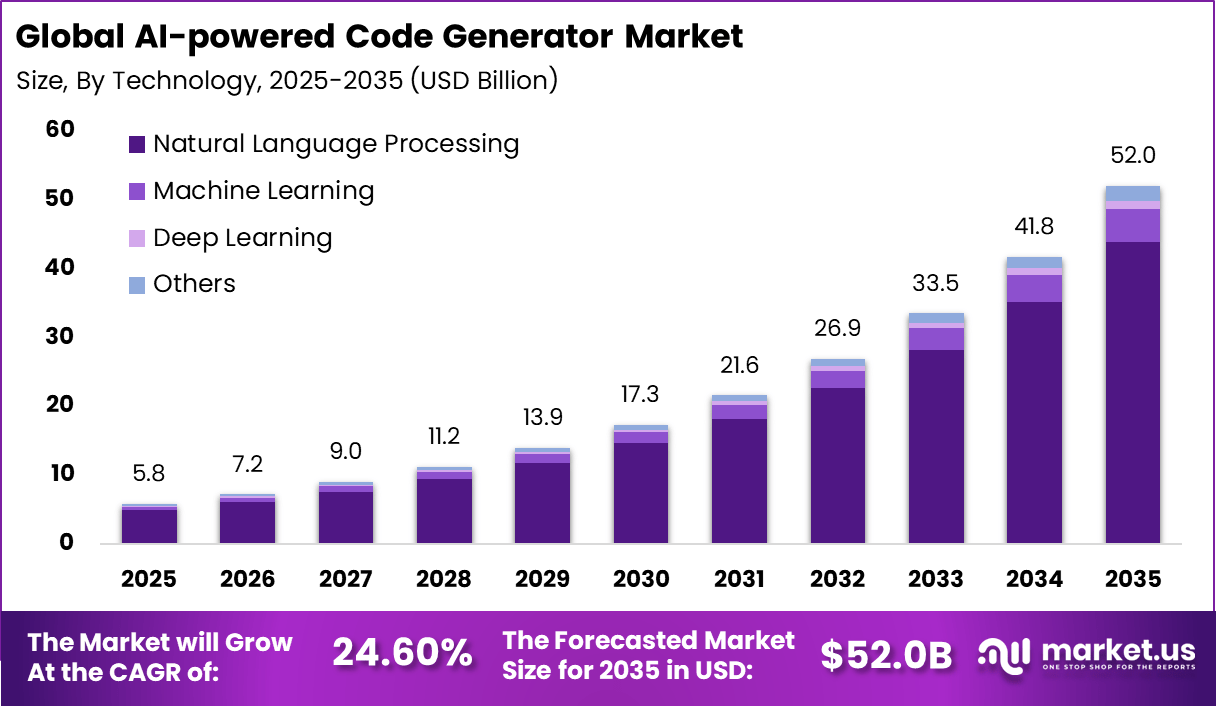
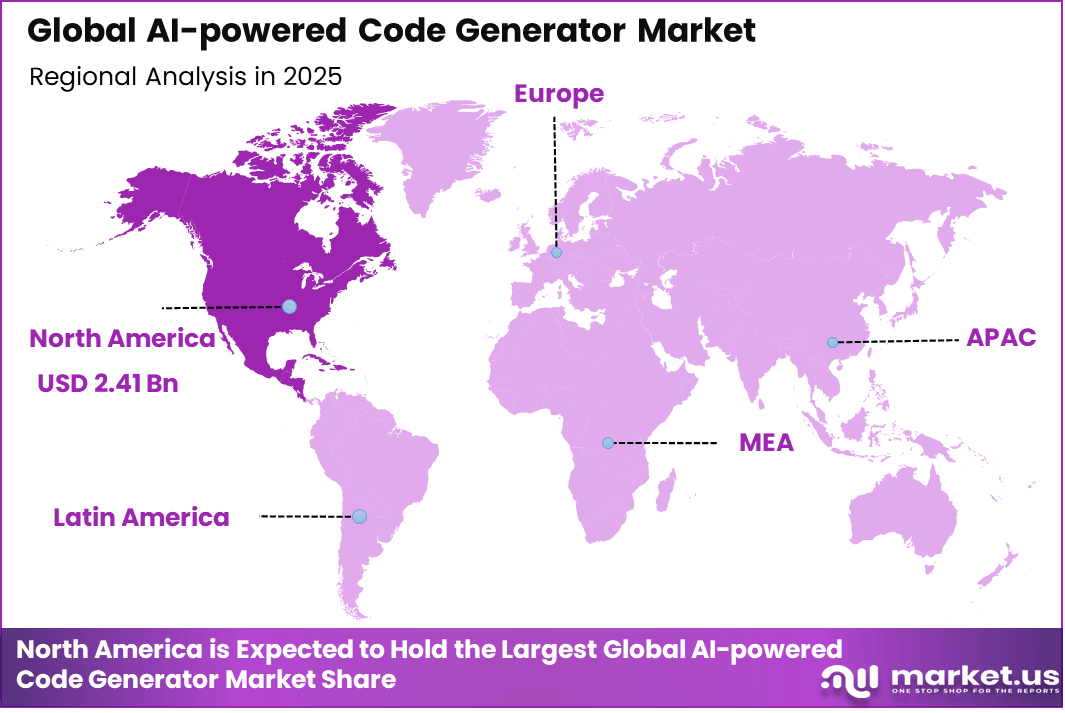
The Global AI-powered Code Generator Market generated USD 5.8 billion in 2025 and is predicted to register growth from USD 7.2 billion in 2026 to about USD 52 billion by 2035, recording a CAGR of 24.60% throughout the forecast span. In 2025, North America held a dominan market position, capturing more than a 41.9% share, holding USD 2.41 Billion revenue.
The AI-powered code generator market refers to software solutions that use artificial intelligence and machine learning to automatically generate, suggest, or complete source code for software development tasks. These tools assist developers by transforming natural language prompts, requirements, or design models into executable code, reducing manual effort and accelerating development cycles.
AI-powered code generators support multiple programming languages, frameworks, and development environments, and are used by enterprises, software teams, and individual developers. Adoption spans application development, DevOps automation, quality assurance, and low-code/no-code initiatives. Traditional coding processes often require significant time and expertise, creating bottlenecks in digital transformation efforts.
One major driver of the AI-powered code generator market is the need for improved development speed and efficiency. Software delivery cycles are shortening as competitive pressures and customer expectations rise. AI-based tools help teams generate boilerplate code, refactor existing modules, or translate requirements into working functions. This capability reduces lead times and accelerates time to market for new features and products.
According to secondtalent, AI has become a core component of modern software development workflows. In 2025, around 41% of all code is either AI generated or AI assisted, indicating deep integration of AI across development processes. Adoption among professionals is high, with 76% of developers either already using AI coding tools or planning to adopt them, including 62% active users and 14% planning near term adoption. This trend reflects growing reliance on AI to support faster and more reliable software delivery.
Usage intensity and productivity gains further highlight AI’s impact. About 82% of developers use AI coding assistants on a daily or weekly basis, making these tools part of routine development work. Developers report saving between 30% and 75% of time on coding, debugging, and documentation tasks when using AI assistants. GitHub Copilot users complete 126% more projects per week compared to manual coders, demonstrating a significant boost in output and overall efficiency.
Top Market Takeaways
- By component, hardware accounted for 75.6% of the AI-powered code generator market, including GPUs and accelerators that power AI model training and inference for code generation.
- By technology, natural language processing took 84.3% share, enabling tools to understand prompts and generate accurate code from plain English descriptions.
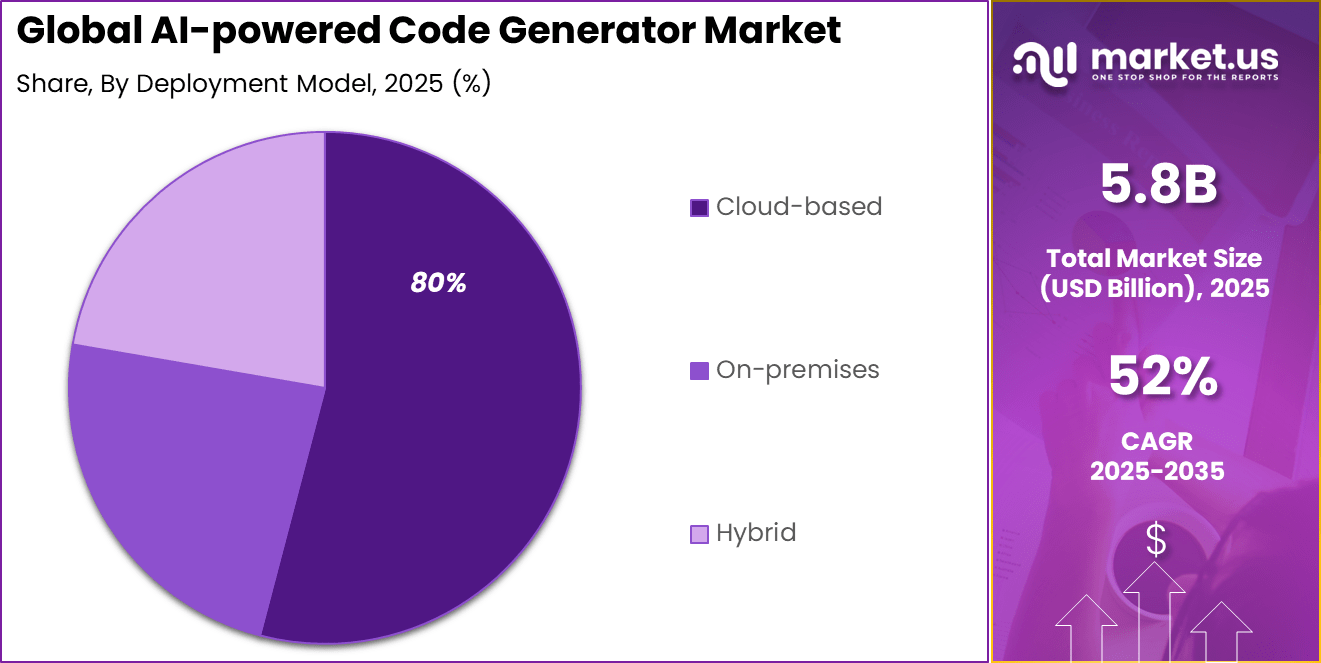
- By deployment model, cloud-based solutions captured 80.1%, providing scalable access to high-compute resources without on-site infrastructure.
- By application, enterprise application development led with 35.9%, speeding up custom software builds for business needs.
- By industry vertical, IT and telecommunications held 40.5%, using generators for network automation and app scaling.
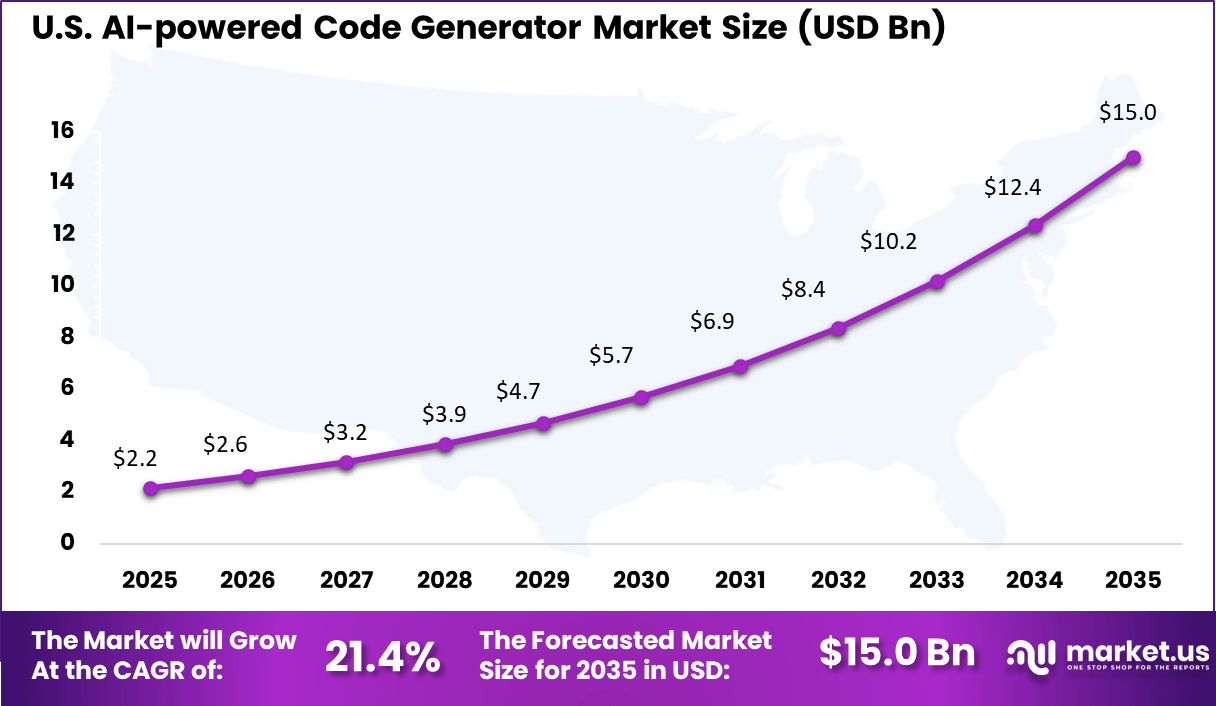
- North America had 41.9% of the global market, with the U.S. at USD 2.16 billion in 2025 and growing at a CAGR of 21.4%.
Key Adoption and Usage Insights
- High adoption was evident, as 85% of developers regularly used AI tools for coding and software development. Within this group, 62% relied on at least one AI assistant as part of their core workflow.
- Routine integration strengthened over time, with 82% of developers using AI coding tools on a daily or weekly basis. This frequency shows that AI assistance has shifted from optional support to a standard productivity layer.
- Widespread trial supported long term adoption, as 84.4% of programmers had experimented with at least one AI based code generation tool. Early exposure accelerated trust and familiarity across skill levels.
- Enterprise scale usage expanded rapidly, with 21% of code at a major global technology firm being AI assisted by early 2025. In parallel, AI contribution reached 75% of production code at a leading cloud provider, highlighting deep integration in large engineering environments.
- Tool preference remained concentrated, as 82% of developers using AI coding tools reported usage of ChatGPT, while 68% relied on GitHub Copilot. This indicates strong consolidation around a small set of mature platforms.
Key Insights Summary
Productivity and Impact Insights
- Time savings were substantial, as developers reported reductions of 30% to 75% in time spent on coding, testing, and documentation tasks. This improvement allowed teams to focus more on architecture, review, and problem solving.
- Output efficiency increased sharply, with users of AI coding assistants completing up to 126% more projects per week compared with developers relying solely on manual coding approaches.
- Economic value from these productivity gains was significant, with AI driven coding efficiency projected to contribute more than USD 1.5 trillion to global economic output by 2030.
Popular Tools and Performance Indicators
- Tool usage remained concentrated among a few platforms, with 82% of developers using ChatGPT, 68% relying on GitHub Copilot, 47% adopting Google Gemini, and 41% using Claude.
- Code acceptance rates highlighted the need for human oversight. While completion rates were relatively high, developers accepted only about 30% of AI generated suggestions, confirming selective adoption and review.
Challenges and Risk Considerations
- Security vulnerabilities remained a key concern, as around 48% of AI generated code samples contained potential security weaknesses. This reinforced the importance of rigorous testing and secure coding practices.
- Accuracy trust gaps persisted, with only 3% of developers expressing high confidence in AI output quality. At the same time, 46% actively distrusted the accuracy of generated code, emphasizing cautious usage.
- Technical debt risks increased in some environments, as AI assisted coding was linked to four times higher code cloning rates. This trend raised long term maintenance and complexity concerns, requiring stronger governance and code review standards.
Component Analysis
The hardware segment accounts for 75.6% of the AI-powered Code Generator market, indicating strong reliance on computing infrastructure to support model training and inference. High-performance processors, accelerators, and memory systems are required to run large language models efficiently.
Enterprises invest in robust hardware to ensure low latency, stable performance, and secure execution of code generation workloads. This hardware foundation is critical for handling complex prompts, large codebases, and continuous usage at scale.
From an operational standpoint, dedicated hardware improves reliability and throughput for development teams. It supports parallel processing and faster iteration cycles during code generation and testing. The strong share of hardware reflects enterprise preference for performance assurance and control when deploying AI systems that directly impact software quality and delivery timelines.
Technology Analysis
Natural Language Processing holds 84.3% of the technology segment, making it the core enabler of AI-powered code generation. NLP allows developers to describe requirements in plain language and receive functional code outputs. This capability reduces the gap between intent and implementation, enabling faster development and easier collaboration between technical and non-technical stakeholders.
The dominance of NLP is driven by its effectiveness in understanding context, syntax, and programming intent. Advanced NLP models can generate, refactor, and document code across multiple languages. The strong share of this technology reflects its central role in improving developer productivity and simplifying software creation workflows.
Deployment Model Analysis
Cloud-based deployment accounts for 80% of the market, reflecting strong preference for scalable and accessible delivery models. Cloud platforms allow organizations to access AI code generation tools without managing complex infrastructure. This supports rapid onboarding and consistent performance across distributed development teams.
Cloud deployment also enables continuous updates and model improvements. Providers can roll out enhancements without disrupting users. The strong adoption of cloud-based models highlights demand for flexibility, cost efficiency, and ease of integration with existing development environments.
Application Analysis
Enterprise application development represents 35.9% of application demand, making it a leading use case for AI-powered code generators. Enterprises use these tools to accelerate development of internal systems, customer platforms, and business applications. AI-generated code helps reduce development time while maintaining consistency with enterprise standards.
These tools also support faster prototyping and modernization of legacy systems. Development teams can focus more on design and logic rather than repetitive coding tasks. The strong share of this application reflects enterprise focus on speed, efficiency, and scalable software delivery.
Industry Vertical Analysis
The IT and telecommunications sector accounts for 40.5% of market adoption, making it the largest industry vertical. This sector manages complex software environments and continuous development cycles. AI-powered code generators help teams handle high development workloads and frequent updates efficiently.
In IT and telecom environments, automation and reliability are critical. Code generation tools support faster deployment and reduce error rates. The strong presence of this sector reflects its early adoption of AI-driven development tools to maintain competitiveness and operational efficiency.
Key Reasons for Adoption
- Software development speed is improved through automated code creation and suggestions
- Developer productivity is increased by reducing repetitive and manual coding tasks
- Skill gaps are addressed by supporting junior developers with guided code outputs
- Time-to-market pressure is managed through faster application development cycles
- Multi-language development needs are supported within a single coding environment
Benefits
- Code quality is improved through standardized and consistent outputs
- Development errors are reduced with real-time syntax and logic assistance
- Engineering teams can focus more on design and architecture decisions
- Software maintenance becomes easier with cleaner and well-structured code
- Development costs are optimized through efficient use of engineering resources
Usage
- Used by developers to generate boilerplate code and reusable components
- Applied in application prototyping to quickly test ideas and features
- Utilized in enterprise projects to support large-scale software development
- Integrated into development environments for real-time coding assistance
- Adopted in training programs to help learners understand coding structures
Emerging Trends
Key Trend Description Multimodal code generation Tools support inputs beyond text, including images and voice, to enable diverse code creation. Enhanced security features Greater focus on secure and reliable code with built-in vulnerability detection and compliance. Explainable AI mechanisms Systems provide transparency into code generation logic to support trust and debugging. Low-code / no-code integration Seamless embedding in platforms allows non-developers to build applications. IDE and workflow embedding Deeper integration with development environments improves productivity and workflow efficiency. Growth Factors
Key Factors Description Developer productivity demands Organizations seek faster coding and reduced repetitive tasks to meet tight deadlines. Skilled developer shortages AI assists junior developers and helps scale output across teams. Software complexity rise AI tools manage complex codebases spanning multiple languages and frameworks. Cloud and DevOps adoption Agile and collaborative environments require tools that support scalable deployment. AI/ML technological advances Improvements in accuracy, context understanding, and multi-language support drive adoption. Opportunity Analysis
Opportunities in the domain of AI code generation are emerging through the integration of these technologies with broader development ecosystems. The expansion of AI-assisted coding into low-code and no-code platforms can democratize software creation by enabling individuals with limited programming expertise to contribute to application development.
This wider accessibility fosters innovation and inclusivity within development communities, potentially expanding the talent pool and accelerating digital transformation efforts across industries. Furthermore, the evolution of specialized prompt engineering roles may create new professional niches focused on optimizing AI code output and aligning it with business requirements.
Challenge Analysis
A key challenge confronting the implementation of AI-powered code generators relates to security and reliability concerns in generated code. Reports indicate that significant proportions of AI-produced code may contain vulnerabilities, and subtle flaws can be overlooked due to the apparent correctness of outputs. These issues heighten the importance of human oversight and strengthen the requirement for rigorous code review and testing procedures.
Without robust practices to identify and mitigate security vulnerabilities, the integration of AI code generation into critical systems poses risks to operational integrity. Ensuring that AI tools complement rather than replace human expertise in security-critical development contexts remains a central challenge for practitioners and organizations alike.
Key Market Segments
By Component
- Hardware
- GPUs
- Accelerators
- Others
- Software
- Code Generation
- Code Completion
- Others
- Services
- Implementation
- Consulting
- Others
By Technology
- Machine Learning
- Deep Learning
- Natural Language Processing
- Others
By Deployment Model
- Cloud-based
- On-premises
- Hybrid
By Application
- Web Application Development
- Mobile Application Development
- Enterprise Application Development
- API Development
- Others
By Industry Vertical
- BFSI
- IT & Telecommunications
- Healthcare & Life Sciences
- Manufacturing
- Retail & Ecommerce
- Government & Public Sector
- Media & Entertainment
- Other Verticals
Regional Analysis
North America accounted for 41.9% share, supported by strong adoption of artificial intelligence across software development and enterprise IT operations. AI powered code generators have been widely used to improve developer productivity, reduce development time, and support rapid application deployment.
Demand has been driven by growing software complexity and shortage of skilled developers, where automation helps accelerate coding and reduce repetitive tasks. The region’s mature cloud infrastructure and strong developer ecosystem have further supported adoption across startups and large enterprises.
The U.S. market reached USD 2.16 Bn and is projected to grow at a 21.4% CAGR, reflecting rapid expansion of digital services and application development. Adoption has been particularly strong among technology companies and digital native businesses that require fast and scalable development processes. AI powered code generators have helped U.S. developers improve efficiency, standardize code quality, and reduce time spent on routine coding activities.
Key Regions and Countries
- North America
- US
- Canada
- Europe
- Germany
- France
- The UK
- Spain
- Italy
- Russia
- Netherlands
- Rest of Europe
- Asia Pacific
- China
- Japan
- South Korea
- India
- Australia
- Singapore
- Thailand
- Vietnam
- Rest of APAC
- Latin America
- Brazil
- Mexico
- Rest of Latin America
- Middle East & Africa
- South Africa
- Saudi Arabia
- UAE
- Rest of MEA
Competitive Analysis
The AI-powered Code Generator Market is led by major technology platforms such as GitHub, Inc., Amazon Web Services, Inc., Google Inc., and OpenAI. These players focus on large scale language models and deep integration with developer tools. Their solutions improve coding speed and reduce repetitive tasks. Strong cloud infrastructure supports enterprise adoption. Continuous model training enhances code accuracy and security.
Developer focused and startup driven companies strengthen market innovation and usability. Providers such as REPLIT, INC., Anysphere, Inc., Tabnine Ltd., Sourcegraph, Inc., and Qodo emphasize real time assistance and collaboration. Their tools are widely used by individual developers and agile teams. Ease of integration with IDEs supports faster adoption. Subscription based models improve accessibility.
Specialized vendors and regional players add competitive depth and customization. Companies including SilexPro, Cline Bot Inc., AUGMENT CODE, and Beijing Zhipu Huazhang Technology Co., Ltd focus on niche use cases and localized models. Their offerings support enterprise specific workflows. The presence of other emerging players continues to drive innovation and market expansion.
Top Key Players in the Market
- GitHub, Inc.
- Amazon Web Services, Inc.
- Google Inc.
- REPLIT, INC.
- Anysphere, Inc.
- Tabnine Ltd.
- Qodo
- OpenAI
- SilexPro
- Sourcegraph, Inc.
- Cline Bot Inc.
- AUGMENT CODE
- Beijing Zhipu Huazhang Technology Co., Ltd
- Others
Future Outlook
Growth in the AI-powered Code Generator market is expected to accelerate as software development teams aim to improve productivity and reduce development time. These tools are being used to generate code, suggest fixes, and support testing across different programming languages.
Rising demand for faster application delivery and shortage of skilled developers are supporting adoption. Over time, better accuracy, secure code generation, and deeper integration with development environments are likely to increase trust and wider usage.
Recent Developments
- GitHub has been active in advancing its Copilot platform. In October 2025, the company launched multi-model support for Copilot, allowing developers to choose from models like Anthropic’s Claude 3.5 Sonnet, Google’s Gemini 1.5 Pro, and OpenAI’s GPT-4o, along with GitHub Spark for building web apps in natural language.
- Anysphere, behind the Cursor AI editor, expanded its reach. In June 2025, it launched AI coding agents for web and mobile browsers, following a $900 million funding round that valued the company at $9.9 billion.
Report Scope
Report Features Description Market Value (2025) USD 5.8 Bn Forecast Revenue (2035) USD 52 Bn CAGR(2025-2035) 24.60% Base Year for Estimation 2025 Historic Period 2020-2024 Forecast Period 2025-2035 Report Coverage Revenue forecast, AI impact on Market trends, Share Insights, Company ranking, competitive landscape, Recent Developments, Market Dynamics and Emerging Trends Segments Covered By Component (Hardware (GPUs, Accelerators, Others), Software (Code Generation, Code Completion, Others), Services (Implementation, Consulting, Others)), By Technology (Machine Learning, Deep Learning,Others), By Deployment Model (Cloud-based, On-premises, Hybrid), By Application (Web Application Development, Mobile Application Development, Others), By Industry Vertical (BFSI, IT and Telecommunications, Healthcare and Life Sciences,Other Verticals) Regional Analysis North America – US, Canada; Europe – Germany, France, The UK, Spain, Italy, Russia, Netherlands, Rest of Europe; Asia Pacific – China, Japan, South Korea, India, New Zealand, Singapore, Thailand, Vietnam, Rest of Latin America; Latin America – Brazil, Mexico, Rest of Latin America; Middle East & Africa – South Africa, Saudi Arabia, UAE, Rest of MEA Competitive Landscape GitHub, Inc., Amazon Web Services, Inc., Google Inc., REPLIT, INC., Anysphere, Inc., Tabnine Ltd., Qodo, OpenAI, SilexPro, Sourcegraph, Inc., Cline Bot Inc., AUGMENT CODE, Beijing Zhipu Huazhang Technology Co., Ltd, Others Customization Scope Customization for segments, region/country-level will be provided. Moreover, additional customization can be done based on the requirements. Purchase Options We have three license to opt for: Single User License, Multi-User License (Up to 5 Users), Corporate Use License (Unlimited User and Printable PDF)  AI-powered Code Generator MarketPublished date: Jan. 2026add_shopping_cartBuy Now get_appDownload Sample
 -
-
- GitHub, Inc.
- Amazon Web Services, Inc.
- Google Inc.
- REPLIT, INC.
- Anysphere, Inc.
- Tabnine Ltd.
- Qodo
- OpenAI
- SilexPro
- Sourcegraph, Inc.
- Cline Bot Inc.
- AUGMENT CODE
- Beijing Zhipu Huazhang Technology Co., Ltd
- Others
Our Clients

- 173488
- Jan. 2026