


Report Overview
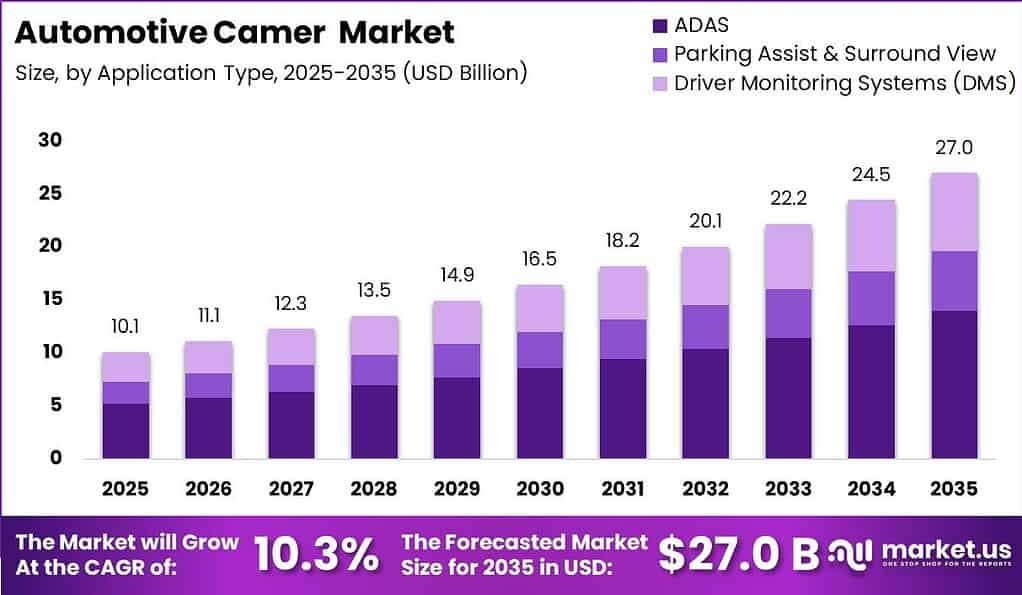
Global Automotive Camera Market size is expected to be worth around USD 27.00 Billion by 2035 from USD 10.10 Billion in 2025, growing at a CAGR of 10.3% during the forecast period 2026 to 2035. This trajectory reflects a structural shift in vehicle architecture, where cameras are becoming mandatory safety hardware rather than optional upgrade content. Investors entering now face a market where regulatory demand locks in unit volumes before consumer preference even becomes a variable.
The automotive camera market covers camera modules, image sensors, and integrated perception systems designed for fitment in passenger cars, commercial vehicles, and electric and autonomous platforms. The market spans original equipment manufacturer supply chains and the aftermarket channel. Applications range from rear-view and surround-view systems to advanced driver assistance functions and in-cabin driver monitoring. This breadth means suppliers serve both compliance-driven mandates and performance-upgrade demand simultaneously.
Key Takeaways
- The global Automotive Camera Market was valued at USD 10.10 Billion in 2025 and is forecast to reach USD 27.00 Billion by 2035.
- The market grows at a CAGR of 10.3% during the forecast period 2026 to 2035.
- By Application, ADAS dominates with a 44.70% share, making it the largest application segment.
- By View Type, Rear View holds the largest position with a 48.60% share.
- By Vehicle Type, Passenger Cars lead with a 66.50% share of the total market.
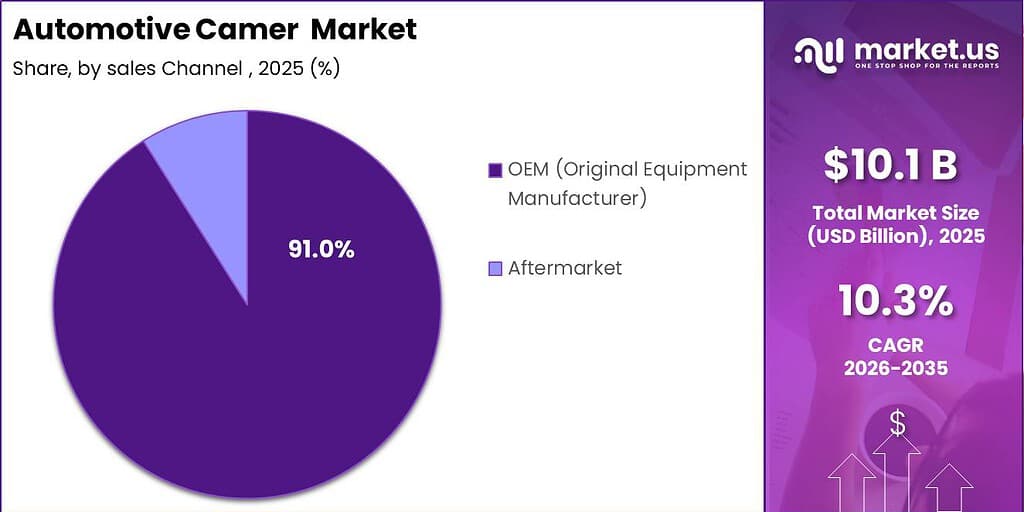
- By Sales Channel, OEM holds dominant share at 91.00%, reflecting factory-level camera integration as the primary route to market.
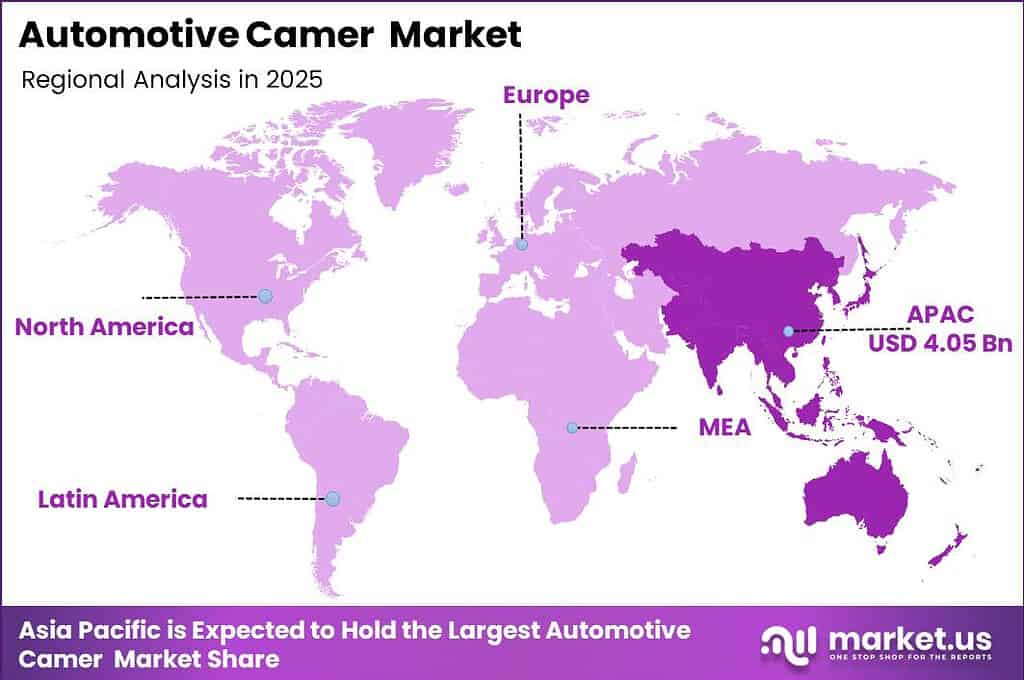
- Asia-Pacific is the leading region, holding a 40.10% market share valued at USD 4.05 Billion.
Regulatory action is the sharpest demand lever in this market. As per our research, 100% compliance with rear visibility camera requirements was reported for vehicles manufactured after May 1, 2018 under FMVSS No. 111, confirming that mandates convert directly into guaranteed camera unit volumes. Rearview camera systems became mandatory for new US passenger vehicles from May 2018. This means every new vehicle sale in a regulated market now carries a baseline camera content floor regardless of trim level.
European fleet scale amplifies this opportunity further. As per our research, European vehicle manufacturers sold around 12.6 Million new vehicles in the EU during 2024. Each sale in a post-July 2024 regulatory environment carries mandatory camera-based safety content. This creates a predictable annual demand pool for OEM camera suppliers operating in Europe. In January 2025, Omnivision introduced its new automotive image sensor portfolio with improved HDR performance, reflecting supplier investment in capturing this growing regulated volume.
End-use industry growth connects directly to camera content per vehicle. As per our research, electric vehicles represented 2.3% of the EU passenger car fleet in 2024. This share signals accelerating adoption of newer platforms that carry denser ADAS sensor loads by design. As this fleet proportion rises, average camera count per vehicle will climb with it, lifting revenue per unit sold above what combustion-era averages would suggest.
Application Analysis
ADAS dominates with 44.70% due to mandatory safety regulation across vehicle classes.
In 2025, ADAS held a dominant market position in the By Application segment of the Automotive Camera Market, with a 44.70% share. The National Highway Traffic Safety Administration finalized FMVSS 127 in April 2024, requiring automatic emergency braking across nearly all US light vehicles by September 2029. Camera modules are the primary sensing input for collision avoidance, lane assistance, and pedestrian detection within these systems. Suppliers that hold validated ADAS camera platforms gain multi-year OEM platform awards rather than per-unit bids.
Driver Monitoring Systems represent the fastest-growing sub-segment within the Application group. The European Commission mandated driver drowsiness and attention warning systems for all new vehicle types from July 2024 under General Safety Regulation 2. The ITU reports that in-cabin sensing requirements are expanding beyond Europe into regulated markets in Japan and South Korea. This regulatory spread pulls DMS camera demand into volume production timelines, giving early-certified suppliers first-mover advantage in a segment where qualification cycles are long.
Lane Departure Warning systems rely on forward-facing cameras calibrated to lane-marking detection at highway speeds. The United Nations Economic Commission for Europe has incorporated LDW requirements into UNECE Regulation 130, covering vehicles across multiple regulated markets globally. In May 2025, Mobileye announced that a global automaker selected its imaging radar technology to complement camera-based automated driving systems, signaling that LDW is evolving toward sensor-fused architectures. Suppliers that offer combined camera and radar-ready platforms will command higher content value per vehicle.
Adaptive Cruise Control, Autonomous Emergency Braking, Blind-Spot Detection, and Parking Assist and Surround View collectively account for the remaining application share. AEB is the application most directly tied to FMVSS 127, with NHTSA projecting the rule will prevent at least 24,000 injuries annually. Parking Assist and Surround View systems are migrating from luxury trims into mid-segment vehicles as sensor costs fall, expanding the addressable unit base for camera suppliers serving these sub-applications.
View Type Analysis
Rear View dominates with 48.60% due to US and global mandatory fitment regulations.
In 2025, Rear View held a dominant market position in the By View Type segment of the Automotive Camera Market, with a 48.60% share. FMVSS No. 111 established mandatory rear-view camera fitment for all new US passenger vehicles from May 2018, creating a guaranteed per-vehicle demand floor that remains structurally intact. The US light vehicle fleet averaged 12.6 years of age in 2024, meaning replacement vehicles consistently carry rear camera content while aging fleet vehicles present an aftermarket retrofit opportunity. This dual demand channel sustains rear-view camera volume above any single regulatory cycle.
Front View cameras serve forward collision warning, autonomous emergency braking, and lane departure warning functions and are the fastest-growing view type by content value per vehicle. NHTSA’s FMVSS 127 rule, finalized in April 2024, requires AEB systems across nearly all US light vehicles by September 2029, directly expanding mandatory front-camera demand. Industry trade association data from ACEA shows that European manufacturers sold approximately 12.6 Million new vehicles in the EU in 2024, each now subject to GSR2 requirements that include forward-camera-dependent ADAS functions. Suppliers with validated front-view modules gain preferred-supplier status in a compliance-driven procurement environment.
Side View and Blind-Spot camera systems address lateral detection gaps that mirrors alone cannot resolve at speed or in low-light conditions. UNECE has advanced camera monitor system regulations that allow side cameras to replace physical mirrors on heavy commercial vehicles in several markets. The Federal Register (2019-22036) documented NHTSA’s active evaluation of camera-based alternatives to traditional mirrors for both light and heavy vehicles. This regulatory pathway converts side-view cameras from a premium add-on into a standards-driven requirement across commercial fleets, creating a volume growth runway outside the passenger car segment.
Vehicle Type Analysis
Passenger Cars dominate with 66.50% due to high global production volumes and mandatory camera fitment rules.
In 2025, Passenger Cars held a dominant market position in the By Vehicle Type segment of the Automotive Camera Market, with a 66.50% share. ACEA data shows that European vehicle manufacturers produced approximately 75.5 Million cars globally in 2024. Each passenger car manufactured for a regulated market now carries at minimum one rear-view camera under FMVSS 111 and EU GSR2 provisions. The passenger car segment sets the baseline camera volume for the entire market and determines the unit economics that Tier 1 suppliers build their cost structures around.
Commercial Vehicles, covering Heavy Commercial Vehicles and Buses and Coaches, represent a structurally distinct demand block for automotive cameras. ACEA data shows that approximately 6.2 Million medium and heavy commercial vehicles operated across EU roads in 2024, while around 31.1 Million vans were also active in the EU fleet. Camera content per commercial vehicle unit is rising faster than in passenger cars because blind-spot, reversing, and driver monitoring requirements are being applied simultaneously across fleet categories. Operators face insurance and liability incentives to fit cameras ahead of mandates, giving aftermarket suppliers an accelerated sales window.
Electric and Autonomous Vehicles represent the fastest-growing vehicle type sub-segment and carry the highest average camera count per unit of any platform. Tesla’s vision-only Full Self-Driving architecture deploys more cameras per vehicle than radar-lidar alternatives, setting a benchmark that other EV and autonomous programs reference. National statistical offices in China recorded battery-electric vehicle production exceeding 9 Million units in 2024. As EV production scales, total camera demand per model year rises disproportionately relative to internal combustion vehicle output, shifting the revenue mix toward higher-specification sensing hardware. Hatchback, Sedan, SUV, Crossover, and Luxury vehicles together hold the remaining passenger car sub-segment share.
Sales Channel Analysis
OEM dominates with 91.00% due to factory-integrated mandatory camera content at production.
In 2025, OEM held a dominant market position in the By Sales Channel segment of the Automotive Camera Market, with a 91.00% share. Regulatory mandates in the US, EU, Japan, and South Korea require camera fitment at the point of manufacture rather than post-sale, locking virtually all camera revenue into the OEM supply chain. ACEA confirms that approximately 75.5 Million cars were manufactured globally in 2024, each representing a captive OEM camera procurement event. This concentration means camera suppliers must maintain homologated platform status with OEMs to access the dominant volume channel, raising barriers to entry for new hardware competitors.
The Aftermarket channel, while holding only 9% of current share, serves aging fleets in markets where regulatory retrofit incentives or insurance pricing create a pull for camera upgrades. The US light vehicle fleet average age of 12.6 years in 2024 means a substantial installed base of vehicles with no factory camera content remains in daily operation. Trade association data from the Auto Care Association shows the US automotive aftermarket generated over $490 Billion in 2023, indicating the financial scale of the channel through which retrofit camera systems can be distributed. Suppliers that build aftermarket-compatible modules at accessible price points can capture volume outside the OEM procurement cycle without competing on platform qualification.
Key Market Segments
By Application
- ADAS (Advanced Driver Assistance Systems)
- Lane Departure Warning (LDW)
- Adaptive Cruise Control (ACC)
- Autonomous Emergency Braking (AEB)
- Blind-Spot Detection (BSD)
- Parking Assist and Surround View
- Driver Monitoring Systems (DMS)
- Others
By View Type
- Rear View
- Front View
- Side View / Blind Spot
- Others
By Vehicle Type
- Passenger Cars
- Hatchback / Sedan
- SUV / Crossover
- Luxury / Premium Vehicles
- Commercial Vehicles
- Heavy Commercial Vehicles (HCVs)
- Buses and Coaches
- Electric and Autonomous Vehicles
By Sales Channel
- OEM (Original Equipment Manufacturer)
- Aftermarket
Regional Analysis
Asia-Pacific Dominates the Automotive Camera Market with a Market Share of 40.10%, Valued at USD 4.05 Billion
Asia-Pacific leads the global automotive camera market on the strength of its vehicle production scale and domestic ADAS mandate rollout. China, Japan, and South Korea anchor regional demand through both high OEM output and government-driven safety requirements. Japan’s JNCAP and South Korea’s KNCAP safety assessment programs have systematically incentivized camera content in domestic vehicles. This regulatory alignment across the region’s three largest auto markets creates structural demand that sustains Asia-Pacific’s dominant position through the forecast period.
Europe is the fastest-growing major regional market, accelerated by General Safety Regulation 2 applied to all new vehicle types from July 2024. As per our research, the European Union hosted nearly 256 Million passenger cars on its roads in 2024, creating a large installed base for ADAS upgrades. Around 31.1 Million vans and approximately 6.2 Million medium and heavy commercial vehicles were also operating across EU roads in 2024. Together these fleets represent an upgrade addressable market that camera suppliers can target through both OEM redesign cycles and aftermarket retrofit channels.
North America sustains high camera content per vehicle through the FMVSS 111 rear-view mandate already embedded in every new passenger car. The FMVSS 127 AEB rule finalized in April 2024 adds a forward-camera compliance layer effective by September 2029, creating a defined investment horizon for US-market camera suppliers. Latin America and the Middle East and Africa remain earlier-stage markets where vehicle affordability constraints and lower regulatory mandates limit near-term camera penetration, but premium feature democratization in China and India is compressing cost curves that will eventually widen access in these regions.
Key Regions and Countries
North America
- US
- Canada
Europe
- Germany
- France
- The UK
- Spain
- Italy
- Rest of Europe
Asia Pacific
- China
- Japan
- South Korea
- India
- Australia
- Rest of APAC
Latin America
- Brazil
- Mexico
- Rest of Latin America
Middle East and Africa
- GCC
- South Africa
- Rest of MEA
Market Dynamics
Market Opportunity Analysis - Regulatory gaps, fleet age, and segment migration create entry points for focused camera suppliers
The aftermarket channel holds only 9% of current sales channel share but sits on top of the largest addressable retrofit base in the market. The US light vehicle fleet averaged 12.6 years in 2024, meaning tens of millions of vehicles in daily operation carry no factory camera content. Suppliers that engineer retrofit-compatible modules at accessible price points can capture recurring aftermarket revenue without competing in OEM platform qualification cycles, where Tier 1 incumbents hold structural advantages through long-standing homologation relationships.
Driver Monitoring Systems represent the fastest-growing application sub-segment but remain underpenetrated in mainstream and commercial vehicle trims. The European Commission applied DMS requirements to new vehicle types from July 2024 under GSR2, yet most mid-market vehicle programs have not yet integrated DMS at scale. Suppliers with compact, cost-optimized DMS camera modules can fill this gap across the large volume of mid-segment vehicles that will require compliance upgrades before next-generation platform redesigns arrive.
As per our research, automotive camera systems are expanding from rear-view applications into digital mirror and camera monitor technologies for future vehicle designs. This migration creates a new hardware category that does not yet have entrenched supply incumbents at scale. Camera-mirror systems are currently penetrating European and Japanese markets first, where regulatory approval for mirror substitution exists. Suppliers that achieve early type approval in these markets gain reference program credentials that accelerate entry into North American and Chinese programs as regulations evolve.
Electric and Autonomous Vehicles carry the highest camera count per unit of any vehicle type and represent the fastest-growing vehicle sub-segment by share trajectory. China recorded battery-electric vehicle production exceeding 9 Million units in 2024. However, the supplier ecosystem for high-specification EV ADAS camera platforms outside China remains fragmented. International suppliers with validated high-resolution CMOS sensor platforms and OTA update capability hold a competitive entry point into EV-specific camera program awards that are still being issued across multiple global OEM groups.
Technology and Innovation Landscape - High-resolution sensing, sensor fusion, and software-defined architectures redefine camera value per vehicle
High-resolution CMOS sensor adoption is enabling low-light object detection performance that meets NCAP rating thresholds, directly linking image sensor specification to regulatory compliance outcomes. This means camera module selection is now driven by sensor resolution and night performance scores rather than price alone. Suppliers that secure NCAP-validated sensor platforms gain preferred-supplier status on safety-critical programs where OEMs cannot risk a downgrade in their vehicle safety rating from a component change.
As per our research, camera-based sensing technologies are used in ADAS functions including collision avoidance, lane assistance, and automated driving support. The shift from single-view to multi-camera sensor-fusion architectures is accelerating across both passenger and commercial vehicle platforms. Centralized, software-defined vehicle architectures are simultaneously replacing distributed camera-ECU designs. This combination reduces hardware unit count while increasing per-camera processing load, shifting competitive advantage toward suppliers with integrated compute and optics capabilities rather than standalone module producers.
As per our research, camera-based rear visibility systems are being evaluated as alternatives to traditional mirrors for both light vehicles and heavy trucks. Over-the-air update capability is being built into camera modules for post-sale ADAS feature upgrades, creating a hardware design requirement that did not exist in the prior generation of camera products. Modules that cannot receive OTA updates will face obsolescence on software-defined vehicle programs, where feature sets are expected to evolve throughout the vehicle lifecycle rather than being fixed at production.
Synthetic data generation for camera-based scenario training is reducing real-world testing dependency for OEMs. This technology compresses validation timelines by substituting simulated edge cases for physical test drives in adverse conditions. Suppliers that provide synthetic data tools alongside camera hardware deepen their integration into OEM development workflows, raising switching costs. In January 2025, Omnivision introduced an automotive image sensor portfolio with improved HDR performance for ADAS and surround-view systems, reflecting how image quality advances are keeping pace with the escalating performance demands of AI-based perception models.
Drivers
Regulatory standardization is converting automotive cameras from optional trim content into platform-level safety hardware. The European Commission required reversing detection and multiple driver-assistance functions across all new vehicles sold in the EU from July 7, 2024. NHTSA finalized FMVSS 127 in April 2024, requiring AEB across nearly all US light vehicles by September 2029. This rule is projected to prevent at least 24,000 injuries and save 360 lives annually. ACEA recorded 75.5 Million cars manufactured globally in 2024, giving these mandates a high-volume transmission mechanism across annual OEM production cycles.
Tesla’s vision-only Full Self-Driving approach pushes camera count per vehicle above radar-lidar architectures, shifting industry hardware economics in favor of camera suppliers. This architectural choice raises the average camera content per vehicle across the competitive EV segment. Consequently, camera suppliers are shifting from discrete hardware bids toward multi-year platform awards that bundle optics, image processing, calibration software, and lifecycle support. Mandatory ADAS fitment alone contributes an estimated +2.1% incremental uplift to the baseline CAGR.
| Driver | (~) % Impact on CAGR Forecast | Geographic Relevance | Impact Timeline |
|---|---|---|---|
| Mandatory ADAS Fitment | +2.1% | Europe, North America, Japan, South Korea | Short term (2 years or less) |
| Multi-Camera Vehicle Architectures | +1.5% | Global | Short term (2 years or less) |
| Rising Global Vehicle Output | +1.0% | Asia-Pacific, North America, Europe | Medium term (2 to 4 years) |
| Premium Feature Democratization | +0.8% | China, India, Southeast Asia, Latin America | Medium term (2 to 4 years) |
| Parking Automation Adoption | +0.7% | Urban Asia, Europe, North America | Medium term (2 to 4 years) |
Restraints
Germany’s court rulings over in-vehicle camera data and privacy compliance create a legal overhang for camera suppliers operating in Europe’s largest auto market. Federal Reserve-linked credit conditions held the expected federal funds rate near 4.4% at year-end 2024. This kept financing costs elevated, weakening retail vehicle demand and slowing fleet replacement. Average US light vehicle age reached 12.6 years in 2024 and 12.8 years in 2025. Slower fleet turnover directly reduces annual OEM camera procurement volumes regardless of how strong regulatory mandates are on paper.
Pricing pressure on commodity single-view camera modules is squeezing Tier 1 supplier margins as AI processing costs rise simultaneously. Automakers respond to affordability pressure by deleting non-mandatory surround-view and cabin-camera content from entry trims. Suppliers absorb price concessions and carry underutilized capacity as a result. Vehicle affordability pressure alone contributes an estimated -1.4% deduction from the baseline CAGR. OEM price-down mandates add a further -1.1%, making margin defense the central commercial challenge for camera hardware vendors through the near term.
| Restraint | (~) % Impact on CAGR Forecast | Geographic Relevance | Impact Timeline |
|---|---|---|---|
| Vehicle Affordability Pressure | -1.4% | North America, Europe, Latin America | Short term (2 years or less) |
| OEM Price-Down Mandates | -1.1% | Global | Short term (2 years or less) |
| Legacy Fleet Persistence | -0.9% | North America, India, Latin America | Medium term (2 to 4 years) |
| Privacy-Law Deployment Limits | -0.6% | Europe, selected US states | Medium term (2 to 4 years) |
| Low-Cost Trim Decontenting | -0.5% | India, Southeast Asia, Africa, Latin America | Short term (2 years or less) |
Challenges
Camera-led perception systems must maintain reliable detection through darkness, glare, rain, snow, lens contamination, and high-speed closing events. NHTSA’s FMVSS 127 requires compliant systems to avoid contact with a lead vehicle at speeds up to 62 mph. The European Commission’s safety regime expects its 2024 driver-assistance package to avert at least 140,000 serious injuries and save more than 25,000 lives by 2038. This regulatory performance expectation increases scrutiny of false negatives and degraded-mode behavior, extending validation cycles and engineering expenditure for every camera supplier seeking compliance.
Cybersecurity validation adds a second layer of technical cost to camera platform development. UNECE Regulation No. 155 mandates cybersecurity management systems, while UN Regulation No. 156 governs software-update processes. European type approvals for new vehicle types applied from July 2022 and for existing types from July 2024. Suppliers must fund larger corner-case datasets, self-cleaning sensor designs, sensor fusion logic, and over-the-air model governance simultaneously. Cross-condition perception reliability alone imposes an estimated -1.2% friction drag on maximum CAGR potential, with cybersecurity validation adding a further -0.9%.
| Challenge | (~) % CAGR Friction Drag | Geographic Relevance | Mitigation Horizon |
|---|---|---|---|
| Cross-Condition Perception Reliability | -1.2% | Global | Long term (4 years or more) |
| Cybersecurity Validation Complexity | -0.9% | Europe, Japan, South Korea, North America | Medium term (2 to 4 years) |
| Sensor Calibration Burden | -0.8% | Global | Medium term (2 to 4 years) |
| Semiconductor Supply Concentration | -0.7% | Global, concentrated in East Asia | Medium term (2 to 4 years) |
| Thermal Power Constraints | -0.5% | Global | Long term (4 years or more) |
Opportunities
Mirror-to-camera replacement systems are moving from regulatory pilots into commercial production, converting a physical component into a software-manageable digital surface. Surround-view 360-degree systems are also migrating from luxury-only trims into mid-segment vehicles as cost optimization reduces per-unit sensor prices. These shifts expand the average camera count per vehicle without requiring new vehicle sales to grow. Suppliers that position camera-mirror modules as a cost-competitive alternative to physical mirror assemblies gain access to replacement cycles across both passenger and commercial vehicle categories.
Software-defined vision creates a recurring revenue stream on top of hardware supply. UNECE Regulation No. 155 and No. 156 establish the governance foundation for secure post-sale functionality and software updates. NHTSA’s FMVSS 127 compliance deadline of September 2029 creates a defined upgrade horizon across nearly all US light vehicles up to 10,000 pounds. Suppliers that decouple algorithms from hardware can offer subscriptions, paid performance upgrades, and fleet analytics. Reusable software across multiple vehicle programs could lower incremental feature-development cost per platform by 20% to 35%, with software-heavy revenue mixes potentially lifting gross margin by 5 to 10 percentage points.
| Opportunity | (~) % Potential CAGR Upside | Geographic Relevance | Execution Window |
|---|---|---|---|
| Software-Defined Vision Services | +1.7% | North America, Europe, China, South Korea | Medium term (2 to 4 years) |
| Commercial Fleet Video Analytics | +1.3% | Global logistics corridors | Medium term (2 to 4 years) |
| Aging-Fleet Retrofit Systems | +1.0% | North America, India, Latin America | Short term (2 years or less) |
| Camera-Mirror System Expansion | +0.8% | Europe, Japan, China, North America | Long term (4 years or more) |
| Automated-Mobility Sensor Upgrades | +0.7% | China, United States, Europe, Gulf states | Long term (4 years or more) |
Key Company Insights
Robert Bosch GmbH operates across the full automotive camera stack, from CMOS image sensors through ADAS perception software, giving it a margin structure that pure hardware competitors cannot match. Battery-electric vehicles represented 2.3% of the EU passenger car fleet in 2024, a share that will expand the addressable market for high-specification camera platforms Bosch already supplies to EV OEMs. This embedded position in a growing platform category insulates Bosch from the commodity pricing pressure that threatens single-function camera module vendors.
Magna International Inc. has built direct integration with software-defined vehicle programs through two strategic moves. In October 2025, Magna expanded production of its camera-based Driver Monitoring System with a Germany-based OEM in China, accessing the world’s largest EV market through a proven compliance product. In March 2025, Magna partnered with Nvidia to integrate Nvidia Drive AGX into next-generation AI-enabled ADAS and autonomous vehicle platforms. These two moves together position Magna to capture content growth in both DMS and high-compute ADAS categories simultaneously.
Key Players
- Robert Bosch GmbH
- Continental AG
- Magna International Inc.
- Valeo S.A.
- Denso Corporation
- ZF Friedrichshafen AG
- Aptiv PLC
- Hyundai Mobis Co., Ltd.
- Panasonic Automotive Systems Co., Ltd.
- Autoliv Inc.
- Forvia Hella
- Gentex Corporation
- Hitachi Astemo, Ltd.
- Mcnex Co., Ltd.
- Ficosa International S.A.
Recent Developments
- January 2026: Mobileye announced that a major U.S. automaker selected its EyeQ™6H-powered surround ADAS platform for future vehicle programs, securing a multi-year OEM platform award in the high-compute camera segment.
- January 2026: Visteon launched its AI-ADAS compute module powered by Nvidia to accelerate deployment of camera-based ADAS systems, positioning the company in the software-defined vehicle compute stack.
- September 2025: Valeo introduced its latest Scala™ 3 Lidar platform with enhanced integration for camera-based ADAS perception systems, advancing multi-sensor fusion capability for regulated safety applications.
- April 2025: Onsemi launched the Hyperlux™ automotive image sensor family designed for high-performance front-view and surround-view camera applications, targeting OEM programs requiring superior low-light detection performance.
Geopolitical Impact Analysis
Trade policy shifts are restructuring automotive camera supply chains at the component level. According to WTO data, global goods tariff rates on automotive electronics rose across multiple trade corridors following US Section 301 tariff expansions, with additional duties on Chinese-origin electronics components reaching up to 25% in some categories. The World Bank reports that semiconductor input costs for auto-grade image sensors increased by approximately 15% to 20% between 2022 and 2024 due to export controls and supply concentration in East Asia. Camera module manufacturers sourcing CMOS sensors primarily from Taiwan and South Korea face direct cost exposure when geopolitical friction tightens semiconductor trade flows.
Logistics disruption adds a second layer of geopolitical cost pressure across the automotive camera supply chain. Data from UNCTAD shows that container shipping rates on Asia-to-Europe routes spiked by over 200% during Red Sea rerouting in early 2024, as vessels avoided the Suez Canal corridor. The World Shipping Council estimated that route diversions added an average of 10 to 14 transit days per voyage between Asia and European ports. This affects just-in-time delivery windows for camera modules destined for European OEM assembly lines, forcing suppliers to carry higher inventory buffers. Higher working capital requirements compress margins already under pressure from OEM price-down mandates.
Report Scope
| Report Features | Description |
|---|---|
| Market Value (2025) | USD 10.10 Billion |
| Forecast Revenue (2035) | USD 27.00 Billion |
| CAGR (2026-2035) | 10.3% |
| Base Year for Estimation | 2025 |
| Historic Period | 2020-2024 |
| Forecast Period | 2026-2035 |
| Report Coverage | Revenue Forecast, Market Dynamics, Market Opportunity Analysis, Technology and Innovation Landscape, Competitive Landscape, Recent Developments |
| Segments Covered | By Application (ADAS: Lane Departure Warning, Adaptive Cruise Control, Autonomous Emergency Braking, Blind-Spot Detection, Parking Assist and Surround View; Driver Monitoring Systems; Others), By View Type (Rear View, Front View, Side View / Blind Spot, Others), By Vehicle Type (Passenger Cars: Hatchback / Sedan, SUV / Crossover, Luxury / Premium Vehicles; Commercial Vehicles: Heavy Commercial Vehicles, Buses and Coaches; Electric and Autonomous Vehicles), By Sales Channel (OEM, Aftermarket) |
| Regional Analysis | North America (US and Canada), Europe (Germany, France, The UK, Spain, Italy, and Rest of Europe), Asia Pacific (China, Japan, South Korea, India, Australia, and Rest of APAC), Latin America (Brazil, Mexico, and Rest of Latin America), Middle East and Africa (GCC, South Africa, and Rest of MEA) |
| Competitive Landscape | Robert Bosch GmbH, Continental AG, Magna International Inc., Valeo S.A., Denso Corporation, ZF Friedrichshafen AG, Aptiv PLC, Hyundai Mobis Co. Ltd., Panasonic Automotive Systems Co. Ltd., Autoliv Inc., Forvia Hella, Gentex Corporation, Hitachi Astemo Ltd., Mcnex Co. Ltd., Ficosa International S.A. |
| Customization Scope | Customization for segments, region / country-level will be provided. Additional customization can be done based on requirements. |
| Purchase Options | We have three licenses to opt for: Single User License | Multi-User License (Up to 5 Users) | Corporate Use License (Unlimited User and Printable PDF) |





































