


Global 1-(2-(2-Hydroxy Ethoxy)-Ethyl) Piperazine Market Size, Share, And Industry Analysis Report By Purity Level (Greater than or equal to 98, Greater than or equal to 99), By Application (Pharmaceuticals, Cosmetics, Agrochemicals, Others), By Region and Companies - Industry Segment Outlook, Market Assessment, Competition Scenario, Statistics, Trends and Forecast 2026-2035
- Published date: February 2026
- Report ID: 179657
- Number of Pages: 264
- Format:
-
keyboard_arrow_up
Quick Navigation
Report Overview
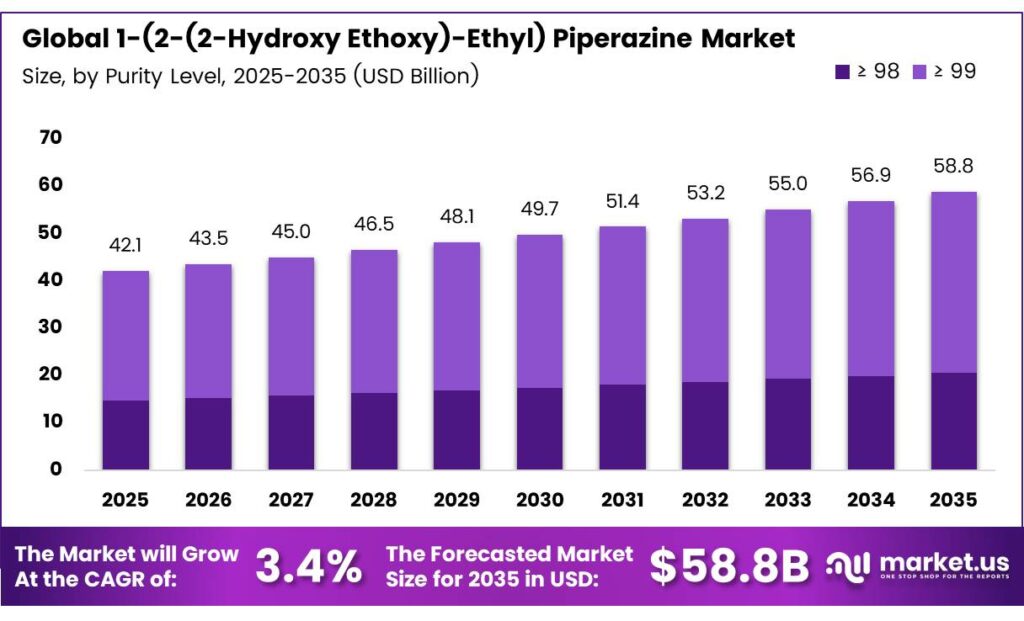
The Global 1-(2-(2-Hydroxy Ethoxy)-Ethyl) Piperazine Market size is expected to be worth around USD 58.8 billion by 2035 from USD 42.1 billion in 2025, growing at a CAGR of 3.4% during the forecast period 2026 to 2035.
1-(2-(2-Hydroxy Ethoxy)-Ethyl) Piperazine, widely known as HEEP, is a specialty chemical intermediate used across pharmaceutical, cosmetic, and agrochemical manufacturing. It serves as a critical building block for active pharmaceutical ingredients. Consequently, demand from drug formulators and synthesis teams continues to rise.
HEEP plays a central role in the synthesis of quetiapine fumarate, a leading antipsychotic medication. Pharmaceutical manufacturers rely on this intermediate to meet growing global demand for mental health treatments. Moreover, its functional properties make it suitable for use in premium personal care formulations as an emulsifier and hydrating agent.
- The United States exported USD 315,087.46 thousand worth of compounds with a pyrimidine or piperazine ring under HS 293359 in 2024, corresponding to 6,950,360 kg. This positions the US as a significant global exporter, reflecting strong domestic production capacity and international commercial reach.
Government support and regulatory frameworks shape the HEEP supply chain significantly. India’s trade policy provides an export incentive reward rate of 3% under the Merchandise Exports from India Scheme for piperazine-ring compounds under HS code 29335990. Additionally, import duties of 7.5% apply to HEEP classified under this code, influencing procurement decisions for global buyers.
- India led global piperazine imports under HS 29335990 with a 67% share, accounting for 947 shipments between July 2024 and June 2025. This dominance reflects India’s role as the primary destination for raw HEEP intermediates, driven by its large-scale generic pharmaceutical manufacturing base.
Emerging economies are investing in pharmaceutical infrastructure, expanding production capacity for specialty intermediates. This trend is creating new growth corridors in the Asia-Pacific and Latin America. Therefore, manufacturers are scaling operations to serve both regulated and emerging market buyers efficiently.
Key Takeaways
- The Global 1-(2-(2-Hydroxy Ethoxy)-Ethyl) Piperazine Market is valued at USD 42.1 billion in 2025 and is projected to reach USD 58.8 billion by 2035, growing at a CAGR of 3.4%.
- The ≥99% segment holds the dominant share at 62.5%.
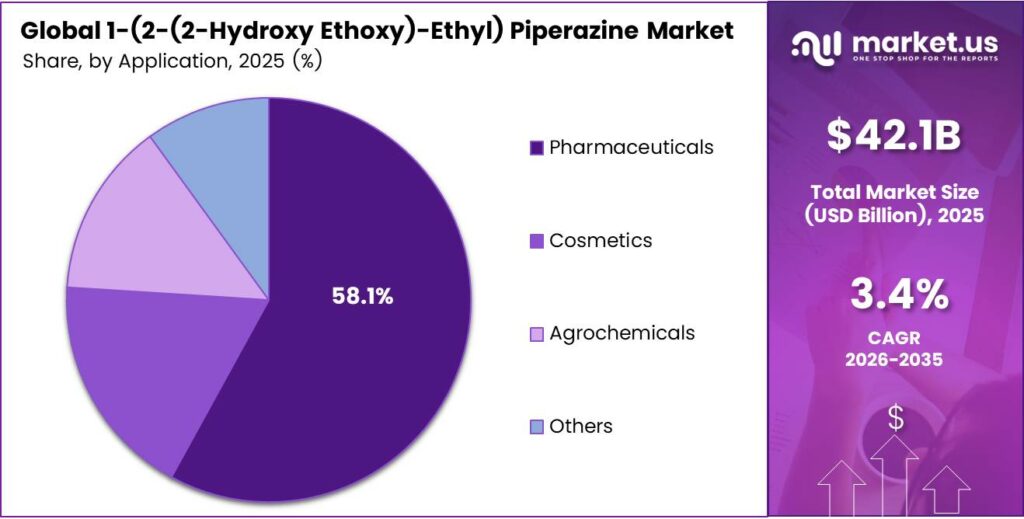
- The Pharmaceuticals segment leads with a 58.1% market share.
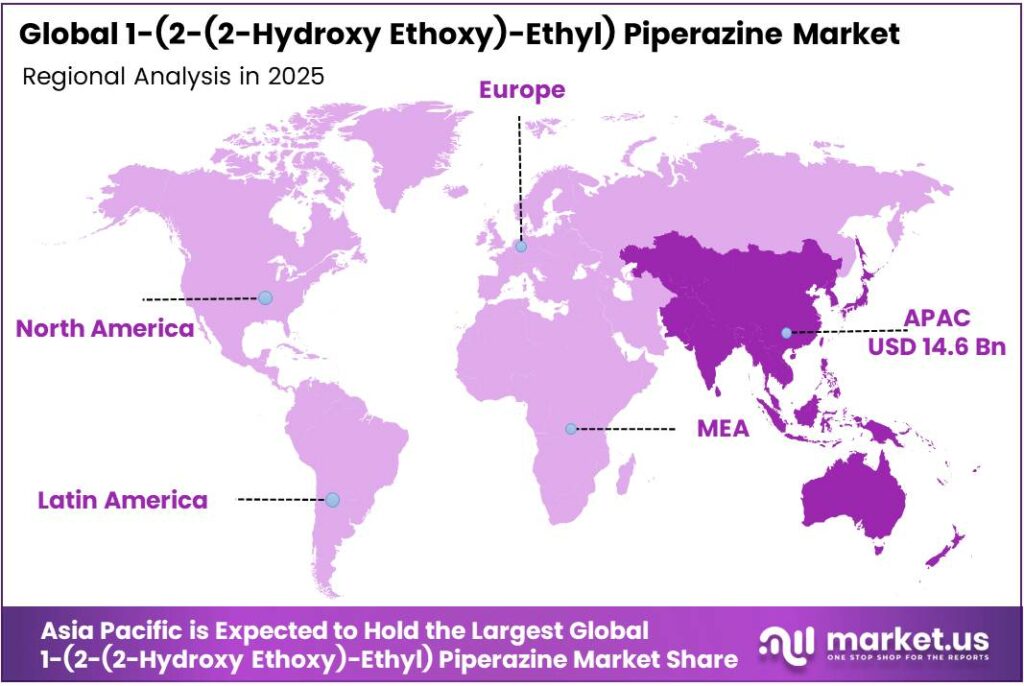
- Asia Pacific dominates the regional landscape with a 34.7% share, valued at USD 14.6 billion.
Purity Level Analysis
The ≥99 Purity dominates with 62.5% due to stringent pharmaceutical-grade requirements in API synthesis.
In 2025, The ≥99 Purity held a dominant market position in the By Purity Level segment of the 1-(2-(2-Hydroxy Ethoxy)-Ethyl) Piperazine Market, with a 62.5% share. Pharmaceutical manufacturers require ultra-high purity intermediates to comply with regulatory standards. Consequently, contract drug makers and API producers consistently choose this grade to reduce impurity risks in final formulations.
The ≥98 Purity represents the alternative grade suitable for applications where strict pharmaceutical compliance is not required. Cosmetic formulators and some agrochemical producers adopt this grade for cost efficiency. However, the growing push toward tighter quality standards in multiple end-use sectors is gradually limiting the commercial scope of this grade.
Application Analysis
Pharmaceuticals dominate with 58.1% due to widespread use as a quetiapine fumarate intermediate in antipsychotic drug production.
In 2025, Pharmaceuticals held a dominant market position in the By Application segment of the 1-(2-(2-Hydroxy Ethoxy)-Ethyl) Piperazine Market, with a 58.1% share. Drug manufacturers prioritize HEEP for synthesizing quetiapine and related antipsychotic compounds. Moreover, rising global mental health awareness continues to expand demand for pharmaceutical-grade HEEP intermediates.
Cosmetics represent a growing secondary application, where HEEP functions as a high-performance emulsifier and hydrating agent. Premium skincare and personal care brands increasingly incorporate specialty piperazine-based compounds for improved formulation stability. Additionally, consumer demand for advanced cosmetic ingredients supports continued adoption across this segment.
Agrochemicals form a developing application area, with HEEP being explored for specialty crop protection and fertilizer formulations. Research activity in this space remains active across Asia-Pacific agrochemical producers. Furthermore, the Others sub-segment captures niche industrial uses, including polymer additives and specialty resin applications, showing incremental growth.
Key Market Segments
By Purity Level
- ≥98
- ≥99
By Application
- Pharmaceuticals
- Cosmetics
- Agrochemicals
- Others
Emerging Trends
Pharmaceutical-Grade Purity Standards and Regional Supply Chain Consolidation Drive New Market Dynamics
Contract manufacturers increasingly demand pharmaceutical-grade, high-purity HEEP material to meet strict regulatory requirements. This preference is reshaping procurement patterns and pushing suppliers toward tighter quality control programs. Moreover, long-term supplier qualification and traceability programs are becoming standard practice across the industry.
- China and India are rapidly expanding production capacity for piperazine-ring intermediates. Switzerland led global exports of HS 293359 compounds in 2024 with USD 9,928,148.45 thousand in trade value, while China and India are scaling up rapidly to compete. This supply concentration in the Asia-Pacific is reshaping global trade flows significantly.
Manufacturers are focusing on process optimization to reduce waste and improve regulatory alignment. Green chemistry principles are gaining traction among HEEP producers seeking to attract environmentally conscious buyers. Consequently, incremental innovation in synthesis efficiency is becoming a key differentiator among specialty intermediate suppliers.
Drivers
Rising Mental Health Drug Demand and Asia-Pacific Pharmaceutical Expansion Accelerate HEEP Market Growth
Global demand for quetiapine fumarate and related antipsychotic medications is rising sharply as mental health disorder prevalence increases. Pharmaceutical manufacturers source HEEP as a critical synthesis intermediate for these drug molecules. Therefore, this clinical demand directly translates into sustained volume growth for specialty piperazine intermediates across regulated markets.
- Asia-Pacific generic pharmaceutical hubs are rapidly expanding manufacturing capacity. China, India, and the United States together contributed 84% of global piperazine exports under HS 29335990 between July 2024 and June 2025. This regional concentration of production reflects the Asia-Pacific’s dominant role in driving HEEP supply and commercial growth.
Continuous advancements in high-yield, cost-efficient synthesis technologies are enabling producers to lower production costs. Premium cosmetics brands are also increasing HEEP utilization as an emulsifier and hydrating agent. Additionally, growing investment in specialty intermediate research is broadening the application range of this versatile piperazine compound.
Restraints
Regulatory Compliance Costs and Raw Material Price Volatility Challenge HEEP Market Participants
Evolving Good Manufacturing Practice standards across multiple regulatory jurisdictions are significantly raising compliance costs for HEEP producers. Manufacturers must maintain documentation, facility audits, and quality systems aligned with US FDA, EMA, and CDSCO requirements. Consequently, smaller producers face disproportionate cost burdens compared to larger established manufacturers.
- India’s Ministry of Commerce confirms a basic customs duty of 7.5% on piperazine-ring compounds under HS 29335990. This duty level raises input costs for Indian pharmaceutical manufacturers who import HEEP. Moreover, similar trade barriers in other regions add procurement complexity and reduce cost competitiveness for end-users relying on imported intermediates.
Upstream petrochemical raw material prices remain volatile and unpredictable. HEEP production depends on ethylene oxide and piperazine derivatives, both of which face supply disruptions from energy market fluctuations. Therefore, pricing instability in feedstock markets continues to compress manufacturer margins and complicate long-term supply contract negotiations.
Growth Factors
Emerging Market Expansion and Novel Drug Development Unlock Long-Term HEEP Market Opportunities
Emerging markets with a developing mental healthcare infrastructure represent a major untapped opportunity for HEEP suppliers. Growing government investment in psychiatric care facilities and generic drug production is expanding the addressable market. Moreover, rising awareness of treatable mental health conditions is driving higher prescription volumes for quetiapine-based medications globally.
- Biopharmaceutical researchers are increasingly adopting HEEP for novel neurological drug candidates and complex API development. According to World Bank WITS, India exported USD 535,928.43 thousand of piperazine-ring compounds at 6,822,090 kg in 2024. This volume underscores India’s growing role as a strategic supplier for next-generation pharmaceutical development programs worldwide.
The shift toward green chemistry and sustainable manufacturing practices is creating new commercial advantages. ESG-focused pharmaceutical buyers increasingly prefer suppliers demonstrating waste reduction and process efficiency. Additionally, HEEP diversification into agrochemical formulations and specialty polymer resins is opening new revenue channels beyond traditional pharmaceutical markets.
Regional Analysis
Asia Pacific Dominates the 1-(2-(2-Hydroxy Ethoxy)-Ethyl) Piperazine Market with a Market Share of 34.7%, Valued at USD 14.6 Billion
Asia Pacific leads the global HEEP market with a dominant 34.7% share, valued at USD 14.6 billion in 2025. China and India anchor this leadership through large-scale generic pharmaceutical manufacturing and growing export capacity. Moreover, government support for API production and chemical manufacturing parks continues to strengthen the region’s competitive position.
North America maintains a significant market position driven by advanced pharmaceutical research and strong regulatory infrastructure. The United States operates as both a major consumer and a notable exporter of piperazine-ring compounds. Additionally, increasing domestic investment in specialty chemical manufacturing supports continued regional demand growth.
Europe holds a prominent position in the global HEEP market, supported by established pharmaceutical companies and stringent quality standards. Switzerland and Ireland rank among the world’s top exporters of piperazine-ring compounds by trade value. Furthermore, the EU’s strong regulatory environment encourages high-purity intermediate production aligned with global pharmaceutical requirements.
The Middle East and Africa market remains at an early stage of development for HEEP consumption. Improving healthcare infrastructure across Gulf Cooperation Council countries and South Africa is gradually increasing pharmaceutical production activity. Therefore, long-term demand for specialty chemical intermediates like HEEP is expected to grow as regional drug manufacturing capacity expands.
Key Regions and Countries
North America
- US
- Canada
Europe
- Germany
- France
- The UK
- Spain
- Italy
- Rest of Europe
Asia Pacific
- China
- Japan
- South Korea
- India
- Australia
- Rest of APAC
Latin America
- Brazil
- Mexico
- Rest of Latin America
Middle East & Africa
- GCC
- South Africa
- Rest of MEA
Key Players Analysis
Valeshvar Biotech operates as a specialty intermediate producer with a focus on pharmaceutical-grade chemical compounds. The company serves API manufacturers seeking reliable HEEP supply under consistent quality standards. It reflects its scale as a niche supplier within the specialty intermediates market, positioning it as a focused player in the HEEP value chain.
Tokyo Chemical Industry (India) Pvt. Ltd. brings the global reputation and technical expertise of the TCI Group to the Indian specialty chemicals market. The company supplies high-purity laboratory and industrial-grade reagents, including piperazine derivatives, to pharmaceutical research and manufacturing clients. Its strong distribution network and product quality consistency make it a preferred sourcing partner for regulated industry buyers across the subcontinent.
Shanghai Ruifu Chemical Co., Ltd. is a China-based specialty chemical manufacturer focused on pharmaceutical intermediates and fine chemicals. The company serves domestic and international drug producers requiring consistent-grade HEEP and related piperazine compounds. Its location within China’s established chemical manufacturing ecosystem gives it access to competitive feedstock pricing and strong logistical infrastructure for export markets.
Surya Life Sciences Ltd. is an Indian pharmaceutical intermediate manufacturer with a broad portfolio of specialty chemicals used in API synthesis. The company caters to generic drug producers across domestic and export markets. Its capabilities in producing controlled intermediates and compliance with multi-regional regulatory standards position it as a reliable long-term supply partner for HEEP consumers globally.
Top Key Players in the Market
- Valeshvar Biotech
- Tokyo Chemical Industry (India) Pvt. Ltd.
- Shanghai Ruifu Chemical Co., Ltd.
- Surya Life Sciences Ltd.
Recent Developments
- In 2025, Valeshvar Biotech Pvt. Ltd. operates as a global Contract Development and Manufacturing Organization (CDMO) specializing in intermediates, fine specialty chemicals, and active pharmaceutical ingredients. The company maintains production facilities equipped for advanced intermediates and specialty chemicals, including dedicated production blocks.
- In 2025, Tokyo Chemical Industry (India) Pvt. Ltd., a subsidiary of the global TCI group, manufactures and supplies reagents for chemistry, life sciences, materials science, and analytical chemistry. The Gujarat Biotechnology Research Centre has empaneled the company to supply chemicals, consumables, minor equipment, and gases, as part of a list that includes other scientific suppliers.
Report Scope
Report Features Description Market Value (2025) USD 42.1 Billion Forecast Revenue (2035) USD 58.8 Billion CAGR (2026-2035) 3.4% Base Year for Estimation 2025 Historic Period 2020-2024 Forecast Period 2026-2035 Report Coverage Revenue Forecast, Market Dynamics, Competitive Landscape, Recent Developments Segments Covered By Purity Level (≥98, ≥99), By Application (Pharmaceuticals, Cosmetics, Agrochemicals, Others) Regional Analysis North America (US and Canada), Europe (Germany, France, The UK, Spain, Italy, and Rest of Europe), Asia Pacific (China, Japan, South Korea, India, Australia, and Rest of APAC), Latin America (Brazil, Mexico, and Rest of Latin America), Middle East & Africa (GCC, South Africa, and Rest of MEA) Competitive Landscape Valeshvar Biotech, Tokyo Chemical Industry (India) Pvt. Ltd., Shanghai Ruifu Chemical Co., Ltd., Surya Life Sciences Ltd. Customization Scope Customization for segments, region/country-level will be provided. Moreover, additional customization can be done based on the requirements. Purchase Options We have three licenses to opt for: Single User License, Multi-User License (Up to 5 Users), Corporate Use License (Unlimited Users and Printable PDF)  1-(2-(2-Hydroxy Ethoxy)-Ethyl) Piperazine MarketPublished date: February 2026add_shopping_cartBuy Now get_appDownload Sample
 -
-
- Valeshvar Biotech
- Tokyo Chemical Industry (India) Pvt. Ltd.
- Shanghai Ruifu Chemical Co., Ltd.
- Surya Life Sciences Ltd.
Our Clients

- 179657
- February 2026






