


Quick Navigation
Overview
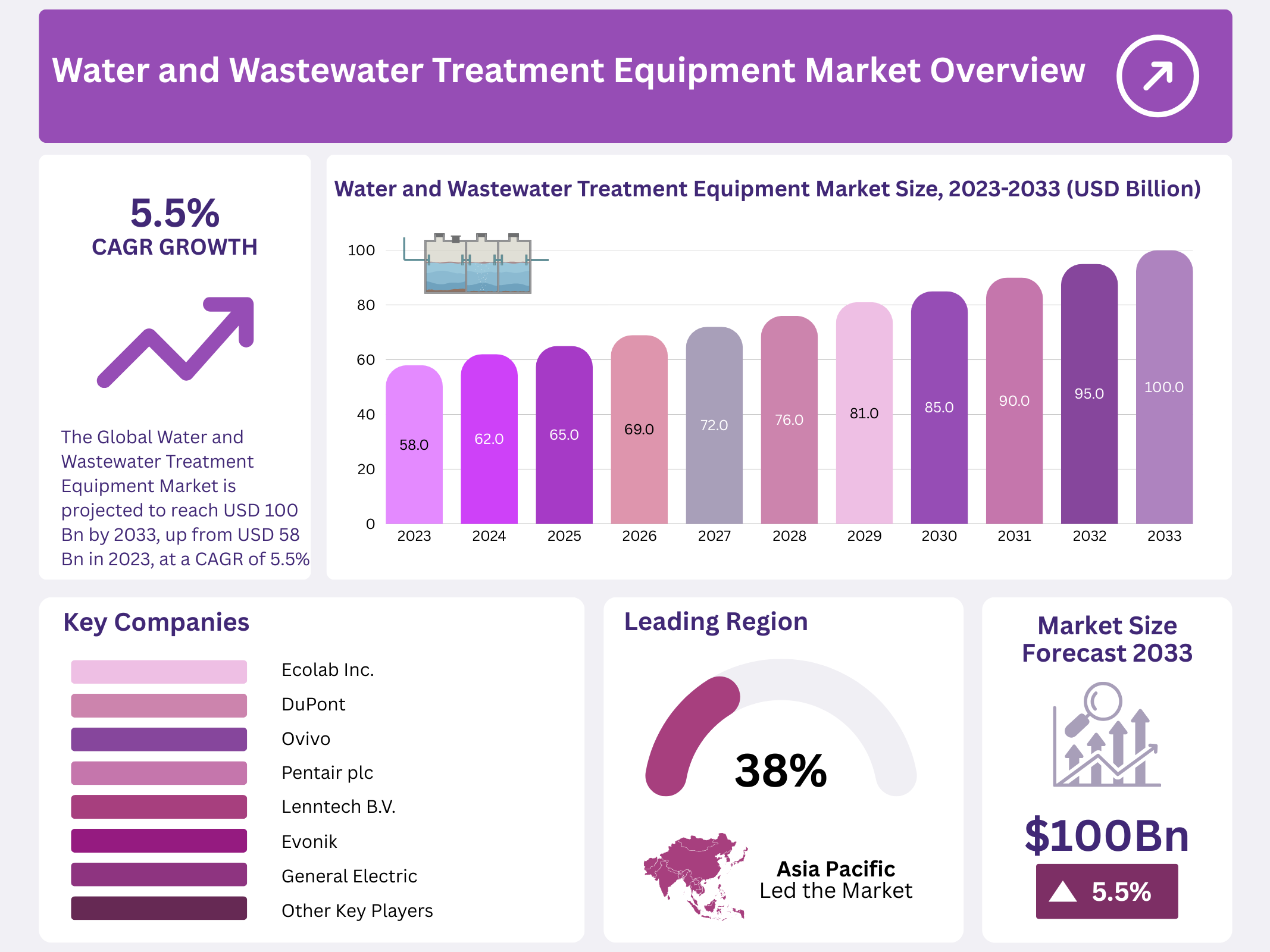
New York, NY – March 10, 2026 – The Global Water and Wastewater Treatment Equipment Market is projected to reach approximately USD 100 billion by 2033, up from USD 58 billion in 2023, with a CAGR of 5.5% over the forecast period. Wastewater treatment equipment encompasses a range of technologies and systems used to treat contaminated water for safe discharge into the environment or for reuse.
These systems remove pollutants, harmful substances, and contaminants from wastewater generated by residential, commercial, and industrial activities. The treatment process typically involves several stages, utilizing physical, chemical, and biological methods to ensure effective purification.
Government regulations are a major factor driving growth in the water and wastewater treatment equipment market. For instance, the U.S. Environmental Protection Agency (EPA) enforces strict water quality regulations and supports infrastructure development through programs such as the Clean Water State Revolving Fund (CWSRF), which allocated $1.1 billion in 2022 for wastewater treatment initiatives.
Likewise, in Europe, the EU Water Framework Directive (WFD) requires member states to achieve good water quality standards by 2027, encouraging substantial investments in water treatment infrastructure across the region. These regulatory measures are accelerating the adoption of advanced treatment technologies worldwide.
Key Takeaways
- The Water and Wastewater Treatment Equipment Market is set to reach USD 100 billion by 2033, with a 5.5% CAGR from 2023.
- Membrane Separation technology captured 43.2% market share in 2023, vital for water purification.
- Filtration and Adsorption Importance Captured 34.3% market share removes impurities, while adsorption tackles organic compounds and heavy metals.
- Primary Treatment Dominance Captured 49.3% market share in 2023, essential for removing solids and organic matter from wastewater.
- Municipal Application Dominance Captured 69.3% market share in 2023, crucial for ensuring public health and environmental protection.
- Asia Pacific Market Leadership Held a commanding 38.4% market share, driven by industrial activities and urbanization.
Report Scope
| Report Features | Description |
|---|---|
| Market Value (2023) | USD 58 Billion |
| Forecast Revenue (2033) | USD 100 Billion |
| CAGR (2024-2033) | 5.5% |
| Segments Covered | Based on Equipment(Membrane Separation, Biological, Disinfection, Sludge Treatment, Other Equipment), By Type(Filtration, Disinfection, Adsorption, Desalination, Testing, Others), Based on Process(Primary, Secondary, Tertiary), Based on Application(Municipal, Industrial, Other Applications) |
| Competitive Landscape | Ecolab Inc., Aquatech International LLC, Calgon Carbon Corporation, DuPont, Ecologix Environmental Systems, LLC, Evonik Industries AG, Evoqua Water Technologies LLC, General Electric, Koch Membrane Systems, Inc, Lenntech B.V., Ovivo, Parkson Corporation, Pentair plc, Samco Technologies, Inc., Toshiba Water Solutions Private Limited (TOSHIBA CORPORATION), Veolia Group, Xylem, Inc. |
Key Market Segments
Equipment Analysis
In 2023, membrane separation dominated the market, accounting for over 43.2% of the total share. This technology is widely used to remove harmful particles and contaminants from water due to its high efficiency and reliability. Membrane separation is applied in various areas, including industrial wastewater treatment and potable water purification, making it a vital component of modern water treatment systems. The demand for this technology is expected to rise further, supported by stricter environmental regulations and increasing requirements for high-quality water.
Biological treatment ranked as the second-largest segment in the market. These processes use natural microorganisms to break down pollutants in wastewater, making them a sustainable and environmentally friendly solution. Their limited reliance on chemicals aligns with the growing global emphasis on eco-friendly treatment methods. Biological treatments are widely used in municipal and industrial wastewater treatment, demonstrating their flexibility and increasing significance in the industry.
By Type
In 2023, filtration held the leading market share, capturing more than 34.3% of the global market. Filtration systems remove impurities from water using various methods, including sand filtration, activated carbon filters, and membrane technologies. Their widespread use across both drinking water purification and wastewater treatment makes filtration one of the most fundamental technologies for maintaining water quality and environmental safety.
Disinfection remained another key segment, essential for ensuring safe water supplies by destroying harmful microorganisms. Technologies such as chlorination, UV treatment, and ozonation are widely adopted in municipal water systems and industrial facilities. Continuous improvements in these technologies aim to enhance efficiency while minimizing chemical use and harmful by-products.
Adsorption also represents a significant technology within the market. This process removes contaminants by attracting pollutants to solid surfaces, making it particularly effective in removing organic compounds and heavy metals. Activated carbon is commonly used due to its high efficiency in treating drinking water and industrial wastewater. Its adaptability and effectiveness ensure the continued importance of adsorption in water treatment systems.
Process Analysis
In 2023, primary treatment accounted for the largest share of the market, holding over 49.3%. This stage represents the first step in wastewater treatment and focuses on removing solid particles and organic matter through processes such as sedimentation and flotation. Its large market share highlights its essential role in preparing wastewater for subsequent purification stages.
With growing wastewater volumes and stricter environmental regulations, demand for efficient primary treatment solutions continues to increase. By reducing the pollutant load early in the process, this stage helps improve the efficiency and performance of later treatment phases.
Secondary treatment is another crucial step, utilizing biological processes to further reduce organic pollutants. Microorganisms are used to break down organic substances in wastewater, enabling treatment systems to meet regulatory standards for water quality. This stage significantly enhances water purity before final processing or environmental discharge.
Application Analysis
In 2023, municipal applications dominated the market, accounting for more than 69.3% of the total share. Municipal water treatment systems are essential for supplying clean drinking water and treating wastewater generated by urban populations. These facilities play a critical role in protecting public health and maintaining environmental standards.
The large market share of this segment reflects the extensive infrastructure required to manage water supply and wastewater treatment in cities and communities. Investments in municipal water treatment systems are increasing due to population growth, stricter regulatory requirements, and the need to upgrade aging infrastructure.
Regional Analysis
The Asia Pacific region holds a leading position in the global water and wastewater treatment equipment market, accounting for approximately 38.4% of the total market share. This strong growth is driven by the increasing demand for advanced water treatment technologies across both municipal and industrial sectors. Rapid industrialization and urban development in countries such as China, India, Japan, South Korea, Australia, and New Zealand are major factors contributing to the expansion of the regional market.
In North America, the water and wastewater treatment equipment market is also experiencing steady growth, supported by economic development and the rising need for sustainable water management solutions. Increasing awareness of environmental protection and the adoption of eco-friendly practices, particularly in the United States and Canada, are key drivers accelerating market growth in the region.
Europe is witnessing significant growth in the water and wastewater treatment equipment market due to the rising demand for efficient and advanced water treatment technologies across municipal and industrial sectors. The region’s strong focus on improving water quality and promoting sustainable water management practices continues to strengthen its position as an important player in the global market.
Top Use Cases
- Municipal Wastewater Treatment: As a market research analyst, I see this as a core use case where equipment like clarifiers, filters, and disinfection units clean sewage from homes and offices in cities. It removes dirt, germs, and pollutants before safe release into nature. This supports public health, meets local rules, and helps growing urban areas manage daily waste flows without harming rivers or lakes.
- Industrial Wastewater Treatment in Manufacturing: From a market research view, factories in the food, textile, and chemical sectors rely on treatment equipment such as membrane systems and biological reactors. These units remove oils, chemicals, and solids from process water so it can be reused or safely discharged. This cuts pollution risks, helps firms follow environmental laws, and lowers freshwater needs in busy production lines.
- Oil and Gas Produced Water Treatment: Market research highlights how this equipment, including separators and advanced filtration, handles salty, oily water from drilling and refining. It cleans and reuses the water for further operations or safe disposal. This use case is vital for energy firms facing strict discharge rules, reducing environmental impact while keeping operations running smoothly in water-scarce regions.
- Power Generation Cooling and Boiler Systems: As a market research analyst, I observe that power plants use treatment equipment like reverse osmosis and softeners for boiler feed and cooling tower water. These systems remove minerals and impurities to prevent scaling and corrosion. It ensures reliable energy output, supports water reuse in high-heat processes, and meets tough industry standards for clean operations.
- Agricultural Irrigation with Reclaimed Water: In my market research analysis, treatment equipment, such as disinfection and filtration units, turns wastewater into safe water for crop irrigation. Farmers apply this treated supply to grow food without using precious freshwater sources. This approach boosts farm efficiency, protects soil health, and helps regions facing dry conditions maintain steady food production through smart reuse practices.
Recent Developments
Ecolab Inc.
- Ecolab projects strong 2026 growth driven by its high-tech sector expansion, particularly following the acquisition of Ovivo Electronics. This strengthens its position in semiconductor water treatment and data center liquid cooling solutions, capitalizing on the AI boom. The company is benefiting from robust demand for its advanced ultrapure water and process management technologies.
Aquatech International LLC
- Aquatech has been selected as the technology partner for Texas’s first major seawater desalination plant in Corpus Christi. Once completed, it will be the third-largest facility of its kind in the Americas, capable of producing potable water per day with industry-leading energy efficiency to provide a drought-resilient water source.
Calgon Carbon Corporation
- Calgon Carbon is investing to expand its drinking water carbon reactivation capacity at its Columbus, Ohio, plant. This expansion is a direct response to growing demand from utilities needing to comply with new EPA regulations for removing persistent PFAS “forever chemicals” from drinking water.
DuPont
- DuPont’s new FilmTec Fortilife XC160UHP reverse osmosis membrane has been named a finalist for a 2026 Edison Award. Designed for industrial wastewater treatment and reuse, this element operates under ultra-high-pressure conditions to efficiently concentrate waste streams, helping industries like petrochemicals and power generation meet discharge regulations while reducing energy and operational costs.
Conclusion
The water and wastewater treatment equipment sector stands out for its essential role in building a sustainable future. As communities and industries face growing pressure to conserve resources and protect the environment, smart innovations in monitoring, reuse, and energy-saving designs are driving positive change. This equipment not only meets strict safety rules but also turns waste into valuable resources, creating new opportunities for cleaner water access and responsible growth across the globe.







