


Quick Navigation
Overview
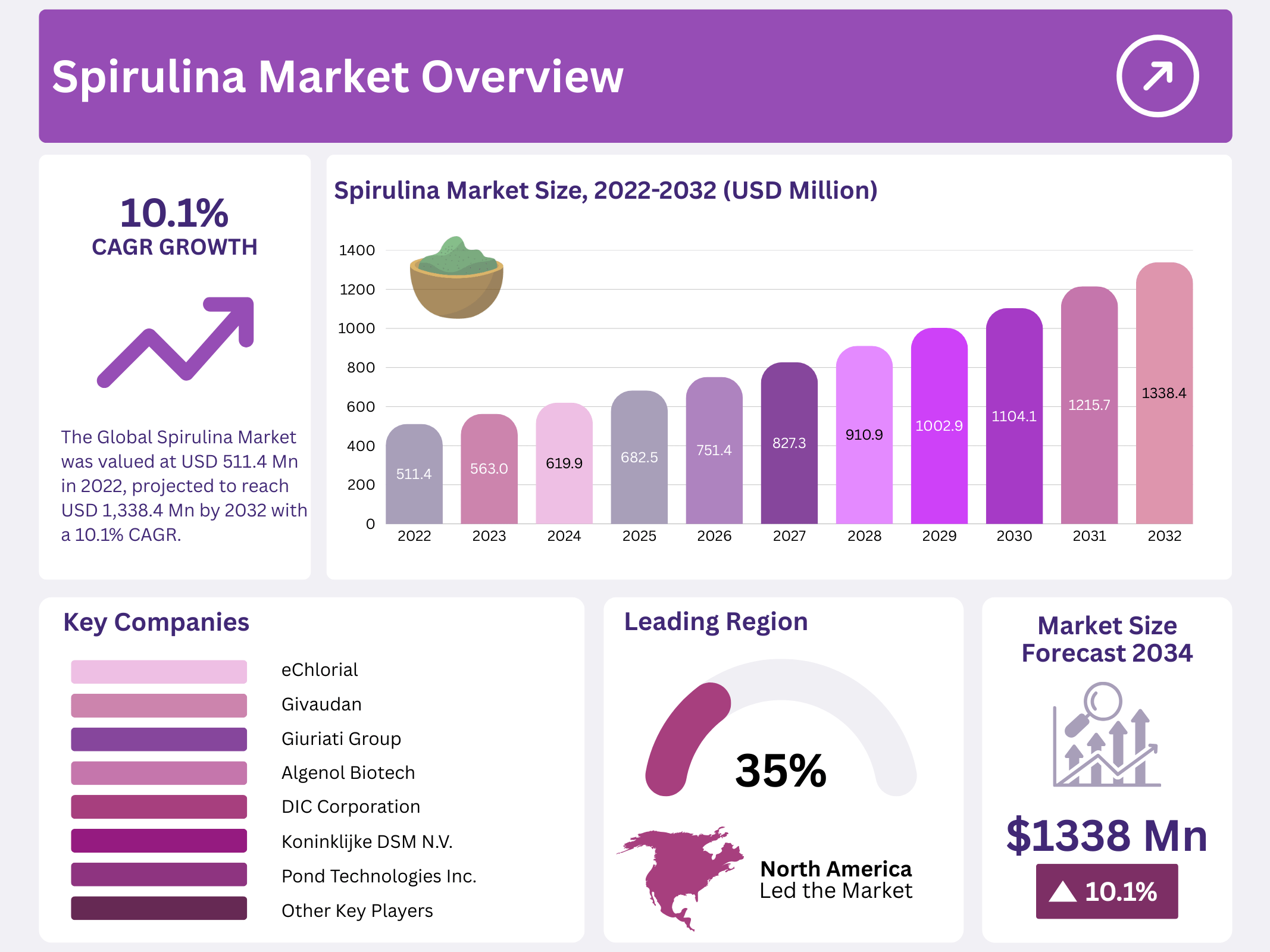
New York, NY – December 03, 2025 – In 2022, the Global Spirulina Market was valued at USD 511.4 million and is projected to reach USD 1,338.4 million by 2032, growing at a CAGR of 10.1% between 2023 and 2032. Spirulina is a multicellular, filamentous blue-green alga from the Cyanophyceae class and is widely recognized for its use across health foods, pharmaceuticals, aquaculture nutrition, and dietary supplements. Its dense nutritional composition has also led to its use in specialized applications such as space nutrition.
The rising demand for Spirulina is largely driven by its rich content of proteins, essential amino acids, vitamins, minerals, and antioxidants. It has a long history of consumption in both raw and processed forms, including powders, tablets, and capsules, a practice that continues in many regions today. Spirulina platensis is the most widely cultivated species, commonly found in Africa, Asia, and South America, while other strains are native to parts of Central America.
Commercial Spirulina production is concentrated in countries such as the United States, India, China, Thailand, Taiwan, Pakistan, and Myanmar. The market outlook remains positive, supported by growing global awareness of preventive healthcare and wellness-focused diets. As consumers increasingly prefer natural, plant-based, and nutrient-dense food ingredients, Spirulina has emerged as a sought-after superfood associated with benefits such as immune support, improved energy levels, and overall nutritional balance.
Key Takeaways
- The Global Spirulina Market was valued at USD 511.4 million in 2022, projected to reach USD 1,338.4 million by 2032 with a 10.1% CAGR.
- Spirulina is a nutrient-dense blue-green alga used in health foods, pharmaceuticals, aquaculture, supplements, and even space nutrition.
- Spirulina Platensis dominates the market due to its superior nutritional profile and widespread health benefits recognition.
- Direct Sales/B2B channel led the market in 2022, serving the bulk needs of food processing, nutraceuticals, and cosmetics industries.
- The Nutraceuticals segment was the largest application in 2022, capturing 51.7% revenue share driven by strong health-benefit demand.
- North America held the biggest regional share at 35.2%, fueled by high health awareness and preference for natural plant-based supplements.
Report Scope
| Report Features | Description |
|---|---|
| Market Value (2022) | USD 511.4 Million |
| Forecast Revenue (2032) | USD 1,338.4 Million |
| CAGR (2025-2032) | 10.1% |
| Segments Covered | By Type (Spirulina Platensis and Spirulina Maxima), By Form (Tablet & Capsule, Powder, Liquid, and Granule), By Distribution Channel (Direct Sales/B2B and Indirect Sales/B2C), By Application (Nutraceuticals, Food & Beverages, Cosmetics, Animal Feed, and Others) |
| Competitive Landscape | Cyanotech Corporation, Givaudan, Koninklijke DSM N.V., Sensient Technologies Corporation, DIC Corporation, eChlorial, Giuriati Group, Algenol Biotech, Pond Technologies Inc., E.I.D. – Parry (India) Limited, Lifevision Healthcare, NB Laboratories Pvt Ltd and Other Key Players. |
Key Market Segments
By Type Analysis
The Spirulina Platensis segment holds a dominant position in the global Spirulina market, driven by its well-known nutritional strength, wide range of applications, and strong recognition for health-supporting benefits. By type, the market is categorized into Spirulina Platensis and Spirulina Maxima. Among these, Spirulina Platensis accounted for the largest share in 2022.
It is the most widely available and extensively studied Spirulina species, often referenced in scientific research and public health discussions due to its broad availability. This species grows efficiently in aquatic environments, enabling simple cultivation, harvesting, and processing, while offering a rich profile of macro- and micronutrients.
In several African countries, Spirulina Platensis serves as an important protein source, traditionally harvested from natural water bodies, dried, and consumed locally. Its demand has also risen significantly in the human health and wellness sector, particularly as a dietary protein supplement across Asia. In addition, Platensis plays a growing role in animal nutrition, where it is increasingly used in poultry feed and aquaculture as a protein- and vitamin-enriching ingredient.
By Distribution Channel
The Direct Sales/B2B segment dominated the global Spirulina market in 2022, supported by its critical role in supplying large volumes of Spirulina to industries such as food processing, nutraceuticals, and cosmetics. Based on distribution, the market is segmented into direct sales/B2B and indirect sales/B2C.
Direct sales remain the preferred channel as they effectively address industrial demand, enabling bulk procurement and uninterrupted supply to manufacturers and processors. This channel allows customization in terms of quantity, formulation, and packaging, aligning products with specific industrial requirements.
Moreover, direct sales reduce costs by removing intermediaries, improving supply chain efficiency. They also encourage long-term collaborations and strategic partnerships between Spirulina producers and end-use industries, supporting innovation, product development, and joint business initiatives.
By Application
The Nutraceuticals segment led the global Spirulina market in 2022, primarily due to Spirulina’s exceptional nutritional profile and wide range of health benefits. By application, the market is divided into nutraceuticals, food & beverages, cosmetics, animal feed, and others. Among these, nutraceuticals emerged as the most revenue-generating segment, accounting for 51.7% of the market share in 2022.
Spirulina is widely recognized as a powerful “superfood,” valued for its dense nutrient composition and suitability for both terrestrial and space nutrition. Scientific studies suggest Spirulina’s potential in addressing oxidative stress-related conditions, supporting cholesterol management, boosting immunity, promoting gut health, reducing heavy-metal-induced toxicity, and assisting in weight management.
Its versatility extends to use in supplements aimed at metabolic health, detoxification, and overall wellness. Because of its compact form and complete nutritional profile, Spirulina is also used as a capsule-based food source for space missions. Its ability to deliver essential nutrients necessary for human growth and health continues to strengthen its adoption, positively influencing the overall growth of the global Spirulina market.
Regional Analysis
North America emerged as the leading region in the global Spirulina market, accounting for a 35.2% market share. The region’s strong performance reflects growing health awareness and the increasing preference for natural, plant-based nutritional supplements among consumers.
Spirulina is widely recognized in North America as a nutrient-dense superfood, aligning well with consumer goals related to immunity support, protein enrichment, and overall wellness. High awareness of lifestyle-related health concerns and preventive nutrition has significantly contributed to the rising adoption of Spirulina across dietary supplements, functional foods, and beverages.
At the same time, stricter regulations on synthetic food additives in Europe and the Asia Pacific have enhanced the appeal of Spirulina as a natural ingredient. Its vibrant blue-green pigment is increasingly used as a clean-label colourant and mild flavour enhancer in food and beverage formulations. The clean-label movement, reinforced by the COVID-19 pandemic, has further strengthened consumer trust in natural and minimally processed ingredients such as Spirulina.
The market landscape remains competitive, with key players focusing on product innovation, formulation upgrades, and strategic partnerships to expand applications and visibility. In addition, the mature health and wellness ecosystems in Europe and the Asia Pacific, supported by established nutraceutical and functional food channels, continue to drive steady market expansion across these regions.
Top Use Cases
- Nutraceuticals and Dietary Supplements: Spirulina serves as a popular choice for health-focused consumers seeking natural boosts to their daily wellness routines. Packed with essential proteins, vitamins, and antioxidants, it helps support immune function, energy levels, and overall vitality without synthetic additives. As more people turn to plant-based options for better digestion and heart health, brands are innovating with easy-to-use powders and tablets, making it a go-to for busy lifestyles aiming for sustainable nutrition.
- Food and Beverages Enhancement: In the food industry, spirulina acts as a versatile superfood ingredient that adds vibrant natural colour and nutritional punch to everyday products. It enhances smoothies, energy bars, and yogurts with its rich profile of amino acids and minerals, appealing to those craving clean-label snacks. This trend aligns with growing preferences for wholesome, minimally processed foods that deliver real health perks like improved metabolism and antioxidant protection in delicious forms.
- Animal Feed and Aquaculture Nutrition: Spirulina provides a sustainable protein source for livestock and fish farming, improving feed quality while reducing reliance on traditional resources. Its high digestibility and nutrient density help enhance animal growth, immunity, and overall health, making it ideal for eco-conscious producers. As the push for greener agriculture rises, integrating spirulina into feeds supports better yields and healthier herds without compromising on environmental friendliness.
- Cosmetics and Personal Care Products: Spirulina’s potent antioxidants and anti-inflammatory properties make it a star in skincare formulations, where it helps hydrate, detoxify, and rejuvenate the skin. From creams to masks, it promotes firmness and a youthful glow, attracting beauty enthusiasts who prefer natural alternatives to chemical-heavy options. This application taps into the booming demand for clean beauty that nourishes from within, fostering brand loyalty among health-savvy consumers.
- Addressing Malnutrition in Vulnerable Groups: Spirulina offers a simple, effective solution for combating nutrient gaps in children and underserved communities, thanks to its compact yet powerful blend of vitamins and proteins. Easily added to local foods like biscuits or porridges, it aids in building stronger bodies and minds quickly. With its low-resource growing needs, it empowers small-scale efforts to tackle hunger, promoting accessible wellness where traditional diets fall short.
Recent Developments
1. Cyanotech Corporation
Cyanotech, a Hawaii-based leader, recently highlighted its Spirulina Pacifica for immune support amidst global health trends. They emphasize sustainable, natural aquaculture and the product’s high antioxidant (phycocyanin) content. Facing market pressures, they continue to focus on premium, branded ingredients for the nutraceutical sector.
2. Givaudan
Givaudan incorporates spirulina primarily as a natural blue colourant within its extensive colour portfolio. Their recent focus is on sustainable and traceable sourcing to meet clean-label demand in food and beverage. They develop spirulina-based solutions that address stability and application challenges for manufacturers seeking vibrant, plant-based colours.
3. Koninklijke DSM N.V. (Now part of Firmenich as DSM-Firmenich)
Following the merger, the new entity leverages spirulina within its nutrition and bioscience portfolio. Recent developments include exploring spirulina’s potential in alternative proteins and sustainable food systems. Their research continues into its nutritional benefits, including supporting micronutrient fortification in challenging environments.
4. Sensient Technologies Corporation
Sensient focuses on spirulina-derived natural blue and green food colours. A key recent development is the enhancement of the heat and pH stability of these colours for diverse applications, such as confectionery and beverages. They provide consistent, clean-label colour solutions to help brands reformulate away from synthetic dyes.
5. DIC Corporation
Through its subsidiary Earthrise Nutritionals, DIC is a global volume leader in spirulina production. Recent developments include investing in production efficiency and sustainability at their California facility. They market Spirulina Earthrise for human nutrition and are active in research promoting its health benefits and environmental advantages as a sustainable crop.
Conclusion
Spirulina is emerging as a powerhouse ingredient in the evolving landscape of health and sustainability. Its natural versatility across supplements, foods, feeds, beauty, and nutrition programs positions it perfectly for the rising tide of conscious consumers who prioritize wellness without harming the environment. While challenges like awareness persist, ongoing innovations in production and applications signal strong potential for broader adoption, making spirulina a smart bet for forward-thinking brands aiming to capture the superfood wave.







