


Quick Navigation
Overview
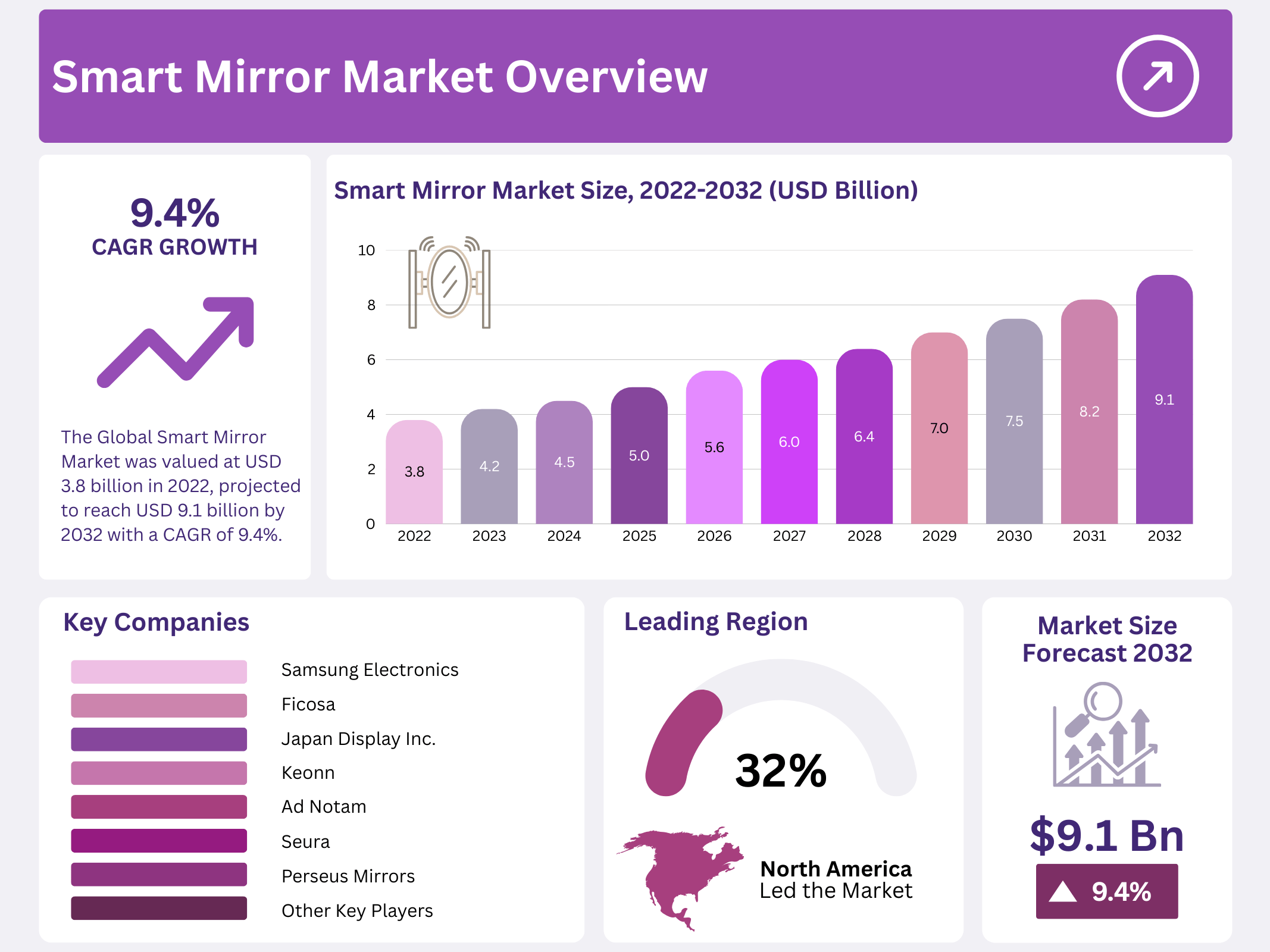
New York, NY – December 18, 2025 – The Global Smart Mirror Market was valued at USD 3.8 billion in 2022 and is projected to reach USD 9.1 billion by 2032, expanding at a CAGR of 9.4% during the 2023–2032 forecast period. This growth reflects rising adoption across both commercial and residential environments, supported by continuous advancements in display, sensor, and connectivity technologies.
Smart mirrors—also known as communicating mirrors, interactive mirror TVs, or magic mirrors—are gaining strong traction in commercial spaces such as hotels, retail outlets, healthcare facilities, and corporate offices. Their ability to combine real-time information, personalization, and digital interaction enhances user experience. In wholesale and retail environments, smart mirrors are increasingly used to improve customer engagement and product awareness, which is further accelerating market demand.
In parallel, leading companies are expanding their product portfolios with innovative and feature-rich smart mirror solutions to strengthen market presence. Government regulations promoting energy-efficient and green building technologies are also playing a key role. Strict guidelines encouraging the adoption of energy-saving solutions, including switchable and smart glass technologies, are expected to further support smart mirror adoption over the forecast period.
Key Takeaways
- The Global Smart Mirror Market was valued at USD 3.8 billion in 2022, projected to reach USD 9.1 billion by 2032 with a CAGR of 9.4%.
- The software segment shows strong growth due to enabling real-time data, personalization, and interactive features.
- Touchscreen mirrors hold a significant market share thanks to efficient, interactive interfaces and better affordability.
- Automotive application leads the market, fueled by increasing vehicle production and emphasis on driver safety.
- Offline distribution channels dominate as consumers prefer in-store purchases for high-value electronics.
- North America leads with over 32.5% revenue share, supported by product availability, affordability, and strict fuel efficiency regulations.
Report Scope
| Report Features | Description |
|---|---|
| Market Value (2022) | USD 3.8 Billion |
| Forecast Revenue (2032) | USD 9.1 Billion |
| CAGR (2023-2032) | 9.4% |
| Segments Covered | By Component- Hardware, Software, and Services); Product Type- Touch Screen, Without Touch Screen; By Application- Automotive, Residential, Healthcare, Others; and By Distribution Channel- Offline, Online |
| Competitive Landscape | Samsung Electronics, Ficosa, Japan Display Inc., Keonn, Ad Notam, Seura, Perseus Mirrors, Magna International Inc., Electric Mirror, Gentex, ALKE, Dension, Other Key Players |
Key Market Segments
Component Analysis
Software Segment Led the Global Smart Mirror Market
Based on components, the global smart mirror market is segmented into hardware, software, and services. Among these, the software segment recorded strong growth during the forecast period, driven by rapid technological advancement. Smart mirror software enables intelligent functions such as real-time data display, personalization, and interactive features, making mirrors more than just reflective surfaces.
These software-driven mirrors often act as personal assistants, delivering timely information such as weather updates, notifications, and reminders. Advanced features like facial recognition and voice control further enhance the user experience. Such capabilities are increasingly valued in the fashion and cosmetics industries, where virtual try-ons and personalized recommendations are gaining traction.
Product Type Analysis
Touchscreen Mirrors Dominated Due to Better Performance
Based on product type, the global smart mirror market is divided into touchscreen and non-touchscreen mirrors. The touchscreen segment accounted for a significant market share due to its higher efficiency, interactive interface, and improved affordability. Touchscreen mirrors allow users to navigate features easily, making them more attractive across both commercial and residential applications.
Additionally, the growing adoption of smart electronic devices worldwide supports demand for touchscreen-based solutions. As consumers become more familiar with interactive displays, the preference for touchscreen smart mirrors continues to rise. This trend is expected to support strong market expansion between 2023 and 2032.
Application Analysis
Automotive Segment Drove Market Growth
By application, the global smart mirror market is segmented into automotive, healthcare, residential, and others. The automotive segment emerged as the leading contributor, supported by rising vehicle production and growing focus on driver safety.
Smart mirrors integrated with high-resolution digital cameras and LCD displays help drivers monitor blind spots and surrounding traffic more effectively. These systems improve visibility on both sides of the vehicle, reducing accident risks. As advanced driver-assistance technologies gain importance, automotive adoption of smart mirrors continues to expand.
Distribution Channel Analysis
Offline Stores Remained the Preferred Purchase Channel
Based on distribution channels, the global smart mirror market is segmented into offline and online sales. The offline segment dominated the market during the forecast period, as many consumers prefer in-store purchases for high-value electronic products.
Offline stores allow customers to explore a wide range of smart mirrors, assess performance firsthand, and receive detailed product guidance from sales staff. This personalized buying experience builds confidence and remains a key factor supporting the dominance of offline distribution channels.
Regional Analysis
North America dominated the smart mirrors market, capturing a revenue share exceeding 32.5%. This leadership is driven by the widespread availability and affordability of advanced products, such as coated glazing, coupled with stringent fuel efficiency and emissions regulations in the region. Local companies are actively developing and offering innovative solutions tailored to consumer demands.
The Asia-Pacific region is projected to experience the fastest growth. This robust market growth is fueled by rising demand for premium automobiles, increasing disposable incomes, and greater adoption of connected and smart technologies. Additionally, heightened awareness of energy conservation is expected to drive focus on energy-efficient solutions, including advanced climate control systems, across the region.
Top Use Cases
- Home Fitness and Wellness: Smart mirrors bring gym-like training into homes with live virtual coaches and on-screen guidance. They correct posture during exercises, track movements, and connect to fitness apps to show real-time health stats. This keeps users motivated and helps them exercise effectively without leaving home, perfect for busy lifestyles.
- Retail Shopping Experiences: In stores, smart mirrors let shoppers virtually try on clothes, makeup, or accessories instantly. They suggest matching outfits, checking sizes in stock, and offering style tips. This makes shopping faster and more enjoyable, cuts down on changing room waits, and helps customers feel confident in their choices.
- Healthcare and Vital Monitoring: Smart mirrors support daily health checks by measuring heart rate, temperature, and skin conditions through built-in sensors. They remind users to take medicine and share data with doctors. This simple at-home monitoring makes it easier for people to stay on top of their wellness and catch issues early.
- Beauty and Skincare Routines: These mirrors scan skin to spot dryness, wrinkles, or uneven tone and suggest tailored products or routines. Users can test virtual makeup looks and follow guided skincare steps. This personalized approach helps people improve their skin health easily and builds better daily beauty habits.
- Automotive Safety Features: In cars, smart mirrors use cameras for clearer rear views and detect blind spots or lane changes. They display navigation or alerts directly on the mirror surface. This reduces driving risks, improves visibility in all conditions, and makes vehicles safer and more modern for everyday commuters.
Recent Developments
1. Samsung Electronics
Samsung has integrated its Smart Mirror with its SmartThings ecosystem and Bixby AI, focusing on the connected home. Recent developments emphasize health, with prototypes featuring embedded sensors for vital sign monitoring and personalized morning routines that display calendar, news, and health data. It acts as a central home IoT dashboard.
2. Ficosa
As an automotive supplier, Ficosa is developing Smart Mirrors as Digital Rearview Monitors and Transparent Pillar displays to enhance driver vision and safety. Their focus is on camera-based mirror replacement systems that reduce blind spots and integrate with Advanced Driver-Assistance Systems (ADAS) for commercial and passenger vehicles.
3. Japan Display Inc. (JDI)
JDI leverages its proprietary eLEAP OLED technology to create ultra-thin, high-brightness, and energy-efficient displays ideal for mirror-integrated applications. Their developments enable brighter, more durable screens for smart mirrors in automotive and retail settings, improving visibility even in direct sunlight.
4. Keonn
Keonn specializes in RFID-based retail solutions. Their Smart Mirrors for stores function as interactive fitting rooms. Recent advancements include integration with inventory systems for real-time stock checks, “try-on” item suggestion features, and the ability to summon an associate—all aimed at boosting sales and customer experience.
5. Ad Notam (Adnotam)
Ad Notam designs high-end, gesture-controlled Smart Mirrors primarily for luxury hospitality and residential projects. Their recent work focuses on bespoke designs that seamlessly blend into interior decor, offering features like mood-based lighting control, media playback, and climate management through minimalist gesture interfaces.
Conclusion
Smart mirrors are quickly changing how people interact with everyday objects by adding useful technology to a simple reflective surface. They bring convenience, personalization, and smarter insights to homes, stores, healthcare, beauty routines, and cars. As consumers seek more connected and interactive solutions, these mirrors will likely become common in daily life, offering practical benefits while opening new ways for brands to engage users and improve experiences across industries.







