


Quick Navigation
Introduction
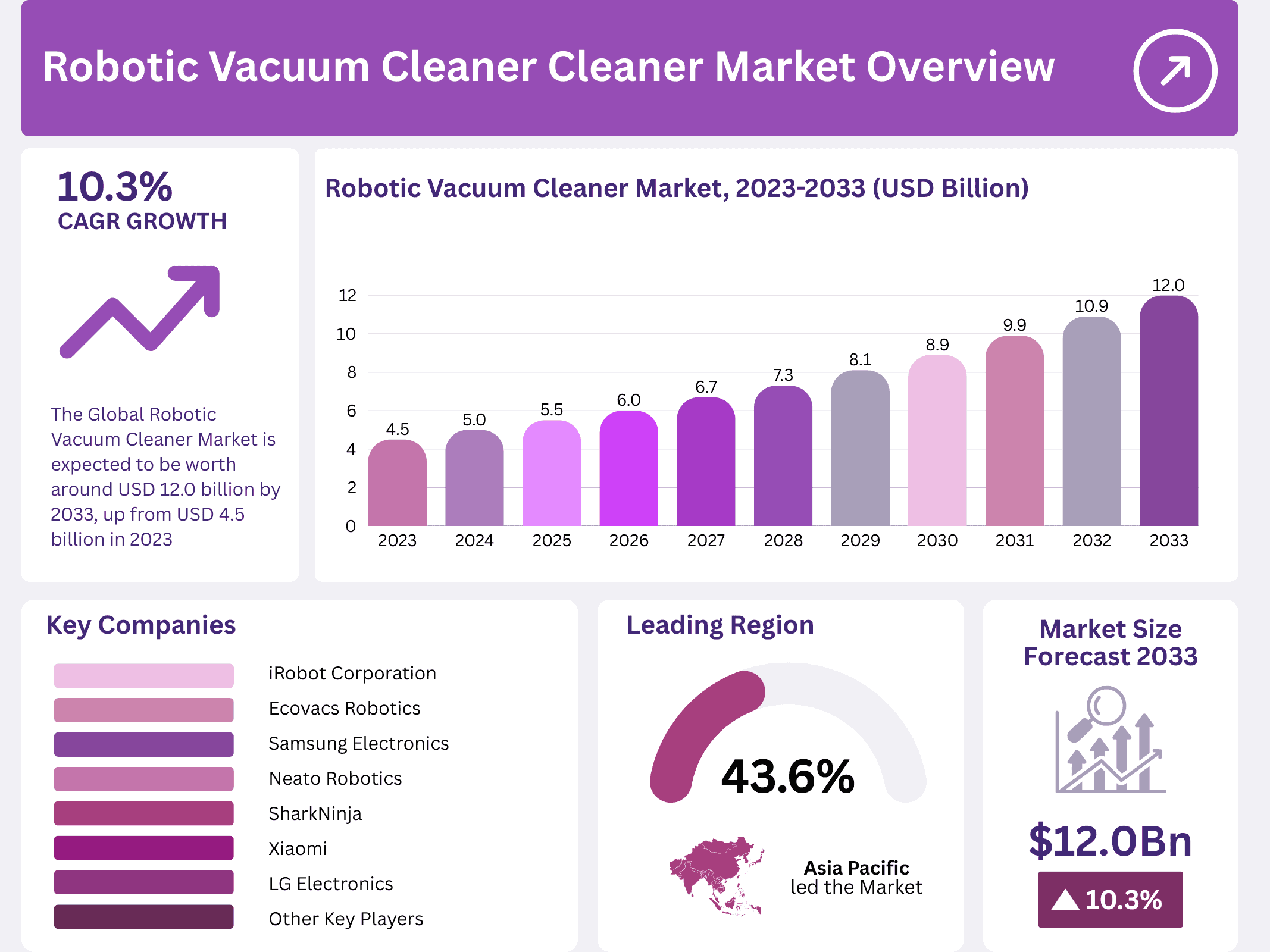
The Robotic Vacuum Cleaner Market is expected to grow from USD 4.5 billion in 2023 to approximately USD 12.0 billion by 2033, expanding at a CAGR of 10.3% between 2024 and 2033.
The global Robotic Vacuum Cleaner Market is gaining strong momentum as households increasingly adopt automated cleaning solutions. Driven by lifestyle changes, smart home penetration, and time constraints, robotic vacuum cleaners are transitioning from premium gadgets to practical household appliances. The market reflects a clear shift toward convenience-driven consumption patterns.
Moreover, rapid technological progress is reshaping product capabilities. Advanced navigation, intelligent mapping, and automated charging functions are improving performance and user experience. As a result, robotic vacuum cleaners are becoming more reliable across diverse residential and commercial environments, reinforcing long-term demand growth globally.
In parallel, health awareness and indoor air quality concerns are accelerating adoption. Robotic vacuum cleaners effectively manage dust, allergens, and pet hair, aligning with hygiene-focused consumer priorities. This trend is particularly relevant in urban regions where compact living spaces require efficient and frequent cleaning solutions.
Furthermore, expanding e-commerce access and competitive pricing strategies are supporting wider adoption. Consumers now benefit from extensive online product comparisons, feature transparency, and after-sales support. Collectively, these factors are strengthening market penetration across both developed and emerging economies.
As smart homes evolve into integrated ecosystems, robotic vacuum cleaners are positioned as core components. Compatibility with voice assistants and home automation platforms is reinforcing their value proposition, signaling sustained growth throughout the forecast period.
Key Takeaways
- The market is projected to reach USD 12.0 billion by 2033.
- The market is expanding at a CAGR of 10.3% during 2024–2033.
- Floor vacuum cleaners accounted for 62.3% of total demand in 2023.
- Residential applications held a 47.6% market share in 2023.
- Online channels dominated with a 57.2% share in 2023.
- Asia Pacific led the market with a 43.6% share and USD 1.9 billion revenue.
Market Segmentation Overview
By type, floor robotic vacuum cleaners dominate the market due to their versatility across hard floors and carpets. Their ability to autonomously manage daily cleaning routines supports widespread residential adoption. Continuous improvements in suction power and navigation accuracy further strengthen this segment’s leadership.
In contrast, robotic pool vacuum cleaners represent a niche yet growing segment. As home leisure infrastructure expands, demand for automated pool maintenance solutions is increasing. These devices enhance hygiene while reducing manual labor, supporting incremental market expansion.
By application, the residential segment leads due to busy lifestyles and rising smart home adoption. Robotic vacuums align well with household automation trends, offering consistent cleaning without human intervention. Their integration into daily routines reinforces sustained residential demand.
Meanwhile, commercial and industrial applications are gaining traction. Offices, hotels, and warehouses increasingly deploy robotic vacuums to maintain cleanliness without disrupting operations. This diversification highlights the market’s expanding functional scope.
By distribution channel, online platforms dominate due to convenience and product transparency. Digital channels enable consumers to compare features, pricing, and reviews efficiently. As logistics networks improve, online sales are expected to maintain their leadership position.
Offline retail remains relevant for consumers seeking physical demonstrations and immediate purchases. However, hybrid retail strategies are increasingly blending in-store experience with digital engagement to remain competitive.
Drivers
First, the rising adoption of smart home automation is a primary growth driver. Consumers increasingly prefer interconnected devices that reduce manual effort. Robotic vacuum cleaners seamlessly integrate into smart ecosystems, enhancing household efficiency and convenience.
Second, technological advancements are accelerating market expansion. Features such as AI-based navigation, obstacle detection, and automatic docking significantly improve cleaning accuracy and usability. These innovations directly enhance consumer satisfaction and repeat purchases.
Use Cases
In residential settings, robotic vacuum cleaners provide automated daily cleaning for apartments and houses. They effectively manage dust and allergens, supporting healthier indoor environments while reducing time spent on household chores.
In commercial spaces, robotic vacuums are used for routine maintenance in offices, hotels, and retail outlets. Their quiet operation and autonomous functionality enable cleaning during operational hours without disrupting occupants.
Major Challenges
One key challenge is the relatively high upfront cost of robotic vacuum cleaners. Price sensitivity limits adoption among budget-conscious consumers, particularly in developing markets where affordability remains critical.
Another challenge involves performance limitations on complex surfaces. Thick carpets, cluttered spaces, and uneven flooring can reduce cleaning efficiency, impacting consumer perceptions of reliability compared to traditional vacuums.
Business Opportunities
Opportunities exist in integrating advanced AI and machine learning for adaptive cleaning. Smarter navigation and personalized cleaning patterns can significantly enhance value, driving premium product adoption.
Additionally, emerging markets present substantial growth potential. Rising urbanization, increasing disposable incomes, and expanding e-commerce access are creating new demand for affordable robotic cleaning solutions.
Regional Analysis
Asia Pacific dominates the global market due to rapid urbanization and strong smart home adoption. Countries such as China, Japan, and South Korea are driving demand, contributing 43.6% of global revenue in 2023.
North America and Europe follow, supported by high consumer awareness and preference for automated home maintenance. Meanwhile, Latin America and the Middle East & Africa are witnessing gradual growth driven by expanding middle-class populations.
Recent Developments
- In August 2023, Xiaomi launched robotic vacuums with a 30% increase in suction power and dual mop functionality.
- In June 2023, SharkNinja acquired a robotics firm to strengthen AI integration capabilities.
- In March 2023, Neato Robotics introduced a model with enhanced pet hair collection and improved battery efficiency.
Conclusion
The Robotic Vacuum Cleaner Market is positioned for sustained growth, supported by automation trends, technological innovation, and evolving consumer lifestyles. While cost and performance challenges remain, expanding applications and emerging market demand present strong long-term opportunities. As smart homes become mainstream, robotic vacuum cleaners are set to become essential household appliances worldwide.







