


Quick Navigation
Introduction
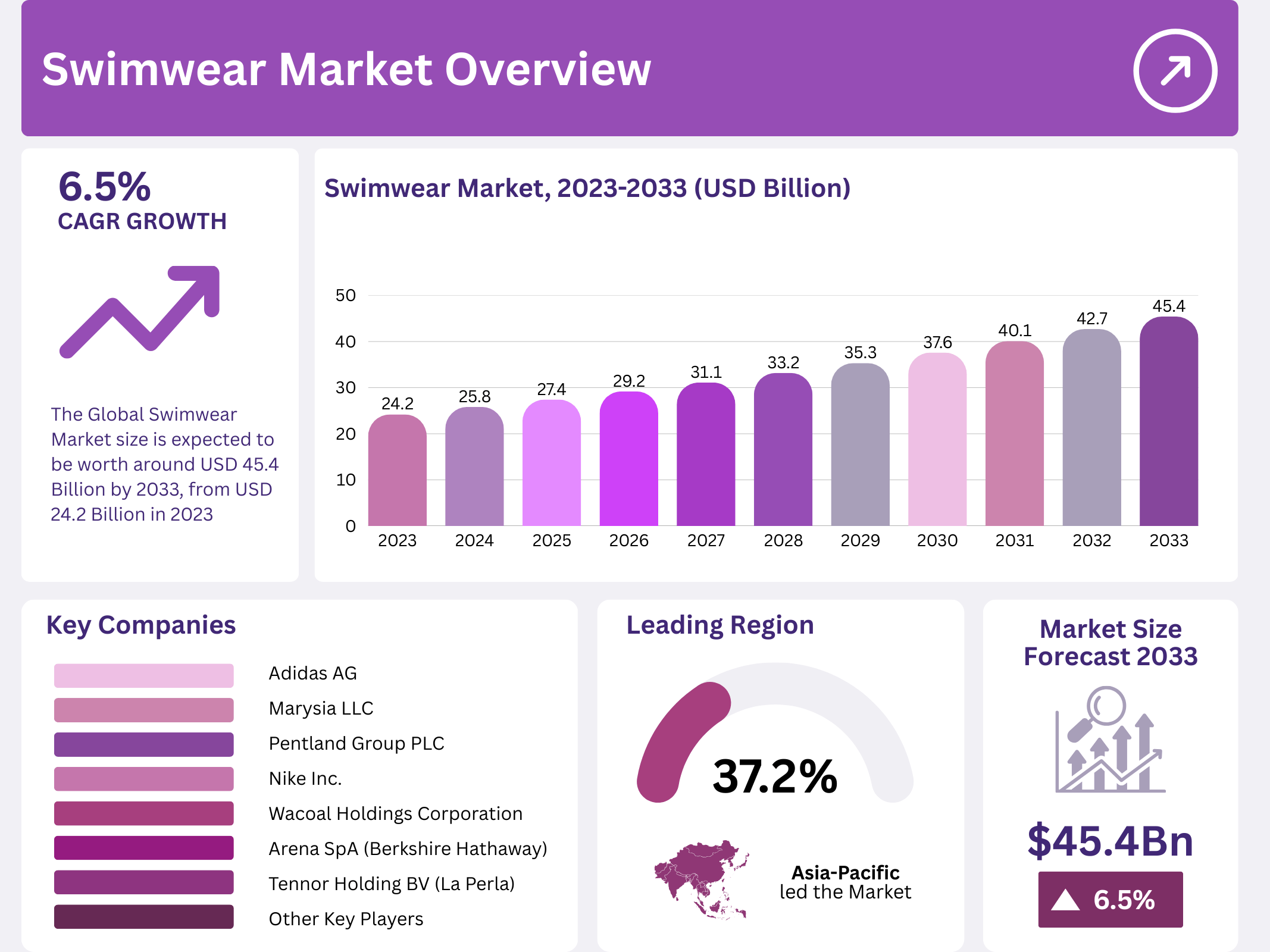
The Global Swimwear Market is poised for remarkable growth, projected to reach USD 45.4 Billion by 2033 from USD 24.2 Billion in 2023, reflecting a steady CAGR of 6.5% during the forecast period. This growth highlights evolving consumer preferences, rising lifestyle consciousness, and increasing participation in aquatic activities.
Swimwear, designed for activities such as swimming, diving, and surfing, combines fashion, comfort, and performance. Modern fabrics now ensure quick-drying, UV resistance, and durability, aligning with consumer demand for high-performance yet stylish attire suitable for both sports and leisure.
The global market’s diversity—from mass-market swimwear to luxury collections—caters to multiple demographics including men, women, and children. With innovation driving product design and sustainability shaping production, the industry is undergoing transformative development worldwide.
Asia Pacific dominated the global swimwear market with a 37.2% share, equivalent to USD 9.0 Billion in 2023. This growth is propelled by rising disposable incomes, beach tourism, and growing fitness awareness. Meanwhile, technological advancements and sustainability trends continue to redefine the market’s future direction.
As swimwear becomes both a functional and fashion staple, major brands are integrating digital tools and eco-friendly materials into their operations. These advancements are enabling faster product development cycles, reducing environmental footprints, and meeting evolving global consumer expectations efficiently.
Overall, the swimwear market stands at a pivotal moment—blending innovation, sustainability, and inclusivity—to cater to the next generation of fashion-conscious and eco-aware consumers worldwide.
Key Takeaways
- The Global Swimwear Market size is expected to be worth around USD 45.4 Billion by 2033, growing from USD 24.2 Billion in 2023 at a CAGR of 6.5%.
- In 2023, Polyester led the material segment with a 34.3% share due to its durability and resistance to chlorine and UV rays.
- The Women’s segment dominated end-user demand, capturing a 65.5% share in 2023.
- Asia Pacific held the largest regional share at 37.2%, generating USD 9.0 Billion in revenue.
Market Segmentation Overview
By Material Type, Polyester dominated with 34.3% of the market share in 2023. Its resilience, quick-drying capacity, and eco-friendly variants make it the preferred choice for performance and leisure swimwear. Brands increasingly adopt recycled polyester to meet sustainability goals without sacrificing quality.
Nylon remains widely favored for its smooth texture and comfortable fit, while Spandex contributes flexibility and superior stretch. Innovative blends are enhancing wearability, color retention, and shape stability, ensuring long-lasting performance across various consumer segments.
By End-User, Women accounted for 65.5% of the market share, driven by demand for fashionable and functional swimwear. Inclusive sizing, body-positive designs, and sustainable fabrics fuel this segment’s expansion. Men and Kids segments also show growth as aquatic recreation and family tourism increase globally.
Drivers
Growing Interest in Water Sports and Fitness: The surge in aquatic recreation, beach tourism, and water sports participation globally has propelled swimwear demand. Consumers now seek high-quality, durable, and performance-oriented swimwear that supports active lifestyles.
Technological Innovations and Sustainable Fabrics: Advancements in textile technology, such as UV-protective and chlorine-resistant materials, have transformed swimwear functionality. Moreover, the rise of eco-friendly fabrics like recycled polyester has aligned the industry with sustainability-focused consumers.
Use Cases
Fashion and Lifestyle Integration: Swimwear has evolved beyond functionality, serving as a fashion statement both on and off the beach. Consumers now wear stylish swimwear for social events, integrating it into lifestyle and travel wardrobes.
Sports and Professional Use: Competitive and recreational swimmers rely on technologically advanced swimwear offering compression, reduced drag, and enhanced hydrodynamics. Brands like Arena and Speedo leverage simulation tools to improve design precision and athlete performance.
Major Challenges
Seasonal Demand Fluctuations: The market heavily depends on seasonal trends, particularly summer months, creating inconsistent revenue flows and complicating inventory management for retailers and brands.
Environmental and Cost Constraints: Premium, eco-friendly, and technologically advanced swimwear often comes at higher prices. Additionally, conventional materials contribute to pollution, pressuring brands to adopt greener production practices while balancing affordability.
Business Opportunities
Expansion in Emerging Markets: Rapid economic growth and rising middle-class spending in Asia Pacific, Latin America, and Africa present vast opportunities for market penetration, especially in lifestyle-driven swimwear categories.
Inclusive and Sustainable Offerings: The increasing demand for inclusive sizing and sustainable materials creates room for innovation. Brands focusing on recycled fabrics and adaptive designs can capture loyal, eco-conscious consumers globally.
Regional Analysis
Asia Pacific: Leading with a 37.2% share, the region benefits from increasing disposable incomes, expanding tourism, and rising fitness awareness. Countries like China, India, and Australia are driving rapid growth through lifestyle shifts and urban beach culture expansion.
North America and Europe: North America shows robust growth supported by established brands, high consumer spending, and eco-conscious preferences. Europe’s market thrives on fashion-forward trends, sustainable innovation, and coastal tourism, supported by a strong retail and e-commerce presence.
Recent Developments
- In July 2023, Nike Inc. launched a new eco-friendly swimwear line made from recycled ocean plastics, reinforcing sustainability leadership.
- In June 2023, Arena SpA unveiled a swimwear collection featuring advanced hydrodynamic technology, targeting professional athletes.
- In May 2023, Wacoal Holdings Corporation partnered with distributors in Southeast Asia to expand its swimwear market reach and brand visibility.
Conclusion
The Global Swimwear Market is on a strong growth trajectory, driven by technological innovation, eco-conscious production, and the convergence of fashion and function. As brands focus on inclusivity, sustainability, and digital transformation, they are well-positioned to meet evolving global consumer needs.
With Asia Pacific emerging as a key growth hub and advancements in materials redefining design possibilities, the industry is set for substantial evolution. Strategic expansion, digital engagement, and sustainable development will continue to shape the swimwear market’s competitive landscape in the decade ahead.







